

Key Takeaways
Apply the same evidence test to every sacred book
Belief is a factual claim. Harris begins with a test of symmetry: Christians reject Muslim claims about divine revelation without first proving Islam false, because the burden is on believers to support their claims. He asks Christians to apply that standard to their own scriptures. A book calling itself God’s word does not establish that it is. Nor does personal certainty make incompatible religious claims equally credible. The question is not whether a faith comforts someone, but whether its claims about reality withstand evidence and argument.
Disagreement has consequences. Harris stresses that exclusive doctrines cannot all be true at once. If one faith alone offers salvation, then the stakes are not merely personal preferences. For him, treating religious claims as exempt from ordinary scrutiny gives unsupported beliefs unusual authority over public life and the lives of children raised within them.
The symmetry test is powerful because it makes belief easier to inspect from the outside: the reasons that feel compelling inside one tradition may look unconvincing when offered by another. This resembles a basic principle of scientific reasoning, where a claim is not privileged because its proponent sincerely holds it. Still, scrutiny should be even-handed rather than merely skeptical. Historical testimony, personal experience, and philosophical argument can all count as evidence, though they differ in strength. The useful demand is not that every question be settled by a laboratory, but that believers explain what would count against their claims.
Ground morality in sentient well-being, not divine command
Suffering gives morality a subject. Harris argues that moral questions matter because actions affect the experience of conscious beings. Pain, fear, safety, and happiness are not abstract decorations; they are what makes conduct consequential. On this view, people can judge cruelty and care without first accepting a sacred text. Love and cooperation matter because they shape the lives of those involved, not because a command makes them good.
Moral concern can cross belief. Harris accepts that religious teachings, including Jesus’s emphasis on love, can inspire valuable conduct without proving the religion’s supernatural claims. A person can take a humane teaching seriously while rejecting the surrounding theology. This separates the possible wisdom of an ethical insight from the truth of the story used to transmit it.
Connecting morality to the experiences of sentient beings gives ethical debate a shared starting point across religious and nonreligious communities. It also invites evidence: which choices reduce preventable harm, and for whom? The difficult question is how to weigh competing interests. Well-being can conflict across individuals, and a simple appeal to happiness may neglect rights, dignity, or fairness. The strongest version of Harris’s proposal treats suffering as morally central without pretending it supplies an effortless answer to every dilemma. Ethical reasoning still needs careful principles and public discussion.
Reject any moral authority that still licenses slavery
Scripture contains moral conflict. Harris challenges the claim that the Bible is a flawless guide by pointing to passages that permit slavery, regulate the treatment of enslaved people, and instruct slaves to obey their masters. He contrasts these texts with later moral judgments that slavery is an abominable institution. The issue is not whether the Bible contains compassionate passages. It does. The issue is whether a perfect moral authority should leave such a basic wrong permissible.
Readers supply the judgment. Harris argues that abolitionists could draw on parts of scripture, but had to interpret those passages against others that defended slavery. To recognize the injustice, people had to see enslaved people as fellow human beings capable of suffering, rather than as property. In his account, moral progress came from human judgment, not from a clear biblical prohibition.
This example puts pressure on the idea that a text can function as a complete moral rulebook when its teachings require readers to decide which passages deserve authority. It also shows how interpretation is shaped by social change: a community’s moral standards can alter what it notices in inherited texts. That does not prove religious traditions cannot support reform, but it complicates claims that scripture independently supplies a stable moral compass. The broader lesson is to examine not only a tradition’s ideals, but also the rules it has permitted and the judgments needed to reject them.
Judge religious ethics by the suffering their policies cause
Intentions do not erase outcomes. Harris argues that moral attention should track actual suffering, not only conformity to religious rules. He points to debates over sex education, contraception, HPV vaccination, and embryonic stem-cell research. In his 2006 discussion, he contends that abstinence-only policies can leave teenagers less prepared to use contraception, while resistance to vaccination or medical research can place doctrinal concerns above preventable illness and injury.
Embryos clarify the dispute. Harris describes a three-day embryo, or blastocyst, as a small group of cells without a brain or neurons, and argues that it cannot experience suffering as a child or patient can. He challenges the claim that its potential future personhood should outweigh the needs of people who could benefit from research. His examples make a practical demand: compare the harms at stake rather than treating religious conviction as the answer.
The section’s strength is its insistence that policies be evaluated by their consequences for real people, especially those with little power in the debate. Public health ethics often uses this kind of harm assessment alongside consent, fairness, and evidence of benefit. The embryo question also reveals a genuine moral disagreement: some frameworks assign value to potential life, while others emphasize present capacity for experience. Harris’s approach is clear about its priority, but readers should notice that the dispute involves competing principles, not simply a contest between compassion and indifference.
Separate compassionate service from the truth of its theology
Good works prove kindness, not doctrine. Harris acknowledges that believers make courageous sacrifices to help others. He argues that this compassion does not show that religious beliefs are true, since secular doctors and volunteers also respond to suffering without religious motivation. He also criticizes missionary work when it mixes material assistance with proselytizing or inaccurate claims about contraception and disease prevention.
Care can be misdirected. Mother Teresa serves as a complicated example. Harris grants that she mobilized compassion, but questions the moral priorities expressed in her opposition to abortion and her emphasis on suffering as spiritually meaningful. His point is not that religious helpers never do good. It is that sincere motives do not guarantee sound judgment, and that a charitable act can coexist with policies that, in his view, worsen suffering.
Separating a person’s generosity from the truth of their worldview prevents two common errors: dismissing real care because it is religious, or treating admirable service as evidence that its theology is true. This distinction is useful in evaluating charities, institutions, and leaders. The harder question is how to assess mixed legacies without reducing them to a verdict on one policy or motive. Outcomes matter, but so do context, available choices, and the beneficiaries’ own accounts. Harris’s criticism is sharpest when it asks whether help expands people’s agency or leaves them dependent.
Atheism permits civic virtue; religious belief guarantees no social health
Nonbelief is not a moral program. Harris rejects the claim that atheists must be immoral because they lack divine commands. He notes that people in secular groups and scientific institutions can behave decently, and that societies with low religious observance can function as civic communities. He also disputes the attempt to explain atrocities by atheism alone, arguing that tyrants such as Hitler or Stalin embraced other forms of dogma and political myth.
Correlation is not a verdict. Harris cites 2005 comparisons that associate more secular, developed countries with favorable measures such as life expectancy, literacy, and gender equality. He also compares crime and social conditions across American states. Crucially, he acknowledges that these correlations do not establish whether religion causes social problems, responds to them, or shares causes with them. His narrower conclusion is that belief in God does not guarantee a healthy society.
The distinction between moral behavior and religious belief is essential: a population can share ethical norms without sharing a theology, and religious commitment does not immunize a society from violence or inequality. The cross-country comparisons are suggestive, but they cannot isolate religion from wealth, institutions, education, or history. Their strongest use is to rebut a sweeping claim that secularism necessarily produces moral collapse, not to prove that secularism causes social health. Readers should also treat the book’s 2005 data as historical evidence, not as a current statistical snapshot.
An all-powerful, loving God must answer for preventable suffering
Suffering challenges benevolence. Harris asks how an all-knowing, all-powerful, loving God can coexist with the deliberate abuse of children, devastating disasters, disease, and genocide. Hurricane Katrina is one example: residents had scientific warnings, while prayer offered no comparable forecast or protection. Yet, as Harris notes, many survivors said the disaster strengthened rather than weakened their faith.
The explanation has a cost. The classic problem of evil, also called theodicy, concerns how divine goodness can be reconciled with suffering. Harris argues that if God can prevent horrors but chooses not to, or cannot prevent them, either divine goodness or power is in question. He challenges the tendency to treat survival as evidence of special favor while leaving the dead unexplained. For him, acknowledging suffering without a supernatural explanation makes human life more precious, not less.
The problem of evil remains a strong test because it asks believers to account for suffering that appears unrelated to human choice, such as disease or natural disaster. The argument is not automatically decisive: some theological responses appeal to human freedom, spiritual growth, or limits on what people can understand. But those responses carry their own burden, especially when suffering is extreme and falls on children. Harris’s central challenge is evidential: explanations should not make every possible state of the world equally compatible with divine goodness.
Test prophecy and scripture as history, not as self-authenticating proof
A prediction can be fitted afterward. Harris examines claims that New Testament events fulfill earlier biblical prophecies. He argues that Gospel writers could shape accounts of Jesus to echo texts they already knew. One example concerns a passage in Isaiah: the Hebrew word used there means a young woman, while a Greek translation rendered it as a virgin, helping support the later account of a virgin birth.
Texts show human seams. Harris also points to differences among the Gospels, including conflicting accounts of the timing of the crucifixion, and to a New Testament passage that attributes a saying to Jeremiah although it appears in Zechariah. He asks why a genuinely omniscient book contains no clear, specific knowledge beyond its historical period. For him, apparent prophecy and textual irregularities call for ordinary historical investigation, not special exemption.
Historical criticism is most useful when it distinguishes what a text says from how later communities interpret it. Translation choices, literary aims, and disagreements among accounts can illuminate how scripture took shape without settling every theological question. Harris’s challenge is compelling when it resists circular reasoning, where a text’s claim to divine origin is treated as proof of that origin. Yet the absence of modern science in an ancient text is not, by itself, a complete refutation of religious meaning. The key issue is whether specific factual claims can bear the weight placed on them.
Evolution explains nature's rough edges better than perfect design
A scientific theory explains facts. Harris argues that calling evolution a theory does not make it a mere guess. In science, a theory is an explanatory account that connects evidence and can be tested. He describes the core process: genetic variation arises through mutation, and natural selection favors traits that improve survival or reproduction in particular environments. Over vast periods, populations diverge and new species emerge.
Nature looks patched together. Harris points to extinct species, nonfunctional eyes in animals living in darkness, and features of human anatomy that create medical problems. Such imperfections make more sense, he argues, as inherited compromises shaped by evolution than as the work of a perfect designer. He criticizes intelligent design for treating gaps in current knowledge as evidence of divine intervention rather than offering a testable scientific explanation.
Evolution’s explanatory strength lies in its ability to connect many kinds of evidence, including genetic relationships, adaptation, and imperfect anatomy, within one revisable account. That makes it more than an alternative story about origins. The argument from imperfect design also has force against claims of flawless engineering, though it cannot alone establish that no creator exists. Scientific explanations can describe mechanisms without settling every metaphysical question about why there is a universe. Keeping those questions distinct helps avoid both religious overreach and exaggerated claims about what science proves.
Treat religious identity as a conflict risk, not a protected fact
Belief can raise the stakes. Harris argues that religion divides people into moral communities and can attach eternal rewards or punishments to those divisions. He distinguishes direct violence carried out in the name of God from conflicts whose political or territorial aims are reinforced by religious identity. He cites sectarian disputes across places including Northern Ireland, the Balkans, Kashmir, and the Middle East.
Criticism is not hostility to people. The book challenges the idea that religious violence can always be explained away by poverty, lack of education, or politics. Harris points to the educated, middle-class September 11 hijackers as evidence that religious conviction can motivate violence in its own right. His conclusion is not that every believer is violent, but that protecting ideas from criticism can obstruct honest debate about how beliefs shape conflict and policy.
Religious identity can intensify group boundaries, particularly when people believe that the conflict concerns ultimate truth or eternal destiny. That mechanism deserves serious attention, and criticism of doctrines need not be hostility toward believers. At the same time, conflicts are rarely monocausal. Political power, land, historical grievance, and economic conditions can shape when religious divisions become violent. Harris is most persuasive when he insists that religious motivation be included in the explanation, rather than treated as a polite fiction or assumed to explain everything.
Keep ritual and wonder without pretending certainty is knowledge
Meaning need not depend on dogma. In closing, Harris recognizes that prayer, faith, and religious community can accompany experiences of love, transformation, and bliss. He argues that similar experiences arise in other religions, in art and music, and in encounters with nature. The intensity of an experience therefore does not, by itself, prove the supernatural interpretation attached to it.
Build honest forms of belonging. Harris calls for ways to mark birth, marriage, and death without making claims people cannot justify. He presents the challenge as preserving ritual and spiritual depth while teaching children to examine beliefs rather than inherit them unquestioned. The proposal is not to strip life of wonder, but to separate wonder from certainty about invisible beings, an afterlife, or the exclusive truth of one tradition.
This closing distinction offers a constructive alternative to the idea that secularism must mean emotional emptiness. Ritual can help people share grief, mark transitions, and feel part of a community without requiring agreement about supernatural claims. The design challenge is to make such practices meaningful rather than merely imitative. Religious traditions often provide dense networks of memory, music, care, and obligation, and those functions should not be dismissed as irrational leftovers. Harris’s proposal is strongest when it treats emotional needs as real while leaving factual claims open to scrutiny.
Analysis
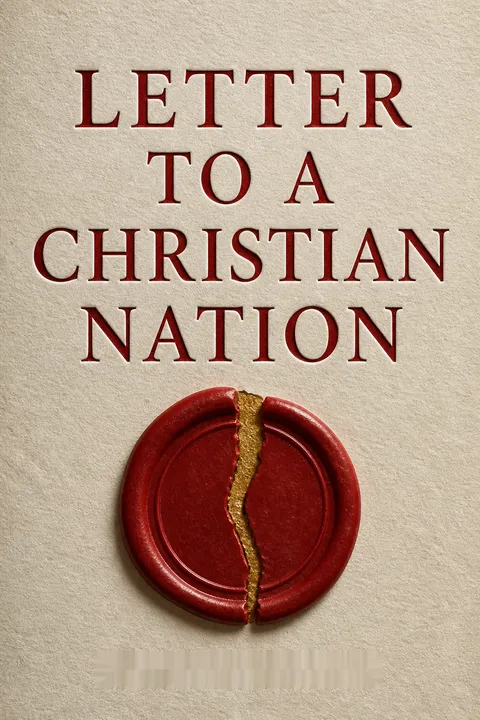
Letter to a Christian Nation is a polemical argument about standards of evidence, morality, and the political authority of religion. Its central move is to connect questions that are often kept separate: if scripture is claimed as divine, its moral content and historical accuracy matter; if religious beliefs guide public policy, their consequences for human welfare matter too. The result is not simply an argument against God. It is an argument against granting religious claims a special exemption from criticism.
The book’s strongest method is comparative. Christians are asked to evaluate their own claims as they evaluate Islam, then to consider whether scriptural rules on slavery or punishment meet present moral standards. These comparisons make familiar beliefs newly visible. The examples involving public health and stem-cell research also force ethical debate toward concrete consequences instead of abstract declarations of virtue.
Its main philosophical pressure point is the claim that morality can be grounded in well-being. That offers a shared, observable concern, but it does not by itself settle how to balance competing interests, define flourishing, or protect rights when aggregate welfare conflicts with individual freedom. The book sometimes treats these hard questions as more straightforward than they are. Likewise, its cross-national and state-level comparisons challenge the claim that religion guarantees social virtue, but they cannot establish that secularism causes better outcomes. The author acknowledges this causal limitation, though the rhetoric can make the correlations feel more conclusive than they are.
The argument is also shaped by its 2006 American context, especially disputes over evolution, sex education, stem-cell research, and Christian political influence. Its statistics and descriptions should be read historically rather than as a current account. Its enduring contribution is narrower and sturdier: beliefs can be psychologically meaningful without being factually true, and sincere conviction does not exempt a policy from scrutiny. A pluralistic society can protect people’s freedom of belief while refusing to treat ideas as immune from evidence, moral argument, or criticism of their effects.
Review Summary
Reviews of Letter to a Christian Nation are polarized. Supporters praise Harris's passionate, logical dismantling of religious dogma, highlighting his clear arguments against religion's harmful influence on public policy, science, and morality. Critics argue the book's hostile, condescending tone undermines its message, making it unlikely to persuade its intended Christian audience. Many note the arguments aren't original. Several reviewers, including atheists, find Harris's approach counterproductive, resembling the zealotry he condemns. The book scores well among non-believers seeking rhetorical ammunition but falls short as a genuine bridge to religious audiences.
People Also Read



Glossary
Theodicy
Reconciling God with sufferingTheodicy is the attempt to explain how a God understood as powerful and good can coexist with suffering and evil. Harris uses the problem to question whether a deity who knows about preventable horrors and can stop them remains both benevolent and omnipotent.
Intelligent design
Design-based creation claimIntelligent design is the claim that features of life or the universe point to an intelligent creator, rather than being fully explained by natural processes such as evolution. Harris argues that it relies on gaps in scientific knowledge and does not offer the testable explanatory account required of a scientific theory.
Blastocyst
Early embryo cell clusterA blastocyst is an early stage of embryonic development, discussed in the book in connection with embryonic stem-cell research. Harris describes the three-day embryo as a small collection of cells without a brain or neurons, and uses that description to question whether it can suffer in the way a developed person can.
Natural selection
Differential survival and reproductionNatural selection is an evolutionary process in which inherited variations that improve survival or reproduction in a particular environment tend to become more common across generations. In Harris’s account, it works with mutation over long periods to explain adaptation and the emergence of new species.
About the Author
Other books by Sam Harris





Download PDF
Download EPUB
.epub digital book format is ideal for reading ebooks on phones, tablets, and e-readers.








