

Key Takeaways
Assume your choices have hidden causes you cannot reliably introspect.
The mind has two tracks. The book’s central claim is that a large share of perception, judgment, and behavior is produced by automatic processes outside conscious awareness. This “new unconscious” is not a Freudian vault of repressed desires. It is ordinary brain activity, inaccessible because of how mental processes are organized, and often useful for survival. Charles Sanders Peirce demonstrated the gap in the 1880s: when he and a colleague compared weights too similar to distinguish consciously, they still chose correctly more than 60 percent of the time.
Small cues can steer choices. People ate more from larger popcorn containers, even when the popcorn tasted awful. Wine shoppers bought more French or German bottles depending on the music playing nearby, while few recognized the music’s influence. Such findings do not make conscious reasoning useless. They do make confidence about personal motives a poor substitute for testing them.
The useful shift is from asking whether people are rational to asking which parts of a decision they can actually inspect. That question fits behavioral economics, where choices often respond to framing, defaults, and cues rather than to stated preferences alone. It also suggests a practical habit: when a decision matters, change one feature of the setting and see whether the preference holds. The caution is that a hidden influence is not automatically a controlling one. These studies reveal susceptibility in particular conditions, not proof that every preference is secretly manipulated.
Your brain edits sensory reality before consciousness gets the finished picture.
Perception is constructed. The brain receives far more information than conscious thought can handle. The book estimates sensory input at roughly 11 million bits per second, compared with a conscious processing capacity of about 16 to 50 bits. Unconscious systems filter, combine, and interpret that flood, then present a usable experience. They fill the blind spot in each eye and restore speech sounds obscured by a cough, a process called phonemic restoration.
Awareness is not required. After strokes damaged patient TN’s visual cortex, he reported no conscious sight, yet he identified happy or angry faces above chance and carefully walked around obstacles. This ability, called blindsight, showed that some visual information can guide behavior without entering awareness. The implication is not that the world is imaginary. It is that experience is the brain’s best working model, not a raw copy of sensory input.
This account resembles predictive processing: the brain combines incoming signals with context to generate a coherent scene, rather than waiting passively for complete data. That is why perception can be both astonishingly efficient and confidently mistaken. The distinction matters in settings where a polished impression feels like direct evidence, from medical symptoms to eyewitness accounts. Still, calling perception an edited model should not be confused with saying reality is arbitrary. The model is constrained by the world, and its practical success is precisely what makes these quiet corrections so easy to overlook.
Treat vivid memories as reconstructions, especially when the stakes are high.
Memory saves the gist. The mind retains a broad outline, then rebuilds missing details from expectations, later information, and context. In Frederic Bartlett’s studies, people retold an unfamiliar Indigenous folktale in simpler, more familiar forms as time passed. They did not merely forget details. They supplied new ones that made the story easier to understand.
Confidence can grow with error. Jennifer Thompson carefully studied her rapist’s face, yet repeatedly identified Ronald Cotton, an innocent man. DNA evidence later showed that Bobby Poole committed the crime. The book reports that mistaken eyewitness identification appeared in 75 percent of the DNA-based exonerations examined by the Innocence Project. Repeatedly recalling an event can reinforce the updated version, not restore the original. For important conversations or decisions, contemporaneous notes and independent records can preserve evidence memory will reshape.
The consequence is institutional as much as personal. Telling witnesses to be more careful cannot repair a system that gives them suggestive lineups or treats certainty as accuracy. Better procedures reduce opportunities for memory to absorb cues from investigators, while independent records protect everyday decisions from confident disagreement. There is a further nuance: memory’s flexibility is not simply a defect. A system that preserved every sensory detail would be cumbersome, and the book’s case studies show why the mind favors meaning over a complete transcript. The risk rises when a reconstructed memory is treated as forensic fact.
Treat belonging as a biological need, not a social luxury.
Connection is built in. In one study, students expecting painful electric shocks were more likely to wait with other participants than students expecting only mild sensations: 63 percent chose company in the anxious group, compared with 33 percent in the relaxed group. Human infants also show early social preferences, reaching more readily for a figure that helps another than for one that obstructs it.
Isolation carries a cost. Social rejection activates brain regions involved in the emotional distress of physical pain. In a nine-year study cited in the book, adults with the fewest social ties were twice as likely to die as otherwise similar adults with stronger networks. These findings do not mean every relationship is protective or that social contact cures illness. They do show that connection is not merely pleasant decoration around an otherwise self-sufficient life.
The deeper point is that relationships operate like part of a person’s health infrastructure. They can provide emotional regulation, practical help, and a reason to maintain routines, functions that are difficult to replace with individual willpower. Yet biological importance should not become pressure to socialize indiscriminately. Isolation can reflect illness, bereavement, unsafe relationships, or limited access to community, not a personal failure. The reported overlap between social and physical pain pathways is revealing, but shared neural activity does not make rejection identical to an injury or make painkillers an appropriate general remedy.
Expect people to read your tone and gestures before your explanation.
Signals escape conscious control. Clever Hans, the celebrated horse, appeared to solve arithmetic by tapping a hoof. Psychologist Oskar Pfungst found that Hans was responding to tiny, involuntary movements by questioners who knew the answer. People transmit similar cues through posture, gaze, facial expression, and voice, often without intending to.
Expectations can shape performance. In studies described by the book, students handled rats they believed were gifted more gently, and those rats performed better than rats labeled poor learners, even when the animals were essentially alike. Teachers given false information that certain children had high potential also saw stronger subsequent test gains among those pupils. These results suggest that expectations can leak into treatment and influence responses. They do not make every gesture a reliable code for hidden motives.
The strongest application is not learning to decode strangers like a poker opponent. It is recognizing that expectations alter behavior through ordinary interaction. A teacher who anticipates curiosity may offer more patience and harder questions; a manager who assumes incompetence may unintentionally restrict someone’s chance to succeed. This is a feedback loop, not mind reading. Nonverbal meanings also depend on culture, disability, and individual style, so tidy body-language rules invite overconfidence. The more defensible practice is to notice patterns across an interaction and check interpretations with direct, respectful questions.
Use categories for speed, then check whether they have replaced the person.
Categories reduce mental load. Grouping objects lets the brain respond quickly: a large, shaggy animal with sharp teeth is treated as a possible threat without a fresh analysis of every feature. The same shortcut organizes judgments about people. But when identical lines were labeled as two groups, participants judged members within each group as more alike and the gap between groups as larger than it was.
Social categories can bias judgment. The Implicit Association Test measures how quickly people connect categories, such as gender, with particular traits. The book cites studies in which many participants showed automatic associations they rejected in conscious self-reports. Such a result indicates a learned association, not a complete diagnosis of an individual’s character or conduct. To resist the shortcut, slow down, seek information about the particular person, and notice when group membership is doing more work than observed behavior.
The distinction between having an association and acting on it is essential. Categorization is unavoidable and often helpful, but its speed can disguise a stereotype as an observation. The practical response is not to pretend categories have vanished; it is to add individuating evidence before making consequential decisions. Repeated, meaningful contact can make out-group members easier to perceive as distinct people. At the same time, a timed association test should not be treated as a verdict about someone’s moral worth. Its value lies in prompting scrutiny of habits that introspection alone may miss.
Give rival groups a shared task that requires real cooperation.
A boundary can create a feud. In the Robbers Cave experiment, researchers divided boys at camp into the Rattlers and Eagles. Each group developed its own identity; after the groups competed for prizes, insults, raids, and fights followed. Merely bringing the groups into contact did not end the hostility.
Shared dependence changes the relationship. The researchers arranged problems the boys could solve only together, including restoring a blocked water supply and pulling a stalled truck uphill. Cooperation sharply reduced conflict. Other experiments found favoritism even when groups were assigned on arbitrary distinctions, such as which painter participants preferred. The lesson is not that every common project dissolves prejudice. It is that contact becomes more constructive when people need one another to achieve a valued goal.
This is a useful design principle for schools, workplaces, and civic life: shared identity is strongest when cooperation is built into the task, not merely announced in a slogan. A joint problem can redirect attention from symbolic status competition toward practical interdependence. But the arrangement must be credible. If one group controls the rewards or bears most of the cost, a common assignment may sharpen resentment rather than soften it. The experiment’s striking results come from an artificial camp, so real institutions also need fair procedures, equal voice, and sustained collaboration.
Name feelings cautiously; context can turn bodily arousal into false certainty.
The body helps label emotion. In a classic experiment, volunteers given adrenaline but not told its effects were more likely to interpret their bodily arousal according to the mood of a person nearby. In another study, men questioned on a high, swaying bridge were more likely to contact the interviewer afterward than men questioned on a low, stable bridge. Anxiety can be mistaken for attraction when context offers that explanation.
Explanations can be invented afterward. In a face-choice experiment, researchers secretly switched the photograph participants had selected. Most failed to notice, yet confidently explained why they preferred the face they had not chosen. People can sincerely describe a reason without knowing what actually shaped their response. A feeling is real as an experience, but its apparent cause may be wrong.
This account gives physical state a role in interpretation without reducing emotion to bodily chemistry. Context, learned concepts, and personal history also matter, and the same racing heart can accompany fear, excitement, or exertion. That makes a brief pause useful when a strong reaction appears in an unusually charged setting. It does not mean feelings should be dismissed until a laboratory identifies their source. Emotional experience contains information, but like any signal, it benefits from interpretation rather than automatic acceptance as a complete explanation.
Let optimism fund effort, but let outside evidence set your estimates.
The self has a defense lawyer. People commonly rate themselves above average, even in skills where others or objective tests disagree. Motivated reasoning is the unconscious process of favoring evidence that supports a desired conclusion and discounting evidence that threatens it. It can protect confidence, but it also distorts hiring, negotiation, and planning. In one study, people assigned to opposite sides of a mock lawsuit estimated a fair award at roughly $40,000 or $20,000, depending on their role. When they assessed the evidence before learning which side they represented, the gap fell to about $7,000.
Confidence can make effort possible. The book also describes the author’s son persisting at basketball after repeated school-team rejections, then making the team and becoming captain. Optimism can sustain practice. For deadlines or high-stakes decisions, however, use outside records and estimates rather than relying only on the version of events that feels most encouraging.
The book’s most balanced point is that self-enhancement can be both a distortion and a resource. Confidence helps people persist through work whose difficulty is hard to appreciate in advance, while unchecked confidence can produce costly deadlines, acquisitions, and negotiations. A useful complement is reference-class thinking: compare a plan with the actual duration or outcomes of similar projects, rather than estimating from the plan’s ideal sequence. That approach preserves ambition while limiting self-deception. The aim is not a perfectly neutral self-image, which may be impossible, but decisions that can survive contact with outside evidence.
Analysis
The book’s most durable contribution is not the claim that people are irrational. It is a more precise model of why introspection is incomplete: conscious experience is assembled from sensory signals, bodily states, stored expectations, social cues, and automatic judgments, many of which are not available for direct inspection. This model links perception, memory, emotion, group identity, and self-image without treating them as separate mysteries. The recurring pattern is compression followed by reconstruction. The mind filters excess information, fills gaps, and presents a coherent account that usually works well enough for action.
That coherence is both the system’s strength and its hazard. A reconstructed face can guide a witness toward the wrong person. A social category can turn a brief observation into a confident stereotype. Motivated reasoning can protect persistence, but can also make a manager mistake desire for a forecast. The book is strongest when it shows these mechanisms through concrete experiments, particularly where objective records expose a mismatch between confidence and accuracy. Its stories make an abstract claim tangible: a person can be sincere and still mistaken about the causes of a choice.
Some caution is necessary. Brain imaging identifies changes in blood flow associated with tasks; it does not by itself reveal a complete mental mechanism. Nor should one assume that every striking laboratory result has the same size in ordinary life. Social psychology findings vary in robustness, and effects may depend on participants, settings, and procedures. The book’s broad thesis remains more secure than every individual example or numerical estimate.
The practical response is neither to distrust every feeling nor to imagine that conscious thought has no influence. It is to build checks around decisions where hidden cues matter: record facts before memory shifts, gather independent judgments, separate evidence review from advocacy, and ask whether a preference survives a change in framing. The unconscious is not an enemy to defeat. It is an indispensable partner whose confident stories sometimes need auditing.
Review Summary
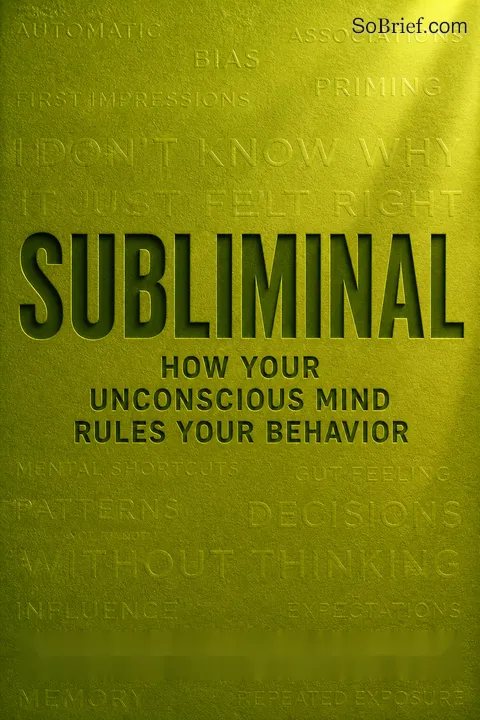
Subliminal explores the unconscious mind's influence on behavior through neuroscience and psychology. Mlodinow presents engaging examples and studies demonstrating how our brains process information, make decisions, and form memories without conscious awareness. Readers found the book fascinating, accessible, and well-written, praising Mlodinow's ability to explain complex concepts. Many were surprised by the extent of unconscious influence on their actions and perceptions. Some felt the book lacked depth in certain areas but overall found it enlightening and thought-provoking, encouraging self-reflection on decision-making processes and biases.
People Also Read








Glossary
new unconscious
Automatic processes outside awarenessThe modern scientific account of mental processes that operate without conscious access. These processes include perception, memory, attention, learning, and judgment. Their inaccessibility is treated as a normal feature of brain organization, not necessarily as repression or a defense against distressing desires, as in older Freudian accounts.
blindsight
Visual responses without conscious sightA condition in which a person with damage to the brain’s primary visual system reports no conscious vision but can still respond to some visual information. In the case discussed in the book, patient TN could identify emotional expressions above chance and navigate around obstacles despite reporting blindness.
phonemic restoration
The brain fills missing speech soundsAn auditory perceptual effect in which listeners experience a speech sound that has been removed or masked by noise. The brain uses surrounding speech and sentence context to supply a plausible missing sound, often without the listener noticing that the original signal was incomplete.
change blindness
Failure to notice a visual changeThe failure to detect a change in a scene, even when the changed object or person was visible moments before. Changes can go unnoticed during brief interruptions or shifts in attention. The phenomenon shows that conscious awareness does not preserve every detail of the visual environment.
theory of mind
Inferring other people’s mental statesThe ability to attribute beliefs, intentions, and feelings to other people and use those inferences to understand or predict their behavior. The book describes much everyday theory of mind as rapid and automatic, while more complex social reasoning can involve several layers of beliefs about what one person thinks another person knows or wants.
Implicit Association Test
Measures automatic mental associationsA timed sorting task used to estimate how readily a person associates concepts, such as social groups, with attributes such as positive or negative words. Faster responses when categories are paired in a familiar way are interpreted as evidence of stronger automatic associations. The result measures response patterns, not a complete account of a person’s beliefs or behavior.
in-group
A group a person identifies withA social group that a person regards as including them. Membership can be based on a lasting identity, such as nationality or profession, or a temporary and arbitrary distinction. The book describes how even minimal group membership can produce greater affinity for fellow members and different judgments of people outside the group.
out-group
A group seen as outside one’s ownA social group a person does not identify with in a given situation. The term describes the us-and-them distinction rather than the group’s popularity or status. Perceiving people as out-group members can encourage judgments that they are more alike than they really are and can support favoritism toward one’s own group.
motivated reasoning
Reasoning steered by desired conclusionsA process in which a person’s preferences, identity, or interests influence how evidence is interpreted. Evidence supporting a preferred conclusion may be accepted with less scrutiny, while contrary evidence faces stricter demands. The process can be unconscious and sincere, helping preserve confidence while also distorting judgments and estimates.
confabulation
Filling knowledge gaps with believed explanationsThe creation of a plausible explanation or memory to fill a gap in knowledge, sometimes without awareness that the account is invented. In the book, people who could not access the true cause of an action still supplied confident explanations. Confabulation can make an incomplete understanding feel coherent rather than uncertain.
FAQ
What's Subliminal: How Your Unconscious Mind Rules Your Behavior about?
- Exploration of the Unconscious: The book examines how our unconscious mind influences our thoughts, feelings, and behaviors, often without our awareness. It highlights the importance of understanding both conscious and unconscious processes to fully grasp human experience.
- Two-Tiered Brain Concept: Mlodinow introduces the idea of a two-tiered brain, where the unconscious mind operates alongside the conscious mind, affecting our perceptions and decisions.
- Social Neuroscience: The book discusses the emerging field of social neuroscience, which studies how brain processes underpin social behavior and interactions.
Why should I read Subliminal?
- Understanding Human Behavior: The book provides insights into the hidden forces that shape our behavior, enhancing self-awareness and interpersonal understanding.
- Scientific Basis: Mlodinow presents complex psychological concepts in an accessible manner, supported by scientific research and real-life examples.
- Practical Applications: Insights from the book can be applied to personal relationships, professional interactions, and decision-making processes.
What are the key takeaways of Subliminal?
- Unconscious Influence: A significant portion of our thoughts and actions is governed by unconscious processes, which we often fail to recognize.
- Memory Distortion: Memories are not perfect recordings but are reconstructed and can be influenced by external factors.
- Social Connection: The unconscious mind plays a role in forming and maintaining social bonds, which can improve our interactions and relationships.
What are the best quotes from Subliminal and what do they mean?
- “These subliminal aspects...”: This quote underscores the idea that while we may not consciously recognize the influence of our unconscious mind, it significantly shapes our experiences and decisions.
- “The heart has its reasons...”: Reflects the complexity of human emotions and decisions, suggesting that our feelings often drive our actions more than rational thought does.
- “To gain a true understanding...”: Emphasizes the necessity of exploring both conscious and unconscious aspects of our mind to fully comprehend our behavior and motivations.
How does Leonard Mlodinow define the "new unconscious" in Subliminal?
- Evolutionary Perspective: The "new unconscious" is seen as essential for survival, shaped by evolutionary pressures, and operates automatically.
- Scientific Advancements: Contrasts with Freud's earlier notions, focusing on the unconscious as a functional and adaptive part of our cognitive architecture.
- Neuroscientific Evidence: Advancements in neuroscience, particularly fMRI technology, have allowed researchers to observe unconscious processes in real-time.
What role does memory play in our unconscious behavior according to Subliminal?
- Memory Reconstruction: Memories are reconstructed each time we recall them, often influenced by our current beliefs and emotions.
- Influence of Context: The context in which we remember an event can significantly alter our recollection, leading to inaccuracies.
- Implications for Eyewitness Testimony: Memory distortions can have serious implications in legal contexts, where eyewitness accounts may be unreliable.
How does Subliminal explain the importance of social connections?
- Biological Basis: Social connections are crucial for human survival, with our brains wired to seek out and maintain relationships.
- Impact on Health: Social isolation can have detrimental effects on physical and mental health, making strong social bonds essential for well-being.
- Unconscious Cues: Much of our social behavior is governed by unconscious cues, aiding in forming and maintaining relationships.
What experiments does Leonard Mlodinow reference to illustrate unconscious behavior?
- Peirce and Jastrow's Weight Experiment: Demonstrated that participants could make accurate judgments about weights they could not consciously perceive.
- Eyewitness Identification Studies: Showed the fallibility of eyewitness testimony, where participants misidentified suspects based on suggestive cues.
- Social Interaction Experiments: Participants' behaviors were influenced by their expectations of others, demonstrating the power of unconscious biases.
How does Subliminal address the concept of "change blindness"?
- Definition of Change Blindness: Individuals fail to notice changes in their visual field, particularly when their attention is diverted.
- Experiments Demonstrating Change Blindness: Participants did not notice significant changes in images or scenes due to their focus on other elements.
- Implications for Everyday Life: Change blindness can affect interactions and decision-making processes, leading us to overlook important details.
What insights does Subliminal provide about nonverbal communication?
- Power of Nonverbal Cues: Nonverbal communication often conveys more than spoken words, with body language and facial expressions playing critical roles.
- Research on Nonverbal Signals: People can accurately interpret emotions and intentions through nonverbal signals, even without conscious awareness.
- Implications for Relationships: Understanding nonverbal communication can enhance interpersonal relationships, leading to more fulfilling social interactions.
How does Subliminal explain the relationship between emotions and decision-making?
- Emotions as Guides: Emotions play a crucial role in decision-making, often serving as a guide for our choices.
- Cognitive Biases: Emotions can lead to cognitive biases, affecting our judgments and decisions.
- Interplay of Emotion and Reason: Emphasizes balancing emotions with rational thought for better outcomes in personal and professional contexts.
How does Subliminal address the concept of self-perception?
- Inflated Self-Assessment: Discusses the "above-average effect," where individuals overestimate their abilities and qualities.
- Cognitive Dissonance: People often rationalize their choices to maintain a positive self-image, even against contradictory evidence.
- Impact on Behavior: Self-perception influences actions and interactions, shaping how we approach challenges and opportunities.
About the Author
Other books by Leonard Mlodinow



Download PDF
Download EPUB
.epub digital book format is ideal for reading ebooks on phones, tablets, and e-readers.








