

Key Takeaways
Our defining human advantage is not strength, but the drive to understand
Curiosity outlasts need. The book opens with the author’s father, a starving prisoner at Buchenwald, who gave up a piece of bread to learn the solution to a mathematics puzzle. Even amid extreme deprivation, the desire to know remained powerful. The story frames the book’s central claim: humans do more than react to the world; they ask why it works as it does.
A costly mental edge. Over millions of years, upright posture freed hands to carry and shape objects. Early humans made stone tools, hunted cooperatively, and developed brains that consume about 20 percent of the body’s calories despite accounting for only about 2 percent of its weight. The investment paid off in a capacity for questioning, planning, and understanding.
The opening story makes curiosity concrete by showing that knowledge can matter even when it offers no immediate survival advantage. It also complicates simple accounts of motivation: people seek understanding for intellectual pleasure, identity, and connection, not only for practical reward. The evolutionary story is persuasive as a broad arc, though it should not be mistaken for a claim that intelligence automatically makes humans wiser or more humane. The same capacity that produces mathematics and science can also serve cruelty. Curiosity is a distinctive human resource, not a moral guarantee.
Shared questions, not just hunger, helped pull nomads into settled life
Ritual before farming. Göbekli Tepe, a monumental site in what is now southeastern Turkey, was built about 11,500 years ago by hunter-gatherers. Its huge carved pillars required organized labor, yet there is little evidence that people lived nearby or farmed there. The author presents it as an early sanctuary, suggesting that shared spiritual concerns helped draw people together before agriculture became dominant.
Settlement changed life. The nearby village of Çatalhöyük grew to thousands of residents, many still hunting and gathering. Its inhabitants buried relatives beneath their homes and made art depicting people asserting control over animals. The transition from wandering to settled life was not simply an upgrade in comfort: it altered social ties, beliefs, work, and humanity’s sense of its place in nature.
This account usefully resists the tidy story that people settled only because farming made food more reliable. Göbekli Tepe suggests that shared meaning can organize collective effort before a society has the economic machinery usually associated with civilization. The claim remains an interpretation of archaeological evidence, not a settled explanation of why agriculture began. That uncertainty strengthens the larger lesson: human institutions may grow from several motives at once, with ritual, cooperation, and material needs reinforcing one another.
Cities turned practical records into tools for cumulative knowledge
Complex life needed records. In Mesopotamian cities such as Uruk, irrigation, food storage, trade, taxation, and conflict resolution required coordination among strangers. Writing first served those practical demands. About 85 percent of excavated early writing tablets concern accounting, including lists of grain, livestock, workers, and rations. The records were mundane, but they made urban exchange more dependable than memory alone could.
Administration became intellectual infrastructure. Scribes learned complex cuneiform, and tablet houses trained new generations to preserve and extend knowledge. Mathematics first helped with weights, measures, building, and labor estimates. The idea of laws also developed from social and religious rules, before people began to apply the concept to nature. These tools did not yet amount to modern science, but they made lasting, shared inquiry possible.
The account treats writing and mathematics not as abstract ornaments but as technologies that let knowledge outlive its original users. That is a powerful distinction: a discovery held in one person’s memory can vanish, while a recorded procedure can be checked, taught, and revised. The same logic applies to modern organizations, where databases and communication systems shape what can be known collectively. Still, records do not guarantee truth. They preserve errors as efficiently as insights, so institutions need ways to question what they store.
Challenge inherited explanations by asking what nature does, not what it intends
From chaos to order. Early Greek thinkers began treating nature as a system that might have consistent patterns rather than a scene of divine whims. Thales proposed natural, if mistaken, explanations for events such as earthquakes. Pythagoras argued that numerical relationships could reveal the structure of nature. Aristotle gathered immense detail about the living and physical world, but often explained change through purpose, such as a seed growing toward its intended form.
A new question. The book contrasts explanations of what nature is for with questions about how it behaves. That change made abstract patterns and physical causes central to inquiry. Aristotle’s authority endured for centuries, in part because his ideas fit common sense and established belief. The history shows why progress can require more than collecting observations: it can require replacing the questions used to interpret them.
The contrast between purpose and mechanism remains useful beyond the history of physics. Asking what a process is meant to accomplish can illuminate human institutions, while asking what causes it can explain physical events. Trouble begins when one mode is applied indiscriminately to the other. Aristotle’s purpose-based reasoning was not foolish in its context, but it became restrictive when treated as a universal account of nature. The section’s deeper point is not that ordinary intuition is worthless, but that it must remain open to correction.
Build networks where ideas can meet, survive criticism, and improve
Culture can accumulate. The book calls the human process of building on earlier knowledge cultural ratcheting. Macaque monkeys on the Japanese island of Kojima learned to wash sweet potatoes after a young monkey began the behavior. The habit spread through imitation, but the group did not develop it into a steadily expanding body of techniques. Humans, by contrast, preserve and modify ideas across generations through teaching, language, and shared records.
Discovery needs contact. Newton relied on planetary observations gathered by others, and Edmond Halley’s visit helped prompt the work that became the Principia. European universities, the Royal Society, and later collaborative research centers created places for ideas to be tested and exchanged. The author’s own physics method grew from a conversation with another researcher. Great discoveries have individual creators, but they rarely have individual origins.
This view shifts attention from isolated intelligence to the conditions that allow intelligence to compound. A network is valuable not merely because it produces more conversations, but because it increases the chance that an unfinished idea meets a useful objection, analogy, or technique. Yet proximity alone does not create insight. Groups can reinforce orthodoxies as readily as they challenge them. The productive environment combines connection with disagreement, and gives people enough independence to pursue ideas that the group initially finds strange.
Use experiments to expose where common sense fails
Measure the intuition. Aristotle believed heavier objects fall faster, a view that fits everyday experience because air resistance slows light objects such as leaves. Galileo studied polished balls rolling down inclined planes, using water collected from a leaking container to estimate elapsed time. The slower motion made measurement possible. He found that distance increased with the square of time and did not depend on the ball’s weight, then reasoned toward what would happen in free fall.
Design the test carefully. Galileo’s method required imagining a cleaner situation than ordinary life, one with less friction and air resistance, to reveal the underlying pattern. Experiments are not merely demonstrations of what a scientist already believes; they can force a change of mind. The crucial skill is deciding which complications to control and which features must remain for the test to answer the question.
Galileo’s work illustrates that good experiments are designed arguments. The rolling plane preserved important features of falling motion while slowing the process enough to observe it. That approach appears across many fields: isolate a mechanism, measure its effects, and then judge how far the result can be generalized. The risk is overconfidence in the idealized setup. A clean experiment can reveal a principle without capturing every real-world complication, so its conclusions need both precision and clearly stated limits.
Find the principle that turns a catalog into an explanation
A pattern becomes powerful when it predicts. Lavoisier weighed substances in chemical reactions and helped establish that mass is conserved, replacing vague accounts of combustion with measurable changes. Dalton then used laboratory proportions to estimate relative atomic weights. Mendeleev organized elements by recurring properties, left gaps for elements not yet discovered, and predicted the properties of one later identified as gallium.
Biology needed its own mechanism. Darwin spent years gathering evidence before proposing that random variations, filtered by natural selection, can reshape populations over generations. The periodic table connected chemical facts; natural selection connected biological diversity. In each case, the central achievement was not simply a larger collection of observations. It was an organizing idea that explained existing evidence and made claims about what investigators might find next.
The section offers a useful test for explanatory ideas: do they merely summarize what is already known, or do they help identify what remains unseen? Mendeleev’s gaps and Darwin’s mechanism made their proposals vulnerable to evidence, which is a strength rather than a weakness. Still, an elegant pattern is not automatically a true explanation. The historical cases become compelling because their organizing principles gained support from later observation, not because their creators displayed confidence or ingenuity alone.
Accept that reality extends beyond what human senses can inspect
The invisible became testable. For centuries, many scientists treated atoms as useful fictions because no one could see them directly. Einstein’s explanation of Brownian motion showed how the erratic movement of visible particles in water could be explained by collisions with unseen molecules. That evidence helped establish atoms as real objects of scientific inquiry, even before they could be imaged individually.
Quantum ideas widened the gap. Planck introduced the idea that energy can come in discrete packets while studying radiation from heated objects. Einstein argued that light itself has particle-like packets, and Bohr used quantum rules to explain patterns in hydrogen’s emitted light. Later quantum theory relied on mathematics and indirect measurements to describe a world that resists ordinary pictures. The book links this understanding to technologies including computers, lasers, and medical imaging.
The move beyond direct perception is not a retreat from evidence. It is a change in what counts as evidence: measurements, statistical patterns, and predictions can support claims about things no unaided observer can see. This broadens scientific reach while increasing dependence on instruments, models, and collective scrutiny. A vivid picture can help people understand a theory, but it can also mislead if treated literally. The strongest account keeps the explanatory mathematics and the limits of the picture in view together.
Let probability replace certainty when experiments demand it
Nature sets a limit. The uncertainty principle says that certain pairs of properties, such as an electron’s position and momentum, cannot both be known precisely at once. This is not merely a flaw in measuring equipment. Quantum theory treats the limitation as part of how nature behaves. For everyday objects, the effect is too small to matter, which is why Newton’s laws remain useful at familiar scales.
Prediction becomes probabilistic. In Newtonian physics, complete information about the present could, in principle, determine the future. Quantum theory instead predicts probabilities for possible outcomes. Einstein resisted this conclusion because he believed the universe should have a deeper, fully determinate account. The book contrasts his objection with his father’s experience of surviving a Nazi selection by chance. That personal history makes randomness imaginable, but it is an analogy, not evidence for quantum physics.
This is a difficult but important distinction: probability can reflect either ignorance about a system or a limit built into the system itself. Quantum theory makes the stronger claim. Its success changes the intuitive meaning of prediction, but it does not imply that every event is random or that ordinary causal explanations are useless. The account also wisely separates personal experiences of chance from physical proof. A story can make an abstract idea emotionally legible without serving as scientific evidence for it.
Treat dark matter, dark energy, and life's origin as unresolved, not settled
The map still has blank regions. The book notes that ordinary matter and light appear to account for only about 5 percent of the universe’s matter and energy; dark matter and dark energy are proposed to explain observations that existing theories do not fully account for. Their nature remains unknown. Biology also lacks settled answers about how life began and how the brain produces conscious experience.
Perspective can unlock a problem. In the closing riddle, a monk climbs a mountain one day and descends the next. Imagine instead two monks traveling in opposite directions at the same time: they must meet, revealing the point the first monk crosses at the same time on each trip. The thought experiment models scientific creativity: change the framing, then test whether the new view clarifies the problem.
The ending joins scientific humility to practical imagination. Unresolved questions are not evidence that inquiry has failed; they mark the edge between what current methods explain and what they do not. At the same time, mystery should not be romanticized. A gap in knowledge is a research problem, not permission to accept any appealing story. The monk puzzle captures a productive sequence: reframe the problem, derive a consequence, and see whether the new perspective actually resolves it.
Analysis
The book’s main achievement is to make scientific history a story about changing minds, not simply a parade of famous discoveries. Its narrative moves from the biological capacity to ask questions, through the social tools that preserve knowledge, and into the methods and theories that explain nature. Writing, mathematics, universities, instruments, and correspondence are not background scenery here. They are part of the machinery of thought. This makes the history useful to readers outside science: innovation depends on both individual imagination and the conditions that let ideas circulate, face criticism, and accumulate.
Its strongest recurring pattern is the tension between intuition and evidence. Aristotle’s account of purposeful change fits ordinary experience; Galileo’s measurements expose where that fit breaks down. Newton’s mechanics then becomes common sense to later generations, until atomic evidence demands new concepts. The story shows how yesterday’s counterintuitive theory can become tomorrow’s mental furniture, a point that applies to science and to professional judgment more broadly.
The narrative also resists the myth of the solitary genius. Newton needs Halley, Darwin depends on correspondence, and quantum theory emerges through debate among several researchers. Yet the book’s focus on a handful of celebrated European men can make scientific development appear more linear and geographically narrow than its own argument about culture suggests. Its account is selective, and the origins of major transitions, including settlement and early ritual, remain interpretive rather than certain.
The quantum chapters deliver the book’s deepest philosophical turn. Scientific progress does not simply reveal a more detailed version of everyday reality. It can revise what counts as an observable, a cause, or a prediction. That is both empowering and sobering: human reasoning reaches far beyond the senses, but each successful theory has a domain and a history. The book’s durable lesson is therefore not that science will answer every question, but that its best answers remain open to disciplined revision.
Review Summary
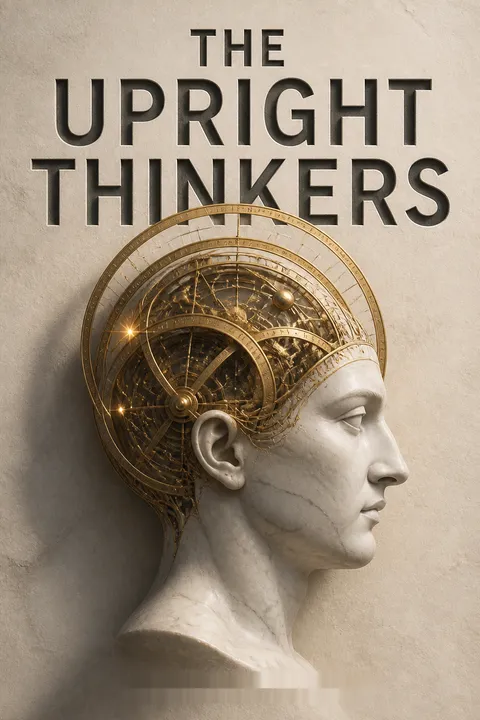
The Upright Thinkers is a captivating journey through the history of human scientific thought, from early hominids to modern quantum physics. Mlodinow's engaging writing style and humor make complex concepts accessible to general readers. The book excels in its coverage of early human development and quantum theory, though some reviewers found the middle sections on classical physics less engaging. Many praise Mlodinow's ability to synthesize vast amounts of information and provide a human perspective on scientific discoveries. Overall, it's highly recommended for those interested in the evolution of scientific thinking.
People Also Read








Glossary
cultural ratcheting
cumulative cultural learningThe process by which people preserve useful knowledge and innovations, pass them to others, and build on them across generations. Other animals can transmit learned behaviors, but the book distinguishes human culture by its capacity to accumulate improvements rather than simply repeat a behavior.
Neolithic revolution
shift toward settled lifeThe long transition from mostly nomadic hunting and gathering to settled villages and, in many places, food production, beginning around the end of the last ice age. The book emphasizes that this change was not simply a practical response to hunger: shared ritual and spiritual life may have encouraged settlement before agriculture became widespread.
Merton rule
distance under constant accelerationA fourteenth-century rule stating that an object accelerating uniformly from rest travels the same distance in a given time as an object moving steadily at half the first object’s final speed. It was an early quantitative description of motion, developed by scholars at Merton College, Oxford.
natural selection
differential survival and reproductionThe process by which inherited variations that help organisms survive and reproduce become more common in a population. Darwin connected this process to random variation: organisms do not acquire every useful trait by intention, but advantageous differences are more likely to persist across generations.
spontaneous generation
life arising from nonliving matterThe historical belief that living organisms could arise directly from nonliving materials, such as maggots appearing from meat or frogs emerging from mud. Experiments by Francesco Redi challenged the idea for flies, and later work by Louis Pasteur showed that microorganisms did not arise spontaneously under the tested conditions.
quantum
discrete packet of energyA minimum portion of a quantity that, in the relevant physical process, is not exchanged in arbitrarily small amounts. Planck used the term for discrete packets of energy in his account of blackbody radiation. The idea became central to quantum physics, which describes atomic-scale phenomena.
uncertainty principle
limit on paired measurementsA principle of quantum theory stating that certain pairs of properties, such as position and momentum, cannot both have precisely determined values at the same time. The limitation is not merely due to imperfect instruments. It reflects a feature of the quantum description of nature and is negligible for ordinary macroscopic objects.
correspondence principle
quantum to classical agreementA principle used in developing quantum theory: its predictions should agree with classical physics in conditions where classical physics already works well. It helped physicists test new quantum models against established results, especially as they sought to describe atomic systems without discarding the successful predictions of older mechanics.
gold foil experiment
test revealing the nucleusAn experiment in which Ernest Marsden directed alpha particles at thin gold foil and observed how they scattered. Most passed through with little deflection, but a few bounced back sharply. Ernest Rutherford used those unexpected results to argue that an atom’s positive charge and most of its mass are concentrated in a tiny central nucleus.
FAQ
What's The Upright Thinkers about?
- Human Evolution of Thought: The book traces the journey of human intellectual development from primitive beginnings to modern scientific understanding.
- Interconnected Knowledge: It highlights the unity of human knowledge, showing how philosophy, science, and culture have influenced each other.
- Key Historical Figures: The narrative includes significant thinkers like Aristotle, Galileo, and Newton, detailing their contributions and societal contexts.
Why should I read The Upright Thinkers?
- Engaging Storytelling: Leonard Mlodinow presents complex scientific concepts in an accessible manner, appealing to both casual readers and those with a scientific background.
- Understanding Our Heritage: The book offers insights into humanity's intellectual heritage, helping readers appreciate the historical context of modern science.
- Inspiration for Curiosity: It encourages readers to embrace their curiosity and the importance of questioning and exploration.
What are the key takeaways of The Upright Thinkers?
- Curiosity as a Driver: The book illustrates that the human drive to know is fundamental to our species, as seen through historical anecdotes.
- Evolution of Thought: It highlights the transition from mythological explanations to scientific reasoning and laws.
- Science and Culture Interplay: Mlodinow emphasizes the deep interconnection between scientific advancements and cultural developments.
What are the best quotes from The Upright Thinkers and what do they mean?
- “The nobility of the human race lies in our drive to know.”: This quote underscores the intrinsic human desire for knowledge and understanding.
- “To know it is to understand your heritage as a human being.”: Mlodinow emphasizes the importance of understanding our intellectual history.
- “Science is the soul of modern technology.”: This statement reflects the foundational role of scientific inquiry in technological advancements.
How does The Upright Thinkers connect science and culture?
- Cultural Influences on Science: Mlodinow illustrates how cultural contexts have shaped scientific inquiry and acceptance.
- Interdisciplinary Approach: The book emphasizes that scientific advancements often arise from the interplay of various fields.
- Historical Context: Mlodinow provides examples of how shifts in cultural attitudes can lead to scientific breakthroughs.
What role does curiosity play in The Upright Thinkers?
- Fundamental Human Trait: Curiosity is portrayed as a defining characteristic of humanity, driving the quest for knowledge.
- Catalyst for Discovery: The book presents examples of how curiosity has led to significant scientific advancements.
- Encouragement to Question: Mlodinow advocates for maintaining a curious mindset, encouraging readers to challenge established beliefs.
How does Mlodinow describe the evolution of scientific thought in The Upright Thinkers?
- From Myth to Reason: The book outlines the transition from mythological explanations to rational, evidence-based inquiry.
- Key Scientific Methodologies: Mlodinow discusses the importance of experimentation and observation in developing scientific theories.
- Continuous Progress: The narrative emphasizes that scientific thought evolves over time, building on previous knowledge.
What challenges did early scientists face according to The Upright Thinkers?
- Resistance to New Ideas: Early scientists often encountered skepticism and hostility when proposing ideas that contradicted established beliefs.
- Isolation and Lack of Collaboration: Many worked in isolation, limiting the exchange of ideas and hindering progress.
- Technological Limitations: They faced significant challenges due to the lack of precise instruments for measurement.
What is the significance of the periodic table in The Upright Thinkers?
- Organizing Chemical Knowledge: Mendeleev's periodic table revolutionized chemistry by categorizing elements based on their properties.
- Foundation for Future Research: It serves as a foundational tool for chemists, guiding research and experimentation.
- Cultural Impact: The periodic table has become a cultural icon, symbolizing the quest for knowledge.
How does The Upright Thinkers address the relationship between science and philosophy?
- Interplay of Ideas: Mlodinow explores how scientific discoveries often raise philosophical questions about existence and reality.
- Historical Context: The book discusses how figures like Aristotle and Newton approached science with philosophical underpinnings.
- Modern Implications: Contemporary scientific debates continue to challenge philosophical views, particularly in quantum mechanics.
How does The Upright Thinkers explain the concept of quantum mechanics?
- Fundamental Shift in Physics: Quantum mechanics introduces concepts like uncertainty and wave-particle duality, challenging classical physics.
- Key Figures and Discoveries: The book discusses contributions from pioneers like Planck, Einstein, and Heisenberg.
- Philosophical Implications: Mlodinow explores the philosophical questions raised by quantum mechanics, such as determinism and existence.
What is the uncertainty principle, and why is it important according to The Upright Thinkers?
- Definition of the Principle: The uncertainty principle states that certain pairs of physical properties cannot be simultaneously measured with precision.
- Implications for Physics: It signifies a fundamental limit to what can be known about atomic and subatomic particles.
- Broader Impact: The principle has influenced various fields beyond physics, reminding us of the universe's complexities and mysteries.
About the Author
Other books by Leonard Mlodinow

Download PDF
Download EPUB
.epub digital book format is ideal for reading ebooks on phones, tablets, and e-readers.








