

Key Takeaways
Build knowledge by challenging inherited explanations, then keep what survives evidence.
Start with a better question. In ancient Miletus, thinkers such as Anaximander began explaining nature through observation and argument rather than inherited myths. Their crucial innovation was not merely proposing new answers. Students could criticize teachers and improve or discard their ideas. Democritus extended this approach with the proposal that matter consists of indivisible atoms moving through empty space.
Ideas need a test. Democritus had a powerful intuition, but evidence took centuries. In 1905, Einstein used the jittering motion of tiny particles suspended in liquid to infer the dimensions of the molecules striking them. The result made atoms measurable, not just imaginable. The book's historical arc is a reminder that sound reasoning can inspire a theory, while observation and experiment decide whether it holds up.
The story distinguishes two virtues often mistaken for rivals: imagination proposes a picture, and criticism makes it corrigible. This resembles the logic of modern scientific models, which are useful not because they reproduce every detail but because they organize evidence and invite sharper tests. The Milesians' willingness to challenge their own teachers is especially important: intellectual progress needs institutions that protect disagreement, not merely brilliant individuals. Still, evidence rarely gives a simple verdict in isolation. Measurements depend on instruments and assumptions, so reliability comes from repeated checks and competing explanations, not one dramatic experiment.
Describe quantum reality as events and relations, not tiny permanent objects.
A particle has no full-time address. Quantum theory began with Planck's idea that light exchanges energy in packets. Einstein argued that these packets, now called photons, explain why light can eject electrons from a material only when its frequency is high enough. Later, Heisenberg and Dirac developed a theory in which measurable properties appear in interactions, and the theory predicts outcomes as probabilities rather than certainties.
Relations do the work. In Rovelli's relational interpretation, an electron need not possess a definite position between interactions. The theory predicts what may happen when systems meet, not a complete inventory of properties each carries in solitude. A stone, on this view, is a stable pattern of quantum events, much as a wave keeps its shape while its water continually changes. This interpretation is influential but not the only account of quantum mechanics.
This perspective makes familiar objects less like independent beads and more like durable patterns in a network of interactions. That shift connects naturally to process thinking in biology, where an organism persists through continual exchange rather than by keeping the same material parts. It also warns against treating a successful mathematical description as a literal photograph of hidden reality. The relational interpretation gives a coherent reading of quantum predictions, but the same experimental successes support rival interpretations. The distinction between reliable calculation and unsettled ontology is essential here.
Treat gravity as geometry, not a mysterious force crossing empty space.
Newton's moon linked sky and Earth. Newton compared the acceleration of a hypothetical moon skimming above Earth's surface with the measured acceleration of falling objects. Their match suggested that the same gravity governs both. Faraday later proposed that forces travel through fields rather than acting across empty space. Einstein combined the idea of a gravitational field with the question of what space itself is: in general relativity, gravity is the curvature of spacetime.
Geometry makes predictions. Matter changes spacetime's shape, and that shape guides the motion of matter and light. The theory explains Mercury's slightly unusual orbit and predicts that gravity bends light and slows clocks near massive bodies. Black holes and gravitational waves also follow from its equations. These effects have been observed, making general relativity one of physics' most successful descriptions, though the book emphasizes that it is not the final theory.
Einstein's move is powerful because it replaces an unexplained action at a distance with a local, measurable structure: geometry. It also shows how a change in concepts can unify phenomena that once seemed unrelated. The analogy of curved surfaces helps, but it can mislead if taken too literally, since spacetime is not a rubber sheet sagging into some external space. The stronger lesson is operational: curvature is inferred from how distances, clocks, and trajectories behave. A theory's metaphors open the door; its measurable consequences keep it honest.
Quantum gravity asks what happens when both theories must work together.
Two successes collide. General relativity describes gravity as a smooth, changing spacetime. Quantum mechanics describes physical fields through discrete, probabilistic interactions. Each works remarkably well in its domain, but neither in its present form handles situations where intense gravity and quantum effects matter together, such as the interior of black holes or the universe's earliest moments.
The scale is extreme. The Planck length, roughly 10^-33 centimetres, is the scale at which the book expects quantum gravity to become important. Matvei Bronstein saw in the 1930s that measuring smaller regions would require enough energy to create a black hole, undermining the idea of endlessly divisible space. Loop quantum gravity is one attempt to reconcile the two theories. It is a research program, not an experimentally established answer, and physicists disagree about the best path.
The conflict is productive because each theory exposes a blind spot in the other. This resembles a broader strategy in science: when two well-tested models disagree at their boundary, the mismatch can identify where a deeper account is needed. The Planck scale is not simply an unusually small place waiting for a better microscope; the act of probing it may alter the geometry being probed. Yet a compelling conceptual argument does not establish a unique theory. Multiple frameworks can respect the same constraints, so mathematical consistency must ultimately meet empirical tests.
Imagine space as quantized connections, not an infinitely divisible stage.
Space has a grain. In loop quantum gravity, a spin network is a graph whose nodes represent discrete volumes and whose links encode adjacency and discrete areas. These are not particles sitting inside a pre-existing space. Their relations are what construct space. Calculations in the theory suggest that area and volume can take only specific values, rather than varying continuously down to arbitrarily small amounts.
A network builds geometry. The number associated with each node helps specify its volume, while the links specify how neighboring regions meet. At everyday scales, the network is so fine that space appears smooth, much as fabric looks continuous from a distance but reveals threads up close. The theory's central claim is not merely that space is made of smaller pieces. It is that spatial relations arise from the connections among those pieces.
This is a radical reversal of the usual picture: relations are not arranged inside space; their structure gives rise to spatial location. Similar ideas appear in network science, where global structure can emerge from local connections without a central blueprint. The comparison is suggestive, not proof that physical space behaves like an ordinary network. Nor should a diagram of nodes be mistaken for a literal map of tiny beads. The graphs are mathematical states used to calculate geometry, and the physical interpretation remains tied to the theory's continuing development.
Treat time as a relation among processes, not a cosmic clock.
Clocks already disagree. Relativity shows that time passes at different rates in different gravitational conditions. A clock closer to Earth runs slightly slower than one raised above it. There is no universal present shared by the whole cosmos, either: distant events can be neither definitively past nor future relative to a given observer.
Change needs no master clock. In quantum gravity, the fundamental equations may contain no time variable. This does not mean nothing happens. It means that processes are described through relations among changing physical quantities, rather than against a single background clock. Galileo's story of timing a swinging chandelier by counting his pulse hints at the issue: time is measured by comparing processes. At the fundamental level, the theory treats such comparisons as primary and a common flow of time as an approximation.
The argument separates lived time from the mathematical role of a universal parameter. That is a useful distinction: ordinary clocks are physical systems, not windows onto a cosmic metronome. The idea also resembles how temperature emerges from the collective behavior of many particles, rather than belonging to a single molecule. But saying time does not exist can sound stronger than the physics warrants. The more precise claim is that a universal background time is absent from the proposed fundamental description, while temporal experience and clock readings remain real features of the world at larger scales.
Read cosmic and black-hole bounces as testable, unfinished proposals.
Quantum effects may prevent collapse. In loop quantum cosmology, a contracting universe may reach a maximum density and rebound instead of shrinking to an infinitely small point. The book calls this a Big Bounce. A related proposal says matter collapsing inside a black hole might also rebound, potentially making very old black holes explode after an immense time as measured from outside.
The clues are not confirmations. Loop theory also offers an account of black-hole heat: the horizon's quantum area elements could provide microscopic states linked to its entropy. Researchers have looked for possible traces of a cosmic bounce in background radiation, and some have speculated that unusual radio bursts might come from exploding primordial black holes. These are research directions, not established observations. The book presents the predictions as opportunities for nature to confirm or rule out the theory.
These proposals show how a theory at the frontier can turn abstract structure into concrete questions about the sky. The scientific value lies not in how vivid a bounce sounds, but in whether its predicted traces can be distinguished from other causes. That is a demanding standard, especially when signals are faint and models depend on assumptions about the early universe. The chapter's strongest contribution is its calibration: it treats potential observations as tests to pursue, not victories already won. Speculation becomes science through discriminating predictions.
Use information to connect physical correlations, entropy, and experienced time.
Information counts alternatives. Shannon information measures how many possible outcomes remain open. If two balls are known to have opposite colours, learning the colour of one tells you the colour of the other: their states are correlated. In physics, information describes such relations between systems, not necessarily thoughts in a mind.
Entropy tracks what is unknown. Boltzmann connected entropy with the number of microscopic arrangements compatible with a large-scale description. A hot cup cools because energy spreads among more possible arrangements in the tea and its surroundings. Rovelli suggests that time's familiar direction may also emerge from this large-scale, incomplete view: irreversible heat flow distinguishes past from future. This idea, called thermal time, is a proposal for how time may arise from statistical relations, not a settled replacement for ordinary clocks.
Information provides a bridge between microscopic detail and macroscopic description. It helps explain why a system can be physically constrained even when an observer lacks knowledge of its exact state. The conceptual gain is substantial, but information should not be casually promoted from a useful measure to the universe's literal substance. Shannon's measure depends on a defined set of alternatives, and entropy depends on how a system is described. The account is strongest when information means structured correlation, rather than a mysterious material floating behind matter.
Value science for its best current answers, not final certainty.
Authority cannot settle physics. Georges Lemaître inferred that the universe was expanding from Einstein's equations and astronomical clues, despite Einstein's resistance. Lemaître's view prevailed as observations accumulated. The episode illustrates the book's standard for credibility: arguments and evidence count more than reputation, and even a great theory can require revision.
Confidence comes in degrees. General relativity and quantum mechanics have passed many tests. Loop quantum gravity, by contrast, has mathematical development and promising ideas but lacked confirmed empirical predictions in the account presented here. The absence of expected supersymmetric particles at the energies discussed was a clue, not proof for loop theory. Science earns trust by exposing claims to possible correction. Its answers remain provisional, but they are more reliable than claims insulated from testing.
The distinction between provisional knowledge and arbitrary opinion is central. A conclusion can be revisable and still be strongly supported when many independent tests converge. This is a more demanding form of humility than simply saying that nobody knows anything: it ranks claims by evidence while keeping the door open to correction. The frontier of quantum gravity makes that discipline especially visible. Established physics and a promising candidate theory should not receive equal confidence merely because both are discussed by experts.
Analysis
Rovelli's book is both a history of ideas and an argument about what a physical theory permits people to call real. Its narrative moves from the Milesians' break with myth, through atomism, Newtonian mechanics, fields, relativity, and quantum theory, toward loop quantum gravity. That long route is more than scene-setting. It demonstrates how scientific concepts become intelligible only after the inherited framework changes: space becomes dynamical, particles become interaction-defined, and time loses its status as a universal background.
The adaptation's central tension is between mathematical success and ontological interpretation. General relativity and quantum mechanics make extraordinarily accurate predictions, but Rovelli's relational reading of quantum theory and loop quantum gravity's discrete geometry are not equivalent to direct observations of tiny spatial atoms. Equations can constrain possible worlds without uniquely deciding how those worlds should be described. This is why the book's distinction between established results and frontier proposals matters as much as its account of the proposals themselves.
The informational theme offers a promising synthesis. Correlations connect quantum measurement, thermodynamic entropy, and the emergence of macroscopic time. It reframes an apparent conflict between objective physics and observer-relative descriptions: a system's state can be discussed through its physical relations to other systems, without reducing reality to private human awareness. Still, information is a formal measure whose meaning depends on specified alternatives and a chosen description. It illuminates physical structure, but it does not automatically explain why that structure exists.
The book's enduring intellectual lesson is therefore methodological. Scientific realism need not mean that today's picture is final, and uncertainty need not flatten all claims into equal speculation. Some parts of physics are robustly tested; quantum gravity remains an open construction. Keeping those levels distinct allows wonder without confusing elegance, plausibility, and evidence.
Review Summary
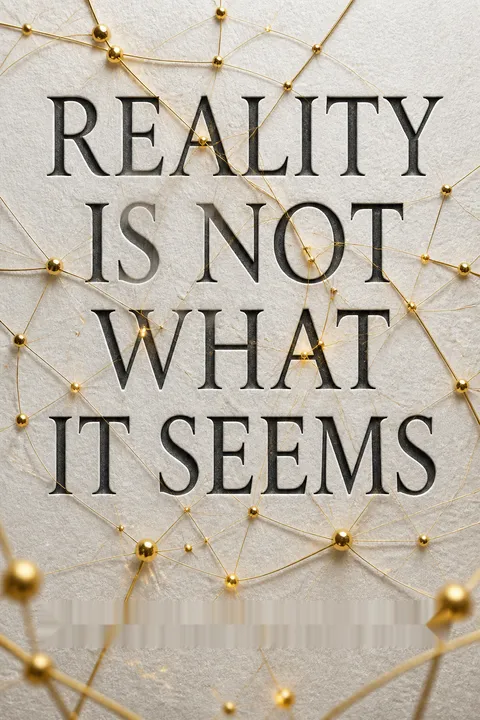
Reality is Not What it Seems offers an accessible introduction to quantum gravity and loop quantum theory. Rovelli explains complex physics concepts through historical context and poetic language. Many readers appreciate his clear writing style and ability to make difficult ideas comprehensible. The book covers the development of physics from ancient Greece to modern quantum mechanics. Some criticize Rovelli's treatment of competing theories and philosophical implications. Overall, readers find the book engaging and thought-provoking, praising Rovelli's passion for science and his skill in conveying complex ideas to a general audience.
People Also Read




Glossary
quantum gravity
quantum theory of spacetimeA research program seeking a coherent account of gravity that also obeys quantum mechanics. The problem matters where quantum effects and strong gravitational curvature are both important, such as near black-hole interiors or the universe's earliest phase. The book focuses on loop quantum gravity while noting that the field has no settled, experimentally confirmed theory.
relational interpretation
properties defined through interactionsRovelli's interpretation of quantum mechanics, in which a physical system's properties are defined relative to interactions with other systems. The theory predicts the possible results and probabilities of these interactions, rather than assigning every system a complete set of observer-independent properties at all times. It is one interpretation among several, not a consensus reading.
Planck length
quantum-gravity length scaleA length scale formed from the constants of gravity, relativity, and quantum mechanics. In the book it is approximately 10^-33 centimetres, and marks the scale at which the usual description of smooth spacetime is expected to fail. It is not a directly observed smallest length, but a theoretically important scale in quantum-gravity research.
spin network
graph describing quantum spaceA quantum state of the gravitational field represented by nodes joined by links. In loop quantum gravity, nodes carry discrete volume values, while links encode adjacency and contribute discrete areas. The network does not sit inside a pre-existing space. Its pattern of connections represents the spatial relations from which space is constructed.
spinfoam
history of changing spin networksA structure representing a possible process in loop quantum gravity. As a spin network changes, its nodes trace lines and its links trace surfaces, forming a foam-like pattern. Calculations assign probabilities to processes by summing over possible spinfoams that share the relevant boundary conditions. It serves as a quantum description of spacetime change without assuming a background space and time.
Big Bounce
proposed rebound of the universeA loop quantum cosmology proposal in which a contracting universe reaches a maximum density and then expands, rather than collapsing to a singular point. Quantum effects are proposed to prevent unlimited compression. In the book, this is a theoretical possibility that may connect a prior contracting phase to our expanding universe, not an established account of cosmic history.
Shannon information
measure of possible alternativesA mathematical measure of the number of alternatives that remain possible for a system. Shannon defines its quantity as the base-two logarithm of the number of alternatives, so a choice between two outcomes is one bit. In the book, information also describes physical correlations, such as one system's state constraining what can be known about another.
thermal time
time emerging from statistical descriptionA proposal that the familiar passage of time may emerge when a system is described through statistical averages rather than all its microscopic details. Heat and irreversible change provide the direction associated with ordinary time. At the fundamental level, the theory may have no external time variable, while large-scale observers recover temporal order from relations among physical processes.
quantum field
field with quantum propertiesA physical field whose interactions are governed by quantum mechanics. Its measurable properties are granular and probabilistic, and its quanta appear as particles, such as photons in the electromagnetic field. In the book's account, the familiar distinction between particles and fields becomes less fundamental: particles are discrete manifestations of quantum fields.
FAQ
What's "Reality is Not What it Seems" about?
- Exploration of Quantum Gravity: The book delves into the journey of understanding quantum gravity, a field that seeks to unify general relativity and quantum mechanics.
- Historical Context: It traces the evolution of scientific thought from ancient philosophers like Democritus to modern physicists, highlighting how our understanding of reality has changed.
- Conceptual Revolution: Rovelli discusses how concepts of space and time have been radically altered by twentieth-century physics, particularly through the theories of relativity and quantum mechanics.
- Vision of the Universe: The book presents a vision of the universe as a dynamic, interconnected web of quantum events, challenging traditional notions of space and time.
Why should I read "Reality is Not What it Seems"?
- Deepen Understanding of Physics: It provides a comprehensive overview of the fundamental concepts in modern physics, making complex ideas accessible to a general audience.
- Philosophical Insights: The book offers philosophical reflections on the nature of reality, encouraging readers to question their perceptions and assumptions.
- Engaging Narrative: Rovelli combines scientific rigor with engaging storytelling, making the exploration of abstract concepts both informative and enjoyable.
- Broaden Perspective: Reading this book can broaden your perspective on the universe and our place within it, fostering a sense of wonder and curiosity.
What are the key takeaways of "Reality is Not What it Seems"?
- Quantum Nature of Space: Space is not a continuous entity but is composed of discrete quanta, challenging the traditional view of space as a smooth continuum.
- Relational Time: Time is not a universal constant but emerges from the interactions of quantum events, suggesting that time is more relational than absolute.
- Unified Theory of Fields: The book posits that all physical phenomena can be understood as manifestations of quantum fields, including gravity.
- End of Infinity: Quantum gravity suggests that infinities, such as those predicted by classical physics, do not exist in reality, offering a more finite and comprehensible universe.
How does Carlo Rovelli explain quantum gravity in "Reality is Not What it Seems"?
- Granular Space: Rovelli explains that space is made up of tiny, discrete units called "quanta," which form the fabric of the universe.
- Spin Networks: He introduces the concept of spin networks, which are graphs that represent the quantum states of space, showing how space is woven from these fundamental elements.
- Spinfoams: The book describes spinfoams as the histories of spin networks, illustrating how space and time emerge from these quantum processes.
- Beyond Classical Physics: Rovelli emphasizes that understanding quantum gravity requires moving beyond classical physics and embracing a new framework where space and time are not fundamental.
What are the most important concepts in "Reality is Not What it Seems"?
- Quantum Granularity: The idea that space and time are composed of discrete units, rather than being continuous.
- Relational Reality: The concept that reality is defined by interactions and relationships between quantum events, rather than independent objects.
- Covariant Quantum Fields: The notion that all physical phenomena, including space and time, are manifestations of quantum fields.
- Big Bounce Theory: A hypothesis suggesting that the universe may have undergone a bounce, rather than a singular Big Bang, due to quantum gravitational effects.
How does "Reality is Not What it Seems" challenge traditional views of space and time?
- Non-Continuous Space: Rovelli argues that space is not a smooth continuum but is made up of discrete quanta, challenging the classical view of space.
- Emergent Time: The book suggests that time is not a fundamental aspect of the universe but emerges from the interactions of quantum events.
- Dynamic Spacetime: Space and time are not static backdrops but dynamic entities that are influenced by the presence of matter and energy.
- Relational Framework: The traditional notion of absolute space and time is replaced by a relational framework where events are defined by their interactions.
What is the significance of the "Big Bounce" theory in "Reality is Not What it Seems"?
- Alternative to Big Bang: The Big Bounce theory offers an alternative to the traditional Big Bang model, suggesting that the universe may have rebounded from a previous contraction.
- Quantum Repulsion: Rovelli explains that quantum gravitational effects could prevent the universe from collapsing into a singularity, leading to a bounce.
- Implications for Cosmology: This theory has significant implications for our understanding of the universe's history and its potential future.
- Testable Predictions: The Big Bounce theory provides testable predictions that could be confirmed through observations of cosmic background radiation.
How does Carlo Rovelli address the concept of infinity in "Reality is Not What it Seems"?
- End of Infinity: Rovelli argues that quantum gravity eliminates the concept of infinity, as there is a minimum scale to space and time.
- Singularities Resolved: The theory suggests that singularities, such as those predicted by classical physics, do not exist due to quantum effects.
- Finite Universe: The book posits that the universe is vast but finite, challenging the notion of an infinitely large cosmos.
- Practical Implications: By placing limits on infinity, quantum gravity resolves many of the mathematical inconsistencies found in classical theories.
What role does information play in "Reality is Not What it Seems"?
- Information as Fundamental: Rovelli suggests that information is a fundamental aspect of reality, influencing how physical systems interact.
- Correlations and Relations: Information is seen as the measure of correlations between different systems, shaping the structure of the universe.
- Thermodynamics and Quantum Mechanics: The concept of information is linked to both thermodynamics and quantum mechanics, providing a unifying framework.
- Emergence of Time: Information theory helps explain the emergence of time as a macroscopic phenomenon resulting from the averaging of microscopic variables.
What are the best quotes from "Reality is Not What it Seems" and what do they mean?
- "Reality is a network of granular events": This quote encapsulates the idea that the universe is composed of discrete quantum events, rather than continuous processes.
- "Time is our ignorance": Rovelli suggests that our perception of time is a result of our limited understanding of the universe's fundamental processes.
- "The world is a game of mirrors": This metaphor highlights the relational nature of reality, where objects and events are defined by their interactions and reflections.
- "The truth is in the depths": A nod to Democritus, this quote emphasizes the importance of delving deep into the nature of reality to uncover fundamental truths.
How does "Reality is Not What it Seems" relate to the history of scientific thought?
- From Democritus to Einstein: Rovelli traces the evolution of scientific ideas from ancient atomism to modern quantum gravity, showing how our understanding has progressed.
- Revolutionary Ideas: The book highlights key moments in history where revolutionary ideas challenged and changed our perception of reality.
- Interdisciplinary Approach: Rovelli draws on philosophy, mathematics, and physics to provide a comprehensive view of the development of scientific thought.
- Continuity and Change: The narrative emphasizes both the continuity of certain ideas, like granularity, and the radical changes brought about by new discoveries.
What future directions does "Reality is Not What it Seems" suggest for physics?
- Further Exploration of Quantum Gravity: Rovelli encourages continued research into quantum gravity to refine and test the theories presented.
- Integration of Information Theory: The book suggests that integrating information theory with quantum mechanics and general relativity could lead to new insights.
- Experimental Confirmation: Rovelli emphasizes the importance of empirical tests, such as those involving cosmic background radiation, to validate theoretical predictions.
- Open Questions: The book leaves open several questions about the nature of reality, inviting future physicists to explore and expand upon these ideas.
About the Author


Download PDF
Download EPUB
.epub digital book format is ideal for reading ebooks on phones, tablets, and e-readers.








