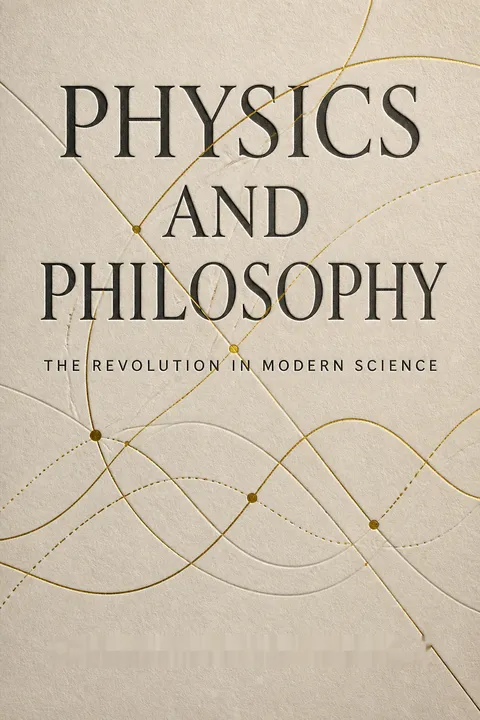


Key Takeaways
Read quantum physics as a revision of reality, not just a theory of atoms.
A revolution in assumptions. The story begins with Max Planck trying to explain the color of heated objects. His successful formula implied that energy comes in discrete amounts, a proposal that sat uneasily with classical physics. Einstein extended the idea to light, Bohr applied it to the atom, and new theories followed. Each step explained more, but also made familiar pictures of nature less reliable.
A new target for theory. Heisenberg's central claim is that quantum physics changes more than our inventory of tiny objects. It changes what can sensibly be said about them. In this view, experiments produce real, communicable results, while the underlying atomic world is described through possibilities rather than a miniature copy of everyday things.
The book's most arresting move is to treat conceptual change as part of scientific progress, not as decorative philosophy added after the equations. A theory can predict exceptionally well while challenging assumptions about what exists independently of observation. That distinction remains valuable wherever models are mistaken for literal pictures. Still, a successful mathematical description does not by itself prove that reality lacks observer-independent structure. The book makes a powerful case for intellectual restraint, while leaving open how much metaphysics the physics actually requires.
Treat quantum uncertainty as nature's limit, not a clumsy measurement.
A limit in nature. The relations of uncertainty state that position and momentum cannot both have arbitrarily precise values at once. Greater precision about one entails less precision about the other. This is not simply a flaw in an instrument or a careless experimenter. Heisenberg argues that the limitation belongs to the quantum description of nature itself.
A measurement has a cost. His imagined microscope uses very short wavelength radiation to locate an electron. That radiation would also jolt the electron, changing its momentum. The example makes the tradeoff tangible, although the point is deeper than mechanical disturbance: quantum theory does not assign both properties exact simultaneous values. It can still predict probabilities precisely, but not a perfectly specified path for each particle.
This distinction separates fundamental uncertainty from ordinary ignorance. A weather forecast is uncertain because the system is too complex to track completely; the quantum limit, as presented here, is built into the theory's account of measurable properties. That shift changes what counts as a complete explanation. It does not mean that every measurement is unreliable or that nothing can be known. The useful discipline is to ask whether uncertainty comes from missing information, limited instruments, or the structure of the model itself.
Choose an experiment knowing wave and particle descriptions cannot appear together.
Two useful descriptions. Complementarity is the idea that some aspects of a quantum system require descriptions that cannot be manifested together, though each is needed to account for different experiments. Light and electrons can produce wave-like interference in one setup and particle-like impacts in another. The experiment does not reveal a single classical picture that neatly combines both behaviors.
The question shapes the evidence. In a two-opening experiment, waves passing through both openings can create an interference pattern. If the setup instead determines which opening a particle uses, that pattern disappears. For Heisenberg, this is not a license to choose any story one likes. The mathematical theory constrains what each arrangement can show, and the apparatus determines which property is made observable.
Complementarity is a useful antidote to the demand that every object must fit one familiar category. In other fields, too, methods can reveal different features while obscuring others: a map optimized for roads is not a map of watersheds. The analogy has limits, since quantum alternatives are tied to precise experimental predictions, not merely to different perspectives. The concept is strongest when it explains why incompatible measurements matter, and weakest when used as a vague slogan for accepting contradictions.
Predict quantum outcomes statistically, not as hidden individual trajectories.
A function of possibilities. A probability function is the mathematical description used to calculate the likelihood of possible measurement results. Heisenberg describes it as combining objective tendencies with incomplete knowledge. Max Born gave the mathematical quantity its probability interpretation. The function predicts what may be found, but does not provide a continuous account of what a particle is doing between observations.
Reliable patterns, uncertain events. Repeat an electron scattering experiment under the same conditions, and individual electrons may go in different directions. Quantum theory can predict the relative frequency of those results across many trials, even when it cannot say which way one electron will go. This differs from classical statistics, where uncertainty is usually attributed to missing information about an otherwise definite process.
The distinction between a probability and an undiscovered fact is philosophically consequential. It blocks the easy assumption that every uncertainty must conceal a precise answer waiting to be uncovered. Yet the book's preferred interpretation is not the only possible way to understand the formalism. Its practical strength is clearer than its final account of what probabilities are. Readers can retain the core lesson without claiming that the debate about underlying reality has been conclusively settled.
Use atomic models without mistaking their pictures for the atom itself.
Speak from the apparatus. Experiments still need classical descriptions: an instrument setting, a detector click, or a mark on a photographic plate. These are shared records that observers can discuss clearly. Heisenberg's observer is not a human mind magically creating events. The key interaction is between the atomic system and the measuring equipment, which produces a definite record.
Words have borders. Terms such as orbit, wave, and particle remain useful, but their everyday meanings do not transfer cleanly to atoms. A question about an electron's exact orbit can therefore be misleading, rather than merely unanswered. When ordinary language becomes confusing, the mathematical scheme and its connection to experimental results provide firmer ground. The lesson is to use familiar images as tools, not as portraits of microscopic reality.
This is a subtle account of how science speaks: ordinary language anchors the experiment, while mathematics organizes relationships that everyday words cannot capture. It also clarifies that observation is a physical process, not a demand for consciousness to intervene. The tension lies in the boundary between the quantum object and the classical apparatus. The book treats that division as necessary for reporting results, but its dependence on a classical description invites the question of how the apparatus itself fits into a quantum world.
Expect space and time to change when experiments outrun everyday intuition.
Relativity redraws the map. The failed search for an ether wind, including the Michelson and Morley experiments, helped undermine the idea of a universal frame at rest. Special relativity makes simultaneity depend on the observer's motion: events judged simultaneous in one frame need not be simultaneous in another. Everyday intuition misses this because ordinary speeds are far below the speed of light.
Space-time participates. General relativity goes further by linking the geometry of space-time with the distribution of mass. Space is not merely an empty stage on which matter acts. Heisenberg distinguishes the strong experimental standing of special relativity from the more limited evidence available for general relativity in his era. Both theories show why familiar concepts must be tested, not treated as permanent foundations.
Relativity and quantum theory make a shared methodological point by different routes: concepts that seem self-evident can have restricted domains. Relativity is easier to visualize because it preserves a more continuous account of events, while quantum theory challenges the idea of a definite microscopic history. The book's comparison also cautions against treating all scientific revolutions as equally disruptive. A theory may revise how a concept is measured without making the concept useless in the everyday settings where it works.
See particles as transformable forms of energy, not indestructible building blocks.
From atoms to forms. Ancient atomists imagined indivisible units of matter. Heisenberg contrasts that picture with experiments in which high-energy collisions can create new particles or turn particles into radiation. Mass and energy are related, and familiar building blocks are not permanent little objects. In the book's account, different particles are forms matter can take, rather than an inventory of indestructible substances.
A unity still sought. Heisenberg connects this view to Greek debates about the one and the many, and to Plato's emphasis on mathematical form. He proposes that particles may ultimately be understood through solutions to fundamental mathematical laws. But he presents that underlying law as an unresolved goal, not a finished discovery. The historical comparison is a guide to the problem, not proof that ancient philosophers had modern physics in hand.
The movement from substance to transformation is a deep change in explanatory style. It encourages attention to relations, processes, and mathematical structure instead of asking only what tiny material things are made of. But calling energy a universal substance can mislead: it risks turning a measurable physical quantity into a kind of cosmic fluid. The book's analogy is suggestive, not literal. Its more durable claim is that particles can change identity and that theories must explain those transformations.
Let each science earn its concepts instead of forcing biology into physics.
Different toolkits, connected laws. Heisenberg describes physics as a family of conceptual systems. Newtonian mechanics works in its domain, while relativity and quantum theory extend or replace it under different conditions. Quantum theory helped bring chemistry into a mathematical account of atoms and bonds. That achievement did not mean every useful chemical concept could simply be translated into Newton's mechanics.
Explanation has levels. Biology draws on physics and chemistry, and experiments in living systems often confirm those laws. Yet concepts such as life, function, and perception may still be needed for a complete description. Heisenberg leaves open whether evolution plus physics and chemistry will suffice. This is not an argument for a mysterious vital force. It is a warning that successful lower-level explanations do not automatically make higher-level vocabularies dispensable.
The argument anticipates a productive idea in contemporary philosophy of science: explanations can be layered without being rivals. Molecular mechanisms may explain how a function is carried out, while biological language identifies what the function is and why it matters to the organism. The challenge is to distinguish genuine explanatory limits from temporary gaps in research. Heisenberg is careful not to declare biology irreducible; his value lies in keeping reduction an empirical project rather than a philosophical decree.
Treat nuclear knowledge as political power with obligations, not neutral cleverness.
Physics changes the stakes. Nuclear weapons made the consequences of scientific knowledge impossible to keep inside the laboratory. Heisenberg argues that their destructive scale makes large wars self-defeating, but does not eliminate conflict. Political groups may still gamble on smaller wars, believing the other side will avoid escalation. Technical power can therefore create new dangers even when it deters some forms of violence.
Responsibility needs specifics. Scientists, he argues, should inform governments about the consequences of nuclear war and can foster international cooperation through shared research. He is skeptical of general declarations for peace that avoid naming the compromises required to preserve it. The point is not that scientists alone can settle political disputes. Their expertise can clarify consequences, but decisions about justice and acceptable sacrifice remain collective moral questions.
This closing argument distinguishes technical authority from moral authority. Physics can estimate what a weapon does; it cannot decide which political settlement is fair. That boundary makes public responsibility more demanding, not less: scientists must communicate consequences without presenting policy preferences as deductions from equations. Heisenberg's insistence on concrete commitments also exposes the weakness of symbolic consensus. A peace statement matters only when its supporters can say what costs, restraints, or risks they are prepared to accept.
Analysis
The book's enduring contribution is less a final interpretation of quantum mechanics than a disciplined account of what scientific concepts can and cannot do. Its historical arc makes that point vivid: Planck's formula begins as a response to a specific measurement problem, then forces revisions to the older pictures of light, atoms, and physical knowledge. The narrative shows that a theory can preserve predictive precision while withdrawing the intuitive story that once seemed to explain its subject.
Heisenberg's strongest distinction is between observable records and claims about what lies behind them. A detector mark is public evidence; an electron's unobserved path is not simply the same kind of fact. This is a persuasive warning against treating models as photographs. It is less decisive as a metaphysical conclusion. A mathematical framework that does not require definite hidden trajectories does not, by itself, prove that no deeper account is possible. The book sometimes moves quickly from limits on meaningful prediction to claims about the status of reality.
Its treatment of language is especially useful because it avoids two extremes. Scientific vocabulary is neither a transparent window onto nature nor an arbitrary game. It is a constructed tool, constrained by experiment, whose terms work within domains. That position also supports the book's resistance to crude reductionism: chemistry and biology can depend on physics without being exhausted by the vocabulary of mechanics.
The final political argument follows from the same methodological humility. Equations can clarify consequences, but they do not settle values. That lesson is more durable than the book's mid-century forecasts about weapons or particle theory, which belong to their historical moment. Read as both a record of a scientific revolution and a guide to intellectual caution, the book remains valuable precisely because it treats changed knowledge as a challenge to judgment, not a license for certainty.
Review Summary
Physics and Philosophy receives mixed reviews. Some praise its insightful exploration of quantum mechanics and its philosophical implications, appreciating Heisenberg's ability to connect physics with broader intellectual history. Others find it challenging, with dense physics content and dated information. The book is lauded for its examination of language, reality, and the nature of scientific knowledge. While some reviewers struggled with the technical aspects, many found value in Heisenberg's unique perspective on the intersection of science and philosophy.
People Also Read







Glossary
Copenhagen interpretation
quantum measurement accountAn interpretation of quantum theory associated with Bohr and Heisenberg. It treats the mathematical description as a way to predict possible measurement results, while requiring experimental arrangements and outcomes to be described in classical terms. It rejects the assumption that particles always possess a complete set of definite classical properties between observations.
relations of uncertainty
limits on joint precisionRelations stating that certain pairs of physical quantities, notably position and momentum, cannot both be specified with unlimited precision at the same time. In Heisenberg's account, this is not merely a practical defect in measuring equipment. It marks a limit on the applicability of classical descriptions to atomic systems.
complementarity
mutually exclusive descriptionsBohr's idea that some features of quantum systems require different experimental arrangements and descriptions that cannot be fully manifested at once. Wave and particle accounts are the central example. Each can be useful for explaining particular observations, while neither alone supplies a complete classical picture of the system.
probability function
quantum outcome predictorThe mathematical function used in quantum theory to calculate the probabilities of possible measurement results. Heisenberg describes it as combining objective tendencies with information available about the system. It does not, by itself, depict a definite sequence of events between observations or predict every individual outcome.
potentia
objective possibilityAn Aristotelian term Heisenberg uses to clarify quantum probability. It refers to a possibility or tendency that is not simply an actual event, but is also not merely an observer's guess. Quantum theory's description of possible outcomes occupies, in this analogy, an intermediate status between possibility and realized fact.
dogmatic realism
assumed independent realityThe position that statements about the material world describe an objective reality independently of the conditions under which those statements can be verified. Heisenberg contrasts it with practical realism, which accepts ordinary claims about an external world while allowing that quantum theory limits how completely microscopic objects can be described.
principle of correspondence
quantum-classical linkBohr's guiding idea that quantum descriptions should connect with classical results in the appropriate limiting cases, such as systems with large quantum numbers. It helped researchers develop quantum theory from known classical behavior, even as the theory required them to abandon classical descriptions for atomic-scale phenomena.
closed system of concepts
coherent scientific frameworkA set of definitions, principles, and mathematical relations that fit together consistently and describe a range of phenomena. Heisenberg uses this idea for frameworks such as Newtonian mechanics and quantum theory. A framework can be internally precise while still having limits, discovered through experience, on where it describes nature successfully.
FAQ
1. What is "Physics and Philosophy: The Revolution in Modern Science" by Werner Heisenberg about?
- Explores the philosophical impact: The book examines how the revolutionary developments in modern physics, especially quantum theory and relativity, have transformed our understanding of reality, knowledge, and scientific concepts.
- Focuses on quantum mechanics: Heisenberg, a key architect of quantum mechanics, discusses the origins, interpretation, and implications of quantum theory, particularly the Copenhagen interpretation.
- Bridges science and philosophy: The text connects the evolution of scientific ideas with philosophical traditions, comparing ancient Greek, Cartesian, and Kantian thought to modern physics.
- Addresses broader consequences: Heisenberg also considers the influence of modern physics on society, language, and human thinking, including the ethical and political ramifications of scientific advances.
2. Why should I read "Physics and Philosophy" by Werner Heisenberg?
- Firsthand insight from a pioneer: Heisenberg was a Nobel laureate and one of the principal creators of quantum mechanics, offering unique authority and perspective.
- Clarity on complex ideas: The book provides a lucid, non-mathematical explanation of the most challenging concepts in modern physics and their philosophical significance.
- Relevance to broader questions: It addresses fundamental questions about reality, knowledge, and the limits of scientific inquiry, which are relevant to anyone interested in science, philosophy, or the nature of truth.
- Historical and cultural context: Heisenberg situates scientific revolutions within the broader sweep of intellectual history, making the book valuable for understanding the interplay between science and culture.
3. What are the key takeaways from "Physics and Philosophy" by Werner Heisenberg?
- Limits of classical concepts: Classical physics concepts like space, time, and causality are not universally applicable; quantum theory reveals their limitations.
- Copenhagen interpretation: Reality at the atomic level is not objectively determined until observed; quantum mechanics describes probabilities, not certainties.
- Role of language and logic: Scientific language and logic are shaped by experience and may require revision as knowledge expands, especially in quantum physics.
- Science and subjectivity: The observer plays an unavoidable role in defining what can be known; objectivity in science is more nuanced than previously thought.
4. How does Heisenberg explain the Copenhagen interpretation of quantum theory in "Physics and Philosophy"?
- Measurement creates reality: According to the Copenhagen interpretation, properties like position or momentum do not have definite values until measured; observation brings potentialities into actuality.
- Probability, not determinism: Quantum mechanics provides only statistical predictions about ensembles of systems, not definite outcomes for individual events.
- Complementarity principle: Different experimental setups reveal complementary aspects (e.g., wave or particle) of quantum systems, but never both simultaneously.
- Limits of classical language: Classical terms are necessary for describing experiments, but their applicability is limited by quantum uncertainty.
5. What is Heisenberg’s uncertainty principle, and how is it presented in "Physics and Philosophy"?
- Fundamental limit to knowledge: The uncertainty principle states that certain pairs of physical properties (like position and momentum) cannot both be known to arbitrary precision simultaneously.
- Not just measurement error: This uncertainty is inherent in nature, not due to experimental imperfections or lack of information.
- Implications for reality: The principle implies that quantum particles do not have well-defined trajectories or states independent of observation.
- Philosophical consequences: It challenges the classical notion of an objective, observer-independent reality and introduces indeterminacy at the heart of physics.
6. How does "Physics and Philosophy" by Heisenberg compare quantum theory to earlier philosophical traditions?
- Greek philosophy parallels: Heisenberg draws connections between quantum concepts and ancient ideas, such as Aristotle’s "potentia" (potentiality) and Heraclitus’s focus on change.
- Critique of Cartesian dualism: The book critiques Descartes’ strict separation of mind and matter, showing that quantum theory blurs this distinction.
- Kantian a priori revisited: Heisenberg argues that Kant’s "synthetic a priori" concepts (like space, time, causality) are not absolute but have limited applicability in light of modern physics.
- Evolution of scientific concepts: The text demonstrates how scientific revolutions force a reevaluation of philosophical assumptions about reality and knowledge.
7. What is the role of language and logic in science according to "Physics and Philosophy" by Heisenberg?
- Language shaped by experience: Scientific and everyday language are formed through interaction with the world, and their concepts have only limited, context-dependent meaning.
- Limits of precision: Even the most precise scientific terms are idealizations and may lose their applicability as knowledge advances.
- Need for new logic: Quantum theory may require modifications to classical logic, such as relaxing the law of the excluded middle ("tertium non datur") at the quantum level.
- Communication and understanding: While mathematics provides unambiguous predictions, plain language is necessary for broader understanding, though it may be inherently vague in quantum contexts.
8. How does Heisenberg address criticisms and alternative interpretations of quantum mechanics in "Physics and Philosophy"?
- Hidden variables debate: Heisenberg discusses proposals like Bohm’s hidden variables, which attempt to restore determinism, but argues they add unnecessary and unobservable elements.
- Symmetry and consistency: Alternative interpretations often sacrifice key symmetries or features of quantum theory, making them less satisfactory.
- Role of the observer: Critics object to the centrality of the observer in the Copenhagen interpretation, but Heisenberg maintains this is an unavoidable consequence of quantum phenomena.
- No return to classical realism: Heisenberg concludes that attempts to restore a classical, objective reality are incompatible with experimental facts and the structure of quantum theory.
9. What does "Physics and Philosophy" by Heisenberg say about the structure and unity of matter?
- From atoms to energy: The book traces the historical development from Greek atomism to the modern view that all matter is composed of energy and elementary particles.
- Transmutation and unity: Experiments show that elementary particles can be transformed into one another, supporting the idea of a fundamental unity of matter.
- Matter and form: Heisenberg relates quantum particles to Aristotelian "potentia," suggesting that particles are forms or solutions of underlying laws, not static substances.
- Ongoing challenges: The search for a complete mathematical description of matter, uniting quantum theory and relativity, remains unfinished.
10. How does "Physics and Philosophy" by Heisenberg relate quantum theory to other sciences and human knowledge?
- Chemistry and physics unified: Quantum theory provides the foundation for understanding chemical behavior and the stability of atoms.
- Biology and limits of reductionism: While physics and chemistry explain much of biology, Heisenberg suggests that life may involve concepts beyond current physical theories.
- Psychology and subjectivity: The book argues that physics cannot fully explain consciousness or subjective experience, highlighting the limits of reductionist approaches.
- Science as interplay: Heisenberg emphasizes that science is not just about describing nature, but about the interplay between nature and human questioning.
11. What are the broader implications of "Physics and Philosophy" by Heisenberg for society, ethics, and culture?
- Impact on worldviews: The conceptual revolution in physics challenges materialism and calls for a more nuanced understanding of reality.
- Ethical responsibility: Heisenberg discusses the political and ethical consequences of scientific advances, especially regarding nuclear weapons.
- Science and tradition: The book explores how modern physics interacts with different cultural and philosophical traditions worldwide.
- Tolerance and openness: Heisenberg advocates for intellectual openness and tolerance, recognizing the limits of any single worldview or doctrine.
12. What are the best quotes from "Physics and Philosophy" by Werner Heisenberg, and what do they mean?
- "What we observe is not nature itself, but nature exposed to our method of questioning."
- This highlights the active role of the observer in shaping what can be known in quantum physics.
- "In the experiments about atomic events we have to do with things and facts, with phenomena that are just as real as any phenomena in daily life. But the atoms or the elementary particles themselves are not as real; they form a world of potentialities or possibilities rather than one of things or facts."
- Heisenberg distinguishes between observable phenomena and the underlying quantum reality, which is a realm of possibilities.
- "Every word or concept, clear as it may seem to be, has only a limited range of applicability."
- This quote underscores the limitations of language and concepts, especially when applied to new scientific domains.
- "Natural science does not simply describe and explain nature; it is part of the interplay between nature and ourselves."
- Heisenberg emphasizes that science is a human activity, shaped by our questions and perspectives, not a detached observation of an independent reality.
Download PDF
Download EPUB
.epub digital book format is ideal for reading ebooks on phones, tablets, and e-readers.








