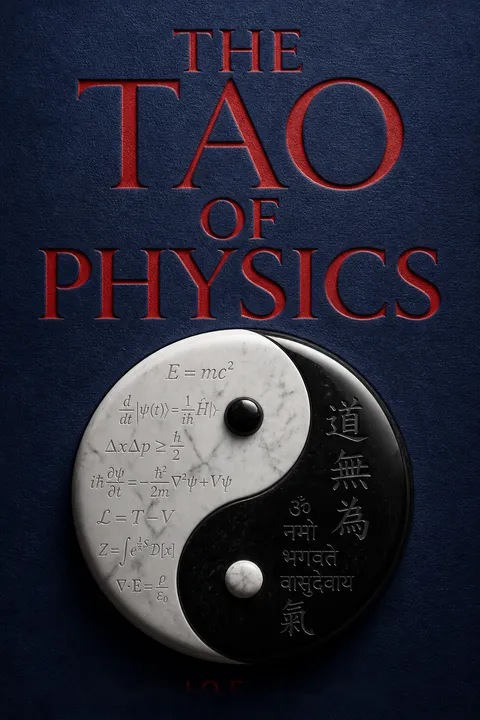


Key Takeaways
Use physics and mysticism as complementary maps, not competing explanations
A beachside beginning. Capra opens with a moment on a California beach: watching waves and feeling his breathing, he imagines the energy and particles described in his physics research as a cosmic dance. The experience connects scientific ideas he knew mathematically with Hindu imagery of Shiva, the dancing deity associated with creation and destruction. It becomes the starting point for his central argument: modern physics and Eastern mystical traditions can point toward similar pictures of reality as unified, dynamic, and interdependent.
Different routes, not one method. The book compares scientific models with mystical descriptions, not equations with religious doctrine. Capra argues that neither physics nor mysticism replaces the other. Each offers a distinct kind of inquiry, and their convergence can enlarge a reader's sense of what a worldview includes.
What's compelling is the book's invitation to let scientific and contemplative habits correct each other's blind spots. Physics disciplines intuition with measurement; contemplative practice can make assumptions about separateness feel less inevitable. But resemblance is not proof of identity. A physicist's mathematical account and a mystic's first-person report have different standards of validation. The strongest reading treats their parallels as prompts for philosophical reflection, not as evidence that ancient traditions secretly anticipated modern equations.
Treat scientific models as maps with limits, not mirrors of reality
Useful, not final. Capra argues that scientific theories describe selected features of nature rather than reality in its entirety. Newtonian mechanics works extremely well for familiar objects moving at ordinary speeds, but its assumptions fail at atomic scales or near the speed of light. Quantum theory and relativity extend our descriptions into those domains. They do not make Newton's laws useless; they reveal where those laws apply.
Know the map's edges. The book compares concepts and equations to maps: necessary for orientation, yet never identical to the terrain. A model can be precise within its range and still leave out important phenomena. Scientific progress, in this account, depends partly on asking what a theory explains, what it ignores, and where its approximations break down.
This is a durable lesson in scientific reasoning: confidence should attach to a model's demonstrated domain, not to its claim to describe everything. It also guards against a common false choice between absolute truth and arbitrary opinion. Maps can be more or less accurate for specific purposes. The caution is that saying all models are limited does not make all models equally good. Evidence, predictive success, and explanatory reach still distinguish a useful map from a misleading one.
Read Eastern traditions as distinct practices, not one interchangeable doctrine
Shared themes, real differences. Capra brings Hinduism, Buddhism, Taoism, and Zen into conversation because each includes traditions focused on direct experience and the limits of ordinary concepts. Hindu thought often describes an underlying reality, Brahman, and the individual essence, Atman, as united. Buddhist teaching centers on suffering, impermanence, and the grasping that intensifies suffering. Taoism emphasizes the Way, or Tao, and acting in accord with natural change. Zen gives special weight to meditation and direct insight.
Practice matters. These traditions are not just collections of claims. Meditation, yoga, ritual, and everyday disciplines are ways practitioners train attention and experience. Capra notes that books can introduce these paths, but cannot substitute for the experience or practice they describe.
The comparative approach is most persuasive when it preserves these differences. Buddhist analysis of craving is not simply another name for Hindu metaphysics, and Zen's resistance to doctrinal explanation is not identical to Taoist naturalism. Across disciplines, this is a useful principle for comparison: recurring patterns can matter without erasing context. The book sometimes compresses diverse schools into a shared Eastern worldview. Readers gain more by treating its broad parallels as a starting hypothesis than as a complete account of any tradition.
At quantum scale, relations matter more than isolated objects
Particles have context. Quantum theory describes many subatomic outcomes in terms of probabilities. In Capra's account, a particle is not always best understood as a tiny, independent object with properties fixed in advance. What can be said about it depends on how it is prepared and measured. The mathematical theory predicts the probabilities of results, while experiments test those predictions across many events.
The whole matters. Capra uses the Copenhagen interpretation to emphasize that observation links the object, the apparatus, and the process of measurement. He also notes that physicists disagree about how to interpret quantum theory. Even so, he argues that the theory undermines the simple picture of matter as separate, self-sufficient pieces and encourages a relational view of physical events.
The relational emphasis is a powerful corrective to the intuition that objects possess every property independently of any context. It resonates with systems thinking, where a component's role depends on its connections and environment. Yet the leap from quantum relations to a universal spiritual oneness is philosophical, not a result demanded by the equations. Quantum theory supports precise predictions about experiments; its interpretation remains debated. Keeping those levels distinct lets the relational insight stay strong without asking physics to settle metaphysics.
Treat measurement as part of the question, not a view from nowhere
Choose what to measure. In quantum physics, the experimental arrangement helps determine which property can be measured. Capra explains this through the uncertainty principle: position and momentum cannot both be specified with unlimited precision. The limitation is not simply a flaw in instruments. It is built into the theory's account of subatomic phenomena.
Participation has boundaries. The book calls attention to the observer's role and, following physicist John Wheeler, presents the observer as a participant in the physical description. This does not mean that a person's wishes freely determine what happens. It means that an experiment is an interaction, and that claims about measured properties must include how the measurement was made. Capra extends this point toward the mystical idea that subject and object are deeply connected.
The book makes an important distinction visible: scientific knowledge is produced through procedures, not collected from a perfectly detached vantage point. That insight aligns with fields such as psychology, where measurement choices can change what behavior is noticed or recorded. A necessary qualification concerns consciousness. Quantum mechanics requires a physical account of measurement, but it does not require human awareness to cause outcomes. The book's move from experimental participation to a deeper unity of mind and matter is suggestive, not experimentally established.
Use complementary models when one picture cannot capture reality
Two views, one phenomenon. Light and subatomic matter can display wave-like or particle-like behavior, depending on the experiment. A wave spreads across space; a particle is associated with a localized event. Capra explains that neither everyday image is a complete description of what happens at the atomic scale. Physicists use each within the conditions where it is useful.
Opposites can cooperate. Niels Bohr called this relationship complementarity. Capra connects it with the Chinese idea of yin and yang, paired forces that differ but depend on each other. Bohr chose the yin-yang symbol for his coat of arms. For Capra, this is a vivid example of an Eastern pattern of thought resembling a modern scientific strategy: keep multiple partial descriptions in play rather than forcing one to eliminate the other.
Complementarity offers a practical intellectual habit: when two descriptions conflict, first ask whether they answer different questions or work at different scales. This can help beyond physics, from biology's genetic and environmental explanations to the competing perspectives used to understand a social problem. The analogy has limits. Yin and yang are embedded in a broad cosmology, while Bohr's complementarity addresses a specific problem in quantum theory. A shared pattern of thought is not evidence that the two frameworks mean the same thing.
See space and time as one observer-dependent framework
Relativity changes the stage. Newtonian physics treats space as a fixed three-dimensional setting and time as a universal clock. Relativity joins them into space-time and shows that measurements of duration and distance depend on the observer's motion. Gravity also affects space-time's structure. The book uses the familiar example of clocks on fast-moving particles: from a laboratory's perspective, those particles last longer than slower counterparts.
Ordinary intuition has a range. These effects are tiny in everyday life, so ordinary assumptions remain practical there. At high speeds or in strong gravitational settings, they fail. Capra sees a parallel with mystical accounts of time and space as limited mental categories, but the scientific claim is narrower: relativity gives precise rules for physical measurements, not a laboratory demonstration of timeless consciousness.
Relativity is a reminder that the frame from which a measurement is made is part of its meaning. That insight has philosophical reach, but it should not be inflated into the claim that reality is merely subjective. Different observers can disagree about some measurements while still using shared laws to relate their accounts. The distinction matters in any debate about perspective: dependence on a standpoint does not imply that every standpoint is equally accurate or that there is no external world.
Picture matter as ongoing activity, not inert building blocks
Matter becomes motion. Capra describes subatomic particles as dynamic patterns rather than miniature solid objects. In quantum field theory, particles can be understood as localized manifestations of fields, and interactions involve particles being created, exchanged, and absorbed. The apparent solidity of familiar materials emerges from processes at smaller scales, not from tiny, permanently unchanged billiard balls.
A dance, not a diagram. Capra's guiding image is Shiva's dance, which represents continual creation and dissolution. He connects it to bubble-chamber photographs showing particle tracks produced in high-energy collisions. The image is memorable because both portray change and interaction. But it is an analogy: the Hindu deity is not a physical explanation, and the scientific account is not proof of a religious cosmology.
The shift from substance to process also appears in biology, where an organism remains recognizable while its cells and internal activities continually change. Thinking in terms of processes can therefore clarify how stability and change coexist. Still, scientific descriptions of fields and particle interactions are mathematically defined and experimentally tested; metaphorical language helps imagination but cannot replace that work. The cosmic-dance image is strongest as a bridge for attention, not as a claim that physics and theology have converged on one literal account.
Explain particles through mutual consistency, not ultimate building blocks
The bootstrap proposal. Capra presents Geoffrey Chew's bootstrap hypothesis as a challenge to the search for one final ingredient of matter. In the proposal, particles are defined through their relationships and reactions with other particles. Their properties would follow from the demand that the whole network fit together consistently, rather than from a few supposedly fundamental parts.
A web with no first strand. Capra compares this idea with the Buddhist image of Indra's net, in which each jewel reflects the others, and with the Buddhist term interpenetration for mutual inclusion among phenomena. The scientific bootstrap was a research program, not a completed or universally accepted theory. Its value in the book is also philosophical: it asks whether explanation can be relational all the way down.
The bootstrap idea challenges reductionism without denying the usefulness of reduction. A system can be studied by isolating components, yet those components may only be intelligible within larger patterns. This tension appears in complex systems research, where local rules can generate global organization. The proposal also carries a major burden: consistency alone must yield testable predictions and match observations. Capra's enthusiasm can make a speculative program sound more conclusive than it was. Its lasting contribution is the question it poses, not a settled account of particle physics.
Let interdependence inform ethics without claiming physics proves spirituality
From worldview to responsibility. Capra argues that a fragmented picture of separate people and resources can encourage exploitation, while an ecological view emphasizes relationships and dependence. In the book's closing argument, the scientific picture of interconnected processes can support a more cooperative way of thinking about society and nature. The fifth-edition preface extends this concern to ecosystems and sustainable communities.
Complementary work. Capra does not call for scientists to become mystics or for mysticism to replace science. He argues that analytical inquiry and intuitive, contemplative insight contribute different forms of understanding. Physics can describe physical relationships; spiritual traditions can offer practices and ethical orientations. The connection, in his view, is most useful when it changes how people understand their place in the living world.
Interdependence gives environmental ethics a vivid systems perspective: actions that look local can affect networks of people, species, and resources. But a physical description cannot by itself dictate what people ought to value. Moving from interconnectedness to care requires additional moral commitments, such as concern for future generations or for nonhuman life. Stating that step openly makes Capra's social argument stronger. It preserves the book's ecological ambition without turning a scientific analogy into an automatic proof of a political or spiritual conclusion.
Analysis
The book's enduring achievement is not a demonstration that quantum mechanics confirms Eastern religion. It is a forceful tutorial in the ways scientific revolutions unsettle common sense. Capra traces a movement from the Newtonian image of independent objects in fixed space to accounts involving probability, interaction, and observer-dependent measurement. He then places those changes beside themes in Hindu, Buddhist, Taoist, and Zen traditions. The comparison gives readers a memorable route into difficult physics and asks them to notice how assumptions about separateness shape a worldview.
That method also creates the book's central risk. Similar language can conceal different meanings. A quantum probability function is a mathematical object used to predict measurement outcomes; Buddhist emptiness concerns the lack of independent, fixed essence. They may invite a fruitful analogy, but neither establishes the other. Likewise, the observer's role in quantum experiments does not mean human consciousness creates physical reality. Capra acknowledges competing interpretations, yet his rhetoric sometimes gives one metaphysical reading the feel of a scientific conclusion.
The historical setting matters. The particle physics, cosmology, and speculative bootstrap program discussed in the 1970s and 1980s should be read as period-specific, not as a current textbook account. Still, the book's broader questions remain productive: Are objects best understood in isolation? How do measurement choices shape knowledge? Can explanatory models remain useful without being final? Its closing ecological argument is best treated as an ethical proposal informed by systems thinking, not as a deduction from physics. Read with these distinctions in view, The Tao of Physics is an imaginative work of comparative philosophy, valuable less for proving a cosmic unity than for teaching intellectual humility about the maps used to describe reality.
Review Summary
The Tao of Physics draws parallels between modern physics and Eastern mysticism, arguing that both converge on similar ideas about the nature of reality. While some readers praise its thought-provoking insights and accessible explanations of complex concepts, others criticize its oversimplification and questionable interpretations. The book explores quantum mechanics, relativity, and particle physics alongside Buddhist, Hindu, and Taoist philosophies. Many find it enlightening and perspective-changing, though some physicists dispute its scientific accuracy. Overall, it remains a controversial yet influential work bridging science and spirituality.
People Also Read








Glossary
maya
Mistaking concepts for realityIn Capra's account of Hindu thought, maya is the illusion of treating the mind's categories and the world's changing forms as separate, fixed realities. It does not mean that the experienced world simply does not exist. The confusion lies in mistaking a limited conceptual view for the underlying unity that the tradition calls Brahman.
avidya
Ignorance of interdependenceA Buddhist term for ignorance or mistaken understanding. In the book, avidya describes the habit of dividing experience into independent things and selves, then treating those divisions as ultimate facts. This mistaken view supports attachment and suffering. Buddhist practice aims to loosen it through insight into impermanence and the dependent character of phenomena.
wu-wei
Action aligned with natureA Taoist principle often translated as nonaction. It does not mean doing nothing. It means avoiding forced or contrary action and responding in a way that fits the natural course of a situation. Capra presents wu-wei as a form of spontaneity and harmony with the Tao, rather than passive withdrawal from life.
complementarity
Limited, mutually necessary descriptionsNiels Bohr's term for descriptions that are individually limited but jointly needed to account for quantum phenomena. Capra uses the wave and particle accounts as the central example: experiments reveal different aspects, and neither everyday picture alone provides a complete account. Complementarity does not mean that any contradictory explanation is automatically acceptable.
uncertainty principle
Limits simultaneous precisionA principle of quantum theory stating that certain pairs of properties, such as a particle's position and momentum, cannot both be specified with unlimited precision. Capra emphasizes that this is not merely a defect in measuring equipment. The limitation belongs to the theoretical description of atomic phenomena and informs the book's discussion of observation.
S-matrix theory
Probabilities for particle reactionsA mathematical framework discussed by Capra for representing the probabilities of possible reactions among strongly interacting particles. Rather than describing particles as isolated objects with fixed internal parts, it emphasizes the connections between incoming and outgoing states. In the book, it serves as a route to a more relational account of particle structure.
bootstrap hypothesis
Structure from mutual consistencyGeoffrey Chew's proposal that particles and their properties may be determined by the self-consistency of their mutual relationships, rather than by a set of fundamental constituents. Capra presents the hypothesis as both a research program in particle physics and a philosophical challenge to reductionism. It was speculative, not an established final theory.
interpenetration
Mutual inclusion of phenomenaA concept associated in the book with the Avatamsaka tradition of Mahayana Buddhism. It describes a vision in which things and events are so deeply related that each is connected with, and in a sense reflects, the whole. Capra compares this image with relational approaches in physics, while the two remain distinct accounts.
Bell's theorem
Tests local hidden-variable accountsA result in quantum foundations that places mathematical constraints on theories based on local hidden variables. Capra discusses it through the Einstein-Podolsky-Rosen debate and presents it as evidence against a picture of reality made entirely of separate parts connected only by local signals. It concerns testable correlations, not proof of a mystical worldview.
physical vacuum
Quantum fields' lowest-energy stateIn the field-theory account described by Capra, the vacuum is not ordinary empty space. It is the underlying physical state in which fields and particle processes exist, with the possibility of transient particle activity. Capra compares this dynamic conception with mystical descriptions of emptiness, but the scientific vacuum and spiritual emptiness are not identical concepts.
FAQ
What is The Tao of Physics by Fritjof Capra about?
- Exploration of Parallels: The book investigates the striking parallels between modern physics—especially quantum theory and relativity—and Eastern mysticism, including Hinduism, Buddhism, Taoism, and Zen.
- Unity of Science and Mysticism: Capra argues that both disciplines reveal a fundamentally interconnected, dynamic, and holistic view of the universe.
- Challenging Mechanistic Worldview: It critiques the classical Western view of matter as solid and separate, replacing it with a vision of reality as a web of energy and processes, akin to Eastern concepts of impermanence and flow.
Why should I read The Tao of Physics by Fritjof Capra?
- Bridges Science and Spirituality: The book offers a unique synthesis connecting abstract scientific concepts with the experiential wisdom of Eastern mysticism.
- Cultural and Philosophical Insight: It helps readers appreciate the broader implications of scientific discoveries, encouraging a holistic worldview that integrates rational and intuitive knowledge.
- Personal Growth and Inspiration: By revealing the harmony between physics and mysticism, Capra invites readers to explore new ways of perceiving reality, enriching both spiritual and intellectual life.
What are the key themes and takeaways from The Tao of Physics by Fritjof Capra?
- Unity and Interconnectedness: Both modern physics and Eastern mysticism emphasize the fundamental interconnectedness and oneness of the universe, transcending the classical notion of isolated objects.
- Dynamic Nature of Reality: Reality is seen as intrinsically dynamic, characterized by continuous change, cycles, and the interplay of polar opposites.
- Limits of Language and Concepts: Both fields recognize that ordinary language and classical logic are inadequate to fully describe ultimate reality, which transcends opposites and defies precise verbal expression.
What are the best quotes from The Tao of Physics by Fritjof Capra and what do they mean?
- “Physicists do not need mysticism, and mystics do not need physics, but humanity needs both.” This quote encapsulates Capra’s belief in the complementary value of science and spirituality for a fuller understanding of reality.
- “Form is emptiness, and emptiness is indeed form.” Quoted from Buddhist sutras, this phrase illustrates the inseparability of phenomena and their underlying reality, a concept echoed in quantum field theory.
- “The dance of Shiva is the dance of subatomic matter.” Capra uses this metaphor to link ancient religious imagery with the dynamic processes observed in modern physics.
How does The Tao of Physics by Fritjof Capra explain the relationship between modern physics and Eastern mysticism?
- Parallel Worldviews: Capra demonstrates that concepts in quantum theory and relativity closely resemble philosophical and spiritual ideas found in Eastern traditions, such as the unity of opposites and the illusory nature of separateness.
- Direct Experience and Observation: Both physicists and mystics rely on direct experience—scientific experiments and meditative insight, respectively—and recognize the limitations of conceptual knowledge.
- Philosophical Implications: The book argues that modern physics returns to a mystical worldview similar to that of early Greek and Eastern philosophies, but now grounded in rigorous experiment and mathematics.
What are the key concepts of modern physics discussed in The Tao of Physics by Fritjof Capra?
- Quantum Theory and Wave-Particle Duality: Particles are described as probability patterns or wave packets, exhibiting both particle and wave characteristics, leading to a dynamic and non-deterministic view of matter.
- Relativity and Space-Time: Space and time are unified into a four-dimensional continuum, challenging the classical notion of absolute time and space.
- Quantum Field Theory: Particles are seen as excitations of underlying quantum fields, with interactions mediated by the exchange of virtual particles, emphasizing creation and destruction processes rather than static entities.
How does The Tao of Physics by Fritjof Capra describe the dynamic nature of the universe?
- Cosmic Flow and Change: The book emphasizes that ultimate reality is dynamic, with all phenomena in constant flux, resonating with Eastern concepts like Brahman, Tao, and samsara.
- Quantum Restlessness: Subatomic particles are never at rest but exhibit intrinsic motion and vibration due to quantum effects, making matter a continuous dance of energy.
- Cosmic Scale Dynamics: The universe is portrayed as an ever-changing, expanding, and oscillating whole, from the microscopic to the macroscopic scale.
How does The Tao of Physics by Fritjof Capra explain the Eastern mystical concepts of unity and opposites in relation to physics?
- Unity of All Things: Eastern mysticism’s experience of oneness corresponds to quantum physics’ view of the universe as an inseparable web of relations.
- Beyond Opposites: Mystics transcend dualities such as good and bad, existence and nonexistence, seeing them as complementary aspects of a dynamic whole; physics similarly unifies opposites like particle and wave, space and time.
- Dynamic Balance: The interplay of polar opposites (yin and yang) in Eastern thought parallels the complementarity principle in quantum physics, emphasizing a dynamic, cyclical unity.
What is the significance of space-time diagrams and particle-antiparticle symmetry in The Tao of Physics by Fritjof Capra?
- Four-Dimensional Patterns: Space-time diagrams represent particle interactions as patterns in space-time without a fixed temporal sequence, illustrating the equivalence of space and time.
- Particle-Antiparticle Symmetry: For every particle, there exists an antiparticle with equal mass and opposite charge; antiparticles can be interpreted as particles moving backward in time, revealing a fundamental symmetry.
- Implications for Causality: Viewing space-time diagrams as four-dimensional patterns without a definite time direction challenges the absolute meaning of causality, paralleling Eastern mystics’ view of transcending causation.
What is the role of the quantum field and the concept of emptiness in The Tao of Physics by Fritjof Capra?
- Quantum Field as Reality: Particles are local condensations of continuous quantum fields, blurring the classical distinction between matter and empty space.
- Emptiness as Creative Potential: The quantum vacuum is not empty but a dynamic source of all particles and forms, paralleling Eastern mysticism’s concept of emptiness or void (e.g., Sunyata, Tao).
- Unity of Form and Emptiness: The inseparability of phenomena and their underlying reality is illustrated by the Buddhist phrase “Form is emptiness, and emptiness is indeed form,” echoed in quantum field theory.
What is the bootstrap hypothesis in The Tao of Physics by Fritjof Capra, and how does it relate to Eastern mysticism?
- No Fundamental Building Blocks: The bootstrap hypothesis posits that no particle is truly elementary; all particles are dynamically composed of one another in a self-consistent network.
- Self-Consistency as Fundamental: The universe is seen as a web of interrelated events where properties of any part depend on all others, reflecting the Eastern mystical idea of interpenetration and mutual embodiment.
- Philosophical Implications: This view denies fundamental laws or entities, aligning with Eastern teachings that all phenomena are interconnected and that ultimate reality transcends conceptual explanation.
How does The Tao of Physics by Fritjof Capra address the role of consciousness and observation in physics and mysticism?
- Observer and Observed Inseparability: Quantum theory shows that the observer cannot be separated from the observed phenomena, emphasizing the participatory nature of knowledge.
- Mystical Experience of Unity: Eastern mystics describe states of consciousness where the distinction between subject and object dissolves, paralleling the quantum insight of non-separability.
- Future Scientific Integration: Capra discusses the possibility that future physics theories may explicitly include consciousness, echoing Eastern views of consciousness as an integral aspect of the universe.
About the Author



Download PDF
Download EPUB
.epub digital book format is ideal for reading ebooks on phones, tablets, and e-readers.








