

Key Takeaways
Study relationships across scales, because living forms rarely make sense alone.
A connected world. Capra’s central claim is that Leonardo sought to understand life by tracing relationships, patterns, and transformations across nature. He studied water, rocks, plants, animals, and the human body not as separate subjects, but as related parts of a living world. He compared, for example, branching rivers, branching trees, and branching blood vessels to see how similar patterns could appear in different systems.
Patterns, not sameness. Leonardo called the Earth a living body and compared its water pathways with the body’s blood vessels. The comparisons helped him ask new questions, but they could also mislead him when he assumed that similar patterns meant identical mechanisms. His notebooks show a mind moving between fields, revising connections as its understanding changed.
What's striking is how close this method comes to modern systems science, which studies relationships and feedback rather than treating every component as independent. It can reveal causes that disappear when a problem is divided into disciplinary boxes. But resemblance is a starting point, not proof: a river network and a circulatory system may share branching geometry while obeying different forces. Leonardo’s best work combines cross-field imagination with close observation. The distinction matters today, when systems language can sound profound while leaving the actual mechanisms untested.
Test inherited explanations against nature, then revise them without embarrassment.
Experience first. Leonardo respected ancient writers but refused to treat their authority as evidence. He observed and experimented, repeated tests under different conditions, and changed his explanations when they failed. In studying water flow, he made its movement visible by adding millet seeds to a glass vessel. Their paths revealed currents the eye alone could not easily follow, turning a drawing into a record of observed behavior.
A method before its time. Leonardo’s practice anticipated important features of modern science: organized observation, testing, reasoning, and provisional models. He often kept several explanations alive while investigating a problem. Yet he worked largely alone, seldom dated his notes, and published none of his scientific findings. His work therefore did not become part of the collaborative scientific exchange that developed in later centuries.
The durable lesson is not that Leonardo should replace Galileo in a historical honor roll. It is that strong inquiry depends on a willingness to let evidence inconvenience a favored explanation. Modern science adds safeguards he lacked, including peer criticism, shared methods, and replication by independent teams. Those institutions reduce the risk that a gifted observer mistakes a compelling drawing for a reliable result. His example is most useful as a model of intellectual discipline, not as a claim that one person privately completed modern science.
Treat water as life's medium and as a model of changing form.
Life in motion. Leonardo filled hundreds of notebook pages with water, which he regarded as essential to living bodies and as a force that continually reshapes the Earth. He studied waves, river currents, erosion, evaporation, and the swirling eddies formed around obstacles. His drawings of turbulence were not simply snapshots. They combined repeated observations into diagrams of recurring flow patterns, some remarkably accurate and others mistaken.
Stable, yet changing. A whirlpool keeps a recognizable shape while water continually passes through it. Capra connects this feature to living organisms, whose form persists even as matter and energy move through them. Leonardo did not state that a vortex and an organism are the same kind of system, but his fascination with water’s changing forms helped him see nature as dynamic rather than fixed.
The vortex offers a memorable way to picture how stability can arise from continuous change. In contemporary biology, a body maintains its organization through ongoing exchanges with its surroundings, not by keeping the same material forever. That makes Leonardo’s visual intuition fertile, especially for readers accustomed to imagining life as a static collection of parts. The limit is equally important: water’s physical circulation is not a biological metabolism. A metaphor can sharpen attention to pattern, but it cannot substitute for the chemistry that explains living processes.
Read fossils as records of deep time, not supernatural interruptions.
Evidence in the rocks. Leonardo found marine fossils high in the Apennines and asked how they got there. He rejected the popular claim that a single biblical flood carried shells to the mountains. Fossils appeared in successive rock layers, sometimes with joined shells and traces of organisms preserved nearby. Such evidence suggested that the creatures had lived and been buried in the environments where their remains were found, not swept there as debris.
A changing Earth. Leonardo described how rivers erode rock, carry fragments, and deposit them in layers. He understood that these processes took far longer than human history and that the Earth’s surface had changed over immense periods. His explanation of how mountains formed blended inherited ideas with original observations and was not modern plate tectonics. His methods and observations, however, anticipated principles later central to geology.
Fossils become persuasive evidence when they are read in context: their location, surrounding strata, and preserved details all constrain possible explanations. That is a powerful example of how scientific reasoning combines observation with a theory of time. Leonardo’s geology is not best judged by asking whether he guessed today’s correct account of mountain building. His tectonic model had serious limitations. The more significant achievement is recognizing that ordinary processes, repeated over vast durations, can explain features that once seemed to require a single extraordinary event.
Connect plant shape to the hidden flows that build it.
Form has causes. Leonardo did more than draw plants beautifully. He recorded how branches and leaves are arranged, compared different branching patterns, and asked how nourishment might influence growth. He described a plant’s vital sap as feeding its tissues and proposed that its movement helped shape where branches developed. Modern biology explains these processes through mechanisms Leonardo could not observe, including hormones and cellular transport, but his attempt to link form with internal activity was strikingly forward-looking.
Experiments and habitats. To challenge the idea that plants grow by consuming soil, he raised a gourd with a small root supplied with water; it produced about sixty fruits. He concluded that sunlight and moisture were essential, though he could not identify the full role of carbon dioxide in plant growth. In paintings such as the Virgin of the Rocks, he also placed accurately identified plants in suitable habitats and seasons.
Plant form is an especially clear case of structure emerging from processes: light, water, nutrients, and growth signals shape the visible organism. Leonardo’s attention to habitat adds an ecological dimension often missing from decorative botanical illustration. His gourd experiment also shows both the strength and limits of observation. It challenged a familiar belief, but the conclusion could not identify where most plant mass came from. Modern experiments benefit from measurement tools and chemical theory; careful observation remains what tells researchers which questions to ask.
Use anatomy to understand coordinated motion, not merely inventory parts.
The body as a whole. Leonardo studied bones, muscles, tendons, and nerves to understand how they worked together in movement. He drew anatomical structures from different views, sometimes showing a sequence of layers or replacing muscles with cords to clarify the direction of their pull. His iconic Vitruvian Man places one figure in two positions, relating the body’s changing posture to a circle and a square while exploring ideal proportion.
Analysis needs synthesis. The anatomical book by Andreas Vesalius, published after Leonardo’s death, organized body structures into separate systems. Capra contrasts its dissective approach with Leonardo’s effort to show parts in relation to an integrated body. Dissection is indispensable for identifying structures, but Leonardo warned against treating a fragment as if it explained the living organism. His drawings make the relations among parts visible, not just their shapes.
Anatomy works through a productive tension: dissection isolates structures so they can be studied, while physiology asks how those structures cooperate. Leonardo’s visual method tries to keep both views in play. That is relevant beyond medicine, where a narrow focus on one organ or metric can obscure interactions across a whole person. Still, reduction is not inherently a mistake. It generates precise knowledge when its findings are reconnected to function, context, and the organism. The problem is not studying parts, but mistaking the part for the complete explanation.
Borrow analogies to generate hypotheses, then test where they break.
A useful comparison. Leonardo often used similarities across systems to make unfamiliar processes easier to investigate. For years, he compared water moving through the Earth with blood moving through the body. He imagined underground water pathways that rose to mountain springs, much as blood vessels carry fluid through an animal. The analogy suggested questions about circulation and nourishment, but it also led him to explanations that did not fit what he observed.
Revising the model. He considered whether heat, distillation, or suction could raise water inside mountains. Observations of cold mountain springs and dry caves undermined these proposals. In old age, he concluded that rivers were supplied by water vapor rising into the atmosphere and returning as precipitation. The resemblance between Earth’s water cycle and bodily circulation had helped frame the problem, but could not establish that their routes or driving forces were alike.
Analogical reasoning is a powerful engine of discovery because it transfers a known structure to an unknown problem. Its danger is that a neat correspondence can quietly become an assumed mechanism. Leonardo’s long detour shows why analogy needs a stopping rule: compare patterns, derive predictions, and check whether the relevant forces and materials behave as expected. This is a useful standard for interdisciplinary work. Similar network shapes or cycles may invite collaboration between fields, but their underlying causes must still be demonstrated independently.
Let experiments expose engineering limits before ambition hardens into a design.
Learn from birds. Leonardo spent decades studying flight, drawing birds and designing machines with flapping wings. He recognized that air moving over a wing can be treated like a wing moving through still air, a principle that underlies wind-tunnel experiments. His studies also captured important details of wing motion and pressure around a bird, though his explanations were incomplete by modern aerodynamic standards.
Power is a constraint. Leonardo measured human strength and compared human and bird anatomy. He eventually recognized that a person could not generate enough power to lift a heavy, flapping machine. He then focused on gliding and soaring, which require less muscular force. His flying machines never became practical aircraft, but the shift shows how close study of nature and physical limits can redirect a design rather than merely decorate it with a borrowed shape.
Biomimicry works best when designers borrow a function or principle, not just an organism’s appearance. Leonardo’s movement from flapping wings toward gliding reflects that distinction: he studied what birds do, then confronted what human bodies and materials could actually accomplish. Modern engineering formalizes this through testing and performance measures, while nature provides a vast library of solutions. But biological success does not guarantee an easy human copy. A design must also fit its materials, energy source, scale, and intended use.
Define life by continual exchange, not by a static body.
The body in flux. Leonardo identified the heart as a muscle with four chambers and carefully studied its valves. He even described swirling blood near the aortic valve that helps begin its closure, a subtle mechanism confirmed only much later. Yet he did not discover the circulation of blood. He retained the older belief that blood moved back and forth through separate arterial and venous systems, and his theory that turbulent blood generated body heat was wrong.
Renewal sustains life. Leonardo nevertheless understood that living tissues need a continuing supply of nourishment and generate waste as they use it. He compared this ongoing renewal to a flame sustained by fuel. His studies of embryos also considered how the developing fetus depended on nourishment from the mother. These observations led him toward an account of life as an active process, rather than a body that simply retains a fixed set of materials.
The flame is a useful model of an open system: its recognizable form persists only while fuel and oxygen enter and waste products leave. Modern physiology extends this insight through biochemical pathways, cellular regulation, and exchange between tissues and blood. Leonardo’s account remains a mixture of sharp observation and mistaken mechanism, particularly in cardiac physiology. That mixture is instructive. A researcher can identify a real organizing principle, such as continual exchange, while still lacking the tools or concepts needed to explain how it works.
Design with ecological processes, and make knowledge deepen respect for life.
Nature as a teacher. Leonardo treated nature as a model for art, science, and engineering. In hydraulic projects, he studied river behavior and proposed redirecting water through carefully placed changes rather than forcing a blunt solution. He imagined canals that could irrigate fields and power mills, linking engineering to the surrounding landscape and its flows.
Knowledge carries responsibility. Capra presents Leonardo’s respect for animals, landscapes, and living systems as a contemporary lesson for ecological design. Understanding how water, soil, plants, and communities depend on one another can inform more sustainable technologies and institutions. Leonardo did not provide a modern blueprint for sustainability, and his ambitions included military machines as well as useful civic works. His relevance lies in the habit of studying nature closely before attempting to reshape it.
Ecological design asks whether a human-built system can work with surrounding processes instead of treating them as obstacles or free resources. That question is increasingly important for cities, energy systems, and agriculture, where interventions can shift costs onto distant communities or ecosystems. Leonardo’s engineering invites attention to flows and context, but respect for nature cannot mean assuming every natural process is benign. Floods, for example, can devastate lives. Good design needs ecological knowledge, engineering judgment, and an honest accounting of risk.
Analysis
Capra’s most persuasive achievement is to make Leonardo’s notebooks legible as an intellectual practice rather than a cabinet of curiosities. The book moves from water and geology to plants, mechanics, flight, and anatomy, showing how observation in one field could sharpen questions in another. This structure makes a strong case that Leonardo’s lasting distinction is not simply an extraordinary number of early discoveries. It is his habit of treating form as something produced and maintained by relationships and processes.
That case is also interpretive. Leonardo left undated, unpublished notes, and Capra reconstructs a coherent trajectory from scattered records. The reconstruction is illuminating, but it risks hindsight bias: once modern science has named a principle, an earlier sketch can look more complete than it was. The book is strongest when it distinguishes an accurate observation from an incomplete theory. Leonardo captured important features of fossils, fluid turbulence, and heart-valve motion, while his account of mountain formation and blood circulation remained substantially wrong. Calling these insights anticipations is justified only when their limits stay visible.
The deeper lesson concerns the difference between pattern and mechanism. Leonardo’s comparisons across the Earth, plants, animals, and people generated productive hypotheses, yet the water cycle shows how a valid pattern analogy can mislead when treated as a literal causal map. Current interdisciplinary science faces the same challenge. Shared network structures can suggest where to look, but each system’s material properties and feedback processes must be tested on their own terms. The book’s ecological conclusion follows from this method, though it should not be mistaken for a complete environmental program. Leonardo’s work models attention, curiosity, and design informed by nature. Those practices matter because contemporary crises cross disciplinary boundaries. Their value is not that Renaissance science secretly contained every modern answer, but that its best questions remain useful: What is connected? Which processes sustain the form? What evidence would change the model? That is a demanding and practical legacy.
Review Summary
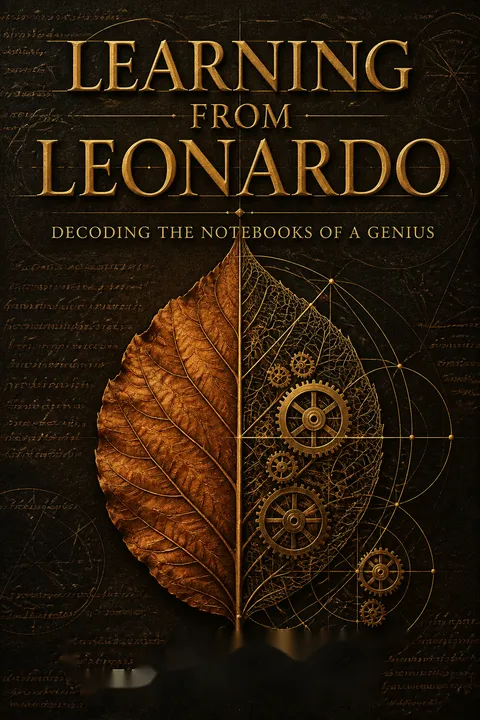
Readers generally praise Learning from Leonardo as a fascinating exploration of da Vinci's genius, particularly his systemic thinking and scientific insights. Many appreciate Capra's thorough analysis of Leonardo's notebooks and the book's detailed illustrations. Some find the content technical but enlightening, while others criticize Capra's speculative approach or political commentary. Overall, reviewers commend the book for deepening their understanding and admiration of Leonardo, though opinions vary on its accessibility and depth.
Glossary
systemic thinking
Seeing patterns and relationshipsA way of understanding phenomena by examining their relationships, organization, and context, rather than only identifying their separate components. Capra uses the term to describe Leonardo’s habit of linking patterns across fields, such as branching in rivers, plants, and blood vessels. Similar patterns can guide inquiry, but they do not prove that the systems share the same mechanisms.
geometry done with motion
Geometry of transformationsLeonardo’s proposed approach to describing forms that change shape while retaining quantities such as volume. He explored how geometric figures could be transformed through movement, especially in connection with flowing water. Capra identifies it as an early precursor to topological thinking, while emphasizing that Leonardo’s method did not become a developed mathematical theory.
vital sap
Plant-nourishing fluidLeonardo’s term for the life-sustaining fluid he believed moved through plant tissues and supplied nourishment. He used its flow to explain growth, branching, and a plant’s response to injury. The concept is not identical to a modern biochemical substance. Capra relates it broadly to nutrients and plant hormones, whose roles were not known to Leonardo.
vital spirits
Life-giving bodily essenceA classical medical concept describing a force that sustains bodily life. Leonardo retained the idea but tried to explain it through natural processes involving blood, air, heat, and the heart. Capra sees a loose resemblance to oxygenated blood, but Leonardo did not identify oxygen or understand modern circulation, so the terms should not be treated as equivalent.
four powers of nature
Motion, weight, force, impactLeonardo’s grouping of motion, weight, force, and percussion as central variables in the study of mechanics. Percussion refers broadly to impact and its effects. His terminology was not as sharply defined as modern physics, and he sometimes used the same word in different senses. The grouping captures his effort to describe how mechanical quantities relate and change.
movements of consumption
Processes that wear forms downCapra’s description of Leonardo’s attention to irreversible processes that gradually alter or wear away forms. Examples include erosion of mountains, the aging of the body, and friction in machines. Leonardo connected such transformations with a qualitative sense of time as a force of change. The phrase links observations across physical, geological, and biological settings.
FAQ
What is Learning from Leonardo: Decoding the Notebooks of a Genius by Fritjof Capra about?
- Comprehensive study of Leonardo’s science: The book explores Leonardo da Vinci’s scientific investigations, including his work in fluid dynamics, geology, botany, mechanics, flight, and anatomy.
- Integration of art and science: Capra highlights how Leonardo’s artistic mastery and scientific curiosity were inseparable, leading to a unique synthesis of knowledge.
- Systemic and holistic approach: The book emphasizes Leonardo’s systemic thinking, viewing nature as a network of interconnected living forms, and decodes his notebooks through the lens of modern science.
- Relevance for today: Capra argues that Leonardo’s approach offers vital lessons for contemporary science, ecology, and design, especially in the context of sustainability.
Why should I read Learning from Leonardo by Fritjof Capra?
- Unveils Leonardo’s scientific genius: The book reveals Leonardo as a pioneering scientist whose discoveries in areas like energy conservation and embryology were centuries ahead of his time.
- Learn systemic thinking: Capra presents Leonardo’s approach as a model for understanding complex systems, which is crucial for addressing today’s ecological and technological challenges.
- Bridges history and modern science: Readers gain a rich historical perspective and see how Leonardo’s ideas connect to and enrich current scientific knowledge.
- Inspiration for modern challenges: Leonardo’s integration of empirical method, intellectual fearlessness, and holistic memory offers valuable lessons for individuals and societies facing systemic issues.
What are the key takeaways from Learning from Leonardo by Fritjof Capra?
- Leonardo as a systemic thinker: He saw nature as a dynamic, interconnected web, focusing on patterns, relationships, and transformations rather than isolated parts.
- Empirical and experimental method: Leonardo pioneered a scientific approach based on observation, repeated experiments, and logical reasoning, predating Galileo and Bacon.
- Integration of disciplines: His work demonstrates the inseparability of art, science, and design, providing a model for interdisciplinary innovation.
- Legacy for sustainability: Leonardo’s respect for nature and systemic worldview anticipate modern ecological and systems science, offering guidance for sustainable living.
What are the most memorable quotes from Learning from Leonardo and what do they mean?
- “Wisdom is the daughter of experience.” This underscores Leonardo’s empirical approach, valuing observation and experimentation as the foundation of knowledge.
- “One who does not respect life does not deserve it.” This quote reflects Leonardo’s deep reverence for all living beings and the ethical basis of his science.
- “The large bird will take its first flight from the back of the great Swan… filling the universe with amazement.” This poetic prophecy reveals Leonardo’s belief in the possibility of human flight, grounded in scientific principles.
- Quotes as guiding principles: These statements encapsulate Leonardo’s philosophy of learning, respect for life, and visionary thinking.
What are the key characteristics of Leonardo’s genius according to Fritjof Capra?
- Relentless curiosity and fearlessness: Leonardo was driven by boundless enthusiasm for discovery and a fearless approach to new fields of knowledge.
- Intense concentration and holistic memory: He had extraordinary patience and the ability to memorize large amounts of information as coherent wholes.
- Empirical method and systemic thinking: Leonardo’s science was based on systematic observation and logical reasoning, always focusing on living forms and their transformations.
- Integration of art and science: His artistic skills and scientific curiosity were inseparable, fueling his quest to understand life’s secrets.
How does Fritjof Capra describe Leonardo da Vinci’s empirical method in Learning from Leonardo?
- Precursor to modern science: Leonardo developed an empirical approach involving systematic observation, repeated experiments, and logical reasoning, predating Galileo and Bacon by a century.
- Testing and revising theories: He rigorously tested accepted concepts with observations, revising or replacing them when contradicted by evidence.
- Use of analogies and models: Leonardo used simplified models and analogies, such as comparing water flow to marching men, to analyze complex phenomena.
- Tentative and evolving mindset: His scientific method was characterized by a willingness to revise theories based on new evidence.
What is systemic thinking in Leonardo’s science as explained by Fritjof Capra?
- Focus on patterns and relationships: Systemic thinking emphasizes the whole and the interconnections between parts, rather than reductionist analysis.
- Living forms and transformations: Leonardo’s science is a science of qualities, portraying nature as dynamic and continually transforming.
- Anticipation of modern systems science: His approach aligns with contemporary ecological and complexity theories, viewing the Earth as a living system.
- Unity of life at all scales: Leonardo saw recurring patterns in both the macrocosm (Earth) and microcosm (human body).
What are Leonardo da Vinci’s major scientific discoveries discussed in Learning from Leonardo?
- Conservation of energy and Bernoulli’s theorem: Leonardo intuited the conservation of energy in flowing water and described experiments anticipating Bernoulli’s theorem.
- Mechanics and motion: He studied friction, center of gravity, falling bodies, pendulum motion, and ballistic trajectories, often formulating principles ahead of Galileo and Newton.
- Anatomy and physiology: Leonardo’s anatomical drawings revealed the heart’s chambers, coronary vessels, and blood flow, including insights into arteriosclerosis and embryology.
- Flight and aerodynamics: He recognized air’s compressibility, the relativity of motion, and pressure distribution around wings, laying foundations for the science of flight.
How does Fritjof Capra explain Leonardo’s studies on the movements of water in Learning from Leonardo?
- Water as life’s matrix: Leonardo saw water as essential to all living bodies, nourishing and sustaining life, and symbolically linked it to spiritual rebirth.
- Pioneering fluid dynamics: He studied water’s flow, turbulence, vortices, and waves with remarkable accuracy, inventing experimental methods like flow visualization.
- Water cycle and analogies: Leonardo initially equated the water cycle to blood circulation but eventually recognized their differences, demonstrating his empirical and systemic approach.
- Anticipation of modern science: His work on water anticipated many principles of modern fluid dynamics.
What geological insights of Leonardo da Vinci are highlighted in Learning from Leonardo by Fritjof Capra?
- Living Earth concept: Leonardo viewed the Earth as a living body with bones (rocks), flesh (soil), and blood (water veins), foreshadowing Gaia theory.
- Accurate geological observations: He made detailed maps, studied erosion, sedimentation, and rock strata, and recognized geological time scales before modern geology.
- Tectonic theory: Leonardo proposed a dynamic Earth model with land masses floating in water, anticipating aspects of plate tectonics and isostasy.
- Systemic view of geology: His approach connected geological processes to broader patterns in nature.
How does Learning from Leonardo portray Leonardo’s anatomical research and view of the human body?
- Integrated study of form and function: Leonardo combined detailed anatomical dissections with studies of mechanics to understand the body’s movements.
- Human body as a living organism: He saw the body as animated by the soul, integrating voluntary and involuntary movements.
- Proportions and harmony: Leonardo studied ideal human proportions, famously illustrated in the Vitruvian Man, emphasizing harmony and transformation.
- Comparative anatomy and embryology: He compared human anatomy with animals and made early observations on fetal development.
What is the legacy of Leonardo da Vinci for modern science and society according to Fritjof Capra in Learning from Leonardo?
- Pioneer of interdisciplinary science: Leonardo’s integration of art, science, and design exemplifies systemic thinking essential for solving complex global problems.
- Model for sustainable innovation: His respect for nature and use of natural principles as design models inspire contemporary ecological literacy and ecodesign movements.
- Enduring inspiration: Leonardo’s work encourages a holistic worldview that honors the unity and interdependence of life.
- Guidance for the future: Capra urges us to build sustainable communities aligned with nature’s wisdom, drawing on Leonardo’s systemic approach.
About the Author
Other books by Fritjof Capra
Download PDF
Download EPUB
.epub digital book format is ideal for reading ebooks on phones, tablets, and e-readers.








