

Key Takeaways
Stop treating the skin as a border around a self-contained you

The central reversal. Watts argues that the familiar sense of a separate ego, sealed inside the body and facing an alien universe, is a misleading picture of what a person is. People do not arrive from outside nature, he says. They grow from it, as leaves grow from trees. Breathing, eating, and sensing depend on a world that is not merely around the body but involved in making it possible.
A dangerous illusion. When people feel separate from nature, they may treat it as something to conquer. Watts connects this attitude to technology used without regard for the environment that sustains life. His Vedanta-inspired answer is that the deepest self is not the isolated ego, but the larger process of nature expressing itself as an individual.
What's striking is how this reframing shifts the question from whether people are independent to where their dependence begins and ends. Contemporary systems thinking makes a similar move: a body is sustained by exchanges with its surroundings, not by a sealed interior. That insight can support ecological responsibility without requiring belief in a universal divine Self. The distinction matters because physical interdependence is observable, while the claim that the universe is literally one's deepest identity is a philosophical interpretation, not a scientific conclusion.
Notice how opposites make each other possible before choosing sides

Attention edits reality. Watts calls the interdependence of contrasts the Game of Black-and-White. Light needs darkness as a contrast, and a musical phrase depends on intervals between notes. Yet conscious attention tends to spotlight what is present and overlook the spaces or absences that make it intelligible. The result is a habit of treating paired features as separate forces locked in battle.
A narrow view misleads. Imagine seeing a cat pass through a slit in a fence. The head appears first and the tail later, making it tempting to mistake sequence for cause. Seeing the whole animal corrects the error: head and tail belong to one living pattern. Watts applies the same caution to cause and effect, and to other divisions that may be products of selective attention rather than independent realities.
This account connects naturally with Gestalt psychology, which studies how perception organizes a figure against a background. A foreground object is never experienced in isolation; its meaning depends partly on what surrounds it. That is a useful check on political and personal arguments that turn contrasts into absolute enemies. Still, recognizing interdependence does not make every opposition symmetrical. A person harmed by another may need protection and accountability, even when both remain part of a shared social world.
Catch the impossible commands that manufacture a guilty ego

A self taught in contradiction. Watts argues that the separate ego is reinforced by social expectations. A child is told to be independent while being shaped by other people, to behave naturally on command, and to love family members because love is required. Such contradictory demands create what he calls a double-bind: a situation in which every available response can be judged wrong.
The rules stay hidden. The child is praised for being an individual, then criticized for acting unlike the group. Adults may repeat the same confusion, demanding sincerity while pressuring others to perform approved feelings. Watts says these pressures help create the impression of an isolated inner manager responsible for every choice. The problem is not simply individual weakness. The social rules themselves can make spontaneity feel like another obligation.
The double-bind helps explain why commands such as “just relax” can make relaxation harder: monitoring whether the command is being obeyed adds another layer of pressure. Family systems theory also uses the term for contradictory communication that can trap people in no-win interactions. The concept is most useful when it identifies a pattern, not when it becomes a universal excuse. Social pressures shape action, but naming them does not remove the need to consider how particular choices affect other people.
Treat every organism as inseparable from its living environment
Behavior belongs to a field. Watts uses organism/environment to describe a living being together with the conditions and relationships that make its activity possible. An ant cannot be fully understood by watching its legs alone. Food, temperature, other ants, predators, and the ground all matter. As the description grows more complete, the supposed subject expands from one ant to a network of interactions.
The boundary is useful, not absolute. A rainbow depends on sunlight, moisture, and an observer in a particular position. Watts uses this example to show that what appears as a distinct thing can arise through relationships. He does not say that people can control the whole field. Rather, he challenges the assumption that an organism is a self-sufficient unit acting upon a wholly separate world.
This is the book's most practical bridge between metaphysics and science. Ecology studies relations among organisms and their surroundings, while embodied approaches to cognition emphasize that perception and action depend on a body situated in an environment. Both make isolated explanations look incomplete. The rainbow example, however, needs careful handling: dependence on an observer for a perceived phenomenon does not establish that the observer creates the entire physical world. Relational explanation is powerful without settling every question about reality.
Meet death as life's partner, not its foreign enemy
Finitude is part of the rhythm. Watts places life and death among the paired contrasts people try to divide. His point is not that death feels harmless, but that imagining it as an absolute intruder can intensify fear and make life a permanent campaign against its own limits. He compares death's place in life to the role of darkness in a rhythm: an interval, not simply an opposing substance.
Let fear be seen. Watts questions the cultural images that shape expectations of dying, including the idea that a good death must be denied or hidden. He favors honest companionship over false reassurance. He also describes facing fear rather than pretending it is absent. This is not a promise about personal survival after death, nor a reason to neglect medical care. It is an invitation to consider mortality without turning it into a forbidden subject.
The argument aligns with a broader distinction between accepting mortality and welcoming suffering. Acceptance can make room for honest conversations, practical preparation, and presence with someone who is dying; it does not require abandoning treatment or minimizing grief. Watts's emphasis on cultural conditioning is also useful, since expectations affect how people interpret bodily change and vulnerability. His more sweeping suggestion that death can awaken a cosmic identity remains a spiritual reading, not a conclusion that follows from the fact of mortality.
Stop trying to win your way out of the ego trap
Self-improvement can preserve the self. Watts warns that trying to become completely unselfish or spiritually enlightened can reinforce the very ego one hopes to escape. The effort can turn into a new contest: the person who is most detached, most humble, or most advanced still has a status to defend. Even the wish to get rid of the self may quietly assume a separate self capable of performing the escape.
Let experience be experience. Watts suggests noticing the feeling of separateness without treating it as a defect that must be forcibly removed. He does not reject meditation or other disciplines outright. He questions using them as tools for acquiring spiritual rank or a guaranteed result. In his account, insight comes less from conquering the ego than from recognizing that the supposed conqueror is part of the same experience.
This is a sharp critique of turning inner life into a performance review. In modern terms, constant monitoring can make a person more preoccupied with the identity being monitored, even when the goal is self-transcendence. That does not make deliberate practice pointless; habits of attention can still be valuable for many reasons. The useful distinction is between practicing for its direct experience and demanding that practice certify a superior self.
Do not postpone being alive until your life becomes useful
A future-only life stays unfinished. Watts criticizes the habit of treating school, work, and even retirement as steps toward a later moment when life can finally be enjoyed. The goal keeps moving, so arrival never lasts. He contrasts this with activities such as listening to music, which need not justify themselves by producing money, status, or improved productivity.
Play is not mere frivolity. Watts distinguishes serious play, like performing music, from trivial or insincere behavior. Work, too, can become absorbing when its value lies partly in doing it well, not only in the reward at the end. His point is not to abandon practical responsibilities. It is that a life organized solely around future outcomes can miss the experience that makes those outcomes worth pursuing.
The distinction between activity and instrument matters in a culture that often measures leisure by whether it restores someone for work. Intrinsic motivation offers a useful parallel: an activity can be worthwhile because engagement itself is rewarding, not because it produces a separate prize. Yet not everyone has equal freedom to choose work or leisure, and necessity cannot simply be wished away. Watts's challenge is best read as a question about what can be made meaningful within real constraints, not as a denial of them.
Honor opponents as necessary participants, not evil to erase
Conflict can be contained. Watts argues that identities often rely on contrast: groups define themselves against outsiders, and winners depend on someone losing. He extends this idea to nature, where species compete and also participate in wider systems. Trying to remove every rival or source of disorder can damage the relationships that keep a larger system functioning.
Recognition is not surrender. Watts does not call for abandoning causes such as civil rights, peace, or conservation. He argues that pursuing them with absolute moral certainty can turn opponents into objects to eliminate, intensifying the conflict. A more humane approach recognizes that opposition is part of the situation and seeks limits, compromise, and workable coexistence. Acknowledging dependence on an opponent is not the same as approving that opponent's conduct.
This insight resembles conflict-resolution approaches that separate firm limits from dehumanization. Respecting an opponent's humanity can preserve the possibility of negotiation, while clear boundaries protect people from harm. The ecological analogy also encourages caution about interventions whose effects spread through connected systems. But interdependence alone cannot tell a society which conflicts are just or how power should be distributed. That requires ethical judgment alongside the recognition that no party exists in a vacuum.
If the Self is cosmic, nobody gets to be spiritually superior
The deepest self cannot become an object. Watts calls the underlying reality IT: a name for what cannot be fully captured by ordinary descriptions because every description sets one thing apart from another. His Vedanta-inspired image is not of a separate ruler outside the universe, but of a single reality appearing as many forms, including each person. The claim is meant as a change in felt identity, not a boast by the everyday ego.
Images point, they do not prove. Watts uses myth and analogy to make this difficult idea approachable, while warning against confusing a metaphor with a literal account. His story of a divine reality hiding in its many forms is one such image. If taken seriously, it includes other people and the rest of nature, not just the speaker. Claiming cosmic unity as a personal achievement would recreate the separation the idea challenges.
The book's best safeguard against spiritual grandiosity is built into its central claim: if the deepest identity belongs equally to all forms, it cannot confer private rank. The use of myth also resembles the way models work in science: an image can reveal a relationship without being a literal picture of reality. That analogy has limits, because a scientific model can be tested against observations, while metaphysical experience is harder to verify. Readers can still use the idea as a lens without treating it as established fact.
Analysis
Watts builds a persuasive arc from a familiar sensation to a radical alternative. The apparent inner observer feels separate from the body, the body from its surroundings, and the individual from the universe. He then shows how attention, language, and social expectations reinforce those divisions. His recurring examples, from musical intervals to the cat glimpsed through a fence, make an abstract argument memorable: selective perception can make a connected process look like a collection of independent things.
The book is strongest when it challenges the assumption that individuals can be understood apart from their relationships. Its ecological emphasis anticipates ways of thinking in which organisms, environments, and behavior form interdependent systems. It is also psychologically astute about self-defeating demands. A person commanded to be spontaneous or unselfish may become more self-conscious, not less.
A distinction is essential, however. Interdependence does not prove that the universe is literally one Self, or that an individual's consciousness is cosmic in scope. Watts sometimes moves from relational observations to Vedanta metaphysics with more confidence than the evidence requires. Quantum physics, sensory perception, and ecology can complicate the picture of isolated objects without confirming his spiritual interpretation. The strongest reading therefore treats the cosmic Self as a proposed way of experiencing identity, not as a scientific result.
There is a second risk: the language of universal unity can be used to soften real harms or excuse passivity. Watts's own argument resists that move by emphasizing compassion, contained conflict, and the need to honor opponents without endorsing their actions. His most durable contribution is not a proof that every person is the universe in disguise. It is a challenge to live as though separation were complete, nature were an enemy, and usefulness were the only measure of value. That challenge remains meaningful even for readers who decline the metaphysical conclusion.
Review Summary
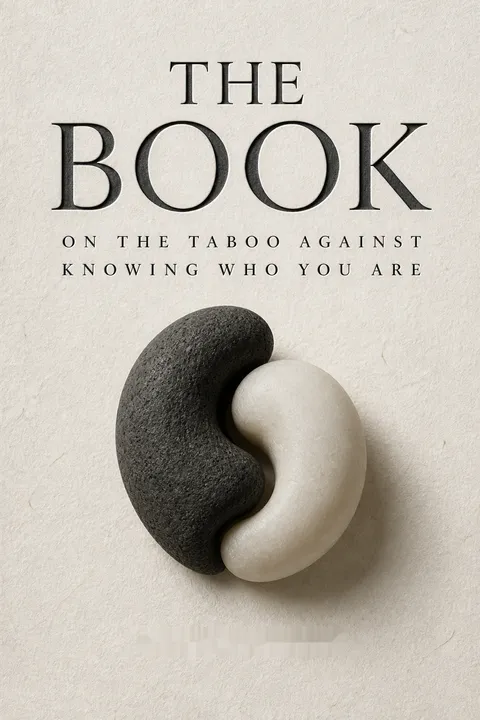
The Book by Alan Watts explores Eastern philosophy and its relevance to Western thought. Many readers found it life-changing, praising Watts' ability to explain complex concepts in an accessible way. The book challenges the notion of a separate ego and emphasizes interconnectedness. Some critics found it shallow or dated, while others appreciated its profound insights. Readers noted its potential for expanding consciousness and providing a new perspective on reality. The book's style is conversational and often humorous, making it engaging for many readers.
People Also Read


Glossary
Game of Black-and-White
Interdependent oppositesWatts's name for the way contrasting poles depend on each other: light and darkness, sound and silence, or life and death. The game becomes a fight when one side is treated as wholly separate and required to defeat the other. Seeing the relationship does not erase differences; it changes how those differences are understood.
double-bind
Contradictory social demandA situation in which a person receives instructions or expectations that conflict, leaving no response that can satisfy them all. Watts's examples include being told to act freely while being pressured to conform, or being ordered to feel affection spontaneously. He uses the concept to explain how social life can foster guilt and a confused sense of personal agency.
Fully Automatic Model
Mechanistic universe pictureWatts's label for a view of the universe as a machine operating without intelligence or purpose, with human consciousness arising as an accidental by-product. He argues that this picture can make people feel alienated from nature and encourage them to treat it as an unintelligent mechanism to control. He presents it as a cultural model, not a neutral description.
correlative vision
Seeing paired relationsA way of understanding apparent opposites as related aspects of one process rather than independent realities. Watts applies it to such pairs as organism and environment, self and other, or energy and relative stillness. It does not mean that differences disappear. It means that each side is intelligible through its relation to the other.
organism/environment
Living being and surroundingsWatts's paired term for an organism considered together with the physical, biological, and social conditions of its life. A behavior such as walking cannot be fully described by body movements alone; ground, food, temperature, and other organisms may also matter. The term directs attention away from isolated causes and toward interacting relationships.
lila
World as divine playA Vedanta term Watts uses for the universe understood as the creative play of the Self. The image presents existence not as a task that must achieve an outside purpose, but as an unfolding display of forms and experiences. Watts uses it to connect the idea of cosmic unity with play, while treating the idea as a spiritual image rather than a scientific account.
maya
Creative appearance and illusionA Vedanta term Watts associates with the world's appearance as a multitude of separate forms. He describes it as more than simple falsehood: it also carries associations of creative power, art, measurement, and play. The term points to the possibility that familiar divisions are useful ways of perceiving reality without being its ultimate, independent structure.
IT
Unobjectifiable underlying realityWatts's deliberately spare name for the reality he considers prior to divisions between self and other, subject and object, or organism and environment. It cannot be described as an ordinary object because every description distinguishes it from something else. Watts treats the term as a pointer to an experience of identity with the whole, not a claim that the everyday ego is all-powerful.
FAQ
What's "The Book: On the Taboo Against Knowing Who You Are" about?
- Exploration of Self-Identity: The book delves into the concept of self-identity and the illusion of the separate ego, suggesting that our perception of being distinct from the universe is a hallucination.
- Integration of Eastern and Western Thought: Alan Watts combines insights from Western science and Eastern philosophies, particularly Vedanta, to challenge the conventional understanding of self.
- Critique of Modern Society: It critiques how modern society's emphasis on individuality and separation leads to a sense of alienation and misuse of technology.
- Philosophical Inquiry: The book is a philosophical inquiry into the nature of existence, encouraging readers to question their assumptions about who they are.
Why should I read "The Book: On the Taboo Against Knowing Who You Are"?
- Challenge Your Perceptions: It offers a profound challenge to the conventional perceptions of self and identity, encouraging deeper introspection.
- Blend of Philosophies: The book provides a unique blend of Eastern and Western philosophies, offering a holistic view of human existence.
- Relevance to Modern Life: It addresses contemporary issues of alienation and environmental destruction, making it relevant to today's societal challenges.
- Insightful and Thought-Provoking: Alan Watts' writing is both insightful and thought-provoking, making complex ideas accessible and engaging.
What are the key takeaways of "The Book: On the Taboo Against Knowing Who You Are"?
- Illusion of the Separate Ego: The idea that the self is a separate entity is a cultural illusion, not aligned with the reality of interconnectedness.
- Unity with the Universe: True self-awareness involves recognizing one's unity with the universe, rather than seeing oneself as isolated.
- Misuse of Technology: The book critiques how the illusion of separateness leads to the misuse of technology and environmental harm.
- Philosophical and Practical Implications: Understanding the interconnectedness of all things has both philosophical and practical implications for how we live our lives.
How does Alan Watts integrate Eastern and Western philosophies in the book?
- Vedanta Philosophy: Watts draws heavily on Vedanta, a central philosophy of Hinduism, to illustrate the interconnectedness of all things.
- Western Scientific Insights: He contrasts this with Western scientific perspectives, showing how both can lead to a deeper understanding of self.
- Modern and Accessible Style: The book presents these philosophies in a modern, Western style, making them accessible to a broad audience.
- Cross-Fertilization of Ideas: Watts uses a cross-fertilization approach, blending insights from different traditions to challenge conventional thinking.
What is the "taboo" that Alan Watts refers to in the book?
- Ignoring True Self: The taboo is the societal conspiracy to ignore or deny our true nature as interconnected with the universe.
- Cultural Conditioning: Society conditions individuals to perceive themselves as separate egos, which Watts argues is a fundamental misunderstanding.
- Consequences of the Taboo: This taboo leads to feelings of alienation and contributes to the destructive use of technology.
- Breaking the Taboo: Recognizing and breaking this taboo is essential for achieving a sense of unity and peace with the world.
How does Alan Watts describe the illusion of the separate ego?
- Ego as a Hoax: Watts describes the ego as a hoax, a false sense of self that is culturally constructed and not reflective of reality.
- Perception of Separation: The perception of being a separate entity enclosed in a "bag of skin" is a hallucination.
- Impact on Behavior: This illusion affects how we interact with the world, often leading to conflict and environmental harm.
- Path to Realization: Realizing the interconnectedness of all things can dissolve the illusion of the separate ego.
What role does technology play in the themes of the book?
- Misuse of Technology: Watts argues that the illusion of separateness leads to the misuse of technology for domination rather than cooperation.
- Environmental Destruction: This misuse contributes to the eventual destruction of the natural environment.
- Need for Harmony: He advocates for a harmonious relationship with technology, recognizing our interdependence with the environment.
- Technological Success and Failure: The book suggests that technological success without understanding our true nature is ultimately a failure.
What are some of the best quotes from "The Book: On the Taboo Against Knowing Who You Are" and what do they mean?
- "The prevalent sensation of oneself as a separate ego enclosed in a bag of skin is a hallucination." This quote encapsulates the central theme of the book, challenging the reader to reconsider their perception of self.
- "We do not 'come into' this world; we come out of it, as leaves from a tree." This metaphor illustrates the idea of interconnectedness, suggesting that we are not separate from the universe but an expression of it.
- "The hostile attitude of conquering nature ignores the basic interdependence of all things." Watts critiques the modern approach to technology and nature, advocating for a more cooperative relationship.
- "You’re IT." This simple statement emphasizes the realization that the self is not separate from the universe but is the universe experiencing itself.
How does Alan Watts address the concept of death in the book?
- Death as a Natural Process: Watts presents death as a natural and necessary part of life, not something to be feared.
- Illusion of Finality: The book challenges the notion of death as a final end, suggesting it is part of the ongoing process of life.
- Opportunity for Awakening: Death is seen as an opportunity for awakening to the true nature of self and existence.
- Cultural Attitudes: Watts critiques cultural attitudes towards death, advocating for a more accepting and understanding approach.
What is the significance of the "Game of Black-and-White" in the book?
- Understanding Opposites: The "Game of Black-and-White" is a metaphor for understanding the interdependence of opposites, such as life and death.
- Beyond Duality: It encourages moving beyond dualistic thinking to see the unity in apparent contradictions.
- Life as a Game: Watts suggests that life should be approached as a game, with an understanding of the balance between opposites.
- Philosophical Insight: This concept provides philosophical insight into the nature of existence and the illusion of separateness.
How does the book suggest we overcome the illusion of separateness?
- Awareness and Understanding: Overcoming the illusion involves becoming aware of the interconnectedness of all things and understanding the ego as a construct.
- Living in the Present: The book advocates for living fully in the present moment, rather than being caught up in past or future concerns.
- Embracing Unity: Embracing the unity of self and universe can lead to a more harmonious and fulfilling life.
- Practical Implications: This realization has practical implications for how we interact with others and the environment.
What practical advice does Alan Watts offer for achieving a sense of unity with the universe?
- Meditation and Contemplation: Engaging in meditation and contemplation can help dissolve the illusion of the separate ego.
- Mindfulness Practices: Practicing mindfulness and being present in the moment are key to experiencing unity with the universe.
- Letting Go of Control: Letting go of the need to control and dominate can lead to a more harmonious existence.
- Living Authentically: Living authentically and embracing one's true nature as part of the universe is essential for achieving a sense of unity.
About the Author
Other books by Alan W. Watts

Download PDF
Download EPUB
.epub digital book format is ideal for reading ebooks on phones, tablets, and e-readers.








