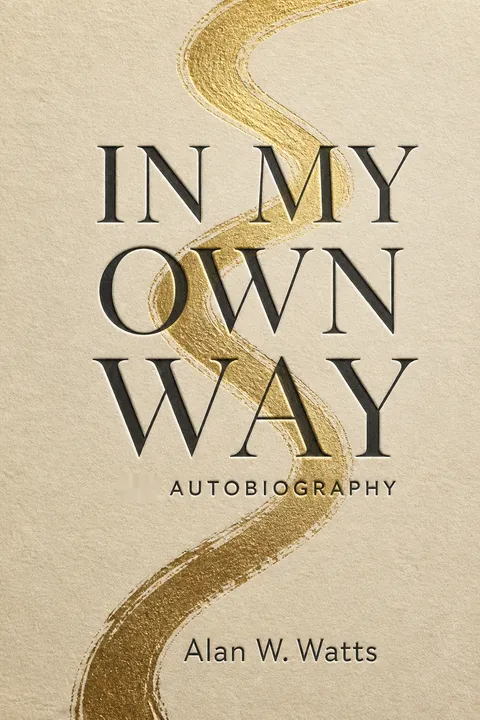


Key Takeaways
Make your own way by holding opposites together
A life of contradictions. Watts presents himself as mystic and sensualist, ordained priest and religious skeptic, showman and critic of the ego. The title captures this double meaning: following one’s natural character can fulfill a person, while that same character can also obstruct them. His childhood garden, alive with birds, flowers, and untended growth, becomes an early model of a world too rich to fit the tidy divisions imposed by school or doctrine.
A self made with others. Watts refuses to tell his life as a simple climb toward success. He describes himself through the people who shaped him, from his parents and teachers to friends and spiritual interlocutors. The result is not a polished defense of eccentricity, but a portrait of a person learning to live without resolving every tension into a single identity.
What's striking is that Watts treats contradiction as a condition to inhabit, not a puzzle to solve. That resembles dialectical approaches in philosophy, where apparently opposed ideas can expose the limits of each other. It also offers a useful check on personal branding: people are rarely as consistent as their public roles suggest. Still, celebrating contradiction can become an excuse to avoid accountability. The useful question is not whether a person contains opposites, but whether they can acknowledge the consequences of acting from each side.
Stop postponing life for a future version of yourself
Now is where life happens. Watts argues that the past reaches us as memory and the future as anticipation, both present experiences. He arranges his autobiography around this idea, circling through memory rather than marching from birth to old age. This is not a claim that history or planning is useless. It is a warning that imagined futures can become a screen between a person and the life already occurring.
A simple conversation changes the view. Walking home with his first wife, Eleanor, Watts is discussing how to concentrate on the present when she points out that thoughts about the past and future are also happening now. The exchange loosens his belief that awareness requires special effort. For him, the present is not a tiny instant to seize, but the living field in which memory, expectation, and sensation appear.
The distinction between experiencing the present and planning for the future matters. Attention research and mindfulness practices often train people to notice thoughts without automatically following them, a skill that can reduce rumination without requiring anyone to abandon goals. Watts’s insight is strongest as a correction to compulsive deferral, not as a complete theory of time. Memory preserves lessons, and anticipation supports coordination. The practical test is whether planning serves present action or replaces it with an endless rehearsal of a life that has not begun.
Use words as maps, never mistake them for reality
Descriptions divide what life joins. Watts doubts that language can capture experience without changing it. Grammar encourages people to imagine a solid self that owns thoughts and sensations, as if every action required a separate inner actor. He sees the ego less as a permanent object than as a social and linguistic construction. This does not mean that a person is unreal; it means that the familiar picture of a self sealed off from the world is incomplete.
Attend before interpreting. In sensory-awareness exercises, people listen to sounds or notice movement without immediately naming, judging, or explaining them. Watts argues that this reveals experience as a continuous interaction between organism and surroundings. The distinction between inner and outer remains useful for ordinary tasks, but it is not proof that the two exist independently.
This section anticipates a central concern in embodied cognition: perception is not simply a detached mind receiving a finished world, but an activity shaped by the body and its surroundings. Watts is right that categories can make fluid processes look like isolated objects. Yet language is not merely a trap. Shared labels let people communicate, remember, and coordinate, and scientific distinctions can reveal patterns that unaided sensation misses. The balance is to use concepts as working tools while staying alert to what they leave out.
Build an education around curiosity, mentors, and lived practice
School was not his university. Watts remembers British schooling as a regimen of rote lessons, corporal punishment, military drills, and sports he disliked. Teachers who made learning feel punitive, including one who struck his fingers during piano lessons, nearly turned subjects he loved into chores. He did not reject learning itself. He rejected the assumption that memorizing facts and following a prescribed path amounted to education.
A self-made curriculum. After leaving school without a university degree, Watts learned through books, discussion, and close contact with mentors. Christmas Humphreys guided his Buddhist studies; bookseller Nigel Watkins helped him choose what to read; other teachers brought psychology, music, and comparative religion into the mix. His father supported this independent path. The education was irregular, but it joined intellectual study to conversation, observation, and practice.
Watts’s account distinguishes learning from credentialing, a distinction still relevant wherever institutions reward measurable performance more readily than curiosity. Mentorship also supplies what a syllabus cannot: a model of how to ask questions and follow an interest across fields. But his freedom depended on unusual support, including a family willing to help and access to books and knowledgeable adults. Self-directed learning is not equally available to everyone. A fair educational ideal preserves structure and access without confusing compliance with understanding.
Let traditions be instruments, not authorities to obey
Belonging without exclusive allegiance. Watts grew up amid Anglican services and fears of sin, then declared himself a Buddhist as a teenager. He later became an Episcopal priest, drawn to the beauty of ritual, and left the Church when its institutional demands no longer fit what he believed. He did not see this as a simple conversion from one faith to another. He treated traditions as different ways people approach experience, each offering images, practices, and insights.
Ritual can be enjoyed for itself. At Northwestern University, Watts created a richly musical church service, with chant, polyphony, and carefully staged ceremony. He valued its beauty, not as a technique for earning salvation or proving superiority, but as an absorbing human practice. His refusal to claim one tradition as the sole path did not require dismissing all of them.
Watts models religious pluralism as active engagement rather than a vague claim that all beliefs are interchangeable. Ritual can shape attention, community, and emotion even when participants disagree about its truth claims. That distinction helps explain why music or ceremony may matter beyond doctrinal agreement. The limitation is that traditions carry histories and ethical commitments that cannot always be blended without loss. Respectful comparison requires learning what a practice means to its community, not merely selecting the parts that suit an individual seeker.
Give the body and senses equal standing with intellect
The garden taught before the classroom. In Chislehurst, Watts delighted in vegetables, insects, birdsong, and overgrown patches of land. These encounters made the living world feel complete without needing a theory to justify it. He later criticizes schooling and work cultures that train calculation while neglecting cooking, gardening, movement, craft, and the ordinary skills of inhabiting a body.
Attention can be physical. Watts finds contemplative practice in activities such as walking, calligraphy, tea preparation, chanting, dancing, and listening. Their value is not that they produce a supernatural result, but that they involve the person directly in what is happening. This approach links spiritual inquiry to sensory life rather than treating the body as a distraction from it.
The argument resonates with embodied learning, in which understanding develops through action and perception as well as abstract explanation. Cooking teaches timing and transformation; gardening makes interdependence tangible; music organizes attention through the body. These practices can make ideas memorable because they are lived, not merely defined. Watts’s contrast between sensory life and intellectual culture can be overstated, however. Careful analysis also helps people understand ecosystems and improve health. The stronger case is for joining analysis to experience, rather than choosing one as the enemy of the other.
Accept your actual temperament before promising to improve it
A role can become a trap. Watts describes entering marriage and ministry with expectations that he could become the person others wanted him to be. His marriages ended, and he came to see that promises of self-reform can create expectations neither partner can sustain. He also resists the idea that a spiritual teacher must appear morally flawless. His own appetite for food, drink, sex, performance, and conversation sits awkwardly beside his mystical claims, and he does not hide the mismatch.
Acceptance is not a free pass. Watts argues that knowing one’s tendencies is more honest than pretending they have disappeared. He presents himself as a fallible person rather than a finished exemplar. His account of sexual freedom and marriage reflects his own convictions, not a universal rule for relationships. He stresses consent and mutual honesty, while acknowledging that his choices caused pain and conflict.
The distinction between self-acceptance and self-justification is essential. A realistic account of temperament can help people make commitments they can honor, instead of pledging an idealized future self. Contemporary psychology likewise distinguishes acceptance of internal experience from approval of every action. Watts’s candor is valuable, but his personal conclusions about marriage and sexual exclusivity should not be mistaken for evidence that his arrangement suits everyone. Honesty becomes ethically meaningful when it includes attention to other people’s needs, boundaries, and consequences.
Treat altered states as catalysts, not substitutes for judgment
Experience can open a question. In the 1950s and 1960s, Watts took part in supervised experiments with LSD and other psychedelics. He describes the experience as making opposites appear interdependent, including self and world, motion and rest, and light and dark. He called this way of seeing polar vision. For him, the drug did not deliver a final doctrine; its effects needed to be considered alongside prior knowledge and ordinary sober judgment.
A catalyst can also destabilize. Watts warns that intense experiences may produce panic or inflated certainty, especially without preparation or support. He opposed legal repression that drove use underground and obstructed research, while also worrying about uncontrolled substances and unsafe settings. His practical distinction is between a catalyst that opens inquiry and a substance treated as a way of life.
Watts’s distinction between a powerful experience and a reliable conclusion is useful far beyond psychedelics. Novel states can loosen familiar assumptions, but intensity alone does not establish truth. Psychology and medicine increasingly emphasize context, expectations, support, and individual vulnerability when evaluating such experiences. His criticism of blanket prohibition also identifies a genuine policy tradeoff: criminalization can increase risks while limiting research. Still, his own positive interpretations should not be generalized into safety claims. Careful evidence and harm reduction matter precisely because transformative experiences can be unpredictable.
Listen to experience before demanding that it explain itself
Rain needs no translation. In Kyoto, Watts visits a Zen teacher who asks students to approach even an ordinary book as a chance to understand Zen. The teacher’s point is that explanation is not the same as direct attention. Later, during a formal lecture at a monastery, rain pounds the roof so loudly that it drowns out the speaker. The lecture continues, but Watts hears the rain as the event that matters.
The ordinary can be complete. Listening without rushing to label or interpret does not make thought useless. It lets experience arrive before commentary claims to have captured it. Watts links the sound of rain to his wider argument: reality is not a message hidden behind appearances, waiting for a clever theory to decode it. Sometimes the task is simply to notice what is happening.
This ending gives the book’s abstract argument a concrete test: can attention rest with a sound before turning it into a symbol? Research on mindfulness similarly treats nonjudgmental attention as a trainable way to notice experience, not as a demand to stop thinking forever. The rain story also shows that meaning can arise through participation rather than explanation. Still, interpretation has its place, especially when people must communicate or act together. Direct attention is a beginning for understanding, not a replacement for it.
Analysis
The autobiography’s governing claim is not that eccentricity is inherently wise, but that a life becomes distorted when it is forced into inherited categories. Watts’s story moves from a nature-filled childhood, through religious rebellion and self-directed study, into priesthood, institutional departure, and a California network of artists, therapists, and spiritual experimenters. Each stage tests the same question: can the person experience life directly, or must experience be authorized by doctrine, school, profession, or social respectability?
The form enacts the argument. Watts resists straight chronology because he sees memory as something reconstructed in the present. He makes the self relational by filling the narrative with teachers, spouses, friends, and places. The garden, the church service, the Japanese tea ceremony, and the sound of rain are not decorative interludes. They are demonstrations of his philosophical method: attention to particular experience can expose assumptions that abstract debate conceals.
The book’s sharpest contribution is its account of how the ego is sustained by language, social roles, and effortful self-management. Its most productive tension is that Watts writes with conspicuous personality while arguing that the separate ego is not a fixed entity. The tension is not simply hypocrisy. A person can use a public voice while questioning the belief that the voice belongs to an independent, permanent self. Yet the argument risks becoming too permissive when acceptance is used to weaken obligations or when institutional critique slides into contempt for ordinary work and education.
Watts is also a historically situated interpreter of Asian traditions, not a neutral representative of them. His synthesis opened doors for Western readers, but his preference for direct experience sometimes compresses the differences among Buddhist, Taoist, Hindu, and Christian traditions. Read generously, the autobiography is an invitation to test inherited ideas against lived experience. Read critically, it asks readers to distinguish liberation from self-exemption. Its lasting value lies in keeping both questions alive.
Review Summary
In My Own Way is a captivating autobiography that offers insight into Alan Watts' life, philosophy, and spiritual journey. Readers appreciate Watts' wit, honesty, and ability to blend Eastern and Western thought. The book provides a unique perspective on counterculture, religion, and personal growth. While some find it self-indulgent or dated, many praise Watts' writing style and his exploration of consciousness, spirituality, and human nature. The autobiography is seen as a valuable reflection of Watts' ideas and experiences, offering both wisdom and entertainment.
People Also Read






Glossary
goeswithness
inseparable mutual relationWatts’s term for the way apparently separate aspects depend on and imply one another. Front and back, self and other, or a flower and its environment are distinguishable in thought, but not fully independent in lived reality. The concept challenges the idea that the world is fundamentally made of isolated objects.
eternal now
present experience as realityWatts’s name for the present as the only place in which experience occurs. Memories of the past and ideas about the future are themselves present events. The term does not require abandoning memory or planning; it challenges the habit of treating an imagined future as more real than current experience.
organism-environment field
organism and surroundings togetherWatts’s way of describing a living being and its surroundings as one interacting process rather than two independent entities. A person’s experience depends on the world they perceive and act within, while that world is encountered through the person’s body and activity. The phrase shifts attention from isolated objects to relationships.
polar vision
opposites as interdependent polesWatts’s description of an experience in which opposites appear as mutually dependent aspects of one process. Examples include self and other, voluntary and involuntary, or solid form and empty space. He associated this perception with psychedelic experience, while warning that it could be destabilizing and did not itself settle ethical questions.
Sensory Awareness
attention to unlabelled experienceA practical approach to noticing bodily sensation, movement, sound, and contact with the environment before interpreting them. Watts discusses work associated with Elsa Gindler, Hilde Elsberg, and Charlotte Selver. It is not primarily exercise or posture training. Its purpose is to help people experience perception and response as connected processes.
double bind
contradictory demands without escapeA communication pattern discussed through Gregory Bateson’s work, in which a person receives conflicting demands and cannot satisfy one without violating another. A familiar form is being ordered to show an emotion spontaneously, such as being told that one must love. Watts connects this structure to religious commands to become unselfish or natural through deliberate effort.
ji-ji-mu-ge
no barrier between eventsA Buddhist phrase Watts uses for the interpenetration of particular things and events. Each event exists through relations with others, rather than as a sealed unit. The term helps explain his view that individual identity and the wider world are distinguishable for practical purposes, yet inseparable in experience.
shaman
independent spiritual practitionerWatts contrasts a shaman with a priest. A priest holds an authorized role within an institution and inherits established forms of practice. A shaman, in Watts’s account, works independently and follows an unconventional path, often drawing authority from direct experience rather than formal appointment. Watts uses the distinction to describe his own uneasy fit with organized religion.
FAQ
What's In My Own Way: An Autobiography about?
- Personal Journey: The autobiography chronicles Alan Watts's life from 1915 to 1965, detailing his philosophical evolution and spiritual journey. It highlights his experiences with Eastern philosophies, particularly Buddhism and Taoism.
- Cultural Reflections: Watts reflects on his upbringing in England, his education, and his move to the United States, where he became a key figure in introducing Eastern thought to Western audiences.
- Philosophical Insights: The book delves into themes such as the integration of spiritual and material life, the nature of self, and the importance of living authentically.
Why should I read In My Own Way: An Autobiography?
- Unique Perspective: Alan Watts offers a distinctive viewpoint on spirituality, blending Eastern and Western philosophies. His engaging writing style makes complex ideas accessible.
- Inspiration and Reflection: The autobiography encourages readers to reflect on their own lives and beliefs, challenging conventional views on religion, identity, and existence.
- Cultural Context: It provides historical context on the mid-20th century's East-West dialogue on spirituality and philosophy, relevant for those interested in cultural studies.
What are the key takeaways of In My Own Way: An Autobiography?
- Integration of Opposites: Watts emphasizes the importance of integrating the spiritual with the material, encouraging readers to find balance in their lives.
- Self-Discovery: The book illustrates the journey of self-discovery, highlighting the importance of understanding one's identity beyond societal labels.
- Living Authentically: Watts advocates for living true to oneself, encouraging readers to embrace their individuality and personal truths.
What are the best quotes from In My Own Way: An Autobiography and what do they mean?
- "The paths are many but their end is one.": This quote emphasizes the universality of spiritual experience, suggesting that various paths lead to the same truth.
- "To be or to get in your own way means all at once to fulfill yourself and to obstruct yourself.": Watts highlights the paradox of self-fulfillment, where personal beliefs can both aid and hinder growth.
- "The sensation called 'self' is unrealizable without the sensation called 'other.'": This underscores the interconnectedness of all beings, suggesting our understanding of self is tied to our relationships.
How does Alan Watts view the concept of self in In My Own Way: An Autobiography?
- Illusion of the Self: Watts discusses the self as an illusion, encouraging readers to look beyond the constructed self to understand their true nature.
- Interconnectedness: He emphasizes that our sense of self is deeply connected to others, challenging the notion of individuality.
- Authenticity: Watts advocates for living authentically, suggesting that embracing one's true self is essential for personal fulfillment.
What role does spirituality play in In My Own Way: An Autobiography?
- Exploration of Eastern Philosophies: Spirituality is central, as Watts explores Buddhism and Taoism as pathways to deeper understanding and personal growth.
- Integration of Spiritual and Material: He emphasizes integrating spiritual insights with everyday life, encouraging readers to find spirituality in daily experiences.
- Personal Spiritual Journey: The autobiography reflects Watts' own spiritual journey, illustrating how his experiences shaped his understanding of existence.
How does In My Own Way: An Autobiography address the concept of ego?
- Ego as Illusion: Watts discusses the ego as a construct that can hinder true understanding, suggesting that a rigid sense of self limits experiences.
- Transcending the Ego: He emphasizes that realizing one's unity with the universe allows for a more profound sense of individuality.
- Ego and Spirituality: Watts argues that intense spirituality often leads individuals to reject militaristic and authoritarian structures, highlighting the conflict between ego-driven ambitions and spiritual growth.
What is Alan Watts' view on education in In My Own Way: An Autobiography?
- Critique of Traditional Education: Watts critiques the traditional education system, describing it as "half-miseducated" and stifling creativity.
- Value of Self-Directed Learning: He emphasizes the importance of self-directed learning and personal exploration over rote memorization.
- Integration of Knowledge: Watts advocates for a holistic approach to education, integrating philosophy, art, and spirituality for a deeper understanding of life.
How does In My Own Way: An Autobiography explore the theme of love?
- Complex Nature of Love: Watts explores love's complexities, emphasizing it as a profound connection beyond romantic or sexual experiences.
- Interconnectedness of Beings: He highlights love as a fundamental aspect of existence, transcending individual identities.
- Love as a Path to Understanding: Watts suggests that love can lead to deeper understanding and awareness, allowing individuals to connect with life's essence.
What is the significance of the title In My Own Way?
- Personal Authenticity: The title reflects Watts' commitment to living life on his own terms, embracing individuality and personal truth.
- Integration of Opposites: It suggests integrating various life aspects—spiritual, material, and personal—into a cohesive whole.
- Philosophical Exploration: The title encapsulates the philosophical exploration throughout the book, encouraging readers to seek their own understanding.
How does Alan Watts describe his family background in In My Own Way: An Autobiography?
- Victorian Influence: Watts describes his family as influenced by Victorian values, shaping his early views on religion and spirituality.
- Supportive Environment: Despite a strict upbringing, he acknowledges the support and encouragement from his parents, fostering his creativity.
- Impact on Philosophy: His family background played a significant role in shaping his philosophical outlook, navigating tensions between traditional beliefs and his emerging understanding.
How does In My Own Way: An Autobiography address the relationship between spirituality and sexuality?
- Sexuality as Natural: Watts views sexuality as a natural part of human existence that should not be repressed.
- Integration of Experiences: He emphasizes integrating sexual and spiritual experiences for a holistic understanding of self and universe.
- Critique of Moralism: Watts critiques moralistic attitudes towards sexuality, believing they create unnecessary guilt and hinder spiritual growth.
About the Author
Other books by Alan W. Watts



Download PDF
Download EPUB
.epub digital book format is ideal for reading ebooks on phones, tablets, and e-readers.








