

Key Takeaways
Stop using self-improvement to turn yourself into a better self
Self-change turns in circles. Watts argues that the self trying to defeat its ego is still the ego at work. The same snag appears when someone tries to accept themselves in order to become more impressive, or renounces comfort to feel spiritually superior. The effort cannot escape the very motive it hopes to remove. Watts calls a teaching that works indirectly to reveal such a truth upaya, or a skillful means: a prompt that helps someone see what direct instruction cannot settle.
The limit can be revealing. Discovering that self-command cannot deliver a new, purified self is not a failure to practice correctly. For Watts, it can loosen the fantasy that the self is fully in charge. That release is described as something that happens, not a prize earned through heroic effort.
This resembles a paradox recognized in acceptance-based therapies: making calmness the goal can turn every anxious thought into evidence of failure. A more workable stance is to notice the struggle without demanding that noticing produce a particular state. Watts pushes this insight further by questioning whether a self can author its own transformation at all. That is a powerful check on spiritual perfectionism, though it should not be mistaken for advice to abandon deliberate change where choices and circumstances really can be changed.
The present is not a destination; it is where every escape occurs
There is nowhere else to stand. Watts uses Tao, the Chinese term for the Way or living process of nature, to describe reality as it unfolds. Attention may wander into memory or anticipation, but those thoughts are happening now. The present is not a special mood to achieve after mastering meditation; it is the condition in which every mood and thought appears.
Accord is not an achievement. The title's instruction to become what you are is deliberately paradoxical. A person cannot get outside life in order to rejoin it. Watts's point is not that every thought is wise or every action harmless. It is that feeling out of step with existence does not mean one has literally escaped it.
This argument has a useful connection to phenomenology, the study of experience as it is lived: even recollection and planning arrive as present experiences. It also loosens the common habit of treating mindfulness as a special mental product. The distinction matters, since noticing the present need not mean ignoring consequences or refusing to plan. The claim is strongest as a correction to imagined separation, not as proof that all circumstances are equally good or that practical problems solve themselves.
Treat spiritual teachings as directions, not as the thing they describe
Symbols can outlive their use. Watts compares religious teachings to a raft used to cross water and to a finger indicating the moon. The image, doctrine, or practice may orient attention, but mistaking it for the reality it indicates turns a means into an attachment. A person can study explanations of attention while never actually attending to anything.
Look before collecting methods. Watts argues that direct experience begins with noticing what is already present, not with endless discussion of the right technique or a tally of spiritual credentials. This does not make every ritual or teaching worthless. It asks what the practice helps someone see, and whether the practice has become a substitute for seeing.
The distinction between a model and what it models is familiar in science: a map can guide inquiry without being the territory. Watts applies that caution to religion and self-knowledge, where elegant descriptions can create the feeling of insight without changing what a person attends to. Still, practices can train attention, and shared traditions can preserve hard-won knowledge. The useful test is not whether a symbol is discarded, but whether it remains a tool rather than an unquestioned authority.
Feel what is here before turning feeling into a command
Feeling is not the same as acting. Watts distinguishes inward experience from outward behavior. A person can acknowledge anger, fear, or grief without treating the emotion as an order. Trying to deny a feeling does not make it disappear, but neither does noticing it require acting on it.
Conflicts may not resolve on demand. He imagines sorrow colliding with pride: one feeling pulls toward tears, the other resists them. Choosing one side may simply conceal the other. Watts suggests that emotional responses can be adaptive, much like a structure that bends under pressure rather than snapping. His point is not that every feeling is accurate, but that forced emotional control can block the experience that needs to be understood.
This distinction aligns with a central idea in emotion research and psychotherapy: an emotion is information and bodily activity, not automatically a verdict or a behavioral instruction. Naming anger, for example, can create room between feeling and response. Watts's emphasis on allowing experience is humane, particularly when shame makes people deny what they feel. It needs a boundary, however. Acceptance of an emotion does not justify harmful conduct, and some feelings are shaped by mistaken beliefs that deserve examination.
Drop the demand that inner life produce a planned result
Non-forcing is not laziness. Watts calls wu-wei a mode of action without striving to force life into a preconceived ideal. It is not deliberate imitation of a supposedly perfect person, nor a deliberate attempt to relax. Both approaches still chase a desired state.
Notice the self-improvement loop. The mind seeks happiness, then tries to make itself happy, creating a task that feeds on its own effort. Watts calls attention to this self-referential trap: the more one monitors whether one is relaxed or spiritually advanced, the more the monitoring becomes another strain. Seeing that the cycle has no final self-made solution is, in his account, the opening to non-forcing. It is not a technique for guaranteeing calm.
The idea helps explain why performance pressure can disrupt activities that usually run smoothly, such as sleep or conversation. Attention is useful when it supports action, but intrusive self-monitoring can consume the capacity it is meant to improve. Watts's account is especially sharp about turning happiness into a personal project. Its limit is that purposeful effort remains essential for many tasks. The distinction is not between effort and inactivity, but between effort that serves a task and effort aimed at controlling one's whole inner state.
Quit trying to secure pleasure from a life built on change
Pleasure cannot be isolated. Watts presents Samsara as the changing round of ordinary existence, and Nirvana as release from the grasping that treats any temporary condition as permanent security. Pleasure and pain, like other opposites, depend on one another; the attempt to keep pleasure while excluding change makes satisfaction fragile.
Even release can become a craving. If someone pursues Nirvana as a special, permanently pleasant state, the pursuit repeats the same grasping under a spiritual name. Watts uses images of flight through open sky to suggest that life leaves no lasting possession behind. This is not an endorsement of despair. He describes the recognition that nothing can be secured as potentially freeing, while insisting that it cannot be manufactured by will.
The argument anticipates a familiar finding in the study of wellbeing: people often adapt to desirable changes and resume wanting more. It is a useful challenge to the fantasy that one perfect condition can end dissatisfaction. Yet impermanence does not make pleasure meaningless, and the pursuit of relief can be necessary in illness, poverty, or danger. Watts's strongest point is narrower: no achievement can abolish change itself, so a life organized around permanent control is bound to disappoint.
Look for the sacred in the ordinary, not in a special life
The seeker overlooks the scene. In Watts's parable, a cake seller leaves his family and shop to find an Immortal. He studies elaborate rules, then subjects himself to punishing exercises in breath and diet. Neither teacher reveals the answer. A traveling merchant finally helps him recognize that the Immortal he sought was already present in ordinary life, including daily work, changing seasons, and simple pleasures.
The story shifts the goal. The cake seller does not gain a supernatural identity or escape common life. He recognizes his dependence on processes he does not control. Watts uses the tale to challenge the assumption that wisdom requires exotic practices or a dramatic break with ordinary responsibilities.
The parable speaks to a modern tendency to treat experience as valuable only when optimized, branded, or made exceptional. Attention to ordinary routines can counter that habit without requiring a retreat from society. The tale also carries a caution: romanticizing everyday life can conceal exhausting work or limited choices. Its insight is not that routine is automatically fulfilling, but that the search for a more authentic life can make people miss the relationships and living processes already shaping their days.
Let the knower's limits produce wonder, not another theory
The mind cannot fully stand outside itself. Watts argues that concepts such as ultimate reality cannot function like ordinary claims about observable objects. The knower cannot turn itself into a complete object of knowledge, just as an eye cannot directly view itself. He sees value in logical critiques that expose when religious language makes claims it cannot support, but rejects the idea that whatever cannot be measured is therefore meaningless.
Words can unsettle false problems. Metaphysical language, in his account, may work less like a scientific report and more like a prompt that loosens futile attempts to define existence from outside it. Watts also draws an analogy to physics, where foundational entities are described through measurable behavior even when their ultimate nature remains unclear.
This is a productive meeting point between philosophy of language and contemplative thought: asking what a claim can actually mean often exposes hidden assumptions. Watts is also right that intellectual humility need not collapse into cynicism. But the analogy between physics and spiritual experience has limits. The fact that scientific theories use unresolved foundations does not establish any particular religious insight. His argument is most persuasive as a case for wonder and conceptual caution, not as empirical proof of mystical claims.
Take unity seriously by extending dignity beyond the enlightened
Nonduality refuses spiritual rankings. In Mahayana Buddhism, nonduality means that apparent opposites are not ultimately separate realities. Watts explores this through the contrast between jiriki, reliance on one's own effort, and tariki, reliance on help beyond one's own effort. Shinran's form of Pure Land Buddhism emphasizes that spiritual acceptance cannot be earned as a reward for virtue.
Acceptance should widen concern. Watts does not treat this as permission to behave carelessly. If ordinary people and other living beings are not outside the reality one reveres, compassion follows as a human response. The Bodhisattva ideal expresses this by making liberation inseparable from concern for others. Spiritual freedom is not a private possession to display as an achievement.
This account connects metaphysical unity to a practical ethical question: what follows if worth is not a trophy awarded to the most disciplined? The answer can temper moral superiority and make compassion less conditional. It also exposes a genuine danger in absolute language. Saying that good and evil are nondual can be misused to excuse harm or silence judgment. Watts's emphasis on compassion and responsibility helps resist that reading, but ethical discernment still requires attention to consequences and to the needs of those affected.
Let self and world meet without either one disappearing
Meaning arises in relationship. In his interpretation of Christian symbolism, Watts treats the birth of the divine child as an image of a new awareness formed through the meeting of self and world. Taking the universe into oneself can inflate the ego; surrendering oneself completely can erase personal agency. Neither extreme creates a genuine union.
The result is not a merger. Watts describes a relationship in which a person receives life while also giving themselves to it. The new center is neither the isolated self nor an all-consuming world, but the meaning created through their relation. His symbolic reading links Christian incarnation with a broader mystical pattern: opposites remain distinct, yet their connection makes something possible that neither could produce alone.
This relational picture has a strong parallel with ecological thinking, where organisms are neither self-sufficient units nor mere passive products of their surroundings. Agency and dependence can coexist. The image also offers a useful alternative to both individualism and self-erasure. Its limitation is that symbolic interpretations are not the same as historical explanations of Christian doctrine, and the two should not be confused. As a psychological reading, however, it captures how identity can be shaped through reciprocal involvement rather than isolation.
Analysis
Watts's recurring target is not reason, discipline, or religion in themselves. It is the fantasy that a separate, self-commanding ego can step outside life, inspect it, and then engineer a perfect relationship to it. Across essays on Taoism, Zen, Buddhism, psychology, and Christian symbolism, the same circularity appears: the self tries to stop being self-centered, seeks a final state of freedom, or attempts to make the knower fully know itself. Each project can reproduce the separation it aims to end.
The collection's answer is less a method than a change in how the problem is seen. Direct attention replaces endless rehearsal of spiritual concepts; emotional honesty replaces denial; ordinary life replaces the imagined elsewhere. The everyday examples matter. A meal, a bird, a shopkeeper's routines, or a falling snowflake are not illustrations of a hidden realm so much as occasions to notice that life is already occurring without the ego's supervision. The title therefore names a paradox: one cannot become what one is by moving toward it as a future achievement.
That paradox is both the book's originality and its chief practical risk. Readers can turn non-striving into another performance, or use universal unity to dismiss real suffering and moral distinctions. Watts's discussions of compassion, responsibility, and the relation between self and world help prevent those distortions, but do not supply a detailed ethics or a procedure for hard choices. The strongest interpretation is not that action is pointless or every condition acceptable. It is that action becomes distorted when it is driven by the demand to secure a permanent self-state, and that awareness of dependence can deepen rather than weaken responsibility.
As a collection, the book moves by returning to a small set of insights from different angles rather than building one cumulative argument. That repetition is useful: a philosophical claim becomes more concrete when it reappears in a parable, a religious symbol, or a critique of self-control. Watts's prose can sometimes make experiential claims sound more settled than they are. His enduring contribution is instead the invitation to distinguish direct experience from the explanations that claim to contain it, and to meet uncertainty without automatically converting it into either doctrine or despair.
Review Summary
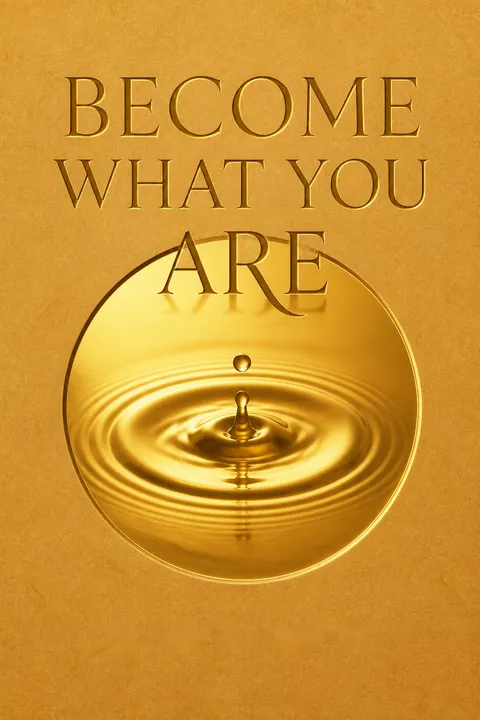
Become What You Are by Alan Watts receives mostly positive reviews, with readers appreciating his accessible approach to Eastern philosophy. Many find the book insightful and inspiring, praising Watts' ability to convey complex ideas simply. The collection of essays is seen as thought-provoking, encouraging readers to live in the present and embrace their true selves. Some reviewers note repetition and inconsistency between essays, but overall, the book is valued for its wisdom and perspective on life.
People Also Read



Glossary
Tao
the way of natureA central Chinese philosophical term that Watts uses for the living process of nature and existence. It is not a fixed object or a rulebook that can be fully defined. In his account, the Tao is already at work in ordinary life, including processes that occur without conscious control.
wu-wei
non-forcing actionA Taoist term Watts presents as nonstriving or action that does not force life toward a preconceived spiritual result. It does not mean laziness or deliberate relaxation. Trying to imitate an ideal or trying to achieve a state of effortless calm still involves striving; wu-wei describes the release of that self-defeating effort.
upaya
skillful teaching meansA Sanskrit Buddhist term for a skillful means used to help someone approach a truth indirectly. Watts applies it to teachings that seem like instructions but reveal the limits of the student's ability to command the self. Their value lies not in being obeyed as formulas, but in the insight their use may provoke.
Samsara
the changing round of lifeA Buddhist term for existence understood as a cycle marked by change, attachment, and suffering. Watts uses it particularly to describe the ordinary world in which people try to secure lasting happiness from temporary conditions. In Mahayana thought, he notes, Samsara need not be treated as an ultimate reality separate from Nirvana.
Nirvana
release from graspingA Buddhist term for liberation from the craving and attachment that make changing experience a source of suffering. Watts stresses that Nirvana is not simply oblivion or a permanent pleasure to be acquired. Turning it into an object of desire repeats the grasping from which it is meant to release a person.
nonduality
opposites are not separate realitiesA principle in Hindu and Mahayana Buddhist thought that denies ultimate separation between pairs such as self and world, Samsara and Nirvana, or unity and diversity. In Watts's account, nonduality does not erase everyday distinctions. It points to a reality that includes both sides rather than reducing everything to one side.
jiriki
self-powered religious effortA Japanese Buddhist term for relying on one's own effort to pursue enlightenment. Watts contrasts it with tariki, or reliance on other-power. He describes the risk that self-powered practice can turn spiritual progress into a claim of personal merit, though effort and discipline remain important in several Buddhist traditions.
tariki
reliance on other-powerA Japanese Buddhist term, especially associated with Shin Buddhism, for reliance on Amida Buddha's vow and compassionate power rather than one's own spiritual merit. Watts interprets this not merely as passive belief, but as an experience of being accepted without first earning acceptance, which can loosen spiritual pride and support gratitude.
Second Birth
awareness born through relationshipWatts's symbolic reading of spiritual transformation as a new center of awareness arising through the relationship between self and world. The self does not absorb the universe, and the universe does not erase the self. Their mutual giving and receiving produces a sense of meaning that neither isolated side could provide.
FAQ
What's "Become What You Are" about?
- Collection of Writings: "Become What You Are" is a collection of essays by Alan Watts that explore Eastern philosophy and its application to Western life.
- Themes and Topics: The book covers themes such as the nature of self, the concept of Tao, the limits of language in spiritual understanding, and the psychological symbolism in Christianity.
- Philosophical Exploration: Watts delves into the paradox of self-denial, the idea of living in the present moment, and the challenge of seeing life "just as it is."
- Eastern Thought for Westerners: The book serves as an interpretation of Eastern thought, making complex ideas accessible to a Western audience.
Why should I read "Become What You Are"?
- Insightful Perspectives: The book offers profound insights into the nature of self and reality, encouraging readers to explore their own existence.
- Accessible Language: Watts uses simple and playful language to explain complex philosophical concepts, making it an engaging read.
- Cultural Bridge: It acts as a bridge between Eastern and Western philosophies, providing a unique perspective on life and spirituality.
- Timeless Wisdom: The essays contain timeless wisdom that can help readers find harmony and peace in their daily lives.
What are the key takeaways of "Become What You Are"?
- Present Moment Awareness: Life exists only in the present moment, which is infinite and eternal, and understanding this can lead to a more harmonious existence.
- Non-Duality: The book emphasizes the non-dual nature of reality, where opposites like life and death, pleasure and pain, are interconnected.
- Self-Realization: True self-realization involves letting go of the ego and embracing the flow of life without resistance.
- Integration of Traditions: Watts integrates various religious and philosophical traditions to offer a holistic view of spirituality.
What is the "Paradox of Self-Denial" in "Become What You Are"?
- Concept Explanation: The paradox of self-denial is the idea that one must lose oneself to truly find oneself, a common theme in many spiritual traditions.
- Inevitability of the Present: Despite attempts to escape it, one cannot be out of harmony with the present moment, as it is the only reality.
- Self-Transcendence: True self-transcendence is not achieved through effort but through the realization of one's own incapacity to change oneself.
- Skillful Means: The concept is a form of "upaya" or skillful means, used to awaken individuals to truths that cannot be reached directly.
How does Alan Watts interpret the concept of Tao in "Become What You Are"?
- Tao as Natural Flow: Watts describes Tao as the natural flow of life, which is both infinitely moving and eternally resting.
- Wu-Wei Principle: The principle of "wu-wei" or non-doing is central, suggesting that harmony with the Tao is achieved by not forcing outcomes.
- Beyond Definition: Tao cannot be defined or understood through conventional means, as it is the substance of knowing and existing.
- Living in Accord: To live in accord with the Tao is to move with life without resistance, accepting change as a natural process.
What does "Become What You Are" say about the limits of language in spiritual understanding?
- Language Limitations: Watts argues that language is limited in expressing spiritual truths, as it often points to concepts rather than the reality itself.
- Finger and the Moon: He uses the metaphor of the finger pointing at the moon to illustrate how words are merely indicators, not the essence.
- Direct Experience: True understanding comes from direct experience and awareness, not from intellectual analysis or verbal descriptions.
- Transcending Words: The book encourages readers to transcend words and concepts to experience the ineffable nature of reality.
What role does the concept of non-duality play in "Become What You Are"?
- Central Theme: Non-duality is a central theme, emphasizing that reality is not divided into separate entities but is a unified whole.
- Beyond Opposites: Watts explains that opposites like good and evil, life and death, are interdependent and part of the same reality.
- Spiritual Realization: Realizing non-duality involves seeing beyond the illusion of separateness and understanding the interconnectedness of all things.
- Practical Implications: This understanding can lead to a more harmonious and less conflicted way of living, as one embraces the totality of existence.
How does Alan Watts address the concept of self-realization in "Become What You Are"?
- Letting Go of Ego: Self-realization involves letting go of the ego and the illusion of control, allowing life to unfold naturally.
- Embracing Change: Watts encourages embracing change and the impermanence of life as a path to self-discovery and fulfillment.
- Unity with Life: True self-realization is recognizing one's unity with the flow of life and the present moment.
- Beyond Self-Improvement: The book suggests that self-improvement efforts are often ego-driven and that true growth comes from acceptance and awareness.
What are the best quotes from "Become What You Are" and what do they mean?
- "Life exists only at this very moment...": This quote emphasizes the importance of living in the present, as it is the only reality.
- "You may believe yourself out of harmony with life...": It suggests that one cannot truly be out of harmony with life, as existence itself is life.
- "The perfect man employs his mind as a mirror...": This highlights the Taoist ideal of reflecting life without attachment or resistance.
- "Become what you are": A call to embrace one's true nature and live authentically, without the constraints of ego or societal expectations.
How does "Become What You Are" integrate various religious and philosophical traditions?
- Eastern and Western Thought: Watts draws from Eastern philosophies like Taoism and Buddhism, as well as Western religious symbolism.
- Universal Truths: He identifies universal truths that transcend cultural and religious boundaries, offering a holistic view of spirituality.
- Psychological Symbolism: The book explores the psychological symbolism in Christian thought, relating it to Eastern concepts.
- Interconnected Wisdom: By integrating these traditions, Watts provides a comprehensive understanding of the human experience and spiritual growth.
What is the significance of the "Second Immortal" story in "Become What You Are"?
- Allegorical Tale: The story of the Second Immortal is an allegory about the search for enlightenment and the realization of one's true nature.
- Ordinary Life as Enlightenment: It suggests that enlightenment is found in the ordinary aspects of life, not in extraordinary experiences or achievements.
- Inner Journey: The tale emphasizes the importance of looking within oneself for wisdom and understanding, rather than seeking external validation.
- Simplicity and Acceptance: The story highlights the value of simplicity and acceptance in the spiritual journey, encouraging readers to find peace in everyday life.
How does "Become What You Are" address the problem of faith and works in Buddhism?
- Self-Reliance vs. Faith: The book explores the tension between self-reliance and faith in Buddhist practice, particularly in the Mahayana tradition.
- Non-Duality of Nirvana and Samsara: Watts discusses the non-duality of Nirvana and Samsara, suggesting that enlightenment is not separate from ordinary life.
- Role of the Bodhisattva: The Bodhisattva ideal is presented as a way to reconcile self-effort with compassion and service to others.
- Faith as Acceptance: Faith is seen as an acceptance of one's inherent Buddha-nature, rather than a reliance on external deities or forces.
About the Author
Other books by Alan W. Watts




Download PDF
Download EPUB
.epub digital book format is ideal for reading ebooks on phones, tablets, and e-readers.








