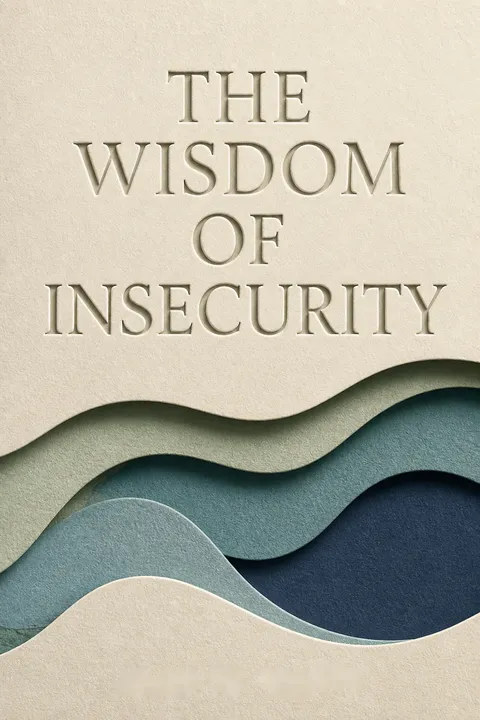


Key Takeaways
Stop trying to secure a changing life; let insecurity teach you how to live.
Security can become its own trap. Watts calls this the law of reversed effort: trying to force a state can produce its opposite. Straining to stay afloat may make a swimmer sink; clinging to certainty can deepen the fear that certainty is meant to quiet. Life changes, bodies age, and plans fail. The problem is not simply that security is impossible, but that treating it as a prerequisite for living turns the present into a waiting room.
Let go of the guarantee. Watts is not advising carelessness about food, shelter, or practical planning. He argues that no plan can abolish uncertainty, and that demanding such a guarantee makes ordinary life feel unsafe. A more honest starting point is to acknowledge what cannot be controlled, then meet the circumstances actually at hand.
The distinction between practical safety and total psychological certainty is crucial. A seat belt reduces a real risk; it does not promise that nothing bad will happen. Modern risk management makes the same distinction when it separates sensible precautions from attempts to eliminate all uncertainty, which can become costly and paralyzing. Watts’s reversal is illuminating as a diagnosis of compulsive control, but it is not a universal rule: effort often does improve outcomes. The useful question is narrower: is this action addressing a solvable danger, or trying to secure a guarantee no action can provide?
A future worth reaching is useless if you arrive absent.
Tomorrow only matters as a lived moment. Watts argues that memory and foresight help people learn and plan, but can also commandeer attention. He describes a person awaiting an operation who spends otherwise comfortable days dreading it. The worry offers no new decision or preparation; it simply takes over the present. Likewise, someone focused entirely on earning enough to enjoy life may reach retirement without knowing how to enjoy unstructured time.
Plan, then return. The future is not fake, but it is not directly experienced until it becomes now. If each present is treated merely as a step toward a better one, satisfaction keeps moving out of reach. Planning is useful when it supports life; it becomes self-defeating when the imagined future prevents contact with the life it is meant to support.
This is not an argument against forecasting. Medical preparation, saving, and collective planning can prevent genuine harm. The distinction is between instrumental thought, which helps choose an action, and repetitive anticipation, which supplies no further information. Cognitive psychology describes a related trap: people can mentally rehearse possible futures while confusing vivid simulation with actual control. A practical test follows from Watts’s case: after planning, is there a next step to take? If not, continued rehearsal may be attention spent on an event that is not yet here.
Protecting yourself from pain can also deaden the pleasures you want.
Sensitivity has a cost. Watts sees pleasure and pain as linked consequences of being alive and responsive. The capacity to love deeply also makes loss hurt deeply; dulling vulnerability can therefore dull delight. He describes people who respond to emotional injury by becoming hard, or who learn to perform toughness as protection. Such defenses may reduce exposure, but they also narrow the range of experience.
Do not demand painless pleasure. A pleasurable sensation can lose its force through repetition, or become unpleasant when pushed beyond its limits. Watts compares this to consuming rich food until appetite disappears. His point is not that suffering is good in itself, but that a life organized around excluding every discomfort risks becoming less vivid, not more secure.
The idea resembles a basic feature of affect: organisms adjust to repeated stimulation, and emotional openness can increase both reward and vulnerability. It also cautions against treating resilience as invulnerability. Yet pain is not always a necessary price for pleasure, and trauma or illness can overwhelm rather than deepen awareness. The more defensible lesson is that blanket avoidance has costs, while chosen vulnerability can make attachment and enjoyment possible. The distinction between unavoidable discomfort and preventable harm matters; accepting the former should never be used to excuse the latter.
Treat the self as a moving process, not a permanent observer.
The observer is hard to separate. Watts asks readers to inspect experience directly. When someone notices, “I am reading,” that thought itself becomes the next experience; there is no second, separate observer available for inspection. Memory creates a feeling of continuity, but what is present now is a memory, not direct access to the past. Watts uses the phrase “the great stream” for experience understood as continuous change rather than a collection of fixed things.
The self belongs to that stream. On this account, the familiar division between a controlling “I” and a bodily “me” is not a fact to discover but a way of describing experience. The claim is not that a person has no history or practical identity. It is that no unchanging inner spectator can be found apart from sensations, thoughts, and feelings as they occur.
This argument is strongest as a phenomenological exercise: attention reveals that self-awareness arrives as experience, rather than from an easily located inner witness. Contemporary work on the constructed self, including research on how memory and perception integrate information, offers a compatible picture of personal continuity as an achievement rather than a little observer in the head. Compatibility is not proof, however. The fact that experience of a self is difficult to isolate does not establish that personal identity is unreal in every sense. Watts challenges a particular picture of the self, not the practical importance of personhood.
Use labels as tools, never confuse the map with the living thing.
Words simplify what they describe. A label such as “water,” “self,” or “nature” lets people communicate and reason efficiently, but the label is not the experience it points to. Watts compares language and thought to money: useful symbols can represent real resources without becoming food or shelter. Problems arise when a fixed description is mistaken for a complete account of a changing reality.
Keep the tool, drop the spell. Scientific classifications help people predict events; religious images can express ways of understanding life. Watts does not claim that these systems are equally useful for every purpose. He argues that neither system captures reality in full. A photograph of a moving train can show positions, but the sequence of still images is not the felt movement itself. Description helps orient attention; direct experience supplies what description leaves out.
The map metaphor is especially valuable because it preserves the practical power of concepts without granting them sovereignty. Science depends on abstraction, measurement, and shared definitions; its success is not cancelled by recognizing that models simplify. In philosophy of science, models are often judged by what they let researchers explain or predict, not by whether they duplicate reality in every detail. Watts’s caution becomes less persuasive when it seems to dismiss explanation as merely symbolic. The stronger reading is that useful models should remain revisable and should not be confused with the whole of lived experience.
Meet fear as present experience instead of making a second enemy of it.
Resistance can amplify distress. Watts argues that trying to stand apart from fear often adds another struggle: fear is present, and the mind is alarmed that it is present. He offers a story about a visitor asking a sage how to find peace of mind. The sage asks him to produce the mind so it can be calmed; the visitor cannot find it, and the search itself loosens the problem’s grip. The tale points toward attention, not a clever technique.
Notice before reacting. Awareness, in Watts’s specialized sense, means attending to present sensations, thoughts, and feelings without immediately judging or naming them. It does not require pretending pain is pleasant or refusing help. The proposal is that seeing an experience clearly can interrupt the extra tension created by futile attempts to escape an experience that is already occurring.
This has a clear connection to acceptance-based therapies, which distinguish experiencing an emotion from struggling with the fact that it exists. Such approaches can help people respond more flexibly, but they do not claim that attention makes every symptom disappear. Watts sometimes writes as though understanding the impossibility of escape naturally dissolves distress; in real life, severe anxiety, chronic pain, and trauma may require treatment and support. His insight remains useful when framed modestly: awareness can change a person’s relationship to suffering, even when it cannot remove the cause.
Let reason serve the body instead of treating instinct as an obstacle.
The body already knows much. Breathing, digestion, and healing do not depend on conscious instructions. Watts calls attention to this ordinary intelligence to challenge a culture that prizes deliberate calculation while neglecting bodily rhythms. He contrasts eating in response to bodily need with eating driven by anxiety or endless stimulation, and criticizes treating clock schedules as more authoritative than sleep, rest, and appetite.
Use thought as an instrument. Watts is not asking readers to reject reasoning. He says the brain is part of the organism and should help it navigate the present, rather than pursue abstract promises of endless satisfaction. His warning is that constant stimulation and future-oriented striving can make it harder to notice simpler forms of pleasure, such as rest, food, and unhurried attention.
The argument anticipates current interest in interoception, the perception of signals from inside the body, and in how bodily states shape judgment and emotion. It also resists the idea that rationality means suppressing physical needs. Still, bodily signals are not infallible guides: hunger, fatigue, and pain can be altered by illness, deprivation, or stress, while clocks and medical technology can protect health. The most useful balance is neither mind over body nor impulse over judgment. Reason can interpret bodily information, while bodily information keeps abstract plans connected to human limits.
Act from attention to others, not from a project of becoming virtuous.
Self-improvement can hide self-absorption. Watts questions morality built mainly on rewards, punishments, and the wish to see oneself as good. Trying to force oneself into an ideal can split the mind into a judge and a judged self, preserving the very self-concern the ideal was meant to overcome. He calls “creative morality” action that arises from an undivided awareness of other people and the circumstances in front of oneself.
Rules still have a role. Communities need practical standards for sharing resources, caring for vulnerable people, and living together. Watts’s target is not every rule but the belief that obedience or moral display automatically produces love. His test is whether conduct responds to the actual person and situation, rather than serving mainly as proof of the actor’s goodness.
This account usefully separates ethical concern from moral branding. Research on prosocial behavior suggests that helping can arise from empathy, social norms, identity, or anticipated reward, often in combination. Motives are rarely pure, so a demand to act without self-interest can become another form of self-surveillance. Watts’s emphasis on attention counters that spiral, but spontaneous care alone cannot settle questions involving institutions, conflicting rights, or unequal power. Ethical rules can protect people precisely when goodwill is uneven. The insight is strongest as a critique of performative virtue, not as a replacement for public standards.
Read religious language as a pointer to experience, not a guarantee about eternity.
Symbols need not be forecasts. Watts distinguishes belief, which clings to a desired picture of reality, from faith, which stays open to what may be found. He argues that religious language can be read as symbolic descriptions of present experience, rather than predictions about a future heaven or an immortal individual self. In this reading, “eternal life” points to fully inhabiting the present, not extending personal experience without end.
Keep the symbol in perspective. Images of God, salvation, or an afterlife may guide attention, but they become obstacles when treated as possessions that settle every uncertainty. Watts sees value in science’s willingness to question claims, and in religion’s capacity to express experiences that ordinary description struggles to capture. Neither, in his view, should be mistaken for a final grip on the mystery of existence.
This interpretive move lets religious language speak to secular readers without requiring them to accept supernatural claims. It also invites believers to distinguish an image that opens reflection from one used to shut down doubt. Yet symbolic readings are not neutral translations: traditions make historical and communal claims that cannot simply be reduced to private experience. Watts’s account is best treated as one philosophical interpretation of religion, not a demonstration that competing interpretations are mistaken. Its enduring contribution is the insistence that certainty about sacred ideas can become a substitute for the openness those ideas are meant to cultivate.
Analysis
Watts builds a deliberate reversal. He begins with the modern appetite for certainty, then argues that the appetite itself intensifies insecurity because it imagines a separate self that must be defended from change. His proposed exit is not a better belief system but a shift in attention: experience is encountered as present, moving, and not cleanly divisible into observer and observed. From this shift follow his accounts of the body, ethics, and religion. Each is an application of the same critique of separation and fixation.
The book’s most durable contribution is diagnostic. It distinguishes useful planning from rumination, bodily responsiveness from compulsive stimulation, and moral action from efforts to polish the self. Its metaphors make abstract claims memorable, especially the contrast between a symbol and what it signifies. The result is less a set of instructions than a challenge to notice when thought becomes a substitute for contact with life.
The argument also has limits. Watts moves from the difficulty of locating a separate observer to broad claims about the self and reality that do not follow by logic alone. His historical and scientific remarks reflect 1951, and some cultural contrasts between animal instinct and modern life are too sweeping to treat as evidence. Nor can present-focused awareness replace planning, medicine, or institutions that reduce material insecurity. Read most carefully, the book does not ask readers to abandon reason or responsibility. It asks them not to mistake either for total control. Its paradox is practical: uncertainty cannot be abolished, but the struggle to abolish it can be examined, and that examination can change how the present is lived.
Review Summary
The Wisdom of Insecurity receives mostly positive reviews, praised for its insights on living in the present and challenging conventional thinking about security and anxiety. Readers find it thought-provoking and life-changing, appreciating Watts' clear writing style and ability to present complex ideas accessibly. Some criticize the book as repetitive or lacking practical application. Many note its continued relevance despite being written in 1951. Critics generally recommend it for those seeking philosophical perspectives on anxiety and personal growth.
People Also Read





Glossary
law of reversed effort
Striving can defeat itselfWatts’s name for the paradox that trying to force a desired psychological state can produce the opposite. He illustrates it with the effort to stay afloat, which can make a swimmer sink. Applied to security, the idea is that trying to eliminate all uncertainty can heighten the sense of being threatened.
the great stream
Reality as ongoing changeWatts’s image for reality understood as a continuous process rather than a collection of separate, fixed things. Human bodies, thoughts, and surroundings participate in this movement. The image challenges the sense of a permanent inner self standing outside change and trying to control it.
awareness
Undivided attention to experienceWatts uses awareness to mean direct attention to present sensations, thoughts, feelings, and desires without immediately filtering them through labels or judgments. It is not simply knowing facts about an experience. It involves seeing what is occurring before thought turns it into a separate object to manage.
European dissociation
A split between brain and bodyA term Watts attributes to Lancelot Law Whyte for a perceived imbalance in modern Western life. Deliberate, verbal thinking dominates while bodily and instinctive processes are neglected. Watts connects this division to the felt separation between a controlling self and the rest of the organism.
creative morality
Responsive action rooted in careWatts’s term for ethical conduct arising from attention to people and circumstances, rather than from the pursuit of moral status or obedience motivated only by rewards and punishments. It does not remove the need for practical rules, but questions whether rule-following alone can produce genuinely caring relationships.
belief and faith
Clinging versus opennessWatts distinguishes belief as attachment to a preferred account of truth from faith as openness to what may be discovered, even when it unsettles expectation. In this usage, faith does not mean certainty about a doctrine. It means allowing inquiry without first requiring the result to confirm a desired picture.
FAQ
What's "The Wisdom of Insecurity" about?
- Exploration of Insecurity: The book delves into the nature of insecurity and anxiety in modern life, proposing that these feelings are inherent to the human condition.
- Present Moment Focus: Alan Watts emphasizes the importance of living in the present moment, suggesting that true happiness and understanding come from embracing the now.
- Philosophical Insights: It combines insights from Eastern philosophies, particularly Zen Buddhism, with Western thought to address existential concerns.
- Challenge to Conventional Beliefs: The book questions traditional beliefs about security, permanence, and the self, encouraging readers to rethink their understanding of life.
Why should I read "The Wisdom of Insecurity"?
- Timeless Relevance: Despite being published in 1951, the book addresses issues of anxiety and insecurity that are still prevalent today.
- Philosophical Depth: It offers a deep philosophical exploration of life, drawing from both Eastern and Western traditions.
- Practical Wisdom: Watts provides practical advice on how to live more fully in the present, which can lead to a more fulfilling life.
- Challenging Perspectives: The book challenges readers to reconsider their views on security, happiness, and the self, potentially leading to personal growth.
What are the key takeaways of "The Wisdom of Insecurity"?
- Embrace Insecurity: Watts argues that insecurity is a natural part of life and that embracing it can lead to a deeper understanding of existence.
- Live in the Present: The book emphasizes the importance of living in the present moment as the key to happiness and fulfillment.
- Illusion of the Self: Watts suggests that the concept of a separate self is an illusion, and recognizing this can lead to a more integrated way of living.
- Letting Go of Control: The pursuit of control and security is futile; instead, one should accept the fluidity and impermanence of life.
What are the best quotes from "The Wisdom of Insecurity" and what do they mean?
- "If happiness always depends on something expected in the future, we are chasing a will-o’-the-wisp." This quote highlights the futility of seeking happiness in future expectations rather than the present moment.
- "The more security I can get, the more I shall want." Watts points out the paradox of security, where the pursuit of it only leads to more insecurity.
- "To understand music, you must listen to it." This metaphor suggests that to truly understand life, one must experience it directly rather than through concepts or labels.
- "There is no other reality than present reality." This emphasizes the book's central theme of living fully in the present moment.
How does Alan Watts interpret Zen Buddhism in "The Wisdom of Insecurity"?
- Integration with Western Thought: Watts interprets Zen Buddhism by integrating its principles with Western philosophical ideas, making it accessible to a broader audience.
- Focus on the Present: Zen's emphasis on the present moment is a key theme in the book, aligning with Watts' message of living in the now.
- Illusion of the Self: Zen's teaching on the illusion of a separate self is central to Watts' argument, encouraging readers to see beyond the ego.
- Practical Application: Watts provides practical insights from Zen that can be applied to everyday life, such as mindfulness and acceptance of change.
What is the "law of reversed effort" mentioned in "The Wisdom of Insecurity"?
- Concept Explanation: The "law of reversed effort" suggests that trying too hard to achieve something often leads to the opposite result.
- Examples Given: Watts uses examples like trying to float by struggling in water, which causes sinking, to illustrate this concept.
- Application to Life: The idea is applied to life, suggesting that the pursuit of security and happiness through effort can lead to anxiety and dissatisfaction.
- Philosophical Implication: It implies that letting go and accepting the flow of life can lead to more genuine fulfillment.
How does "The Wisdom of Insecurity" address the concept of the self?
- Illusion of the Self: Watts argues that the self is an illusion created by the mind, and recognizing this can lead to liberation.
- Unity with Experience: He suggests that there is no separate "I" experiencing life; rather, we are one with our experiences.
- Impact on Anxiety: Understanding the illusory nature of the self can reduce anxiety and the need for control.
- Philosophical Insight: This concept is rooted in Eastern philosophies, particularly Buddhism, which Watts interprets for a Western audience.
What role does the present moment play in "The Wisdom of Insecurity"?
- Central Theme: The present moment is central to Watts' philosophy, as he believes it is the only reality we truly experience.
- Source of Fulfillment: Living in the present is presented as the key to happiness and fulfillment, as opposed to dwelling on the past or future.
- Mindfulness Practice: The book encourages mindfulness and awareness as ways to fully engage with the present.
- Contrast with Modern Life: Watts contrasts this focus with modern life's tendency to plan for the future, which he argues leads to dissatisfaction.
How does Alan Watts view the relationship between science and religion in "The Wisdom of Insecurity"?
- Different Languages: Watts suggests that science and religion are two different languages describing the same universe.
- Focus on the Present: He argues that while science deals with the past and future, religion should focus on the present and eternal.
- Misunderstanding of Religion: Watts believes that religion is often misunderstood as making predictions, rather than offering insights into present experience.
- Complementary Perspectives: He sees value in both perspectives, suggesting that they can complement each other when properly understood.
What is the significance of "creative morality" in "The Wisdom of Insecurity"?
- Beyond Rules: Creative morality goes beyond conventional rules and regulations, focusing on love and understanding in human relations.
- Freedom and Action: It emphasizes freedom and creative action, rather than adherence to rigid moral codes.
- Integration with Life: Watts suggests that true morality arises naturally when one is fully integrated with life and aware of the present.
- Critique of Conventional Morality: The book critiques conventional morality as being based on fear and control, rather than genuine understanding.
How does "The Wisdom of Insecurity" redefine the concept of God?
- God as Experience: Watts redefines God as the immediate experience of reality, rather than a separate, supernatural being.
- Symbolic Language: He uses religious symbols to describe present experience, suggesting that God is the meaning behind words and thoughts.
- Beyond Belief: The book encourages moving beyond belief in God to a direct experience of the divine in everyday life.
- Integration with Eastern Thought: This redefinition aligns with Eastern philosophies, which emphasize the unity of all things and the divine nature of the present moment.
What practical advice does "The Wisdom of Insecurity" offer for dealing with anxiety?
- Embrace Insecurity: Watts advises embracing insecurity as a natural part of life, rather than resisting it.
- Live in the Present: Focusing on the present moment can reduce anxiety about the future and regrets about the past.
- Let Go of Control: Accepting the impermanence and unpredictability of life can lead to greater peace of mind.
- Mindfulness Practice: Practicing mindfulness and awareness can help individuals become more attuned to their experiences and reduce anxiety.
About the Author
Other books by Alan W. Watts





Download PDF
Download EPUB
.epub digital book format is ideal for reading ebooks on phones, tablets, and e-readers.








