

Key Takeaways
Zen loosens the self that treats awakening as self-improvement
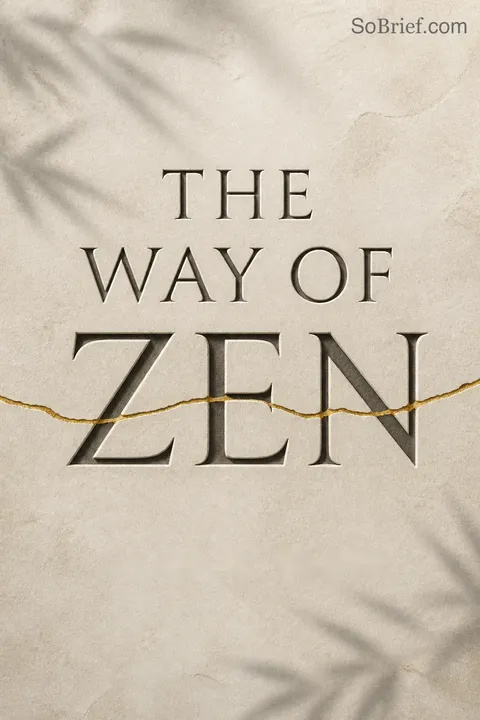
A way, not a system. Watts presents Zen as a way of liberation, not a creed or a program for becoming a better version of the ego. It took shape where Indian Mahayana Buddhism met Chinese Taoist thought, then rooted itself deeply in Japan. The Tao is the indefinable process of life; wu-wei means acting without forcing or overmanaging. Zen uses ideas and practices to direct attention toward experience before it is divided into concepts.
A cultural meeting. The history matters: Taoism contributed a trust in spontaneity, Buddhism a close examination of grasping, and Chinese and Japanese settings shaped how these ideas were practiced. Watts writes as a cultural interpreter, not as a Zen master. He argues that reading can orient a newcomer, but lived practice is needed to understand what the tradition means.
What's valuable here is the refusal to package Zen as a portable set of lifestyle tips. Ideas change when they cross cultures, because practices depend on institutions, language, and social expectations. That insight resonates with translation studies: a concept rarely arrives intact when its surrounding assumptions are left behind. Watts's synthesis is inviting, though its broad East-West contrasts can make internally diverse traditions sound more unified than they are.
Stop mistaking labels, roles, and memories for the living world
Maps help, then mislead. Watts calls the shared words and categories used to organize experience conventional knowledge. They make communication possible, but they simplify what they describe. A word divides a continuous world into named things; a social role, such as parent or professional, highlights one part of a person and leaves much else out. Even personal identity depends on selected memories arranged into a story.
The label is not the life. Such abstractions are useful tools, not independent realities. The book compares the mistake to treating a measuring system as the thing it measures. Zen aims to notice the gap: experience is happening in its full complexity before it is sorted into separate objects, events, and a supposedly fixed self.
The distinction resembles a basic finding of cognitive science: categories reduce the effort required to navigate a complicated world, but they also shape what becomes noticeable. A job title or diagnosis can help coordinate care while narrowing how a person is understood. The answer is not to abandon labels, which would make shared life difficult, but to hold them lightly and remain alert to what they leave out.
See suffering as the strain of grasping at what cannot be held
A diagnosis of frustration. Watts explains duhkha, often translated as suffering, as the frustration produced when people demand security or lasting satisfaction from changing experience. The Buddha's teaching follows a physician's logic: recognize the distress, identify grasping as its cause, see that the cycle can end, and follow a path that supports clear awareness. Trishna means craving or clinging; avidya is the misperception that makes the grasping seem workable.
Control feeds itself. Trying to control life can create more problems that seem to require control. The effort to eliminate every unwanted feeling, for instance, can turn attention into a constant check for whether the feeling is gone. The Eightfold Path offers guidance for understanding, conduct, and awareness. Its practices are presented as practical supports for clarity, not commandments enforced by a creator deity.
This account anticipates a familiar pattern in modern therapies: struggling to suppress an unwanted thought can keep attention fixed on it. The model is useful because it identifies how a solution can perpetuate the problem. Its scope needs care, however. Not all distress comes from mistaken personal grasping; illness, violence, and deprivation are real conditions. The framework illuminates one dimension of suffering without replacing social or medical remedies.
Treat emptiness as interdependence, not a vacant universe
Nothing stands alone. In this book, maya is not the claim that the world is simply unreal. It describes how naming and measurement draw boundaries around changing experience. Nagarjuna's sunyata, or emptiness, means that things lack independent existence: each is defined through relations with others. A body, for example, can be described as one organism, a collection of organs, or part of a social group, depending on the question being asked.
Form remains vivid. Emptiness does not require the world of forms to disappear. The Mahayana image of a net of gems captures the point: each part reflects the rest. Watts links this vision to the idea that everyday forms and ultimate reality are not separate domains. A tree, a sound, or a passing event matters precisely as a particular, changing part of a larger web.
The relational view connects naturally with ecology and systems theory, where an organism cannot be fully explained apart from its environment and interactions. It also guards against the false choice between solid, isolated objects and sheer nothingness. A useful caution is that interdependence does not erase distinctions that matter. A person and an institution may shape one another, but responsibility and unequal power still need to be named.
Let the mind work without an inner supervisor seizing the controls
No-mind is not blankness. The term wu-hsin, translated as no-mind, describes awareness that is not divided against itself by a second layer of constant self-monitoring. It does not mean unconsciousness or the absence of thought. The book compares the problem to a feedback system that keeps adjusting itself: if its stop and go signals become identical, the system wavers instead of acting.
Trust trained intelligence. People already rely on complex capacities they cannot consciously direct, from breathing to coordinated movement. Zen applies this observation to attention and action: thinking can occur, but endlessly checking whether one is thinking correctly can obstruct it. Watts does not reject reflection. He warns against trying to control every act from a separate, supposedly superior point of view.
The feedback analogy makes a difficult point concrete: self-correction is valuable until it becomes so constant that it interferes with performance. Research and practice in sports, music, and other skilled activities often distinguish useful preparation from disruptive overattention during execution. Yet automaticity is not always wiser than deliberation. High-stakes choices may require explicit checking, so the practical question is when monitoring helps and when it merely repeats itself.
Practice without turning awakening into another prize to win
Sitting is not a transaction. Za-zen is seated meditation, but Watts stresses that sitting should not be treated as a technique for purchasing a future spiritual achievement. Zen's Sixth Patriarch, Hui-neng, rejected the image of a mind that must be polished clean. He argued that trying to force thoughts to stop only creates another struggle with thought.
Methods differ. Rinzai Zen uses koan, brief challenges drawn from exchanges between teachers and students, to unsettle habitual reasoning. Soto Zen emphasizes sitting without pursuing a special result. The traditions have different methods, and Watts notes that training systems can become institutional measures of rank. He also warns against equating an intense emotional breakthrough with lasting insight. Practice may support awareness, but no method guarantees awakening.
The distinction between practice and achievement is useful in any discipline where the process can be corrupted by scorekeeping. Structured challenges can expose assumptions that ordinary reflection leaves untouched, while quiet repetition can build attentiveness without dramatic expectations. Neither method is immune to status games. A school can assess technique more easily than insight, so institutional approval should not be confused with a complete measure of a person's understanding.
Stay engaged with ordinary life instead of fleeing its imperfections
Awakening returns to the world. Mahayana Buddhism gives a central role to the Bodhisattva, an awakened figure whose concern includes other beings rather than private escape. Watts describes this through prajna, insight into the emptiness of fixed boundaries, and karuna, compassion expressed in the world of particular lives. The two belong together: seeing that forms are not separate from emptiness does not make their ordinary reality disposable.
Everyday life counts. The layman Vimalakirti became an important model because his wisdom was compatible with ordinary responsibilities. Zen likewise treats work, eating, and human feeling as possible expressions of practice. This is not permission to indulge every impulse. Watts distinguishes unforced responsiveness from both repression and careless self-indulgence, while acknowledging that Zen's emphasis on freedom from fixed moral rules can be difficult to interpret.
This pairing of insight and compassion answers a persistent ethical question: if the self is not an isolated substance, why care about anyone? The answer is that relational existence makes others part of the same field of life, not irrelevant appearances. Still, insight alone does not specify fair conduct. Shared ethical norms, accountability, and attention to harm remain necessary for translating a nondual outlook into dependable public behavior.
Train deeply, then let the brush, bow, or body respond freely
Discipline makes room. Zen arts show how control and spontaneity can cooperate. In ink painting, the brush must be practiced until a stroke can look alive rather than labored. In the tea ceremony, ordinary actions such as preparing a bowl become an occasion for full attention. Japanese gardens use carefully chosen rocks and plants to suggest a natural scene without making it look mechanically arranged.
Skill should disappear into action. Watts recounts the struggle of an archery student who spent years trying to release the bowstring without consciously forcing the moment. The point is not that practice is useless, but that practice cannot dictate the exact instant of fluent action. Technique prepares the conditions; overmanaging the final response can spoil it. Zen's ideal is not careless improvisation, but trained ease without display.
This account closely resembles the distinction between explicit instruction and tacit expertise. A musician may learn rules consciously, then depend on embodied timing when performing. The book's emphasis on spontaneity is strongest when read as the fruit of training, not its replacement. It can mislead if used to dismiss feedback, correction, or deliberate practice, all of which help develop the competence that later feels effortless.
Treat each moment as life itself, not a waiting room
Time is experienced now. Watts draws on the Zen teacher Dogen, who treats each moment as complete rather than as a fragment on its way to becoming something else. Firewood and ash, for instance, belong to different moments in a process; one should not imagine that the later state contains the earlier one unchanged. Past and future are real as memory and anticipation, but both are encountered in present experience.
Do not postpone living. The image of a fish swimming in water suggests that a life unfolds within the conditions it actually inhabits. Planning has a place, but demanding a guaranteed future can make the present feel like a mere prelude. Zen practice does not require concentrating on the instant as a special object. It asks for clear attention to the activity already underway.
The argument speaks to a modern habit of treating the present as raw material for a later, supposedly better life. Attention research helps explain why repeated task-switching and future-oriented checking can fragment experience, though planning itself is essential for long projects and collective commitments. The useful distinction is not present versus future. It is between planning that serves life and postponement that makes life perpetually conditional.
Analysis
Watts builds a bridge through a sequence of translations. Taoism first challenges the assumption that reality must be grasped in explicit concepts. Indian Buddhism then sharpens the problem: grasping produces frustration, but the self doing the grasping cannot secure itself by greater effort. Chinese Zen turns these ideas toward immediacy, and Japanese practice and art show how that immediacy might appear in disciplined activity. The book's recurring strength is to make abstract claims tangible through ordinary acts, a bodily gesture, a bowl of tea, a brushstroke, or a moment of hesitation.
Its central intellectual move is also its main vulnerability. Watts presents Zen as an experience that language can indicate but never capture. That formulation protects the lived dimension of the tradition from being reduced to doctrine, yet it can make disagreement difficult: a critic can be told that the concept misses the experience, while a devotee can claim that an experience confirms the concept. The most responsible reading treats the claims about self, time, and reality as interpretive proposals, not as findings established by the feedback analogy or by meditation alone.
The book's East-West contrasts are similarly illuminating but broad. Watts's account is a mid-century synthesis, not a neutral survey of every Buddhist lineage or Chinese and Japanese intellectual tradition. He acknowledges uncertainty about historical origins, yet the narrative can still suggest a cleaner cultural convergence than the evidence warrants. Its practical value does not depend on accepting every historical generalization. Readers can retain the sharpest insight: concepts and self-control are useful, but they become constricting when mistaken for reality itself. Zen's challenge is not to discard thought, ethics, or skill. It is to use them without expecting them to provide a final, separate position from which life can be mastered.
Review Summary
The Way of Zen is praised for its clear, accessible introduction to Zen Buddhism, offering insights into its history, philosophy, and practices. Readers appreciate Watts' ability to explain complex Eastern concepts to Western audiences, though some find parts challenging. The book is valued for its exploration of Zen's influence on art and culture. While not a practical guide, it's seen as a thought-provoking work that challenges conventional thinking and offers a new perspective on life, consciousness, and the nature of reality.
People Also Read




Glossary
Tao
the way of realityA central Taoist term meaning the way or process through which the world unfolds. Watts presents it as indefinable, not a creator who assembles the universe according to a plan. It is closer to spontaneous growth than deliberate manufacture, and cannot be fully captured by descriptions or abstract concepts.
wu-wei
non-forcing actionA Taoist and Zen term for action that is not driven by strain, excessive control, or deliberate manipulation. It does not mean inactivity. It points to effective response that arises without an inner struggle to manage every detail, like a learned skill operating without constant self-correction.
tzu-jan
spontaneous naturalnessA Taoist term that Watts translates as self-so-ness or naturalness. It refers to the unforced way something functions when it is not being made to conform to an imposed plan. In human action, it is not childish impulse or rebellion against convention, but spontaneity that can coexist with social life and developed skill.
conventional knowledge
shared symbolic understandingWatts's term for knowledge organized through socially agreed words, classifications, roles, and other signs. It is indispensable for communication and practical coordination, but it abstracts from the full complexity of experience. Confusion begins when these useful symbols are treated as if they were the complete reality they describe.
maya
reality divided by conceptsAn Indian philosophical term that Watts interprets through measurement, naming, and boundary-making. Maya is not simply the claim that the world is nonexistent. It describes how experience is divided into apparently independent things and events, even though those divisions depend on perspective and changing relations.
duhkha
frustration or sufferingA Buddhist term commonly rendered as suffering. Watts emphasizes the frustration that arises when people demand lasting satisfaction, certainty, or control from changing conditions. It includes pain and loss, but also the dissatisfaction built into trying to hold experience still or secure a permanent self.
trishna
craving and clingingA Buddhist term for thirst, craving, or grasping. In Watts's account, it drives efforts to possess experience, preserve identity, and secure a desired outcome. Because experience changes and the self is not a fixed object, these efforts generate further frustration rather than final security.
anatman
absence of graspable selfA Buddhist teaching usually translated as no-self. Watts stresses that it does not simply assert that nothing exists within a person. It denies that there is an enduring, independent ego that can be found and held apart from changing experience, memory, and relations with the world.
sunyata
emptiness of independent existenceThe Mahayana Buddhist term for emptiness. In Watts's explanation, things are empty because they have no self-contained nature independent of other things. Emptiness does not mean a blank universe or the disappearance of ordinary forms. It means that forms exist through relations and cannot be isolated as absolute entities.
tathata
suchness of direct experienceA Mahayana term meaning suchness, thusness, or thatness. It points to experience as encountered before it is divided and categorized by thought. Watts uses it for the actual character of things in their particularity, without claiming that a description can capture their complete nature.
prajna
intuitive liberating insightA Buddhist term for wisdom or insight that sees through fixed concepts and the assumption that things exist independently. Watts distinguishes it from merely accumulating information. Prajna recognizes the relational character of experience and undermines the attempt to make awakening into an object that an ego can possess.
karuna
compassionate engagementA Mahayana Buddhist term for compassion. Watts pairs karuna with prajna: insight into emptiness does not require withdrawing from the world of forms, but can express itself through concern for beings in that world. Compassion is the active dimension of awakened understanding.
dhyana
unified present awarenessA Buddhist term from which the Chinese word ch'an and Japanese word Zen derive. Watts argues that ordinary translations such as meditation can mislead, since dhyana is not simply thinking things over or entering a trance. It combines clear awareness with a less divided relation between knower and known.
wu-hsin
unselfconscious mindLiterally no-mind, this Zen term does not describe a blank or unconscious state. It refers to mind functioning without treating itself as a separate object to control, inspect, or correct at every step. Thoughts and perceptions may continue, but they are not held in a constant grip.
satori
sudden awakeningA Japanese Zen term for awakening or seeing into one's nature. Watts stresses that it is not necessarily a permanent, miraculous transformation or a possession acquired by effort. It names a direct recognition that can occur suddenly, including the recognition that the separate self seeking an ultimate object cannot be secured.
za-zen
seated Zen practiceJapanese for seated meditation in Zen. In the practice described by Watts, a person sits upright and attends to present experience without making the session a device for obtaining a future reward. Zen teachers differ on its role, and Watts cautions against treating posture alone as proof of insight.
koan
Zen training challengeA Zen teaching case, often a brief exchange or question associated with an earlier master. In Rinzai training, a student works with a koan and presents an intuitive response to a teacher. Watts describes it as a method for disrupting habitual conceptual reasoning, not merely a riddle with a clever verbal solution.
FAQ
What's The Way of Zen about?
- Exploration of Zen Buddhism: The Way of Zen by Alan W. Watts explores the philosophy and practice of Zen Buddhism, tracing its historical roots and cultural significance. It integrates elements from both Taoism and Buddhism, emphasizing a unique approach to liberation.
- Cultural Context: The book discusses the growth of interest in Zen in the West, particularly post-World War II, and its resonance with contemporary thought. It highlights parallels between Zen and modern scientific and psychological insights.
- Two-Part Structure: Divided into two main parts, the first focuses on the background and history of Zen, while the second addresses its principles and practices. This structure helps readers understand both the historical context and practical applications of Zen philosophy.
Why should I read The Way of Zen?
- Comprehensive Overview: Alan Watts provides a thorough introduction to Zen Buddhism, making it accessible for both beginners and those with prior knowledge. His engaging writing style and clear explanations demystify complex concepts.
- Cultural Exchange: The book encourages exploration of the intersections between Eastern and Western philosophies, fostering a deeper understanding of both. Watts emphasizes learning from Zen without directly importing it from its cultural origins.
- Personal Insight: Watts shares personal experiences and insights from studying Zen, adding a relatable and human element to the text. This invites readers to reflect on their own lives and beliefs.
What are the key takeaways of The Way of Zen?
- Zen as Liberation: Zen is presented as a "way of liberation" rather than a strict philosophy or religion, emphasizing direct experience and personal insight over dogma and intellectual understanding.
- Embracing the Void: A central theme is the acceptance of the "Great Void," which is not to be feared but embraced. True freedom comes from letting go of attachments and preconceived notions.
- Non-Duality: The book highlights the Zen perspective of non-duality, where distinctions between self and other, subject and object, dissolve. This understanding is crucial for achieving enlightenment.
What are the best quotes from The Way of Zen and what do they mean?
- "Above, not a tile to cover the head; Below, not an inch of ground for the foot.": This quote encapsulates the Zen attitude towards existence, emphasizing freedom and detachment from material concerns.
- "The Tao which can be spoken is not the eternal Tao.": Reflects the limitations of language in conveying reality's essence, underscoring that ultimate truths are beyond verbal expression.
- "Those who know do not speak; those who speak do not know.": Highlights the paradox of wisdom in Zen, suggesting that genuine insight transcends words and cannot be fully articulated.
How does The Way of Zen address the relationship between Zen and Taoism?
- Shared Philosophical Roots: Watts explores how Zen Buddhism is deeply influenced by Taoist thought, particularly in its understanding of nature and spontaneity. Both traditions emphasize living in harmony with the natural world.
- Complementary Practices: Zen incorporates Taoist practices, such as meditation and mindfulness, to achieve liberation. This blending enriches the Zen experience and offers diverse pathways to enlightenment.
- Cultural Exchange: Historical interactions between Zen and Taoism have shaped each other over time, leading to a unique synthesis that characterizes Zen as a distinctly Chinese form of Buddhism.
What is the role of meditation (za-zen) in Zen practice according to The Way of Zen?
- Central Practice: Za-zen, or sitting meditation, is fundamental in Zen, cultivating mindfulness and awareness. It allows practitioners to quiet the mind and connect with their true nature.
- Direct Experience: Meditation is not merely a technique but a means to experience reality directly, emphasizing presence without attachment to thoughts or distractions.
- Path to Enlightenment: Regular practice of za-zen leads to insights and awakenings, deepening understanding of oneself and the world, essential for realizing one's Buddha nature.
How does The Way of Zen explain the koan method?
- Definition of Koan: A koan is a paradoxical question or statement used in Zen practice to provoke deep thought and insight, often leading to moments of awakening.
- Purpose of Koans: Designed to exhaust the logical mind, koans push practitioners beyond conventional thinking to experience a direct understanding of reality.
- Training Process: Students engage with koans under a master's guidance, emphasizing personal discovery rather than rote memorization of answers.
What is "wu-wei" and how does it relate to Zen practice in The Way of Zen?
- Concept of Non-Action: Wu-wei translates to "non-action" or "effortless action," emphasizing alignment with the natural flow of life. In Zen, it encourages spontaneous, unforced action.
- Naturalness in Action: True effectiveness comes from allowing things to unfold naturally rather than forcing outcomes, aligning with Zen's belief in trusting intuition and inherent wisdom.
- Integration with Zen Philosophy: Wu-wei reflects the non-dualistic nature of reality, allowing individuals to experience a deeper connection to their true nature and the world.
How does The Way of Zen address the concept of enlightenment?
- Non-Duality of Enlightenment: Enlightenment is not a distant goal but an inherent aspect of our being, suggesting that we are already Buddhas at our core.
- Letting Go of Seeking: Pursuit of enlightenment can be counterproductive, as expressed in the quote, “To seek the Buddha and to seek the Dharma is precisely making karma for the hells.”
- Awakening in Everyday Life: Enlightenment is portrayed as a natural state realized through everyday actions and experiences, rather than through rigorous spiritual practices alone.
What is the significance of the "Bodhi Tree" in Zen according to The Way of Zen?
- Symbol of Awakening: The Bodhi Tree is where Siddhartha Gautama attained enlightenment and became the Buddha, symbolizing the potential for awakening within all individuals.
- Connection to Nature: Represents interconnectedness of all life and the importance of being present in nature, with Zen practice emphasizing mindfulness as a path to enlightenment.
- Cultural Heritage: Serves as a reminder of Zen's historical roots and evolution, connecting practitioners to the broader Buddhist tradition while embodying unique aspects of Zen philosophy.
How does The Way of Zen differentiate between Zen schools?
- Rinzai vs. Soto: Watts outlines differences between the Rinzai and Soto schools, particularly in their approaches to meditation and koan practice.
- Rinzai Emphasis on Koans: Focuses heavily on the koan method, encouraging intense seeking and doubt to provoke awakening.
- Soto Focus on Za-zen: Emphasizes za-zen as a practice of simply sitting and being present, without striving for specific outcomes or enlightenment.
What are the challenges of understanding Zen as presented in The Way of Zen?
- Cultural Differences: Western readers may struggle with Zen concepts due to cultural and philosophical differences, as Zen's non-linear, paradoxical nature can be challenging.
- Language Limitations: Language limitations in conveying Zen teachings can lead to misunderstandings, as many concepts are inherently ineffable.
- Personal Experience Required: Understanding Zen requires personal experience rather than mere intellectual study, with practice and meditation essential for grasping its essence.
About the Author
Other books by Alan W. Watts






Download PDF
Download EPUB
.epub digital book format is ideal for reading ebooks on phones, tablets, and e-readers.








