

Key Takeaways
Treat Buddhist teaching as a path to test, not a belief badge.
Test ideas in experience. Rahula presents the Buddha as a human teacher who asks students to understand for themselves rather than depend on divine rescue or unquestioned authority. In the Kalama story, townspeople face rival teachers who each claim exclusive truth. The Buddha advises them not to treat tradition, scripture, clever argument, or a teacher’s reputation as proof. They should examine whether a teaching leads to harmful or beneficial conduct.
Use teachings as tools. Another story compares doctrine to a raft: it helps someone cross dangerous water, but is not a possession to carry forever. The point is not that every belief is equally true. It is that even a useful teaching should serve understanding, not become an object of blind attachment.
This approach resembles scientific inquiry in its insistence that claims remain open to examination, while extending the test beyond prediction to ethical consequences. It also counters a familiar failure of authority: confusing confidence with evidence. Yet usefulness alone cannot establish truth. A belief may feel helpful and still be mistaken, while a true insight may initially unsettle its audience. The strongest reading therefore combines the Buddha’s practical test with careful attention to evidence, consequences, and the limits of personal judgment.
Face life’s instability without pretending that pleasure does not exist.
Understand dukkha clearly. Dukkha is often translated as suffering, but Rahula stresses its broader sense: pain, instability, imperfection, and the inability of changing things to provide lasting satisfaction. The Buddha does not claim that life contains no happiness. Family affection, material comfort, and meditative calm can all be genuine pleasures. The difficulty is that they change, and clinging to them makes their loss painful.
Look at the whole picture. Rahula describes three dimensions: ordinary pain, distress when a pleasant condition changes, and the deeper unsatisfactoriness of all conditioned experience. His doctor analogy captures the method: neither exaggerate the illness nor falsely reassure the patient. Diagnose the condition accurately, find its cause, and consider whether it can be treated.
This realism is more subtle than either pessimism or forced positivity. It makes room for pleasure while asking what happens when pleasure becomes a demand for permanence. That question connects with contemporary work on adaptation: people often adjust to favorable conditions, so yesterday’s delight can become today’s baseline. The Buddhist account, however, is not simply a theory of mood or expectation. Its claim reaches further, treating impermanence as a basic feature of experience, which readers may accept as a spiritual analysis without mistaking it for a clinical diagnosis.
Trace distress to the craving that keeps experience demanding more.
Find the active cause. The Second Noble Truth identifies tanha, or craving, as a central source of dukkha. It includes wanting sensory pleasure, wanting continued existence or becoming, and wanting non-existence. It can also attach to opinions and ideals, not only possessions or pleasures. Rahula emphasizes that craving is not an isolated first cause: it arises in dependence on sensation, which arises through contact between senses and their objects.
Follow the conditions. Paticca-samuppada, or Conditioned Genesis, describes how factors depend on and reinforce other factors. Ignorance conditions intentional formations; contact conditions sensation; craving conditions clinging and continued becoming. Karma here means intentional action, not a cosmic system of reward and punishment. The practical question is where a chain of conditions can be understood and interrupted.
The account shifts attention from blaming a single external event to examining the response that sustains distress. That is compatible with many therapeutic approaches, which distinguish an experience from the interpretation or behavior that follows it. The distinction should not be used to blame people for suffering caused by illness, poverty, or violence. Rahula’s own account of social conditions makes that limitation clear. Craving is a proposed mechanism within a wider causal picture, not a claim that every hardship is solved by changing one’s attitude.
Stop treating changing experience as proof of a permanent owner.
Examine the supposed self. The Five Aggregates are the book’s analysis of what people call a person: physical form, sensation, perception, mental formations, and consciousness. Each changes and depends on conditions. Rahula argues that none supplies a permanent, independent self behind experience. Anatta, or no-self, names this absence of an enduring soul or ego, not the claim that people do not exist in ordinary conversation.
Continuity without a fixed core. The book compares a life to a changing series: one moment conditions the next, without an unchanging substance passing between them. A person who is reborn, in this account, is neither simply the identical entity nor an entirely unrelated one. The analysis challenges possessiveness and ego-driven conflict, while leaving everyday names and responsibilities intact as conventional ways of speaking.
The idea is often confused with nihilism, but the argument is closer to replacing a fixed object with a process. Cognitive science also describes selfhood as assembled from memory, bodily signals, and changing mental activity. That resemblance can make the Buddhist analysis easier to approach, but it does not prove its metaphysical claims about rebirth. Nor does constructed identity erase practical personhood. Legal, relational, and moral responsibilities can remain meaningful even if the self is not an eternal substance.
Aim to end craving, not to acquire a heavenly destination.
Nirvana is cessation. Rahula defines Nirvana through the ending of craving, hatred, and delusion. It is not a reward granted by a deity, a place reached after death, or the annihilation of a soul. Since the book argues that no permanent self exists, there is no self for Nirvana to destroy. Nirvana is described as liberation from the conditions that sustain suffering and continued becoming.
Do not mistake the map for the destination. The Buddha treats Nirvana as ultimate truth, but Rahula warns that language can mislead: positive descriptions may prompt people to imagine a special state, while negative descriptions may sound like nothingness. Nirvana is not produced as an effect by following a path. It is something the path makes possible to realize, including in this life.
The refusal to turn liberation into a reward system is philosophically important. It directs attention toward a transformation of experience rather than a promised location. The caution about language also echoes a broader problem in philosophy: words built for ordinary objects can distort claims about what exceeds ordinary categories. Still, calling Nirvana ultimate truth does not make it easy to assess from outside the practice. The account asks readers to distinguish intellectual speculation from lived realization, while leaving room for honest uncertainty about what that realization entails.
Train conduct, attention, and understanding as one connected path.
Join three forms of training. The Noble Eightfold Path is the book’s practical route toward the cessation of dukkha. Its eight factors are not a checklist performed in strict sequence. They support one another and are grouped under ethical conduct, mental discipline, and wisdom. Ethical conduct includes truthful, considerate speech, non-harming action, and a livelihood that does not injure others.
Build a balanced practice. Mental discipline develops effort, mindfulness, and concentration. Wisdom includes understanding the Four Noble Truths and cultivating thoughts of renunciation, goodwill, and non-violence. Rahula insists that compassion and wisdom need each other: warmth without discernment can be ineffective, while intellect without care can become harsh. The path is a way of living, not a ceremony or a profession of belief.
The path’s structure prevents a common imbalance in self-improvement: treating insight as sufficient while ignoring behavior, or treating good intentions as a substitute for clear thought. It also resembles an integrated model of learning, where habits, attention, and interpretation influence one another. Its ethical emphasis gives concentration a purpose beyond performance or unusual mental states. The model is demanding, though, because a person’s ability to choose a harmless livelihood or practice steadily depends partly on circumstances, not just resolve.
Notice reactions while they happen, before they harden into habits.
Practice bhavana in daily life. Bhavana means mental cultivation, not escape from ordinary activity. The Satipatthana, or Foundations of Mindfulness, organizes attention around body, feelings, mind, and mental objects. A person might observe breathing, notice whether a feeling is pleasant or painful, recognize anger as present, or examine a thought as it arises.
Observe rather than rehearse. Rahula also emphasizes mindfulness during everyday actions, such as walking, eating, or speaking. The point is not to narrate every movement with an inner voice, but to attend to what is happening instead of living entirely in regret or anticipation. In his example of anger, recognizing the state of mind creates some distance from it. That distance can make a response possible where automatic reaction once seemed inevitable.
This practice has a useful connection to cognitive defusion, the therapeutic skill of noticing a thought as a thought rather than obeying it as a command. Attention can create space between impulse and action without requiring the impulse to disappear. That distinction matters: mindfulness is not suppression, constant self-monitoring, or a guarantee of calm. It can also be difficult for people whose attention is disrupted by stress or trauma. Rahula’s emphasis on ordinary actions keeps the practice grounded, but the method still requires patience and context-sensitive care.
Practice the path inside households, workplaces, and reciprocal relationships.
Make ordinary life part of the discipline. The Sigala discourse recasts six directions as relationships: parents, teachers, spouses and children, friends and neighbors, employees, and religious teachers. Instead of performing a ritual toward the compass points, a person honors these directions by fulfilling responsibilities. Parents care for children’s development; adult children support parents; teachers educate; students show respect and diligence.
Make duties mutual. Employers should assign suitable work, pay wages, and attend to workers’ needs; workers should act honestly and responsibly. Friends support one another, and religious teachers offer guidance while laypeople provide material support. The book also treats family life and lay practice as legitimate Buddhist paths, not inferior distractions. Its account of husband and wife includes mutual care, though it reflects the social assumptions of its period.
The discourse turns ethics from private virtue into a network of obligations, a perspective that resonates with care ethics and modern discussions of reciprocal responsibility. It asks not only whether someone is kind, but what their role requires of them. That is especially powerful in work relationships, where generosity without fair wages would be hollow. The historical gender roles deserve critical reading, even as the text’s broader insistence on respect and mutual duties remains useful. Relationship ethics must be adapted without treating inherited hierarchy as timeless.
Judge public policy by whether it reduces poverty and violence.
Treat material conditions as morally relevant. Rahula rejects the idea that Buddhism concerns only private spirituality. The Buddha links poverty with crime and argues that punishment alone cannot solve deprivation. Support for farming, access to capital for business, and adequate wages can reduce insecurity and make peaceful life more possible. Material welfare is not the final goal, but it helps create conditions in which people can live well.
Apply ethics to power. The Ten Duties of a Ruler include generosity, integrity, restraint, non-violence, patience, and responsiveness to the people. Rahula points to Emperor Asoka, who regretted the mass suffering caused by conquering Kalinga and turned toward rule by moral persuasion rather than further military expansion. The political lesson is concrete: peace requires more than threatening force; it requires institutions and policies that reduce fear and harm.
This is a strikingly social account of ethics. It recognizes that behavior is shaped by incentives and material security, a premise shared by many approaches to public health and crime prevention. It also gives non-violence an institutional dimension: rulers must restrain themselves, not merely preach restraint to citizens. Asoka’s example illustrates a political choice, not proof that every conflict can be resolved without force. The argument is strongest as a challenge to treating coercion and punishment as complete substitutes for fair conditions and legitimate government.
Analysis
Rahula’s book moves from a question of authority to a program of diagnosis and practice. The Buddha is presented not as a supernatural rescuer but as a teacher who points toward a way that each person must test and follow. The Four Noble Truths then supply the book’s organizing logic: understand dukkha, identify its causes, recognize its cessation, and cultivate the path. This makes the work unusually coherent for a survey of Buddhist ideas. No-self, karma, mindfulness, ethics, and social policy are not disconnected doctrines; they are related accounts of how experience and conduct arise, and how they might change.
The distinctive strength is the refusal to split liberation from ordinary life. The book treats a changing self as a source of clinging, but it does not use that analysis to dismiss responsibility. It joins mental cultivation to truthful speech, non-harming work, family duties, economic security, and just government. Its practical vision is therefore broader than meditation advice, and its political concern is more substantial than a call to personal kindness.
Rahula also writes from a particular interpretive standpoint. He privileges early Pali sources and presents their teaching in a modern, humanist register, emphasizing rational inquiry and shared foundations across Buddhist traditions. That makes a difficult body of thought accessible, but readers should distinguish the clarity of this presentation from proof that every Buddhist school or practitioner frames the tradition identically. The book’s claims about rebirth and ultimate realization also exceed what can be settled by ordinary empirical testing.
The most productive reading holds both sides together. The text offers a disciplined method for examining craving, identity, and action, while asking for trust in a larger account of liberation. Readers need not collapse those elements into either pure psychology or unquestioned metaphysics. Its lasting challenge is more immediate: can insight become a way of responding to suffering that is clear-eyed, compassionate, and socially responsible?
Review Summary
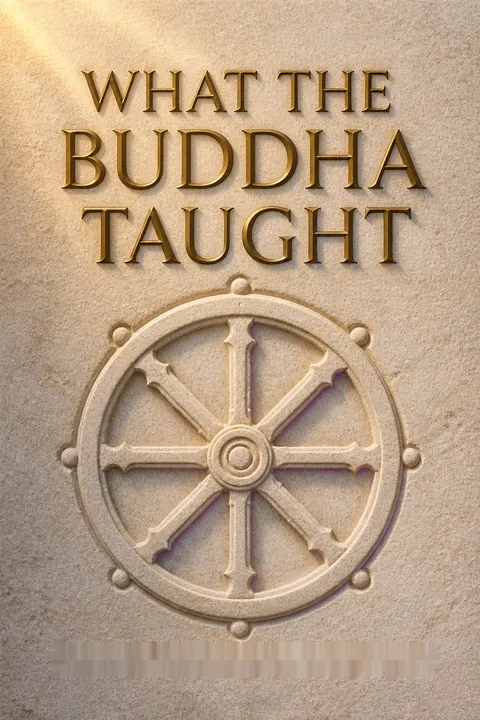
What the Buddha Taught receives high praise for its clear, concise explanation of core Buddhist teachings. Readers appreciate Rahula's focus on original texts and his clarification of misconceptions. Many find it an excellent introduction to Buddhism, though some note its dated language and perspective. The book is valued for its accessibility and depth, covering key concepts like the Four Noble Truths and meditation. While some criticize certain aspects, most reviewers recommend it as a foundational text for those interested in understanding Buddhist philosophy and practice.
People Also Read





Glossary
Four Noble Truths
A diagnosis and pathThe Buddha’s framework for understanding dukkha and liberation. It identifies dukkha, its arising through craving and related conditions, its cessation, and the path leading to cessation. Rahula presents each truth as a task: understand the problem, abandon its cause, realize its ending, and cultivate the path.
Dukkha
Unsatisfactoriness in experienceA Pali term often translated as suffering, but broader in meaning. It includes direct pain, distress when pleasant conditions change, and the instability of conditioned experience. In Rahula’s account, it does not mean that life contains no happiness; it means that changing things cannot provide permanent satisfaction when treated as permanent.
Tanha
Craving that sustains distressLiterally associated with thirst, tanha means craving or desire that sustains clinging and continued becoming. Rahula distinguishes craving for sense-pleasure, for existence or becoming, and for non-existence. The term also includes attachment to views and ideals, not only desire for physical objects or pleasures.
Paticca-samuppada
Dependent arising of conditionsUsually rendered as Conditioned Genesis or dependent origination, this teaching explains how events and experiences arise through conditions rather than independently. Rahula presents a sequence in which ignorance conditions formations, contact conditions sensation, and craving conditions clinging and becoming. The sequence is interdependent, not an appeal to one absolute first cause.
Five Aggregates
Components of personhoodThe five groups used to analyze what is conventionally called a person: matter, sensation, perception, mental formations, and consciousness. Rahula emphasizes that each is changing and conditioned. Their combination accounts for experience without requiring a separate, permanent soul or self behind them.
Anatta
Absence of permanent selfThe teaching of no-self or no-soul. It denies that an enduring, independent entity exists within or behind a person’s changing experience. Rahula presents anatta as an analysis of the Five Aggregates, not as a denial that people exist in ordinary life or that actions have consequences.
Nirvana
Cessation of cravingThe Buddhist goal described by Rahula as liberation through the ending of craving, hatred, and ignorance. It is not a heavenly location or the destruction of a permanent soul. The book treats Nirvana as ultimate truth, realized through the path and possible in this life, while warning that language can easily distort its meaning.
Noble Eightfold Path
Integrated training for liberationThe path leading to the cessation of dukkha, consisting of right understanding, thought, speech, action, livelihood, effort, mindfulness, and concentration. Rahula groups these factors as wisdom, ethical conduct, and mental discipline. They support one another and are cultivated together, rather than followed as a rigid sequence.
Bhavana
Mental cultivationA Pali term often translated as meditation, meaning cultivation or development of the mind. In Rahula’s account, bhavana includes more than formal sitting practice. It develops qualities such as mindfulness, concentration, energy, and insight, and can be practiced while attending to ordinary actions and experience.
Satipatthana
Foundations of mindfulnessA framework for cultivating mindfulness through observation of body, feelings, mind, and mental objects. Rahula emphasizes that it concerns lived experience and everyday activity, not withdrawal from life. Its purpose is to understand how states arise and cease without clinging to them as self.
Karma
Intentional action and resultsIn the Buddhist teaching discussed by Rahula, karma means intentional action, especially action expressed through body, speech, or mind. It does not mean the result of an action, nor a system of divine reward and punishment. Intentional actions condition consequences and may contribute to continued becoming.
FAQ
What's "What the Buddha Taught" about?
- Overview of Teachings: "What the Buddha Taught" by Walpola Rahula provides a comprehensive introduction to the fundamental teachings of the Buddha, focusing on the Four Noble Truths and the Noble Eightfold Path.
- Clarification of Misconceptions: The book aims to clarify common misconceptions about Buddhism, such as the belief that it is pessimistic or solely for monks.
- Practical Application: It emphasizes the practical application of Buddhist teachings in everyday life, making it accessible to both laypeople and scholars.
- Inclusion of Texts: The book includes translations of key Buddhist texts, such as selections from the Suttas and the Dhammapada, to illustrate the teachings.
Why should I read "What the Buddha Taught"?
- Authoritative Source: Written by a respected Buddhist monk and scholar, the book offers an authoritative and clear explanation of Buddhist teachings.
- Comprehensive Introduction: It serves as an excellent introduction for those new to Buddhism, covering essential concepts and practices.
- Practical Insights: The book provides practical insights into how Buddhist teachings can be applied to modern life, promoting peace and understanding.
- Cultural Understanding: Reading this book can enhance your understanding of Buddhist culture and philosophy, which is influential in many parts of the world.
What are the key takeaways of "What the Buddha Taught"?
- Four Noble Truths: The book explains the core Buddhist concept of the Four Noble Truths, which outline the nature of suffering and the path to liberation.
- Noble Eightfold Path: It details the Noble Eightfold Path, a guide for ethical and mental development leading to enlightenment.
- Anatta Doctrine: The book discusses the doctrine of Anatta, or "No-Soul," which challenges the notion of a permanent self.
- Practical Meditation: It emphasizes the importance of meditation and mindfulness as tools for achieving mental clarity and peace.
What is the Buddhist attitude of mind according to "What the Buddha Taught"?
- Supremacy of Man: Buddhism places man in a supreme position, emphasizing personal responsibility and the potential for self-liberation.
- Freedom of Thought: The Buddha encouraged freedom of thought and inquiry, advising followers to question and understand teachings rather than accept them blindly.
- Tolerance and Non-Violence: The book highlights Buddhism's emphasis on tolerance and non-violence, advocating for peaceful coexistence and understanding.
- Practical Approach: Buddhism is presented as a practical philosophy, focusing on real-world application rather than metaphysical speculation.
How does "What the Buddha Taught" explain the Four Noble Truths?
- Dukkha (Suffering): The First Noble Truth acknowledges the presence of suffering in life, encompassing not just pain but also impermanence and insubstantiality.
- Samudaya (Origin of Suffering): The Second Noble Truth identifies craving or "thirst" as the root cause of suffering, leading to rebirth and continued existence.
- Nirodha (Cessation of Suffering): The Third Noble Truth asserts that the cessation of suffering is possible through the elimination of craving, leading to Nirvana.
- Magga (Path to Cessation): The Fourth Noble Truth outlines the Noble Eightfold Path as the means to end suffering and achieve enlightenment.
What is the Noble Eightfold Path as described in "What the Buddha Taught"?
- Right Understanding: Understanding the nature of reality and the Four Noble Truths.
- Right Thought: Cultivating thoughts of selflessness, love, and non-violence.
- Right Speech, Action, and Livelihood: Engaging in ethical conduct through truthful speech, non-harmful actions, and honest livelihood.
- Right Effort, Mindfulness, and Concentration: Developing mental discipline through effort, mindfulness, and concentration to achieve wisdom and liberation.
What is the doctrine of Anatta in "What the Buddha Taught"?
- No Permanent Self: Anatta, or "No-Soul," is the Buddhist doctrine that denies the existence of a permanent, unchanging self or soul.
- Five Aggregates: The book explains that what we consider the self is a combination of five aggregates: matter, sensation, perception, mental formations, and consciousness.
- Source of Suffering: The belief in a self leads to attachment and suffering, and understanding Anatta is key to liberation.
- Practical Implications: Realizing Anatta helps in overcoming ego and achieving a state of non-attachment and peace.
How does "What the Buddha Taught" address meditation?
- Mental Culture: Meditation, or Bhavana, is described as mental culture aimed at cleansing the mind of impurities and developing concentration and insight.
- Two Forms: The book distinguishes between Samatha (concentration) and Vipassana (insight) meditation, with the latter being essential for realizing Nirvana.
- Mindfulness Practice: Emphasis is placed on mindfulness of breathing and awareness of bodily activities, feelings, and thoughts as foundational practices.
- Practical Benefits: Meditation is presented as a practical tool for achieving mental clarity, relaxation, and peace in daily life.
What does "What the Buddha Taught" say about Buddhism and the modern world?
- Applicable to All: The book argues that Buddhism is not just for monks but is applicable to laypeople living in the modern world.
- Social and Economic Welfare: It highlights the Buddha's concern for social and economic welfare, advocating for ethical living and community well-being.
- Non-Violence and Peace: Buddhism's message of non-violence and peace is presented as relevant and necessary in today's conflict-ridden world.
- Practical Wisdom: The teachings offer practical wisdom for addressing contemporary issues such as materialism, stress, and interpersonal conflicts.
What are the best quotes from "What the Buddha Taught" and what do they mean?
- "One is one's own refuge": This quote emphasizes personal responsibility and the potential for self-liberation without reliance on external forces.
- "Truth is not negative": It highlights the positive nature of realizing the truth of Anatta and Nirvana, dispelling the illusion of a permanent self.
- "Hatred is never appeased by hatred": This underscores the Buddhist principle of overcoming hatred with love and kindness, promoting peace and harmony.
- "The victor breeds hatred": It reflects the futility of conquest and the value of self-conquest as the true path to peace and happiness.
How does "What the Buddha Taught" explain the concept of Nirvana?
- Beyond Duality: Nirvana is described as the cessation of suffering and the realization of ultimate truth, beyond duality and relativity.
- Not a Result: It is not a result of any action but a state to be realized through wisdom and insight.
- Freedom from Craving: Nirvana is achieved by extinguishing the "thirst" or craving that leads to suffering and rebirth.
- State of Happiness: It is a state of perfect mental health, peace, and happiness, free from the defilements of desire, hatred, and ignorance.
Download PDF
Download EPUB
.epub digital book format is ideal for reading ebooks on phones, tablets, and e-readers.








