

Key Takeaways
Awaken by attending to the life already unfolding in front of you.
The search turns around. Gautama, raised in comfort, was shaken by the discovery that illness, aging, and death reach everyone. He gave up the prospect of ruling and spent years seeking an answer, until he recognized that freedom depended not on acquiring a theory, but on seeing experience clearly. Hagen presents the Buddha as a human being who woke up, not a god offering salvation from elsewhere.
The book’s central instruction is awareness: notice what is happening now, before wishes and explanations take over. Its banquet image captures the irony. People can be surrounded by what sustains them yet remain unable to recognize their real hunger. The task is not to escape ordinary life, but to become present to it.
What's striking is the reversal of the usual self-improvement story. The remedy is not a more impressive future self, but closer contact with the life that is already here. Acceptance-based therapies make a related distinction: pain may be unavoidable, while the struggle to deny or outrun it can add a second layer of distress. Still, presence should not be confused with passivity. Attending carefully can reveal when action, treatment, or protection is needed. Awareness is most useful not as retreat from the world, but as a better starting point for responding to it.
Expect difficulty; stop demanding that life become problem-free.
Dissatisfaction has a shape. Hagen uses the Sanskrit term duhkha for more than obvious suffering. It describes the recurring mismatch between our wish for stability and a world that keeps changing. Its forms include direct physical or emotional pain, the unease that comes with change, and the deeper anxiety of existing as a seemingly separate being who must die.
A farmer asks the Buddha to solve troubles involving crops, marriage, and children. The Buddha says that ordinary difficulties cannot all be removed. The extra trouble is the demand to have no trouble at all. This does not mean that pain is imaginary or that practical problems should be ignored. It means that distress grows when reality is treated as a failed version of the life one thinks ought to exist.
The distinction between pain and resistance is psychologically useful, especially when a situation cannot be controlled. It also needs careful boundaries. Illness, poverty, violence, and discrimination are not merely mistaken attitudes; they have material causes and call for material responses. The argument is strongest when applied to the additional burden of insisting that hardship must not exist. It is weaker if used to tell people that suffering is their own fault. A clear account of distress should make room for both inner habits and external conditions.
Notice craving before trying to crush it.
Wanting feeds wanting. Hagen describes three forms of craving: pursuit of pleasurable experience, the wish to continue existing, and the wish to escape existence. The objects differ, but each begins when the mind treats something as separate and insists that it must be gained, kept, or removed.
Trying to command desire to disappear can become another desire: wanting not to want. Hagen therefore recommends noticing the pull without condemning or indulging it. A story from his own life shows how interpretation matters. When he first thought a person had slashed his car roof, he felt anger and despair. Learning that a raccoon had torn into the car to reach food changed his response. The damage remained, but the story of malicious intent had dissolved.
This resembles urge-surfing approaches, in which a person observes an impulse as a changing event instead of treating it as an order. The method can create space between feeling and action without requiring a battle against the feeling itself. The raccoon episode also shows how judgments depend on inferred motives, not only visible outcomes. Yet some cravings signal genuine needs, including hunger, safety, or connection. Observing an urge should clarify what it is asking for, not automatically discredit it. The useful question is whether a response is wise, not whether desire is bad.
Test teachings against experience instead of mistaking maps for truth.
A teaching is a pointer. Hagen rejects the idea that awakening requires accepting Buddhist doctrine, ritual, or a teacher's authority. His test is practical: examine what is happening and find out whether a claim holds up in experience. Belief can be a provisional guide when evidence is absent, but it is not the same as seeing something directly.
Books and teachings can help orient attention, yet they cannot do the seeing for the reader. Hagen compares them to a raft useful for crossing water, not an object to carry forever. This applies to his own book as well. The point is not to replace one rigid belief system with another, but to use ideas as aids and let them go when they obscure the experience they were meant to clarify.
The invitation to test claims is an important safeguard against religious authority and unexamined tradition. It also raises a philosophical complication: experience is not a neutral recording. Attention, memory, language, and prior learning shape what people notice and how they interpret it. Contemporary theories of perception emphasize this interplay between incoming signals and expectation. That does not make firsthand inquiry worthless; it makes humility essential. A sound practice treats experience as evidence to examine, not as an infallible verdict that ends discussion.
Trade the permanent self for a changing stream, not nihilism.
No fixed core appears. Hagen challenges the assumption that a person must contain an unchanging self that persists unchanged through time. Body, memory, thought, and feeling all shift. He calls a person a stream: a continuing process, not a solid passenger carried through life untouched by change.
This view avoids two extremes. An eternal soul that remains wholly unchanged is not found in immediate experience; neither is the claim that experience is nothing but inert matter. The book asks readers to look for the supposedly permanent self rather than simply accept or deny it. Its conclusion is not that people do not matter, but that no separate, lasting entity can be isolated as the owner of every experience.
The stream image connects with modern accounts of identity as something maintained through memory, bodily continuity, and social relationships rather than housed in a single inner object. This can loosen rigid self-stories without erasing practical personhood. People still need stable commitments, accountability, and care for their future selves. The philosophical claim that no permanent self is directly observable is stronger than the everyday claim that identity changes. Keeping those levels distinct helps preserve the insight without turning it into a denial of ordinary human needs.
Let awareness, not rigid rules, guide speech, work, and action.
The path is a practice. The Eightfold Path is the Buddha's practical approach to ending confusion. Hagen groups its eight aspects into seeing and intention, ethical conduct, and mental cultivation. They concern understanding experience, examining motives, speaking responsibly, acting without needless harm, earning a living carefully, applying effort, staying mindful, and meditating.
The word samma, commonly translated as right, means appropriate or in tune with reality here, rather than morally perfect in opposition to wrong. Hagen treats the Buddhist precepts as guidance, not inflexible commands. A rule can fail when circumstances collide, while attention to the people affected and one's own motives can reveal a more responsible response. The path is not a checklist for appearing virtuous; it is a way to notice what conduct creates confusion and harm.
This approach resembles practical ethics that weighs context, consequences, and intention instead of relying on a single universal rule. Its strength is moral attentiveness: a person must see who may be harmed and what a situation actually requires. Its risk is that appeals to personal awareness can conceal self-interest or bias. Institutions, shared standards, and accountability remain important precisely because people do not always perceive their motives accurately. Situational judgment works best when it is informed by principles and open to challenge, rather than treated as a license to do whatever feels right.
Return to the breath without turning meditation into another achievement.
Practice is ordinary attention. Hagen describes meditation not as relaxation, trance, or a method for earning enlightenment, but as staying with immediate experience. A simple practice is to sit upright, notice breathing in and out, and count each breath up to ten if attention wanders. When thoughts arise, neither suppress them nor follow them. Notice the distraction and return to the breath without scolding yourself.
The same attention can include posture, sensation, mood, and the chatter of the mind. Hagen recommends beginning with a short daily session, perhaps five minutes, and valuing regularity more than duration. A jogger wearing headphones misses a flock of geese passing close overhead, illustrating how easily a person can move through a vivid moment without registering it. Practice trains the return.
Breath practice gives attention a concrete anchor and makes distraction observable rather than shameful. That supports metacognition, the capacity to notice thoughts as thoughts instead of automatically following them. The instruction to return gently is especially valuable because self-criticism can become another distraction. Meditation is not, however, a guaranteed treatment for every form of distress, nor does the book's emphasis on non-striving make sustained practice effortless. Its modest promise is more credible: repeated attention can improve familiarity with the mind, without requiring a special state.
Understand every person and object through the conditions that sustain it.
Nothing stands alone. Dependent Arising names the principle that experience occurs through conditions: when one set of circumstances appears, related events take shape. A printed book, for instance, depends on sunlight, trees, human labor, language, and technologies of writing and printing. Calling it a book is useful, but the label can hide how much it relies on what lies beyond its apparent boundary.
Hagen distinguishes relative truths, the practical names and facts used in everyday life, from ultimate truth, direct awareness of experience as interconnected and changing. Relative concepts are necessary for ordinary tasks; trouble begins when they are mistaken for independent, permanent things. Seeing relationships more fully can soften blame and simplistic divisions, while also clarifying how choices affect other people and the world.
The emphasis on conditions has a strong parallel in systems thinking, where outcomes emerge from interacting parts rather than isolated causes. It encourages more careful judgments about responsibility and consequence. But interdependence does not mean every cause is equally important, or that complex effects can be predicted from a brief moment of attention. Analysis and evidence still matter. The most practical reading is not that distinctions are useless, but that useful categories should remain revisable, with their limits and dependencies kept in view.
Analysis
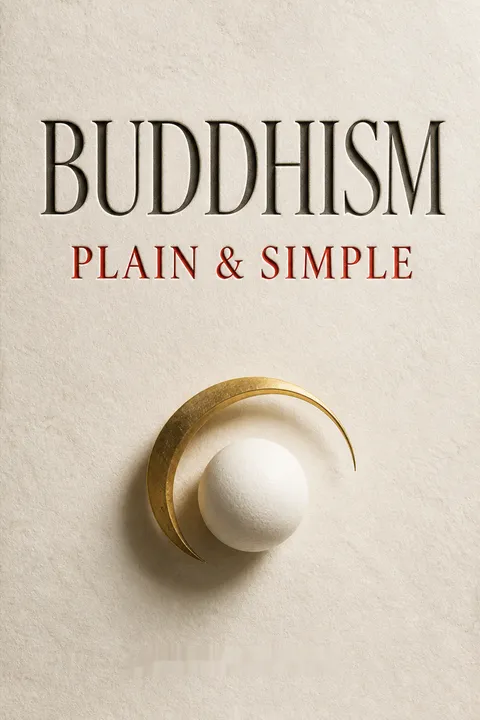
Buddhism Plain and Simple is a practical philosophy organized around a single discipline: attend to experience before converting it into a fixed story about the world or the self. Its narrative starts with Gautama confronting sickness, aging, and death, then turns that existential shock into a program of observation. The progression from dissatisfaction, through craving, toward release and practice gives the book a clear explanatory arc. Personal anecdotes, parables, and meditation instructions keep abstract Buddhist ideas close to daily life.
Hagen's most effective move is to distinguish unavoidable difficulty from the additional distress created by demanding that reality comply with preference. That reframing can reduce futile struggle without promising a painless life. His treatment of intention also links private attention to public conduct: speech, livelihood, and action matter because they affect other lives, not because they earn supernatural reward. The self-as-stream image similarly offers a vivid alternative to both an eternal soul and a picture of life as meaningless machinery.
The book's central claim is also its main vulnerability. It treats direct perception as a route to truth prior to conceptual thought, yet perception is shaped by learning, expectation, and bodily condition. Immediate experience is indispensable evidence, but not an unfiltered view from nowhere. Nor can all suffering be traced to craving or mistaken interpretation. Illness, deprivation, and injustice require changes in circumstances as well as changes in attention. Hagen's argument is most persuasive when it addresses the mental grip added to hardship, not when it appears to make the mind the source of every harm.
The practical lesson survives these limits: concepts and identities can help organize life, but they become burdensome when mistaken for complete descriptions. The book asks readers to test that distinction directly, to notice the mind's tendency to grasp or resist, and to let attention inform conduct. Its aim is not to win a theory of reality, but to make ordinary experience less governed by reflexive certainty and avoidance.
Review Summary
Buddhism Plain and Simple by Steve Hagen receives mostly positive reviews for its clear, concise introduction to Buddhist principles. Readers appreciate its stripped-down approach, focusing on core teachings without cultural or religious trappings. Many find it thought-provoking and potentially life-changing. Some criticize it for oversimplification or lack of practical guidance. The book's emphasis on mindfulness and seeing reality as it is resonates with many readers. While some find it repetitive or confusing, others praise its accessibility and return to it multiple times for insights.
People Also Read







Glossary
duhkha
Recurring dissatisfactionA Buddhist term Hagen uses for more than pain or unhappiness. It includes the strain of physical and emotional suffering, the instability of changing conditions, and the existential unease associated with seeing oneself as a separate being subject to death. In the book, duhkha is linked to craving and to resistance against experience as it is.
samma
In tune with realityA Pali term often translated as right in descriptions of the Eightfold Path. Hagen rejects the sense of right as the opposite of wrong. He uses samma to mean appropriate, conducive to awakening, or aligned with reality, emphasizing clear seeing over rigid moral classification.
Eightfold Path
Practice for ending confusionThe Buddha's eight-part path described by Hagen as a practical way to address dissatisfaction. Its aspects concern view, intention, speech, action, livelihood, effort, mindfulness, and meditation. The parts work together as a way of seeing and living, rather than as a sequence of achievements or a fixed code of behavior.
right view
Seeing without fixed beliefsA way of perceiving experience without becoming trapped by a frozen opinion, identity, or conceptual explanation. Hagen does not mean having no thoughts or views at all. He means recognizing that ideas are not reality itself and remaining responsive to the changing whole of a situation.
Nirvana
Cessation of duhkhaIn Hagen's account, nirvana is the ending of confusion and dissatisfaction through seeing experience clearly. It is not a blank or tranquil oblivion, and it is not a distant place to reach. The term points to freedom from the grasping and mistaken assumptions that sustain duhkha.
Dependent Arising
Events arise through conditionsA Buddhist teaching that phenomena occur in relation to conditions rather than as independent, self-contained entities. Hagen uses the phrase to describe how experience and events are interlinked. Its twelvefold chain presents ignorance, intention, craving, grasping, and distress as connected aspects of bondage, which can cease through seeing.
stream
A person as processHagen's term for a person understood as continuing change rather than as a permanent entity moving unchanged through time. A stream persists through ongoing movement, not through a fixed core. The image is meant to challenge the assumption of an enduring self without denying the reality of experience.
FAQ
What's "Buddhism Plain & Simple" about?
- Author's Background: Written by Steve Hagen, a Zen priest and teacher, the book aims to demystify Buddhism by focusing on its core teachings.
- Core Focus: It emphasizes awareness and direct perception of reality, stripping away cultural and ritualistic elements often associated with Buddhism.
- Structure: The book is divided into three parts, addressing the human condition, the path to awakening, and the nature of a free mind.
- Practical Guidance: It offers practical advice on how to live mindfully and engage with the present moment.
Why should I read "Buddhism Plain & Simple"?
- Clarity and Simplicity: The book presents Buddhism in a straightforward manner, making it accessible to beginners and those unfamiliar with the religion.
- Focus on Awareness: It emphasizes the importance of awareness and mindfulness, which are applicable to everyday life.
- Cultural Neutrality: By avoiding cultural trappings, it provides a universal approach to understanding Buddhism.
- Practical Application: Offers practical steps for incorporating Buddhist principles into daily life, making it relevant for personal growth.
What are the key takeaways of "Buddhism Plain & Simple"?
- Awareness is Key: The essence of Buddhism is awareness, not belief or ritual.
- Understanding Duhkha: Recognizing the nature of suffering (duhkha) and its origins is crucial for liberation.
- Middle Way: The book advocates for a balanced approach, avoiding extremes in thought and action.
- Interdependence: Understanding the interconnectedness of all things is essential for seeing reality as it is.
How does Steve Hagen define enlightenment in "Buddhism Plain & Simple"?
- Direct Perception: Enlightenment is seeing things as they truly are, without the filters of belief or desire.
- Beyond Concepts: It involves moving beyond conceptual thinking to experience reality directly.
- Freedom of Mind: Enlightenment is described as a liberation of the mind, free from confusion and suffering.
- Accessible to All: The book emphasizes that enlightenment is accessible to anyone willing to engage with their actual experience.
What is the "Eightfold Path" according to "Buddhism Plain & Simple"?
- Right View: Understanding the nature of reality and the path to liberation.
- Right Intention: Cultivating a mindset focused on awakening and compassion.
- Right Speech and Action: Engaging in truthful, harmonious, and ethical behavior.
- Right Livelihood and Effort: Earning a living in a way that supports awakening and maintaining a balanced effort in practice.
How does "Buddhism Plain & Simple" address the concept of self?
- Illusion of Self: The book argues that the self is an illusion, a concept that leads to suffering.
- Stream of Experience: Instead of a fixed self, we are a stream of experiences and perceptions.
- No Permanent Identity: There is no unchanging core or identity; everything is in constant flux.
- Freedom from Self: Recognizing the illusion of self leads to liberation and freedom from suffering.
What is "Dependent Arising" in "Buddhism Plain & Simple"?
- Interconnectedness: Dependent Arising explains how all phenomena are interconnected and arise together.
- Chain of Causation: It describes a twelve-link chain that illustrates how ignorance leads to suffering.
- Breaking the Chain: By understanding and seeing this chain, one can break free from the cycle of suffering.
- Practical Insight: The concept encourages seeing the world as a seamless whole, rather than as separate entities.
What practical advice does "Buddhism Plain & Simple" offer for daily life?
- Mindfulness Practice: Encourages regular meditation and mindfulness to stay present and aware.
- Observing Intentions: Advises observing one's intentions and actions to ensure they align with awakening.
- Living in the Moment: Emphasizes the importance of engaging fully with the present moment.
- Letting Go of Control: Suggests releasing the desire to control outcomes and instead focus on seeing reality clearly.
What are the best quotes from "Buddhism Plain & Simple" and what do they mean?
- "Be a light unto yourself": Encourages self-reliance and personal responsibility in seeking truth.
- "Seeing is believing": Highlights the importance of direct perception over conceptual belief.
- "You are already enlightened": Suggests that enlightenment is not something to be attained but realized.
- "The point of Buddhism is to just see": Emphasizes the core practice of awareness and direct experience.
How does "Buddhism Plain & Simple" differentiate between belief and seeing?
- Belief as Limitation: Beliefs are seen as limited and often misleading, preventing true understanding.
- Seeing as Direct Experience: True knowledge comes from direct perception, not from holding beliefs.
- Beyond Concepts: Seeing involves moving beyond conceptual frameworks to experience reality directly.
- Certainty in Seeing: Unlike beliefs, seeing provides certainty and clarity, free from doubt.
How does "Buddhism Plain & Simple" approach the topic of morality?
- Beyond Rules: Morality is not about following rules but about seeing and understanding the whole situation.
- Intentions Matter: Right action arises from right intention, which is rooted in awareness and compassion.
- Contextual Ethics: Moral actions are determined by the context and the inclination of the mind.
- Natural Morality: When one sees clearly, moral actions naturally follow without the need for rigid rules.
What is the significance of the "Middle Way" in "Buddhism Plain & Simple"?
- Avoiding Extremes: The Middle Way avoids the extremes of eternalism and nihilism, focusing on balance.
- Practical Approach: It offers a practical path that is applicable to everyday life and decision-making.
- Dynamic Balance: Encourages a flexible and adaptive mindset, open to change and new insights.
- Foundation for Awakening: The Middle Way is the foundation for awakening, leading to a free and enlightened mind.
About the Author
Download PDF
Download EPUB
.epub digital book format is ideal for reading ebooks on phones, tablets, and e-readers.








