

Plot Summary
The Crossing Is Announced
In 1934, Bình watches Gertrude Stein and Alice B. Toklas prepare to leave Paris for a lecture tour across America. Photographers gather at their door, making clear that the women now belong to a public eager to claim them. Their cook has spent five years in their home, but the journey makes him wonder whether he will soon be unemployed and alone again.
A letter from his oldest brother, Anh Minh, has finally arrived after years of silence. It urges Bình to come home and hints that the family has changed. At the Gare du Nord, Bình keeps the letter in his worn suit and studies the departing women, caught between the fear of starting over and the pull of Vietnam.
The opening makes departure both a public spectacle and a private threat. Stein and Toklas can turn travel into an event because fame gives them an audience; Bình experiences the same journey as a possible loss of wages, shelter, and belonging. The delayed letter intensifies that uncertainty by making home neither a refuge nor a known quantity. His position behind the women in the station photograph captures the novel’s central imbalance: he is indispensable to their daily lives, yet largely invisible in the story the world sees. His hesitation is not indecision alone. It is the hard-won caution of someone whose choices have repeatedly been made by other people.
A Cook Finds Rue Fleurus
Years earlier, in 1929, Bình studies a notice seeking a live-in cook for two American women at 27 rue de Fleurus. He has been in Paris for three years, taking short domestic jobs that end when employers reject his accent, his appearance, or the gaps in his history. Knowing the city’s streets better than he can speak its language, he finds the address and meets Alice B.
Toklas. Gertrude Stein soon tests his French through a comic exchange about a pineapple he cannot name. His gestures win her interest, while his cooking secures the position. Bình enters a household where two women share a home and a life, and where his skill gives him a room, regular meals, and a place to remain.
The job notice offers more than employment: it interrupts Bình’s cycle of temporary rooms and unexplained dismissals. His linguistic limitation is not simply a deficiency. It forces him to improvise with gesture, repetition, and food, making communication an embodied skill rather than a test he can pass only on French terms. Stein recognizes creative possibility in the very habits that employers might dismiss as awkward. Yet the security is conditional. Bình enters as a servant, and the household’s warmth does not erase the unequal arrangement that keeps his labor necessary and his identity easy to misname.
The Apron and the Old Man
Bình’s route out of Saigon began in childhood, in a house ruled by the Old Man, a violent father who called his sons stupid and used religious authority to control the poor. Bình’s mother built a small food business in her kitchen, while Anh Minh found his measure of success as sous chef in the Governor-General’s household.
He taught Bình kitchen discipline and French, hoping his younger brother might rise through the same ranks. At the Governor-General’s, however, French chefs held authority over Vietnamese staff, and Anh Minh remained subordinate when Jean Blériot arrived from France.
Bình, then a young garde-manger, was assigned to guide Blériot through the markets. Their daily trips brought them close, and Bình’s professional lessons began to mingle with desire.
The kitchen gives Bình both a trade and a vocabulary for imagining a life beyond his father’s reach. Anh Minh treats professional skill as a ladder, but the colonial hierarchy keeps its upper rungs reserved for Frenchmen, exposing the limits of merit within an unequal institution. The Old Man’s cruelty also makes authority emotionally suspect: his religious certainty masks self-interest, while Anh Minh’s approval offers a rare counterweight. Blériot’s arrival therefore introduces more than attraction. It places Bình’s desire inside a structure where race, rank, and employment shape what intimacy can safely mean.
Blériot’s Kitchen Affair
As Blériot and Bình make repeated market trips, shared work and private encounters grow into a sexual relationship. Bình knows the difference in their rank and does not mistake Blériot for a rescuer, but he chooses the risk because his life offers little he feels compelled to protect. The Governor-General’s secretary, who wants Blériot for herself, notices the pair’s closeness.
She uses the chauffeur’s observations to construct an accusation, persuades Madame to dismiss Blériot, and informs the Old Man about Bình. Anh Minh cannot shield his brother from the consequences. Bình leaves the household and the family home, losing his position, his brother’s confidence, and the future of advancement Anh Minh had imagined for him.
The affair is not framed as a simple romance destroyed by jealousy. Its consequences reveal how vulnerable private life becomes when one partner controls the other’s livelihood and when colonial employers can expel workers at will. The secretary weaponizes the household’s racial and sexual assumptions, while the chauffeur’s imperfect sympathy cannot undo what his information sets in motion. Bình’s choice is neither pure liberation nor mere recklessness: it asserts desire within a system that punishes him for having it. Anh Minh’s disappointment hurts because his plan was also an act of care, but it asked Bình to survive by accepting a future that did not feel like his own.
Bình Takes to Sea
After losing both jobs, Bình boards the freighter Niobe because he needs somewhere to sleep and a way out. Seasickness and menial galley work reduce him to a kitchen boy, despite his experience in a prestigious household. His bunkmate, the sailor Bão, keeps him company with stories and jokes, including a tale about a basket weaver whose craft fails whenever he leaves his native land.
Before Bình sails, his mother presses a red pouch into his hand. He assumes it holds money, then discovers at sea that it contains gold leaf. Bão later carries it back to Saigon for Anh Minh to return to their mother, while Bình remains abroad, moving between ships and eventually settling in Paris.
The voyage turns exile into a material condition: Bình can carry his knife skills across borders, but the social value of those skills changes with each port and employer. Bão’s basket-weaver story gives shape to the fear that some forms of livelihood depend on a particular soil, while the red pouch binds Bình to the mother he has left. Its gold is not a convenient fortune that rescues him. It becomes a promise he cannot fulfill directly, entrusted instead to a sailor. The sea offers distance from the Old Man, but it cannot sever the emotional obligations that travel with Bình.
The Man on the Bridge
In 1927, while living precariously in Paris, Bình meets a Vietnamese man beside the Seine. They recognize one another as fellow outsiders and trade stories about work, travel, and the streets they have inhabited. The man has been a cook, sailor, laborer, and teacher; Bình recognizes the same unsettled life in himself.
He invites Bình to a Vietnamese restaurant, where the chef serves food shaped by many countries rather than one tradition. They share a generous meal and walk together through the night. The stranger is leaving Paris that evening, and he refuses Bình’s offer to accompany him to the station. Bình returns alone to the bridge, but the meeting gives the city a new promise: he may see the man again.
The encounter briefly reverses the usual pattern of Bình’s Parisian life. Rather than being examined as a foreign laborer, he meets someone who understands displacement without requiring him to explain it. Their meal matters because the chef’s mixed culinary practice makes travel visible as transformation, not simply loss of origin. Yet the stranger departs before intimacy can become a shared life. The bridge, joining two banks while belonging to neither, gives Bình an image for connection that is real but provisional. His decision to remain in Paris is therefore partly a wager on the possibility of return.
A Sunday Reappears
Years later, the stranger appears at Stein and Toklas’s Saturday tea, introduced as Marcus Lattimore, an American writer seeking a cook for a Sunday dinner. Bình recognizes him, though neither man makes their earlier meeting the center of the encounter. Lattimore hires him, and the meal becomes an evening alone together rather than the dinner party Bình expected.
They eat, drink, and begin an affair shaped by uneven languages and carefully chosen gestures. Lattimore calls Bình by an Americanized nickname, while Bình listens closely to his voice and imagines the scholar-prince from his mother’s stories. Sundays become their private time, and Bình returns to the rue de Fleurus before dawn so he can keep his position.
The earlier stranger’s return converts a fleeting encounter into a relationship, but recognition does not make the lovers equally secure. Lattimore can move between the public world of Stein’s literary circle and the private garret; Bình must preserve his employment by timing each visit around the household’s routines. Their shared language is French, imperfectly possessed by both, so intimacy depends on bodies, food, and interpretation as much as words. Bình’s fantasy of a scholar-prince makes love legible through a story inherited from his mother, but it also shows how easily hope can be mistaken for evidence of permanence.
Lattimore Reads the Eyes
During their Sundays, Lattimore tells Bình how he left the American South and built a life in Paris using money from his mother. He presents himself as an iridologist, claiming that patterns in the iris reveal bodily weaknesses and future illness. His clients include Prince Norodom of Cambodia and the young Emperor of Vietnam.
Lattimore identifies signs of impotence in both men, and each collapses under the diagnosis. The stories expose the confidence and theater behind his practice, but Bình is more interested in the man beneath the professional performance: a son marked by racial ancestry, estrangement, and dependence on inherited money. Meanwhile, Lattimore grows curious about Stein’s writing and asks Bình about her private papers.
Iridology mirrors the novel’s persistent question of how much can truly be known by looking. Lattimore claims to read hidden futures from the eye, yet his own past is carefully managed through performance and selective disclosure. His encounters with the Emperor and Prince make his confidence visible, but they also reveal how authority can be produced through a ritual of examination. Bình, trained to notice bodies because language often excludes him, is both drawn to and skeptical of this claim to insight. Lattimore’s curiosity about Stein’s papers shifts their intimacy toward a new transaction, one in which Bình’s access to the household becomes a resource.
The Notebook Leaves Fleurus
As Stein’s reputation rises, photographers crowd the rue de Fleurus, and Lattimore becomes increasingly interested in her unpublished pages. He asks Bình to take a notebook from the cupboard where Toklas keeps Stein’s manuscripts.
Bình first resists, aware that Stein and Toklas have made a home for him and share their meals with him. But he also wants a photograph with Lattimore, and he yields to the request. In the notebook, he recognizes his own name repeated among Stein’s words and feels that his life has become material for someone else.
He gives the notebook to Lattimore. Soon afterward, Lattimore leaves Paris, leaving a note of thanks that says Stein has rendered Bình accurately. At Lené’s studio, Bình finds a salt-print portrait of the man from the bridge, identified by an adopted name.
The notebook theft is the story’s sharpest conflict between intimacy and ownership. Bình wants to be seen by Lattimore, yet the stolen pages make him confront the possibility that being represented is another form of being used. His choice is not simply criminal or romantic: it attempts to purchase closeness with an act that compromises the household that has sheltered him. Lattimore’s departure leaves the exchange brutally unequal, while the note reduces a relationship to a judgment of literary accuracy. The photograph offers Bình an image in place of the person, a tangible trace that cannot answer whether the love he imagined was mutual.
A Pigeon Falls in Snow
After Lattimore leaves, Bình spends a winter day in the Luxembourg Gardens and watches children gather around an injured pigeon. One girl tries to shelter it; a boy prods it with a stick. A woman finally cups the bird in her hands and moves it away from the children, while Bình shouts at them to stop.
The sight recalls his mother, whose life began in a forced marriage to the Old Man and continued through years of labor, grief, and stubborn survival. She had protected Bình as a child and secretly given him the red pouch before he left Vietnam. Now, in his imagination, she appears in a gray dress and leaves the Old Man’s house, a vision of the courage Bình wishes he could give her.
The injured pigeon makes vulnerability public, while the crowd’s hesitation shows how easily suffering becomes spectacle. The woman’s intervention matters because she acts without certainty that the bird can be saved. Bình’s response links this small rescue to his mother’s history, but his imagined farewell also exposes the limits of his knowledge: he cannot return to repair her life or confirm what she felt. His mother’s endurance is not romanticized as effortless strength. It is a practiced survival shaped by coercion, compromise, and a refusal to surrender all ownership of herself.
The Letter Confirms Loss
As Stein and Toklas’s American departure approaches, another letter from Anh Minh reaches Bình. Their father has suffered a stroke and now lies helpless, while their mother has died. Anh Minh describes her passing through Catholic faith, but Bình remembers the woman who kept her own Buddhist and ancestral practices and protected her sons in the kitchen.
He imagines her leaving the Old Man’s house in the gray áo dài she had saved for the future. The news does not make him ready to return. The father who once denied him as a son is still alive, and the brother who asks him home cannot erase that history. Bình reads the letter in the kitchen, then speaks aloud, startled by his own voice.
The letter changes the meaning of home without resolving it. Anh Minh offers the family’s losses through the language of Catholic consolation, but Bình cannot simply adopt that account of their mother. His memory preserves her as a person who combined religious traditions and made choices within severe limits. The surviving father remains the obstacle around which the family story turns, now physically weakened but not emotionally absolved. Bình’s spoken response marks a small change in his relation to himself: a man accustomed to being misnamed and unheard discovers that his own voice can still emerge.
Bình Stays on Shore
At the Gare du Nord and later in Le Havre, Bình helps Stein and Toklas manage their trunks, photographers, and final preparations. The women leave their dogs in Paris, and Bình understands that he too will remain behind. Toklas offers him either a return ticket to Paris or cash for a one-way journey elsewhere. He takes the money, refusing to decide where to go before he must.
At the docks, he sews a loose button onto Stein’s shoe while photographers record the women aboard the SS Champlain. Then he watches the ship depart. The letter from Anh Minh, the absent Lattimore, and the loss of his mother travel with him, but none dictates his next destination. His future is uncertain, and for once the uncertainty belongs to him.
The ending answers the opening’s fear of being left behind by separating abandonment from choice. Bình does not follow Stein and Toklas to America, nor does he return to Vietnam under the pressure of family duty. Taking cash rather than a ticket preserves possibility, a modest act of agency for someone whose life has often been routed by employers, poverty, and colonial borders. His last task is still service, sewing Stein’s button as the cameras look on, but the image no longer exhausts his identity. He remains outside the frame of the famous voyage, carrying a story that he has begun to claim as his own.
Analysis
The Book of Salt makes domestic labor the ground on which questions of identity, intimacy, and authorship become concrete. Bình feeds Stein and Toklas, yet the meals do not make him their equal; the novel instead asks what recognition looks like when a worker is welcomed into private rituals but remains socially disposable. Food offers him a form of expertise that survives linguistic exclusion, while salt links taste to the bodily evidence of labor, grief, and travel.
The book’s shifting chronology resists a simple progress narrative. Memories of Saigon, the ship, the bridge, and Paris return as Bình tries to interpret the present, much as the sea repeatedly rearranges his sense of distance. His remembered father’s voice functions as an internalized authority, showing how coercion continues after the body has escaped its source. His mother’s kitchen provides a different inheritance: practical knowledge, stories, and a model of endurance that does not require submission to a single faith or identity.
Lattimore’s relationship with Bình tests the distinction between being loved and being useful. Both men know forms of displacement, but they do not share equal freedom to leave, to conceal themselves, or to turn another person’s history into material. The stolen notebook makes this problem explicit. Bình wants a record of himself, yet discovers that representation can still be a form of appropriation. Stein’s fame, like the colonial household in Saigon, depends on networks of labor that the celebrated figure does not fully control or acknowledge.
The ending offers no tidy homecoming. Bình sends the famous women across the Atlantic and refuses a predetermined return route. His choice is modest, financially precarious, and meaningful precisely because it remains open. The story belongs to him not because every wound is repaired, but because he continues to interpret what happened rather than letting employers, family, lovers, or authors have the final word.
Review Summary
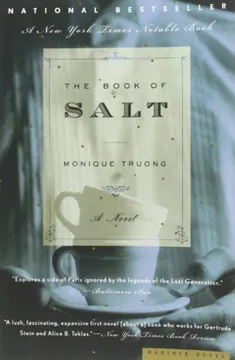
The Book of Salt received mixed reviews, with praise for its poetic prose, rich sensory descriptions, and exploration of themes like colonialism, sexuality, and identity. Critics lauded Truong's unique perspective and characterization of the Vietnamese cook working for Gertrude Stein and Alice B. Toklas in 1930s Paris. However, some found the non-linear narrative and stream-of-consciousness style challenging to follow. While many appreciated the novel's literary merit, others felt it lacked a cohesive plot. Overall, reviewers admired Truong's debut for its lyrical language and cultural insights.
Characters
Bình
Exiled cook and witnessA Vietnamese cook who moves between Saigon, ships, and Paris, Bình is alert to the hierarchies that others prefer not to see. His French remains imperfect, but his sensory intelligence is exact: he reads streets, food, gestures, and silences with unusual precision. Cooking gives him employment and a language of care, while desire repeatedly exposes him to rejection and danger. He has learned to make himself useful in households that may never regard him as fully human, yet he is not simply passive. His humor, imagination, and ability to question the stories told about him keep a private self alive beneath the servant’s role. The novel follows his struggle to decide what home and belonging can mean when both have caused pain.
Alice B. Toklas
Keeper of the householdToklas is Stein’s companion, editor, cook, and practical guardian of their shared life. She attends to manuscripts, meals, visitors, and domestic boundaries with a precision that can be both protective and controlling. Her devotion to Stein is profound, but she has a strong inner life of her own, shaped by spiritual longing, sensual pleasure, and a sharp awareness of what must be preserved. She understands that care is made of repeated acts, from feeding a lover to safeguarding a page. With Bình, she is exacting about food and conduct, yet she also offers him a rare form of trust and inclusion. Her apparent selflessness conceals discernment and desire.
Gertrude Stein
Writer at the centerStein is an American writer whose confidence, appetite, and force of personality shape the household at 27 rue de Fleurus. She relishes attention and tests the people around her, while Toklas manages much of the daily labor that makes her work possible. Her unconventional writing and growing public reputation draw visitors, admirers, and photographers. To Bình, she is employer, conversational puzzle, and a person whose attention can feel like recognition even when it is also an act of possession. Stein trusts her own judgments, sometimes too readily, and expects the world to meet her on her terms. Her dependence on Toklas and on domestic workers complicates the image of the self-made genius.
Marcus Lattimore
Bình’s elusive loverLattimore is an American from the South who lives in Paris and presents himself as an iridologist. He is self-possessed, observant, and adept at moving among social settings, yet his family history leaves him acutely conscious of race, legitimacy, and the protection that money can provide. His first connection with Bình arises from shared displacement and an unusual attentiveness to the other man’s life. Their relationship develops through meals, Sundays, and bodily communication, but Lattimore’s curiosity is not always separable from ambition. He is drawn to Stein’s literary world and to what Bình can reveal about it. His charm and vulnerability coexist with a guardedness that makes his intentions difficult to read.
Bình’s mother
Kitchen’s quiet protectorBình’s mother is a resourceful woman married young to the Old Man and forced to build a life inside a household governed by male power. Her kitchen becomes her working territory, where she prepares food for sale, raises her sons, and preserves spiritual practices that her husband does not share. She is neither an unbroken saint nor a simple victim. She experiences guilt, longing, tenderness, and anger, and she learns to survive by bending without surrendering every part of herself. Her stories give Bình an imaginative language for love, while her practical care teaches him how to work. She remains central to his understanding of home even when distance separates them.
Anh Minh
Brother and kitchen mentorBình’s oldest brother is a skilled sous chef in the Governor-General’s household and the person who first teaches him how a professional kitchen works. Anh Minh believes in advancement through discipline, language, and loyalty, and he tries to create a safer future for Bình by guiding him into the trade. His ambition is sincere, but it is shaped by a colonial system that limits how far a Vietnamese servant can rise. He loves his younger brother while struggling to understand choices that endanger the future he planned for him. Anh Minh’s practical lessons, silences, and rare acts of help remain with Bình long after the brothers are separated.
The Old Man
Father and family tyrantThe Old Man is Bình’s father, a Catholic convert who turns religious authority into a means of control and profit. He exploits the desperation of gamblers and treats his wife and sons as extensions of his own will. His violence is physical when Bình is young and later becomes a stream of remembered insults that follows the son abroad. He prizes Anh Minh’s professional success because it reflects well on him, while treating Bình as a disappointment. Even in memory, he remains difficult for Bình to escape. His character shows how belief can become another instrument of power when it is severed from compassion.
Bão
Sailor and storytellerBão is Bình’s bunkmate aboard the Niobe, a sailor whose stories, jokes, and physical warmth help a seasick young man endure the voyage. He enjoys making himself the hero of his tales, but his humor also gives Bình companionship when language and land have both fallen away. His stories about work, desire, and travel often carry lessons that Bình only understands later. Bão does not explain everything he feels, and his reticence leaves Bình to imagine the missing parts. His return voyage also makes him a link between Bình’s life in France and the family he left in Vietnam.
Jean Blériot
French chef and loverBlériot arrives in Saigon as the French chef de cuisine at the Governor-General’s house, taking the authority Anh Minh had hoped to earn. He is commanding, handsome, and exacting in the kitchen, but his private intimacy with Bình unsettles the rigid roles he enforces in public. Their relationship gives Bình a glimpse of desire beyond the family’s expectations, while the difference in rank remains impossible to ignore. Blériot is not a simple villain or a rescuer. He is a man whose privilege lets him occupy a position Bình can never share on equal terms.
The chauffeur
Observer with divided loyaltiesThe Governor-General’s chauffeur is an educated Vietnamese man whose time in France has left him with ambitions and disappointments. He enjoys poetry, gossip, and the sound of his own French, and he watches the household closely. His observations help expose the relationship between Bình and Blériot, though he also tries to offer Bình advice and medical information. The chauffeur’s mixture of curiosity, regret, and imperfect sympathy makes him more than a simple informant. He understands some of the constraints around Bình’s life, but understanding does not prevent him from contributing to its consequences.
Madame’s secretary
Architect of the accusationThe Vietnamese secretary in the Governor-General’s household speaks and writes French fluently, a skill that gives her access unavailable to most staff. She is ambitious, attentive to appearances, and determined to secure Blériot’s interest. When desire and competition collide, she uses her position to shape what the household believes about him and Bình. Her actions reveal how colonial power can be exercised not only by French employers but also through the unequal opportunities that staff members compete for.
Anh Hoàng
Brother on the railwaysBình’s brother Hoàng works as a porter on the railways, carrying luggage for French travelers while hoping for a better position. His labor reflects the family’s limited routes toward security and status. Though not a central actor in Bình’s Paris life, his work helps define the different forms of endurance available to the brothers.
Anh Tùng
Brother at the pressesBình’s brother Tùng works in a printing shop, cleaning type after each day’s news has been set. He handles stories of colonial profit and political violence without having power over either. His steady labor gives Bình another portrait of a brother making do within the limits imposed on their family.
Father Vincente
Priest to the poorA local Catholic priest whose small congregation grows through the Old Man’s recruitment schemes. Father Vincente provides religious authority that the Old Man exploits, though the priest does not know the full arrangement.
Prince Norodom
Lattimore’s royal clientThe Cambodian crown prince visits Lattimore in Paris for an iridology consultation. Skeptical but curious, he treats the diagnosis as both a personal matter and a question of what his country needs.
The Emperor of Vietnam
Lattimore’s second royal clientA young Vietnamese emperor seeks Lattimore’s examination after hearing of Prince Norodom’s visit. He is competitive, theatrical, and accustomed to turning wealth and attention into instruments of influence.
The concierge
Gatekeeper at FleurusThe concierge at 27 rue de Fleurus directs Bình to the cook’s opening and explains the household’s preferred forms of address. He later cares for Stein and Toklas’s dogs and dreams of America.
Lené
Portrait photographerLené photographs the lovers and keeps a striking old portrait of the man Bình once met on the bridge. His studio turns photographic likeness into both a commodity and a place where Bình can encounter a trace of the absent man.
Basket and Pépé
The household’s spoiled dogsStein and Toklas’s poodle and Chihuahua occupy a favored place in the household, often receiving elaborate care from their owners. Bình resents their privilege but tends to them as part of his work, and their eventual separation from the women makes the journey’s costs visible.
Plot Devices
Salt and cooking
A language of the bodyFood lets Bình communicate skill, memory, and care when spoken language fails him. Cooking also marks the uneven terms of his employment: he prepares meals that allow others to feel at home, while his own sense of home remains unsettled. Salt carries several meanings in the novel, from seasoning and labor to tears, the sea, and the bodily traces of survival. The kitchen is both a refuge where Bình can command his craft and a workplace where employers can claim the results. Meals repeatedly create intimacy, but they do not guarantee that the people who share them understand one another.
Bridges and voyages
A geography of belongingThe Seine, the ocean, ships, and bridges give physical shape to Bình’s movement between places and relationships. A ship can offer work and shelter while carrying him farther from family; a bridge allows two people to meet without promising that either will remain. The recurring water imagery makes distance feel changeable, sometimes measured in miles and sometimes in years of separation. These settings also connect Bình’s present life in Paris to earlier departures from Vietnam and to the possibility of a return he cannot yet choose.
Misnamed words
Identity under translationBình’s name is repeatedly altered by French and American employers, while his limited French forces him to improvise through gesture, food names, and observation. These misunderstandings are comic at times, but they also reveal who has the power to define another person. His own thoughts move between Vietnamese, French, and the English he hears from Lattimore and Stein. Language becomes both a barrier and a tool: Bình can be misunderstood in conversation yet read a room with remarkable accuracy. The device foregrounds the difference between being named by others and being recognized on one’s own terms.
The red pouch
A mother’s hidden inheritanceBefore Bình leaves Vietnam, his mother gives him a red pouch that he assumes contains money. At sea he discovers gold leaf inside. The object connects her practical resourcefulness to the value of what can travel across borders, while also complicating Bình’s idea of what he has been given. He cannot use it to restore the years of her life or return to her side. He entrusts it to Bão to carry back to Anh Minh and their mother. The pouch’s fate reveals how family love can be carried and passed along, but not made equivalent to presence.
Notebooks and photographs
Who owns a life storyStein’s notebooks hold the private labor behind her public authorship, while photographs turn people into images that can be collected, displayed, and remembered. Bình’s work gives him access to both forms of record, and Lattimore’s interest makes that access consequential. A notebook can preserve a person’s name while also making that person into someone else’s subject. A photograph offers a visible likeness but cannot guarantee intimacy or truth. Together, the objects raise the novel’s central question about who may tell a story, who may claim it, and what a person risks when he wants to be seen.
Download PDF
Download EPUB
.epub digital book format is ideal for reading ebooks on phones, tablets, and e-readers.








