

Key Takeaways
Practice Zen as a lived discipline, not an idea to collect
A sourcebook for practice. Philip Kapleau assembles teachings, practice instructions, private interviews, letters, and accounts of awakening to show Zen in action. Its central subject is zazen, the disciplined practice of sitting with focused attention to realize the nature of mind. Zen, the book insists, is not an intellectual hobby or a collection of provocative sayings. Study can orient a seeker, but direct practice is the test.
Guidance matters. Yasutani-roshi explains how to sit and train; Bassui’s letters urge sustained self-inquiry; contemporary students describe their struggles and insights. The teacher, or roshi, helps students choose a practice and assess their understanding. The structure moves from teaching, through practice, toward enlightenment, while insisting that no description can substitute for experience.
What's striking is the book's insistence that ideas about transformation are not the same as transformation. That distinction resembles learning an instrument: explanation helps, but skill emerges through repeated, corrected performance. The teacher and community supply feedback that solitary reading cannot. At the same time, the authority of a spiritual teacher deserves careful boundaries. A disciplined practice can be valuable without making every claim by a teacher self-validating; trust is strongest when paired with transparency, consent, and attention to a student's well-being.
Test the belief that you and the world are separate
A hidden assumption. The book calls our inherent wholeness Buddha-nature: the fundamental perfection that Zen practice seeks to realize, not a special object hidden inside the body. Ordinary thought, it argues, divides experience into an observing self and an external world. That division feels obvious, but it can generate grasping, fear, and conflict.
A mirror for attention. Yasutani compares mind to water. When disturbed by thoughts, it cannot clearly reflect the moon; when calm, its clarity becomes apparent. This is not a claim that pain or injustice is imaginary. It is an invitation to examine how interpretation and attachment shape experience, and to see whether awareness can meet each moment before reflexively separating it into “me” and “not me.”
The practical force of this idea does not depend on accepting its metaphysics. Contemporary accounts of perception also emphasize that experience is shaped by attention and interpretation, rather than delivered as a perfectly neutral copy of the world. That connection makes Zen's inquiry psychologically legible: habitual self-focus can narrow what a person notices. The stronger claim, that all existence is ultimately one, remains a spiritual realization rather than an experimentally settled fact. The distinction keeps the practice open without turning belief into proof.
Build concentration before demanding insight from the mind
Train in stages. Yasutani offers progressively more demanding forms of zazen. A beginner can count each exhalation, then follow the breath with the mind's attention. Shikan-taza, or “just sitting,” is an advanced form in which the practitioner sits alertly without using a count or question as an anchor. These methods are not interchangeable shortcuts; the teacher assigns one according to a student's condition and resolve.
Set the body carefully. The book recommends an erect back, relaxed abdomen, and stable sitting posture, often the half-lotus or full-lotus. It also permits a chair when crossed legs are too painful. Sitting periods should be manageable and may alternate with walking meditation. The point is not to punish the body, but to make steadiness possible and give attention a clear task.
The sequence resembles graduated training in both physical rehabilitation and cognitive skill: a stable, simpler task can prepare someone for a less supported one. The book's willingness to adapt posture is important, since pain can overwhelm attention rather than deepen it. Its language sometimes treats bodily discomfort as a test of resolve, a framing that can be misused. A sound application distinguishes productive effort from injury or coercion. The practice is demanding, but suffering is not itself evidence of progress.
Ask Mu until analysis runs out of road
A question, not a puzzle. A koan is a brief Zen case used as a focused spiritual exercise, not a riddle to solve with clever reasoning. The best-known example begins when a monk asks whether a dog has Buddha-nature and the master Joshu replies, “Mu.” The word can mean “no” or “nothing,” but treating it as a vocabulary problem misses its purpose. The student concentrates on Mu and probes its meaning with the whole mind.
A long struggle. Kapleau describes an American former businessman who left his career to train, endured repeated sittings, and spent years working with Mu. During a sesshin, an intensive retreat, he experienced a sudden shift that his teacher tested rather than accepting on assertion alone. His story presents awakening as neither a quick trick nor a purely intellectual conclusion.
A koan is a deliberately bounded form of inquiry: instead of multiplying theories, the practitioner returns to one unresolved question. This can interrupt the mind's habit of mistaking explanation for understanding. Its value lies less in producing a clever answer than in exposing the limits of the answering impulse. Yet the method relies heavily on a teacher's judgment and a tradition's account of what counts as realization. The book is most persuasive when the koan is understood as disciplined attention, not as a test with a secret answer.
Use sesshin to turn solitary effort into sustained momentum
A week with a rhythm. Sesshin means an intensive period of Zen practice, often several days long. At a monastery it can include early waking, repeated sitting, walking meditation, instruction from the roshi, meals taken in silence, and physical work. The schedule reduces distractions and lets each activity become part of the training. Shared effort also helps practitioners persist when concentration falters.
Intensity has a cost. The book describes the kyosaku, a stick used to rouse or encourage a sitter, and the forceful methods of some monasteries. Kapleau also records students who found those methods frightening or disruptive, and teachers who adjusted them. Sesshin is presented as an opportunity, not a guarantee of enlightenment. Its value depends on whether discipline supports attention rather than merely enforcing endurance.
The retreat's structure is a kind of temporary attention architecture: silence, repeated routines, and shared purpose reduce the choices competing for a practitioner's focus. That can make sustained effort easier than attempting the same intensity alone. The book also exposes a real tension between encouragement and pressure. A stick or shouted command may energize one student and distress another. Modern applications should preserve the retreat's clear rhythm while treating consent, physical safety, and individual differences as central conditions, not inconveniences.
Treat visions as passing weather, not evidence of awakening
Unusual is not ultimate. Makyo is the Zen term for visions, sensations, or other strange experiences that can arise during concentrated practice. The book gives examples such as seeing forms in ordinary objects, hearing sounds others do not hear, or feeling the body float or sink. Such experiences may accompany intense concentration, but they do not prove that someone has realized the truth of mind.
Return to the practice. Yasutani advises students not to chase pleasant visions or panic over frightening ones. They are temporary events, not reliable measures of spiritual development. The same caution applies to moments of calm, emotional release, or sudden insight. Rather than turning an experience into a status claim, the practitioner returns to the assigned exercise and, when appropriate, discusses it with the teacher.
This is a valuable safeguard in any practice that alters attention: vividness can feel like certainty, even when it says little about the truth of an interpretation. Contemporary discussions of meditation increasingly distinguish unusual experiences from clinical or spiritual conclusions, a distinction that protects both curiosity and judgment. The book's instruction not to cling is useful, though it should not be read as a reason to dismiss distressing symptoms. Experiences that persist or impair daily life may call for support beyond a Zen teacher.
Let first insight mature into ordinary conduct
Three aims, one path. Yasutani describes three aims of zazen. Joriki is the concentration and steadiness developed through practice. Kensho is an initial direct seeing into one's nature. The third aim is living the Buddha's Way in daily life, so insight is expressed in action rather than treasured as an experience. These aims support one another, but concentration alone does not remove mistaken views, and an awakening does not automatically make a person wise or ethical.
Keep practicing. The book warns that a first glimpse can fade or remain shallow if practice stops. It links zazen with the Buddhist precepts and with growing responsibility toward others. This is why enlightenment is not treated as a finish line. A person tests the depth of insight in ordinary life: in work, relationships, restraint, and the ability to respond without being driven by self-interest.
The distinction between a peak experience and durable change is broadly useful. In psychology, brief states and stable traits are treated differently; a moment of clarity does not by itself establish a lasting pattern of behavior. The book's insistence on continued practice gives insight a practical measure. Its claim that full enlightenment is necessary for genuinely knowing good from evil is more debatable. Ethical judgment can develop through reflection, relationships, and accountability too. The strongest reading treats contemplative insight as a potential aid to moral life, not its sole source.
Read the Oxherding pictures as a map from insight to service
Ten stages of maturation. The Ten Oxherding Pictures use a herder and an ox to portray spiritual development. The sequence begins with searching, moves through glimpsing and catching the ox, then taming and riding it. The ox eventually disappears, followed by the self; the practitioner returns to the source and finally enters the marketplace among ordinary people, helping where possible. The ox represents the mind or nature that the seeker is trying to realize.
Awakening returns to life. The pictures resist the idea that the goal is to remain in a private state of serenity. Even after the images of self and ox fall away, the final stage brings the practitioner back among people. The map therefore connects inner realization with outward usefulness. Its point is not to grade oneself mechanically, but to remind practitioners that insight can deepen and take on a more generous form.
The pictures work as a narrative correction to spiritual exceptionalism. Their final scene does not place the practitioner on a mountaintop; it returns that person to common life, where understanding must coexist with other people's needs. This resembles developmental models in which competence is incomplete until it can be used in context. Still, the sequence can be mistaken for a universal ladder with neat, measurable stages. Its best use is as a reflective map, not a credential system for ranking practitioners.
Let insight deepen into service, not a claim of superiority
A sickbed becomes a practice place. Yaeko Iwasaki began Zen practice while seriously ill and pursued it largely at home, with guidance from her teacher. After years of zazen, she described a rapid deepening of insight over several days. Her letters show joy and humility, but also concern that others might misunderstand her death and blame the practice. She wanted her experience to help people encounter the Dharma, not to establish her importance.
Make the vow concrete. The book's ideal is not escape from ordinary life but a commitment to the welfare of all beings. Iwasaki's story joins the accounts of laypeople, workers, and Western students who pursued Zen outside the monastery. Their examples make the path accessible, while offering no promise that every practitioner will have the same experience or timetable.
Iwasaki's story gives the book an intimate human center: spiritual practice occurs within vulnerability, not outside it. Her worry about how others might interpret her death also shows how seriously she took the consequences of religious teaching. The account is moving as testimony, though testimony cannot establish that meditation caused or prevented a medical outcome. That distinction protects the story from becoming a cure claim. Its durable lesson is ethical: an insight worth trusting should enlarge responsibility rather than inflate the person who reports it.
Analysis
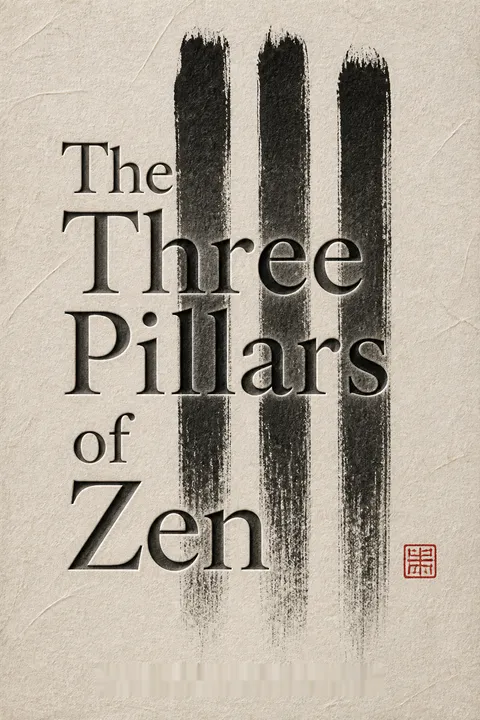
The Three Pillars of Zen is both an introduction and an argument about how knowledge is acquired. Kapleau's sourcebook moves from Yasutani-roshi's practical instruction, through encounters between teacher and student, toward accounts of awakening. Its organizing claim is that Zen cannot be reduced to a philosophy because its central propositions are meant to be tested in practice. Sitting, breathing, questioning, work, ritual, and instruction form a linked discipline rather than a menu of detachable techniques.
The book's strongest achievement is its treatment of process. It makes attention physical, gives novices concrete methods, and shows that practice can be difficult, repetitive, and highly social. The stories of the American businessman, the Canadian housewife, and Yaeko Iwasaki resist the idea that Zen belongs only to secluded monks. The Oxherding Pictures add a useful narrative arc: the point of insight is not permanent withdrawal, but a return to ordinary life with a changed relation to it.
The book also requires critical reading. Its claim that all beings are inherently perfect is a spiritual premise, not a demonstrated finding. Its accounts of awakening are personal testimony, powerful as experience but not controlled evidence of a universal mechanism. And while a teacher can offer essential feedback, the same asymmetry creates risks if authority is treated as beyond question. Kapleau's own material acknowledges different responses to forceful discipline, making consent and individual limits important to any modern practice.
Read at its best, the book does not promise a quick cure or a special identity. It presents a demanding experiment: attend closely, question assumptions about self and world, and see whether that work produces steadier attention, less compulsive self-concern, and greater responsibility. Its lasting contribution is to connect an inward discipline with a public ethic, while reminding readers that descriptions of realization are maps, not the territory.
Review Summary
The Three Pillars of Zen is widely regarded as a classic introduction to Zen Buddhism, offering practical guidance on meditation techniques, enlightenment experiences, and the integration of Zen principles into daily life. Readers appreciate its comprehensive approach, combining teachings, practice instructions, and personal accounts. While some find it dense and challenging, many praise its authenticity and depth. The book's emphasis on direct experience and rigorous practice is seen as both inspiring and daunting. Critics note its focus on Rinzai Zen and suggest it may not fully represent all schools of Zen Buddhism.
People Also Read






Glossary
Zazen
Zen sitting practiceThe central discipline of Zen Buddhism: sitting in a stable posture while training attention and quieting habitual thought. Methods include counting or following the breath, working with a koan, and just sitting. In this book, zazen is both preparation for insight and an expression of the Buddha-nature it seeks to realize.
Koan
Focused Zen inquiryA brief Zen case, question, or exchange used as a spiritual exercise. A koan is not meant to be solved through ordinary logic or clever interpretation. The practitioner concentrates on it until habitual reasoning is exhausted and a more direct understanding becomes possible. The teacher uses questioning to assess the student's grasp.
Mu
A koan's central wordThe response given by the Zen master Joshu when asked whether a dog has Buddha-nature. The word can be translated as “no” or “nothing,” but Zen practice does not treat it as a simple answer. A student uses Mu as a focus for concentrated inquiry, rather than trying to settle its meaning intellectually.
Kensho
Seeing one's true natureA direct experience of one's nature and, in the book's account, of the underlying unity of existence. Kensho may be a first glimpse rather than complete realization. Its depth varies, and the text stresses that an initial experience needs continued practice and guidance if it is to become integrated into daily life.
Sesshin
Intensive Zen retreatA concentrated period of Zen practice, commonly lasting several days. A sesshin may combine repeated zazen, walking meditation, instruction, private interviews, meals, and work, often within a mostly silent schedule. Its structure is intended to sustain attention and effort, while communal practice provides support for individual training.
Dokusan
Private teacher interviewA formal, individual meeting with a Zen teacher. Students report their practice, raise problems arising directly from it, and may be tested on a koan. In the book, dokusan supplies personal guidance that group lectures cannot provide. It is treated as a serious part of training, not an open-ended discussion of abstract topics.
Joriki
Power from concentrationThe strength and steadiness developed through sustained zazen and concentration. Joriki can help a practitioner remain composed and act decisively rather than being driven by immediate impulses. The book distinguishes this power from enlightenment: concentration may grow without resolving mistaken views about self and world.
Shikan-taza
Just sittingA form of zazen in which the practitioner sits with alert, concentrated awareness without counting the breath or using a koan as an anchor. It requires a stable posture and sustained attention, since there is no external measure for whether the mind has become distracted. The book presents it as a demanding practice.
Makyo
Meditation-related phenomenaVisions, unusual sensations, sounds, or other striking experiences that may arise during concentrated practice. The book treats makyo as temporary mental phenomena, not proof of enlightenment. Practitioners are advised not to pursue pleasant experiences or fear disturbing ones, but to continue their practice and seek guidance when needed.
Ten Oxherding Pictures
A map of Zen developmentA sequence of ten images and commentaries portraying spiritual development through the search for, discovery of, and integration of an ox, which symbolizes the mind or true nature. The sequence moves from seeking toward realization, then returns the practitioner to everyday life among ordinary people. It emphasizes maturation and service, not merely a moment of insight.
FAQ
What's The Three Pillars of Zen about?
- Comprehensive Zen Overview: The Three Pillars of Zen by Philip Kapleau offers a detailed introduction to Zen Buddhism, focusing on teaching, practice, and enlightenment. It includes lectures, personal instructions, and letters from Zen masters.
- Practical Guidance: The book emphasizes practical methods of Zen practice, particularly zazen (sitting meditation), and provides insights into the experiences of both Japanese and Western practitioners.
- Cultural Context: Kapleau contextualizes Zen within its historical and cultural background, illustrating its evolution from India to China, Japan, and the West.
Why should I read The Three Pillars of Zen?
- Authentic Zen Experience: Essential for anyone serious about Zen practice, especially those without access to a qualified Zen master. It provides authentic teachings directly from the masters.
- Diverse Perspectives: Includes perspectives from both Eastern and Western practitioners, showcasing the universality of Zen principles and helping readers relate to the teachings personally.
- Practical Techniques: Offers practical techniques for meditation and mindfulness, which can be integrated into daily life for greater peace and clarity.
What are the key takeaways of The Three Pillars of Zen?
- Zazen Importance: Emphasizes zazen as the core practice of Zen, stating, "Zazen is the gateway to total liberation," leading to inner peace and clarity.
- Three Essentials of Zen Practice: Outlines three essentials: strong faith, strong doubt, and strong determination, crucial for deepening practice and achieving enlightenment.
- Understanding of Buddha-nature: Explores the concept of Buddha-nature, asserting that "all beings are endowed with Buddha-nature from the very first," fundamental to realizing one's true self.
What is zazen, and how is it practiced according to The Three Pillars of Zen?
- Definition of Zazen: Zazen is "sitting meditation," involving sitting in a specific posture to cultivate mindfulness and concentration, the primary method for achieving enlightenment in Zen Buddhism.
- Posture and Breathing: Details the correct posture for zazen, emphasizing an erect back and proper breathing techniques, with a focus on counting inhalations and exhalations.
- Mindfulness in Daily Life: Zazen extends to all activities, with Kapleau stating, "To enter fully into every action with total attention and clear awareness is no less zazen."
What are the five varieties of Zen mentioned in The Three Pillars of Zen?
- Bompu Zen: "Ordinary" Zen for physical and mental health benefits, accessible to everyone, emphasizing concentration and mental clarity.
- Gedo Zen: "Outside ways," including practices from other religions aiming for personal improvement but not true enlightenment, like certain forms of yoga.
- Shojo Zen: "Small Vehicle," focusing on individual salvation and cessation of suffering, a more self-centered approach compared to Mahayana Buddhism.
- Daijo Zen: "Great Vehicle," emphasizing kensho (enlightenment) and realization of one's true nature, seeking to understand interconnectedness.
- Saijojo Zen: Highest form, involving shikan-taza (just sitting) and actualization of Buddha-nature in daily life, representing the culmination of Zen practice.
What is the significance of the koan "Mu" in The Three Pillars of Zen?
- Core Koan: Central to Zen practice, especially in the Rinzai tradition, serving as a tool for breaking through mind delusions and realizing true nature.
- Challenge to Duality: Joshu's "Mu" response challenges dualistic thinking, emphasizing that the essence of all beings is Buddha-nature, transcending distinctions.
- Path to Enlightenment: Working on "Mu" can lead to profound insights and enlightenment, described as "the one barrier of the supreme teaching."
How does The Three Pillars of Zen address the relationship between Zen practice and daily life?
- Integration of Zen: Stresses that Zen practice should permeate all life aspects, not just formal meditation, with Kapleau stating, "To enter fully into every action with total attention and clear awareness is no less zazen."
- Mindfulness in Action: Encourages maintaining awareness and presence in all actions, fostering a deeper connection to true nature.
- Living Zen: Portrays Zen as a way of life cultivating compassion, awareness, and harmony, helping navigate modern life's complexities with ease and clarity.
What is kensho, and how is it discussed in The Three Pillars of Zen?
- Definition of Kensho: Described as a sudden awakening or realization of one's true nature, often a preliminary experience on the path to full enlightenment.
- Experiential Nature: Emphasizes kensho as a direct experience, not merely intellectual understanding, with the truth unmistakably brought home.
- Significance in Practice: Achieving kensho is a significant milestone, serving as a foundation for deeper exploration and understanding of the self.
How does one achieve enlightenment according to The Three Pillars of Zen?
- Intense Self-Inquiry: Continuous questioning of one's True-nature, such as "What is Mu?" or "Who am I?" is essential for penetrating delusions.
- Zazen Practice: Regular and dedicated zazen practice cultivates the necessary concentration and insight to realize one's Buddha-nature.
- Letting Go of Attachments: Enlightenment involves relinquishing attachments to thoughts, concepts, and ego, allowing for a direct experience of reality.
What role does the kyosaku play in Zen practice as described in The Three Pillars of Zen?
- Stimulating Concentration: The kyosaku, or "encouragement stick," awakens practitioners and helps focus energy during zazen.
- Compassionate Guidance: Administered with care and compassion, intended to spur on those struggling to maintain concentration.
- Not Punishment: The kyosaku is not punitive; it is a tool for enhancing practice and deepening meditation experience.
What are the common experiences (makyo) during zazen as described in The Three Pillars of Zen?
- Definition of Makyo: Refers to illusory visions and sensations during zazen, including hallucinations and unexpected emotional responses.
- Nature of Experiences: Makyo can be intriguing or frightening but are not inherently good or bad; they should not be clung to or feared.
- Focus on Practice: Key is to continue practicing zazen without attachment to these experiences, as they can distract from the true purpose.
What are the best quotes from The Three Pillars of Zen and what do they mean?
- "Zazen is the gateway to total liberation.": Highlights meditation's importance as a means to achieve enlightenment and freedom from suffering.
- "All beings are endowed with Buddha-nature from the very first.": Emphasizes the inherent potential for enlightenment within every individual.
- "To enter fully into every action with total attention and clear awareness is no less zazen.": Illustrates that Zen practice extends beyond meditation, encouraging mindfulness in all life aspects.
Download PDF
Download EPUB
.epub digital book format is ideal for reading ebooks on phones, tablets, and e-readers.








