

Key Takeaways
Let practice ripen where you are, instead of waiting for ideal conditions
Practice takes time. Uchiyama compares Buddhist practice to a persimmon tree. In his example, a sweet-fruited branch is grafted onto a bitter tree after long growth; the fruit does not appear simply because someone planted a seed. Zazen, seated Zen practice, also needs sustained attention before its value becomes part of a life. The point is not to escape ordinary circumstances for a spiritual ideal, but to cultivate compassion within the life already at hand.
Roots matter more than scenery. Uchiyama spent years practicing amid poverty and obscurity. He did not claim that sitting made hardship pleasant or guaranteed success. The practice, like the graft, needs tending in the conditions one actually inhabits: family, work, community, and the wider culture.
The persimmon image makes spiritual development concrete: a tradition survives through careful transmission and adaptation, not admiration from a distance. It also resists the fantasy that practice begins only after life becomes orderly. The metaphor has limits, since people are not trees and no single lineage owns the capacity for compassion. Its useful point is more modest: inherited forms need active cultivation, and their worth appears in the lives they help people lead.
Let thoughts arise without following them or trying to erase them
Posture anchors attention. Uchiyama gives practical instructions for sitting: use a stable position, keep the back upright, relax the shoulders, rest the hands in the lap, and leave the eyes open with the gaze lowered. A chair is acceptable if sitting cross-legged is not possible. Breathing should be natural, not forced. The physical form matters because it gives attention a steady task rather than a puzzle to solve.
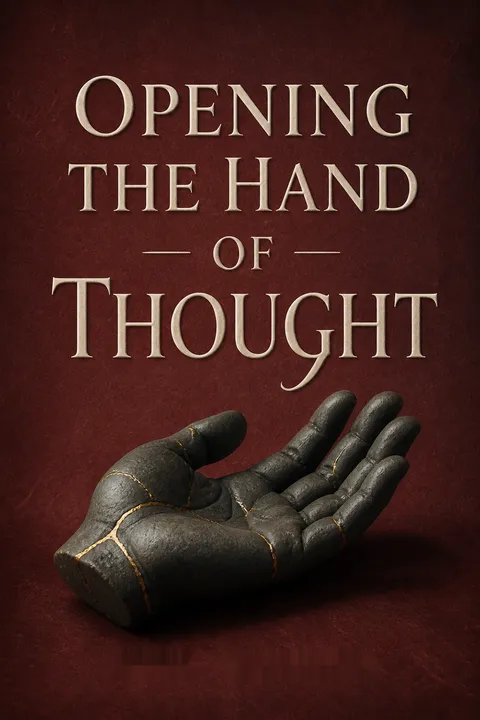
Thoughts can pass through. Uchiyama calls the practice of releasing mental grasping “opening the hand of thought.” This does not mean stopping thoughts or pushing them away. A thought can appear without becoming a chain of associations that captures attention. When the mind wanders or grows drowsy, the sitter notices and returns to the posture, again and again.
This approach resembles cognitive defusion, a technique in which thoughts are noticed as mental events rather than treated as commands or facts. The bodily anchor also matters: attention is trained through posture, not just through an abstract instruction to be mindful. There is a practical caution, however. Drowsiness, pain, or distress may call for adjustment rather than sheer persistence. The aim is alert, sustainable practice, not proving toughness by ignoring the body's signals.
Treat sitting itself as practice, not a ticket to enlightenment
No trophy at the finish. Shikantaza means “just sitting”: zazen performed without treating it as a tool for acquiring a special experience or improved identity. Uchiyama argues that when sitting becomes a bargain, the mind turns practice into another project of gaining, comparing, and judging. The practitioner still aims to sit upright and awake, but does not use a calm session as proof of achievement or a restless one as proof of failure.
Practice is already the work. Uchiyama presents practice and enlightenment as inseparable: sitting enacts the way of life it is meant to express, rather than producing enlightenment as a later reward. This is why he distinguishes religious practice from useful but goal-directed meditation, such as sitting mainly to feel healthier or more productive. Such benefits may occur, but they are not the foundation of this practice.
The distinction between practice and payoff challenges a culture that turns even rest into a productivity strategy. It also protects meditation from becoming another status contest, where unusual experiences serve as spiritual credentials. Yet non-instrumental practice should not be confused with indifference to consequences. A practice can be undertaken for its own sake while still being assessed by whether it supports steadier, more responsible conduct. The book's challenge is to act without making personal gain the measure of the act.
Loosen identity built from status, comparison, and other people's approval
Roles are not the whole self. Uchiyama describes how people define themselves through relationships and labels: spouse, employee, winner, failure, wealthy person, or respected teacher. He compares these identities to clothes that can change with circumstance and age. A businessman who had money and a loving family nevertheless felt empty; Uchiyama suggested that his sense of worth depended too heavily on external measures.
Jiko is broader than ego. Uchiyama uses this Buddhist term for a whole or universal self, not the self-centered personality that seeks advantage. It points to life as actually lived, including the body and its involuntary processes, and the world encountered through each person's perspective. This does not erase individual differences or relationships. It asks practitioners not to mistake social rank or self-description for the entirety of life.
The account anticipates a useful distinction in psychology between a person and the stories a person tells about identity. Social roles provide belonging and coordination, but they become brittle when treated as an entire measure of worth. Uchiyama's broader account of self counters isolation by emphasizing connection, though its universal language can be difficult to verify as a metaphysical claim. It may be most usable as a discipline of perspective: status is real in social life, but it need not dictate how every encounter is valued.
Use impermanence to loosen the self without falling into nihilism
Four seals describe reality. Uchiyama presents four Buddhist principles, called the Four Seals:
1. All things change, so life cannot be secured against loss.
2. Life includes suffering, especially when death and uncertainty are denied.
3. Nothing exists as a fully independent, permanent self.
4. Tranquility is found in seeing things as they are, without clinging.
The Middle Way avoids extremes. Interdependence means that things arise through conditions rather than existing alone. Uchiyama compares the self to a candle flame: it appears continuous, but depends on changing conditions. The Middle Way is not a compromise between two opinions. It avoids both the claim that a permanent self exists independently and the claim that nothing exists at all. Letting go of fixed ideas makes room to respond to this changing life.
The candle image is a compact model of continuity without permanence. It helps explain how a person can change while remaining accountable for actions, and why dependence does not mean nonexistence. This view also resonates with ecological thinking, where organisms persist through relationships with environments rather than apart from them. The teaching can be misread as denying stable identity or material hardship. Its more careful implication is that persons are real, but never self-sufficient or fixed in the way clinging imagines.
When moods change, keep returning instead of grading your meditation
Retreat strips away distraction. A sesshin is an intensive period devoted largely to zazen. At Antaiji, Uchiyama describes five-day retreats of silent sitting and walking, with fourteen sitting periods each day, beginning at four in the morning and ending around nine at night. Long stretches of discomfort and boredom made it hard to escape into ordinary distractions. The point was not to win a contest of endurance, but to meet each moment without relying on entertainment or self-congratulation.
Mental weather changes. A practitioner may feel clear one day and distracted the next. Uchiyama compares such conditions to weather: temperature and humidity affect how sitting feels, but neither a calm mind nor a busy one proves success or failure. Zazen is the repeated act of waking up to the posture and allowing thoughts, moods, and sensations to be part of experience without being ruled by them.
The weather analogy counters a common error in contemplative practice: confusing a pleasant mental state with progress. It also encourages a more realistic account of attention, which shifts with sleep, discomfort, and environment. The intensive retreat gives this lesson force by removing easy distractions, but it is not a universal template. People have different physical capacities and obligations. The transferable principle is not to endure every condition unchanged, but to stop treating each fluctuation as a verdict on one's worth or practice.
Make your vow practical, and let repentance keep it humble
A vow gives practice direction. A bodhisattva is someone who commits to awakening for the benefit of all beings. Uchiyama describes this as treating people, tasks, and situations as part of one's own life, then acting with care rather than for praise. Repentance is not merely feeling guilty. It means facing one's inability to fulfill the vow honestly and returning to practice without claiming moral perfection.
Compassion accepts consequences. Uchiyama recounts a story of a monk who took flour from a monastery storehouse to feed fellow monks suffering from inadequate food. The abbot expelled him and demanded repayment. The monk accepted the consequences, repaid the debt through begging, and was eventually allowed back. Uchiyama uses the story to show that ethical action can require judgment beyond rule-following, but that good intentions do not cancel responsibility.
The story makes compassion more demanding than kind feeling: it requires attention to others' actual needs and willingness to bear costs. Its ethical tension is important. Breaking a rule can be justified by context, but people are also skilled at dressing self-interest in the language of care. Uchiyama's emphasis on accepting consequences offers a safeguard, though not a complete decision procedure. The story invites questions about who bears the risk, whose needs count, and whether the action genuinely serves the community.
Let years of sitting show up as care in ordinary work
Practice has three expressions. Uchiyama draws on Dōgen's three minds: magnanimous mind, which meets situations without reducing them to personal preference; nurturing mind, which cares for what one encounters as a parent cares for a child; and joyful mind, the energy that comes from fully engaging in the task at hand. These are not moods to manufacture. They are ways of bringing the inclusive perspective of practice into cooking, cleaning, work, and relationships.
Practice needs company and time. Uchiyama advises sustained practice, even across decades, and cooperation in a sangha, a community of practitioners. At Antaiji, each person's commitment helped support the others, like small pieces of charcoal gathered into a fire. His seven points of practice also insist that sitting must function in daily life, that practitioners take responsibility for their own development, and that a genuine practice place should be protected from status-seeking.
This is where the book's inward discipline becomes socially testable. Attention that never changes how someone cooks, cleans, listens, or shares responsibility risks becoming private theater. The three minds offer a bridge from contemplation to conduct, while the sangha supplies accountability and a setting for learning cooperation. Still, long duration alone does not guarantee wisdom; communities can also reinforce hierarchy or exclusion. The decisive test is whether time in practice enlarges care and responsibility, rather than merely strengthening attachment to the identity of practitioner.
Analysis
Uchiyama's book is at once a practical manual, a philosophical argument about self, and a teacher's account of how a life of practice is built. Its central move is to relocate the value of zazen from what it might produce to what sitting enacts: a way of meeting the present without letting each thought become a command. That makes the book unusually resistant to the modern habit of turning every activity into self-optimization.
Its teaching method is concrete. The persimmon, the changing weather of retreat, the socially defined self as clothing, and the disputed flour theft all translate abstract doctrine into recognizable decisions. These stories do not merely decorate a theory. They test whether ideas about nonattachment can survive in the body, in a community, and under material pressure. The practical instructions also keep the philosophy grounded: posture, natural breathing, attention, and returning after distraction.
The most productive tension lies in Uchiyama's account of universal self. It can loosen the fantasy of an isolated ego and encourage care for others, but it can sound like a claim that individual boundaries or social facts are unreal. A careful reading keeps both levels in view. Personal identities and unequal circumstances matter in daily life; they simply do not exhaust what a person is. Likewise, letting thoughts go is not suppressing them, and accepting a situation is not automatically endorsing it.
The ethical center is therefore not withdrawal but responsibility. Vow supplies direction, repentance limits self-righteousness, and ordinary acts reveal whether sitting has become a way of life. Uchiyama offers no metric for spiritual achievement, and that absence is deliberate. The reader is left with a demanding question: can attention be renewed, again and again, without turning either success or failure into a permanent identity?
Review Summary
Opening the Hand of Thought is highly regarded as a clear and accessible introduction to Zen practice. Readers appreciate Uchiyama's straightforward explanations of zazen and his ability to make complex concepts understandable. Many consider it one of the best books on Soto Zen, praising its practical advice and inspirational quality. While some find certain sections repetitive or difficult to grasp, most reviewers recommend it for both beginners and experienced practitioners. The book's emphasis on zazen as a lifelong practice and its exploration of Buddhist concepts resonates with many readers.
People Also Read




Glossary
zazen
seated Zen practiceA formal practice of sitting upright and alert, traditionally associated with Zen. Uchiyama emphasizes the posture, natural breathing, and allowing thoughts to arise without pursuing or suppressing them. He also uses “a life of zazen” to mean a daily orientation shaped by sitting, not merely a meditation session.
opening the hand of thought
releasing mental graspingUchiyama's phrase for allowing thoughts, feelings, and perceptions to arise without clinging to them or turning them into extended chains of judgment. It does not mean eliminating thought. In zazen, the practitioner aims to maintain an upright, awake posture while letting mental events come and go.
shikantaza
just sitting without instrumental aimA Soto Zen term meaning “just sitting.” In Uchiyama's presentation, shikantaza is zazen practiced without treating it as a means to gain enlightenment, calm, status, or another reward. The practitioner still applies effort to posture and alertness, but sitting itself is the practice rather than a step toward a separate achievement.
jiko
whole, inclusive sense of selfA Japanese Buddhist term that Uchiyama uses for the self in a broad sense, beyond the ego or socially defined personal identity. It includes the living body, experience, and the world encountered through one's life. Translations such as “universal self” or “whole self” approximate the term, but can sound more abstract than its practical meaning.
Four Seals
four marks of Buddhist realityUchiyama's summary of four Buddhist principles: phenomena are impermanent, life is marked by suffering, things lack an independent permanent self, and nirvana is tranquility. He also connects the final principle with seeing things as they are. The Four Seals frame practice as a response to unavoidable features of existence, rather than a promise to escape them.
Middle Way
avoiding fixed extremesA Buddhist teaching that avoids treating things as either permanently self-existing or simply nonexistent. Uchiyama explains it through interdependence: people and phenomena arise through changing conditions, so they are neither independent substances nor nothing at all. In practice, the Middle Way means loosening fixed concepts and responding to life as it unfolds.
sesshin
intensive communal sitting retreatA period of concentrated Zen practice, often lasting several days, with repeated sessions of zazen and walking meditation. Uchiyama describes Antaiji retreats as silent and demanding, with little distraction. Their purpose is not to produce a special mental state, but to let practitioners encounter changing thoughts, sensations, and moods through sustained practice.
bodhisattva
awakening being serving allA person who follows the Buddha Way through a commitment to the awakening and well-being of all beings. Uchiyama stresses that a bodhisattva is not a perfected or exceptional person. It is an ordinary practitioner whose life direction is shaped by a vow to care for others, alongside honest recognition of personal limitations.
three minds
attitudes guiding bodhisattva activityUchiyama's practical rendering of three attitudes associated with Dōgen: magnanimous mind, which meets situations broadly rather than through narrow preference; nurturing mind, which cares for what is encountered; and joyful mind, which finds vitality in fully engaging with the task at hand. Together they describe how practice can shape everyday conduct.
FAQ
1. What is "Opening the Hand of Thought" by Kōshō Uchiyama about?
- Foundations of Zen Practice: The book is a comprehensive guide to the foundations of Zen Buddhist practice, focusing especially on the meaning and method of zazen (seated meditation).
- Letting Go of Thought: Uchiyama introduces the concept of "opening the hand of thought," which means letting go of grasping at thoughts and experiencing life directly.
- Universal Self and True Living: The book explores the nature of self (jiko), distinguishing between the personal, ego-driven self and the universal self that is interconnected with all things.
- Practical and Philosophical: It combines practical instructions for meditation with deep philosophical reflections on the nature of reality, suffering, and spiritual practice.
2. Why should I read "Opening the Hand of Thought" by Kōshō Uchiyama?
- Direct Zen Guidance: Uchiyama Roshi is considered one of the clearest and most accessible Zen teachers, making complex ideas understandable for both beginners and experienced practitioners.
- Practical Application: The book offers concrete advice on how to practice zazen and integrate its principles into daily life, not just in the meditation hall.
- Universal Relevance: Its teachings address fundamental human concerns—suffering, dissatisfaction, and the search for meaning—making it relevant regardless of religious background.
- Bridges East and West: Uchiyama’s background in both Western philosophy and Eastern practice provides a unique perspective that resonates with modern readers.
3. What are the key takeaways from "Opening the Hand of Thought"?
- Zazen Is the Core: Zazen, or just sitting, is the heart of Zen practice and is itself the realization of the Buddha Way.
- Letting Go of Thoughts: True practice involves letting go of thoughts, not suppressing them, but not being carried away by them either.
- Universal Self: The self is not a fixed, isolated entity but is fundamentally interconnected with all beings and phenomena.
- Practice for Its Own Sake: Zen practice is not about gaining enlightenment or personal benefit, but about living out the reality of life as it is, moment by moment.
4. How does Kōshō Uchiyama define "opening the hand of thought" in Zen practice?
- Letting Go, Not Grasping: "Opening the hand of thought" means releasing the mental grasp on thoughts, emotions, and concepts as they arise during zazen.
- Not Suppressing Thoughts: It is not about stopping thoughts or making the mind blank, but about not chasing after or clinging to them.
- Returning to Reality: By letting go, one returns to the direct experience of the present moment and the reality of life.
- Foundation of Zazen: This attitude is the essence of zazen and the gateway to experiencing the universal self.
5. What is the significance of zazen (seated meditation) in "Opening the Hand of Thought"?
- Zazen as Buddha’s Practice: Uchiyama emphasizes that zazen itself is the practice of the Buddha, not a means to an end but the end itself.
- Posture and Attitude: The book provides detailed instructions on posture, breathing, and mental attitude, highlighting the importance of sitting with the whole body and mind.
- Letting Go in Practice: Zazen is the concrete activity where "opening the hand of thought" is practiced, allowing thoughts to come and go without interference.
- Daily Life Integration: True zazen is not separate from daily life; its spirit should permeate all activities and relationships.
6. How does "Opening the Hand of Thought" by Kōshō Uchiyama explain the nature of self (jiko)?
- Beyond Ego: The self (jiko) is not the ego or personal identity, but a universal self that is interconnected with all beings and phenomena.
- Personal and Universal: Uchiyama distinguishes between the personal self (conditioned by thoughts and circumstances) and the universal self (the reality of life itself).
- Letting Go of Fixed Identity: True practice involves letting go of fixed ideas about who we are, allowing the universal self to manifest.
- Practical Examples: The book uses everyday examples (like the story of the squashes on a vine) to illustrate how we are all connected at a fundamental level.
7. What are the "Four Seals" of Buddhism discussed in "Opening the Hand of Thought"?
- All Phenomena Are Impermanent: Everything is in constant change; nothing lasts forever.
- All Things Are Suffering: Life involves dissatisfaction and suffering due to clinging and ignorance.
- All Things Are Without Self: There is no permanent, independent self; all things are interdependent.
- Nirvana Is Tranquility: True peace is found in letting go and realizing things as they are, beyond attachment and aversion.
8. How does Kōshō Uchiyama address the problem of dissatisfaction and suffering in modern life?
- Material Progress Isn’t Enough: Uchiyama observes that technological and material advances do not bring true peace or satisfaction.
- Root of Dissatisfaction: The endless pursuit of desires and comparison with others leads to perpetual dissatisfaction.
- Practice as Solution: By practicing zazen and letting go of thoughts, one can find peace and contentment in the present moment, regardless of external circumstances.
- Living the Universal Self: True fulfillment comes from living out the reality of the universal self, not from chasing after external gains.
9. What is the role of vow and repentance in Zen practice according to "Opening the Hand of Thought"?
- Vow as Life Direction: Vow means setting a direction for one’s life, aiming to benefit all beings and live out the universal self.
- Repentance as Humility: Repentance is not about guilt, but about recognizing one’s limitations and returning to the practice with sincerity.
- Two Pillars of Practice: Uchiyama teaches that vow and repentance are the two essential practices that support and deepen zazen.
- Continuous Renewal: Through vow and repentance, practitioners continually renew their commitment to the path, regardless of setbacks.
10. How does "Opening the Hand of Thought" by Kōshō Uchiyama connect Zen practice to daily life?
- No Separation from Life: Zazen is not just a meditation technique but a way of living that should inform every aspect of daily life.
- Practice in Action: The attitudes cultivated in zazen—letting go, presence, compassion—are to be expressed in work, relationships, and challenges.
- Facing Reality Directly: Uchiyama encourages readers to meet each moment and circumstance as it is, without escaping into fantasies or regrets.
- Community and Cooperation: Practicing together in sangha (community) and cooperating with others is emphasized as essential for sustaining practice.
11. What are the "Seven Points of Practice" outlined by Kōshō Uchiyama in "Opening the Hand of Thought"?
- Practice for the Sake of Practice: Study and practice the Buddhadharma only for its own sake, not for personal gain or emotion.
- Zazen as True Teacher: Regard zazen itself as the most venerable and reliable teacher.
- Integrate Practice and Life: Ensure that zazen works concretely in daily life through vow, repentance, and the three minds (magnanimous, nurturing, joyful).
- Live by Deeply Rooted Vow: Root your vow deeply and let it guide your life.
- Take Responsibility: Recognize that development and backsliding are your own responsibility; endeavor to practice and grow.
- Long-Term Commitment: Sit silently for ten years, then ten more, and then ten more—emphasizing lifelong practice.
- Cooperate in Community: Work together to create a supportive environment for sincere practice.
12. What are the best quotes from "Opening the Hand of Thought" by Kōshō Uchiyama and what do they mean?
- "Opening the hand of thought is the very act of zazen."
This encapsulates the core practice: letting go of mental grasping is itself the heart of Zen meditation. - "Zazen is the self doing itself by itself."
Zazen is not about achieving something external; it is the self manifesting its true nature without interference. - "Practice and enlightenment are one."
Enlightenment is not a distant goal but is realized in the very act of sincere practice, moment by moment. - "Everything I encounter is my life."
This expresses the non-dual view that all experiences and beings are included within the universal self. - "Gaining is delusion, losing is enlightenment."
Letting go of the desire to gain or achieve is the path to true awakening and peace.
Download PDF
Download EPUB
.epub digital book format is ideal for reading ebooks on phones, tablets, and e-readers.








