

Key Takeaways
Read Islam's rise as late antiquity's culmination, not a desert-born rupture
A world already changing. Holland begins with Yusuf, the Jewish king of Himyar, whose defeat by Christian forces in 525 dramatizes a Near East where political conflict and religious allegiance were inseparable. Across the region, Roman and Persian empires competed while Jews, Christians, Zoroastrians, and smaller communities argued over the one God and the proper way to serve Him. Monotheism was already reshaping identities and state power before Islam appeared.
An inheritance transformed. The book's central claim is that Islam did not arrive in an empty Arabia and simply replace antiquity. The Arab Caliphate inherited and reshaped late antiquity's imperial ambitions, religious debates, and administrative traditions. It was new, but also, in Holland's account, the final great empire of the ancient Near East.
What's striking is the change of scale: Islam's emergence becomes more intelligible when treated as part of a regional transformation rather than a self-contained origin story. This resembles a broader historical principle: innovations often emerge from dense contact zones, then retrospectively appear to have arrived fully formed. The framing also guards against explaining a civilization's success through a single cause, such as a prophet's charisma or military prowess. Its limit is that contextual continuity can be overemphasized too. Islam's distinct teachings and institutions matter precisely because they recombined inherited materials into something not reducible to its predecessors.
Treat religious identities as historical achievements, not sealed inheritances
The past is made useful. Persian king Peroz faced a weakened empire and powerful Parthian nobles. To bind them to his rule, he sponsored a revised royal ancestry linking his dynasty to legendary Kayanid kings associated with Parthia. The resulting history helped justify present-day alliances and military plans. In another case, Zoroastrian priests placed their scriptures in writing and reshaped Zoroaster's biography to strengthen their emerging religious institution.
Boundaries take work. Christian bishops and emperors also labored to define one authoritative creed, while Jewish rabbis compiled and interpreted the Torah and Talmud. These traditions became enduring, but their familiar forms were shaped through political decisions, scholarship, and argument. Holland's point is not that believers merely invented their faiths, but that historical communities actively organized inherited beliefs into recognizable religions.
The examples illuminate a central insight of memory studies: communities preserve the past by selecting, organizing, and repeating it, not by storing it untouched. Institutions make those accounts durable through texts, rituals, and official authority. This does not make the resulting traditions fraudulent. It shows how continuity is produced and maintained. A useful caution is that political usefulness alone cannot explain why a tradition resonates or survives. The book is strongest when it shows the interaction between material pressures and sincere belief, rather than reducing religious conviction to a ruler's convenient propaganda.
Let gaps in the record limit certainty, not license confident reconstruction
The evidence arrives late. Most surviving Muslim biographies of Muhammad, collections of hadith, and Qur'anic commentaries took shape generations after his lifetime. Holland stresses that early accounts of events such as the Battle of Badr are scarce, often filtered through later transmitters, and sometimes impossible to verify. Contemporary Christian sources do mention a prophet associated with the Arabs, and one names Muhammad, but they offer only brief glimpses.
The Qur'an is different evidence. Holland treats the Qur'an as the best surviving early source, while noting its sparse historical detail and difficult allusions. Early manuscripts show some copying variations, but the fragments discussed do not establish deliberate rewriting. This makes the book's method deliberately provisional: later tradition may preserve real memories, yet historians must distinguish what the evidence supports from what it cannot settle.
What's valuable here is the separation of two questions that are often collapsed: whether Muhammad existed, and how much can be established about his life. Sparse documentation weakens detailed reconstructions without making every account equally implausible. Historical method depends on weighing independent evidence, dating sources, and asking what a text was meant to do. The same discipline applies to any poorly documented past. Still, absence of early Muslim records is not proof that none existed or that later accounts are wholly invented. The book's skepticism is most persuasive when it marks that boundary clearly.
Explain Arab victories through exhausted empires, not sudden military magic
The superpowers were depleted. The Roman-Persian war of 602 to 628 devastated the region, while waves of plague beginning in 541 killed many people and disrupted farming, taxation, and military recruitment. Both empires struggled to restore their finances and authority. When Arab forces entered Palestine in the 630s, the Roman state had few troops available to defend its provinces.
A vulnerable frontier. Arab tribes had long served as allies and mercenaries for both empires. Their leaders knew the frontier's routes and politics, and local populations had reason to resent imperial demands. The Arab forces were not necessarily enormous; Holland argues that exhaustion and political fragmentation mattered as much as battlefield strength. Victory then opened access to tax systems, officials, and cities built by the fallen powers.
This account replaces the dramatic image of a fully formed new power appearing from nowhere with a model of cascading state weakness. In political science, states often fail not from one decisive blow but from the loss of capacity across several linked systems: revenue, recruitment, legitimacy, and local cooperation. That model helps explain why invasion can succeed even when invaders are not numerically overwhelming. Yet structural vulnerability is not a complete explanation. It clarifies the opportunity, not why particular Arab coalitions organized effectively or how their religious message helped sustain collective action.
Look to Arabia's mixed frontier for Islam's intellectual raw materials
The desert was connected. Arab groups traded, fought, and served as Roman or Persian allies along the frontier. Christian communities, Jewish groups, Zoroastrians, and local polytheists lived across the broader region, sometimes near one another and sometimes in conflict. The desert offered refuge to beliefs that imperial authorities had marginalized, including forms of Christianity that did not fit official doctrine.
Influence is not proof of copying. The Qur'an refers to biblical figures, Christian stories, angels, judgment, and other ideas familiar across late antiquity. Holland argues that these parallels make more sense in a connected Near East than in an isolated Mecca. He raises the possibility that some material and settings associated with early Islam lay farther north than later tradition suggests. These are provocative historical hypotheses, not established facts.
The frontier is a powerful explanatory setting because borders are rarely simple walls. They are zones where people, languages, customs, and political loyalties meet. Such contact can generate new religious forms without requiring a direct line of borrowing from one source. The book is right to make isolation a claim that requires evidence, not an assumption. Its more specific suggestions about where Muhammad lived or where Qur'anic references originated remain much less secure. A mixed milieu supports contextual influence; it cannot, by itself, identify a text's author or place of composition.
Separate Qur'anic evidence from later biography before fixing Islam's map
The scripture is not a travelogue. The Qur'an names few places, says little about its opponents' precise beliefs, and mentions Mecca only once in an ambiguous passage. The familiar detailed portrait of Mecca as a major trading city, and the story of Muhammad's life there, comes largely through later Muslim accounts. Holland notes that surviving external references to Mecca are strikingly late and limited.
Bakka remains uncertain. The Qur'an describes a sacred House associated with Abraham at a place called Bakka. Later Muslim scholarship identified it with Mecca, but Holland argues that the text itself does not resolve the location. He explores possible links to older Abrahamic sanctuaries near Palestine. The conclusion is methodological: preserve the distinction between what the Qur'an says, what later tradition explains, and what historians can independently confirm.
This is a useful lesson in historical geography: a familiar map can be the product of later interpretation rather than direct evidence. It also demonstrates how sacred narratives can anchor a community to place by connecting present ritual to a revered past. The argument should be read cautiously, however. Silence in external records can reflect incomplete archives, changing political relevance, or the uneven survival of documents. The later identification of Bakka with Mecca is not automatically false because it is late. The strongest claim is narrower: the Qur'an alone does not settle the question.
See the first Muslim community as political formation, not creed complete
Belief built a community. The Constitution of Medina, a compact preserved within later Islamic tradition and regarded by many scholars as early, presents Muhammad's community as a political alliance. It joined emigrants and local groups, including Jews, and described members as Believers. The document supports the idea that Muhammad's work involved state-building as well as preaching, even though it does not answer every question about the community's origins.
Expansion unsettled unity. The conquests brought extraordinary wealth and territory, but disputes over leadership and distribution soon fractured the community. Umar became a model of austere rule; Uthman was accused of favoring his family; Ali's conflict with Mu'awiya and the Kharijite revolt turned political disagreements into struggles over legitimate faith. The early movement was powerful, but neither politically nor doctrinally settled.
The account makes an important distinction between a movement's founding coalition and the later religious identity built around it. Political communities can precede standardized doctrine, especially when they must organize security, membership, and authority under pressure. The comparison with early Christian institutions is suggestive, since both traditions developed amid internal disagreement. The Constitution is valuable precisely because it offers a rare documentary foothold. But a single compact cannot reveal the full composition of the community or prove that all later accounts of its development are unreliable.
Track how Abd al-Malik turned conquest into a distinct Islamic order
Rule needed a public language. After civil war, Caliph Abd al-Malik rebuilt Umayyad authority through coinage, administration, and monumental architecture. Arabic became the language of official records, and new coins replaced older Roman and Persian imagery. The Dome of the Rock in Jerusalem displayed inscriptions affirming Muhammad's prophethood and rejecting Christian claims about God. These public acts gave the empire a more distinct religious identity.
A formative moment, not a settled verdict. Holland argues that Islam's institutional form was still developing under Abd al-Malik, and that his government helped standardize scripture and religious claims. Evidence for early Qur'anic inscriptions and later reports about editing are significant, but they do not prove that he authored or invented the Qur'an. The broader point is that state power helped make a recognizable Islamic order visible across a vast empire.
Coins, monuments, and administrative languages are not decorative details. They are tools of governance that make authority legible in everyday life. Abd al-Malik's reforms show how a ruling house can turn a heterogeneous conquest into a more coherent political identity. This is a strong historical insight because it links religious formation to institutions without treating faith as cynical theater. The evidence supports a process of consolidation, but the boundary between standardizing an existing scripture and shaping its received form remains difficult to draw. The distinction matters, especially when claims concern a sacred text.
Whoever controls the Prophet's precedent can judge the Caliph
Law moved authority. From Iraq's mosques and scholarly circles emerged the ulama, Muslim scholars and legal experts who worked to define how believers should live. They developed hadith, reports about Muhammad's words and actions, and used chains of transmitters called isnads to support their authority. Together, hadith formed the Sunna, a body of prophetic practice that could guide law and conduct beyond the Qur'an's explicit instructions.
The past became a check on rulers. Holland argues that scholars drew on the region's older legal and religious cultures while locating their authority in Muhammad's lifetime. Their ideal of the Prophet's community could be used to criticize the Umayyad rulers as worldly or unjust. Abbasid-era scholars later compiled biographies and traditions that made the Prophet the central source of Islamic norms, even as the Caliphate lost practical control over religious interpretation.
This is a striking case of authority shifting from rulers to interpreters. A government can command armies and taxes, but a legal tradition can define what counts as legitimate rule. The process also resembles the development of professional expertise: specialists gain influence by controlling methods of verification and interpretation. The book's account properly emphasizes that hadith transmission was contested, not a neutral pipeline. Its suggestion of Jewish and Zoroastrian influence is plausible within the shared intellectual setting, but similarities alone cannot establish direct borrowing in each individual ruling.
Analysis
Holland's main achievement is to make early Islam historically adjacent to, rather than detached from, the world it transformed. The story begins with late antique empires struggling to turn religious claims into political order, then follows the Arab conquests, the Umayyad consolidation, and the scholars who made prophetic precedent central to Islam. The narrative's recurring mechanism is institutional: rulers and religious specialists use texts, rituals, buildings, and public symbols to make authority appear continuous, universal, and divinely sanctioned.
The book is most persuasive when it reconstructs that shared environment. Persian royal mythmaking, Christian councils, rabbinic scholarship, and the political pressures on frontier Arabs show that religious traditions develop through both conviction and collective organization. Its treatment of believers' supernatural worldview is also valuable. It explains why victories, defeats, plagues, and political upheavals could be read as evidence about God's favor, without requiring a modern reader to accept those interpretations as historical causes.
The most contentious move is the reconstruction of Islam's earliest geography and chronology. Holland correctly stresses that later biographies cannot simply be treated as contemporary records. But the same gaps that weaken traditional narratives also limit alternative reconstructions, including suggestions that Mecca or the Quraysh belonged to a different northern setting. The absence of evidence is informative, yet it rarely identifies one replacement explanation. His strongest version of the case is therefore contextual rather than definitive: the Qur'an and early community belong within late antique networks, while many precise claims about place, sequence, and authorship remain uncertain.
That tension is productive. The book asks readers to distinguish sacred memory, political legitimation, and recoverable history without assuming they are mutually exclusive. Its broad arc, from competing empires to a religion whose scholars outlasted caliphs, shows how ideas can survive the regimes that first promote them. The result is not a settled origin story, but a sharper account of why the evidence is difficult and why the stakes of interpretation remain so high.
Review Summary
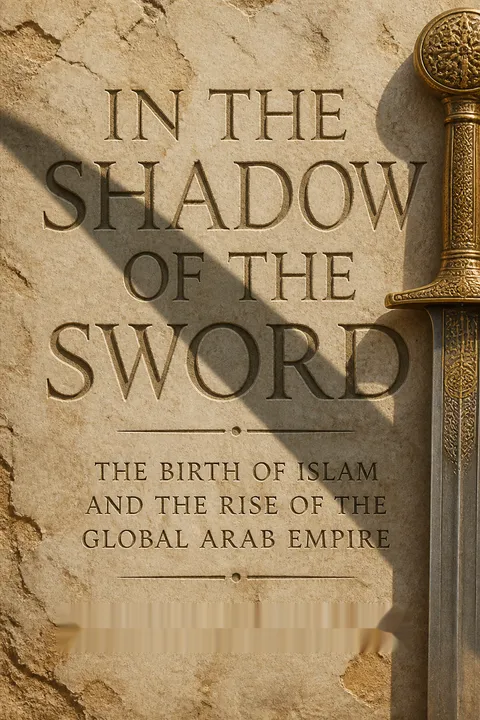
In the Shadow of the Sword explores the rise of Islam and the Arab Empire, challenging traditional narratives. Readers appreciate Holland's narrative style and historical context but find the book's structure and focus sometimes lacking. Some praise its controversial insights, while others criticize its speculative nature. The book covers late antiquity, focusing on Roman and Persian empires before delving into early Islam. Readers note it's more about setting the stage for Islam's emergence than a comprehensive history of the religion itself. Overall, it's seen as thought-provoking but not definitive.
People Also Read

Glossary
Late Antiquity
ancient world in transitionA period spanning roughly the centuries around the fifth to seventh centuries, when Roman and Persian power changed, older civic traditions persisted, and Judaism, Christianity, and other religious movements took new institutional forms. Holland uses it not as an age of simple decline, but as a period of experimentation whose political and religious transformations shaped the world that Islam entered.
Jahiliyya
pre-Islamic ignoranceAn Arabic term derived from jahl, meaning ignorance. In later Muslim tradition, it describes the period before Islam as an age without proper knowledge of God. Holland treats the concept as a powerful retrospective distinction: it helped define Islam as a new beginning while obscuring continuities between Arab society and the religious world around it.
farr
divine royal favorIn Sasanian Persian political culture, farr was the supernatural radiance or favor believed to mark a legitimate king. It helped explain royal authority as more than military power. A ruler who lost the favor of heaven could lose his right to rule, so military defeat, broken oaths, and political disorder carried religious as well as practical significance.
Hijra
religiously charged migrationAn Arabic word meaning migration or emigration. Muslim tradition uses it especially for Muhammad's departure from Mecca to Yathrib, later Medina, in 622, the event that begins the Islamic calendar. Holland also emphasizes the term's broader early resonance: believers could understand emigration as a continuing commitment to God's cause, not only as one biographical journey.
Umma
community of believersA Qur'anic term for a community or people. In the early Islamic setting discussed by Holland, it describes a political and religious community that could bring different groups together under shared allegiance to God. The idea challenged older tribal loyalties, though it did not prevent later conflicts over leadership, justice, and membership.
Mushrikun
those accused of associating partnersThe Qur'anic designation for people accused of shirk, or associating other beings with the one God. Later tradition often depicts them as ordinary idol worshippers. Holland notes that the Qur'an itself portrays them as sharing some monotheistic beliefs with Muhammad, while disagreeing over angels and other intermediaries. Their exact historical identity remains uncertain.
Muhajirun
emigrants for God's causeAn Arabic term meaning those who migrate or emigrate. Holland notes that early Arab conquerors appear to have used it as a self-description before Muslim became the standard identity. The word connects religious commitment with movement, military expansion, and the formation of a new community, while its precise scope in the earliest period remains debated.
isnad
chain of transmittersA chain of named authorities attached to a hadith, intended to trace a report back through generations to Muhammad or a Companion. Muslim scholars used isnads to assess the authority of prophetic traditions. Modern historians debate how reliably these chains preserve early information, since some may reflect later legal and theological disputes.
Sunna
prophetic practice and lawAn Arabic word meaning custom or established practice. In Islamic scholarship, the Sunna is the body of Muhammad's reported words and actions, preserved largely through hadith, and treated as an authoritative guide alongside the Qur'an. Holland emphasizes that its formation took time and that scholars used it to define conduct and limit political authority.
ulama
Muslim scholars and juristsThe Arabic plural for learned authorities, especially scholars of religious law. In Holland's account, the ulama developed expertise in interpreting the Qur'an and transmitting hadith, eventually gaining power to define Islamic norms independently of the Caliph. Their authority rested on scholarship and claims about the Prophet's precedent rather than direct control of the state.
About the Author
Download PDF
Download EPUB
.epub digital book format is ideal for reading ebooks on phones, tablets, and e-readers.








