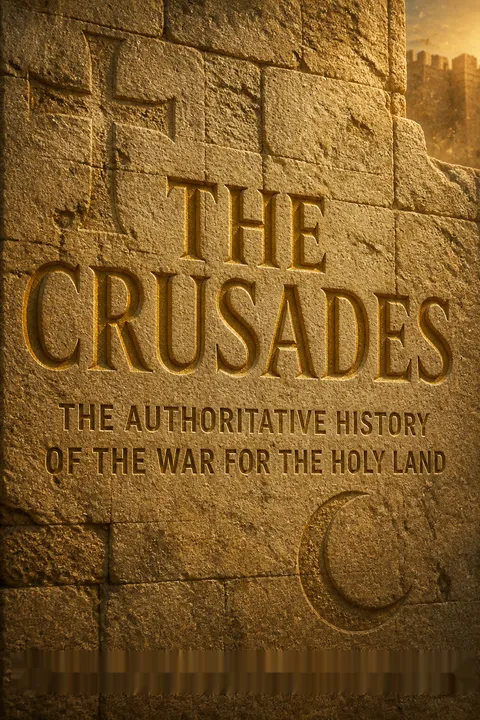


Key Takeaways
Read the First Crusade as penance in arms, not emergency defense
A new path to salvation. In 1095, Pope Urban II answered a request for help from the Byzantine emperor, then expanded the mission into an armed pilgrimage to Jerusalem. Latin Christians were taught that joining could help remit sin. For people who feared damnation, this fused familiar practices, especially pilgrimage and penance, with warfare. It helps explain why nobles and ordinary people accepted a journey that could cost them their lives and fortunes.
Urgency through exaggeration. Urban described Muslims as immediate, barbarous threats, although the evidence does not show that Western Europe faced an imminent invasion or that Christians in the Levant were undergoing widespread persecution. His rhetoric helped mobilize support, but the crusade was not simply a defensive response to fresh aggression. It was also an act of Christian expansion, shaped by religious conviction and papal ambition.
The crusade shows how a political project can become persuasive when it answers a private moral need. Urban did not have to make spiritual belief up from scratch; he joined an existing fear of sin to an extraordinary new form of penance. That helps explain mass participation without reducing every crusader to either a fanatic or a profiteer. It also cautions against treating official justifications for war as neutral evidence. A leader’s account of danger can mobilize people even when the threat is distant or overstated.
See Muslim disunity as the opening the crusaders could exploit
A divided frontier. The First Crusade entered a Levant that was not a unified Muslim heartland. Sunni Seljuq rulers, Shi‘ite Fatimids, local warlords, and Christian communities shared a politically fragmented region. The Seljuq empire fractured after a succession crisis just as the crusaders arrived. This did not cause the expedition, since western Christians had no clear knowledge of the crisis, but it made a coordinated response harder.
Cooperation had limits. Byzantine emperor Alexius I used the crusaders to help recover territory, and the Greeks helped capture Nicaea. But Frankish leaders had ambitions of their own, most notably Bohemond’s bid to rule Antioch. During the long siege there, rival Muslim rulers sent separate forces instead of uniting. The First Crusade’s success depended on religious cohesion among the Franks meeting political fragmentation among their opponents.
This is a reminder that wars are shaped by political structure as much as by battlefield courage. Fragmented authority can make a smaller invading force seem stronger because local rivals cannot coordinate in time. But disunity is an opportunity, not a permanent explanation: the Muslim world later developed leaders and institutions capable of mobilizing resistance. The comparison also applies to modern conflicts, where observers often mistake an opponent’s internal divisions for proof of lasting weakness.
Treat Outremer as a negotiated frontier, not a sealed Christian colony
A Latin minority ruled. Outremer, a medieval term for the lands beyond the sea, was made up of the Latin states of Jerusalem, Antioch, Edessa, and Tripoli. The Franks governed a much larger population of Muslims, Jews, and eastern Christians. They did not replace that population wholesale. They adapted some local institutions, relied on native farmers and traders, and sometimes made truces or military agreements with Muslim neighbors.
Contact was practical, not equal. Trade could cross front lines, and Christian rulers even issued imitation Islamic coins to work within the Levant’s commercial system. Art such as Queen Melisende’s Psalter blended western, Byzantine, eastern Christian, and Islamic influences. Yet coexistence did not mean equality or harmony. Franks were a ruling minority, laws could discriminate, and religious hostility persisted alongside daily exchange.
Frontier societies often depend on people they also classify as outsiders. Trade, labor, and shared infrastructure can make cooperation necessary without dissolving hierarchy or prejudice. That distinction helps avoid two tempting simplifications: Outremer was neither a multicultural utopia nor a society sealed off from its neighbors. Material evidence, including coins and manuscripts, is especially valuable because it reveals practical entanglements that political chronicles focused on battles might otherwise obscure.
Track jihad as a political project, not an inevitable Muslim response
Revival took time. After Jerusalem fell in 1099, Muslim writers and preachers called for resistance, but their appeals initially gained little political force. Zangi’s capture of Edessa in 1144 became a rallying point, though his main ambitions also involved Muslim-held territories. His son Nur al-Din unified Aleppo and Damascus through a mixture of pressure, diplomacy, and limited warfare, while presenting himself as a defender of Sunni Islam.
Faith and ambition overlapped. Saladin inherited no automatic claim to lead Islam. He built power in Egypt and Syria, invoked jihad to justify unification, and fought Muslim rivals as well as Franks. His motives cannot be reduced to sincere devotion or cynical empire building alone. The religious cause was real, but it also helped legitimize rule and gather support.
Political movements rarely separate cleanly into belief on one side and ambition on the other. A ruler may sincerely believe in a cause while recognizing that it can unify followers and strengthen authority. That mixed motive is not unique to medieval Islam; it is a recurring feature of state-building. The useful caution is against turning a gradual, contested revival into an inevitable religious reaction. The book instead shows specific leaders making strategic choices under changing pressures.
Hattin won Jerusalem for Saladin, but not a stable Muslim empire
Water helped decide Hattin. In 1187, Saladin drew the Frankish army away from its base near Saffuriya and into a dry, exposed position near the Horns of Hattin. The crusaders faced thirst, heat, smoke, and repeated attacks. Their defeat destroyed the kingdom of Jerusalem’s field army, and Saladin quickly captured much of Palestine before taking Jerusalem that October.
Victory was not effortless. Saladin initially threatened to sack Jerusalem, but Balian of Ibelin warned that the defenders would destroy Muslim holy sites and kill their Muslim prisoners if no terms were offered. A negotiated surrender followed, and most inhabitants were allowed to leave after ransom, with some captives enslaved. Saladin’s empire remained politically fragile, and his army failed to take Tyre. His victory was immense, but not a simple story of inexorable Muslim unity.
Hattin illustrates how logistics can turn geography into a weapon: water access, distance, and timing helped shape the outcome before the decisive fighting. The capture of Jerusalem also resists easy moral contrasts. Saladin’s initial threat was harsh, the final terms were comparatively restrained for the period, and those terms were largely honored. Explaining that context does not erase violence; it helps distinguish between a ruler’s public image, actual choices, and the limits imposed by military bargaining.
At Acre, supply lines and siegecraft mattered as much as kings
A port sustained the siege. The Third Crusade began after Hattin and Jerusalem’s fall. Richard the Lionheart and Philip Augustus joined a siege already under way at Acre, where the Mediterranean kept bringing Christian troops, food, and equipment. Saladin struggled to break the besiegers’ positions or keep the city supplied. After nearly two years, intense bombardment and attacks on the walls forced Acre’s surrender in July 1191.
Victory carried a stain. Richard demanded payment, the return of the True Cross, and the release of Christian prisoners. When negotiations stalled, he ordered about 2,700 Muslim captives killed. The crusaders then marched south under Richard’s close tactical control and defeated Saladin’s forces at Arsuf. These gains restored a Frankish foothold on the coast, but the crusade never recaptured Jerusalem.
Acre makes military success look less like a duel between famous rulers and more like a test of logistics, engineering, and endurance. The sea gave the besiegers a lifeline that Saladin could not reliably cut. The massacre of prisoners is a necessary counterweight to heroic portraits of Richard. At the same time, leaders’ reputations can obscure the contributions of soldiers, sailors, engineers, and supply networks, without which neither the siege nor the march could have succeeded.
A crusade’s sacred destination could overpower its commander’s strategy
The army wanted Jerusalem. Richard favored attacking Egypt or consolidating control of the coast, both defensible strategies given the risks of besieging Jerusalem. But many crusaders understood the expedition primarily as a journey to the Holy City. In 1191, popular pressure helped push the army inland, even though the supply route was vulnerable and Saladin still commanded a field force.
Command could not erase conviction. Richard later retreated from Beit Nuba, judging that Jerusalem could not be taken and held safely. The choice made military sense, but it devastated morale. In 1192, the same conflict returned: the crusaders advanced near Jerusalem, then withdrew amid leadership disputes and Richard’s reluctance to risk the army. The crusade ended with a truce, Christian access to the city, and Muslim control of Jerusalem.
This tension resembles a familiar problem in organizations: leaders can define an operational goal, but they cannot assume that followers share the same definition of success. For the crusaders, Jerusalem was not merely a strategic asset; it was the devotional purpose of the journey. Richard’s retreats may have been militarily prudent, yet prudence alone could not preserve legitimacy. The episode shows why managing expectations is part of command, especially when a shared mission carries meanings beyond measurable outcomes.
The Fourth Crusade shows how papal plans unraveled into political opportunism
The pope could not command events. Innocent III wanted a carefully organized crusade to the Holy Land, but the expedition’s leaders contracted with Venice to transport an army larger than the force that actually arrived. Unable to pay the full bill, they accepted a Venetian proposal to attack Zara, a Christian rival, and then diverted to Constantinople. In 1204 they sacked the Christian capital instead of reaching Jerusalem.
Egypt brought another failure. The Fifth Crusade chose Damietta as a route to Jerusalem, but spent months stalled after capturing it. Its leaders rejected an offer to return Jerusalem, then advanced south too late and were trapped by the Nile flood near Mansourah. Frederick II later regained Jerusalem through negotiation in 1229, but the settlement was temporary and politically contested. Crusading ideals did not guarantee coherent plans or outcomes.
The Fourth Crusade is a stark case of institutional design failing under financial pressure. A transport contract, an unpaid debt, and Venice’s commercial interests pulled the expedition away from its declared goal. This is not evidence that every participant secretly planned the diversion; the source emphasizes cumulative choices, not a single master conspiracy. The Fifth Crusade reveals a different weakness: confidence in a grand strategy can become costly when leaders misread terrain, timing, and the enemy’s capacity to wait.
Baybars fused mamluk discipline and state power to erase Frankish strongholds
A new military state emerged. Mamluks were enslaved boys trained as professional soldiers, then freed into a military elite. After the Mongols entered Syria, the Egyptian mamluk forces defeated them at Ayn Jalut in 1260. Baybars then built a more centralized state, using rapid messengers, disciplined troops, and careful diplomacy to govern and wage war.
The coast fell piece by piece. Baybars targeted the Franks’ castles and ports, often using overwhelming force and demolishing places he did not intend to hold. He captured Antioch in 1268. His successor Qalawun took Tripoli in 1289, and Sultan Khalil captured Acre in 1291 after a massive siege. Acre’s fall ended the Latin states on the mainland, although the crusading movement itself continued beyond the Levant.
The Mamluk rise shows how institutions can convert military skill into durable political power. A trained force, a communication network, and centralized resources allowed the sultanate to act more coherently than the fragmented states it opposed. Yet the victory was not simply a product of military superiority: Mongol pressure shaped Mamluk priorities, while Frankish infighting and shrinking western support weakened Outremer. The ending emerges from interacting systems, not from one final battle alone.
Reject a timeless clash: later politics repeatedly rewrote what crusades meant
The past was remade. Medieval writers already shaped the memory of the First Crusade, emphasizing divine favor, heroic leaders, or Muslim suffering. Centuries later, European writers alternately condemned crusading as fanaticism and celebrated it as imperial adventure. In the nineteenth century, nationalists in France, Belgium, and England claimed crusading heroes as part of their own histories.
Modern parallels are political. After the creation of Israel, some Arab writers and leaders described Western involvement in the region as a new crusade and presented Saladin as a model of Muslim unity. Islamist movements also used crusade language, while George W. Bush’s use of the term after 9/11 reinforced the comparison. The book argues that these are modern appropriations, not evidence of one continuous war between Islam and the West.
Collective memory is not a transparent record; it is a political resource. A society may elevate one medieval figure, suppress another, or reshape a complicated conflict into a clean story of victimhood and revenge. The book’s insistence on historical distance is especially valuable when public language turns the crusades into a forecast of inevitable conflict. Still, rejecting that myth does not require minimizing medieval violence or present-day grievances; it requires separating evidence about the past from claims made in its name.
Analysis
Asbridge’s history is most valuable as a correction to the idea that the crusades were a single, inevitable war between two unified civilizations. The narrative instead tracks changing coalitions, local rivalries, religious motives, commercial interests, and the demands of ruling distant territory. Its structure reinforces that argument: Christian and Muslim perspectives alternate, and major events are tested against the motives and constraints of particular actors rather than treated as steps in a predetermined contest. The First Crusade succeeds partly because a shared devotional purpose binds a diverse army while political divisions weaken its opponents. Yet that same devotional force proves difficult to command. Crusaders may accept immense hardship for Jerusalem, but their leaders cannot always persuade them to follow a strategy that appears to bypass it. On the Muslim side, leaders invoke jihad to unite followers, but they also pursue dynastic power, fight fellow Muslims, and negotiate when circumstances demand. Neither side can be understood through a simple opposition between faith and cynicism.
The book also makes material conditions central to historical explanation. Armies depend on water, food, ships, roads, fortifications, money, and the political institutions that keep these resources moving. Hattin turns water into a weapon; Acre’s coastline sustains a siege; the Nile’s flood helps defeat the Fifth Crusade. These details make military outcomes legible without reducing them to technology or geography alone.
Finally, Asbridge treats memory as part of the history, not an afterthought. Medieval chroniclers shaped events for their audiences, and modern political movements reshaped crusading memory for their own purposes. The distinction matters: the medieval wars were brutal, but they did not create an unbroken conflict that history simply carried forward. The strongest interpretation holds both truths together: religious violence had profound consequences, and later claims about its meaning are themselves political acts.
Review Summary
The Crusades: The Authoritative History of the War for the Holy Land receives high praise for its balanced and comprehensive approach to the subject. Readers appreciate Asbridge's accessible writing style, thorough research, and ability to present both Christian and Muslim perspectives. The book is lauded for its vivid battle descriptions, character portrayals, and analysis of the Crusades' long-term impacts. While some find certain sections less detailed, most reviewers consider it an excellent introduction to the topic, offering fresh insights and challenging common misconceptions about the Crusades.
People Also Read



Glossary
Outremer
Frankish lands overseasA medieval term meaning lands beyond the sea, used for the Latin Christian territories established in the Levant after the First Crusade. The main polities were the kingdom of Jerusalem, the principality of Antioch, and the counties of Edessa and Tripoli. Their populations included Muslims, Jews, and eastern Christians as well as Latin settlers.
jihad
Striving in God's pathAn Arabic term meaning striving or struggle. Muslim scholars debated its meaning, including an inward struggle against sin and an armed struggle against non-Muslim enemies. In the crusading period, rulers and preachers invoked jihad to defend Muslim territory, promote religious orthodoxy, and sometimes justify political unification or expansion.
mamluk
Trained slave soldierA military slave, usually acquired as a boy, converted to Islam, and trained for service in a ruler’s army. Mamluks could rise to command and political power after military training. In Egypt, mamluk soldiers eventually displaced the Ayyubids and established a sultanate that ruled the region and fought the Mongols and crusader states.
Military Orders
Monks who foughtReligious institutions combining monastic vows with armed service. The Templars and Hospitallers began in the Latin East, while the Teutonic Knights emerged later. They recruited trained, full-time soldiers, received donations and land, and built or maintained fortresses. Their wealth and independence made them essential to Outremer’s defence, but also potential political rivals.
crusade indulgence
Remission linked to crusadingA spiritual privilege attached to participation in a crusade. Urban II’s original promise was not precisely defined, and crusaders interpreted it in different ways. Later papal statements clarified that the benefit applied to confessed sins and required a contrite heart. The indulgence helped make armed pilgrimage an accepted form of penance.
barid
Sultan's courier networkBaybars’ restricted postal and intelligence system, using horse-borne messengers and maintained stations to carry messages across the Mamluk realm. Reports could travel between Damascus and Cairo in about four days, or faster in an emergency. The system helped the sultan monitor governors, respond to threats, and coordinate a large, distant empire.
FAQ
What's The Crusades: The Authoritative History of the War for the Holy Land about?
- Comprehensive Overview: The book provides a detailed history of the Crusades, focusing on the conflicts between Christians and Muslims over the Holy Land from the 11th to the 13th centuries.
- Dual Perspectives: Thomas Asbridge presents both Christian and Muslim viewpoints, offering a balanced narrative that includes motivations and strategies from both sides.
- Cultural and Political Impact: It explores how the Crusades shaped the historical relationship between Islam and Christianity and their lasting influence on contemporary religious and political discussions.
Why should I read The Crusades by Thomas Asbridge?
- Scholarly Insight: Asbridge is a renowned expert in medieval history, and his work is grounded in extensive research and analysis of primary sources.
- Engaging Narrative: The book is described as a "ripping yarn," filled with dramatic anecdotes that bring historical events to life, making it accessible to both casual readers and scholars.
- Contemporary Relevance: The themes explored are highly relevant today, as Asbridge connects the historical events of the Crusades to modern conflicts and cultural misunderstandings.
What are the key takeaways of The Crusades by Thomas Asbridge?
- Complexity of Holy Wars: The Crusades were not merely religious wars; they involved political, economic, and social factors that influenced both Christian and Muslim societies.
- Cultural Exchange: Despite the violence, interactions between Crusaders and local populations led to significant cultural exchanges.
- Legacy of Violence: The book discusses how the memory of the Crusades has been shaped over time, often used to justify modern conflicts, highlighting the need for a nuanced understanding of history.
What are the best quotes from The Crusades and what do they mean?
- “The crusades were not simply a catalogue of ceaseless battles and campaigns.”: This quote emphasizes the complex interactions beyond warfare, including cultural exchanges and political maneuvering.
- “The memory of the Crusades was formed in modern times.”: Reflects on how historical narratives are constructed and influence contemporary perceptions of Islam and Christianity.
- “The crusaders were not simply driven by a desire for blood or plunder; they were also empowered by heartfelt piety.”: Highlights the dual motivations of the Crusaders, combining religious fervor with the harsh realities of war.
How does The Crusades by Thomas Asbridge address the Muslim perspective?
- Balanced Narrative: Asbridge ensures that the Muslim perspective is given equal weight, discussing the motivations and responses of Muslim leaders like Saladin.
- Cultural Context: The book explores how the Crusades were perceived in the Muslim world, including internal divisions and rivalries.
- Historical Impact: It discusses the long-term effects of the Crusades on Muslim-Christian relations, emphasizing the need for understanding the historical context of these interactions.
What role did religion play in the Crusades according to The Crusades by Thomas Asbridge?
- Motivation for Warfare: Religion was a primary motivator for many Crusaders, who believed they were fighting a holy war sanctioned by God.
- Spiritual Rewards: The promise of spiritual rewards, such as the remission of sins, was a powerful incentive for participation in the Crusades.
- Religious Justification: Both sides used religious rhetoric to justify their actions, framing the conflict as a battle between good and evil.
What were the significant battles covered in The Crusades by Thomas Asbridge?
- The First Crusade: Details the launch of the First Crusade in 1095, including Pope Urban II's call to arms and the march to Jerusalem.
- Siege of Antioch: Focuses on the siege of Antioch, illustrating the challenges faced by the Crusaders and their eventual victory.
- Capture of Jerusalem: Culminates in the dramatic capture of Jerusalem in 1099, detailing the brutal aftermath and the establishment of the Latin Kingdom of Jerusalem.
How does The Crusades by Thomas Asbridge depict the relationship between the Crusaders and local populations?
- Cultural Interactions: Highlights instances of cooperation and cultural exchange between Crusaders and local Christians, Muslims, and Jews.
- Violence and Coexistence: Illustrates the paradox of violence and coexistence, showing how the Crusades created both conflict and opportunities for interaction.
- Impact on Local Communities: Discusses the profound impact of the Crusades on local populations, including displacement and eventual integration of Crusaders into the region.
What were the consequences of the Crusades as described in The Crusades by Thomas Asbridge?
- Political Fragmentation: Led to the establishment of several Crusader states, often politically fragmented and vulnerable to Muslim counterattacks.
- Cultural Legacy: Discusses the lasting cultural legacy of the Crusades, including how they have been remembered and interpreted in both Christian and Muslim contexts.
- Modern Implications: Connects the historical events of the Crusades to contemporary issues, suggesting that understanding this history is crucial for addressing modern conflicts.
How does The Crusades by Thomas Asbridge relate to contemporary events?
- Historical Parallels: Draws parallels between the Crusades and modern conflicts, particularly in the context of religious extremism and cultural misunderstandings.
- Memory and Identity: Explores how the memory of the Crusades has been used to shape national and religious identities, influencing contemporary political rhetoric.
- Call for Understanding: Advocates for a nuanced understanding of the Crusades, arguing that recognizing the complexities of this history can help foster dialogue and reconciliation today.
What methods does Thomas Asbridge use in The Crusades?
- Primary Source Analysis: Employs a wide range of primary sources, including chronicles, letters, and legal documents, to construct a detailed narrative.
- Comparative Perspectives: Utilizes comparative analysis to juxtapose Christian and Muslim viewpoints, enriching the reader's understanding of the events.
- Narrative History: Adopts a narrative history approach, weaving together personal stories and broader historical trends to create an engaging and informative account.
How does The Crusades by Thomas Asbridge depict the relationship between Saladin and Richard the Lionheart?
- Mutual Respect: Despite being adversaries, there was a level of mutual respect between Saladin and Richard, recognizing each other's military prowess.
- Rivalry and Conflict: Characterized by rivalry, with both men seeking to outmaneuver the other on the battlefield and in the political arena.
- Personal Encounters: Details specific encounters and communications between the two, illustrating how their personal dynamics influenced the larger conflict.
Download PDF
Download EPUB
.epub digital book format is ideal for reading ebooks on phones, tablets, and e-readers.








