

Key Takeaways
Treat awakening as a beginning, not proof that you are finished.
Insight is not immunity. A Zen teacher described a retreat in which his sense of self dissolved into radiant peace and oneness with the world. Months later, depression, workplace betrayal, family conflict, impatience, and familiar neuroses returned. The realization had shown him something real, but it had not erased his personality or completed his emotional development.
Life tests understanding. Kornfield draws on accounts from nearly one hundred spiritual practitioners and teachers. Their experiences differ, but many describe the same gap: powerful insight can coexist with ordinary confusion and hurtful behavior. Spiritual practice matters not only for what it reveals in retreat, but for how its insight enters work, relationships, and daily choices.
The distinction between an experience and an integrated capacity is central. A person may grasp a principle intellectually or feel it intensely without being able to enact it under stress. That gap is familiar in many forms of learning: knowing how to respond is not the same as responding well when threatened. The book’s insistence on ordinary conduct also offers a useful check on spiritual prestige. A moving account of realization is not, by itself, evidence of mature judgment or trustworthy leadership.
Tell the truth about why you seek, even when your motives conflict.
Longing has mixed roots. In a Russian initiation tale, Baba Yaga asks visitors whether they have come on their own mission or someone else’s. The first two give simple answers and are rejected. The third admits that her motives are partly personal, partly shaped by others, and partly unknown. That honesty earns her a welcome. The story treats self-knowledge, not spiritual purity, as the beginning of the journey.
Notice what calls. Kornfield describes people drawn toward spiritual life by grief, childhood wonder, a sense of emptiness, music, nature, or an encounter with a teacher. Suffering can expose the limits of familiar answers, while beauty can awaken a memory of connection. The particular doorway differs; sincerity means following the question rather than pretending to have a perfect reason.
The tale resists the comforting idea that a serious seeker must possess a single, noble motive. Mixed motives are not necessarily hypocrisy; they are material for honest examination. The approach also prevents spiritual identity from becoming another polished self-image. Its practical limit is that uncertainty alone cannot tell someone which teacher or practice is safe. Curiosity needs discernment, especially when the promise of belonging or rescue is powerful.
Use practice to meet your unfinished body, feelings, and stories.
Attention uncovers layers. Kornfield compares defensive habits to scales that gradually become visible through practice. Sitting quietly may reveal clenched muscles, restlessness, old grief, anger, craving, harsh judgments, and repetitive stories about the self. One meditator first blamed the practice for bodily pain, then discovered that years of tension were also present when lying down. The pain softened only when met with kindness rather than fought.
Awareness is not denial. Prayer, meditation, movement, and service can help someone notice these patterns without treating them as the whole self. The point is not to manufacture calm or suppress desire and anger. It is to see how they arise, what they protect, and what remains possible when they are held with care. For some, spiritual practice and therapy both help address unfinished experience.
This account makes spiritual development embodied rather than purely intellectual. Muscular tension, emotional reactions, and personal narratives can reinforce one another, so attention to only one layer may leave the rest untouched. The book’s emphasis on kindness is important because observation can become another form of self-surveillance. At the same time, intense practice can bring difficult material to the surface; interpreting every painful reaction as a necessary purification risks overlooking the need for pacing, support, or clinical care.
Face mortality, practice forgiveness, and ask what remains when identities fall away.
Initiation changes identity. In Kornfield’s retelling of the Indian story of Nachiketa, a young man waits three days in Death’s realm. Offered three blessings, he asks first for reconciliation with his father, then for inner energy to continue, and finally for knowledge of what does not die. Death gives him a mirror and directs him toward self-inquiry. The sequence links emotional repair, courage, and the question of identity.
Forgiveness releases the past. It does not excuse harm or rule out justice. It means loosening the grip of resentment so that old pain does not dictate every next action. Kornfield calls a demanding passage that matures the heart an initiation. It may arise through deliberate discipline or through loss, illness, and crisis. The story’s invitation is to meet fear directly, not to seek danger for its own sake.
The story’s sequence is psychologically astute: unresolved relationships can consume attention, sustained effort requires energy, and self-inquiry asks what identity survives change. Forgiveness is most useful when distinguished from reconciliation or absolution. A person may release hatred while maintaining boundaries or seeking accountability. Likewise, mortality can clarify priorities without making every crisis spiritually beneficial. The value lies in how a person meets difficulty, not in the severity of the ordeal.
Let sorrow, emptiness, oneness, and this moment each open a different gate.
Four doors, one awakening. Kornfield describes four gates through which practitioners may encounter freedom. Sorrow can widen personal grief into compassion for others. Emptiness means seeing that the self and its experiences are changing rather than fixed possessions. Oneness is the felt discovery of connection with other life. The gate of the eternal present points toward what is already here, rather than a distant spiritual destination.
Pain can change scale. One practitioner wept over both personal anguish and environmental destruction, then experienced sensations as passing movements within a vast stillness. Another nun felt the suffering of bereaved mothers and other beings as one shared grief. These accounts do not make sorrow pleasant. They suggest that meeting it fully may loosen isolation and deepen care.
The gates are best read as experiential lenses, not competing explanations that must be settled in advance. Their common practical thread is a shift from possession and separation toward openness. Emptiness, especially, can sound like nihilism when detached from its ethical context. Here it is paired with compassion and connection. The accounts describe what practitioners report; their spiritual significance can be honored without treating every interpretation of an unusual state as objectively verified.
Stop chasing fireworks; ordinary attention is also a path to freedom.
No spectacle required. Extraordinary experiences can inspire practice, but Kornfield warns that making them the goal turns the path into another form of grasping. One teacher spent decades practicing without a dramatic awakening. Repeatedly noticing and releasing judgment, fear, and bodily tension gradually made her kinder and less preoccupied with success. Her change was substantial even though she could not point to a single breakthrough.
Practice returns to now. Kornfield presents both disciplined effort and relaxed presence as valid approaches. In one, practice clears obstacles; in the other, it recognizes the openness already available. Neither guarantees a special state. The work is to notice when the mind is caught, release its grip, and meet the immediate task. An ordinary moment can reveal freedom without becoming a mystical event.
This argument protects practitioners from measuring inner life against dramatic stories. It also shifts evaluation toward durable qualities, such as greater kindness or less defensiveness, rather than intensity of experience. Still, ordinary practice should not become a reason to dismiss genuine distress or the desire for guidance. A quiet path can be fruitful, but its value is clearer when reflected in lived behavior and supported by honest relationships.
Treat awakening maps as spirals, not certificates of permanent perfection.
Maps describe tendencies. In the Theravada map Kornfield discusses, awakening is described in four stages: stream entry, Returning Again, Non-Returning, and Great Awakening. The stages portray progressively less grasping, but teachers disagree about how to identify them. Christian contemplatives describe dark periods after experiences of grace, while other traditions emphasize returning insight to daily life.
Progress is uneven. Practitioners report renewed grief, fear, confusion, and old habits after profound openings. One teacher returned from years in Asia to find that irritability and worries about money had quickly resurfaced. Kornfield therefore presents development as a spiral of opening, contraction, and renewed understanding, not a straight climb. Maps may offer direction, but they cannot certify that someone is permanently beyond ordinary human difficulty.
A map can orient attention without becoming a ranking system. That distinction matters because spiritual categories can turn into status claims, especially when the signs of attainment are disputed even within a tradition. The spiral image better accommodates recurrence and learning, but it should not blur different causes of suffering. A period of depression or confusion may deserve psychological or medical attention rather than an automatic spiritual label.
Keep spiritual authority accountable around power, money, sex, and secrecy.
Good intentions are insufficient. Kornfield identifies recurring risks in spiritual communities: teachers controlling students, mishandling donations, exploiting sexual relationships, or normalizing alcohol and drug misuse. He links these patterns to inflated claims of perfection, isolation from honest peers, and followers who mistake charisma for wisdom. In his interviews, roughly half of those who discussed their spiritual lives described a serious betrayal.
Make truth discussable. Kornfield calls for clear ethical standards that apply to leaders as well as students, and for communities where questions and feedback are possible. Discriminating wisdom means recognizing harm without assuming that every teaching or teacher is worthless. When a respected teacher behaves badly, the community needs ways to protect students, name what happened, and learn from it rather than preserve an idealized image.
The book’s strongest institutional insight is that abuse is not only an individual moral failure. Adoring followers, absent peers, secrecy, and unchecked authority can reinforce one another. Ethical codes and independent accountability therefore matter alongside personal virtue. The interview figure is revealing but should not be mistaken for a population estimate, since these conversations were not presented as a representative survey. The practical lesson is structural: devotion should never require surrendering the ability to question.
Let family expose the spiritual habits that solitude can conceal.
Home is a demanding mirror. Kornfield describes trying to teach meditation to his frightened, dying father. Years of paranoia could not be undone by a brief exercise. What helped was simpler: staying beside him, holding his hand, and not rejecting his fear. Kornfield presents this presence as more meaningful than delivering the right spiritual explanation.
Family patterns persist. A person may carry shame, anger, fear, or dependency learned across generations. Retreat can make these patterns less visible without resolving them. Kornfield describes turning to therapy as well as meditation to face the wounds that resurfaced in intimate relationships. The task is not to force spiritual teachings on relatives, but to meet them as family, practice patience, and make amends where needed.
Family life tests whether a value survives inconvenience, intimacy, and unequal needs. Kornfield’s father story is especially persuasive because the intervention is modest: no conversion, no grand insight, just unhurried presence. This also guards against using spiritual language to bypass another person’s reality. Yet closeness is not automatically healing. Where family relationships involve ongoing abuse, compassion may require distance and firm protection rather than renewed contact.
Include body and emotion in practice; insight cannot stay compartmentalized.
Wholeness has many parts. Kornfield uses the term mandala of awakening for a complete circle of life that includes the body, feelings, mind, principles, relationships, and wider responsibilities. Skill in meditation does not automatically bring emotional maturity or physical care. One teacher who had treated the body as an obstacle later recognized that rest, movement, and health needed to belong to practice.
Feel without obeying. Emotions need neither suppression nor automatic expression. Kornfield’s examples include teachers who grieve, feel anger, or remain temperamentally impatient while learning to hold those reactions with more space. The aim is not to become a different personality. It is to know what is happening and respond with greater care. The body’s limits, sexuality, illness, and pleasure are part of human life, not distractions from it.
The mandala model challenges the assumption that competence in one domain transfers to every other. Its breadth is useful because it brings physical health and emotional life into a spiritual account that might otherwise privilege meditation states. The important distinction is between acceptance and passivity: welcoming a feeling does not require acting on it, while honoring the body can include medical care and limits. A comprehensive practice needs more than introspection; it needs practical attention to daily conditions.
Turn insight into shared care for people, communities, and the earth.
Awakening becomes relationship. In Buddhism, Sangha means the community of people who practice and sustain the path. Kornfield argues that insight matures through spiritual friendship, shared responsibility, and service. He also extends this responsibility beyond human communities. Thai monks began protecting forests by ceremonially ordaining threatened trees, while a prison garden project gave incarcerated men responsibility for growing food and caring for living things.
Let intention guide action. The bodhisattva is a person committed to the awakening and welfare of all beings. Kornfield presents this commitment as a direction, not a promise to solve every problem. Small, repeatable actions can express it, while periods of silence and rest help keep service from becoming frantic or self-important. Care for people and care for the natural world belong within the same field of practice.
This is a practical expansion of contemplative insight: interdependence becomes visible in who is supported, what is consumed, and which living systems receive care. Community also supplies correction that solitary practice cannot, though groups can reproduce hierarchy and denial unless they remain accountable. The balance between action and rest is especially important. A vow to help all beings can inspire sustained work, but without limits it can become grandiosity or burnout rather than dependable service.
Analysis
Kornfield’s central move is to relocate spiritual maturity from peak experience to integration. The book begins with the vivid promise of awakening, then keeps asking what happens when a teacher returns to family, work, illness, and ordinary temperament. Its answer is neither that insight is false nor that enlightened people become flawless. Insight can alter one’s sense of self while leaving habits and relational wounds in need of attention. That distinction lets the book preserve the value of mystical experience without using it as proof of moral superiority.
The structure widens in deliberate circles. Personal suffering opens into compassion; self-inquiry opens into questions of identity; daily life expands into family, community, and the earth. The recurring images of gates, spirals, mirrors, and circles do more than decorate the argument. They resist the fantasy of a single upward ladder and emphasize return: what is learned in solitude must be tested among other people and embodied in conduct. The ending therefore does not offer a final state to attain. It asks whether attention, humility, and care can become ordinary habits.
The book is also unusually candid about spiritual institutions. Its account of exploitation shows how reverence can become dangerous when leaders are insulated from criticism and followers are encouraged to distrust their own perceptions. Accountability is not treated as a secular distraction from spiritual life, but as one of its necessary expressions. This gives the book practical force beyond meditation advice.
Its evidence is chiefly testimony and traditional stories, not a systematic comparative study. The interviews offer intimate texture, but cannot establish how common any experience is or settle the metaphysical meaning of awakening. That limitation need not diminish the book’s main contribution. Its most defensible insight is ethical and experiential: a realization is best judged not by its grandeur, but by whether it helps someone meet change, acknowledge harm, care for the body, and remain open to other lives.
Review Summary
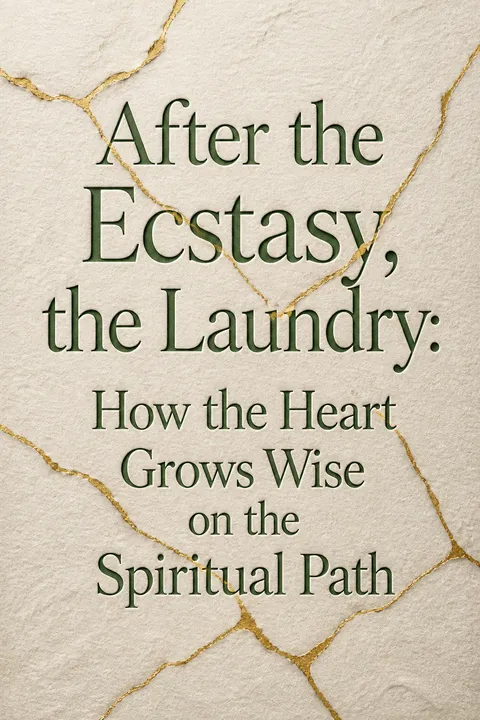
After the Ecstasy, the Laundry explores spiritual awakening and its aftermath, emphasizing that enlightenment doesn't exempt one from life's challenges. Kornfield draws on diverse spiritual traditions, offering personal accounts and wisdom on integrating spiritual experiences into daily life. Readers appreciate the book's grounding perspective, practical insights, and compassionate approach. While some find certain sections less relatable, many praise its authenticity and ability to humanize spirituality. The book resonates with those seeking to balance profound spiritual experiences with the mundane aspects of everyday existence.
People Also Read







Glossary
Satori
sudden insight into onenessA Zen term for a profound awakening experience in which the ordinary sense of a separate self may fall away and the person experiences reality as open or interconnected. Kornfield treats satori as a significant opening, not as proof that someone has completed spiritual development or become free of ordinary psychological patterns.
Stream entry
first recognized stage of awakeningIn the Theravada map presented by Kornfield, stream entry is the first of four stages of Noble Understanding. It marks an initial realization of freedom beyond the usual sense of a separate self. The experience is understood to redirect a person’s life, while further work remains to loosen habits of grasping, aversion, and fear.
Initiation
a passage that matures the heartKornfield uses initiation for a difficult passage that changes how a person understands identity, fear, and life. It may unfold gradually through repeated spiritual discipline or arrive through a crisis such as illness, loss, or confrontation with mortality. It is not merely a formal ceremony, and hardship itself is not presented as something to seek.
The Gates of Awakening
four routes into spiritual insightKornfield’s organizing term for four experiences through which people may encounter awakening: sorrow, emptiness, oneness, and the eternal present. Each offers a different entry into release from a narrow sense of self. The gates are descriptions of possible experiences, not a required sequence or a ranking of practitioners.
The body of fear
conditioned patterns of defensive selfhoodA phrase used for the limiting sense of self built from habitual bodily contraction, emotional reactions, and mental stories. When a person is caught in this pattern, experience is filtered through fear, insecurity, and the urge to control. Practice can help reveal these habits as conditioned processes rather than an unchangeable identity.
Mandala of awakening
the whole field of lived experienceKornfield’s image for a complete spiritual life that includes more than meditation or mystical insight. Its circle embraces the body, feelings, mind, ethical principles, family, community, work, and relationship to the natural world. Awareness in one area does not automatically resolve difficulties in another, so maturity requires attention across the whole field.
Sangha
community that sustains practiceIn Buddhism, Sangha refers to the spiritual community of practitioners and awakened beings. Kornfield presents it as one of the Three Treasures, alongside Buddha and Dharma. The community supports practice, carries teachings, and helps people learn through relationship. It can also offer correction and friendship, provided that it remains open to honest feedback.
Bodhisattva
one committed to all beings’ awakeningA Buddhist ideal of a person dedicated to the liberation and well-being of all beings. Kornfield emphasizes that the bodhisattva vow is a direction for conduct rather than a measurable promise to solve every form of suffering. It guides ordinary choices toward compassion, service, and wisdom, while recognizing that each person can act only within real circumstances.
FAQ
What's After the Ecstasy, the Laundry about?
- Exploration of Enlightenment: The book explores what happens after spiritual enlightenment, focusing on integrating these experiences into daily life.
- Human Experience Focus: It highlights the importance of acknowledging our full humanity, including emotions and relationships, as part of spiritual practice.
- Balance of Inner and Outer: Kornfield discusses balancing inner spiritual practices with outer actions, finding wisdom in both ecstatic and ordinary experiences.
Why should I read After the Ecstasy, the Laundry?
- Practical Guidance: Offers practical advice on navigating spiritual life while staying grounded in reality.
- Rich Personal Stories: Includes personal anecdotes and stories from Kornfield's experiences, making teachings relatable.
- Encouragement for All: Suitable for both seasoned practitioners and newcomers, reassuring readers that struggles are part of the journey.
What are the key takeaways of After the Ecstasy, the Laundry?
- Integration of Experiences: Emphasizes integrating spiritual experiences into everyday life, showing enlightenment as a beginning, not an endpoint.
- Embrace Full Humanity: Encourages acknowledging human emotions and experiences as part of spiritual practice.
- Community and Connection: Highlights the importance of community and spiritual friendship in supporting one's practice.
What are the best quotes from After the Ecstasy, the Laundry and what do they mean?
- “After the ecstasy comes the laundry.”: Spiritual experiences must be integrated into daily life, involving mundane tasks and challenges.
- “The true task of spiritual life is not found in faraway places or unusual states of consciousness: It is here in the present.”: Emphasizes being present and mindful in everyday life.
- “Awakening is not about fixing or holding but to love whatever is here.”: Suggests true spiritual practice involves acceptance and love for all aspects of life.
How does After the Ecstasy, the Laundry define enlightenment?
- Not a Final Destination: Describes enlightenment as an ongoing process requiring continuous effort and integration into daily life.
- Awareness of Impermanence: Involves recognizing the impermanence of all things and embracing the present moment.
- Unity with All Beings: Portrayed as a deep connection with all beings, fostering compassion and understanding.
What is the significance of the title After the Ecstasy, the Laundry?
- Contrast of Experiences: Reflects the contrast between peak spiritual experiences and mundane daily tasks.
- Integration of Spirituality: Highlights the necessity of integrating spiritual insights into everyday life.
- Realism in Spiritual Practice: Conveys a realistic approach to spirituality, acknowledging everyday challenges.
How does After the Ecstasy, the Laundry address the challenges of spiritual practice?
- Realistic Expectations: Discusses common challenges like doubt and confusion, emphasizing realistic expectations.
- Importance of Community: Emphasizes the role of community and support in navigating challenges.
- Continuous Learning: Encourages viewing challenges as opportunities for learning and deepening practice.
What role does compassion play in After the Ecstasy, the Laundry?
- Foundation of Spiritual Life: Presented as a foundational aspect of spiritual practice, essential for growth and connection.
- Response to Suffering: Understanding and embracing suffering can lead to greater compassion for others.
- Cultivation Through Practice: Offers methods for cultivating compassion, such as mindfulness and loving-kindness meditation.
How does After the Ecstasy, the Laundry address the concept of community?
- Importance of Sangha: Highlights the significance of community (Sangha) in supporting spiritual growth.
- Shared Responsibility: Emphasizes shared responsibility for one another’s well-being within communities.
- Conflict as Growth: Views conflicts as opportunities for growth and understanding, encouraging open communication.
What insights does After the Ecstasy, the Laundry provide about the relationship between teachers and students?
- Mutual Learning: Emphasizes reciprocal learning between teachers and students through shared experiences.
- Importance of Discriminating Wisdom: Encourages discernment and compassion when evaluating teachers.
- Navigating Challenges Together: Illustrates that both teachers and students face challenges, requiring open communication.
How does Kornfield suggest we deal with our emotions in After the Ecstasy, the Laundry?
- Acknowledge All Emotions: Encourages acknowledging and accepting the full range of emotions.
- Emotional Awareness: Advocates for developing emotional awareness through mindfulness and compassionate listening.
- Transforming Emotions: Teaches that emotions can be transformed into wisdom and compassion with an open heart.
What practices does Kornfield recommend for integrating spirituality into daily life?
- Mindfulness and Presence: Emphasizes mindfulness in everyday activities to cultivate a deeper connection to the present.
- Compassionate Listening: Advocates for being fully present and attentive to others, fostering deeper connections.
- Regular Reflection: Suggests setting aside time for reflection and meditation to maintain clarity and purpose.
About the Author




Download PDF
Download EPUB
.epub digital book format is ideal for reading ebooks on phones, tablets, and e-readers.








