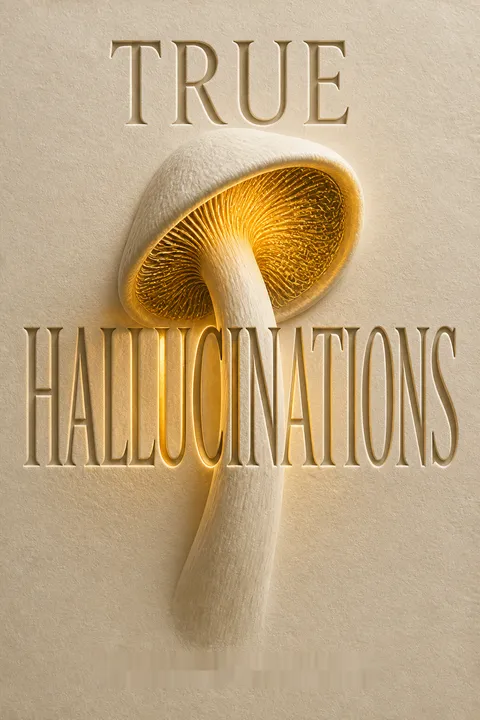


Key Takeaways
The Amazon mushroom changed their world, but not the burden of proof.
A search takes a turn. In 1971, Terence McKenna, his brother Dennis, and friends traveled into Colombia’s Amazon Basin seeking rare Indigenous hallucinogens. At La Chorrera, they found psilocybin mushrooms growing in the mission’s cattle pastures. Their first encounters felt vivid, intelligent, and unlike their previous drug experiences. Soon, the expedition’s original purpose gave way to a more consuming question: were the visions only inner experiences, or contact with an independent intelligence?
Experience became a story. McKenna recounts the journey decades later, including the group’s beliefs, disagreements, and crises. He treats the events as extraordinary, but repeatedly admits that he cannot settle what caused them. The book’s central tension is precisely that gap: a powerful experience can reshape a life without proving the explanation attached to it.
The account is strongest when it keeps perception and interpretation distinct. A psychedelic experience can feel more real, coherent, or socially significant than ordinary life, yet those qualities do not independently establish an external source. Research on expectation and context in altered states helps explain why the same drug can produce strikingly different meanings for different people. That does not make the experience trivial or fabricated. It means that sincerity, intensity, and truth are separate questions, and the book’s narrative is most useful when readers keep all three in view.
Read the jungle's history alongside its visions.
A landscape carries history. Before reaching La Chorrera, McKenna met John Brown, an elderly American who had worked in the Amazon during the rubber boom. Brown described a region scarred by forced labor and violence against Indigenous people. McKenna reports the Witoto population near La Chorrera falling from about 40,000 in 1905 to roughly 5,000 by 1970. He later learned that Brown had helped expose abuses, although another historian implicated him in the violence, leaving his role contested.
The setting is not scenery. The expedition’s search for secret Indigenous knowledge unfolded in a place shaped by colonial extraction, missionary presence, and cultural loss. Remembering that history complicates the travelers’ romantic image of the jungle as a gateway to personal revelation.
This context matters because spiritual adventure stories can turn Indigenous people into props for outsiders’ self-discovery. The book gives readers a way to resist that flattening: the same region that seemed magical to the travelers was also a site of recent, documented brutality. Brown’s disputed history further warns against treating a compelling witness as a transparent source. Respect for the mystery of a place begins with attention to its people, its political history, and the limits of what visitors can claim to understand.
A group's split over reality is part of the evidence.
The party divides. After repeated mushroom experiences, McKenna, Dennis, and Ev became increasingly open to the possibility that the visions touched something beyond individual psychology. Vanessa and Dave favored psychological explanations, including fantasy and wishful thinking. Their disagreement sharpened in isolation, where every conversation carried unusual weight and ordinary sources of perspective were far away.
Interpretation shapes the expedition. The split was not a side issue. It affected what the group noticed, what they feared, and how they understood later events. Some saw signs of an independent intelligence; others saw people becoming absorbed in an elaborate belief system. The same strange setting produced different judgments, even among friends sharing much of the same experience.
Disagreement can be informative without making either side automatically correct. In social psychology, group polarization describes how discussion among like-minded people can push their shared views toward greater certainty. Isolation and emotional stress may intensify that process. But skepticism can also become a reflex that dismisses unfamiliar experience before examining it. The useful question is not which camp had the better personality or stronger conviction. It is which claims had independent support, and whether the people involved could still consider evidence that challenged their preferred account.
A beautiful mechanism still needs a test that can fail.
A theory takes shape. Dennis proposed hyper-carbolation, his name for an imagined process in which vocal sound, psilocybin, and compounds in ayahuasca could alter the body’s chemistry and bind psychedelic molecules to DNA. He pictured the result as a lasting, information-bearing object that could connect minds across time and space. The explanation borrowed language from acoustics, molecular biology, superconductivity, and alchemy, but the proposed molecular process was not established by evidence in the book.
The experiment overwhelms its design. During the planned test, Dennis made a series of strange vocal sounds. Afterward, he and Terence interpreted an image on a mushroom cap as the Earth and concluded that something had succeeded. Their interpretation was powerful, but the image did not verify the elaborate mechanism they had predicted.
A theory can be imaginative and still be judged by ordinary standards of evidence. In science, a hypothesis gains strength when it specifies observations that could show it is wrong, and when other people can reproduce those observations. Here, the proposed mechanism, the expected signs, and the meaning of ambiguous events kept changing together. That makes the story valuable as a case study in how explanatory systems arise under pressure, but it does not turn the system into a confirmed scientific account. Wonder is a reason to investigate, not a substitute for a test.
When someone loses ordinary functioning, choose care before cosmic interpretation.
The ordeal becomes a crisis. After the experiment, Dennis became disorganized, spoke as if he could communicate telepathically, and seemed unable to follow ordinary conversations. He discarded his clothes, wandered off, and rang a mission bell until others intervened. Terence believed for a time that the events were part of a meaningful transformation. Vanessa and Dave were more concerned that Dennis was seriously unwell. The group argued over whether the cause was psychological, chemical, or something they could not explain.
Recovery was gradual. Terence says Dennis remained profoundly altered for days and returned close to his previous state by March 20. Terence also reports going without sleep for nine days. These are descriptions of an extreme and dangerous episode, not evidence that such states should be pursued or allowed to run their course without help.
An interpretation can feel spiritually coherent while a person is losing the ability to care for themselves or communicate reliably. That is a practical threshold for taking distress seriously, whatever its ultimate cause. Modern clinical care can assess sleep loss, substance effects, and other urgent risks without claiming to resolve every metaphysical question. The book’s open-mindedness is most defensible when paired with ordinary safeguards. Treating a crisis as potentially meaningful does not require delaying support or making a vulnerable person prove what is happening.
Witness certainty cannot replace independent corroboration.
Uncanny details persuade. During Dennis’s altered state, he reportedly reenacted a private conversation Terence remembered from an earlier psychedelic experience in Nepal. Terence took this as evidence that Dennis had access to his memories. Later, alone at La Chorrera, Terence watched what appeared to begin as divided clouds and end as a saucer-shaped craft passing overhead. No other person witnessed the event.
The book preserves uncertainty. Terence considers several explanations, including hallucination, memory, and an unknown phenomenon, but cannot determine which is correct. His conviction that he saw something extraordinary is part of the testimony. It is not the same as independent confirmation that the object was an alien craft or that Dennis read his mind.
Eyewitness accounts are important evidence about what a person experienced, but they are not infallible records of what caused it. Memory changes when events are recalled, especially under intense emotion, expectation, sleep deprivation, or intoxication. Independent observers, contemporaneous records, and repeatable measurements help separate these possibilities. The book offers unusual testimony rather than those forms of verification. That distinction leaves room to take Terence seriously as a witness while remaining cautious about the explanations he considered.
Make the timewave risk a prediction, not a pattern-finding game.
A new model of time. After returning from the Amazon, Terence used the I Ching, an ancient Chinese system of 64 hexagrams, to develop what he called the timewave. He proposed that nested cycles shape how novelty enters history. One early pattern used six periods of 64 days, making a 384-day cycle. He later elaborated the idea mathematically and used software to explore it.
A forecast needs limits. The book describes the timewave as pointing toward a world-transforming culmination on December 22, 2012. Terence also acknowledges that early versions contained too many variables and could be shaped by personal interpretation. The book presents the model and its forecast, but does not demonstrate that the predicted historical transformation follows from the mathematics.
A model that can explain nearly any pattern after the fact is difficult to distinguish from a pattern-finding exercise. Good forecasting therefore requires clear rules, a fixed deadline, and outcomes defined before they happen. The timewave’s 2012 forecast is now a historical test: the predicted transformation did not occur as described. That does not erase the personal or creative importance of the model, but it weighs against treating its prophecy as reliable. The distinction between an evocative map and a validated forecast is essential.
Treat the mushroom's alien voice as a question about mind.
The voice becomes an agent. In later mushroom experiences, Terence described an inner voice that seemed knowledgeable and separate from his ordinary self. He came to imagine the mushroom as an ancient intelligence, perhaps extraterrestrial, offering humanity a future partnership. He called the projected spread of this relationship the Strophariad. The book presents these claims as messages encountered in altered states, not as independently verified facts about fungi or life elsewhere in the galaxy.
There are other ways to ask. The book discusses Julian Jaynes’s theory that voices may once have been experienced as divine guidance. Terence wondered whether psychedelic voices could reconnect people with a transpersonal source. The possibility raises a serious question about how minds assign agency to inner speech, without settling where any particular voice originates.
A voice experienced as another presence can be psychologically real without requiring a separate speaker outside the mind. Human beings routinely experience thoughts as surprising, involuntary, or not fully under conscious control. Cultural stories then supply language for interpreting them, whether as ancestors, gods, illness, or extraterrestrials. Jaynes’s theory is one account of how such interpretations may shape consciousness, not a settled explanation. This perspective preserves the importance of Terence’s encounter while keeping the mushroom’s claimed galactic identity in the category of speculation.
A cosmic mission does not cancel grief, conflict, or uncertainty.
Life continues after revelation. The group eventually left La Chorrera, and the friends’ lives diverged. Terence’s relationship with Ev ended painfully. Dennis, who became a trained scientist, later remembered little of the most intense period and preferred not to revisit it. Terence continued developing the timewave and writing about the expedition, but his own account never resolves whether he encountered an external intelligence or an altered state of mind.
The ending stays open. The book’s cosmic hopes coexist with breakups, family strain, and the ordinary consequences of decisions. Terence wonders whether his sense of destiny was insight or grand delusion. He offers no final proof, only a sustained account of what the experience meant to him and why it remained impossible to dismiss.
The unresolved ending is more credible than a victory lap. A vision of planetary transformation does not automatically make its interpreter wiser in relationships, more accurate in science, or protected from loss. Those everyday outcomes do not disprove the experience, either. They show why personal meaning and public truth need different measures. The book is most valuable as a record of how a remarkable episode can organize a life, while still leaving its central claim open to doubt.
Analysis
True Hallucinations is part travel narrative, part memoir, and part speculative theory, organized around an event the author cannot conclusively explain. Its central achievement is not a demonstrable account of alien contact or a validated model of time. It is the close description of how an expedition’s expectations, group tensions, psychoactive experiences, and intellectual ambitions fused into a shared explanatory world.
The chronology gives the story force: a journey to find rare Indigenous preparations, the discovery of psilocybin mushrooms, Dennis’s elaborate theory, a destabilizing experiment, and Terence’s later attempt to turn the episode into a theory of historical time. Each stage changes the meaning of the one before it. The expedition begins as field research, becomes a metaphysical emergency, and ends as a decades-long effort to make a private revelation intellectually legible.
The book’s scientific vocabulary is both part of its drama and a source of risk. Terms from genetics, physics, and mathematics lend Dennis’s proposal the appearance of mechanism, but technical language alone does not establish that a mechanism works. Terence’s later timewave similarly moves from personal pattern recognition toward mathematical claims without providing the independent validation its forecasts would require. Readers should distinguish these proposals from the book’s more reliable evidence: what the participants said, felt, argued about, and remembered.
Its ethical and psychological dimensions matter equally. The Amazon is not an empty stage, and the history of violence against the Witoto challenges the travelers’ tendency to treat local knowledge as a portal into their own quest. The crisis surrounding Dennis also complicates any romantic account of altered consciousness. The book remains compelling because it does not entirely hide these tensions. Its lasting question is not whether every vision was true, but how people should respond when an experience feels more authoritative than the evidence can support.
Review Summary
True Hallucinations recounts Terence McKenna's psychedelic journey in the Amazon. Readers find it a captivating, well-written adventure, praising McKenna's storytelling and unique perspectives. Many appreciate his exploration of consciousness and reality, though some criticize the pseudoscientific elements. The book is described as both profound and bizarre, with vivid descriptions of drug-induced experiences. While some find it enlightening, others see it as the ramblings of an educated hippie. Overall, it's considered a classic of psychedelic literature, albeit divisive.
People Also Read







Glossary
Stropharia cubensis
Psilocybin-containing mushroomThe name used in the book for a mushroom that Terence and Dennis McKenna found growing in cattle pastures near La Chorrera. The brothers identified it as a source of psilocybin and came to see its effects as central to the expedition’s visions. The term identifies the mushroom in their account, not proof of the interpretations they attached to it.
oo-koo-he
Witoto visionary preparationA preparation associated in the book with the Witoto people of the upper Amazon. McKenna describes it as made from Virola resin combined with plant ash and reports that its use was restricted and treated as secret. The expedition originally sought it, but its search was overshadowed by the discovery of psilocybin mushrooms near La Chorrera.
ayahuasca
Amazonian visionary brewA psychoactive preparation made from the Banisteriopsis caapi vine, commonly combined with a plant containing DMT. The book describes its use among Amazonian peoples and discusses the vine’s beta-carboline compounds, which can affect how DMT is metabolized. McKenna’s group attempted to make and use the brew as part of its proposed experiment.
hyper-carbolation
Proposed voice-driven transformationDennis McKenna’s name for a speculative process intended to join psychedelic compounds, vocal sound, and human genetic material into a lasting information-bearing structure. He proposed that this might enable communication across minds and time. The book recounts the theory as the brothers’ working hypothesis, not as a demonstrated biological or physical process.
translinguistic matter
Matter imagined as languageA speculative substance the McKennas thought might emerge through sound and altered consciousness. They imagined it as something that was simultaneously language and material form, rather than ordinary words or liquid. In their account, it could embody meaning directly. The book offers this as an interpretation of visions and shamanic reports, not an established physical substance.
timewave
Model of historical noveltyTerence McKenna’s proposed mathematical model of recurring, nested patterns in time. Developed partly through his interpretation of the I Ching’s 64 hexagrams, it aimed to describe how novelty enters history and to identify periods of major change. McKenna used it to make historical forecasts, including a predicted culmination in 2012, which the book presents as a theory rather than a verified law.
cognitive hallucination
Altered intellectual realityMcKenna’s term for a change not primarily in sensory perception but in a person’s highest-level interpretation of the world. In this state, unlikely ideas may feel coherent, plausible, or certain. He uses the concept to describe how an altered state can reshape judgment and belief, including his own conviction that the Amazon experiment had transformed reality.
bicameral mind
Ancient voice-guided consciousnessJulian Jaynes’s theory, discussed by McKenna, that earlier human beings experienced some mental commands as voices from gods or other authorities rather than as their own thoughts. Jaynes proposed that this form of consciousness influenced ancient behavior and later gave way to more self-aware inner thought. The book raises the theory as a possible lens on psychedelic voices, not as a settled account.
FAQ
What is True Hallucinations by Terence McKenna about?
- Personal psychedelic journey: The book recounts Terence McKenna’s Amazon expedition with his brother Dennis, focusing on their direct exploration of hallucinogenic mushrooms and shamanic traditions.
- Blend of adventure and inquiry: It combines vivid storytelling of their adventures with philosophical and scientific speculation about consciousness, reality, and the psychedelic experience.
- Central experiment and aftermath: The narrative centers on a bold experiment involving psilocybin mushrooms and vocal resonance, leading to profound altered states and lasting impacts on the group.
- Exploration of consciousness: McKenna uses the journey to probe the nature of mind, time, and the possibility of contact with alien intelligence through psychedelics.
Why should I read True Hallucinations by Terence McKenna?
- Unique firsthand account: The book offers a rare, detailed narrative of psychedelic exploration, blending personal adventure with deep philosophical and scientific insights.
- Challenges conventional thinking: It invites readers to question mainstream views on consciousness, time, and reality, proposing innovative models like the fractal nature of time.
- Cultural and historical context: McKenna situates his experiences within broader traditions of shamanism, alchemy, and eschatology, enriching the reader’s understanding of these fields.
- Influence on psychedelic culture: The book has shaped contemporary discussions on psychedelics, making it essential reading for those interested in consciousness studies and alternative science.
Who are the main characters in True Hallucinations by Terence McKenna and what roles do they play?
- Terence and Dennis McKenna: The brothers are the central figures; Terence is the narrator and explorer, while Dennis is the theorist and botanist who devises the key experiment.
- Ev and Solo Dark: Ev, Terence’s lover and translator, and Solo Dark, a member of a fringe religious group, add complexity and tension to the group dynamic.
- Vanessa and Dave: Friends with backgrounds in anthropology and ethnobotany, they provide skeptical and grounded perspectives, eventually diverging from the main group.
- Group dynamics: The interactions among these characters reflect the social, psychological, and philosophical challenges of their extraordinary journey.
What is the significance of the Amazon location, especially La Chorrera, in True Hallucinations?
- Ecological and cultural richness: La Chorrera, deep in the Colombian Amazon, is depicted as a mystical place with abundant psilocybin mushrooms and vibrant indigenous shamanic traditions.
- Historical backdrop: The area’s history, including the rubber boom and indigenous cultures like the Witoto, provides a complex social and spiritual context for the expedition.
- Gateway to the unknown: La Chorrera serves as both a physical and symbolic portal to the psychedelic dimension and the group’s quest for the “Secret.”
- Facilitator of transformation: The unique environment is integral to the unfolding of the group’s visionary experiences and experiments.
What are the key psychedelic substances explored in True Hallucinations by Terence McKenna and what are their effects?
- Psilocybin mushrooms (Stropharia cubensis): Central to the narrative, these mushrooms induce visions, telepathic phenomena, and a sense of contact with alien intelligence.
- DMT and ayahuasca: DMT is described as the most intense natural hallucinogen, linked to encounters with elf-like entities, while ayahuasca is used for deeper shamanic states.
- Harmine and beta-carbolines: Found in ayahuasca, these compounds act as MAO inhibitors and are theorized to play a role in the vibrational and biochemical aspects of the psychedelic experience.
- Unique effects: The substances are associated with altered perceptions of time, synesthesia, and the opening of “transdimensional doorways.”
What was the key experiment at La Chorrera in True Hallucinations and what were its outcomes?
- Psilocybin resonance experiment: Dennis McKenna led an experiment combining psilocybin mushrooms with vocal resonance, aiming to induce a superconducting genetic matrix and access hyperspace.
- Ritual and process: The group consumed mushrooms and ayahuasca, performed vocalizations, and attempted to create a hyperdimensional “stone” or entity.
- Phenomenological effects: The experiment resulted in altered time perception, telepathic communication, and a sense of entering new dimensions, especially for Dennis, who experienced a prolonged shamanic state.
- Aftermath and challenges: The outcomes included profound mystical experiences, psychological strain, group divisions, and ongoing questions about the line between revelation and delusion.
What is the “violet psychofluid” concept in True Hallucinations by Terence McKenna?
- Ethnographic origins: The concept is based on Jivaro shamanic reports of a violet or blue fluid appearing during ayahuasca ceremonies, believed to have magical and healing properties.
- Scientific and mystical theory: Dennis McKenna speculates that the psychofluid is a translinguistic, hyperdimensional substance generated by vocal sounds and biochemical processes involving tryptamines and harmine.
- Role in transformation: The psychofluid symbolizes the fusion of language, mind, and matter, representing the alchemical transformation possible through psychedelics.
- Matrix of communication: It is linked to the idea of a living, holographic matrix that stores information and mediates interdimensional communication.
How does Dennis McKenna’s theory of “hyper-carbolation” relate to the psychedelic experience in True Hallucinations?
- Molecular resonance: Hyper-carbolation is a proposed process where vocal sounds induce superconductive states in molecules bonded to neural DNA, enabling higher-dimensional interactions.
- Alchemical symbolism: The theory draws on harmonic physics and ancient alchemical ideas, suggesting psychedelics can create a “philosopher’s stone” or living hyperdimensional entity.
- Experimental protocol: Dennis outlined a method involving mushrooms, ayahuasca, and specific vocalizations to achieve radical transformation of consciousness and biology.
- Blending science and mysticism: The theory exemplifies the book’s fusion of speculative science with mystical and shamanic traditions.
What is the “timewave” theory in True Hallucinations by Terence McKenna?
- Fractal, cyclical time: The timewave theory posits that time is fractal and cyclical, with repeating patterns of novelty and habit shaping history and personal experience.
- I Ching connection: McKenna links the timewave to the 64 hexagrams of the I Ching, using them to map cycles of change and novelty.
- Prediction of eschaton: The theory predicts a point of maximum novelty—identified as December 22, 2012—heralding a radical transformation or end of ordinary time.
- Challenge to linear time: This model replaces the classical, linear view of time with a dynamic, patterned understanding.
How does True Hallucinations by Terence McKenna connect psychedelic experiences with UFO and alien contact phenomena?
- Elf-like entities and folklore: The book draws parallels between DMT-induced encounters with “little people” and traditional folklore, suggesting a shared archetypal or dimensional source.
- Mushroom as alien intelligence: Psilocybin mushrooms are portrayed as ancient, galactic life forms offering humanity a symbiotic relationship and access to cosmic knowledge.
- UFO as metaphor and phenomenon: The flying saucer is seen as both a symbol of perfected mind and a real phenomenon linked to psychedelic states.
- Contact and transformation: McKenna suggests that psychedelic experiences may be humanity’s gateway to contact with other intelligences and a catalyst for evolutionary change.
What are the main philosophical and scientific ideas underpinning True Hallucinations by Terence McKenna?
- Mind-matter interplay: The book explores the idea that consciousness and physical reality are deeply intertwined, with psychedelics revealing a hyperdimensional matrix where thought and matter co-create.
- Holographic universe: McKenna discusses the brain and universe as holograms, where each part contains the whole, explaining memory and consciousness as non-local phenomena.
- Language as creative force: Language and will are proposed as forces that can influence physical reality, with resonance and intention shaping events at a microphysical level.
- Speculative biology and physics: The narrative incorporates quantum physics, molecular biology, and alchemical symbolism to theorize new models of consciousness.
What are the key takeaways and messages from True Hallucinations by Terence McKenna?
- Reality is multi-dimensional: Time, consciousness, and matter are interconnected in complex, cyclical, and fractal patterns that challenge conventional scientific assumptions.
- Psychedelics as gateways: Substances like psilocybin mushrooms and ayahuasca provide access to higher dimensions and transformative knowledge, potentially enabling contact with alien intelligence.
- Human destiny and responsibility: McKenna calls for openness to new paradigms and recognition of humanity’s place in a cosmic process, suggesting the possibility of a profound evolutionary leap.
- Invitation to question reality: The book encourages readers to reconsider the nature of perception, language, and existence, opening doors to new ways of thinking about mind and the universe.
About the Author
Download PDF
Download EPUB
.epub digital book format is ideal for reading ebooks on phones, tablets, and e-readers.








