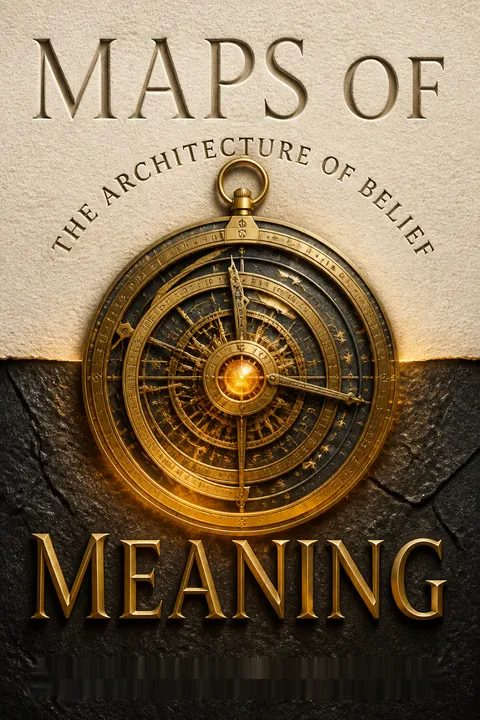


Key Takeaways
When a worldview fails, examine what your old certainty concealed
Beliefs organize a life. Peterson describes leaving the church as a teenager, then finding certainty in socialist politics. The ideology offered a clear account of injustice and a role in fixing it. Reading Orwell, he began to suspect that some believers cared less about the poor than about punishing the rich. The unsettling lesson was that moral language can hide resentment, including one’s own.
Doubt became a task. After his confidence in religion, politics, and academic explanations collapsed, Peterson was left asking how ordinary people could commit terrible acts. A prison encounter and disturbing dreams sharpened the question. His search led to the book’s central proposal: stories and myths encode practical beliefs about what matters, what future to seek, and how to act.
The autobiographical opening gives the theory a useful test: beliefs can clarify a problem while also protecting the believer from self-scrutiny. Social psychology similarly distinguishes stated motives from motives people may not recognize in themselves. That possibility should invite reflection, not automatic suspicion. A political commitment can arise from compassion, resentment, or both; exposing mixed motives does not settle whether its claims are true. The strongest lesson is to examine arguments and incentives separately.
Read the world as a stage for action, not merely a collection of objects
Things also mean. Peterson distinguishes the world as a place of things, described by science, from the world as a forum for action, where events matter because of what they invite or prevent. A child reaching for a fragile glass sculpture learns its color and texture, but also that touching it may bring a parent’s warning. The object has physical properties and a social significance.
Stories map significance. A narrative links a present condition, a desired future, and the actions that might connect them. Science can establish what a tool does; it cannot, on its own, decide what the tool should be used for. That choice depends on values, which are often carried implicitly in stories, customs, and shared expectations.
This distinction resembles the idea of affordances in ecological psychology: a doorway is not only a shape, but a possible passage for a particular person in a particular setting. It also clarifies why facts alone cannot choose social goals. Yet myth and science should not be treated as interchangeable ways of proving claims. Stories can organize value and attention, while empirical methods test descriptions of observable events. Keeping those roles distinct strengthens the argument.
Treat surprise as both a warning and the raw material of learning
Novelty interrupts plans. Peterson uses the orienting reflex to describe the attention, emotion, and pause triggered by something unexpected. In his office example, a missing elevator first creates frustration; stairs offer another route to the same goal. That is ordinary adjustment. A deeper disruption, such as losing a job that defined one’s future, can undermine the goal itself and force a broader reassessment.
Unknown means possibility. Before its significance is understood, a new event can signal both threat and opportunity. Careful exploration may reveal a manageable obstacle or useful information. Avoidance can leave the event frightening and unexamined. The book calls small changes within a stable plan normal adaptation, and changes that challenge the plan’s assumptions revolutionary adaptation.
The account usefully links attention to prediction: unexpected events capture attention because they may require a change in action. Contemporary predictive-processing theories also treat mismatches between expectation and input as important to learning, though they do not establish every claim Peterson makes about brain regions or mythic symbols. The caution is that not every shock is a growth opportunity. Trauma can overwhelm a person’s capacity to explore, making safety and support prerequisites, not signs of cowardice.
When the destination is wrong, rebuild the story, not just the route
A life story has parts. Peterson’s map of meaning includes an interpretation of the present, an imagined future, and a way to move between them. When a plan fails, the first response may be to change the means. If the goal itself proves mistaken, the whole map must be reconsidered. His example is a corporate employee whose controlling style gets him fired, forcing him to question whether that career was ever truly his aim.
Reassessment has levels. Small setbacks may call for a new tactic. Larger failures can expose hidden assumptions about identity, success, or what counts as a good life. The book describes goals as nested: a meeting can serve a career, a career can serve security, and security can serve a deeper value. A failed step can therefore prompt a search for the value beneath it.
This framework connects with cognitive reappraisal, the process of changing how an event is interpreted, and with career theories that distinguish immediate targets from deeper values. Its practical strength is diagnostic: before trying harder, ask whether the method or the destination has failed. Its danger is equally real. People can rename an avoidable setback as a profound calling. Reframing is most credible when it includes evidence, responsibility for one’s role, and attention to consequences for others.
Let tradition train you, but never let it replace conscience
Culture is shelter and restraint. Peterson personifies inherited culture as the Great Father: the shared rules, skills, and expectations that make cooperation possible and protect people from uncertainty. Myths of Marduk, who defeats a chaos dragon and forms an ordered world, portray the work of establishing that protection. But the same authority can become tyrannical when it treats every inherited rule as final.
Learn before you rebel. The book describes socialization as apprenticeship: a young person first adopts a group’s discipline and practices before becoming capable of questioning its rules. Initiation myths dramatize the difficult transition from childhood dependence to adult responsibility. The point is not that every tradition is wise, or every rite healthy. It is that discipline can provide skills and stability, while mature judgment must remain able to revise what no longer serves life.
The apprenticeship model captures a genuine developmental tension: people need instruction and reliable norms before they can exercise informed independence. It also aligns with the idea of scaffolding, where support enables capacities that later become more autonomous. The caution is that hierarchy can disguise coercion as education, and communities can label dissent immature to protect their power. A sound apprenticeship therefore needs accountability, room for questions, and a credible path toward independent judgment.
Recognize evil in the refusal to correct a known falsehood
The lie freezes adaptation. Peterson uses evil to mean more than rule-breaking or aggression. It is the deliberate refusal to face disconfirming experience, especially when preserving a belief requires harming others. In his account, the lie may begin as inaction: ignoring a warning, avoiding a difficult conversation, or pretending a harmful pattern is not happening. Repeated avoidance narrows what a person can acknowledge and eventually makes coercion seem necessary.
Self-examination matters. Peterson recounts discovering that he could imagine violence, despite seeing himself as harmless. Solzhenitsyn’s accounts of the Gulag describe prisoners who preserved their integrity under pressure, and others who became camp enforcers. These stories complicate the comforting idea that evil belongs only to monsters. The book urges readers to examine their own capacity for denial and cruelty before assigning all blame elsewhere.
The emphasis on self-deception is ethically valuable because people often commit harm while seeing themselves as justified. But a moral psychology of individual choice cannot replace analysis of institutions, incentives, propaganda, and coercion. Gulag and Holocaust perpetrators acted within systems designed to normalize violence; explaining their participation requires both personal responsibility and structural account. The useful application is not to imagine everyone equally culpable, but to ask how ordinary habits of compliance can become machinery for harm.
Avoid both obedient rigidity and contemptuous withdrawal
Two escapes share a fear. Peterson contrasts the authoritarian who clings to group certainty with the decadent who rejects shared obligations as meaningless. The first tries to suppress difference; the second avoids the discipline needed to build anything. Both evade the harder task: integrating personal needs, social responsibility, and new information. Contact with strangers or unfamiliar ideas can feel threatening because it challenges the expectations that make a group predictable.
Difference needs judgment. The book argues that cultural contact can produce conflict before it produces a broader understanding. Merely celebrating diversity does not resolve competing values; neither does crushing them. The task is to assess claims, negotiate shared rules, and revise assumptions without treating outsiders as embodiments of chaos or treating every inherited norm as worthless.
This is a useful warning against two familiar simplifications: that order alone guarantees virtue, or that rejecting institutions automatically makes a person free. Political science adds that institutions can both constrain abuse and reproduce it, so their legitimacy depends on checks, participation, and fair treatment. The author’s paired labels are interpretive types, not a complete taxonomy of political behavior. They illuminate defensive motives, but should not flatten real differences among ideologies, communities, or degrees of power.
Let mortality sharpen your attention, not turn life into a joke
Self-awareness brings a price. In the story of the Buddha, Prince Gautama leaves a protected life and encounters old age, sickness, and death. The knowledge shatters his childhood picture of safety and sets him on a search for a way to live with suffering. Peterson reads this and the biblical Fall as myths about self-consciousness: once people recognize their vulnerability, ordinary life becomes shadowed by mortality.
Awareness can still serve life. The book does not treat death as a problem that can be solved by pretending it is absent. Instead, it asks whether the knowledge of limits can deepen responsibility and make action more meaningful. Its danger is nihilism: concluding that because life ends, nothing matters. Its alternative is to act while taking both vulnerability and the value of others seriously.
The connection between mortality awareness and meaning has support across existential psychology, where reminders of death can intensify both defensiveness and commitment to valued relationships. The Buddha story makes that shift vivid without requiring literal belief in its supernatural elements. Still, mortality does not affect everyone in the same way; grief, culture, and material security shape its force. Treating existential distress as a moral failure would miss the need for care, community, and practical support.
Follow disciplined interest into uncertainty, then bring back what you learn
Interest marks a frontier. Peterson treats genuine interest as a signal that something partly understood may hold useful information. The alchemists pursued the prima materia, their term for the mysterious substance from which transformation was thought to emerge. Their search did not produce the magical stone they sought, but it helped sustain investigation of matter. The book reads this as a model of approaching uncertainty rather than retreating into inherited answers.
Return matters. A child in Peterson’s account imagines confronting a dragon, removing the source of its fire, and turning it into a shield. The nightmare stops. The story captures the book’s ideal: face what frightens you, discover what it contains, and use the discovery constructively. Interest is not every impulse. It needs discipline, reality-testing, and a willingness to contribute what is learned to shared life.
Interest can function as an attentional compass, bringing sustained effort to questions that routine overlooks. The history of science offers a parallel: curiosity often opens inquiry, while disciplined methods determine which explanations survive. That distinction keeps the book’s invitation from becoming a defense of impulse. Not every fascination is wise, and some dangers should be avoided rather than approached alone. Interest is most useful when paired with competence, evidence, and regard for the people affected.
Analysis
Maps of Meaning is best read as a synthesis of personal narrative, depth psychology, comparative mythology, and moral argument. Its central interpretive move is to treat myth not as primitive science, but as a symbolic account of how people assign significance and decide how to act. That move gives the book a memorable architecture: familiar order protects, the unknown disrupts, and the exploratory person turns disruption into renewed order. The autobiographical framing matters because Peterson presents this structure as an answer to a lived crisis of belief, not merely as a taxonomy of symbols.
The synthesis is powerful precisely where it is most open to challenge. The book moves between empirical claims about attention and brain function, interpretive claims about myth, and normative claims about good and evil. Those forms of argument do not provide the same kind of evidence. Similar myths across cultures may reflect shared human problems, transmission between societies, or both; resemblance alone cannot prove a universal archetype. Likewise, the proposed links between hemispheres, emotion, and symbolic roles are more speculative than the book’s confident narrative can make them sound.
Its moral contribution is a demand for self-scrutiny: do not confuse loyalty with virtue, or discomfort with proof that an idea is evil. Its limitation is a tendency to make political and psychological failures look primarily like failures of individual courage. Institutions, material pressures, trauma, and unequal power also shape what people can perceive and choose. The most useful reading preserves the book’s challenge to denial while treating its mythic framework as a lens for interpretation, not a final scientific map. That distinction lets readers draw on its ethical force without mistaking symbolic coherence for empirical demonstration.
Review Summary
Maps of Meaning receives mixed reviews, with ratings ranging from 1 to 5 stars. Positive reviews praise its depth, complexity, and insights into human psychology, mythology, and belief systems. Critics argue it's dense, repetitive, and pseudoscientific. Some readers find it life-changing, while others view it as convoluted and poorly written. The book explores the architecture of belief, drawing from psychology, philosophy, and religious studies. Readers appreciate Peterson's interdisciplinary approach but note the challenging nature of the text, requiring significant effort to comprehend fully.
People Also Read








Glossary
world as forum for action
Experience organized by significanceA way of understanding reality in terms of what events mean for action, rather than only describing their observable properties. In this view, people encounter objects as both physical things and invitations, obstacles, threats, or opportunities. Stories and myths represent this practical, value-laden world; scientific description focuses on features that can be observed and compared.
metamythology of the way
A cycle of changePeterson’s name for a recurring story pattern: a stable world is disrupted by unexpected information, breaks down into uncertainty, and is reorganized into a renewed order. The pattern represents how people revise not only their actions, but sometimes their beliefs about the present, the future, and what counts as a worthwhile goal.
Great Mother
The unknown’s creative dangerA mythic figure representing unexplored reality and its double potential. The Great Mother can signify birth, renewal, and unexpected opportunity, but also danger, loss, and destruction. Peterson uses the image to describe how the unknown feels before it has been understood. The figure is a symbolic category in his interpretation, not a claim about women’s nature.
Great Father
Culture’s protective orderA mythic figure representing inherited culture, familiar rules, and accumulated social knowledge. The Great Father protects people by making behavior more predictable and cooperation possible. The same order can become oppressive when it forbids necessary change. Peterson therefore treats the figure as ambivalent, both sheltering and potentially tyrannical.
orienting reflex
Attention to unexpected eventsA response to novelty in which attention shifts toward an unexpected or changed stimulus, ongoing behavior pauses, and the organism begins to assess what is happening. Peterson connects this response with fear, curiosity, and exploration. He uses it to explain why errors and surprises can initiate learning, while familiar, predictable events often receive little attention.
prima materia
Alchemy’s transformative unknownThe alchemical term for the primal, unformed substance thought to underlie material transformation. Peterson interprets it psychologically as the unknown potential from which new experience, knowledge, and patterns of action can emerge. It is associated with chaos and uncertainty, but also with the possibility of creating something valuable from what had not yet been understood.
creative illness
Crisis during transformationA term Peterson draws from Henri Ellenberger for a painful period of psychological upheaval associated with an intense search for understanding. It may involve depression, anxiety, or other distress while the person remains absorbed in a central question. The period can end in a lasting change in outlook, though distress itself does not guarantee insight or recovery.
metanoia
A change of outlookA Greek term often translated as repentance, which Peterson and the cited literary critic Northrop Frye interpret as a change in one’s fundamental outlook. In this account, metanoia is more than regret about a particular act. It means rethinking the assumptions that guide behavior and adopting a transformed way of understanding oneself and the world.
FAQ
What's Maps of Meaning: The Architecture of Belief about?
- Exploration of Belief Systems: The book examines how belief systems shape human experience and behavior, using mythology and psychology as lenses.
- Integration of Disciplines: Peterson combines insights from psychology, philosophy, and religion to explore the nature of meaning and the human condition.
- Order and Chaos: A central theme is the balance between chaos and order, and how individuals navigate these forces in their lives.
Why should I read Maps of Meaning: The Architecture of Belief?
- Understanding Human Motivation: The book provides a framework for understanding why people act the way they do, which can aid personal development and relationships.
- Insight into Cultural Narratives: Peterson analyzes cultural myths and stories, offering insights into their influence on modern society and individual beliefs.
- Practical Applications: Readers can apply the concepts discussed to find meaning and purpose amidst chaos.
What are the key takeaways of Maps of Meaning: The Architecture of Belief?
- Importance of Narrative: Narratives shape our understanding of the world and influence our actions and beliefs.
- Role of Sacrifice: Sacrifice is necessary for achieving meaningful goals, ensuring future prosperity.
- Confronting Evil: The book emphasizes the need to confront darker aspects of human nature and society to prevent suffering.
How does Jordan B. Peterson define meaning in Maps of Meaning: The Architecture of Belief?
- Guiding Principle: Meaning helps individuals navigate life's complexities, providing direction and purpose.
- Connection to Sacrifice: Meaning often requires sacrifice, indicating that personal growth comes at a cost.
- Balance of Chaos and Order: Meaning is found in the interplay between chaos and order, confronting the unknown while maintaining structure.
What role does mythology play in Maps of Meaning: The Architecture of Belief?
- Framework for Understanding: Myths encapsulate universal truths about the human experience, serving as a lens to explore psychology.
- Cultural Significance: Myths guide societies, shaping moral values and collective beliefs.
- Personal Relevance: Myths provide insights into personal struggles and aspirations, remaining relevant to individual lives.
How does Maps of Meaning: The Architecture of Belief address the concept of evil?
- Human Capacity for Evil: Peterson posits that everyone has the potential for evil, emphasizing self-awareness and moral responsibility.
- Confronting Malevolence: The importance of confronting evil within oneself and society is discussed to prevent suffering.
- Historical Context: Historical atrocities illustrate how unchecked evil can manifest, urging vigilance against such tendencies.
How does Maps of Meaning: The Architecture of Belief relate to personal responsibility?
- Central Theme: Personal responsibility is crucial for creating meaning and purpose in life.
- Impact on Society: Encouraging personal responsibility can lead to positive societal contributions and change.
- Confronting Suffering: Accepting responsibility helps individuals confront and manage suffering, essential for growth and resilience.
What is the significance of order and chaos in Maps of Meaning: The Architecture of Belief?
- Duality of Existence: Order represents stability, while chaos embodies uncertainty and potential; both are necessary for balance.
- Personal Development: Engaging with chaos fosters resilience and creativity, encouraging exploration beyond comfort zones.
- Cultural Implications: Societies must balance order and chaos to thrive, avoiding tyranny and anarchy.
How does Maps of Meaning: The Architecture of Belief suggest we confront chaos?
- Embrace Uncertainty: Chaos is a necessary part of life, and confronting it can lead to growth and discovery.
- Developing Resilience: Engaging with chaos builds resilience and adaptability, viewing challenges as opportunities.
- Finding Meaning: Navigating chaos can lead to deeper meaning and a richer life experience.
What practical advice does Maps of Meaning: The Architecture of Belief offer for daily life?
- Be Precise in Communication: Clear language reduces misunderstandings and improves relationships.
- Take Responsibility: Accountability is essential for personal growth and societal contribution.
- Seek Meaning: Actively seek and create meaning by engaging with challenges and exploring new possibilities.
What are the best quotes from Maps of Meaning: The Architecture of Belief and what do they mean?
- “Do not let your children do anything that makes you dislike them.”: Emphasizes discipline in parenting to foster positive relationships.
- “Tell the truth. Or, at least, don’t lie.”: Highlights the moral imperative of honesty for personal integrity and societal health.
- “Life is suffering.”: Acknowledges life's inherent difficulties, underscoring the necessity of meaning and purpose.
How does Maps of Meaning: The Architecture of Belief relate to contemporary issues?
- Crisis of Meaning: Addresses the modern struggle to find purpose in a rapidly changing world.
- Cultural Critique: Critiques ideologies promoting nihilism or victimhood, advocating for responsibility and meaning.
- Practical Guidance: Offers advice for navigating life's challenges, emphasizing truth, responsibility, and meaningful relationships.
About the Author
Other books by Jordan B. Peterson


Download PDF
Download EPUB
.epub digital book format is ideal for reading ebooks on phones, tablets, and e-readers.








