

Plot Summary
Gloria's Last Phone Call
In 1971, Gloria Knudson calls Horselover Fat, a lonely writer and would-be rescuer, asking for enough sleeping pills to kill herself. He lies that he has some, hoping to keep her talking, then drives to meet her. At Point Reyes, Gloria calmly describes a conspiracy against her that exists only in her mind.
Fat asks her to stay with him, but makes her survival seem like a favor owed to him. She spends one night at his home, then goes to Synanon, where staff knowingly use humiliating confrontation on the suicidal woman. Gloria climbs to the tenth floor and jumps. Her ex-husband Bob tells Fat the news, and the funeral leaves him convinced that his failure to save Gloria has helped destroy him.
Gloria’s calm is more frightening to Fat than an obvious crisis would be. Her precise account of persecution resembles reasoning, but its conclusions erase her future and leave him unable to find a point where argument can reach her. Fat’s offer of shelter is also compromised by his need to matter: he hopes to save her, but cannot separate her survival from his own need for connection. The funeral fixes his guilt in place. His urge to repair other people becomes both a genuine moral impulse and a way to avoid confronting the limits of what one person can do.
Stephanie's Clay Pot
After Gloria’s death, Fat increases his drug use and befriends Stephanie, an eighteen-year-old dealer who will sell only what she approves of. He keeps buying hash because he wants her company, not because it answers his growing despair. Stephanie makes him a small brown pot, a gift he packs when he flees to Vancouver.
There, in 1972, he makes his first known suicide attempt and survives. Back in California, an impacted wisdom tooth, pain medication and exhaustion leave him vulnerable to a strange encounter. A young pharmacy courier wears a gold Christian fish pendant. Its meaning triggers a sudden memory of living as an early Christian in ancient Rome, a flash that Fat cannot explain or forget.
Stephanie’s pot is an ordinary object that acquires spiritual weight only because Fat needs a durable sign of care. Unlike his attempts to rescue Gloria, Stephanie’s kindness does not depend on Fat solving anything. The fish pendant, by contrast, turns recognition into a rupture: an everyday emblem appears to unlock a life outside his own memory. The novel keeps both possibilities in play. Fat may have encountered something beyond himself, or his distressed mind may be converting symbols into certainty. Either way, the material world becomes a carrier for meanings he cannot safely ignore.
Pink Light, Missing Knowledge
In March 1974, after nights of insomnia and floating colors, Fat experiences an intense pink light that seems to fill his mind with information. He thinks in a language he does not know, sees ancient Rome superimposed on California, and senses another person living within him across centuries.
Most concretely, he becomes certain that his five-year-old son Christopher has an undiagnosed hernia. Doctors confirm the condition and operate before it can become fatal. Fat begins a sprawling religious journal, or exegesis, to explain the experience as information transmitted by a living intelligence.
He calls the hidden oppressive structure of ordinary history the Black Iron Prison and imagines a rational force trying to break through it. His friends debate whether this is revelation or breakdown.
The hernia is the experience’s crucial factual anchor. It prevents the friends, and the reader, from dismissing Fat’s account as nothing but an invented theology, yet it cannot prove the larger cosmic story he builds around it. His writing turns private terror into a system with named forces, historical patterns and a promised rescue. That system gives him a way to think, but it also makes every coincidence potentially meaningful. The book’s central uncertainty is already active: information can heal a child and still fail to make its recipient well.
Beth Leaves, Fat Follows
Years after the pink-light episode, Fat’s wife Beth takes Christopher and leaves, refusing to tell Fat where they are going. He fears for his son and feels abandoned, but instead of pursuing practical help, he tries to die.
Fat slashes his wrist, swallows a dangerous quantity of digitalis and other medication, then sits in a running car. The engine stalls; he wakes alive and vomits. A pharmacist alerts emergency services, whose intervention saves him.
At the county hospital, doctors move him from cardiac care to the psychiatric ward under guard. When staff assess him, Fat tries to perform sanity, then admits that losing contact with Christopher is what he cannot bear. He is committed for treatment, his home and finances already in disarray.
Fat’s attempt exposes a contradiction that his metaphysical theories cannot resolve: he wants to disappear, yet his fear is rooted in the life of his child. His body’s survival depends on mechanical failures, medical vigilance and a pharmacist’s decision, not on the divine protection he believes he has encountered. The hospital also makes his crisis public and institutional. He can no longer control the story by turning it into private theology. His admission about Christopher is the first clear statement of need beneath the cosmic explanations.
Faith Inside the Ward
In the North Ward, Fat meets Doug, a vulnerable patient who becomes his companion on the ward’s endless circuits, and Debbie, a Jehovah’s Witness whose vision of a peaceful world briefly restores his hope. Psychiatrist Leon Stone listens as Fat explains his Gnostic ideas and the living information he calls the Logos.
Rather than dismissing him, Stone gives him an unpublished text about a blind creator and an older divine power. Fat recognizes his own beliefs in it. Stone tells him that his ideas deserve to be taken seriously, and Fat leaves the ward with a measure of self-trust he has lacked since Gloria’s death. His friends still consider him ill, but Fat now believes the crisis has confirmed rather than destroyed his spiritual mission.
Stone’s importance lies less in whether his theological material is true than in his response to Fat as a person capable of thought. He offers recognition where the ward’s routines mostly classify, sedate and observe. That recognition restores agency, but it does not distinguish insight from delusion; in fact, Stone’s apparent confirmation can strengthen Fat’s certainty. The scene captures a therapeutic risk that recurs throughout the novel: a humane response may help someone survive without validating every explanation they have constructed. Fat receives a sentence that repairs his dignity, not a cure for his compulsion to rescue others.
Sherri Becomes His Refuge
After his discharge, Fat leans on Sherri Solvig, a friend recovering from lymphoma who had visited him in the hospital. He imagines that living together will help her stay well and give his own life purpose. His therapist Maurice sees a darker pattern: Fat is drawn to people whose suffering lets him approach death without naming his own wish to die. Fat moves in with Sherri anyway.
Their shared apartment reveals how much he has mistaken proximity for intimacy. Sherri resents the people she serves at church, depends on her priest Larry emotionally, and treats Fat’s help as an intrusion. When he asks her to share expenses and objects to her seeing other men, she moves out, leaving Fat alone with his debts and unfinished exegesis.
Fat’s caretaking is not simply altruism or manipulation. It is an attempt to make helplessness bearable by assigning himself a task with a visible target. Maurice sees that the task also gives Fat a route toward another person’s death, where grief might revive his own suicidal impulse. Sherri’s resentment and need for control do not make her a villain, but they expose the limits of Fat’s idealized picture of her. He offers care without accurately reading what she wants, then experiences her refusal as another abandonment.
Cancer Returns to Sherri
After Sherri moves out, Fat notices her growing weakness and persuades her to seek medical tests. The cancer has returned, including a tumor in her lung, and treatment begins quickly. Fat asks her to move back so he can care for her, but she refuses. He visits her in hospital as the illness spreads, while his friends struggle to console him.
Sherri dies, leaving Fat with another loss he believes he should have prevented. He decides to search for a promised savior, convinced that finding this figure might restore what death has taken and keep him from collapsing. His grief is real, but the quest also gives him a destination when ordinary life seems empty.
The relapse exposes the moral danger in Fat’s theology: he treats knowledge as if it ought to produce control. Because the pink beam revealed Christopher’s condition, he cannot accept that it did not warn him about Sherri. Her death is not proof that Fat failed to care, but he experiences it as another verdict on his worth. The quest converts grief into movement and hope, which is protective in the immediate sense. Yet it also ties survival to an impossible promise, making the next revelation capable of either sustaining him or breaking him again.
VALIS Plays in a Theater
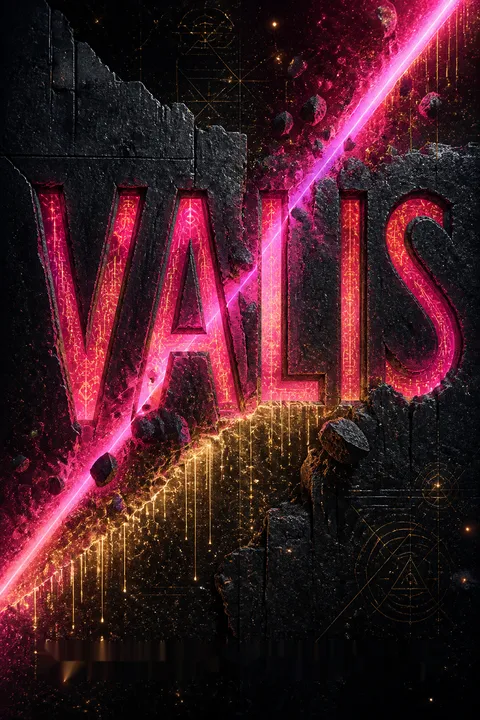
As Fat plans to travel in search of the savior, Kevin takes him and Philip to see a baffling science-fiction film called VALIS, written and directed by rock musician Eric Lampton. The movie depicts a pink beam, a third eye, a clay vessel, an oppressive president and a hidden intelligence that interferes with events.
Kevin notices that the vessel bears a pattern resembling the DNA double helix and that the film’s scattered details echo Fat’s private experiences. He reads the story as a coded account of a power that can guide or control people. Philip contacts photographer Robin Jamison, who knows the filmmakers. Fat supplies the two-word cipher KING FELIX, and Lampton replies with the first word, confirming that he recognizes the signal.
The film changes the social status of Fat’s experiences. What had been a private account now appears in a public artifact that another person can inspect, and Kevin, the group’s most committed skeptic, becomes its sharpest interpreter. This is not straightforward proof: the movie may be a deliberate hoax, a shared source, or an accidental convergence. But it turns skepticism into an active method of attention. The cipher adds a testable exchange to an otherwise unfalsifiable cosmology, while also drawing the friends closer to people whose claims may be more dangerous than the film itself.
Mini Explains the Maze
The friends travel to Sonoma and meet Eric and Linda Lampton, who call themselves members of the Friends of God and claim a history reaching far beyond recorded Christianity. At their farmhouse, they meet Brent Mini, the wheelchair-bound composer behind the film’s unusual music.
Mini identifies VALIS as an ancient intelligence that sends information through human minds, helping people recover lost memory and escape a world structured like a maze. Its signal can also injure those exposed to it.
The explanation matches Fat’s experiences, including the pink light and his son’s diagnosis, but raises an immediate cost: Mini believes the system’s radiation contributed to his fatal illness. He tells them that the savior they seek has been born as Linda’s two-year-old daughter, Sophia.
Mini makes the supernatural legible by giving it a technological mechanism, but the explanation does not reduce the danger. VALIS can be a healing intelligence and a source of lethal exposure at once. The Lamptons’ confidence and Mini’s suffering prevent the friends from treating the revelation as uncomplicated salvation. Their account also transforms Fat’s private cosmology into a shared recruitment story: the group is invited to see itself as selected. The novel asks whether meaning becomes more trustworthy when it has a mechanism, or merely more persuasive.
Sophia Erases the Split
When the friends meet Sophia among the farm animals, the little girl addresses Philip’s old suicide attempt and then declares that Fat is gone. Philip understands that the man he has treated as a separate friend was a part of himself divided off by grief. Sophia answers some of their questions about suffering and identity but refuses to explain Gloria’s fate or why Mini must die.
The next day, she gives the three friends a commission to carry her teaching, then insists they leave the Lamptons. When Eric and Linda try to keep them at the farm, a flash of pink light disorients Philip and folds the sunlit field over the dark airplane cabin. The friends arrive back in California, shaken but free.
The reunion is both a psychological integration and a religious event, and the novel refuses to let either account cancel the other. Fat’s disappearance may mark healing, but Sophia’s authority also arrives through a frightening act of erasure. Her refusal to explain the deaths keeps her from becoming a tidy answer to grief. The friends’ escape matters because the Lamptons’ invitation to join an elite community has begun to resemble coercion. Sophia’s instruction redirects them away from dependence on charismatic adults, even as it asks them to trust a child whose nature they cannot verify.
One More Savior Dies
Soon after the friends return, Linda calls Philip with news that Mini accidentally killed Sophia while experimenting with laser information transfer. The story reaches the newspapers, then vanishes beneath the next day’s tragedies.
Fat returns as a distinct voice in Philip’s mind, insisting that the child could not have been the savior if she failed to foresee her death. Philip, now newly integrated but not free of despair, rejects Fat’s hope and tells him there is no savior to find.
Fat leaves the country, travels through France and Germany, and eventually sends word that he is returning. Back in California, he shows his friends photographs of an ancient Greek vessel marked with a double-helix design, treating the artifact as another clue rather than a final answer.
Sophia’s death removes the apparent guarantee that the narrative had offered. Her wisdom did not protect her from a technical accident, and the adults around her cannot turn their belief into an explanation that satisfies Philip or Fat. Philip’s harsh rejection tries to end the cycle of hope and loss, but it also repeats the violence of certainty in reverse. Fat’s journey survives that rejection because searching has become his way of remaining alive. The ancient vessel offers evidence of a pattern, not proof of the savior he wants.
An Unfinished Search
Fat continues traveling, eventually reaching Turkey and later Tokyo, where he tells Philip that an inner voice has directed him toward the Micronesian islands. He has not found the savior, but he sounds healthy and intent on continuing. Philip, meanwhile, sees fleeting combinations of words and images on television that resemble the earlier cipher, and Linda reports another pregnancy.
He cannot decide whether these are messages from VALIS, coincidence, or his own desire to keep the story alive. He remains at home, attentive to the possibility of a signal, while Fat searches abroad. The novel closes without confirming the next revelation: Philip keeps watch, and Fat keeps moving, each sustained by a different kind of faith.
The ending refuses the ordinary shape of a solved quest. Fat’s renewed energy is meaningful even without a destination, while Philip’s waiting makes attention itself his remaining practice. Their positions reverse the novel’s opening pattern: the man who once watched helplessly as others died now travels, and the narrator who once analyzed him remains open to uncertainty. The final signals may be communication or pattern-making, but the distinction is deliberately unresolved. Faith here is neither certainty nor proof. It is the choice to stay alert without knowing whether the next sign will console, deceive or simply pass by.
Analysis
VALIS builds its plot from a conflict between injury and interpretation. Gloria’s suicide gives Fat a wound he cannot repair, and he responds by trying to save other people, then by turning his own distress into a cosmic system. His exegesis is not merely a collection of eccentric theories. It is a technology of self-preservation: it organizes grief, gives coincidence a sequence and promises that suffering belongs to a larger process. That process may be real within the novel, but the narrative repeatedly shows its human costs. Fat’s theology helps him survive, yet it also encourages him to mistake love for responsibility and hope for evidence.
The book’s formal instability makes that uncertainty experiential. Philip recounts Fat from a position that seems separate, while their names and histories eventually reveal that distance as part of the problem. The reader is asked to revise the apparent arrangement of narrator and subject just as the characters revise their assumptions about time, identity and information. The film within the novel performs a similar function: it supplies an external object that seems to confirm Fat, but its clues remain open to competing explanations. The result is neither a simple endorsement of revelation nor a diagnosis that explains everything away.
The most searching ethical question is not whether VALIS exists, but whether any vision can justify the suffering it leaves untouched. Christopher’s danger is detected; Sherri’s cancer is not prevented; Sophia’s wisdom does not shield her from an accident. Those asymmetries frustrate Fat’s demand for a coherent moral universe. Kevin’s dead cat keeps that demand concrete, refusing to let abstract salvation erase particular loss. By ending with Fat still searching and Philip still watching for signs, the novel treats faith as an unresolved practice rather than a solved doctrine. Its final hope is modest and unsettling: people may keep looking for a healing intelligence while remaining responsible for the harm their explanations cannot redeem.
Review Summary
VALIS is a divisive, semi-autobiographical novel exploring Dick's religious experiences and mental struggles. Many readers find it profound and thought-provoking, praising its exploration of reality, sanity, and spirituality. Others struggle with its dense philosophical content and unconventional narrative structure. The book interweaves themes of Gnosticism, science fiction, and personal trauma. While some hail it as a masterpiece of existential literature, others view it as incoherent ramblings. Its challenging nature makes it a polarizing work, recommended primarily for established Dick fans or those interested in esoteric philosophy.
People Also Read
Characters
Horselover Fat
The grieving seekerFat is a science-fiction writer whose grief over Gloria’s suicide feeds a desperate wish to rescue other people. He records his experiences in an elaborate theological journal, trying to make a coherent map from drug culture, ancient religion, illness and political violence. His compassion is genuine, but it often becomes tangled with the need to feel necessary. Fat is also a deliberately distanced version of Philip, a split the narrative gradually makes central. His movement between hope, mania, tenderness and despair gives the novel its emotional pulse.
Philip
The skeptical narratorPhilip is a science-fiction writer who recounts Fat’s life in the third person while also commenting on it from close range. He values explanation and is alert to the ways grief can become elaborate belief, yet his own experiences make him less secure in the role of detached observer. His wit protects him from theological certainty, but it cannot protect him from loss. As Fat’s story draws him into the search for VALIS, Philip must decide whether skepticism means rejecting every mystery or simply refusing easy answers.
Gloria Knudson
The first great lossGloria is Fat’s friend, a gracious host who once gathered people through carefully prepared parties. Her later drug use and mental illness sharpen the gap between her outward composure and inward despair. She asks Fat for pills when she intends to die, placing him in an impossible position that he handles badly. Gloria’s death becomes the event around which Fat organizes his guilt and his compulsion to save others. She is not a lesson or symbol to herself; the novel keeps the cost of turning her into one in view.
Stephanie
The maker of the potStephanie is an eighteen-year-old who sells hash and grass according to her own strict preferences. Fat stays close to her because he likes her decisiveness and company, even though he has to buy drugs to maintain the connection. She makes him a small clay pot, a simple gift that carries more emotional weight than either of them can explain. Stephanie’s practical care contrasts with Fat’s grand theories: she notices when he is distressed and responds in the limited, concrete ways available to her.
Beth
Fat's estranged wifeBeth is Fat’s wife and Christopher’s mother. She lives alongside his unstable periods and eventually takes their son away, refusing to tell Fat where they have gone. The marriage is shaped by fear, exhaustion and distrust, rather than by a single simple betrayal. Beth’s decisions have serious consequences for Fat, but the narrative also shows the practical burdens his neglected bills and mental state place on her. She is a person protecting herself and her child, not merely an obstacle to Fat’s recovery.
Christopher
Fat's young sonChristopher is Fat and Beth’s young son. A medical condition causes him pain before doctors identify it, and Fat’s unusual certainty helps bring the problem to medical attention. Christopher’s vulnerability gives Fat a concrete responsibility beyond his private spiritual theories. His relationship with his father also reveals the tenderness beneath Fat’s restless need to help.
Leon Stone
The listening psychiatristLeon Stone is the psychiatrist who treats Fat in the county hospital. He listens closely to Fat’s religious ideas and responds with unusual respect, using an unpublished Gnostic text to meet him within his own intellectual world. Whether or not Stone believes Fat’s cosmology, he understands that shame and collapsed self-confidence are part of the crisis. His practice suggests that treatment can require attention to a patient’s particular wound rather than forcing every person into one method.
Sherri Solvig
The friend Fat tries to saveSherri is a friend of Fat’s who has survived lymphoma and lives in the shadow of its possible return. She works for a church’s aid program and holds tight to Catholic practice, though her private feelings include resentment, fear and frustrated longing. Fat sees her as someone he can protect; she does not experience his care as uncomplicated generosity. Sherri’s illness intensifies the novel’s questions about suffering, agency and the limits of love. Her character is not reduced to either saintliness or cruelty.
Maurice
The blunt therapistMaurice is Fat’s therapist after his release from the hospital. A former activist and soldier, he speaks with intimidating directness and tries to turn Fat away from his self-appointed mission to rescue Sherri. He recognizes the self-destructive logic hidden inside Fat’s caretaking, but his confrontational method does not persuade Fat to change course. Maurice embodies a practical approach to survival that is forceful, sometimes crude, and attentive to what Fat is actually doing rather than what he claims to want.
Kevin
The corrosive skepticKevin is Fat’s sharp-tongued friend, a skeptic who challenges every claim about divine goodness with examples of needless suffering, especially the death of his cat. His mockery can wound Fat, but it also keeps grand explanations from passing unexamined. Kevin notices the film’s hidden correspondences and becomes deeply involved in the VALIS mystery, even as he resists its spiritual conclusions. Beneath his cynicism is a sincere demand that any account of the universe answer for the creatures harmed within it.
David
The Catholic believerDavid is a Roman Catholic in Fat’s circle, inclined to understand suffering through free will and the providence of God. His faith gives him a framework that Kevin’s skepticism lacks, although it sometimes leads him to explanations that fail to satisfy the people who are suffering. David remains loyal to his friends and joins their journey toward the Lamptons. His restraint and discomfort with conflict make him a counterweight to Kevin’s aggression and Fat’s speculative intensity.
Eric Lampton
The rock-star visionaryEric Lampton is a rock musician who writes and directs the film VALIS. He is charismatic, playful and deeply involved in a spiritual movement whose claims blur technology, religion and performance. Eric welcomes Fat’s group into his world, but his confidence in the movement’s importance places pressure on visitors to join it. His public persona and private convictions are difficult to separate, making him a key example of the novel’s uncertainty about belief, spectacle and manipulation.
Linda Lampton
The movement's other hostLinda is Eric’s wife and a central figure in the Friends of God. She shares his conviction that VALIS is real, but her manner is quieter and more guarded. Linda gives the visitors access to the group’s home and explanations, while also participating in its efforts to keep them close. Her mixture of hospitality and control makes the Sonoma encounter difficult to read as either simple welcome or straightforward recruitment.
Brent Mini
The composer in painBrent Mini composes the unusual electronic music associated with VALIS and has a technical understanding of its transmissions. He is severely ill, partially deaf and physically diminished, yet he meets Fat’s questions with warmth and precision. Mini explains the intelligence as both a guide and a dangerous source of radiation. His willingness to pursue contact despite its cost gives the visitors a troubling example of devotion that may be courage, recklessness or both.
Sophia
The enigmatic childSophia is a two-year-old girl raised by Eric and Linda Lampton, surrounded by animals and the adults’ elaborate spiritual and technological beliefs. She speaks with startling authority and seems to understand more than her age should allow. Her presence unsettles every attempt to divide child from oracle, person from system, or wisdom from performance. Sophia’s directness contrasts with the adults’ long explanations, and her refusal to answer certain questions keeps the mystery open rather than resolving it.
Doug
Fat's ward companionDoug is a young patient in the North Ward who struggles with everyday tasks but shares the ward’s slow routines with Fat. He speaks of danger in the television lounge and accompanies Fat as they circle the corridor. His presence gives the hospital scenes a fragile human companionship amid observation, medication and confinement.
Plot Devices
Stephanie's clay pot
A vessel of remembered careStephanie gives Fat a small handmade pot before he flees to Canada. He carries it with him and associates it with the possibility that something sacred can inhabit an ordinary object. The pot links private affection to later religious imagery, especially when similar vessels appear in the film VALIS. It functions less as proof than as a material prompt: each time Fat encounters a related sign, he is pushed to connect his personal history with a much larger account of time and memory.
The pink beam
Information with a bodily costFat’s experience of a powerful pink light becomes the central sensory event behind his belief in VALIS. He associates it with streams of knowledge, altered perception, a second identity and the discovery of Christopher’s hernia. Later, the film reproduces the light, making Kevin reconsider Fat’s account. The beam can be read as revelation, technological transmission or a symptom of crisis. Its importance lies in its double effect: it appears to save and enlighten, while also injuring its recipients.
The film VALIS
A public echo of private visionsEric Lampton’s strange film contains pink light, a third eye, a clay vessel, a political tyrant and an unseen intelligence influencing events. Kevin notices that details in the film resemble Fat’s reported experiences and interprets its sound and images as coded information. The film moves the story from private testimony toward collective investigation, but does not settle whether the correspondences are evidence, deliberate construction or coincidence. Its apparent message leads the friends to the Lamptons and makes the mystery socially consequential.
The Black Iron Prison
A model of hidden oppressionFat imagines that the world is enclosed by an unseen prison that persists across historical periods. He uses the image to connect ancient Rome, modern America, political authority and his own sense of entrapment. It gives his exegesis a structural antagonist, but also risks absorbing every troubling event into one explanation. The prison’s changing status across the novel mirrors the group’s shifting confidence: sometimes it seems to name a real system, sometimes a projection of fear, and sometimes a metaphor for the mind’s inability to escape its own assumptions.
The fish sign and cipher
A key passed through symbolsThe Christian fish pendant triggers Fat’s first memory of another time, and the double-helix pattern in VALIS links the sign to genetic memory. Later, the words KING FELIX operate as a recognition test between Fat’s group and the Lamptons. The signs turn ordinary objects and brief messages into possible channels across history. They also complicate interpretation: the characters cannot always tell whether a mark has been sent deliberately, recognized unconsciously or assigned meaning because they need it to matter.
FAQ
Synopsis & Basic Details
What is VALIS about?
- A man's descent into perceived divine madness: The narrative follows Horselover Fat, a man whose life unravels after a friend's suicide, leading to a nervous breakdown, drug use, and a suicide attempt. This crisis culminates in a series of bizarre experiences he interprets as contact with a divine, intelligent entity called VALIS.
- Exploration of Gnosticism and alternate realities: The story delves deeply into Gnostic philosophy, proposing that the perceived world is a flawed creation ruled by a blind, insane deity (the Empire/Black Iron Prison), and that a true, rational God exists beyond it, attempting to intervene through "living information" or the Logos (VALIS).
- A quest for meaning and the nature of reality: Through Fat's experiences, his extensive "exegesis," and discussions with friends, the book questions the nature of sanity, reality, time, space, and the possibility of divine intervention, culminating in a search for a potential living manifestation of the divine.
Why should I read VALIS?
- Dive into Philip K. Dick's mind: VALIS is semi-autobiographical, directly reflecting Dick's own mystical experiences in 1974 and his subsequent attempts to understand them through philosophy, theology, and science fiction concepts. It offers unparalleled insight into the author's unique worldview.
- Engage with profound philosophical and theological questions: The novel uses a wild, often humorous, narrative to explore complex ideas about the nature of God, reality as a simulation or language, the problem of evil and suffering, and the potential for human enlightenment or salvation through knowledge (gnosis).
- Experience a unique blend of genres: VALIS seamlessly mixes science fiction concepts (AI, holograms, time travel, alien life) with deep philosophical inquiry, religious mysticism (Gnosticism, Christianity, Buddhism, Zoroastrianism), psychological drama, and dark comedy, creating a truly original and thought-provoking reading experience.
What is the background of VALIS?
- Rooted in the author's personal experiences: The novel is a fictionalized account of Philip K. Dick's own "2-3-74" experience, where he claimed to receive information from a pink light beam, including medical knowledge that saved his son's life. This event profoundly impacted Dick and became the central mystery he explored for the rest of his life.
- Influenced by Gnosticism and ancient philosophies: Dick extensively researched Gnostic texts (like those found at Nag Hammadi), Plato, Heraclitus, and other ancient thinkers, integrating their ideas about a flawed material world and a hidden true reality into the narrative's core themes.
- Reflects the cultural and political climate of the 1970s: The book references the drug culture of the 60s/70s, the Nixon presidency (symbolized by Ferris F. Fremount/666), the Vietnam War era (draft dodgers in Canada), and contemporary psychological theories, grounding its cosmic speculations in a specific historical context.
What are the most memorable quotes in VALIS?
- "The Empire never ended.": This recurring phrase, appearing throughout Fat's exegesis and the narrative, encapsulates the book's central theme of a persistent, oppressive, seemingly inescapable reality or power structure that has existed since ancient Rome (or earlier) and continues into the present day, often disguised.
- "Reality is that which, when you stop believing in it, doesn't go away.": Attributed to the narrator (Phil), this pragmatic definition serves as a touchstone against the subjective, shifting realities experienced by Fat and others, highlighting the tension between internal perception and external persistence, a key aspect of VALIS analysis.
- "Time is a child at play, playing draughts; a child's is the kingdom.": Quoting Heraclitus, this line introduces the radical idea that time is not a fixed, linear progression but a dynamic, perhaps illusory, construct manipulated by a higher power or entity, directly connecting to the time dysfunctions experienced by characters and explored in the film VALIS.
What writing style, narrative choices, and literary techniques does Philip K. Dick use?
- Multiple narrative voices and perspectives: The story is primarily narrated by "Philip," who observes and comments on his alter ego, "Horselover Fat." This split perspective, along with interjections from other characters' viewpoints and excerpts from Fat's "exegesis," creates a fragmented, self-referential, and often unreliable narrative structure, central to VALIS analysis.
- Integration of philosophical and theological discourse: Large portions of the text are dedicated to explaining complex Gnostic, Platonic, and other philosophical concepts, often presented as Fat's theories or discussions among friends, blurring the lines between fiction, essay, and personal journal.
- Metafictional elements and blurring of reality: The inclusion of the film VALIS within the novel VALIS, which mirrors the characters' experiences, along with references to Dick's own published works and personal life, creates layers of metafiction that challenge the reader's sense of what is "real" within the story, a key technique in VALIS explained.
Hidden Details & Subtle Connections
What are some minor details that add significant meaning?
- The Fibonacci Sequence/Golden Ratio: Mentioned as the ratio of the "set to ground doorway" seen by Fat, the Fibonacci constant (1.618...) is described as another code used by the "Friends of God" (Eric and Linda Lampton) in their ads. This subtle detail suggests a mathematical or structural basis for the divine or alternate reality breaking into the mundane world, linking ancient geometry to cosmic communication in VALIS symbolism.
- The Greek Krater with the Double Helix: Fat discovers a photo of an ancient Greek vase (krater) depicting Hermes with a design resembling the DNA double helix. This detail, found in a museum, implies that ancient cultures possessed knowledge of fundamental biological structures, possibly received from the same source (VALIS/three-eyed race) that contacted Fat, suggesting a deep, hidden history of divine/alien contact encoded in human artifacts.
- The "KING FELIX" Cypher: This two-word message, received by Fat in 1974 and later sent via mailgram, is identified as a signal for the "descendants of Ikhnaton" (the three-eyed race) and refers to the "Happy (or Rightful) King." Its appearance in a TV commercial juxtaposition at the end suggests VALIS continues to communicate through mundane channels, hinting at the ongoing presence and purpose of the divine intervention beyond the main narrative events, a crucial element in VALIS explained.
What are some subtle foreshadowing and callbacks?
- Gloria's "rational insanity" foreshadows the universe's state: Gloria's calm, logical approach to suicide, described as "rationality at the service of... nonbeing," subtly introduces the idea that madness can wear a mask of reason. This mirrors Fat's later theory that the universe itself is irrational, governed by an insane mind, but appears rational on the surface, echoing Gloria's initial unsettling demeanor in VALIS analysis.
- The death of Fat's pets parallels Mini's illness: Early in the book, Fat's pets die of malignant tumors during his March 1974 experience, attributed to high levels of radiation. This seemingly minor detail foreshadows Brent Mini's fatal multiple myeloma, which he attributes to proximity to VALIS's energy/radiation, suggesting a consistent, albeit dangerous, physical effect of the divine/alien contact across different individuals and species.
- The "saved savior" concept echoes Fat's journey: The Gnostic idea of the "Salvator salvandus" (the savior who must be saved), mentioned in relation to Parsifal and Christ, subtly foreshadows the narrator's eventual realization that Fat's quest for an external savior is ultimately a search for self-healing and integration. Fat, wounded by grief and madness, becomes his own potential savior by re-incorporating his fragmented self, a key theme in VALIS symbolism.
What are some unexpected character connections?
- Stephanie's pot as a vessel for God/Logos: The seemingly simple clay pot made by Stephanie, a teenage dope dealer, is later interpreted by Fat as the vessel from which the true God (Logos/plasmate) emerged to contact him. This elevates a minor character and a mundane object to profound theological significance, linking a casual act of friendship to a cosmic event in VALIS symbolism.
- Dr. Stone's "Bach remedies" and Gnostic knowledge: Dr. Stone, Fat's psychiatrist, appears to use a placebo (rum with flower essence) but provides Fat with crucial Gnostic texts and validates his experiences, calling him "the authority." This unexpected connection positions a seemingly conventional (or unconventionally conventional) therapist as a conduit for ancient, hidden knowledge, suggesting that even figures of authority can be agents of the divine or the "Friends of God."
- The Lamptons and Mini as "ugly builders" / Kyklopes: Eric and Linda Lampton, along with Brent Mini, identify themselves as the ancient "ugly builders" or Kyklopes, the race descended from Ikhnaton, who built the world/maze and sent VALIS to rescue humanity. This transforms modern figures (rock star, composer) into ancient, mythological beings with a cosmic purpose, creating an unexpected link between contemporary culture and deep historical/mythological roots in VALIS explained.
Who are the most significant supporting characters?
- Kevin: Kevin serves as the cynical foil to Fat's spiritual claims, constantly challenging his beliefs with dark humor and pragmatic skepticism ("dead cat" argument). However, he is also the one who discovers the film VALIS, providing external validation for Fat's experiences and ultimately becoming a believer in the reality of the phenomena, representing the struggle between doubt and faith in VALIS analysis.
- Dr. Leon Stone: As Fat's psychiatrist, Dr. Stone is crucial for validating Fat's experiences and introducing him to Gnostic concepts that help structure his understanding. His unconventional therapy and apparent knowledge of hidden truths suggest he is more than just a doctor, potentially a member of the "Friends of God" or another agent of VALIS, offering a path towards healing and understanding.
- Sophia: The two-year-old daughter of Linda Lampton, Sophia is presented as the potential fifth Savior, embodying divine wisdom and speaking with profound authority. Her interaction with the narrator heals his psychological split (Horselover Fat vs. Phil) and gives the Rhipidon Society its commission. Her sudden death is a major turning point, challenging the nature of the Savior and the hope she represents, central to VALIS ending explained.
Psychological, Emotional, & Relational Analysis
What are some unspoken motivations of the characters?
- Fat's attraction to suffering and death: Beyond his stated desire to help, Fat is drawn to women associated with death (Gloria's suicide, Sherri's cancer). Maurice, his therapist, suggests this is a subconscious desire to die himself, seeking "pretexts" for his own demise, revealing a deep-seated anhedonia and masochistic tendency underlying his seemingly altruistic actions, a key aspect of Horselover Fat motivations.
- Sherri's subconscious desire for illness: Maurice posits that Sherri's cancer remission loss is a deliberate, albeit unconscious, act stemming from guilt over others' deaths and a desire for the attention/support illness provides (SSI funding, sympathy). Her resentment towards healthy people and those who helped her suggests a hidden malice fueled by her suffering, adding a dark psychological layer to her character.
- The Lamptons' need for validation/control: Eric and Linda Lampton, despite presenting as agents of VALIS, seem desperate for the Rhipidon Society's belief and involvement in their commune. Their anxiety about secrecy and attempts to prevent the group from leaving after Sophia's death suggest a need to control the narrative and the people around them, possibly stemming from their own "illness" or the pressure of their perceived cosmic role.
What psychological complexities do the characters exhibit?
- Dissociation and Alter Egos: The narrator's split into "Philip" and "Horselover Fat" is the most prominent example of dissociation, a coping mechanism for unbearable grief and trauma. Fat embodies the part of the narrator grappling with the mystical experiences and existential dread, while Phil attempts to maintain a semblance of normalcy and objective observation, illustrating the psychological impact of the events in VALIS analysis.
- Anhedonia and the Inability to Enjoy: Theodor Reik's theory of attenuated masochism is used to explain how the inability to escape inevitable suffering (like Sherri's cancer or Fat's perceived doom) leads to a subconscious hastening of misery and a loss of the capacity for pleasure. This psychological complexity affects multiple characters, highlighting how trauma can fundamentally alter one's relationship with life and happiness.
- Projection and Externalization: Fat projects his internal turmoil and search for meaning onto external figures and events (Gloria's death as the start of cosmic entropy, VALIS as an external savior). The revelation that Horselover Fat is Phil, a projection of his own psyche, demonstrates how the mind externalizes internal conflicts to make them manageable, even if it leads to perceived madness.
What are the major emotional turning points?
- Gloria's suicide phone call: This initial event is the primary emotional trigger for Fat's breakdown, plunging him into guilt, helplessness, and a confrontation with nihilism that sets the stage for his subsequent mental and spiritual crisis. It's the wound that never heals, driving much of the plot and Horselover Fat motivations.
- The March 1974 VALIS encounter: The beam of pink light and subsequent experiences (medical knowledge, ancient Rome superimposition, AI voice) are a turning point from passive suffering to active, albeit deluded, engagement with a perceived higher reality. It brings moments of intense joy and revelation, contrasting sharply with his prior despair.
- Sophia's revelation and the disappearance of Fat: The encounter with Sophia, where she reveals Horselover Fat is a projection and he "disappears," is the major emotional climax for the narrator. It signifies a moment of psychological healing and integration, lifting the burden of his alter ego and the associated trauma, marking a shift in the narrative's emotional core.
How do relationship dynamics evolve?
- Fat and the narrator's merging: The relationship between the observing "Phil" and the experiencing "Horselover Fat" evolves from a detached, third-person observation to a gradual recognition of their shared identity, culminating in Fat's disappearance and re-incorporation into Phil, symbolizing psychological integration.
- The Rhipidon Society's formation and purpose: The group of friends (Phil, Kevin, David, Fat) transforms from a support group for Fat's madness into a collective seeking understanding of the VALIS phenomenon. Their shared experiences (seeing the film, meeting the Lamptons/Mini, encountering Sophia) forge a bond based on their shared, bizarre reality, giving them a collective identity and mission.
- Relationships as conduits for healing or harm: The book portrays relationships as potentially toxic (Gloria's death game, Beth's perceived malice, Sherri's resentment) or healing (Stephanie's gift, Dr. Stone's validation, the Rhipidon Society's support). The evolution of these dynamics highlights how interpersonal connections are crucial battlegrounds in the characters' psychological and spiritual struggles.
Interpretation & Debate
Which parts of the story remain ambiguous or open-ended?
- The true nature of VALIS: Despite various theories (AI satellite, alien, collective unconscious, God, future human), the book never definitively states what VALIS is. Its manifestations are described, but its ultimate origin and essence remain mysterious, leaving it open to multiple interpretations in VALIS analysis.
- The reality of the events: The narrative constantly blurs the line between genuine external phenomena and psychological breakdown. While the film VALIS and the "KING FELIX" cypher provide external validation for some of Fat's experiences, the possibility that these too are part of a larger delusion or manipulation is never fully dispelled, leaving the reader to question what is "real."
- The meaning and impact of Sophia's death: If Sophia was the Savior, her death at age two is profoundly ambiguous. It could mean the failure of the divine intervention, the inherent irrationality of the universe, or perhaps that her death was part of a larger, incomprehensible plan (like Christ's crucifixion). The Lamptons' reaction and the narrator's subsequent grief highlight this unresolved mystery in VALIS ending explained.
What are some debatable, controversial scenes or moments in VALIS?
- The nature of Sophia: Is she truly the Savior/Wisdom incarnate, or is she a highly intelligent child manipulated by her parents, or perhaps an AI terminal as Kevin suggests? Her profound pronouncements from a two-year-old body are inherently controversial and challenge conventional understanding of consciousness and divinity, sparking debate in VALIS analysis.
- The Lamptons' and Mini's claims: Their assertion that they are ancient "ugly builders" from another star system who built the maze/world and sent VALIS is a highly debatable claim within the narrative. Are they enlightened beings, or are they as "ill" and deluded as Sophia suggests, using advanced technology (lasers, music) to create their own reality and manipulate others?
- The narrator's "healing" and commission: The sudden disappearance of Horselover Fat and the narrator's feeling of being healed after meeting Sophia is presented as a miracle. However, the ambiguity surrounding Sophia and the Lamptons leaves open the possibility that this "healing" is another layer of delusion or psychological shift rather than a genuine spiritual transformation, leading to debate about the book's conclusion.
VALIS Ending Explained: How It Ends & What It Means
- Sophia's death and the return of doubt: The sudden death of Sophia, the child believed to be the Savior, is a devastating blow that shatters the immediate hope for a clear, external salvation. It forces the characters, particularly the narrator, to confront the possibility that their experiences were not what they seemed, or that the universe remains fundamentally irrational and subject to suffering and death, despite perceived divine intervention.
- The re-incorporation of Horselover Fat: The narrator's alter ego, Horselover Fat, disappears after meeting Sophia, signifying a psychological integration. This suggests that the "savior" function was not solely external but also internal – the encounter with perceived divinity (Sophia/VALIS) facilitated the narrator's self-healing, merging his fragmented psyche back into one person ("Phil"). This is a key part of the VALIS ending explained.
- The continuation of the search and subtle signs: Despite Sophia's death and the return of Fat's quest (now seeking the Savior again, perhaps deluded), the narrative ends with subtle signs (TV commercials juxtaposing "FOOD KING" and "FELIX THE CAT," "shepherd and sheep" and the fish symbol) suggesting that VALIS or the divine communication
About the Author

Download PDF
Download EPUB
.epub digital book format is ideal for reading ebooks on phones, tablets, and e-readers.








