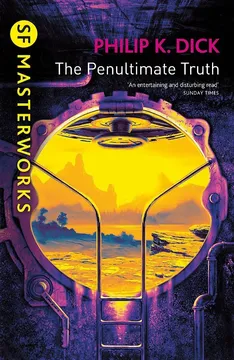


Plot Summary
The Squirrel in the Fog
On his Pacific estate, speechwriter Joseph Adams2 tries to make a machine compose a harmless moral about squirrels. Its canned wisdom disgusts him, especially because he has glimpsed a living squirrel in a world where the species is believed extinct.
His colleague and lover, Colleen Hackett,7 urges him to write in his own words, but Adams2 has grown dependent on the agency that turns his phrases into speeches for Talbot Yancy, the Protector shown to millions underground.
Adams2 serves an elite whose members occupy vast estates while workers manufacture robots below. His unease surfaces as loneliness, irritation, and a wish to tell the truth, yet he still prepares another speech. The work gives him purpose, even as he suspects it is also his drug.
Adams begins as a man who can detect the falseness of a machine's language but cannot yet separate himself from the system that gives his own language value. The squirrel is more than a lost animal: it is evidence of a world that may still contain life beyond the elite's controlled stories. His impulse to write honestly is genuine, but his dependence on the speechmaking apparatus makes conscience feel like a threat to identity. The fog outside and the emptiness inside his estate register the same condition: he has comfort without human company, and insight without the courage to act on it.
Souza Cannot Be Replaced
Underground in the Tom Mix ant tank, elected president Nicholas St. James1 visits Maury Souza,11 the aging mechanic11 who has kept the community's equipment running through fifteen years of war. Doctor Carol Tigh5 privately confirms Souza11 is dying of pancreatitis.
Nicholas1 knows the tank cannot meet its demanding production quota without him, but he cares more about saving his friend11 than preserving output. When Detroit is shown destroyed on the communal screen, Protector Yancy promises the underground population that their sacrifices are making them stronger.
Souza11 dies during the broadcast, and Carol5 reveals the clue she has been collecting: Yancy's pronunciation shifts between speeches, while claims of surface military hospitals make little sense if robots, not people, fight the war. Nicholas1 sees no proof yet, but Carol's5 question unsettles the official account.
Nicholas's crisis begins with a conflict between care and compliance. Souza represents practical knowledge earned through service, not status, and Nicholas feels the human cost of losing him more sharply than the quota's institutional consequences. The Detroit broadcast converts distant destruction into pressure on the tank, while Yancy's reassuring performance tries to turn grief into productivity. Carol's recordings offer a different kind of evidence: not a dramatic confession, but small inconsistencies preserved over time. Her method challenges a system built on spectacle by attending to its seams. Nicholas is not yet ready to accept her suspicion, but personal loyalty has made the question impossible to dismiss.
A Tunnel for One Man
The morning after Souza11 dies, a committee of Tom Mix activists tells Nicholas1 that the tank's quota is failing and offers him twenty thousand Wes-Dem dollars to obtain an artificial pancreas on the black market.
Their plan includes a tunnel, but it reaches only forty feet; Nicholas1 would have to dig the rest alone while avoiding patrols. When he resists, the committee shows him a bomb and makes clear that refusal could kill him and his family. Nicholas1 agrees because the alternative is certain violence, and because Souza11 might still be saved.
His wife Rita6 watches him leave with dread, while Nicholas1 recognizes that fear, not heroism, is pushing him upward. He enters the narrow shaft with a portable scoop, oxygen equipment, and a mission that may cost his life.
The committee's appeal exposes how oppression reproduces itself among the oppressed. The tankers need Nicholas to risk his life, yet they use the same coercive logic that governs them, threatening innocent people to secure a desired outcome. Nicholas's decision is therefore neither simple courage nor free consent. His devotion to Souza gives the mission moral force, but the bomb strips away any romantic account of choice. The tunnel itself makes the dilemma physical: a cramped passage from a system he knows into a world he has been trained to fear. By accepting the task, Nicholas crosses a point of no return without knowing whether the dangers above are real.
Artifacts for a Frame
At the New York Agency, the elderly power broker Stanton Brose4 assigns Adams2 a secret operation, with builder Verne Lindblom8 producing convincing alien weapons and bones. The objects will be planted on land where industrialist Louis Runcible10 plans to build housing for people released from the tanks.
Adams2 must write fabricated scientific articles, dated decades earlier, that will make the discovery appear historically priceless. Brose4 expects Runcible10 to hide the finds rather than surrender valuable land, giving the government grounds to imprison him and seize his empire.
Adams2 realizes the plan depends on exploiting Runcible's10 greed, though Runcible's10 housing offers tankers a less miserable life aboveground. Meanwhile, Adams2 hears a speech by the young Yance-man David Lantano3 that admits the tankers have been deprived of their rightful lives. Lantano's3 candor unsettles Adams2 more than Brose's4 orders do.
The operation turns political power into a manufactured archaeological record: objects, scholarship, legal procedure, and surveillance are coordinated to make a lie appear independently verified. Adams's discomfort grows because the target is not simply a rival elite. Runcible's construction projects could improve the lives of people whom Adams's own class keeps confined. Lantano's speech sharpens the moral contrast by naming deprivation in language Adams has avoided. Yet Adams remains inside the Agency, writing the very material that can ruin Runcible. His predicament is not ignorance but complicity: he sees the human consequences clearly enough to feel shame, but not yet clearly enough to break with the machinery that employs him.
The Lie Has Footage
After Lantano's3 speech leaves him doubting his own work, Adams2 consults the Agency archive and is directed back to two foundational documentaries by Gottlieb Fischer. The films had shaped the rival blocs' accounts of the Second World War, each recasting history to justify its own politics.
Adams2 catches errors that expose both as fraud: one shows Stalin speaking English, while the other places Hitler in a jet years before such aircraft existed. Colleen7 helps him examine the second film, but Adams2 declines to watch it through, recognizing that the archive has not sent him back to praise his craft.
It has shown him that the propaganda tradition began with visible flaws, yet audiences accepted it. Adams2 leaves his carefully written speech behind, a sign that his confidence in the role he has mastered is breaking.
The documentaries make propaganda less like an all-powerful spell than a social agreement to overlook what is in plain sight. The errors are technically small and historically decisive; their survival shows how an audience's expectations can outweigh evidence. Adams's discovery also punctures his professional pride. He has treated skillful persuasion as a craft distinct from political deceit, but Fischer's crude mistakes reveal that the entire institution rests on accepted fabrication. His abandoned speech marks a loss of footing rather than a conversion. He understands more about the system's origins, but knowledge alone does not free him from his career, status, or fear of what resistance might cost.
Yancy Steps from the Screen
After hours of digging, Nicholas1 breaks through into gray daylight and reports the ruins and surviving trees to his tank. His first wonder at the open sky turns to panic when two veteran robots seize him, destroy his intercom, and erase the tunnel entrance.
They prepare to kill him after he refuses to explain his mission. A beam suddenly reduces both machines to scraps, and a hidden rescuer directs Nicholas1 toward the ruins of Cheyenne. When the stranger finally steps into view, Nicholas1 recognizes the face that has addressed him from the tank's screen for fifteen years: Talbot Yancy.
The impossible encounter gives Nicholas1 a brief reprieve, but it also makes the world harder to understand. The figure he thought was only a broadcast image has acted in the physical world.
The surface reverses Nicholas's learned instincts. Sunlight, which the broadcasts have made synonymous with danger, arrives as both revelation and assault; the robots then confirm that danger is real, though not for the reasons he was taught. Yancy's appearance collapses the distinction between a public image and a person, but does not yet explain it. Nicholas's first encounter with truth is therefore not a clean unveiling. It is another puzzle, delivered under threat, in a landscape where machines built by his own people can kill him. His survival depends on accepting help before he can know whether the helper is trustworthy.
The War Ended Thirteen Years Ago
In Cheyenne's ruins, former tanker Jack Blair13 and his companions shelter Nicholas1 and explain what the broadcasts concealed. The war ended thirteen years earlier; most of the surface is green and habitable, while the elite live on vast estates served by the robots the tankers build.
People who emerge from the underground are supposed to enter Runcible's10 apartment complexes, which offer comfort but restrict their movement. Blair's13 group stays in the ruins to preserve what freedom it can.
They also explain that Yancy is a programmed dummy, animated by computer-written speeches, and that Brose4 controls the propaganda system. Nicholas1 absorbs the betrayal slowly, thinking of his wife,6 Carol,5 Souza,11 and everyone in the Tom Mix. He has not yet decided what to tell them, but he now knows their fear of the surface has been cultivated.
The revelation replaces a single falsehood with a more difficult moral landscape. The surface is not a radioactive graveyard, but neither is it a liberated home: the elite's park depends on laborers confined below and on ex-tankers managed in guarded housing. Blair's community embodies a fragile alternative, choosing danger and scarcity over a more comfortable form of captivity. Nicholas must revise not only his facts but his loyalties. He has been elected to protect his tank, and now that duty may require breaking the very beliefs that have kept it orderly. The revelation offers hope, but it also makes betrayal intimate, measured in years taken from people he loves.
The Dig Turns Deadly
While Nicholas1 learns what the surface system hides, Brose's4 operation moves onto Runcible's10 Utah construction site. Lindblom's8 artificial relics are sent into the past, and Adams2 prepares backdated articles to authenticate them.
Runcible,10 warned only that a secret project may concern him, decides to begin digging anyway, hoping his housing development can bring thousands of former tankers aboveground. Agency employee Robert Hig15 watches the excavation for the moment he can announce a find and trigger the legal trap.
When the real planted weapon appears, someone shoots Hig15 before he can alert Runcible.10 The machinery resumes its work and consumes the artifact with the soil. Brose's4 scheme has now left a corpse and no public discovery, while Runcible10 remains unaware of the danger being staged around him.
The planned fraud depends on a precise sequence: an object must be found, interpreted, hidden, and then exposed as evidence of guilt. Hig's death interrupts that choreography at its most important instant. The machinery of the dig literally absorbs the evidence, while the human witness is removed. This failure reveals the vulnerability beneath Brose's confidence: even a system with control over archives and law cannot fully control timing, chance, or the actions of people outside its plan. Runcible's decision to continue construction also matters. He is not simply a passive target; his investment in housing gives the underground population a possible route upward, however constrained.
The Killer Looks Like Brose
A second killing strikes Brose's4 circle when Lindblom8 dies in his Pennsylvania villa, and his alarms trap the assassin inside. Investigator Webster Foote9 arrives expecting a human attacker, but finds no one in the bedroom. Instead, a portable television set proves unnaturally heavy and resists examination.
The room contains an elaborate trail of human traces, including fingerprints, hair, blood, and a brainwave record. Foote9 feeds the clues into a Russian computer, which identifies Brose.4
He recognizes that the supposed evidence may have been planted by a wartime device designed to kill and leave a false trail. Yet Brose4 may also have arranged the trail himself to make an actual crime appear like a frame. Foote9 cannot tell which possibility is true, and Adams2 is now marked as the likely next target.
Foote's investigation turns evidence into a problem of authorship. A fingerprint or brainwave appears objective, yet a device can manufacture the entire chain that gives such traces meaning. The computer's answer is accurate as a classification and useless as a verdict: it identifies whose profile the clues represent, not who arranged them. Brose's power lies partly in making every interpretation serve him, including apparent accusations. Foote's professional habits give him skepticism, but not certainty. The hidden machine also echoes the larger political order: a convincing public surface conceals mechanisms that decide what others are allowed to believe.
Lantano Names His Past
At David Lantano's3 unfinished estate near Cheyenne, Nicholas1 meets Lantano's wife14 and children, then encounters Adams,2 who fears Brose4 will kill him. Foote9 arrives to investigate, and Lantano3 explains that he is a Cherokee warrior from the fifteenth century, displaced into the future by the same time technology used to plant the Utah relics.
He has lived through centuries and once played General Eisenhower in Fischer's fabricated documentary, the source from which the Yancy image was drawn.
Lantano3 also admits killing Hig15 and arranging Lindblom's8 death to stop Brose's4 plot and force a confrontation. He proposes killing Brose4 before the old ruler destroys them all. Nicholas1 receives a map to a possible medical depot, while Adams2 agrees to help, then hesitates as the plan becomes immediate.
Lantano's identity makes political history literally embodied: the image used to govern millions began with a real person displaced across time. Yet his survival does not make him an uncomplicated liberator. He has killed to obstruct Brose and manipulate Adams into action, treating people as pieces in a much longer design. The disclosure therefore complicates the novel's distinction between truth and deception. Lantano can expose the machinery of power while continuing to use its methods. Nicholas, by contrast, receives a practical task that serves another person's life. The difference between them is not simply intellect, but scale: Lantano thinks in centuries; Nicholas remains answerable to particular people.
Nicholas Finds the Pancreas
Adams2 sets out with Foote's9 commandos to retrieve Brose's4 brainwave pattern and meet Lantano3 in New York, where they plan to install a cyanide dart in Adams's2 office. But fear overwhelms him.
When a commando threatens him at gunpoint, Adams2 signals his robots, which kill the four guards; he then flies south instead of returning to the Agency. At Foote's9 mapped site in North Carolina, Nicholas1 and Lantano's robots uncover a sealed medical depot. Nicholas1 finds the artificial pancreas, along with a heart and kidney, and Adams2 arrives seeking refuge.
He admits he will not take part in killing Brose4 and asks to hide underground. Nicholas1 accepts him, then returns to the Tom Mix with the pancreas. The rescue mission has succeeded, though the political crisis remains unresolved.
Adams's refusal is not a return to innocence. He has already helped prepare a killing, and his attempt to escape it produces another death: the commandos who threaten him. His choice is morally compromised, yet it marks a limit he cannot cross. Nicholas's success offers a counterweight to the Agency's lethal abstractions. He retrieves a specific organ for a specific man, and accepts Adams not as a useful speechwriter but as someone in danger. The medical depot also breaks Brose's monopoly over artificial organs. One material discovery can relieve a private crisis, but it cannot by itself undo the political structure that created the shortage.
The Protector Announces Peace
Back in the Tom Mix, Nicholas1 gives Carol5 the pancreas, and she successfully implants it in the frozen Souza,11 whose vital signs recover. The activists report that Commissioner Nunes12 has died in an industrial accident, removing the tank's direct link to the surface authorities.
Soon a delayed transmission brings Yancy onto the screen. The Protector announces that the war is over and promises a gradual return to the surface, while claiming conditions remain dangerous. Nicholas1 believes Brose4 has fallen, though the broadcast does not explain what happened at the Agency.
Adams,2 who has returned to his estate, urges Nicholas1 to help craft a plausible account of the green world above. Nicholas1 instead plans to tell the tankers the truth and spread it to other tanks. The book ends with the choice still contested: revelation or one more protective lie.
The ending resolves the intimate plot before the political one. Souza lives, and Nicholas brings home proof that his dangerous journey mattered; yet the tank's beliefs remain intact because a new broadcast offers peace without admitting the deception. Nunes's absence loosens control, but it does not automatically create freedom. Adams returns to the tool he knows best, shaping a story that might prevent panic, while Nicholas argues for truth, even if it brings anger. Their conflict concentrates the novel's deepest uncertainty: whether people can be liberated by a lie that postpones violence, or whether such protection merely renews the conditions of captivity. The transmission signals change, but not who will control it.
Analysis
The novel's central mechanism is not merely propaganda but the conversion of political power into the everyday conditions under which people decide what is real. The tankers are not persuaded by a single speech; their beliefs are reinforced by one-way broadcasts, ration systems, quota demands, manufactured footage, and the lack of any safe way to compare accounts. The result is a form of captivity that recruits its subjects into maintaining it. They build the leadies that serve the elite, while fearing the surface those same machines help the elite control.
Nicholas1 and Adams2 reveal two different responses to that arrangement. Nicholas1 begins with a concrete obligation to Souza11 and returns with a concrete remedy, an artificial pancreas. His ethics are relational: he measures decisions by the people who will bear their cost. Adams2 understands the broader injustice earlier, but insight does not free him from the pleasures and identity attached to his professional skill. He can make the lie persuasive, and his hesitation shows how complicity survives even in a person who recognizes it. His final desire to write one more speech is not a simple villainous relapse. It is the pull of a role that has organized his life.
Lantano3 complicates the moral geography further. He exposes the history behind Yancy, yet pursues change through concealment, killing, and strategic manipulation. The novel offers no clean revolutionary instrument. Even the promised transition out of the tanks arrives as another broadcast, phrased to manage a population that has not yet heard the truth. Nicholas's1 intention to speak plainly therefore matters more than any single leader's victory. The ending asks whether people can be protected from a truth without being permanently denied the right to know it. Its answer remains unfinished: the lie has weakened, but the people must still decide what to do with the world it concealed.
Review Summary
Reviews of The Penultimate Truth are generally positive, averaging 3.78/5. Many praise its prescient political commentary on propaganda, government deception, and elite manipulation of the masses. Fans appreciate Dick's imaginative dystopian world-building, where most of humanity lives underground, deceived into believing a nuclear war continues. Some critics note the novel feels rushed, with complex but underdeveloped characters and occasionally unclear plotting. While considered mid-tier Dick by some, others regard it as an underrated gem, remarkably relevant to modern political realities despite being written in 1964.
Characters
Nicholas St. James
The tank's elected presidentNicholas leads the Tom Mix ant tank, where he balances production demands against the needs of the people who depend on him. Practical and observant, he values work done personally and respects the knowledge of the mechanic Maury Souza11. His affection for his community is not abstract; it appears in his concern for its sick, his wife6, his brother, and the consequences of every decision. Nicholas is neither a natural revolutionary nor a passive follower. He measures risk through relationships and responsibilities, which makes him cautious but capable of acting when someone he loves is in danger. His perspective anchors the story in the human cost of systems designed to manage populations.
Joseph Adams
The uneasy speechwriterAdams writes speeches for the simulated Protector and belongs to the surface elite whose comfort depends on the underground labor force. He is gifted with language, proud of his craft, and sensitive to the distance between what he believes and what his work helps people believe. Loneliness makes his estate feel less like a reward than an enclosure, yet he relies on the Agency for purpose and recognition. His conscience is active but inconsistent: he can recognize injustice and still hesitate to oppose it. Adams embodies the psychological strain of complicity, especially for someone whose professional skill is the very instrument by which power disguises itself.
David Lantano
The brilliant outsiderLantano is a young, strikingly capable speechwriter whose talent and manner set him apart from the established Agency. He speaks more frankly about the tankers' deprivation than his peers usually dare, and his work suggests a rare ability to understand both language and the audience receiving it. Guarded and difficult to read, he lives under unusual pressures and maintains a household of his own. Other characters respond to him with admiration, suspicion, or awe, often because he appears to operate according to a scale of time and consequence they cannot grasp. His presence tests the difference between moral conviction and the willingness to use power.
Stanton Brose
The aging power brokerBrose is the elderly ruler of the Agency's propaganda apparatus, a physically failing man who maintains authority through access to information, advanced technology, and a network of agents. He treats public belief as something that can be engineered and controlled, and he expects subordinates to execute plans without requiring a moral defense. His dependence on artificial organs contrasts with the scarcity experienced by those below. Brose's intelligence is inseparable from his appetite for control: he can be calculating, secretive, and dangerously adaptable. He represents an institutional power that survives not through public consent, but through monopolies over the tools that shape reality.
Carol Tigh
The doctor who keeps recordsCarol is the Tom Mix's doctor, respected for her intelligence and directness. She cares for patients without disguising hard facts, and her private recordings of Yancy's speeches show the same methodical attention she brings to medicine. Carol trusts evidence more than reassurance and is willing to raise questions that disturb the tank's routines. Her relationship with Nicholas1 carries affection as well as intellectual respect; she sees his evasions and presses him to think more carefully. Carol's work connects bodily survival with the larger question of what the community is being told.
Rita St. James
Nicholas's wary wifeRita is Nicholas's wife1 and a clear-eyed presence in the crowded life of the tank. She understands the danger he faces when the activists pressure him to go aboveground, and she refuses to treat his leadership as a license for others to sacrifice him. Her concern is practical and personal, grounded in their marriage and the family life they have built under confinement. Rita can be sharp when people try to place Nicholas's1 burden on her, but her loyalty is not passive. She helps reveal the intimate costs hidden beneath the tank's official language of duty.
Colleen Hackett
Adams's candid companionColleen is Adams's lover2 and colleague at the Agency. She recognizes his dependence on the speechmaking machine and urges him to write in his own words, while offering small moments of warmth in his lonely life. Her knowledge of language and history helps Adams2 examine the propaganda he has spent years producing. Colleen is perceptive without being sentimental; she can challenge him gently, then follow his reasoning when he confronts the flaws in the old documentaries. She provides a private counterpoint to the public performances that dominate Adams's2 professional world.
Verne Lindblom
The Agency's master builderLindblom is a gifted craftsman who builds the physical sets and objects used by the Agency's propaganda operations. He is Adams's2 longtime friend and colleague, valued for technical skill that cannot easily be replaced. Lindblom is disciplined and loyal to the institution, though his friendship with Adams2 exposes a tension between personal attachment and professional allegiance. He understands the material side of deception: the props, machines, and constructed environments that make a false account feel tangible. His work gives the Agency's words a world to inhabit.
Webster Foote
The private investigatorFoote leads an international private investigation firm and combines close surveillance with an unusual precognitive instinct. He approaches people and machines as sources of evidence, patiently assembling patterns from photographs, recordings, and physical traces. His professionalism is matched by a personal skepticism toward Brose's4 power, though he is not free of self-interest or fear. Foote's investigations help connect events that the Agency wants kept separate. He is a rational observer in a world where evidence itself can be manufactured, and his confidence is repeatedly tested by the limits of what observation can prove.
Louis Runcible
The housing magnateRuncible is a wealthy builder whose vast apartment complexes provide housing for people who leave the underground tanks. His projects offer cleaner, more comfortable conditions than the tanks, but they still restrict residents' freedom of movement. Runcible is a businessman who values property and expansion, yet his construction work gives displaced people a possible route into the open world. He knows that powerful rivals may try to undermine him and hires Foote9 to investigate threats. His position complicates any easy division between self-serving elites and those who make conditions marginally better.
Maury Souza
The indispensable mechanicSouza is the Tom Mix's chief mechanic, an older worker who has spent years repairing the systems that keep the tank functioning. He is gruff but dependable, the sort of person who answers a call to fix a leak or failed machine himself rather than passing it down the chain. Nicholas's1 respect for Souza comes from this record of service, not from title or sentiment. The tank's dependence on his knowledge makes visible how much a community can rest on one person's accumulated skill.
Dale Nunes
The tank's political commissionerNunes is the Wes-Dem political commissioner assigned to the Tom Mix. He relays orders from above and monitors the tankers' loyalty, treating official procedure as both his responsibility and his protection. His anxious insistence on quotas and public meetings makes him a source of friction for Nicholas1, who must manage the community's needs as well as Nunes's demands. Nunes is not simply an impersonal function: his presence gives the surface government a human intermediary inside the tank.
Jack Blair
The Cheyenne shelter leaderBlair is an ex-tanker who helps lead a group living among the ruins of Cheyenne. He welcomes newcomers and explains how former tankers survive outside the official apartment compounds. Blair is blunt about the hardships of scarcity and exposure, but he understands that a comfortable enclosure is not the same as freedom. His hospitality gives Nicholas1 a first human foothold on the surface and a way to hear what the broadcasts have hidden.
Isabella Lantano
Lantano's grounded partnerIsabella is David Lantano's wife3 and the mother of their two children. She is perceptive about her husband's3 guarded nature and does not let Nicholas1 mistake silence for ignorance. Her presence gives Lantano's3 life an intimate dimension beyond his work at the Agency and the unfinished estate he is building.
Robert Hig
The engineer on siteHig works for Runcible10 as an engineer and becomes involved in the Utah construction project. His technical position places him where the excavation and its discoveries can be observed. He is a functional link between the Agency's plans and Runcible's10 work crew.
Plot Devices
The Yancy broadcasts
A voice for managed beliefThe underground population watches regular speeches from Talbot Yancy, whose measured authority explains the war, justifies sacrifice, and promises eventual safety. The broadcasts are supported by staged footage and transmitted through a one-way communications system, so the tankers can hear the government but cannot answer it. Yancy's familiar presence makes him feel like a trusted leader, while the carefully controlled images make claims about the surface seem observable and therefore true. The device turns entertainment, news, and political instruction into one continuous source of reality.
The ant tanks
Shelters that become prisonsThe tanks are vast underground communities where people manufacture robots and live under rationing, quotas, and tight rules. Their inhabitants believe the surface remains too dangerous to inhabit, and the tanks' isolation prevents them from checking that belief independently. Each tank depends on a political commissioner12 to carry information between the underground population and the government above. The structures keep people physically alive, but they also make it possible to control what they know and where they can go.
Leadies
Workers turned weaponsLeadies are mechanical workers built in the underground shops and used aboveground as household servants, construction crews, surveillance tools, and soldiers. Their human makers think of them as labor, but their different types can record conversations, detect movement, obey individual owners, and kill with battlefield precision. The leadies connect the tankers' forced labor to the elite's comfort, while their independent capabilities make them dangerous in moments when no human authority is present. Their loyalties shift with command, ownership, and programming.
The time scoop
Objects planted in historyThe time scoop moves small objects into the past, allowing the Agency to create archaeological discoveries that appear to confirm a fabricated history. Brose's4 plan uses it to place artificial alien weapons and remains in a geological layer where Runcible's10 excavation will uncover them. The device makes physical evidence vulnerable to political authorship: an object can be genuinely old and still be a deliberate lie. Its availability also becomes central to the hidden history of David Lantano3.
The Gestalt-macher
A killer that framesThis wartime assassination machine can enter a building, kill a target with a concealed dart, and leave behind a designed set of clues, including fingerprints, fibers, hair, blood, and a brainwave record. In Lindblom's8 death, its manufactured evidence points investigators toward Brose4, though the identity of the person who programmed it remains uncertain. The machine makes forensic certainty unreliable because it creates the very pattern investigators expect to trust. Its disguise as an ordinary portable television set lets it move through a guarded home unnoticed.
About the Author







Download PDF
Download EPUB
.epub digital book format is ideal for reading ebooks on phones, tablets, and e-readers.








