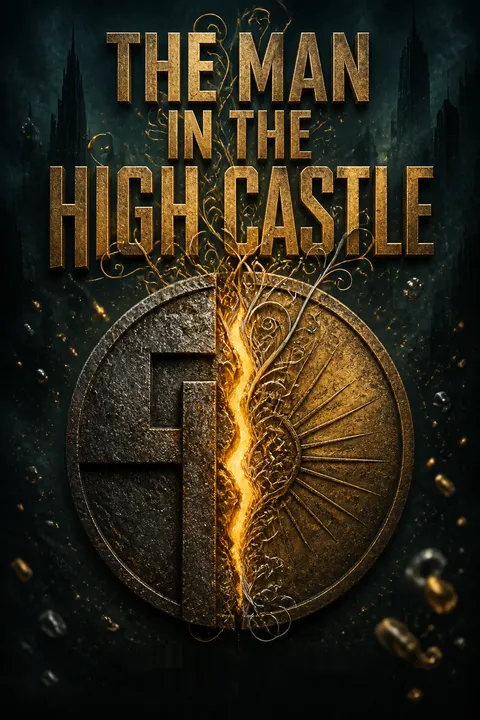


Plot Summary
A Shop of Lost America
In Japanese-ruled San Francisco, antiques dealer Robert Childan waits for a Civil War poster promised to a powerful customer, Mr. Tagomi. His shop sells fragments of a country that has lost the war and now exists under another nation’s gaze. Frank Frink, a skilled Jewish metalworker, wakes to find himself fired after challenging his employer, Wyndam-Matson.
He fears the blacklist will leave him with no work and no safe place to flee. Frank is also separated from Juliana, his ex-wife, and still hopes she might return. Their private worries unfold beneath a public order that makes Japanese approval valuable and German power frightening, while ordinary business depends on accepting the story the victors tell.
The novel opens by making occupation tangible through commerce and employment rather than battlefield spectacle. Childan’s livelihood depends on selling a defeated America back to its rulers, while Frank’s skill has been useful only inside a corrupt factory. Both men are constrained, but their responses differ: Childan seeks recognition within the hierarchy, whereas Frank’s challenge costs him his job. Their personal disappointments are not separate from politics. The regime reaches into work, taste, and intimate hope, turning survival into a series of accommodations.
The Colorado Hitchhiker
In Canon City, Colorado, Juliana Frink teaches judo and lives far from the Japanese-controlled coast she once knew. At a roadside restaurant she meets Joe Cinnadella, an Italian truck driver whose bitterness and intensity unsettle her. When Joe accepts a ride to a motel, Juliana’s attraction overcomes her caution, and he spends the night at her apartment.
The next morning she sees his Cairo campaign medal and hears fragments of his wartime history, including the deaths of his brothers. Joe carries a battered copy of The Grasshopper Lies Heavy, a banned novel imagining that the Axis lost the war. Juliana recognizes that his interest in it is more than casual, though she does not yet understand what he wants from her.
Juliana’s judo gives her a measure of physical agency, but intimacy quickly exposes the limits of that protection. She invites Joe in because she wants connection, then studies him for signs of danger she cannot name. His war medal and the banned novel function as competing credentials: one binds him to the victorious Axis, the other to an imagined defeat. Their attraction grows in the space between those identities. Juliana is perceptive, but desire and loneliness make her willing to postpone judgment.
The Watch for Baynes
Before meeting his visitor, Trade Mission official Nobusuke Tagomi consults the I Ching and worries that no suitable American gift will satisfy him. The visitor, Mr. Baynes, arrives by German rocket and claims to represent a Swedish plastics firm.
During the flight, Baynes unsettles a Nazi artist by revealing that he is Jewish and that Jews still survive inside the Reich. Tagomi gives Baynes a rare Mickey Mouse watch, an American relic chosen to flatter his presumed interests.
Baynes accepts it, but their conversation turns from trade toward the treatment of the old, the sick, and the persecuted. Tagomi senses that Baynes is not simply a businessman, while Baynes waits for an elderly Japanese contact whose arrival will allow him to speak more freely.
The watch condenses the novel’s strange economy: an object from a defeated culture becomes precious because the victors desire it. Yet Baynes’s encounter with the Nazi artist makes clear that his real value lies elsewhere, in the dangerous knowledge he carries. Tagomi’s suspicion and hospitality coexist. His I Ching practice helps him interpret uncertainty, but it cannot tell him exactly whom to trust. The scene places moral questions inside diplomatic etiquette, showing how courtesy can shelter both genuine concern and political concealment.
A Workshop Without Fakes
Frank returns to W-M Corporation hoping to recover his job, but Wyndam-Matson has already replaced him. Shop foreman Ed McCarthy instead urges Frank to make original jewelry, using the metalworking skill he has spent years applying to counterfeit American antiques.
Frank doubts that anyone wants contemporary American art, yet consults the I Ching and finds both encouragement and a warning of future collapse. He decides to proceed anyway. McCarthy offers his own designs and agrees to become a partner; Wyndam-Matson sends them two thousand dollars, money tied to the factory’s shady business.
The men rent a basement, order equipment, and name the venture Edfrank Custom Jewelers. Frank feels newly purposeful, imagining that success might even make him worthy of Juliana again.
Frank’s decision marks a shift from reproducing a past that others will pay to believe in toward making something whose value has no inherited certificate. The risk is economic, but also psychological: he has absorbed a racial stereotype that casts him as an imitator rather than a creator. McCarthy’s encouragement interrupts that internalized judgment, while the mixed oracle reading prevents the new beginning from becoming a simple triumph. Frank chooses to work despite uncertainty, though he still measures his worth partly by whether Juliana might want him back.
The Admiral Who Never Was
A visitor claiming to represent Admiral Harusha offers Childan a huge advance for twelve Civil War pistols. Childan proudly presents a Colt .44, but the visitor identifies it as a recent forgery and withdraws the deal. A university laboratory confirms the gun is fake.
Childan then discovers that the supposed admiral’s carrier sank years earlier, proving the buyer was an impostor, but the impostor’s judgment was correct. Childan confronts his wholesaler, Ray Calvin, who traces the guns to W-M Corporation.
Wyndam-Matson realizes that Frank and McCarthy have exposed the operation and pays them the promised two thousand dollars. Childan recovers his money, yet the discovery shakes his confidence in the antiques on which his reputation and business depend.
The fake Colt creates a crisis of evidence: the forged object is exposed by a fraud, so deception arrives carrying an inconvenient truth. Childan’s business relies on Japanese collectors treating objects as vessels of history, while W-M’s factory manufactures that history on demand. The impostor’s expertise punctures the shared convenience of the counterfeit market, where sellers and buyers have profited by avoiding scrutiny. Frank and McCarthy’s compensation enables their new work, but it comes from the same corrupt system they are trying to leave.
A Novel Opens Elsewhere
At Wyndam-Matson’s apartment, his young visitor Rita finds a copy of The Grasshopper Lies Heavy and describes its imagined history: Roosevelt survives assassination, America prepares for war, and the Axis powers lose.
Wyndam-Matson rejects the premise, insisting that the actual victors were bound to win, and tries to prove that an object’s historical aura exists only in the mind by showing her two similar cigarette lighters. Rita is not persuaded. She leaves with the novel’s premise still lodged between them.
The book is already circulating beyond its banned territories, and its counter-history unsettles people who have built comfortable explanations for the present. It asks readers to imagine not merely a different past, but a different account of who deserved to rule.
The novel within the novel does more than reverse the military outcome. It exposes how people turn contingency into destiny after the fact. Wyndam-Matson treats victory as proof of superiority and calls historical value a delusion, yet his own business depends on certificates and collectors’ belief. Rita’s response suggests that fiction can loosen the certainty holding that arrangement together. The alternate history becomes a test of how much a person’s sense of reality depends on the outcome they inherited.
Bormann Dies at Breakfast
While Joe reads The Grasshopper to Juliana, he condemns its portrayal of Italy as an Axis traitor and defends the Nazi rebuilding program he once served. Juliana challenges his admiration for the regime, aware that her Jewish ex-husband Frank has lived under its threat.
Their argument is interrupted by news that Reich Chancellor Martin Bormann has died. Joe predicts a brutal contest for power; Juliana hopes a less dangerous leader might prevail. She also learns that Joe has worked for German construction projects and that his war memories still shape his loyalties.
When he proposes a trip to Denver, then a visit to the novel’s author, Hawthorne Abendsen, Juliana agrees. The journey offers pleasure, but the book has begun to pull them toward a more consequential meeting.
Joe’s convictions are built from a selective memory of service, brotherhood, and rebuilding. He condemns some Nazi excesses while defending the structure that made his own labor meaningful, a contradiction Juliana sees more clearly than he does. The news of Bormann’s death converts their argument into a political uncertainty with consequences beyond their private lives. Juliana’s decision to travel is motivated partly by companionship and partly by the novel’s challenge to accepted history. She is moving toward a truth she cannot yet define.
Dinner Beneath Borrowed China
The Kasouras invite Childan to dinner, and he enters their elegant apartment hoping to be accepted as more than a white dealer serving Japanese customers. He gives Paul and Betty a New England scrimshaw and shares their meal, but his insistence that the Axis victory saved civilization exposes the racial beliefs beneath his polished manners.
The couple’s reserve leaves him feeling the gulf he had hoped to cross. Later, a Kempeitai officer visits Childan with a photograph of the man who posed as Admiral Harusha.
The officer identifies him as Frank Frink and asks Childan to sign a statement about the attempted fraud. Childan complies, reassured that the police are protecting him. His signature will help turn Frank’s vulnerable position into a legal danger.
Childan’s longing for acceptance does not erase his investment in racial hierarchy. At dinner, he confuses access to Japanese taste and possessions with genuine equality, then retreats to prejudice when the conversation challenges him. The police visit offers a comforting story in which law protects the innocent and isolates the threatening outsider. By signing without examining the consequences, Childan converts private fear into state paperwork. The episode shows how domination can recruit the dominated as witnesses to its own legitimacy.
Reiss Reads the Forbidden
After Bormann’s death, German consul Hugo Reiss reads The Grasshopper Lies Heavy while Berlin’s leadership remains unsettled. The novel imagines Hitler’s defeat and trial, and its account disturbs Reiss more than he expects.
He calls the book dangerous and considers sending someone to deal with Abendsen, who lives in the Rocky Mountain States. But Reiss destroys his own note before acting, wary of political consequences and unwilling to take responsibility for a plan that might fail. Meanwhile, Berlin sends word that a Japanese general is traveling incognito to San Francisco.
Reiss orders his staff to identify the visitor. His hesitation and the new surveillance order place the novel’s fictional challenge beside a real struggle over power and the fragile diplomatic mission Baynes is trying to arrange.
Reiss is neither a dissident nor a simple functionary. The book briefly makes him feel the emotional force of a world in which the Nazi leaders are judged, then he protects himself by recasting that feeling as manipulation. His decision to destroy the note is not a moral conversion, but it reveals the limits of his obedience and ambition. The parallel order to locate the Japanese general shows how the regime treats uncertainty: it surveils first, while individuals like Reiss calculate how much danger they can afford.
Jewelry on Consignment
After two weeks of work, Frank and McCarthy carry their handmade jewelry to Childan’s shop. McCarthy makes the sales call while Frank waits outside, afraid the pieces will be rejected. Childan initially dismisses the unfamiliar designs, then agrees to display several on consignment rather than buy them outright.
The arrangement protects his own money while giving the new business a chance. McCarthy returns with fewer pieces and little confidence, but Childan sees another advantage: contemporary jewelry cannot be challenged as counterfeit antiques.
The sale is modest, and Edfrank has not yet proven that customers will buy its work. Still, their pieces now sit in a prestigious store, where the makers’ labor can be judged without pretending it belongs to another century.
The consignment deal repeats the novel’s pattern of unequal risk: Childan gets inventory without paying in advance, while the makers absorb the uncertainty. Yet the arrangement also introduces a different standard of value. These pieces make no claim to be relics, and their originality is inseparable from the hands that formed them. Childan notices the commercial opportunity before he understands the work’s cultural meaning. The tentative sale therefore advances both the business plot and the book’s argument about how authenticity is made.
The Road to Cheyenne
Baynes spends two weeks asking Tagomi whether the elderly Japanese contact has arrived, while the newly appointed Chancellor Goebbels strengthens his position in Berlin. Unable to wait longer, Baynes secretly contacts an Abwehr intermediary to learn whether the mission is still possible.
At the same time, Joe and Juliana drive toward Denver. Juliana reads more of The Grasshopper, whose generous postwar world Joe criticizes as wishful thinking.
Their arguments reveal how differently they interpret power: she is drawn to the book’s possibility, while he sees its imagined history as a flawed political program. When Juliana suggests driving on to meet Abendsen, Joe agrees. Their destination changes from a night out to a visit with the writer whose story has begun to unsettle them both.
The two journeys advance through waiting and motion. Baynes is trapped by diplomacy’s delays, while Juliana can choose a road, though she does not yet know the cost of traveling with Joe. Their parallel plots expose different forms of agency: Baynes must rely on channels and intermediaries, Juliana on her own judgment. Joe’s critique of the novel is revealing because he interprets it through the ideology that has shaped his life. Juliana’s willingness to keep reading preserves a space for alternatives.
The Charm That Wasn't
Paul Kasoura studies one of Childan’s Edfrank pieces and finds a balance in its irregular shape that he connects to wu, a quality he cannot reduce to conventional art or design. He shows it to other collectors, then proposes that Childan license the work for mass production as inexpensive good-luck charms.
Childan recognizes the commercial promise, but also hears the insult in treating American artisans’ original work as a template for cheap copies. He refuses the proposal and asks Paul to acknowledge the disrespect.
Paul apologizes, and Childan leaves with the handmade piece rather than surrendering the makers’ designs. For the first time, Childan accepts a risk for the sake of the work itself, not simply for the approval or profit it might bring.
Paul’s interpretation grants the jewelry a value that neither its makers nor Childan initially knew how to name. But his plan to reproduce it turns that discovery into a marketable formula, separating the object’s apparent spiritual force from the labor that produced it. Childan’s refusal matters because it breaks his habitual pursuit of advantage under Japanese power. His action does not undo the hierarchy, but it gives him a brief, concrete form of self-respect: he will not help erase the artists behind the work.
Dandelion's Nuclear Target
The long-delayed visitor arrives as General Tedeki, former chief of staff, not the retired businessman Baynes had described. With Tagomi present, Baynes identifies himself as Captain Rudolf Wegener and reveals Operation Dandelion: Germany plans to manufacture a border clash, then use it to justify a surprise nuclear strike on Japan.
Chancellor Goebbels supports the plan, while SS General Heydrich opposes it for reasons of internal power. Baynes gives Tedeki microfilm evidence, but before they can plan their response, SD men storm the Trade Mission.
Tagomi loads his antique Colt .44 and shoots two attackers, preventing them from taking Baynes. The immediate assault fails, but Tagomi is left shaken by having killed, and the proposed attack on Japan remains a live threat.
The mission’s revelation makes the novel’s political machinery brutally concrete: a staged border incident is intended to disguise mass murder as retaliation. The internal Nazi rivalry complicates any easy moral alignment, since Heydrich’s opposition does not make him humane. Tagomi’s use of the Colt transforms a treasured artifact into a weapon, forcing history out of the collector’s case and into the present. His success protects the meeting, but the bodily reality of killing resists the abstract arithmetic of saving millions.
A Razor in Denver
In Denver, Joe’s changed appearance, concealed transmitter, and insistence on reaching Abendsen reveal that he is a German operative assigned to kill the novelist. He wants Juliana beside him because his intelligence file suggests Abendsen will admit an attractive woman. When Joe threatens her, Juliana uses her judo training and a hotel razor blade to slash his throat.
She leaves him bleeding and drives away with the money and clothes she can carry. In the car, she consults the I Ching, whose changing lines direct her toward Abendsen and warn of danger. The next day a newspaper reports Joe’s fatal slashing, though it misidentifies Juliana. She continues north, now traveling to warn the man whose book helped lead her into this crisis.
Juliana’s attraction to Joe has repeatedly competed with her unease; in Denver, that uncertainty becomes a matter of survival. His disguise is not merely a false identity but a practiced performance, built to make violence look like ordinary companionship. Juliana’s physical training gives her a way to act when explanation is no longer safe. The oracle does not spare her from danger, but it gives her a direction after she has escaped. Her journey now has an ethical purpose: warn the author rather than simply satisfy curiosity.
The Silver Triangle
Still disturbed by killing the SD men, Tagomi visits Childan to trade away the Colt .44, but Childan will not accept it. Instead he shows Tagomi the new handmade jewelry. Tagomi initially sees little in it, then returns to buy a small silver triangle, hoping it might help him recover his balance.
In a park, he studies the piece until its reflected light seems to open another world: San Francisco appears altered, with an immense freeway and white Americans who treat him with open hostility. The vision fades, leaving him disoriented and frightened. He retrieves the triangle and forces himself back into the familiar city. The experience does not resolve his guilt, but it makes the world he thought he knew seem less secure.
Tagomi’s encounter makes reality itself feel contingent. The silver object does not offer a clean revelation or an answer to his moral crisis; instead, it loosens the assumptions that held his surroundings together. The alternate San Francisco reverses the racial position Tagomi inhabits in his own world, exposing how power can make one’s environment feel natural until it changes. His attempt to understand the vision through disciplined observation fails, yet the failure is meaningful: perception is not a neutral instrument.
One Signature Against Berlin
Back at the Trade Mission, Tagomi meets German consul Hugo Reiss, who wants the Japanese authorities to hand Frank over to the Reich because Frank is Jewish. Tagomi condemns the moral climate Reiss represents and refuses to sign the extradition form.
Instead, he uses his authority to order Frank’s release. The confrontation leaves Tagomi physically overwhelmed, and he collapses with a heart attack. That evening, Frank walks free from the police station without explanation.
He returns to the basement workshop, where McCarthy has continued making jewelry, and resumes polishing unfinished pieces. Frank does not understand why the transfer to Nazi custody was stopped. He can only take up the work again, grateful for a reprieve that has not erased the danger around him.
Tagomi’s refusal is a specific institutional act, not merely a private feeling of sympathy. He uses the authority available to him to prevent a vulnerable man from being returned to a regime that would destroy him. The decision costs him physically, as if the body registers a conflict that diplomatic language cannot contain. Frank’s release arrives without a satisfying explanation, preserving the book’s resistance to tidy moral accounting. His return to the workshop is a modest affirmation of life after an arbitrary reprieve.
Wegener Returns to Berlin
After delivering the evidence to Tedeki, Baynes returns to Germany under another assumed identity, knowing the SD may be waiting. At the airport, Waffen-SS men recognize him as Rudolf Wegener and take him into custody.
They say they are bringing him to Heydrich, whose opposition to Operation Dandelion may still matter in the struggle with Goebbels. Wegener cannot know whether the promise is genuine or another step toward imprisonment.
During the drive, he considers how little choice he has: even a successful attempt to stop the attack would leave the Nazi system intact, with its plans for conquest elsewhere. He accepts that resistance can only proceed one decision at a time. His mission has reached the people it needed to reach, but its outcome remains uncertain.
Wegener’s return prevents the mission from becoming a clean escape story. He has carried evidence across borders, yet he steps back into the danger from which he came, and the faction that receives him is no moral refuge. His reflection rejects the fantasy that one successful intervention can purify a political system. Instead, resistance is sequential and compromised: an action can be necessary without being sufficient. The ending of his thread leaves the strategic outcome open, matching the novel’s distrust of guaranteed victories.
The Oracle's Inner Truth
Juliana reaches Hawthorne Abendsen’s ordinary Cheyenne home and warns him that an operative came to kill him. She has already read that Joe died in Denver, though the newspaper gives her the wrong name.
Abendsen admits that he used the I Ching to make many decisions while writing The Grasshopper Lies Heavy, but he resists explaining what the book means. Juliana casts the oracle herself and receives Inner Truth. She takes this as confirmation that the world in which Germany and Japan lost the war is true, even if Abendsen cannot accept her conclusion.
He offers no final answer, and she leaves the house alone. Her discovery resolves the question that drove her north, but not the political danger or the mystery of how one world can contain another.
The ending refuses to turn the novel’s central uncertainty into a solved puzzle. Abendsen’s use of the I Ching suggests that the counter-history was shaped by chance and consultation, yet Juliana’s reading gives it a truth beyond authorship. Her certainty does not become universal proof; Abendsen remains doubtful, and the political world outside the house has not changed. The novel therefore separates personal conviction from public fact. Juliana leaves with a transformed understanding, but the reader must still judge what kind of truth fiction can disclose.
Analysis
The novel’s alternate history is not only a reversal of the Second World War. It is a study of how power becomes ordinary: through shop inventories, work permits, diplomatic courtesies, popular books, and assumptions about which people deserve safety. The characters inhabit a world whose victors disagree about their own future, yet those disputes do not make the order humane. Nazi factions compete over expansion and control, while Japanese officials can show personal compassion without escaping the imperial structure that grants them authority.
The repeated attention to objects gives the politics a tactile form. Childan sells supposed pieces of American history; Frank begins by copying them, then tries to make new work. A forged Colt can be recognized by a fraud, and an irregular piece of jewelry can acquire meaning no certificate can supply. The novel asks whether authenticity resides in an object’s past, in the labor that shaped it, or in the person who learns to see it differently. These possibilities never settle into one answer.
The I Ching and The Grasshopper Lies Heavy deepen that uncertainty. The oracle guides action but does not eliminate responsibility; the novel imagines another history but cannot make its characters agree on what that history means. Juliana leaves Abendsen with conviction, while others remain doubtful. Tagomi’s altered perception similarly suggests that reality may be less stable than political power claims, without offering a reliable map beyond it.
The book’s most durable ethical insight is that a choice can matter without repairing the whole system. Tagomi’s refusal to surrender Frank does not end persecution. Baynes’s warning may not prevent war. Frank’s return to the workshop cannot restore his marriage or secure his future. Still, each act changes what happens next. The novel locates hope not in a guaranteed better world, but in the difficult practice of refusing to treat people as abstractions.
Review Summary
The Man in the High Castle is a thought-provoking alternate history novel set in a world where the Axis powers won World War II. Readers appreciate Dick's world-building and exploration of philosophical themes, but some find the plot lacking and characters underdeveloped. The book's use of the I Ching and its novel-within-a-novel concept are praised. While many consider it a masterpiece of speculative fiction, others find it difficult to follow or engage with. The open-ended conclusion and Dick's writing style divide opinions.
People Also Read





Characters
Juliana Frink
Restless judo instructorJuliana is Frank Frink’s estranged wife, living in Colorado and teaching judo. She is observant, physically capable, and drawn to people whose intensity promises escape from her unsettled life. Her attraction can make her underestimate danger, but she is not merely carried along by events: she watches, tests what she hears, and acts decisively when a situation becomes clear. The I Ching gives her a language for uncertainty, while The Grasshopper Lies Heavy provokes her to question the political reality everyone around her treats as settled. Juliana’s independence is complicated by loneliness and a recurring desire for companionship. She is most compelling when those needs conflict with her sharp perception.
Frank Frink
Jewish metalworkerFrank is a skilled craftsman, a Jewish refugee from Nazi persecution, and Juliana’s former husband. He has spent years making convincing copies of American artifacts, work that pays but reinforces his fear that he can imitate rather than create. Losing his factory job forces him to consider a more independent use of his skill. Frank consults the I Ching when choices overwhelm him, finding both comfort and unsettling ambiguity in its answers. He remains emotionally attached to Juliana and sometimes imagines success as a way to become worthy of her. His mixture of technical confidence, self-doubt, and longing makes his creative ambitions inseparable from his struggle to define himself.
Robert Childan
Dealer in American relicsChildan owns American Artistic Handcrafts, a San Francisco shop catering largely to wealthy Japanese collectors. He is meticulous about presentation and eager to be regarded as cultured, yet his standing depends on pleasing people who rule the country he considers his own. He both resents and imitates the tastes of his customers, hoping business intimacy might become social acceptance. The counterfeit antiques he sells expose how much his livelihood rests on an agreed-upon version of history. Childan’s insecurity often hardens into prejudice, but he is capable of reconsidering what he values when confronted with work made in the present. His central tension is between wanting status and wanting self-respect.
Nobusuke Tagomi
Searching trade officialTagomi is a senior Japanese Trade Mission official in San Francisco, responsible for negotiations and delicate relationships with local businesses. He relies on the I Ching not as decoration but as a practice for thinking through decisions whose consequences he cannot fully see. His manners are formal, his sense of duty strong, and his moral concern unusually personal for an official working within an empire. Tagomi’s interest in American artifacts is sincere, but he is increasingly forced to see how collecting and diplomacy touch the lives of people harmed by political power. He seeks equilibrium without assuming that good intentions can remove moral responsibility. His inner conflict gives the novel one of its clearest measures of conscience.
Rudolf Wegener, posing as Mr. Baynes
Disguised German officerWegener travels in San Francisco under the Swedish-sounding identity of Mr. Baynes, presenting himself as a plastics businessman. He is controlled, educated, and practiced at hiding what he knows, but his private reflections reveal a deep unease with Nazi ambition and its reduction of human lives to political abstractions. His work requires him to seek Japanese allies without exposing his real loyalties to German surveillance. Wegener is neither carefree nor certain that his mission can succeed. He understands that opposing one immediate atrocity may leave the machinery of persecution intact, yet he acts because delay carries its own consequences. His discipline is shaped by both fear and moral urgency.
Joe Cinnadella
Restless Italian veteranJoe is an Italian truck driver, a decorated veteran of the Axis war, and Juliana’s brief companion. He carries memories of his brothers’ deaths and a fierce attachment to the comradeship and labor projects that gave his youth meaning. His political arguments blend resentment, idealism, and admiration for authoritarian action. Joe can be attentive and charming, then suddenly rigid when Juliana challenges his beliefs. The contrast between his tenderness and his ideological certainty makes him difficult for her to read. He wants to be seen as more than a low-status laborer, and that hunger shapes how he tells his own story.
Ed McCarthy
Frank's creative partnerMcCarthy is the W-M Corporation foreman who recognizes Frank’s craft skill and urges him to make original jewelry. He is practical, blunt, and willing to risk his own livelihood on designs he believes in. His confidence contrasts with Frank’s hesitation, though he is not immune to anxiety once the work must be sold. McCarthy’s loyalty appears in concrete acts: he offers partnership, shares designs, and keeps working when the business falters. He understands that technical excellence alone cannot create a market, but he refuses to let that uncertainty become an excuse for never trying.
Paul Kasoura
Collector of American artPaul is a young Japanese businessman and collector who, with his wife Betty, welcomes Childan into their home. He is cosmopolitan and curious about American culture, including its books, antiques, and music. His refined manner can conceal how much authority his social position carries. Paul interprets an irregular handmade jewelry piece through the idea of wu, granting it a value that resists ordinary categories of art and commerce. Yet his proposed mass market also exposes the tension between reverence for an object and the desire to profit from it. He is thoughtful, but his thoughtfulness does not make him free of the imperial system around him.
Betty Kasoura
Childan's gracious hostBetty is Paul Kasoura’s wife and an attentive host who helps Childan feel welcome in their apartment. She is composed, socially perceptive, and more direct about racial assumptions than Childan expects. Her warmth does not require her to pretend that his views are harmless. In conversation, she presents a younger generation less bound to the old hierarchies of occupation, though her comfort and status still depend on an unequal world. Betty’s restraint is not passivity: she notices when Childan’s remarks expose the distance between his wish for acceptance and his actual beliefs.
Hawthorne Abendsen
Author behind the castle mythAbendsen is the author of The Grasshopper Lies Heavy, a widely read alternate history that imagines an Axis defeat. Rumors describe him as a besieged writer in a fortified home, but Juliana finds him living in an ordinary house and entertaining guests. He is intelligent, wary of intrusion, and reluctant to claim a definitive meaning for his own book. His writing process involves repeated consultations with the I Ching, yet he does not treat that practice as a substitute for his own authorship. Abendsen’s uncertainty is central to the book’s questions about fiction, truth, and responsibility.
Caroline Abendsen
Author's clear-eyed partnerCaroline is Hawthorne Abendsen’s wife, a capable host who manages the visitors and social life around his work. She is practical, sharp-eyed, and protective of her husband’s time and safety. Her competence contrasts with the public legend of the secluded writer in a fortress. Caroline understands that people who admire the novel may bring unsettling questions with them, and she does not automatically welcome disruption. Her response to Juliana shows the strain of living beside a work that attracts intense interpretations and political danger.
General Tedeki
Retired Japanese strategistTedeki is a former chief of staff who travels to San Francisco under the cover identity Shinjiro Yatabe. Elderly but mentally alert, he is brought into Baynes’s secret mission because he can carry information to influential circles in Japan. He is disciplined, formal, and cautious about the political implications of what he hears. Tedeki understands that diplomatic fictions can offer legal protection even when they do not fool the people watching. His measured manner gives the meeting a sense of institutional experience, but the danger surrounding the mission limits what even a senior figure can promise.
Wyndam-Matson
Counterfeit factory ownerWyndam-Matson owns the factory where Frank and McCarthy produce forged American artifacts. He is nervous in manner but powerful in business, treating corruption as routine overhead rather than a moral crisis. His contempt for the collectors’ belief in historical aura coexists with his profit from selling objects that depend on that belief. When Frank challenges him, he fires him; when the counterfeit trade is threatened, he calculates how to contain the damage. Wyndam-Matson’s weakness is not lack of intelligence but a habit of reducing every human or cultural question to cost and advantage.
Hugo Reiss
German consul in San FranciscoReiss represents the Reich in San Francisco and manages the consulate’s political and diplomatic business. He is alert to the rivalries among Nazi institutions and resents being made subordinate to the security police. Reading The Grasshopper unsettles him, but self-preservation keeps him from turning that discomfort into open opposition. Reiss is observant and politically cautious, often weighing how an action might be used against him by superiors. He embodies the regime’s bureaucratic middle layer, where private doubts coexist with public service and where hesitation may be personal calculation rather than principled resistance.
Martin Bormann
A dying regime's chancellorBormann is the Reich Chancellor whose death triggers a struggle among Nazi leaders. He is mostly absent from the action, but his position has held competing factions in a temporary balance. His passing forces officials and citizens alike to speculate about what kind of power will follow. Bormann’s importance lies less in personal scenes than in the sudden instability his absence creates.
Joseph Goebbels
Ambitious Nazi politicianGoebbels is a leading Nazi figure whose skill as a speaker and organizer makes him a contender for power after Bormann’s death. News of his eventual elevation changes the calculations of officials following events from San Francisco. His public talent is paired with fanatic political ambition, making him a powerful presence even when he appears only through broadcasts and reports.
Rita
Reader of forbidden historyRita is Wyndam-Matson’s young visitor and a reader of The Grasshopper Lies Heavy. She takes the novel’s alternate history seriously enough to challenge the assumptions of the man who profits from counterfeit artifacts. Her encounter with him briefly brings the forbidden book into the orbit of a powerful factory owner.
Plot Devices
The I Ching
Oracle for uncertain choicesThe Book of Changes is consulted by Frank, Tagomi, Juliana, and Abendsen. Its hexagrams do not function as simple predictions; characters use them to frame questions, interpret chance, and decide how to act when ordinary reasoning feels inadequate. The same reading can contain encouragement and warning, leaving room for human judgment rather than replacing it. Its most consequential role comes through Abendsen’s use of it while writing The Grasshopper Lies Heavy and Juliana’s final consultation about that book. The oracle links private decisions across the story, but its answers remain open to interpretation, preserving the novel’s uncertainty about fate and truth.
The Grasshopper Lies Heavy
Counter-history inside the novelAbendsen’s banned book imagines a world in which the Axis powers lost the Second World War. Its alternative history gives characters a way to question the political order they inhabit, but they do not agree on what the book proves. Joe reads it through fascist arguments about leadership, while Juliana finds a challenge to fear and accepted reality. Wyndam-Matson and Reiss respond from their own interests and anxieties. The novel becomes more than a story within the story when Juliana learns that the I Ching guided Abendsen’s choices and consults the oracle herself. Its purpose is not simply to offer a pleasing opposite world, but to unsettle the certainty of the one everyone calls real.
Historic Americana
Artifacts for sale and beliefChildan’s shop trades in American objects prized by Japanese collectors, from Civil War memorabilia to popular-culture relics. Their value rests partly on scarcity and supposed contact with the past, which makes the counterfeit industry profitable. The fake Colt reveals how easily a forged history can pass through a market that benefits from not asking too many questions. The artifacts also give characters a concrete way to negotiate status: Childan wants recognition, Tagomi seeks meaningful objects, and Wyndam-Matson dismisses the aura he sells. The device connects commerce to memory, showing how a conquered culture can survive as collectible evidence even while its people remain politically subordinate.
Operation Dandelion
Pretext for nuclear attackOperation Dandelion is the Reich plan to provoke a border clash between the United States and the Rocky Mountain States, then use the staged conflict as cover for a surprise nuclear strike on Japan. Baynes carries information about the plan to General Tedeki, hoping Japanese leaders can intervene in the Reich’s internal struggle. The operation turns political maneuvering into an immediate threat to civilians and the imperial state. Its details arrive late enough to create suspense, but the rival factions behind it are established beforehand through reports of the Nazi succession crisis. Even after the secret is exposed, the novel leaves the plan’s fate unresolved.
Edfrank Jewelry
Original work versus imitationFrank and McCarthy’s handmade jewelry begins as an attempt to build a business after Frank loses his factory job. Their pieces oppose the counterfeit antiques they once made: each is new, shaped by the artisans’ own hands, and carries no false claim to historical provenance. Childan’s consignment arrangement gives the work a precarious entry into the market. Paul Kasoura recognizes a quality in one piece that he associates with wu, then suggests mass production as good-luck charms. Childan’s refusal to commodify the designs becomes a rare act of principle. The jewelry therefore tests whether originality can retain its meaning when profit invites imitation.
FAQ
Synopsis & Basic Details
What is The Man in the High Castle about?
- Alternate History Setting: The novel is set in 1962, fifteen years after the Axis powers, Nazi Germany and Imperial Japan, won World War II. The former United States is divided into three zones: the Japanese Pacific States of America (PSA) on the West Coast, the neutral Rocky Mountain States (RMS) in the middle, and the Nazi-controlled United States (USA) in the East.
- Interwoven Character Lives: The story follows several characters whose lives intersect in San Francisco and the RMS, including Robert Childan, a dealer in American historical artifacts catering to Japanese tastes; Frank Frink, a secretly Jewish artisan struggling to survive; Nobusuke Tagomi, a Japanese trade official involved in delicate negotiations; and Juliana Frink, Frank's ex-wife living in the RMS.
- The Banned Book: A central element is the controversial and widely read novel The Grasshopper Lies Heavy, which depicts an alternate reality where the Allies won the war. This book circulates secretly in Nazi territories but is popular even among some Japanese, sparking dangerous discussions about the nature of reality and the possibility of a different past.
Why should I read The Man in the High Castle?
- Thought-Provoking Alternate History: The novel offers a chillingly detailed and plausible vision of a world under Axis rule, exploring the cultural, social, and psychological impacts of occupation and oppression. It forces readers to confront uncomfortable questions about power, identity, and complicity.
- Deep Philosophical Themes: Beyond the plot, the book delves into complex philosophical ideas, particularly the nature of reality, authenticity, and the search for meaning in a chaotic universe, often mediated through the use of the ancient Chinese oracle, the I Ching.
- Masterful Character Studies: Philip K. Dick creates deeply human and flawed characters grappling with their circumstances, revealing their inner lives, anxieties, and small acts of resistance or conformity in a world where grand heroism seems impossible.
What is the background of The Man in the High Castle?
- Post-WWII Geopolitics: The historical divergence point is complex, involving Roosevelt's assassination in 1933, leading to weaker US leadership under Garner and Bricker, failure to recover from the Depression, and ultimately, defeat by the Axis powers who developed advanced technology like rockets and atomic bombs first.
- Axis Division of the World: Germany controls Europe, Africa (where they are attempting genocide), and the eastern US, while Japan dominates East Asia and the Pacific coast of North America. A cold war exists between the two victorious powers, with Germany being technologically superior but facing internal power struggles.
- Cultural and Social Impact: The occupation leads to the suppression of American culture (except as collectible artifacts), racial segregation (especially the persecution of Jews and Slavs by the Nazis), and a pervasive sense of unease and moral compromise among the populace.
What are the most memorable quotes in The Man in the High Castle?
- "The wall falls back into the moat. Use no army now. Make your commands known within your own town. Perseverance brings humiliation.": This line from the I Ching (Hexagram 11, line 6 changing to 26) deeply disturbs Frank Frink, suggesting impending doom despite a seemingly favorable overall hexagram. It encapsulates the novel's sense of pervasive, inescapable fate and the futility of grand actions against it.
- "It is possible to build a microcosm while the macrocosm is falling apart.": This thought, attributed to Mr. Tagomi, reflects the characters' attempts to find order, beauty, or meaning in their immediate surroundings (like collecting artifacts or making jewelry) as the larger world descends into chaos and moral decay. It highlights the theme of finding personal truth or sanity amidst collective madness.
- "Truth, he thought. As terrible as death. But harder to find.": Juliana's realization after her encounter with Hawthorne Abendsen captures the novel's core exploration of reality and perception. The "truth" of the alternate history in The Grasshopper is shocking and destabilizing, suggesting that understanding reality can be a painful and dangerous quest.
What writing style, narrative choices, and literary techniques does Philip K. Dick use?
- Multiple Perspectives: The novel employs a shifting third-person limited perspective, primarily following Childan, Frink, Tagomi, and Juliana. This allows Dick to explore the diverse experiences and psychological states of individuals across different social strata and geographical zones within the alternate world.
- Integration of the I Ching: The I Ching is not just a plot device but a structural and thematic element. Characters consult it for guidance, and its hexagrams and interpretations often mirror or foreshadow events, blurring the lines between chance, fate, and conscious decision-making.
- Focus on Authenticity and Reality: Dick uses the trade in historical artifacts (many of which are fake) and the existence of The Grasshopper Lies Heavy (which depicts a "fake" history that might be "true") to constantly question what is real, what is authentic, and how individuals perceive and construct their reality under oppressive conditions.
Hidden Details & Subtle Connections
What are some minor details that add significant meaning?
- The Ubiquitous I Ching: Beyond the main characters, minor figures like the pedecab driver reading a waka poem (often associated with I Ching consultation) or Tagomi's staff being familiar with its concepts show how deeply the oracle has permeated Japanese-influenced society, highlighting its role as a pervasive cultural and philosophical guide in this world.
- Environmental Symbolism: Descriptions of the San Francisco fog rolling in, the empty vastness of the Rocky Mountain States, or the sterile, functional architecture favored by the Germans subtly reflect the characters' emotional states, the oppressive atmosphere, or the emptiness of the conquering ideologies.
- The "Authentic" Artifacts: The trade in pre-war American items, particularly the faked ones produced by Wyndam-Matson's factory, serves as a powerful metaphor for the loss of genuine American identity and history under occupation, where even the past is commodified and counterfeited for the conquerors' consumption.
What are some subtle foreshadowing and callbacks?
- Childan's Early Anxiety: Childan's initial anxiety over the delayed shipment and his fear of disappointing Mr. Tagomi subtly foreshadow his later, more profound anxieties about the authenticity of his goods and his place in society, culminating in his breakdown and subsequent transformation regarding the Edfrank jewelry.
- Juliana's Judo Training: Juliana's seemingly mundane job as a judo instructor in the RMS is a subtle callback to the Japanese influence and, more importantly, foreshadows her later ability to defend herself violently against Joe Cinnadella, demonstrating that even in the neutral zone, skills for survival in a brutal world are necessary.
- The SD's Ineptitude: Kreuz vom Meere's initial frustration with the Abwehr agent and his reliance on outdated surveillance methods subtly foreshadow the SD's eventual failure to capture Baynes/Wegener in Tagomi's office, highlighting the internal inefficiencies and rivalries within the seemingly monolithic Nazi regime.
What are some unexpected character connections?
- Tagomi and the Edfrank Jewelry: The seemingly unrelated plotlines of Tagomi, the high-ranking Japanese official, and Frink/McCarthy, the struggling American artisans, converge unexpectedly when Childan brings the Edfrank jewelry to Tagomi, leading to Tagomi's profound spiritual experience and subsequent protection of Frink.
- Juliana and Abendsen: Juliana's journey, initially driven by her relationship with Joe Cinnadella and her interest in The Grasshopper Lies Heavy, culminates in a direct meeting with the author, Hawthorne Abendsen, revealing the book's true origin and providing Juliana with a sense of purpose and understanding.
- Reiss and Frink: The German Consul, Freiherr Hugo Reiss, becomes indirectly connected to Frank Frink when the San Francisco police attempt to extradite Frink as a Jew under German law, highlighting the far-reaching and arbitrary nature of Nazi power, even in Japanese territory, and setting up Tagomi's crucial intervention.
Who are the most significant supporting characters?
- Ed McCarthy: Frank Frink's business partner, Ed, is crucial as the catalyst for Frink's jewelry venture and provides a grounded, working-class perspective. His initial enthusiasm and later resignation mirror Frink's own struggles and the difficulty of genuine creation in their world.
- Paul and Betty Kasoura: This young Japanese couple serves as a window into the tastes and perspectives of the younger generation of Japanese elite. Their appreciation for American artifacts and their subtle understanding of concepts like wu challenge Childan's assumptions about his customers and ultimately push him towards a new understanding of authenticity.
- General Tedeki (Shinjiro Yatabe): The elderly Japanese general is the crucial contact for Baynes/Wegener, representing a faction within the Japanese military establishment aware of the Nazi threat. His calm demeanor and strategic thinking provide a counterpoint to the frantic actions of other characters and highlight the high-stakes political maneuvering occurring behind the scenes.
Psychological, Emotional, & Relational Analysis
What are some unspoken motivations of the characters?
- Childan's Craving for Acceptance: Beyond mere profit, Childan's intense desire to please his Japanese clients and his desperate attempts to understand their tastes reveal a deep-seated need for acceptance and validation from the ruling class, stemming from his humiliation as a white American in an occupied territory.
- Frink's Search for Identity: Frank Frink's decision to create original jewelry is driven not just by financial necessity but by an unspoken need to assert his identity as an American and an artist, a form of quiet resistance against a regime that seeks to erase his heritage and creativity. His Jewish identity, hidden but ever-present, fuels this need for authentic self-expression.
- Tagomi's Spiritual Quest: Mr. Tagomi's reliance on the I Ching and his later profound reaction to the Edfrank jewelry suggest an unspoken spiritual or existential quest for meaning and order in a world he perceives as increasingly chaotic and morally ambiguous. His diplomatic duties are a facade for a deeper search for the Tao.
What psychological complexities do the characters exhibit?
- Childan's Inferiority Complex and Projection: Childan oscillates between fawning over his Japanese clients and harboring deep-seated resentment and racist thoughts, projecting his own feelings of powerlessness and cultural inferiority onto them ("monkeys dolled up"). His encounter with the "Jewish" imposter triggers his paranoia about being deceived.
- Juliana's Restlessness and Search for Authenticity: Juliana's constant movement (from Frank, from San Francisco, with Joe) and her attraction to intense, potentially dangerous men (like Joe) reflect a deep psychological restlessness and a search for authentic experience or meaning that she feels is missing in her life and the world around her.
- Tagomi's Moral Distress and Dissociation: Tagomi's violent act of self-defense triggers a severe psychological crisis, leading to physical symptoms, dissociation (seeing the Embarcadero Freeway as a nightmare), and a retreat into spiritual contemplation. His struggle highlights the psychological toll of moral compromise and violence in a world devoid of clear ethical guidelines.
What are the major emotional turning points?
- Childan's Encounter with the Imposter: The moment the "Admiral's gentleman" reveals the Colt .44 is a fake shatters Childan's confidence in his business and his perception of authenticity, leading to panic and a re-evaluation of his entire stock and livelihood.
- Tagomi's Act of Violence: Killing the SD agents is a pivotal emotional turning point for Tagomi, forcing him to confront the brutal reality of his world and his own capacity for violence, leading to his subsequent spiritual and psychological breakdown.
- Juliana's Discovery of Joe's True Nature: Realizing Joe Cinnadella is a Nazi assassin fundamentally changes Juliana's perception of him and her situation, forcing her into a desperate act of self-preservation and setting her on the path to seek out Abendsen and the truth.
How do relationship dynamics evolve?
- Childan and the Kasouras: Childan's relationship with Paul and Betty Kasoura evolves from a purely transactional business interaction to a complex social encounter where Childan seeks acceptance but ultimately reveals his underlying prejudices. The Kasouras, in turn, subtly challenge his perceptions of art and authenticity, leading to his shift towards contemporary jewelry.
- Frink and McCarthy's Partnership: The business partnership between Frank Frink and Ed McCarthy starts with shared hope and collaboration but faces strain under financial pressure and the reality of the market. Their dynamic reflects the difficulty of maintaining solidarity and creative integrity in a harsh economic and political climate.
- Juliana and Joe Cinnadella: Juliana's relationship with Joe is initially marked by mystery and attraction but quickly devolves into fear and confrontation as his true, dangerous nature is revealed. Their dynamic highlights the themes of deception, survival, and the sudden eruption of violence in personal lives.
Interpretation & Debate
Which parts of the story remain ambiguous or open-ended?
- The Nature of Reality: The most significant ambiguity is the true nature of the world depicted. Is the alternate history the "real" one, and The Grasshopper a fictional escape? Or, as the ending suggests, is the world of The Grasshopper the true reality, and the novel's setting the "fake" one, perhaps a dream or projection? The novel deliberately leaves this open to interpretation.
- The I Ching's Power: The extent to which the I Ching is a mystical force guiding events or merely a psychological tool for characters to process their reality remains ambiguous. It consistently provides relevant insights, but whether it causes events or simply reflects them is debatable.
- Characters' Ultimate Fates: While some characters reach moments of clarity or decision (Juliana, Tagomi), their long-term fates in the unstable world are left open. Frink is released but returns to his precarious life, Childan finds a new business direction, but the larger political situation remains volatile, leaving their futures uncertain.
What are some debatable, controversial scenes or moments in The Man in the High Castle?
- Depictions of Racism and Atrocity: The novel includes casual racism from both Japanese and German characters towards white Americans, Chinese, and Black people, as well as chillingly detached descriptions of Nazi atrocities (genocide in Africa, concentration camps, medical experiments). While serving to depict the brutal reality of the alternate world, these passages can be disturbing and raise questions about their presentation.
- Tagomi's Spiritual Experience: Tagomi's moment of transcendence while contemplating the Edfrank jewelry, where he briefly sees a different reality (San Francisco without the freeway, with pedecabs and old buildings), is open to interpretation. Is it a genuine spiritual vision, a psychological break, or a glimpse into the "true" reality of The Grasshopper's world?
- Juliana's Killing of Joe: Juliana's act of killing Joe Cinnadella, while presented as self-defense, is a violent and shocking moment. The ambiguity around Joe's exact intentions at that moment (was he truly going to kill her, or just threatening?) and Juliana's own psychological state add layers of debate to the scene.
The Man in the High Castle Ending Explained: How It Ends & What It Means
- The Oracle's Revelation: The novel culminates with Juliana confronting Hawthorne Abendsen, the author of The Grasshopper Lies Heavy. When Juliana asks the I Ching why it wrote the book, the oracle yields Hexagram 61, Chung Fu (Inner Truth). Abendsen interprets this to mean that the world depicted in his novel—where the Allies won—is the "true" reality.
- Blurring Reality and Fiction: This ending suggests that the alternate history the characters inhabit might be a false reality, perhaps a collective delusion or a temporary state, while the world of The Grasshopper is the genuine one. It profoundly blurs the lines between fiction and reality, challenging the reader's own perception of the narrative's setting.
- Meaning and Purpose: For Juliana, this revelation provides a sense of liberation and purpose. She realizes there is "nothing to be afraid of" in the false world and that the truth, though "terrible as death," is worth seeking. The ending implies that even in a seemingly hopeless reality, the search for truth and authenticity, perhaps guided by ancient wisdom like the I Ching, can offer a form of freedom and understanding.
About the Author



Download PDF
Download EPUB
.epub digital book format is ideal for reading ebooks on phones, tablets, and e-readers.








