


Plot Summary
The Skyguard Awakens
In 2077, a meteorite strikes northern Italy at devastating speed, erasing Padua and Verona and sinking Venice beneath the Adriatic. Six hundred thousand people die. The destruction convinces Earth to build Spaceguard, a network designed to find and stop dangerous asteroids. Decades later, its radar detects an enormous object moving in from beyond Jupiter.
It is named Rama, but its speed and interstellar trajectory set it apart from ordinary asteroids. Astronomer William Stenton finds another anomaly: Rama spins once every four minutes. A modified probe is approved to investigate before the visitor swings around the Sun and vanishes. Earth’s first defense against the sky has found something no one knows how to classify.
The meteorite catastrophe gives the story a human scale before Rama enlarges it beyond human history. Spaceguard is a promise that knowledge can become protection: people respond to a random cosmic impact by making observation systematic. Yet the system built to detect threats also discovers an object that cannot be reduced to a familiar danger. Rama’s speed and rotation turn the confidence of surveillance into a new kind of vulnerability. The episode frames scientific attention as both the means by which humanity survives and the force that carries it toward an encounter it cannot control.
The Cylinder in the Sun
The Space Advisory Council argues over whether an expensive probe is worth risking for an object that will soon disappear. The deciding vote sends Sita from Mars on a fast interception. Its cameras return images of a perfectly smooth cylinder, fifty kilometers long, with flat ends and a small stain on its surface.
The probe’s measurements show that Rama is hollow, while its geometry rules out a natural asteroid. The discovery reaches every screen on Earth. The survey ship Endeavour, commanded by William Norton, is diverted from its routine work and burns precious fuel to catch the visitor.
Norton matches Rama’s spin and brings the ship down near its sunlit North Pole, where three low structures keep Endeavour from sliding off the rotating surface.
The probe’s brief encounter transforms a distant astronomical object into an artifact, but it offers no explanation for who built it or why. That gap between recognition and understanding becomes the novel’s central engine. The Council’s vote also establishes that exploration is political and costly: acting requires resources taken from other missions, while delay means losing the chance forever. Norton’s landing makes the abstract discovery bodily. The ship’s danger is not an enemy’s attack but the unknown physics of a surface that was designed by minds humanity has never met.
The First Door Opens
After instruments detect no signals or movement, Norton and Karl Mercer inspect a pillbox beside Endeavour. Norton pulls a recessed wheel from its wall and turns it, opening a sealed entrance. The crew works through three cylindrical air locks and a long corridor before Norton crosses the final threshold.
A delayed flare reveals a vast hollow interior: terraces curve around the axis, and the inside of the cylinder forms a landscape under artificial gravity.
Later surveys map two bowl-shaped ends, a central plain, six sealed towns, and a dark band encircling the interior like a sea. The scale overwhelms the explorers, but the lack of wear makes the ancient structure seem unnervingly new. Norton must decide how much of this silent world his crew can safely explore.
Rama first becomes legible through interfaces: a wheel, a lock, a corridor, then a flare that makes the interior visible for only seconds. Each step is a practical act of access, yet each reveals a world that defeats ordinary human orientation. Norton’s work depends on procedure, but procedure cannot answer what kind of place he has entered. The unnerving cleanliness compounds the problem: age is visible in the vast interval separating builders from visitors, but not in the structure itself. The crew encounters not simply ruins, but a functioning design whose purpose has been withheld.
The Stairway to Paris
Mercer, Joe Calvert, and Willard Myron descend one of Rama’s immense stairways, testing its shifting gravity and finding air that is almost breathable. Norton later leads an expedition across the plain. A smooth, glasslike trench stops short of the sea, while the nearby town called Paris has identical windowless buildings and no visible doors.
The explorers cannot enter without damaging the structure. Back on Earth, exobiologist Carlisle Perera studies Rama’s approach to the Sun and warns that its frozen interior will soon heat unevenly, producing violent winds. Norton receives the warning but keeps his people at work, since time is short. The sight of a faint breeze gives the prediction an immediate, unnerving presence.
The descent turns Rama’s scale into a physical problem: gravity changes with every level, and familiar movements become unreliable. On the plain, the sealed town frustrates the explorers’ instinct to interpret buildings as homes. The environment resists both bodily and intellectual access. Perera’s forecast introduces another limit, time itself. Rama is not merely a puzzle waiting patiently to be solved; sunlight is changing its conditions faster than the crew can investigate. Norton’s decision to continue reflects a commander’s difficult balance between discovery and protection, especially when distant experts cannot see the danger firsthand.
Spring Breaks the Sea
Solar heat reaches the Cylindrical Sea from below. As the water beneath the ice expands and shifts, huge plates crack, tilt, and plunge into the depths, raising waves that force Norton’s teams to retreat. During the climb toward the hub, Rama’s artificial suns flare to life. Norton is nearly overcome by the sight of the entire interior revealed at once, then steadies himself and realizes the long trenches are light sources.
The sudden warmth also lifts vapor from the sea, building clouds and dangerous air currents. What seemed a dead, frozen vessel has begun to change its environment. Norton brings his crew back toward safety, but the brilliant new daylight promises further transformations rather than security.
The thaw makes time visible. Ice that has endured for ages breaks within minutes because the vessel has entered a new thermal environment. Rama’s apparent stillness was never the same as permanent death; its systems can respond when conditions change. The artificial lights deepen that realization, revealing the interior while making the explorers physically vulnerable to its scale. Norton’s brief panic and recovery show how command depends on regulating perception as well as equipment. He cannot master the spectacle, but he can restore enough control to bring his people out of danger.
The Air Comes Alive
After waiting out the first disturbances, Norton returns with Mercer, Calvert, and Myron. The explorers descend through a dense cloud layer and hear a waterfall bending sideways under Rama’s rotation.
Mercer’s tests show that oxygen levels have risen sharply, and the air is now humid and breathable even high above the plain. The Cylindrical Sea has turned green. Laura Ernst’s samples reveal abundant but short-lived microorganisms, which appear to have flourished in the warming water and released oxygen.
The change has unfolded in days, compressing biological processes that took immense spans on Earth. With the weather calmer, Norton’s crew can explore farther, but the rapidly changing ecosystem makes every earlier assumption about Rama’s sterility unreliable.
The new atmosphere makes Rama habitable, but not familiar. Breathable air initially looks like a gift; its sudden appearance instead signals an environment changing at a pace that defeats ordinary biological expectations. The microbes offer evidence of life without answering whether life is natural, designed, or merely temporary. The waterfall dramatizes how rotation alters even basic motion. For the crew, scientific instruments become essential safeguards because sensory comfort is no proof of safety. Rama’s transformation challenges the boundary between a machine and a world: its systems create conditions that resemble ecology, even if their purpose remains unknown.
New York Is Machinery
Norton’s crew builds a raft named Resolution from storage drums and a small motor, then steers it across the thawed Cylindrical Sea toward the island called New York. The crossing exposes them to water that contains strange, potentially harmful compounds, while the island’s towers and pipes grow clearer ahead.
Norton and his companions climb ashore and find no homes, doors, or ordinary streets. The island is a vast, silent machine divided into repeated sections, with structures that suggest industrial work but reveal no product.
Chief Steward Ravi McAndrews proposes that it may manufacture Ramans from materials drawn from the sea. Norton cannot confirm the idea. He also sees that a towering southern cliff bars access to the far continent, leaving the island as the only practical route across the water.
Resolution represents human ingenuity at its most modest: a raft assembled from whatever the ship can spare. Its success allows the crew to approach New York, but physical access does not yield interpretive mastery. The island looks organized enough to invite a functional explanation, yet every missing element, from doors to visible supply routes, frustrates certainty. McAndrews’s manufacturing hypothesis is striking because it comes from someone outside the scientific hierarchy, showing how insight can arise from practical comparison rather than specialist authority. Still, the machine remains unreadable. Rama offers structures that suggest purpose without giving visitors the context needed to know what that purpose is.
Dragonfly Falls South
Junior officer Jimmy Pak reveals that he secretly brought a lightweight sky-bike aboard Endeavour. He persuades Norton to let him fly along Rama’s axis, where he can cross the sea without a bridge.
Dragonfly handles best after Pak drops below the weightless center, and he records the southern continent and its immense central spike, Big Horn. Near the pole, his radio signal acquires a deep pulsing distortion. As he turns back, static raises the hairs on his arms and electrical discharges leap between the spikes.
An electric wind buffets the fragile craft, then a burst of energy breaks its wings. Pak spirals down toward the southern plain, fighting to control the damaged machine. He survives the crash, but is stranded beyond the sheer cliff.
Pak’s flight is an act of ambition made useful to collective discovery. The sky-bike gives him access where the raft and the crew’s equipment cannot go, but its delicacy exposes the mismatch between human tools and Rama’s hidden forces. The strange signal first presents itself as information, then the storm makes clear that the south pole is not merely a landmark. Pak’s courage is practical rather than grand: he keeps making adjustments as danger arrives. His crash shifts the story from exploration to rescue and makes the consequences of reaching farther than the crew can support impossible to ignore.
A Flower and a Biot
Bruised but mobile, Pak watches a crablike creature dismantle Dragonfly and carry off its pieces. The being ignores him, suggesting that the crew has encountered a worker rather than a predator. Pak follows it across the southern plain, where he discovers a deep shaft, strange terrain, and carefully prepared fields.
One trellised plot holds a single flowering plant growing through a tear in its protective covering. Pak risks crawling through a tight metal lattice to collect it, his last physical link to familiar life. The plant retracts after he removes its bloom. He continues toward the sea with little water and no clear route home, while Norton and Endeavour’s crew search for a way to reach him from above the southern cliff.
The crablike creature’s indifference is more unsettling than aggression because it denies Pak the role he expects in a first encounter. He is visible, vulnerable, and apparently irrelevant to the being’s task. The flower offers the opposite experience: a fragile sign of biological kinship that Pak can recognize without understanding its origin. Taking it is both scientific collecting and an emotional choice, made under the pressure of isolation. The episode places two forms of life side by side, one engineered or highly specialized, the other an apparent anomaly. Neither makes Rama more familiar; together they complicate the assumption that the world is simply sterile machinery.
The Sea Throws a Rescue
Norton finds a way to recover Pak: he must jump from the southern cliff into the sea, where Resolution can meet him. Using his shirt to slow and steady his fall, Pak enters the water and is hauled aboard.
As the crew turns for shore, electrical activity resumes around the southern spikes, followed by an earthquake and a vast wave racing around the cylindrical sea. Sergeant Ruby Barnes steers Resolution between submerged barriers that break the wave’s force. The disturbance throws a huge, damaged starfishlike creature onto the surface.
Smaller beings dismantle it just as the crab had taken apart Dragonfly. Norton recognizes a pattern of scavengers treating machines and creatures alike as material to be processed, and forbids further voyages across the dangerous sea.
The rescue depends on a physical principle rather than a new technology: air resistance limits Pak’s fall, while Barnes’s seamanship exploits the sea’s hidden barriers. This practical success is followed immediately by a reminder that Rama’s systems can generate hazards on a planetary scale. The wave and the scavengers link environmental change to the biots’ behavior. To them, damaged machinery and a fallen organism may be equivalent material, a classification that ignores human ideas of possession and personhood. Norton’s ban on further crossings is a hard-earned boundary. Curiosity remains necessary, but he now recognizes that repeated exposure can turn exploration into recklessness.
Mercury Sends a Bomb
Spidery biots begin inspecting the explorers’ camp, then multiply across Rama. Laura Ernst examines one that falls and discovers an organic body built around a powerful electrical battery. The creatures appear to be specialized biological machines, including scouts, scavengers, and larger workers observed near the southern pole.
Their behavior suggests that Rama is operating again, not merely drifting as a dead ark. Meanwhile, Mercury fears the vessel may alter its orbit and threaten the solar system. Its government secretly launches a nuclear missile toward Rama.
At the United Planets General Assembly, Mercury’s Ambassador defends the move as precautionary, arguing that humanity cannot assume the unknown builders are harmless. The missile’s arrival gives Norton a deadline and turns a scientific expedition into a moral crisis.
The biots blur categories that human observers rely on: they are organic, yet appear designed for specific tasks; they move independently, yet may function as parts of a larger system. Their presence makes Rama seem active without revealing whether its original inhabitants survive. Mercury responds to uncertainty by treating capability as imminent hostility. Its choice is understandable as risk management, but the secret launch substitutes unilateral violence for evidence. The conflict shifts the central question from what Rama is to what humans are entitled to do in its presence. The threat to destroy the vessel tests whether fear can justify eliminating an object no one has yet understood.
Rodrigo Cuts the Wires
As the missile closes on Rama, Norton’s communications officer, Boris Rodrigo, proposes cutting the cables that control its warhead. Norton weighs the danger to Rodrigo against the possibility that destroying Rama would be an irreversible crime, then authorizes the mission.
Rodrigo flies alone to the missile, severs its remote-control lines, disables its antenna, and uses Endeavour’s scooter to push it onto a harmless course. Mercury orders the ship to leave, but Norton waits until Rodrigo returns safely. With the weapon no longer aimed at Rama, the crew prepares for one last descent.
Norton leads an expedition into a sealed building in London. Laser cuts reveal a glass-column archive containing images of tools and a suit sized for a three-armed, towering being. Before they can learn more, Rama’s lights begin to fail, and Norton orders retreat.
Norton’s decision joins command judgment to moral responsibility. He does not know that Rama is harmless; he decides instead that ignorance is not sufficient grounds for destroying it. Rodrigo’s intervention is technically precise, but its significance lies in what it preserves: the possibility of learning before choosing violence. The archive offers the first tangible suggestion of the builders’ form, yet even this is mediated through images rather than recoverable objects. Rama’s failing lights end the exploration without delivering a final explanation. The crew must leave with evidence, not comprehension, and Norton’s authority has been used to protect that distinction.
Rama Takes the Sun
Endeavour moves away from Rama as the cylinder changes its orientation and dims. At a safe distance, the crew watches the ship begin accelerating without exhaust or any visible reaction system. Its influence briefly pulls at Endeavour, then releases the survey vessel as Rama gathers speed toward the Sun.
Near the corona, a reflective shell forms around it, shielding the hull from the heat. Rama draws energy, and perhaps material, from the star, then races through the solar system at extraordinary speed.
Its trajectory bends out of the plane of the planets and points toward the Greater Magellanic Cloud. The Hermians’ fear that Rama might stay has proved misplaced, while their attempt to destroy it has failed. Humanity has witnessed a technology it cannot explain, then watched its maker’s vessel depart.
Rama’s departure resolves the immediate political threat while refusing the human expectation of a negotiated encounter. Its propulsion violates the crew’s established physical models, but the story does not turn that violation into a convenient explanation. The Sun serves as a refueling station, not a destination, and the vessel’s route confirms how little the solar system matters to its mission. The failed attack and the successful observation both reveal the limits of human power. The crew can record what happened, but cannot influence it. Rama leaves behind knowledge that is immense in scope and incomplete in every meaningful sense.
The Unanswered Three
With the encounter over, Norton begins to recover from the strain of command. A permit from Mars allows his frozen genetic material to be used, and a child is expected with his Martian family. The news reconnects him to ordinary hopes after weeks of decisions made on behalf of worlds.
Laura Ernst remains close to him, while his two households and the crew’s end-of-mission celebrations point toward a return to private life. Yet Norton feels the loss of Rama, whose inhabitants may never learn that humans saw their vessel.
He has saved it from destruction but has not met its makers or discovered its purpose. In the closing moment, Perera wakes with a final pattern in mind: Rama’s designs repeatedly come in threes, a clue that may matter after the ship is gone.
The ending deliberately refuses the emotional arithmetic of a conventional triumph. Norton’s command has preserved Rama, and his family news offers a concrete future, yet neither event repairs the absence of contact. His sense of loss reflects not a defeat in exploration but the collapse of the expectation that discovery must culminate in recognition. The closing clue makes that incompleteness active: the repeated threes might organize the vessel’s design, but the novel stops before converting pattern into answer. Private continuity and cosmic mystery coexist. Norton can return to human relationships, while the largest relationship imagined by the mission remains unanswered.
Analysis
Rendezvous with Rama makes the limits of interpretation its central drama. The crew’s instruments are extraordinarily capable, yet each measurement opens a larger question: a hollow cylinder is not just an object but an engineered habitat; oxygen in its atmosphere does not prove that it was built for humans; organic biots do not establish that their makers are alive. The novel repeatedly distinguishes observation from understanding, and makes that distinction consequential. Norton must act before he possesses the knowledge he wants.
The explorers’ physical challenges give this epistemic problem weight. Rama’s shifting gravity, curved sea, and strange weather do not merely decorate the setting; they make human habits unreliable. A commander who assumes familiar rules will hold can endanger the crew. Norton’s discipline lies in revising his expectations while preserving a cautious respect for the vessel. His decision to prevent Mercury from destroying Rama marks the ethical culmination of that discipline. He does not know that the vessel is benign. He decides that uncertainty alone does not grant humanity the right to erase it.
Mercury’s response is a counterargument grounded in real fear. Rama may possess a technology capable of changing the solar system’s balance, and waiting could be catastrophic. Yet the missile demonstrates how precaution can become a self-fulfilling danger: humans turn a possible threat into an actual crisis because they cannot tolerate not knowing. Rodrigo’s intervention prevents that fear from deciding the fate of an entire world.
The ending withholds the reward of contact. Rama refuels near the Sun and departs, indifferent to the humans who have studied and defended it. Perera’s final recognition of the repeated threefold pattern offers a fresh question rather than closure. The novel’s most durable idea is that discovery does not guarantee relationship. Humanity can witness something immense, behave more responsibly than its fears urge, and still remain peripheral to the story it has encountered.
Review Summary
Rendezvous with Rama is a classic science fiction novel praised for its innovative concept and sense of wonder. Readers appreciate Clarke's detailed world-building and exploration of an alien spacecraft. Many find the characters underdeveloped but feel this serves the story's focus on discovery. The book's ending divides opinion, with some loving the mystery and others frustrated by unanswered questions. While dated in some aspects, it remains influential and highly regarded in the genre, with fans eagerly anticipating a potential film adaptation.
People Also Read

Characters
William Norton
The cautious explorerCommander of the survey ship Endeavour, Norton is an experienced pilot whose central strength is disciplined judgment. He studies earlier explorers, especially James Cook, because he wants a model for making decisions when evidence is incomplete. His responsibilities extend beyond navigation: he must protect his crew, respect a world that does not belong to them, and decide how much risk discovery justifies. He keeps emotional distance aboard ship to preserve the authority of command, even as he maintains family ties across Earth and Mars. Rama repeatedly places him where calculation cannot settle the choice. His defining tension is between the explorer’s appetite for knowledge and the commander’s obligation to leave the unknown undamaged.
Jimmy Pak
The daring pilotPak is Endeavour’s junior officer, an ambitious athlete and inventive flyer who arrives with a secret plan to use a lightweight sky-bike. He is drawn to the chance to reach Rama’s inaccessible southern hemisphere, partly by professional ambition and partly by the fear of missing a singular opportunity. His confidence is real, but so is his willingness to learn from failure. In unfamiliar territory, he keeps observing and reporting rather than pretending to understand what he sees. His combination of nerve, physical skill, and impulsive curiosity makes him the crew member most prepared to cross a boundary before anyone else can.
Boris Rodrigo
The faithful officerRodrigo is Endeavour’s quiet, dependable communications officer and a committed member of the Fifth Church of Christ, Cosmonaut. His faith gives him a framework for interpreting a vessel that appears to arrive with uncanny precision and may offer a new home. Unlike a zealot who insists on controlling others, he is reserved about his beliefs and earns trust through competence. He takes Rama’s possible purpose seriously, even when his conclusions differ from Norton’s. Rodrigo’s religious imagination and technical discipline coexist without cancelling each other, making him a useful counterweight to the crew’s assumption that scientific explanation and personal conviction must be enemies.
Karl Mercer
The meticulous life specialistMercer is Endeavour’s life-support expert, a capable and exceptionally cautious officer whose knowledge of breathing systems and bodily limits shapes the crew’s explorations. He prefers checklists to bravado and treats unfamiliar conditions as problems to measure before entering. His apparent lack of imagination is balanced by physical courage and practical flexibility: once Rama’s gravity changes the rules, he adapts his methods rather than forcing human habits onto the place. He shares a close partnership with Joe Calvert, and their bond is part of the ship’s settled social fabric. Mercer gives the exploration its necessary skepticism about what human senses alone can safely establish.
Joe Calvert
The adaptable navigatorCalvert is Endeavour’s younger navigation officer, quick-witted and imaginative, with an encyclopedic affection for old films. He uses playful associations to make strange situations bearable, but he is not careless when practical decisions matter. His ease with improvisation complements Mercer’s methodical temperament, and the two share a durable relationship with a wife on Earth. Calvert often gives voice to questions others are reluctant to ask, especially about what alien structures might mean. His humor softens the crew’s tension without diminishing the real risks they face.
Laura Ernst
The crew's physicianErnst is Endeavour’s surgeon and medical officer, responsible for deciding whether the explorers’ bodies can withstand the work they volunteer to do. She approaches Rama with scientific appetite, but she also insists on physical conditioning, medical monitoring, and caution around unfamiliar air and water. Her professional authority gives her influence over Norton’s plans, even when he is eager to press ahead. She is curious enough to want direct access to alien life, yet understands that an encounter can become an ethical problem before it becomes a scientific one. Her history with Norton gives their working relationship a quiet personal complexity.
Carlisle Perera
The bold theoristPerera is an exobiologist who has long argued that interstellar travel is possible and that life beyond Earth should be taken seriously. Rama vindicates some of his broadest ideas, but the vessel’s changing climate also exposes gaps in his predictions. His confidence can make him dogmatic, yet he is willing to revise a theory when new evidence demands it. He supplies the crew with crucial interpretations of Rama’s atmosphere, biology, and motion, though distance leaves him unable to test those conclusions firsthand. Perera represents science as both intellectual daring and the humbling obligation to admit what a model has missed.
Ruby Barnes
The seasoned sailorBarnes is Endeavour’s most experienced sailor and the designer of the improvised raft Resolution. She recognizes that navigating the Cylindrical Sea will require judgment rather than confidence alone. Her expertise becomes valuable because the sea’s curved setting and concealed barriers make ordinary expectations unreliable. Barnes treats danger as something to assess, not dramatize, and her steady command gives the explorers a chance to approach New York and later return safely. Her practical knowledge is a reminder that the mission depends not only on advanced technology but also on old, embodied skills.
Willard Myron
The inventive engineerMyron is Endeavour’s technically gifted sergeant, known for making equipment work and for designing alternatives when it does not. He supports the explorers with mechanical judgment, from expedition logistics to the specialized tools needed to investigate Rama. He is not driven by rank or prestige, preferring useful work to institutional advancement. Myron’s practical intelligence helps turn observations into workable plans, but he is also willing to acknowledge when a phenomenon exceeds current engineering knowledge. His presence keeps the crew’s exploration grounded in the material limits of tools, bodies, and available time.
Pieter Rousseau
The watchful observerRousseau is a skilled observer who spends long shifts surveying Rama from the central hub. His patience and familiarity with the vessel’s geography make him especially good at noticing changes that explorers on the ground may miss. He tracks the biots and keeps watch over distant teams, turning vigilance into a form of care. Rousseau’s childhood fascination with telescopes has prepared him to imagine what might lie beyond the visible landscape, though Rama’s actual wonders exceed those expectations. He offers the expedition a perspective that is at once intimate and remote.
Ravi McAndrews
The practical outsiderMcAndrews is Endeavour’s chief steward and the handler of its engineered monkey crew. He is not a technical specialist, but the rest of the ship respects his intelligence and practical judgment. His everyday familiarity with systems of work and maintenance helps him offer an unexpected interpretation of New York’s machinery. He also provides the crew with a skilled bridge to the simps, whose signs and routines are unfamiliar to many officers. McAndrews shows how useful insight can come from attentive experience rather than formal scientific standing.
Jerry Kirchoff
Norton's trusted executiveKirchoff is Endeavour’s executive officer and the steady administrator who helps Norton manage a mission that continually departs from routine. He handles communications, personnel, and the practical demands of command, often anticipating problems before they reach the captain. His discretion becomes especially valuable when sensitive information cannot safely travel through ordinary channels. Kirchoff’s competence gives Norton room to make difficult field decisions without leaving the ship unattended.
Olaf Davidson
The skeptical astronomerDavidson is an eminent astrophysicist and senior scientific administrator, accustomed to thinking on the scale of stars and galaxies. He is skeptical of claims that intelligent life can cross interstellar distances and initially regards asteroid research as a poor use of resources. Rama challenges the assumptions that have structured his career. His resistance is not simple ignorance; it reflects the intellectual cost of revising a worldview built around immense distances and impersonal physical forces.
Dr. Bose
The diplomatic chairBose is the Martian Ambassador to the United Planets and chair of the committee advising on Rama. At 115, he is a seasoned political observer who understands that scientific decisions are entangled with planetary rivalries and institutional delays. He prefers moderation and carefully framed discussion, but he knows that a novel crisis can make ordinary procedures inadequate. His position requires him to listen to competing theories without mistaking consensus for certainty.
Mercury's Ambassador
The security hardlinerThe unnamed Hermian representative speaks for a society shaped by intense solar heat, scarce margins for error, and a strong engineering culture. He distrusts assurances that Rama is harmless, especially because it may possess a propulsion system capable of changing the balance of the solar system. His position is strategically coherent even when it alarms other delegates: preparation, in his view, is wiser than waiting for proof of danger. He brings the book’s political conflict into focus by treating uncertainty as a security problem.
Myrna and Caroline Norton
Norton's distant familiesMyrna lives on Mars, while Caroline and the children of Norton’s Earth household live on Earth. The physical differences between the planets make a shared family life difficult, but the families are on good terms and receive Norton’s recorded messages. They represent the private commitments that continue beyond the mission’s public importance.
The Endeavour simps
The nonhuman crewThe four genetically engineered monkeys, Blackie, Blondie, Goldie, and Brownie, perform repetitive shipboard work that frees human crew members for specialized duties. They communicate through signs and depend on their handler, McAndrews. Their usefulness and vulnerability make the ship’s reliance on engineered life a small-scale echo of the questions raised by Rama’s biots.
Plot Devices
Spaceguard
A net around EarthSpaceguard is the planetary detection system created after the 2077 meteorite destroys cities in northern Italy. It tracks asteroids, calculates their paths, and gives humanity a chance to respond before another object strikes. Its instruments identify Rama beyond Jupiter, bringing the novel’s central encounter into view. The system embodies humanity’s attempt to turn a traumatic, uncontrollable event into a problem of observation and planning. It can detect the visitor, but it cannot tell whether Rama is dangerous or what its builders intended.
Rama's spinning cylinder
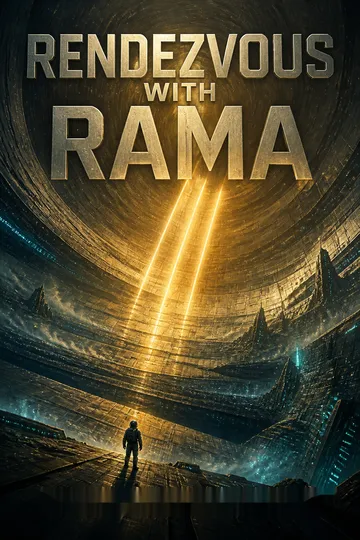
A world turned inside outRama’s hollow, rotating cylinder creates artificial gravity along its inner surface, enclosing a plain, towns, artificial lights, and a sea. The scale makes familiar spatial instincts unreliable: the explorers must continually decide what counts as above, below, land, or sky. The vessel’s repeated structures, sealed spaces, and clean surfaces provide clues without a readable explanation. Its design makes exploration possible while also imposing severe physical and logistical demands on Endeavour’s crew.
Biots
A crew without creatorsBiots are organic beings that appear specialized for inspection, cleanup, construction, and other tasks within Rama. Some resemble animals, while their behavior and unusual physiology suggest that they may be biological machines. They reveal that the vessel has resumed operations even though the explorers find no living Raman inhabitants. Their presence forces the crew to reconsider the boundary between organism and device, while their indifference to humans frustrates expectations of direct contact.
Dragonfly
A fragile bridge southPak’s lightweight sky-bike allows a lone pilot to travel along Rama’s nearly weightless axis and reach the southern hemisphere, which is cut off by the sea and a vast cliff. The craft makes the region accessible without requiring the crew to solve the cliff’s engineering problem first. Its delicate construction also exposes Pak to electrical forces and turbulence that Endeavour’s equipment cannot predict. Dragonfly advances exploration while making its risks personal and immediate.
Mercury's nuclear missile
Fear made into a weaponMercury secretly launches a nuclear missile toward Rama because its government fears that the vessel may change orbit or threaten the solar system. The device turns a speculative political argument into an imminent threat, forcing Norton to weigh the risks of inaction against the danger of destroying an alien artifact. Rodrigo’s mission to disable it makes the crisis a test of both technical skill and moral judgment. Its arrival reveals that human institutions can create a danger more immediate than the unknown visitor.
FAQ
arms/legs of the Raman harness, the tunnels at the bottom of the pit, the ramps in Copernicus, the fences around the enclosure, the flowers
- Threefold Redundancy: The Ramans consistently build in threes, from the airlocks and stairways to the artificial suns and even the structure of New York and the biots. This isn't just a design quirk but a fundamental principle of their engineering and possibly their biology, suggesting a deep-seated cultural or evolutionary preference for this number.
- The Cylindrical Sea as a Biological Engine: The sea isn't just a body of water; it's a complex chemical soup designed to rapidly generate life forms when heated. Its quick thawing and subsequent bloom of microorganisms, followed by the appearance of biots, reveal it as a crucial component of Rama's self-sustaining, on-demand ecosystem, triggered
Rama Series
About the Author
Other books by Arthur C. Clarke


Download PDF
Download EPUB
.epub digital book format is ideal for reading ebooks on phones, tablets, and e-readers.








