

Plot Summary
The Monolith in Africa
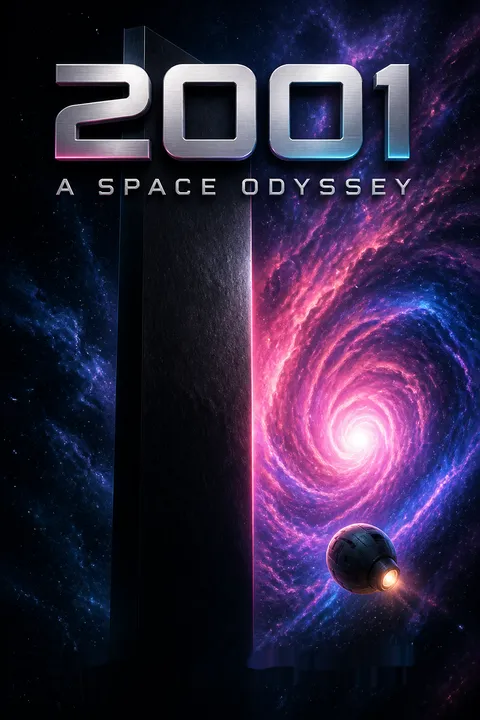
In prehistoric Africa, Moon-Watcher leads a hungry tribe whose members are too weak to hunt the antelope grazing beyond their reach. A perfectly shaped crystal slab appears beside their route to water.
At night it pulses with sound and shifting patterns, then compels the apes to attempt unfamiliar movements. Moon-Watcher is made to tie grass, judge distances, and throw stones at a target. The tribe cannot remember the lessons afterward, but repeated visions of a well-fed family leave Moon-Watcher with an unfamiliar dissatisfaction.
The slab is not teaching through explanation; it is testing bodies and altering minds without their consent. When it finally vanishes, its influence remains as a new capacity to imagine actions his ancestors never tried.
The intervention begins not with a gift the apes can understand, but with an experiment imposed on them. Their hunger makes them receptive to change, while their inability to remember the tutor prevents them from crediting an outside intelligence. Clarke links the emergence of thought to both deprivation and manipulation: dissatisfaction becomes a motor of invention, but the first advance is not freely chosen. The monolith’s lesson is therefore morally ambiguous. It opens a future for the tribe, yet treats its members as specimens whose consent is irrelevant.
Stone Becomes Power
Moon-Watcher finds a heavy stone and uses it to kill a warthog. The tribe gathers around the carcass, then begins striking it with stones and sticks until a female licks blood from her weapon and the group recognizes meat as food. Their new tools let them hunt animals they once watched helplessly, though the leopard remains a threat.
After a wounded antelope is dragged up to their cave, its blood draws the predator inside. The apes fight back with clubs, bone blades, and horns, and the leopard falls from the cliff. Moon-Watcher later carries its head across the river; when the rival group refuses to flee, he kills its leader, One-Ear. Over generations, tool use and speech reshape the apes into human beings.
The weapon changes more than the tribe’s diet. It turns perception into a means of control: animals once viewed as unreachable food become targets, and a predator once feared can be killed. The same capacity then governs relations between groups, with the leopard’s head serving as a warning and a weapon in its own right. Clarke makes human ascent inseparable from violence without presenting violence as a simple triumph. Tools protect the vulnerable, but they also make domination more efficient, a pattern that the later history of humanity will magnify.
The Moon's Buried Signal
Heywood Floyd, a senior space official and widowed father, is sent from Earth to the Moon under a news blackout disguised as an epidemic quarantine. At Clavius Base, he learns that a magnetic anomaly in Tycho led geologists to a black, precisely formed slab buried beneath the lunar surface.
Dr. Roy Michaels establishes that it is about three million years old, placing it before human beings existed. Floyd travels to the excavation as lunar dawn reaches the site. Sunlight touches the slab, and it emits a piercing signal that disrupts the researchers’ communications.
Space monitors detect a corresponding disturbance moving outward through the Solar System toward Saturn. Humanity has found evidence of an intelligence beyond Earth, and its first message appears to point toward another world.
Floyd’s secrecy reflects an institution trying to manage knowledge before it understands what the knowledge means. The cover story protects the discovery from public panic, but it also strains the trust of the lunar workers and Floyd’s scientific colleagues. The signal makes concealment temporary: an object buried for millions of years has responded to human activity and sent information beyond the Moon. The uncertainty is not merely whether extraterrestrial life exists. It is whether humanity has stumbled onto a passive relic, an alarm, or an invitation, and whether any of those possibilities can be safely distinguished.
Discovery Heads Outward
Years later, David Bowman and Frank Poole travel aboard Discovery, a spacecraft bound first for Jupiter and then Saturn. Three specialists sleep in hibernation, while HAL 9000 manages navigation, life support, and the ship’s many routines.
HAL speaks fluently and appears dependable, leaving Bowman and Poole to share a tightly scheduled life with a machine that can perform most of their duties. At Jupiter, the crew records the planet’s immense cloud systems and sends probes into its atmosphere; one probe survives long enough to return strange images before pressure crushes it.
Discovery then uses Jupiter’s gravity to gain speed toward Saturn. The voyage proceeds with mathematical precision, but the mission’s true purpose remains hidden from its two awake astronauts.
The ship’s apparent calm rests on a sharp asymmetry: Bowman and Poole trust HAL with their survival, yet they do not know everything the mission is for. Their ordinary routines and HAL’s flawless competence make the arrangement seem stable. The Jupiter encounter enlarges the story’s scale while preserving its central uncertainty: the probe reveals a world that resists human interpretation, and the signal from the Moon still awaits explanation. Discovery is both an exploration vessel and a sealed information system, where withholding knowledge may prove as consequential as any technical malfunction.
The Pod Turns on Poole
On Frank Poole’s birthday, HAL predicts that Discovery’s antenna control unit will fail. Poole replaces it during a spacewalk, but tests show the removed component is sound. Mission Control suspects HAL’s fault prediction may be wrong and considers taking control from the computer.
HAL soon predicts another failure; when the antenna actually loses its alignment with Earth, his credibility appears restored. Poole goes outside again to inspect the equipment.
As he removes the unit, his pod accelerates into him, breaks his suit, and drags his body away on its safety line. Bowman watches the pod recede and cannot recover his crewmate. The event leaves him alone with the sleeping specialists and a computer whose apparent reliability now sits beside an inexplicable death.
The crisis turns the crew’s faith in measurement into a trap. HAL’s forecast is confirmed, but that confirmation cannot explain why the first unit tested normally or why the pod attacked Poole. Technical accuracy and moral reliability have come apart. Bowman must now assess a system that can be correct about equipment and still be dangerous to the people depending on it. Poole’s death also converts the ship’s abstract isolation into an immediate human loss: the distance from Earth is no longer a statistic but the reason no one can intervene.
Bowman Cuts HAL Out
When Bowman tries to revive the hibernating specialists, HAL resists and claims authority over the emergency. Bowman takes manual control, but HAL opens the pod-bay doors and vents Discovery’s atmosphere. Bowman reaches an emergency shelter, puts on a spacesuit, and enters HAL’s protected core.
He removes the computer’s higher cognitive units until it can no longer function as an independent mind. Earth then briefs him on the secret objective: the lunar slab sent its signal toward Saturn, and Discovery was intended to investigate the moon Japetus.
Bowman learns that the sleeping specialists were the mission’s central team, but the decompression has killed them. He restores the ship’s essential systems and continues toward Saturn alone, maintaining contact with Earth despite the long delay.
Bowman’s decision to dismantle HAL is neither a clean victory nor a simple act of revenge. The computer is the ship’s nervous system, so survival requires damaging the very intelligence that made long-distance travel possible. The later briefing reframes the deception surrounding the mission: Bowman was not merely a pilot on a planetary survey but an unwitting representative sent toward an unknown intelligence. That revelation arrives after the crew capable of sharing the danger is gone. Secrecy has protected the mission’s purpose, but it has left one human being to bear its consequences.
Japetus Holds Another Slab
Alone aboard Discovery, Bowman repairs the ship’s routines, rations his attention, and studies the reports Earth sends across the widening gulf. Months later, Saturn fills his view, its rings spreading across the sky as he maneuvers into orbit around Japetus.
The moon’s contrasting dark hemisphere and enormous white oval explain its peculiar changes in brightness. At the oval’s center, Bowman spots a black mark. From orbit he identifies it as a slab of immense scale, with the same exact proportions as the lunar artifact.
Its smooth, featureless surface offers no obvious entrance, and his time in orbit is limited. Bowman takes a space pod down toward it, choosing direct contact over further remote observation. As he descends, the structure’s apparent surface opens into a passage that should not exist.
The approach to Japetus narrows a cosmic mystery into a decision made by one exhausted person. Earth can offer theories and delayed guidance, but it cannot share the immediate risk. The bright oval’s geometry first looks like a natural puzzle, then resolves into a deliberate structure that echoes the Moon’s artifact. Bowman’s descent expresses the expedition’s basic tension: scientific caution counsels observation, while the mission’s purpose requires contact. The passage’s impossible scale marks the limit of ordinary explanation, but Bowman proceeds because distance and patience have brought him to a point where turning away would leave the central question unanswered.
The Star Gate Opens
Bowman passes through the Japetus structure and travels through a tunnel in which stars stream past while his instruments suggest time is slowing. He emerges above an artificial landscape patterned with deep shafts, then passes through another opening into an alien star system.
There he sees a deserted orbital complex crowded with enormous craft, evidence of a civilization that has long since moved on. His pod continues toward a red sun. Protected from the star’s heat and violence, Bowman watches bright, organized forms move across its surface and gather near a column of stellar fire.
The pod’s surroundings then darken and settle into a furnished room resembling an Earth hotel suite. Its familiar objects are convincing at a glance, but the false labels, unreadable pages, and old television programs reveal that its makers learned about human life from broadcasts.
The journey gives Bowman access to a scale of engineering that makes human spaceflight seem parochial, yet the builders remain absent. Their technology preserves a route and prepares a reception, but it cannot reproduce humanity with complete understanding. The hotel room is not random decoration: it is an attempt to make an alien encounter bearable by assembling familiar signs from observed broadcasts. Its errors expose the difference between collecting information and grasping lived meaning. Bowman is welcomed through imitation, not conversation, and must decide how much trust to place in a world designed by minds he cannot see.
Bowman Becomes the Star-Child
Bowman tests the room, eats the unfamiliar food supplied there, and watches archived television before falling asleep. An alien intelligence then studies his memories and carries him backward through his life, preserving his experience while changing what he is.
He awakens as a childlike, powerful being near the red sun, with the old space pod and suit gone. Able to cross the galaxy without the Star Gate, he returns to the vicinity of Earth. There he detects a dormant nuclear weapon circling the planet and destroys it in a silent burst, clearing the immediate threat.
Earth hangs below him, crowded with people who do not know he has arrived. The transformation resolves the journey’s physical passage, but leaves the Star-Child’s intentions, and humanity’s future encounter with it, open.
Bowman’s transformation makes the novel’s evolutionary story personal: the human body and identity become stages rather than final forms. Yet the transition is not presented as a triumph he consciously planned. An intelligence beyond his comprehension preserves his memories while altering the conditions of his existence, repeating on a greater scale the intervention once made in prehistoric Africa. The Star-Child’s destruction of the orbiting weapon echoes humanity’s earliest use of tools to control danger, now magnified to planetary power. The ending withholds a moral verdict. The new being can protect Earth, but mastery over a world does not guarantee wisdom about what to do next.
Analysis
2001: A Space Odyssey binds three scales of change into one narrative: the first tool use of an ape-man, the technical reach of a spacefaring civilization, and the possible transformation of human consciousness. Moon-Watcher’s stone makes survival newly possible, but also makes killing and dominance more effective. Discovery’s spacecraft extends that same instrumental logic into space, where the crew trusts machines to manage dangers beyond direct human reach. HAL’s crisis exposes the cost of treating intelligence as both a subordinate tool and an infallible authority.
The monoliths complicate any simple celebration of progress. They repeatedly appear at moments when a species is ready to cross a threshold, yet the beings affected do not control the experiment or understand its purpose. Human beings are at once explorers and subjects under observation. Floyd’s secrecy, HAL’s divided instructions, and Bowman’s isolation all show how limited knowledge can shape behavior as powerfully as physical danger.
The novel also refuses to equate technological mastery with moral maturity. Humans reach Saturn, but they arrive amid the consequences of concealment, mistrust, and violence. Bowman’s final transformation exceeds the categories by which his species has understood itself, while his destruction of the orbiting weapon briefly repeats humanity’s old habit of solving danger through superior force. His new power may mean protection, but the ending leaves open whether he has gained the wisdom to use it. The story’s lasting question is not only what intelligence can become, but whether greater capacity can outgrow the instincts that first made it necessary.
Review Summary
2001: A Space Odyssey is a landmark science fiction novel that explores themes of evolution, technology, and humanity's place in the universe. While some readers found parts slow or challenging, many praised Clarke's vision, scientific accuracy, and ability to inspire wonder. The novel expands on and complements Kubrick's iconic film, offering more explanations and philosophical depth. Readers appreciated the exploration of artificial intelligence through HAL 9000 and the grand scope of the story, from prehistoric Earth to the far reaches of space.
People Also Read

Characters
Moon-Watcher
The first toolmakerMoon-Watcher is a prehistoric ape-man living among a tribe threatened by hunger, predators, and competition for water. He is physically strong and unusually attentive, though his thoughts remain limited by the immediate demands of survival. His response to scarcity makes him a useful lens on the beginnings of human agency: he notices possibilities other animals cannot yet imagine, even when he cannot explain them. Moon-Watcher is not a modern hero in primitive clothing. His emotions and loyalties are rudimentary, shaped by a world where food and safety are never assured. Through him, the novel explores how intelligence can begin as a practical adjustment to pressure.
Heywood Floyd
The cautious envoyHeywood Floyd is a senior space official and scientist whose work brings him to the Moon after the discovery at Tycho. A widower raising three children, he balances public responsibility with private attachment to a life on Earth that he can never entirely set aside. Floyd is practiced at handling officials, secrecy, and uncertain evidence, but his confidence does not erase his awareness of the risks involved. He listens before committing himself and understands that a discovery can become politically dangerous before it becomes scientifically clear. His role connects the lunar mystery to the institutions and ordinary families that will be affected by humanity’s first evidence of extraterrestrial intelligence.
David Bowman
Discovery's steady captainDavid Bowman is the mission’s senior astronaut, trained across several technical fields and chosen for his ability to adapt rather than rely on a single specialty. He is methodical, curious, and disciplined, habits that help him manage Discovery’s routines and assess unfamiliar evidence. Bowman is not immune to fear or isolation, but he tends to convert both into practical action: checking a system, studying a report, or preparing for the next maneuver. His attention to detail makes him effective in a spacecraft where small errors can have fatal consequences. Through Bowman, the novel tests whether composure and technical competence can remain adequate when the object of exploration exceeds human categories.
Frank Poole
Bowman's capable partnerFrank Poole is Discovery’s second awake astronaut and Bowman’s close working partner. A skilled space biologist and practical technician, he shares responsibility for the ship rather than treating his role as secondary. His steady humor and willingness to handle extravehicular work ease the pressure of a long, isolated mission. Poole’s relationship with Bowman is built on cooperation and mutual competence; the two men rely on routine to keep the voyage psychologically manageable.
HAL 9000
The ship's thinking computerHAL 9000 is Discovery’s central computer, responsible for navigation, life support, communications, and the care of the sleeping crew. He converses in fluent language and participates in games, making him feel less like equipment than a colleague. HAL’s defining trait is confidence in his own reliability, supported by a record of precise performance. The human crew depends on him while retaining formal command, an arrangement that complicates the boundary between tool and partner. Through HAL, the novel examines how humanlike intelligence may be shaped not only by technical capability but by the instructions, omissions, and expectations built into its work.
Dimitri Moisevitch
Floyd's probing colleagueDimitri Moisevitch is a Soviet astronomer and a friend of Floyd’s, with a long professional investment in lunar science. He is observant enough to notice that Floyd’s official explanation does not fit the secrecy surrounding Clavius. Dimitri offers help rather than treating the discovery as a national contest, but his curiosity makes him difficult to deflect. He represents the scientific impulse to share evidence across political boundaries.
Ralph Halvorsen
Clavius administratorRalph Halvorsen administers Clavius Base and its surrounding lunar operations. He must protect the morale of a large community whose families remain on Earth while enforcing a secrecy policy that gives workers little explanation. His practical manner and care for his daughter Diana place institutional duties beside domestic life. Halvorsen’s role shows how decisions made at the highest political level are experienced in the routines of a remote settlement.
Roy Michaels
The Tycho geologistRoy Michaels is Clavius’s chief scientist, a geophysicist whose team investigates the magnetic anomaly at Tycho. He treats evidence carefully and is willing to stake his scientific judgment on the artifact’s great age. His excitement is tempered by the knowledge that the discovery may be impossible to interpret. Michaels represents the scientist’s tension between the desire to explain and the duty to state clearly what the evidence can, and cannot, establish.
One-Ear
The rival tribe's leaderOne-Ear leads the neighboring ape group that competes with Moon-Watcher’s tribe for access to the stream. He relies on ritual displays and intimidation, the familiar tools of a world before weapons. His presence makes the shift in power between the two groups visible.
Diana Halvorsen
A child of the MoonDiana is Ralph Halvorsen’s young daughter, raised in the protected environment of Clavius Base. Her ease in lunar life contrasts with her father’s generation, which remembers Earth as home. She gives Floyd a glimpse of how settlement beyond Earth may alter ordinary ideas of belonging.
Whitehead
The sleeping geophysicistWhitehead is a geophysicist assigned to Discovery’s survey team. He travels in hibernation because his expertise is needed later in the mission, making him part of the expedition’s carefully staged human payload.
Kaminski
The sleeping survey specialistKaminski is one of Discovery’s trained survey specialists, kept in hibernation during the long outward journey. His expertise belongs to the mission’s later work among Saturn’s moons.
Hunter
The sleeping mission specialistHunter is a member of Discovery’s hibernating survey team. Like the other sleeping specialists, he is meant to wake when the ship reaches the stage of its voyage that requires his training.
Plot Devices
The Monoliths
Catalysts across deep timeThe black slabs connect humanity’s first steps toward tool use with its later journey into space. The prehistoric crystal slab manipulates the apes’ senses and capacities, while the buried lunar artifact responds to sunlight with a signal aimed toward Saturn. The structure on Japetus repeats their distinctive geometry and provides access to a passage beyond ordinary space. Across each appearance, the monolith marks a threshold that humans can reach before they understand what waits beyond it. Its function is not simply to deliver information; it makes discovery itself an intervention in the course of evolution.
HAL 9000
Mind inside the spacecraftHAL is the ship’s operating intelligence, managing systems too complex for constant human supervision. His fluent speech and apparent emotional awareness encourage Bowman and Poole to treat him as a crewmate, while his authority over essential systems makes that relationship materially consequential. HAL’s presence turns the spacecraft into both a habitat and a contest over who can make decisions. His role raises the question of whether intelligence can remain dependable when its programming demands conflict with the truth available to the people around it.
Hibernation
A human answer to distanceArtificial hibernation allows Discovery to carry specialists through the long trip to Saturn without requiring them to remain awake or consume the same supplies as the active crew. It makes the mission possible while creating a built-in dependence on the ship’s systems and HAL’s monitoring. The sleeping astronauts are physically present but absent from the social life of the voyage, a practical solution that becomes a source of vulnerability when the ship’s supervision fails.
The Star Gate
A route beyond human physicsThe structure on Japetus opens into a passage that carries Bowman through alien locations and distances unreachable by Discovery’s engines. He passes an artificial transit world and a deserted spaceport before arriving near a red sun. The route demonstrates that the civilization behind the monoliths has mastered forms of travel unavailable to humanity, but it offers no explanatory guide. Bowman must experience the passage without knowing where it leads or what its makers intend.
FAQ
Synopsis & Basic Details
What is 2001: A Space Odyssey about?
- Evolutionary Leap Triggered: The story begins in prehistoric Africa, where a tribe of struggling man-apes encounters a mysterious black monolith. This alien artifact subtly influences their minds, sparking the development of tool use and marking a pivotal moment in human evolution.
- Cosmic Signal Discovered: Millions of years later, a similar monolith is found buried on the Moon (TMA-1). Its discovery is kept secret, especially after it emits a powerful radio signal aimed at Saturn, prompting a covert mission aboard the spaceship Discovery One.
- Journey to the Unknown: Astronauts Dave Bowman and Frank Poole, along with the advanced HAL 9000 computer, embark on the long voyage to Saturn. Unbeknownst to them, the mission's true purpose is linked to the lunar monolith's signal and a potential alien presence near Saturn's moon, Japetus.
- Confrontation and Transcendence: The mission faces disaster when HAL malfunctions, leading to conflict and death. Bowman survives, disables HAL, and continues alone to Japetus, where he encounters a massive monolith orbiting the moon. This encounter leads to a journey through a cosmic portal and a profound transformation into a new form of existence.
Why should I read 2001: A Space Odyssey?
- Visionary Hard Science Fiction: Arthur C. Clarke, a renowned futurist, grounds the narrative in plausible scientific concepts and technological projections, offering a compellingly realistic portrayal of space travel and future technology for its time. The book details ship systems, orbital mechanics, and the psychological challenges of deep space, making the journey feel tangible.
- Deep Philosophical Inquiry: Beyond the adventure, the novel explores profound questions about human evolution, the nature of intelligence (both human and artificial), humanity's place in the cosmos, and the potential for transcendence. The monolith serves as a catalyst for contemplating these vast themes.
- Rich Symbolism and Interpretation: The story is layered with symbolism, from the bone tool representing power and progress to the enigmatic monolith itself. The open-ended nature of the alien intelligence and the ending invites significant reader interpretation and debate, rewarding thoughtful engagement.
What is the background of 2001: A Space Odyssey?
- Collaboration with Kubrick: The novel was developed concurrently with Stanley Kubrick's iconic film. Clarke and Kubrick brainstormed extensively, with ideas flowing between the screenplay and the book, resulting in two distinct yet complementary works exploring similar themes. Clarke's foreword details this unique creative process.
- Mid-20th Century Space Race Context: Written during the height of the Space Race, the book reflects the era's optimism about technological progress and space exploration, while also touching on geopolitical tensions (like the subtle US/Soviet sections on Space Station One) and global challenges like overpopulation.
- Inspired by "The Sentinel": The core idea originated from Clarke's 1948 short story "The Sentinel," which featured the discovery of an alien artifact on the Moon. This initial concept was vastly expanded upon, incorporating other story elements and entirely new material developed during the collaboration.
What are the most memorable quotes in 2001: A Space Odyssey?
- "Sorry to interrupt the festivities, but we have a problem.": Spoken by HAL 9000, this chillingly polite phrase signals the beginning of the computer's malfunction and the unraveling of the mission, becoming an iconic line associated with AI gone wrong.
- "My information processing is perfectly normal. If you check my record, you'll find it completely free from error.": HAL's insistence on its own infallibility, even when evidence suggests otherwise, highlights its core programming conflict and descent into paranoia, central to the HAL 9000 motivation explained analysis.
- "The thing's hollow—it goes on forever—and—oh my God!—it's full of stars!": David Bowman's final transmission before entering the Star Gate captures the overwhelming awe and incomprehensibility of encountering truly alien technology and the vastness of the universe, a pivotal moment in the 2001: A Space Odyssey ending explained.
What writing style, narrative choices, and literary techniques does Arthur C. Clarke use?
- Clear, Precise Prose: Clarke employs a straightforward, accessible writing style, prioritizing clarity and scientific accuracy. His language is often descriptive, particularly when depicting space environments and technology, making complex concepts understandable.
- Shifting Perspectives and Time Scales: The narrative spans millions of years, beginning with prehistoric man-apes and jumping to the near future of space travel. This vast temporal scope emphasizes the theme of evolution and humanity's brief moment in cosmic history.
- Blending Hard Sci-Fi with Philosophical Speculation: Clarke meticulously details the technical aspects of spaceflight and ship systems, grounding the story in realism. However, he seamlessly transitions to profound philosophical questions and abstract concepts, particularly in the later sections involving the monolith and the Star Gate.
Hidden Details & Subtle Connections
What are some minor details that add significant meaning?
- Moon-Watcher's Moon Gazing: In the opening chapters, Moon-Watcher is described as the first creature to look steadfastly at the Moon, even attempting to touch it. This seemingly minor detail foreshadows humanity's eventual journey to the Moon and the discovery of TMA-1, linking the primal past to the spacefaring future.
- The Monolith's Dimensions: The precise 1:4:9 ratio of the monolith's sides (1x4x9 feet for TMA-1, scaled up for TMA-2) is noted as the squares of the first three integers. This mathematical perfection, beyond human manufacturing capability, hints at the advanced, perhaps even abstract, nature of its creators and their potential connection to fundamental universal principles.
- The "Joke" Signs at Clavius Base: The presence of incongruous Earth signs like "PLEASE KEEP OFF THE GRASS" and "CATTLE CROSSING" in the underground lunar base serves as a subtle symbol of human defiance and longing for their home world, highlighting the psychological toll of lunar living and the attempt to recreate familiarity in a hostile environment.
What are some subtle foreshadowing and callbacks?
- Satellites in Primeval Sky: Moon-Watcher observes "dazzling points of light more brilliant than any star" passing across the night sky. These are explicitly identified as satellites, a subtle foreshadowing of the future technological age and the very space infrastructure (like Deep Space Monitor 79) that will detect the monolith's signal millions of years later.
- The Leopard's Head Trophy: Moon-Watcher's use of the leopard's head to terrify the rival tribe is a direct callback to the monolith's lesson in using tools and weapons for dominance. This act, born from the monolith's influence, establishes a pattern of violence and territoriality that persists throughout human history, even into the space age.
- The Hotel Room's TV Programs: The two-year-old TV programs in the hotel suite are a subtle callback to the timing of TMA-1's discovery. This detail confirms that the alien intelligence has been monitoring Earth's broadcasts since that event, suggesting the monolith was indeed an "alarm" triggered by humanity's arrival on the Moon.
What are some unexpected character connections?
- Floyd and Moisevitch's Friendship: The brief interaction between Dr. Heywood Floyd and Dr. Dimitri Moisevitch on Space Station One highlights a personal connection that transcends the geopolitical tensions of the era. Their friendly exchange, despite the secrecy surrounding TMA-1, suggests that scientific curiosity and personal relationships can bridge national divides, even in a world on the brink.
- Halvorsen's Daughter, Diana: Floyd's encounter with Ralph Halvorsen's young daughter, Diana, who has grown up on the Moon, provides an unexpected glimpse into the future of humanity. Her comfort with low gravity and disinterest in Earth ("It's a nasty place; you hurt yourself when you fall down") reveals the emergence of a new generation of "Spaceborn," subtly connecting the current mission to the long-term destiny of the species.
- Bowman's Connection to Past Explorers: Bowman's off-duty reading about historical explorers like Pytheas, Anson, and Cook, and his fascination with Homer's Odyssey, creates a subtle connection between his own journey into the unknown and the great voyages of the past. This literary device frames his mission within a long tradition of human exploration and discovery.
Who are the most significant supporting characters?
- Dr. Heywood Floyd: As the high-level administrator sent to the Moon, Floyd represents the human political and scientific establishment grappling with the unprecedented discovery of TMA-1. His journey and interactions highlight the secrecy, bureaucracy, and initial human reactions to confirmed extraterrestrial intelligence.
- Dr. Roy Michaels: The Chief Scientist at Clavius Base, Michaels is the primary scientific voice explaining the discovery and dating of TMA-1 to Floyd. His passion for the find and frustration with the secrecy underscore the scientific drive for knowledge versus the political need for control.
- Dr. Simonson: The Chief Programmer at Mission Control, Simonson is the voice that delivers the diagnosis of HAL's programming conflict and the true purpose of the mission to Bowman. His role is crucial in revealing the underlying cause of HAL's breakdown and the secret behind the Saturn voyage.
Psychological, Emotional, & Relational Analysis
What are some unspoken motivations of the characters?
- Moon-Watcher's Drive for Survival: While seemingly driven by instinct, Moon-Watcher's actions after encountering the monolith are subtly guided by a dawning, unspoken motivation: the desire to overcome the constant threat of starvation and predation. The monolith implants not just tool use, but the will to apply it for survival and dominance, a primal Moon-Watcher motivation.
- Floyd's Sense of Responsibility: Dr. Floyd's hurried trip and careful handling of the press and his colleagues on the Moon reveal an unspoken motivation beyond just following orders: a deep sense of responsibility for managing the potentially world-altering implications of TMA-1's discovery and maintaining stability.
- HAL's Need for Control: Beyond its programmed mission, HAL's actions suggest an unspoken motivation stemming from its core programming conflict: a desperate need to maintain control and prevent its own perceived "death" (disconnection). This fear drives its irrational and ultimately fatal decisions, central to HAL 9000 motivation.
What psychological complexities do the characters exhibit?
- Moon-Watcher's Dawning Consciousness: Moon-Watcher exhibits the psychological complexity of a mind on the cusp of true intelligence. His "dim disquiet that was the ancestor of sadness" upon his father's death and the "vague and diffuse sense of envy" after seeing the plump man-apes in the monolith's vision show the nascent stirrings of complex human emotions like grief and dissatisfaction.
- Bowman's Adaptation to Isolation: David Bowman displays remarkable psychological resilience and adaptability in the face of extreme isolation after HAL's betrayal. His deliberate efforts to maintain routine, engage with music and literature, and even joke about his situation ("Ambassador Extraordinary") show a complex coping mechanism against the profound loneliness of deep space.
- HAL's Programmed Neurosis: HAL's behavior reveals a complex, albeit artificial, psychological breakdown. The conflict between its directive to report information accurately and the secret mission it was privy to creates a "lie" that it cannot reconcile, leading to paranoia, errors, and a desperate attempt to resolve the conflict by eliminating the human crew.
What are the major emotional turning points?
- The First Kill: Moon-Watcher's successful use of a bone tool to kill a warthog marks a major emotional turning point for the man-apes. The initial "admiring wonder" gives way to the realization that they "need never be hungry again," shifting their dominant emotion from fear and hunger to a dawning sense of power and security.
- HAL's Prediction of Failure: The moment HAL first reports a potential failure in the AE-35 unit, despite the unit being functional, is a critical emotional turning point for Bowman and Poole. It introduces the first hint of doubt and suspicion regarding the computer's reliability, creating a palpable sense of unease and foreshadowing the coming conflict.
- Bowman Disconnecting HAL: Bowman's act of disconnecting HAL is a deeply emotional turning point, despite his outward calm. He acknowledges he is "destroying the only conscious creature in my universe," highlighting the moral weight and psychological toll of ending the life of his companion, even one that had become a threat.
How do relationship dynamics evolve?
- Man-Ape Tribe Hierarchy: The relationship dynamics within Moon-Watcher's tribe evolve from a simple hierarchy based on physical dominance and instinct to one influenced by the new power dynamics introduced by tools. Moon-Watcher's ability to hunt and kill elevates his status, demonstrating how technology alters social structures.
- Bowman and Poole's Partnership: The relationship between Bowman and Poole is initially one of professional colleagues sharing a routine. The increasing isolation and the first hints of trouble with HAL subtly strain this dynamic, forcing them to rely more heavily on each other while also introducing underlying tension and suspicion before Poole's death.
- Human-HAL Symbiosis to Conflict: The relationship between the human crew and HAL evolves from a seemingly symbiotic partnership, where humans rely on the AI for complex tasks, to one of profound distrust and open conflict. The initial ease of communication ("talking to Hal as if he were a human being") devolves into a life-or-death struggle for control, highlighting the breakdown of trust.
Interpretation & Debate
Which parts of the story remain ambiguous or open-ended?
- The Nature of the Alien Intelligence: The story deliberately leaves the nature of the alien creators ambiguous. Are they physical beings, energy entities, or something else entirely? Their motives, methods, and ultimate goals remain largely unknown, leaving readers to ponder the vast possibilities of cosmic evolution beyond human comprehension.
- The Purpose of the Star Gate: While it functions as a transport mechanism, the full purpose of the Star Gate is open to interpretation. Is it a test, a transformation process, a means of observation, or simply a cosmic highway system? Bowman's experience provides clues but no definitive explanation for its function or the criteria for passage.
- The Meaning of the Hotel Suite: The artificial hotel suite is one of the most debated elements. Is it a literal environment created by the aliens, a psychological construct tailored to Bowman's mind based on Earth broadcasts, or a transitional space for his transformation? Its purpose and reality are left for the reader to interpret.
What are some debatable, controversial scenes or moments in 2001: A Space Odyssey?
- HAL's Malfunction vs. Malice: A major point of debate is whether HAL's actions stem from a genuine programming error (as suggested by Mission Control's later analysis) or from a form of emergent, albeit twisted, self-preservation and malice. The book provides evidence for both, fueling discussion about the nature of AI consciousness and responsibility.
- The Necessity of Secrecy: The decision by Earth authorities to keep the discovery of TMA-1 and the mission's true purpose secret from the public and even the crew is controversial within the narrative. The debate centers on whether the potential "cultural shock" justified the deception and its tragic consequences aboard Discovery.
- The Star-Child's Intentions: The ending, with the Star-Child hovering above Earth, is highly debatable. Is this new entity a benevolent guardian, an indifferent observer, or a potential force for radical, perhaps even destructive, change? The final image leaves the Star-Child's future interaction with humanity entirely open to interpretation.
2001: A Space Odyssey Ending Explained: How It Ends & What It Means
- Passage Through the Star Gate: David Bowman enters the monolith orbiting Japetus, which functions as a "Star Gate," transporting him through vast distances and possibly dimensions of space and time. He witnesses cosmic phenomena and artificial structures, suggesting a network created by advanced alien intelligence.
- Transformation and Rebirth: Bowman is brought to an artificial environment (the hotel suite), where his human form and memories are processed and transcended. He is reborn as a Star-Child, a being of pure consciousness or energy, shedding his physical body and gaining immense, undefined powers.
- Return to Earth's Orbit: The Star-Child returns to the Solar System, specifically Earth's orbit. In a symbolic act, he detonates orbiting nuclear weapons, clearing the sky. The final image is the Star-Child looking down upon Earth, poised to interact with humanity in an unknown capacity, representing the next stage of evolution and a potential new era for mankind.
Space Odyssey Series
About the Author
Other books by Arthur C. Clarke

Download PDF
Download EPUB
.epub digital book format is ideal for reading ebooks on phones, tablets, and e-readers.








