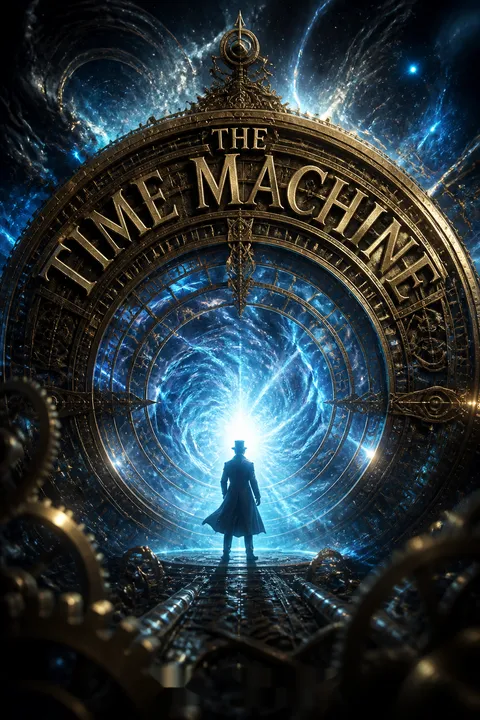


Plot Summary
Time Has Four Dimensions
At a Richmond dinner, the unnamed Time Traveller argues that time is a dimension through which people might learn to move, not merely a current carrying them forward. His guests, especially the argumentative Filby, treat the idea as clever nonsense. The Traveller produces a delicate model and explains its levers; the Psychologist activates one, and the machine disappears from the table before the assembled men can find a trick.
In the laboratory, they see the larger device he intends to ride. Their disbelief persists, but the demonstration has changed the question from whether time travel is imaginable to what the Traveller will find if he attempts it. He finishes the machine and sets out alone.
The dinner party turns scientific proof into a social performance. The Traveller can make his guests witness an impossible event, but he cannot make them trust the witness or the person performing it. Filby’s skepticism and the Psychologist’s attempt to explain away the disappearance expose how readily people protect familiar assumptions, even in the face of evidence. The machine is not just a vehicle; it is a challenge to the limits of respectable knowledge. By making the audience part of the demonstration, Wells also prepares us to question whether seeing, believing, and knowing are ever the same thing.
The Garden Beyond Time
The Traveller launches from his laboratory and watches days and seasons race past until the moving landscape becomes a blur. He stops in the year 802,701, where a violent hailstorm leaves him beside a weathered white statue and his overturned machine.
Delicate, small people approach without fear, touch him curiously, and adorn him with flowers. He removes the machine’s levers before they can handle it, then follows them into a vast communal hall. They eat fruit, laugh at his attempts to learn their simple language, and soon lose interest in him.
Their welcome is gentle, but their indifference unsettles him. The grand buildings and lush, unworked landscape promise a transformed civilization, while their decay hints that its apparent perfection has a cost.
The future first arrives as an aesthetic seduction: flowers, soft clothing, communal fruit, and buildings large enough to make the Traveller feel small. Yet the Eloi’s brief curiosity and easy distraction interrupt his expectation of an intellectually advanced humanity. His first contact is not hostile, but it is not truly reciprocal either. He is an object of novelty, then forgotten. The gap between the world’s beautiful surfaces and the Eloi’s limited attention establishes a central problem for the Traveller: how to interpret a society that seems to have solved hardship while showing little evidence of thought, labor, or history.
The Sphinx Keeps His Machine
After surveying the Thames valley, the Traveller imagines that humanity has achieved a peaceful, communal society. Palaces stand among gardens, private homes and visible work have vanished, and the Eloi appear alike in dress and manner. But when he returns to the lawn after dark, his Time Machine is gone.
He searches in panic, then finds a groove in the turf and narrow footprints leading toward the bronze pedestal beneath the White Sphinx. Its panels are hollow, and he suspects the machine is locked inside, though the Eloi recoil when he gestures toward them. He cannot force the doors. As he studies the landscape, he notices deep wells, mechanical thudding, and currents of air, clues to a hidden system beneath the tranquil surface.
The missing machine transforms a visit into a predicament: the Traveller is no longer free to treat the future as a spectacle. His frantic search also exposes the limits of his confidence. He has brought a device capable of crossing centuries but has no plan for being stranded among people he barely understands. The White Sphinx concentrates that uncertainty into a physical obstacle, while the wells suggest that the visible society depends on forces it does not acknowledge. His theory of an easy, egalitarian future remains plausible only because he has not yet learned to read what the landscape conceals.
Weena Fears the Dark
On his third day, the Traveller pulls a drowning Eloi woman from the river after her companions make no effort to help. Weena repays him with flowers and begins following him; her attachment gives him a first sense of companionship in the future.
She is terrified of darkness, however, and gathers with the others inside great halls at night. Before dawn, the Traveller glimpses pale, ape-like figures carrying something among the ruins. Later he finds one watching him from a shadowed gallery, then sees it climb down a ventilation shaft.
Its reflective eyes and flight from daylight suggest a second human descendant living underground. When he asks Weena about the wells, she becomes distressed, while the bright, carefree Eloi refuse to discuss them.
Weena’s rescue reverses the social pattern the Traveller has been observing: the Eloi fail to help one another, but he acts, and Weena answers with a personal bond. Her gratitude makes the future feel less alien even as her fear points toward a danger she cannot explain. The pale figure changes the Traveller’s problem from a puzzle about decline into a puzzle about division. The wells are not merely infrastructure; they connect two ways of living, one visible and placid, the other hidden and feared. Weena’s tears suggest that what the Eloi have forgotten or refuse to name remains emotionally present.
Below the Ventilation Wells
Unable to recover the machine from the surface, the Traveller climbs down a shaft while Weena watches helplessly from above. Metal footholds bend under his weight, and the air grows hot with the pulse of machinery. In a tunnel below, Morlocks emerge from the darkness and retreat from his matches. He reaches a cavern filled with machines, a meal laid out on a metal table, and the smell of fresh blood.
When his dwindling matches fail to hold the creatures back, they seize him and drag at his clothes. He kicks free and scrambles up the shaft, reaching daylight exhausted and injured. The encounter confirms that the wells lead to an inhabited underworld, but it leaves him uncertain about the Morlocks’ power and purpose.
The descent makes the Traveller’s vulnerability bodily: the footholds are built for smaller inhabitants, darkness defeats his sight, and even a handful of matches becomes a finite resource. His scientific curiosity carries him below, but it cannot protect him once observation becomes contact. The cavern’s machinery and unexplained meal complicate his earlier assumption that the Eloi live in a self-sustaining paradise. He leaves with evidence, not yet a complete explanation. That partial knowledge matters: the Morlocks are frightening as individuals, but the deeper threat lies in the system connecting their labor, their environment, and the people above.
Matches in the Green Palace
The Traveller now suspects the Morlocks maintain the Eloi’s comforts and feed on them, a reversal of the old division between laborers and owners. He takes Weena toward the Palace of Green Porcelain, hoping to find shelter and useful tools. Its galleries hold fossils, corroded machines, ruined books, and exhibits from a vanished age.
In an intact case he discovers matches, then finds camphor that can burn brightly; he also takes an iron bar to use against the bronze doors. These relics give him a defense against creatures that fear light. He plans to cross the woods with Weena, build a fire for the night, and return to the White Sphinx at dawn to reclaim his machine.
The museum is an archive without interpreters. The Traveller can recognize old science and useful objects, but the Eloi cannot read its writing or recover its history. In the galleries, civilization survives as material residue rather than shared knowledge. His interpretation of the Morlocks and Eloi also revises his earlier social optimism: the old class system may have changed bodies and habitats without ending exploitation. Yet the Traveller’s answer is practical rather than political. He gathers matches and metal, trying to turn inherited tools into immediate power, while the future’s vanished knowledge remains beyond his reach.
Weena in the Burning Wood
As darkness gathers, the Traveller carries sticks into a wood with Weena, hoping the fire he leaves behind will discourage pursuit. The flames spread through dry brush while he struggles to find his way, and Morlocks close around them. When Weena collapses, he lights camphor to drive the attackers back, then builds another fire and tries to revive her.
Exhaustion overcomes him. He wakes surrounded by Morlocks, his matchbox missing and the fire dying. Fighting with the iron bar, he holds them off until the spreading forest fire drives them into the open. Blinded by the blaze, they stumble helplessly through the smoke. At daybreak, the Traveller searches the scorched ground for Weena, but finds no trace of her.
The Traveller’s plan depends on controlling fire, but the same force that protects him also destroys the setting he needs to navigate. His exhaustion is not incidental: he has treated himself as a rational observer, yet sleep deprivation turns judgment into a liability. Weena’s vulnerability makes the cost personal, and the sudden disappearance of the matchbox leaves him fighting without the technology he trusted. The fire reverses the Morlocks’ advantage in darkness, but it does not produce a clean victory. Survival comes through an uncontrolled catastrophe, and the Traveller is left with grief rather than mastery.
The Sphinx Opens
After crossing the ash-covered ground, the Traveller reaches the White Sphinx and finds its bronze panels open. His machine waits inside, cleaned and oiled, but the Morlocks slide the panels shut behind him, expecting darkness to give them control. He tries to strike a match and discovers the box is gone, so he cannot light one.
As the Morlocks crowd him, he fits the small levers into the machine by touch, fighting their hands off and recovering a lever they nearly take. He climbs into the saddle and starts the mechanism. The darkness and grasping hands fall away as time begins to move. His escape is narrow, improvised, and costly: Weena is gone, and the machine carries him onward before he can choose a destination.
The Morlocks’ trap turns the Traveller’s earlier tools into a test of adaptation. He has no light and cannot rely on scientific explanation; he must remember the machine’s fittings and act by touch while enemies seize at him. The recovery is not a triumphant conquest of the future but a desperate withdrawal from it. The Sphinx, which held his way home, also becomes the place where the Morlocks try to make him helpless. His escape restores movement, but it does not restore control. In this story, technical power can open a path without granting command over its consequences.
Earth at the End
The Traveller pulls the levers incorrectly and plunges farther into the future instead of returning to his own time. He watches daylight slow, the sun swell into a fixed red presence, and the moon and familiar stars disappear.
On a barren shore, giant crab-like creatures crawl among salt, lichen, and shallow water. Millions of years later, the crabs are gone too; cold, snow, and a nearly lifeless sea replace them. During an eclipse, a last strange creature moves across the water.
Sickened by the thin air and darkness, he forces himself back onto the machine and reverses course. The landscape races backward through ages until the laboratory reappears. He has escaped the Morlocks, but the long view offers no assurance that humanity’s story ends in triumph.
The far future strips away the human scale that has organized the Traveller’s earlier interpretations. The Eloi and Morlocks are not the final form of life; they are brief inhabitants on a planet moving toward environmental collapse. By making him witness both evolutionary change and extinction, Wells denies the comforting assumption that progress belongs to humanity alone. The Traveller can return because his machine lets him move through time, but the vision cannot be reversed as knowledge. He has seen the planet’s eventual indifference, and his return to the familiar laboratory carries that awareness into a room where his friends still measure time by dinner.
The Traveller Disappears Again
The Traveller returns to his friends filthy, limping, and starving, then recounts the journey in the smoking room. The narrator and other guests remain uncertain until they inspect the machine, its bent rail, and the two withered flowers Weena had placed in the Traveller’s pocket.
The next day, the narrator finds him preparing to travel again with a camera and knapsack. Before the promised demonstration, a gust of air and a crash of glass announce that the machine has vanished from the laboratory.
The Traveller does not return. Three years later, the narrator still cannot tell whether the journey was fact or an elaborate invention, but the flowers remain as material evidence of a tenderness that his account claimed survived in the far future.
The frame story turns proof into an unresolved emotional question. The machine’s damage and Weena’s flowers support the Traveller’s account, but neither can reproduce the experience for his listeners. The narrator’s position resembles the reader’s: he has evidence, a persuasive witness, and no final certainty. The Traveller’s second departure repeats the original experiment while withholding its outcome, leaving curiosity alive beyond the narrated adventure. The flowers matter because they are small and ordinary, not instruments of proof. They suggest that the journey’s most durable trace may be the bond the Traveller formed, rather than the scientific claim that began it.
Epilogue
The narrator wonders whether the Traveller has gone into humanity’s past or toward a future the two men once debated. He remembers that the Traveller doubted civilization would rise without limit, while he himself refuses to treat decline as inevitable.
The withered flowers are all that remain in his possession. They cannot verify every detail of the journey, but they preserve its most intimate claim: even in a distant age of diminished human capacities, gratitude and affection still mattered.
The epilogue refuses to convert the Traveller’s disappearance into either proof of his pessimism or a neat mystery solved. Instead, the narrator holds two incompatible impulses together: suspicion that civilization may collapse under its own weight, and a chosen willingness to live as though decline can be resisted. The flowers give that tension a physical scale. They are too fragile to settle a scientific argument, yet they outlast the dinner party’s skepticism as an emblem of reciprocal care. Wells closes not with evidence that progress is possible, but with a modest reason not to abandon human feeling when grand theories fail.
Analysis
The Time Machine tests Victorian faith in progress by making the future a place the protagonist can visit, inspect, and misread. The Traveller initially treats comfort as evidence of social achievement: the Eloi eat fruit in palaces, and visible labor has disappeared. Yet the abandoned buildings, missing machinery, and wells undermine his first explanation. The future is not a perfected society but the endpoint of a division that has become biological. The Eloi and Morlocks embody opposing adaptations to unequal ways of life, though the Traveller’s theory remains a conjecture rather than an omniscient account. That uncertainty matters: he is an intelligent observer, not a neutral authority, and his interpretations shift as evidence accumulates.
The book’s deepest reversal is that security does not abolish danger; it changes who is exposed to it. The Eloi’s ease depends on needs they no longer understand, while the Morlocks’ inherited role as workers has become something more threatening. Wells turns class relations into evolutionary speculation, a forceful but unsettling metaphor that makes social arrangements seem capable of reshaping the human body. The story warns against imagining that institutions can be made permanent simply by designing them well. A system may outlive its original purpose and produce consequences its founders would not recognize.
The frame narrative complicates the authority of this warning. The dinner guests hear a coherent account, see a damaged machine, and handle flowers from a world they cannot verify. The narrator neither fully endorses nor dismisses the Traveller. This keeps the speculative journey suspended between scientific report and personal testimony. The flowers finally make the smallest claim, not that progress is guaranteed or that the Traveller is right about every prediction, but that tenderness can survive where knowledge and power have deteriorated. The book’s hope is narrow and deliberately human: care persists as a trace, even when the larger story of civilization remains uncertain.
Review Summary
The Time Machine receives mostly positive reviews, praised for its pioneering concept of time travel and social commentary. Readers appreciate Wells' imaginative vision of the future and thought-provoking themes. Some find the narrative style dated or slow-paced, but many consider it a classic of early science fiction. The depiction of Eloi and Morlocks sparks discussions on class divide and human evolution. While some aspects may feel outdated, the novella's influence on the genre and its exploration of societal issues remain widely recognized.
People Also Read




Characters
The Time Traveller
Inventive temporal explorerA wealthy, intellectually restless experimenter who builds a machine to test his theory that time is another dimension of travel. He prefers direct observation to received wisdom and trusts his ingenuity to meet whatever his experiments uncover. That confidence makes him bold, but it also encourages him to mistake a quick interpretation for a complete one. In the future, he must revise his assumptions as encounters with the Eloi, the Morlocks, and the ruins complicate his vision of progress. His account is delivered through another person, so the reader sees both his appetite for discovery and the limits of a witness trying to make an immense experience comprehensible.
The Narrator
Skeptical frame witnessAn unnamed member of the Traveller’s dinner circle who records the experiment and its aftermath. He is more attentive than the guests who turn the story into a joke, but he does not claim certainty merely because the Traveller speaks persuasively. His position is that of a careful listener caught between evidence and disbelief. The story reaches us through his memory, making his restraint important: he reports what he sees, while leaving the Traveller’s larger claims open to judgment.
Weena
Tender future companionA small, affectionate member of the Eloi whom the Traveller rescues from the river. She answers his help with flowers and seeks his company, offering a personal connection in a society where curiosity quickly fades. Her fear of darkness gives the Traveller a clue that the daylight world is less secure than it appears. Weena is not a guide who can explain the future in abstract terms; her gestures, attachments, and fears reveal its emotional conditions more clearly than its history.
The Eloi
Daylight future peopleThe small, graceful inhabitants the Traveller first meets in the distant future. They live among gardens and palaces, eat fruit, and approach strangers with a mild curiosity that soon gives way to distraction. Their childlike manner and fear of darkness shape the Traveller’s early assumptions about their society. As a group, they appear comfortable but offer little sign of industry, historical memory, or sustained intellectual inquiry.
The Morlocks
Hidden underground dwellersPale, nocturnal beings encountered first in ruined places and then beneath the earth. Their reflective eyes, sensitivity to light, and familiarity with the ventilation shafts make them a threat the Traveller cannot understand from the surface. Their presence links the abandoned machinery and the Eloi’s fear of darkness. They are not simply a monster from the shadows; their environment and habits point toward a history of human adaptation the Traveller has yet to piece together.
Filby
Argumentative dinner guestA red-haired guest who challenges the Traveller’s theories at the first dinner. Filby’s disbelief gives the scientific demonstration an immediate audience, while his arguments expose how difficult it is to accept a claim that unsettles ordinary ideas of time.
The Psychologist
Doubtful scientific observerA dinner guest who participates in the model’s demonstration and later offers a psychological explanation for its disappearance. He embodies the desire to fit an unsettling event into familiar intellectual categories, even when those categories may be inadequate.
The Medical Man
Practical dinner skepticA physician among the Traveller’s guests who questions the mechanics of time travel and watches the Traveller’s condition closely. His practical skepticism contrasts with the Traveller’s willingness to stake himself on an experiment.
The Editor
Curious newspaper manA journalist who is more interested in turning the Traveller’s extraordinary return into a publishable sensation than accepting it at face value. His appetite for a story reflects the gap between reporting an event and believing it.
Plot Devices
The Time Machine
A vehicle through historyThe Traveller’s brass, ivory, and crystal invention makes time physically traversable. Its levers control movement forward and backward, but the Traveller’s safety depends on judging when and where to stop. The machine drives the plot from the Victorian dinner room into the distant future, then makes escape possible when the Traveller is trapped. Its material damage and strange instability also keep the frame narrative unsettled: the guests can touch the device, yet they cannot reproduce or fully explain its journey.
The White Sphinx
A locked path homeThe weathered statue watches over the lawn where the Traveller arrives. Its bronze pedestal hides the missing machine, turning an imposing landmark into the practical obstacle between him and escape. The Traveller’s changing response to it tracks his changing position: first it is a monument to a civilization he cannot read, then a locked container, and finally the site of a desperate confrontation. Its silent face also gives the future an apparent intelligence that the Traveller cannot distinguish from his own projections.
The Ventilation Wells
A route beneath paradiseBronze-rimmed shafts punctuate the hills and carry a steady mechanical pulse from below. At first the Traveller mistakes them for sanitary infrastructure. Their ladders and air currents eventually lead him into the Morlocks’ tunnels and cavern. The wells make the future’s division visible in the landscape: the surface appears self-sufficient, while hidden machinery and inhabitants sustain a second world below. They also turn a broad social theory into a physical descent the Traveller must undertake himself.
Matches and Fire
Light as weapon and dangerFire gives the Traveller an advantage over creatures adapted to darkness. Matches help him escape underground, while camphor and gathered wood offer a defense during his return across the forest. But the fire spreads beyond his control, contributes to the chaos of the night, and leaves him exhausted and separated from Weena. The device therefore resists a simple equation between technology and mastery: a useful tool can change the balance of power while creating new dangers its user cannot manage.
Weena's Flowers
A fragile trace of careWeena presents flowers to the Traveller after he saves her, making a gift the clearest expression of their developing attachment. The blossoms later travel with him back to the present, where they offer his listeners physical evidence that his story may be more than invention. Their significance lies in the contrast between their delicacy and the scale of the journey: they cannot explain the future or prove every detail, but they preserve the memory of a personal bond across an immense interval.
FAQ
Synopsis & Basic Details
What is The Time Machine about?
- Journey to future dystopia: A Victorian scientist invents a time machine and travels to the year 802,701 AD, where he discovers a seemingly utopian society of Eloi.
- Dark underbelly revealed: He soon learns that the Eloi are preyed upon by the Morlocks, a subterranean race who maintain the world's machinery, revealing a disturbing class division.
- Escape and cautionary tale: The Time Traveller struggles to survive, learns about the future's grim reality, and eventually returns to his own time to share his cautionary tale about the potential consequences of societal trends.
Why should I read The Time Machine?
- Pioneering science fiction: It's a foundational work of science fiction, establishing many tropes of the genre, including time travel and dystopian future, influencing countless subsequent works.
- Social commentary on progress: The novel offers a thought-provoking critique of Victorian society, exploring themes of class division, industrialization, and the potential dangers of unchecked progress.
- Exploration of human nature: It delves into the potential evolution (or devolution) of humanity, examining the consequences of comfort, security, and the loss of intellectual and physical challenges.
What is the background of The Time Machine?
- Victorian anxieties reflected: The novel reflects late Victorian anxieties about social inequality, industrialization, and the potential for societal collapse, fueled by rapid technological advancements.
- Scientific and philosophical influences: Wells drew inspiration from contemporary scientific theories, including Darwinian evolution and the concept of the fourth dimension, popularized by mathematicians and philosophers.
- Socialist undertones present: The stark division between the Eloi and the Morlocks can be interpreted as a commentary on the capitalist system, with the Morlocks representing the exploited working class and the Eloi the idle upper class.
What are the most memorable quotes in The Time Machine?
- "It sounds plausible enough tonight, but wait until to-morrow. Wait for the common sense of the morning.": This quote encapsulates the initial skepticism the Time Traveller faces, highlighting the difficulty of accepting radical ideas that challenge conventional wisdom.
- "I had mastered the problem of the world—mastered the whole secret of these delicious people.": This quote reveals the Time Traveller's initial, naive confidence in understanding the future, which is later shattered by the discovery of the Morlocks.
- "We are kept keen on the grindstone of pain and necessity...": This quote speaks to the theme of the importance of struggle and hardship in maintaining human intelligence and vigor, suggesting that comfort can lead to decline.
What writing style, narrative choices, and literary techniques does H.G. Wells use?
- First-person narration creates immediacy: The use of a first-person narrator, a guest of the Time Traveller, lends credibility to the fantastical story, making it more engaging and believable for the reader.
- Vivid imagery and descriptive language: Wells employs rich descriptions of the future landscape, the Eloi, and the Morlocks, creating a strong sense of atmosphere and immersing the reader in the Time Traveller's experiences.
- Scientific and philosophical discourse: The novel blends scientific concepts with philosophical reflections, prompting readers to consider the implications of time travel, evolution, and social progress.
Hidden Details & Subtle Connections
What are some minor details that add significant meaning?
- The Time Traveller's diet: His initial reliance on fruit in the future foreshadows the Eloi's limited diet and their dependence, highlighting their childlike simplicity and lack of resourcefulness.
- The condition of the buildings: The dilapidated state of the grand buildings in the future suggests a decline in civilization and a lack of maintenance, hinting at the Eloi's passivity and the Morlocks' focus on machinery.
- The absence of animals: The extinction of common animals like horses and dogs points to a significant ecological shift and the Eloi's complete detachment from the natural world, emphasizing their artificial existence.
What are some subtle foreshadowing and callbacks?
- The initial Fourth Dimension debate: The early discussion about the nature of time and dimensions subtly prepares the reader for the possibility of time travel and the distortions of perception that follow.
- The model Time Machine's disappearance: The vanishing of the miniature machine foreshadows the later disappearance of the full-sized machine and the Time Traveller's desperate search for it.
- Weena's fear of the dark: Her intense dread of darkness foreshadows the Morlocks' nocturnal habits and the danger they pose, hinting at the true nature of the Eloi's seemingly idyllic world.
What are some unexpected character connections?
- The Eloi and Morlocks as one: The Time Traveller's initial theories about the Eloi and Morlocks being separate species gradually give way to the realization that they are both descendants of humanity, highlighting the cyclical nature of social inequality.
- The narrator's role as witness: The narrator's skepticism and eventual uncertainty mirror the reader's own struggle to believe the Time Traveller's story, creating a connection between the reader and the narrative.
- Weena as a symbol of hope: Despite her fragility, Weena's affection and gratitude offer a glimmer of hope for the future of humanity, suggesting that even in a degraded state, kindness and compassion can endure.
Who are the most significant supporting characters?
- The Medical Man's skepticism: He represents the scientific community's initial resistance to radical ideas, highlighting the challenges of accepting new paradigms and the importance of empirical evidence.
- Filby's argumentative nature: His constant questioning and skepticism provide a counterpoint to the Time Traveller's claims, forcing him to defend his theories and making the story more engaging.
- The Psychologist's intellectual curiosity: He embodies the open-mindedness and intellectual curiosity that drive scientific exploration, offering a more receptive audience for the Time Traveller's ideas.
Psychological, Emotional, & Relational Analysis
What are some unspoken motivations of the characters?
- The Time Traveller's desire for validation: Beyond scientific curiosity, he seeks recognition and validation from his peers, driving him to share his story and prove the existence of time travel.
- The Eloi's fear-driven passivity: Their lack of curiosity and initiative stems from a deep-seated fear of the Morlocks and the dark, shaping their behavior and limiting their potential.
- The Morlocks' resentment and hunger: Their actions are driven by a combination of resentment towards the Eloi and a primal hunger, reflecting the consequences of social inequality and the struggle for survival.
What psychological complexities do the characters exhibit?
- The Time Traveller's hubris and vulnerability: He displays both intellectual arrogance and emotional vulnerability, oscillating between confidence in his scientific abilities and despair at the horrors he witnesses.
- Weena's childlike dependence and affection: She embodies both innocence and a deep-seated fear, highlighting the psychological impact of the Morlocks' dominance on the Eloi.
- The narrator's internal conflict: He grapples with the tension between his rational skepticism and the compelling nature of the Time Traveller's story, reflecting the human tendency to both question and believe.
What are the major emotional turning points?
- The loss of the Time Machine: This event triggers a descent into despair and a desperate search for his means of returning home, highlighting the Time Traveller's vulnerability and dependence on his invention.
- The discovery of the Morlocks' true nature: This revelation shatters his initial optimism and forces him to confront the dark reality of the future, leading to a sense of disillusionment and horror.
- Weena's death in the forest fire: This tragic event evokes a profound sense of loss and loneliness, reinforcing the Time Traveller's isolation and the bleakness of the future he has witnessed.
How do relationship dynamics evolve?
- Skepticism to reluctant acceptance: The initial skepticism of the Time Traveller's guests gradually shifts towards reluctant acceptance as he presents his evidence and recounts his experiences.
- Curiosity to horror: The Time Traveller's initial curiosity about the future evolves into horror as he uncovers the true nature of the Eloi and Morlocks' relationship.
- Detachment to affection: The Time Traveller's initial detachment from the Eloi transforms into affection for Weena, highlighting his capacity for empathy and connection even in a degraded future.
Interpretation & Debate
Which parts of the story remain ambiguous or open-ended?
- The Time Traveller's ultimate fate: His disappearance at the end leaves his fate uncertain, allowing for speculation about whether he continued his travels, met with disaster, or found a better future.
- The true nature of the Morlocks' society: The exact social structure and motivations of the Morlocks remain somewhat ambiguous, leaving room for interpretation about their level of intelligence and their relationship to the machinery they maintain.
- The possibility of changing the future: The story raises questions about whether the future is fixed or if the Time Traveller's actions could have altered the course of events, leaving the reader to ponder the nature of free will and determinism.
What are some debatable, controversial scenes or moments in The Time Machine?
- The Time Traveller's treatment of Weena: Some readers criticize his paternalistic attitude towards Weena and his failure to fully understand her needs and fears, sparking debate about his ethical responsibility.
- The Time Traveller's violence towards the Morlocks: His willingness to kill the Morlocks raises questions about the morality of violence and whether it is justified in self-defense or to protect others.
- The Time Traveller's interpretation of the future: His theories about the Eloi and Morlocks are based on his Victorian worldview, leading to debate about whether his interpretations are accurate or biased by his own cultural context.
The Time Machine Ending Explained: How It Ends & What It Means
- Uncertainty and open interpretation: The Time Traveller's disappearance leaves the ending open to interpretation, suggesting that the future remains uncertain and that the consequences of humanity's choices are still unfolding.
- Cautionary message reinforced: The ending reinforces the novel's cautionary message about the potential dangers of unchecked progress and the importance of maintaining human values in the face of technological advancement.
- Enduring hope for humanity: Despite the bleakness of the future he witnessed, the narrator's preservation of Weena's flowers suggests that even in the face of despair, there is still room for hope and a belief in the enduring power of human connection.
About the Author
Download PDF
Download EPUB
.epub digital book format is ideal for reading ebooks on phones, tablets, and e-readers.








