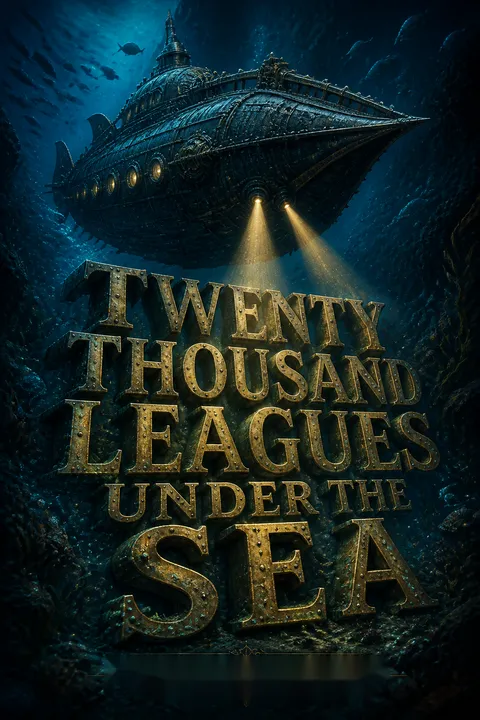


Plot Summary
A Monster Takes the Seas
In 1866, ships begin reporting a vast, fast-moving presence that shines at night. After it damages vessels, including the iron-hulled Scotia, the public demands that it be hunted. Pierre Aronnax, a French naturalist whose expertise has made him a public authority on the mystery, argues that a gigantic narwhal may be responsible.
When the United States outfits the frigate Abraham Lincoln to pursue it, the government invites him aboard. Aronnax accepts, though he has only just returned from exhausting fieldwork and longs for home. His unflappable servant Conseil joins him, as does Ned Land, a celebrated Canadian harpooner who doubts any animal could pierce a ship's iron plates.
The opening turns uncertainty into public danger: a mystery becomes a target as soon as commerce and human safety seem threatened. Aronnax's scientific authority is both a credential and a trap. He is drawn toward the expedition because the unexplained object offers a chance to test the limits of his knowledge, while Ned Land resists the easy conversion of rumor into fact. Their contrasting habits establish the book's central tension between classification and experience. Conseil's steady loyalty anchors the party, but his calm also lets Aronnax pursue his ambition without considering how little control any of them will have once the chase begins.
The Narwhal Is Iron
After months of fruitless searching, Ned spots a luminous shape beside the Abraham Lincoln. The frigate pursues it through a day-long chase, but neither its engines nor its guns can catch or wound the object. That night, Ned throws his harpoon and the creature answers with a violent collision, breaking the ship's steering gear and hurling Aronnax and Conseil into the sea.
Conseil keeps Aronnax afloat until Ned finds them on the creature's smooth metallic back. Their supposed monster is a submarine vessel. Its crew hauls all three aboard, leaving the damaged frigate behind and cutting them off from the world that sent them to destroy it.
The reveal replaces a natural-history puzzle with a human one. Aronnax's classification was not wholly foolish, since the vessel was engineered to resemble a sea creature, but his confidence has helped bring armed force against an unknown person. The chase also shifts the cost of curiosity from professional risk to bodily peril: a failed attempt to capture the object leaves the three men stranded and dependent on it. Ned's harpoon, meant to resolve the mystery, instead establishes the conflict that will shape their captivity. Their survival now depends on the very machine they tried to attack.
Captain Nemo's Terms
The submarine's commander introduces himself as Captain Nemo and identifies the vessel as the Nautilus. He speaks their languages, feeds the captives from the sea, and shows Aronnax a library, art collection, and instruments powered by electricity. The Nautilus can dive, steer, and illuminate the deep, while its crew lives beyond ordinary society.
Nemo allows his guests to move about the vessel, but makes clear that they cannot return to land because their knowledge threatens his secrecy. Aronnax accepts the condition uneasily, drawn by the chance to study an unknown world. Ned refuses to accept captivity as hospitality, while Conseil follows his master and watches the new world with composure.
Nemo's welcome makes captivity difficult to name. He supplies food, comfort, and intellectual riches, then uses the same control that makes those gifts possible to deny his guests a future outside the Nautilus. Aronnax's willingness to stay is not simple consent: scientific wonder seduces him into postponing the question of freedom. Ned sees the coercion clearly, but lacks power to change it. Their different responses create a moral split between knowledge as opportunity and liberty as a non-negotiable need. Nemo, meanwhile, presents self-sufficiency as emancipation, though his insistence on secrecy reveals how much his freedom depends on controlling other people.
The Sea Becomes a Window
Once the Nautilus opens its illuminated viewing panels, the captives watch fish stream through the water beside them, and Ned's anger briefly gives way to amazement. Nemo then invites Aronnax, Conseil, and a crewman on a walk along the seabed near Crespo Island. Diving suits and stored air let them cross coral gardens into a forest of upright sea plants.
The expedition reveals both the beauty and danger of Nemo's domain: a giant sea spider attacks Aronnax, and sharks pass close enough to force the party to hide. Nemo guides them safely back. The experience gives Aronnax a living laboratory, but it also makes Nemo's private world feel more compelling than the land he cannot reach.
The windows and diving equipment turn observation into participation. Aronnax no longer studies specimens brought to a museum; he enters the habitat and discovers how little his categories prepare him for it. The forest's unfamiliar order unsettles the boundary between plant and animal, while the shark encounter punctures any fantasy that beauty makes the deep benign. For Ned, the spectacle briefly interrupts homesickness, demonstrating how wonder can soothe confinement without ending it. Nemo controls the route, equipment, and return, so even the most liberating excursion depends on his permission. The sea opens outward, but the Nautilus remains the gatekeeper.
Vanikoro's Silent Wrecks
As the Nautilus crosses the Pacific, Aronnax studies a sunken ship and later hears the history of La Perouse's lost expedition. At Vanikoro, Nemo guides him to wreckage and produces documents recovered from the seabed, explaining that La Perouse's ships struck the reefs and that survivors eventually perished elsewhere.
The voyage then enters the treacherous Torres Strait, where the Nautilus runs aground on a coral reef. Nemo expects the tide to lift it, and, to Ned's delight, permits Aronnax and his companions to gather food ashore. Their hunting and foraging turn briefly restorative until Papuans surround them. The three escape to the Nautilus, where Nemo's electrified rail shocks the attackers and protects the vessel.
The wrecks at Vanikoro make the ocean an archive that holds what human institutions failed to preserve. Nemo's recovered evidence gives Aronnax's science an extraordinary reach, but it also exposes Nemo's power to decide which histories become visible. The grounding then reverses the usual direction of adventure: the supposedly invulnerable Nautilus is immobilized, and the captives touch land again. Their food-gathering offers a taste of ordinary bodily freedom, but the Papuans' approach renews danger. Nemo's electrical defense saves the vessel without a direct killing, displaying technical mastery as both protection and intimidation. The shore is neither uncomplicated refuge nor simple threat.
A Grave Beneath Coral
After the Nautilus leaves Torres Strait, Nemo suddenly confines Aronnax, Conseil, and Ned, then drugs them into sleep. When Aronnax wakes, Nemo asks him to treat a badly injured sailor. The wound is fatal, and the Captain remains beside the dying man, unable to hide his grief. He later leads the captives in diving suits to a coral forest where the crew buries their companion beneath a cross.
Nemo explains that this underwater cemetery holds his people beyond the reach of sharks and humanity. Aronnax begins to suspect that Nemo's retreat is more than a love of science or solitude. The burial reveals a private community bound by loyalty, loss, and a profound distrust of the surface world.
The confinement signals that Nemo's hospitality has limits Aronnax cannot negotiate, and the unexplained injury intensifies suspicion without resolving it. Yet the funeral complicates any easy portrait of the Captain as merely cold or tyrannical. His grief is visible, and the crew's shared ritual gives the Nautilus a social life rather than the feel of a solitary machine. The coral grave turns the sea into sanctuary, but the insistence that the dead be hidden from people carries an unmistakable bitterness. Aronnax's curiosity now encounters a human cost: the life he studies is organized around losses he has not been allowed to understand.
The Pearl Diver's Rescue
In the Indian Ocean, Nemo invites the three captives to explore Ceylon's pearl banks. Beneath the water, Aronnax watches an Indian diver gather oysters alone. A huge shark attacks, and Nemo charges it with a dagger, but the creature knocks him down. Ned kills the shark with his harpoon, giving Nemo time to free the diver and revive him.
The Captain places a bag of pearls in the man's hand before returning to the Nautilus. Soon afterward, Nemo guides the vessel through a hidden passage beneath the Isthmus of Suez, carrying them from the Red Sea into the Mediterranean. His rescue and generosity reveal that his rejection of society has not erased his concern for the oppressed.
Nemo's action contradicts his language of separation. He risks himself for a stranger whose vulnerability resembles the suffering he says the surface world ignores, and he gives away wealth instead of hoarding it. Ned's harpoon saves the man who keeps him captive, creating an uneasy debt between them without dissolving their conflict. The episode also makes Nemo's ethics concrete: he does not simply condemn injustice, he intervenes when he can. The secret passage reinforces the Nautilus's power to cross borders unseen, but the diver's rescue gives that power a moral purpose. Aronnax sees evidence that Nemo's heart remains engaged with humanity even as he refuses its laws.
Gold Beneath Vigo Bay
As the Nautilus passes through the Mediterranean, Aronnax learns that Nemo sends gold to people resisting oppression. Near Crete, the Captain loads a chest of gold into the small boat and sends it toward shore. Later, in Vigo Bay, he explains the wreck of a Spanish treasure fleet and shows Aronnax his crew recovering its lost bullion.
The money, Nemo insists, is not for private luxury but for people in need. That night, Ned, Conseil, and Aronnax plan to escape while the Nautilus is near Europe. Nemo's unexpected stop to collect treasure defeats their timing. Aronnax understands the source of Nemo's wealth, but the failed opportunity sharpens Ned's conviction that they must seize the next chance.
The gold changes the meaning of Nemo's wealth. He possesses immense resources, yet the story shows them moving outward to support the powerless rather than accumulating as status. Aronnax can recognize the generosity without endorsing Nemo's methods or accepting lifelong captivity. The attempted escape exposes the difference between moral admiration and personal consent: Nemo may aid strangers, but his captives still have no chosen future. The interruption at Vigo is especially consequential because Nemo's secret mission closes the brief opening Ned has been watching for. His benevolence does not make him less dangerous to those he controls.
Atlantis and the Hidden Mine
With the escape attempt thwarted, the Nautilus turns away from Europe. Nemo takes Aronnax on a night walk across a volcanic seabed, where a living underwater eruption illuminates the ruins of Atlantis. Aronnax recognizes a city swallowed by catastrophe, while Nemo stands among its remains in silent contemplation. The next day, the vessel enters a submerged volcanic cavern that serves as a hidden harbor.
Nemo reveals that his crew mines coal there to make sodium, which powers the Nautilus's electrical systems. The refuge makes the ship self-sustaining and difficult to find. For Aronnax, Atlantis enlarges the sea's historical depth; for Nemo, the cave is a practical shield that keeps his chosen life independent of land.
Atlantis turns geological time into a visible loss: civilization becomes ruin while the ocean preserves its outline. Nemo's silence suggests a personal identification with a vanished world, though the narrative does not explain it. The volcanic harbor then grounds the romance of the deep in labor and infrastructure. The Nautilus is not magically independent; its freedom rests on mining, stored resources, and the crew's work. That tension matters because Nemo's escape from terrestrial power reproduces a small, tightly governed society of its own. Aronnax gains knowledge of both the past and the machine, while the means of escape from the surface become more complete.
The Whales' Red Sea
Farther south, Ned sees a herd of whales and asks Nemo to let him hunt. Nemo refuses to kill them for sport, condemning the commercial slaughter that has driven whales from their usual waters. When a pack of aggressive cachalots attacks the herd, however, Nemo turns the Nautilus into a weapon and rams the predators until they are dead.
Ned calls the result butchery, exposing the Captain's selective mercy. The vessel continues into Antarctic waters, where ice closes around it. Nemo insists on pushing onward, and the Nautilus dives beneath the frozen barrier in search of open water. Aronnax, once eager for every new sight, now watches the expedition's ambition begin to threaten everyone aboard.
The whale episode makes Nemo's ethics unstable in a revealing way. He protects animals from commercial exploitation, yet grants himself the authority to decide which species deserve destruction and carries out that judgment on a massive scale. Ned's protest is not merely professional frustration; he recognizes that Nemo's condemnation of violence does not prevent him from exercising it. Their disagreement foreshadows the sharper moral conflict to come. The Antarctic journey compounds this tension: Nemo's technical confidence turns a dangerous environment into a challenge he can master, but his companions bear the risk without having chosen the destination.
The South Pole Claimed
After passing under the Antarctic ice, the Nautilus finds open water and land beyond the frozen barrier. Nemo leads a small party ashore, climbs a volcanic rise, and uses the sun's position to confirm their location. He plants a black flag bearing his emblem and claims the South Pole in his own name.
The achievement is a triumph of navigation, but there is little time to celebrate. The season is turning, the sea is freezing around them, and the Nautilus must head back beneath the ice. An iceberg overturns and traps the vessel in an enclosed passage. What began as a daring exploration now threatens to become a sealed tomb.
Nemo's claim to the pole is a gesture of sovereignty made in a place supposedly beyond nations. By claiming it for himself, he rejects the political world while repeating its language of possession. The act is both audacious and revealing: he wants freedom from human authority, yet still marks territory as his own. The immediate entrapment strips the ceremony of its illusion of mastery. Nature does not recognize Nemo's flag or engineering, and the expedition's achievement becomes a survival problem shared by captives and crew alike.
Air Runs Out
The overturned iceberg seals the Nautilus inside an icy tunnel, and each failed attempt to find an exit reduces the crew's air supply. Nemo orders his men to cut through the ice while Aronnax, Conseil, and Ned join them. The work is exhausting, and freezing water begins to close the trench as fast as they dig.
When the reserves nearly run out, Nemo directs boiling water through the pumps to slow the freeze, then uses the Nautilus's weight to crack the final layer. Conseil and Ned give Aronnax the last breathable air rather than keep it for themselves. The vessel bursts through the ice and rises into open air, with the three friends barely alive.
The crisis makes dependence brutally measurable: air, labor, and time become finite quantities, stripping away the comfort of abstract debate. Nemo's command keeps the crew organized, but it cannot spare anyone the physical cost of escape. The most intimate act belongs to Conseil and Ned, who give Aronnax their remaining air. Their loyalty is enacted through bodily risk, not sentiment. The rescue also reverses Aronnax's earlier priorities. Scientific observation has mattered deeply to him, but survival now depends on relationships that cannot be recorded as discoveries.
The Cuttlefish Takes a Sailor
After the Nautilus rounds South America, an enormous cuttlefish catches its propeller and stops the vessel. Nemo leads the crew onto the platform with axes, while Ned takes his harpoon and Aronnax joins the fight. The creatures pull one sailor away despite the crew's efforts. When a tentacle traps Ned, Nemo cuts him free, and Ned drives his weapon into the animal.
The surviving cuttlefish retreat, but Nemo is left mourning another lost companion. In the aftermath he withdraws from Aronnax, and the Nautilus drifts without its former regularity. The attack has turned the crew's hidden solidarity into fresh grief and deepened the distance between Nemo and his unwilling guests.
The fight briefly aligns Nemo, Ned, and Aronnax against a threat no one can control, but shared danger does not heal their deeper division. Ned repays Nemo's rescue at Ceylon by helping save the Captain, making mutual dependence visible across their antagonism. The sailor's death, however, cannot be balanced by courage or skill. Nemo's grief interrupts the exploratory rhythm and exposes the emotional cost of the community he has built. The sea is not just a setting for marvels; it takes members of the Nautilus with a violence that the Captain's engineering cannot prevent.
The Avenger's Revenge
In the North Atlantic, Nemo brings Aronnax to the wreck of a French ship that chose to sink rather than surrender during a revolutionary battle. The Captain identifies with its defiance. Soon a warship approaches and fires on the Nautilus, treating it as the monster that has endangered shipping. Nemo refuses Aronnax's plea to spare it and rams the vessel below the waterline.
Aronnax watches the ship sink with its crew aboard. Afterward, he sees Nemo kneel before portraits of a woman and two children. The images expose the private grief beneath the Captain's revenge, but they do not justify the deaths he has caused. Aronnax now knows that escape is also a refusal to witness further violence.
The wreck named Avenger gives Nemo's anger a political and personal history, but his act of retaliation transforms injury into collective punishment. The warship's attack makes his fear of human power intelligible; it does not make the slaughter morally proportionate. Aronnax's position changes from fascinated observer to unwilling witness who recognizes complicity in remaining aboard. The portraits introduce grief without supplying a complete biography, preserving the gap between explanation and exoneration. Nemo's emotional suffering is real, yet the narrative insists that pain does not erase responsibility for the lives taken.
The Maelstrom Opens
With Nemo withdrawn and the Nautilus racing through northern waters, Ned sees a chance to escape near Norway. Aronnax and Conseil join him, and the three prepare the small boat in secret. As they try to detach it, the crew raises an alarm about the Maelstrom. The Nautilus is already circling into the whirlpool, and its pull tears the boat from its fittings before Ned can finish.
The violent plunge knocks Aronnax unconscious. He wakes in a fisherman's hut on the Lofoten Islands, with Ned and Conseil safe beside him. The Nautilus and Nemo are gone. Aronnax records the voyage, unsure whether the Captain survived or whether vengeance has ended.
The ending grants the captives freedom through the same uncontrollable force that repeatedly humbled Nemo's engineering. Their escape is neither a clean victory nor a chosen landing: the whirlpool tears them loose and leaves the Captain's fate unresolved. Aronnax survives with knowledge, but the record cannot close the moral or personal questions the voyage has opened. His final act of writing turns experience into testimony, preserving wonders while refusing to pretend that observation equals understanding. The book ends with an unfinished human story, not a solved scientific mystery.
Analysis
The novel's central conflict is not simply between land and sea, or science and mystery. It is between kinds of freedom. Nemo escapes governments, commerce, and social authority by building a self-sufficient world beneath the waves. Yet he protects that freedom by denying his passengers the ability to leave. His independence is therefore real but ethically compromised: he opposes coercive power while exercising coercion himself.
Aronnax embodies the seduction of knowledge. The Nautilus gives him access to environments no scholar has entered, and each discovery makes captivity easier to rationalize. Ned Land supplies the necessary counterargument. He does not deny the wonders; he insists that wonder cannot substitute for choice. Conseil's devotion offers a third model, showing how care can remain active even when individual freedom is restricted. The three responses prevent the voyage from collapsing into a simple celebration of exploration.
The sea also functions as an archive, a resource, and a moral test. It preserves the wrecks of La Perouse and the Avenger, supplies Nemo with wealth and power, and offers shelter to people excluded from the surface world's systems. But nature is not a refuge that can be mastered without consequence. Ice, sharks, cephalopods, and the Maelstrom repeatedly expose the limits of engineering and human control. Nemo can navigate immense depths, yet cannot command grief or guarantee survival.
The book's most troubling question is whether suffering grants the injured person authority to punish others. Nemo's charitable acts show that his anger has not erased compassion, while the destruction of the warship shows how vengeance can turn private loss into public death. Aronnax's eventual escape does not solve Nemo's history or settle his fate. Instead, it leaves the reader with an unresolved measure of responsibility: understanding a person's wounds may explain their violence, but it does not make the victims disappear.
Review Summary
Twenty Thousand Leagues Under the Sea receives mixed reviews, with some praising its innovative science fiction and adventure elements, while others find it tedious due to extensive marine biology descriptions. Readers appreciate Verne's imaginative underwater world and the enigmatic Captain Nemo character. Many note the book's scientific accuracy for its time and its influence on future technology. Some struggle with the pacing and detail-heavy narrative, while others find it captivating. Overall, it's considered a classic that has stood the test of time, despite occasional criticisms of its verbose style.
People Also Read








Characters
Pierre Aronnax
The captive naturalistAronnax is a French naturalist and professor whose expertise in marine life earns him a place on the expedition against the supposed sea monster. Curiosity is his strongest impulse: it leads him to accept danger and later makes the Nautilus's discoveries hard to abandon. He approaches the sea as both a scientist and an aesthete, eager to classify what he sees but susceptible to the beauty and intellectual riches that complicate his captivity. His judgments are thoughtful but not always decisive, especially when Ned presses him to value liberty over study. As narrator, he records wonders with care while struggling to interpret Nemo's motives and the ethical costs of witnessing them.
Captain Nemo
The exiled submarine commanderNemo commands the Nautilus, a submarine of his own design, and has withdrawn from the society whose laws and powers he rejects. He is an engineer, navigator, collector, and scholar, able to turn the ocean into both home and source of supply. His self-command makes him formidable, but grief and anger sometimes break through his reserve. He values independence and protects his crew, while insisting on secrecy so completely that those aboard cannot freely leave. His actions toward animals and vulnerable people suggest a strong sense of justice, though his private moral code can also permit extreme force. To Aronnax, Nemo is at once host, captor, teacher, and enigma.
Ned Land
The restless harpoonerNed Land is a Canadian harpooner whose skill and nerve make him invaluable on the Abraham Lincoln. He distrusts explanations that outpace evidence and recognizes the danger of the Nautilus before Aronnax can admit it. Direct, physical, and often irritable, Ned measures life through action, food, work, and the freedom to choose where he goes. The submarine's luxuries cannot satisfy him because they do not restore his autonomy. His loyalty to Aronnax and Conseil is practical and fierce, expressed through rescue, protection, and shared plans. Ned's resistance gives the story its clearest counterweight to Aronnax's fascination with the deep.
Conseil
Aronnax's steadfast servantConseil has served Aronnax for years and follows him into the expedition without hesitation. His calm manner and habit of classifying animals provide both humor and useful knowledge, but his loyalty is more than a servant's duty. He stays beside Aronnax through danger, treats Ned as a friend, and helps keep the group functioning when panic threatens to take over. Conseil rarely demands attention for himself; his steadiness lets others act, and his willingness to share risk reveals a quietly profound devotion. Where Aronnax is drawn toward explanation and Ned toward escape, Conseil's first instinct is to remain faithful to the people beside him.
Commander Farragut
The monster-hunting captainFarragut commands the Abraham Lincoln during its pursuit of the supposed sea monster. He is a decisive naval officer who believes the threat is real and commits his ship and crew to destroying it. His determination establishes the expedition's confidence in force, even as Ned's skepticism hints that the accepted explanation may be wrong. Farragut gives Aronnax a passage into the adventure and represents the organized authority Nemo has chosen to defy.
J. B. Hobson
The expedition's sponsorHobson, the United States Secretary of the Navy, invites Aronnax to join the Abraham Lincoln's hunt. His letter turns Aronnax's professional interest into action and ensures that France has a scientific representative on the expedition.
Plot Devices
The Nautilus
A home and a prisonNemo's electrically powered submarine is the central setting and the means by which the story can cross oceans, descend into the deep, and reach places ordinary ships cannot. Its steel hull, viewing panels, air reservoirs, diving equipment, and small boat enable exploration and survival. The Nautilus also supplies food and energy from the sea, supporting Nemo's independence from land. Yet the same vessel confines Aronnax, Conseil, and Ned, since Nemo will not let them return to society. Its beauty and ingenuity make captivity unusually seductive, while its power lets Nemo decide when the captives can see, move, or escape.
The Monster Reports
A false shape for truthReports of a luminous, fast-moving creature and damaged ships provide the inciting mystery. The public's competing explanations, from an enormous narwhal to a submarine weapon, turn uncertainty into a reason for pursuit. The vessel's smooth body, speed, and electric light make the Nautilus appear animal-like, so scientific observation alone cannot solve the puzzle until Ned lands on its metal hull. The reports also establish the consequences of misrecognition: an attempt to destroy a supposed monster brings the captives aboard the very machine they sought to stop.
Electricity and Sodium
Power without the surfaceNemo uses electricity to light, heat, and propel the Nautilus, as well as to power defensive systems. He extracts sodium from seawater and secures coal from a submerged volcanic mine, allowing the vessel to avoid dependence on ordinary ports and fuel supplies. Electric illumination also makes the ocean visible through the saloon windows and during night excursions. The device links Nemo's scientific mastery to his political separation from land: it gives him mobility and shelter, but also reinforces the control he holds over everyone aboard.
Diving Apparatus
A body made for depthThe breathing reservoirs, metal helmets, pressure-resistant suits, and electric lamps allow Aronnax, Conseil, and Nemo's crew to walk along the seabed. The apparatus turns underwater environments into places the characters can enter rather than merely observe. It enables the Crespo forest expedition, the visit to Ceylon's pearl banks, and the burial in the coral cemetery. Its air supply also makes time a constant constraint, especially in the ice crisis. The equipment offers freedom of movement, but only within the limits of its stored air and Nemo's permission.
The Nautilus's Small Boat
A narrow path to shoreStored in a sealed recess in the Nautilus, the small boat can be released and retrieved through a system of hatches and bolts. It lets the captives land at Torres Strait and gives Ned a possible means of escape when the submarine nears shore. The boat makes freedom seem mechanically simple, but access depends on secrecy, timing, and conditions at sea. Its role at the ending is transformed by the Maelstrom, which tears it from the Nautilus before the planned escape can unfold.
FAQ
Synopsis & Basic Details
What is Twenty Thousand Leagues Under the Sea about?
- Submarine voyage of discovery: The story follows Professor Aronnax, Conseil, and Ned Land as they embark on an extraordinary journey aboard the Nautilus, a submarine commanded by the enigmatic Captain Nemo.
- Exploration of the ocean depths: The narrative details their exploration of the ocean's wonders, from coral reefs and underwater forests to the deepest trenches, showcasing the diverse marine life and geological formations.
- Encounter with a mysterious captain: The story delves into the complex character of Captain Nemo, a brilliant but tormented man who has rejected human society and seeks refuge in the depths of the sea.
Why should I read Twenty Thousand Leagues Under the Sea?
- Pioneering science fiction: It's a foundational work of science fiction, showcasing Verne's visionary imagination and his ability to blend scientific concepts with thrilling adventure.
- Exploration of complex themes: The novel explores themes of freedom, isolation, revenge, and the relationship between humanity and nature, prompting readers to reflect on these timeless issues.
- Captivating adventure: The narrative is filled with thrilling encounters, from battles with sea monsters to explorations of hidden underwater worlds, making it a captivating read for all ages.
What is the background of Twenty Thousand Leagues Under the Sea?
- Technological optimism: The novel reflects the 19th-century fascination with technological advancements and the belief in the power of science to conquer nature, as seen in the advanced design of the Nautilus.
- Exploration and discovery: It draws inspiration from the era of exploration and discovery, particularly the fascination with the uncharted depths of the ocean and the mysteries they held.
- Social commentary: The story subtly critiques the social and political issues of the time, such as colonialism, oppression, and the destructive nature of war, through the character of Captain Nemo and his motivations.
What are the most memorable quotes in Twenty Thousand Leagues Under the Sea?
- "The sea is everything. It covers seven tenths of the terrestrial globe. Its breath is pure and healthy. It is an immense desert, where man is never lonely, for he feels life stirring on all sides.": This quote encapsulates Captain Nemo's deep love for the ocean and his belief in its power and purity.
- "I am not what you call a civilised man! I have done with society entirely, for reasons which I alone have the right of appreciating.": This quote reveals Captain Nemo's rejection of human society and his desire for independence, highlighting his complex and enigmatic nature.
- "The sea is the vast reservoir of Nature. The globe began with sea, so to speak; and who knows if it will not end with it?": This quote emphasizes the importance of the ocean as a source of life and a symbol of the natural world's enduring power.
What writing style, narrative choices, and literary techniques does Jules Verne use?
- Detailed scientific descriptions: Verne incorporates extensive scientific details and technical explanations, immersing the reader in the world of the Nautilus and the wonders of the ocean.
- First-person narration: The story is told from the perspective of Professor Aronnax, allowing readers to experience the events through his eyes and to share his sense of wonder and curiosity.
- Blend of adventure and social commentary: Verne seamlessly blends thrilling adventure with subtle social commentary, prompting readers to reflect on the ethical implications of scientific progress and the human condition.
Hidden Details & Subtle Connections
What are some minor details that add significant meaning?
- The motto "Mobilis in Mobili": This phrase, found on the Nautilus's tableware, translates to "Moving in a moving thing," reflecting the submarine's unique nature and Captain Nemo's desire for freedom and independence.
- Captain Nemo's library: The vast collection of books, excluding political economy, reveals his intellectual pursuits and his rejection of worldly affairs, highlighting his complex character.
- The organ music: The melancholic music played by Captain Nemo, often at night, hints at his inner turmoil and the tragic past that haunts him, adding a layer of emotional depth to his character.
What are some subtle foreshadowing and callbacks?
- The initial sea monster reports: The early descriptions of the "sea monster" foreshadow the true nature of the Nautilus and the technological marvel it represents, creating a sense of mystery and anticipation.
- The mention of the "Avenger": The name of the sunken ship, revealed later in the story, foreshadows Captain Nemo's desire for revenge and his connection to the past, adding a layer of complexity to his character.
- The recurring motif of the sea as a refuge: The sea is presented as both a source of wonder and a place of escape, foreshadowing Captain Nemo's ultimate desire to find solace and independence in its depths.
What are some unexpected character connections?
- Captain Nemo's knowledge of Aronnax's work: Nemo's familiarity with Aronnax's book on submarine depths reveals a shared intellectual curiosity and a connection that transcends their different backgrounds.
- Ned Land's unexpected skill with a pickaxe: The Canadian's proficiency in mining, revealed during their attempt to escape the iceberg, highlights his adaptability and resourcefulness beyond his role as a harpooner.
- Conseil's surprising bravery: Conseil's willingness to face danger alongside Aronnax, despite his quiet nature, demonstrates his unwavering loyalty and courage, revealing a depth of character beyond his role as a servant.
Who are the most significant supporting characters?
- Conseil: As Aronnax's loyal servant, Conseil provides a calm and rational perspective, often balancing the more impulsive actions of Ned Land and the intellectual curiosity of Aronnax.
- Ned Land: The Canadian harpooner's desire for freedom and his practical skills drive much of the plot, creating tension and conflict while also highlighting the limitations of life aboard the Nautilus.
- The crew of the Nautilus: Though mostly silent and mysterious, the crew's unwavering loyalty to Captain Nemo and their skill in operating the submarine contribute to the overall sense of wonder and danger.
Psychological, Emotional, & Relational Analysis
What are some unspoken motivations of the characters?
- Captain Nemo's desire for revenge: While he claims to have renounced society, his actions reveal a deep-seated desire for vengeance against those who wronged him, driving his attacks on ships and his isolation from the world.
- Professor Aronnax's thirst for knowledge: Beyond his scientific curiosity, Aronnax is driven by a desire to understand the mysteries of the ocean and the enigmatic Captain Nemo, often putting himself in danger to satisfy his intellectual pursuits.
- Ned Land's longing for freedom: The Canadian's constant desire to escape the Nautilus stems from a deep-seated need for independence and a longing for his former life, highlighting the psychological toll of imprisonment.
What psychological complexities do the characters exhibit?
- Captain Nemo's internal conflict: He is torn between his desire for isolation and his lingering connection to humanity, as seen in his moments of compassion and his grief over the loss of his crew.
- Professor Aronnax's moral dilemma: He struggles with his fascination for the Nautilus and its wonders, while also grappling with the ethical implications of Captain Nemo's actions and his own complicity in them.
- Ned Land's frustration and anger: His inability to escape the Nautilus and his longing for freedom lead to increasing frustration and anger, highlighting the psychological impact of prolonged confinement.
What are the major emotional turning points?
- The coral cemetery scene: This poignant moment reveals Captain Nemo's deep connection to his crew and his capacity for grief, challenging the perception of him as a cold and detached figure.
- The battle with the poulps: The loss of a crew member during this violent encounter highlights the dangers of their underwater world and the emotional toll of their isolation, creating a sense of shared vulnerability.
- The sinking of the warship: This act of vengeance reveals the depths of Captain Nemo's hatred and the moral complexities of his character, leaving Aronnax and his companions in shock and questioning their own complicity.
How do relationship dynamics evolve?
- Aronnax and Nemo's complex bond: Their relationship evolves from one of captor and captive to a more nuanced connection based on shared intellectual curiosity and a mutual respect for the ocean, though it is ultimately strained by Nemo's actions.
- The trio's camaraderie: Aronnax, Conseil, and Ned Land form a strong bond based on their shared experiences and their desire for survival, highlighting the importance of friendship in the face of adversity.
- Nemo's isolation: Despite his interactions with Aronnax, Nemo remains emotionally isolated, unable to fully connect with others due to his past traumas and his desire for independence.
Interpretation & Debate
Which parts of the story remain ambiguous or open-ended?
- Captain Nemo's true identity and past: The novel never fully reveals Captain Nemo's origins or the specific events that led to his hatred of humanity, leaving his character shrouded in mystery.
- The fate of the Nautilus and its crew: The ending leaves the fate of the Nautilus and its crew uncertain, allowing readers to speculate on their ultimate destiny and the consequences of their actions.
- The moral implications of Nemo's actions: The novel raises questions about the justification of revenge and the ethical boundaries of scientific exploration, leaving readers to grapple with the moral complexities of Nemo's character.
What are some debatable, controversial scenes or moments in Twenty Thousand Leagues Under the Sea?
- Captain Nemo's acts of vengeance: His sinking of the warship raises questions about the morality of his actions and whether his personal vendetta justifies the loss of innocent lives.
- The crew's unquestioning loyalty: The crew's unwavering obedience to Captain Nemo, even in the face of danger, raises questions about the nature of authority and the potential for blind allegiance.
- The portrayal of colonialism and oppression: The novel's depiction of oppressed races and the critique of colonial powers can be interpreted in different ways, sparking debate about Verne's own views on these issues.
Twenty Thousand Leagues Under the Sea Ending Explained: How It Ends & What It Means
- The Maelstrom's chaos: The story concludes with the Nautilus caught in the maelstrom, a powerful whirlpool that symbolizes the chaotic and unpredictable nature of the ocean and the forces that ultimately overwhelm human control.
- Escape and uncertainty: Aronnax, Conseil, and Ned Land escape the Nautilus in a small boat, but their fate remains uncertain, leaving readers to ponder the consequences of their journey and the possibility of their survival.
- Nemo's ambiguous fate: The ending leaves Captain Nemo's fate unresolved, suggesting that his quest for vengeance and his desire for isolation may have ultimately led to his destruction, or perhaps to a continued existence in the depths of the sea.
About the Author




Download PDF
Download EPUB
.epub digital book format is ideal for reading ebooks on phones, tablets, and e-readers.








