

Plot Summary
Prologue
The second part opens by correcting the first part’s mistaken report: the telescope observers did not actually see the travelers become a satellite of the moon. The projectile has not reached its destination, and the travelers’ fate remains unknown.
This short recap shifts the story from public speculation to the journey itself, following Barbicane, Nicholl, and Ardan through the voyage that the first book’s final announcement could only guess at.
The recap establishes a useful divide between what people want to believe and what observation can support. Maston’s confidence and the public’s appetite for a triumphant report have outrun the evidence, so the new narrative begins by restoring uncertainty. The correction does not diminish the expedition. It makes its actual hazards more compelling: the travelers are not safely established in lunar orbit, and the mechanics that carried them away may yet determine where they end up. Scientific caution becomes part of the suspense rather than a brake on it.
Peace Silences the Gun Club
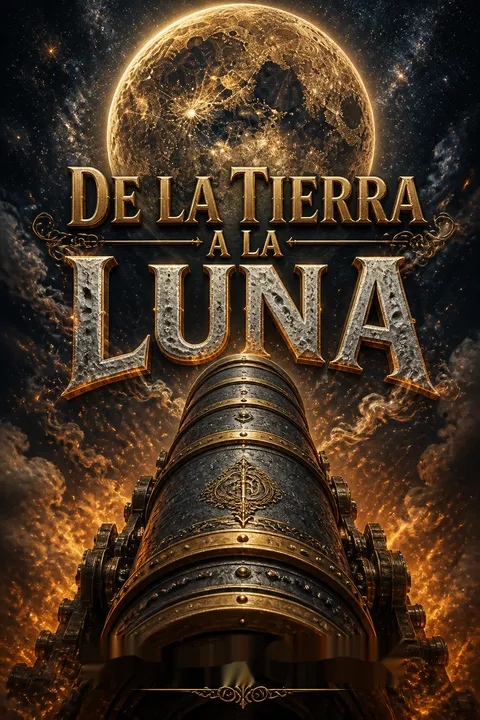
After the Civil War ends, Baltimore’s Gun Club loses the battlefield that gave its artillery inventors purpose. Its members, many scarred or disabled by the fighting, return to calculations with no practical use for them. President Impey Barbicane proposes a project large enough to restore their shared ambition: build a cannon capable of sending a projectile to the moon.
He presents the plan not as a fantasy but as the next application of ballistics. The club erupts in approval, and the idea quickly captures the country. What begins as a remedy for military idleness becomes a national undertaking, with the moon recast as a reachable destination.
The project begins in a culture that has made weapons its most celebrated form of ingenuity. Peace does not erase the Gun Club’s habits; it leaves their technical energies without a socially acceptable target. Barbicane’s proposal transfers those habits from warfare to exploration without fully changing their language of conquest. The moon becomes both an object of scientific inquiry and a new frontier to claim. This ambiguity gives the comedy its bite: the men sincerely pursue knowledge, yet imagine communication with another world through the machinery of bombardment.
A Cannon for the Moon
Barbicane consults the Cambridge Observatory before the Gun Club commits to construction. Its director confirms that a projectile can reach the moon if launched with sufficient speed, then identifies the shortest distance, firing angle, and date needed to meet the moon at its zenith. The answer gives the club a narrow window and a precise objective.
Barbicane’s committee then works backward from the desired journey: an aluminium shell light enough to accelerate, a vast fixed Columbiad, and a charge of compressed gun-cotton. A telescope will be needed to follow the projectile after launch. Mathematical specifications now govern the venture, turning patriotic excitement into deadlines, measurements, and an immense engineering bill.
The observatory’s letter performs a crucial conversion: it changes a collective wish into a problem with constraints. The men can no longer rely on enthusiasm alone, because the moon’s position, the launch site, and the projectile’s mass must agree. Yet the calculations also give the enterprise an air of inevitability. Once the target date is chosen, every obstacle appears to be a technical inconvenience rather than a reason to stop. Verne makes scientific method both a source of discipline and a source of comic overconfidence.
Nicholl Bets Against Barbicane
Captain Nicholl, a Philadelphia inventor who builds armor plate, has spent the war trying to defeat the projectiles Barbicane designed. Their rivalry has outlasted the fighting: Barbicane’s guns and Nicholl’s defenses represent opposing answers to the same contest. Now Nicholl attacks the lunar plan in the newspapers, arguing that the cannon cannot produce the required speed, the shell will fail under pressure, and the experiment could endanger the public.
Barbicane refuses to pause his work or answer each objection. Nicholl turns his challenge into a series of escalating bets against the project’s funding, construction, loading, firing, and range. His personal opposition becomes a public test of the Gun Club’s claims.
Nicholl is more than a skeptic placed against a dreamer. His career has made him the counterforce Barbicane needs to acknowledge: every weapon has a limit, and every claim of mastery invites a test. Their rivalry gives the enterprise an adversarial structure even before the journey has an external danger. At the same time, Nicholl’s arguments are not simply foolish. They concern real failures that the club’s confidence tends to brush aside. His bets make doubt legible in the only currency the Gun Club respects, while revealing how thoroughly its members have turned technical disagreement into personal combat.
Florida Wins the Launch
The cannon must stand where the moon can pass overhead, so Barbicane limits the possible sites to southern Florida or Texas. Their towns campaign fiercely for the economic windfall, and J. T. Maston even urges war against Mexico before Barbicane shows him that American territory already meets the requirement.
Barbicane chooses Tampa Town because it avoids a larger contest among Texas’s rival cities. He then opens an international subscription. Donations arrive from across the world, though England refuses to contribute and several nations give cautiously.
The money allows the Gun Club to hire the Goldspring foundry and begin moving people and materials to Florida. Tampa’s selection transforms a remote town into the center of a global spectacle.
The site dispute shows that the project’s consequences are political and economic long before the cannon fires. Texas and Florida do not compete over abstract scientific prestige; each anticipates new population, transport, and commerce. Barbicane’s choice of Tampa is less a judgment of grandeur than a way to prevent one rivalry from multiplying into many. The world subscription similarly broadens ownership of the experiment while preserving its American leadership. The comic nationalism is therefore coupled to a real network of international interest, which makes the later public response feel earned rather than merely inflated.
Stony Hill Opens
Barbicane surveys the land with engineer Murchison and chooses Stony Hill, a dry, elevated site near Tampa. Murchison brings in a large workforce, and a short railway links the harbor to the construction ground.
Crews dig a shaft nine hundred feet deep, lining it with masonry as they descend. Springs break into the excavation, and a partial collapse kills several workers and delays the work, but Murchison stabilizes the shaft and the digging resumes. Around it, twelve hundred furnaces prepare to melt the enormous iron supply.
The casting sends molten metal pouring into the shaft in a single coordinated operation. After the cannon cools, workers remove its inner mould and bore the barrel smooth. The Columbiad stands ready months ahead of schedule.
Stony Hill makes the project’s scale material. The cannon is not simply an enormous machine; its construction reorganizes land, labor, transport, and public attention around one hole in Florida. The deaths and accident briefly expose the human cost hidden beneath the Gun Club’s triumphant statistics. Barbicane’s care for the workforce complicates his otherwise impersonal manner, though the enterprise still treats danger as an acceptable price of progress. The successful casting then converts years of theory into an object too large to ignore, and the crowd’s curiosity becomes another resource that the organizers can manage and monetize.
The Frenchman Volunteers
With the cannon nearing completion, Barbicane receives a telegram from Michel Ardan, an adventurous Frenchman who proposes replacing the simple cannonball with a passenger capsule and traveling inside it. The idea sounds absurd to the Gun Club, but a second telegram confirms that Ardan is sailing for Tampa. When he arrives, crowds swarm the ship, and he quickly turns public attention into a vast outdoor meeting.
Ardan argues that travel beyond Earth is a natural extension of human movement and treats the danger as a reason to go, not a reason to wait. Captain Nicholl challenges him with the moon’s lack of air and the risks of the launch. Their public exchange makes the expedition a question of human survival, not just ballistics.
Ardan disrupts the project by changing what the projectile is for. Barbicane’s shell was a message or instrument; Ardan turns it into a home for living bodies. His confidence is partly ignorance, but it is also a deliberate refusal to let expertise define the borders of possibility. Nicholl’s objections restore the physical costs that the crowd’s enthusiasm would prefer to overlook. Their exchange dramatizes a productive tension between imagination and verification: neither is sufficient alone, but each forces the other to become more concrete.
A Duel Becomes a Crew
The challenger from the meeting is Nicholl, and his attack on Barbicane’s judgment revives their old feud. They arrange a rifle duel in the woods, where J. T. Maston and Ardan rush to stop them. Ardan finds Nicholl carefully freeing a bird caught in a spider’s web; Barbicane, meanwhile, has become absorbed in calculations for reducing the launch shock.
Ardan uses these acts to argue that the rivals are not made for killing each other. He offers a more compelling test: both men should accompany him to the moon. Barbicane and Nicholl accept at nearly the same moment. Their former competition now places all three inside the experiment, and the Gun Club gains a crew.
The reconciliation is not produced by a long confession or a sudden loss of conviction. Ardan notices that the men’s behavior contradicts the roles their rivalry has assigned them: Nicholl protects a small creature, while Barbicane forgets vengeance in mechanical problem-solving. These moments expose capacities for care and curiosity beneath the language of combat. Ardan’s proposal redirects their competition without pretending it never existed. The crew’s unity is therefore practical and provisional, built around a shared risk that demands cooperation.
A Home Inside the Projectile
Ardan’s participation forces the engineers to redesign the projectile as an upright, furnished capsule. Barbicane devises a water cushion and breakable partitions to soften the launch, while the interior receives viewing ports, provisions, lighting, tools, and chemicals for renewing oxygen and absorbing carbon dioxide.
A giant telescope is assembled on Long’s Peak so observers can track the travelers. J. T. Maston tests the air system by sealing himself inside the capsule for a week; when he emerges, the trial has succeeded.
The Gun Club loads the gun-cotton in small batches under strict precautions, then lowers the shell onto the charge. Nicholl pays one of his lost bets. The remaining danger is no longer construction, but the irreversible firing.
The capsule translates abstract survival into routines: store food, control heat, exchange gases, and cushion force. This is a major change from the Gun Club’s earlier weapons, which measured success by destruction rather than by sustaining life. Maston’s test gives the crew evidence that their air system can work, but it cannot reproduce the whole journey’s conditions. The preparations thus produce confidence without eliminating uncertainty. The projectile becomes a tiny engineered society, dependent on discipline and cooperation inside a machine originally conceived as an artillery shell.
Five Million Watch Fire
On the appointed December night, millions gather around Stony Hill while Barbicane, Nicholl, and Ardan enter the capsule. Maston stays behind, grieving that he cannot fit inside. Engineer Murchison triggers the electric charge at the scheduled instant, and the Columbiad hurls the three men skyward. The launch shakes Florida like an earthquake.
The blast knocks spectators down, injures many, derails trains, damages Tampa’s buildings, and drives ships against one another; the shock also causes destruction far beyond the launch site. The crowd quickly turns from pain to searching the sky for the projectile, but the capsule vanishes from view. The world’s first attempt at a human voyage to the moon has begun at a cost visible on Earth.
The launch makes the novel’s central irony physical: a mission announced as scientific progress begins with the destructive force of a weapon. The crowd’s injuries are not incidental spectacle; they expose the gap between the clean arithmetic of the plan and its consequences for bodies and towns. Yet the spectators’ immediate search for the capsule shows how completely the shared dream absorbs them. The moment is both a triumph of collective effort and a warning that technological achievement does not become harmless simply because its destination is peaceful.
Three Men Wake in Space
Inside the dark capsule, the launch has thrown the three travelers together and crushed the water partitions, but the metal shell remains intact. Ardan wakes first, then revives Nicholl and the wounded Barbicane.
Heat against the capsule’s walls convinces Barbicane that they have left the atmosphere; through a viewing port, the men confirm that Earth is no longer beneath them. They spot a small body racing past, later identified as a second earthly satellite, and use it to estimate their position.
Their dogs, Diana and Satellite, have also suffered in the launch. Satellite’s injuries prove fatal, and the travelers eject his body through a briefly opened port to preserve their air. Diana survives, but the loss makes the journey’s cost intimate.
The launch’s first consequence is not wonder but emergency care. Ardan’s readiness to revive the others gives his exuberance a practical dimension, while Barbicane and Nicholl return to measurement as soon as they can stand. Their changing view of Earth makes departure emotionally legible: the world is becoming a distant object even as they remain physically dependent on its technologies. Satellite’s death sharpens the stakes without turning the journey into melodrama. The crew’s survival depends on choices that are both technical and sorrowful, especially when preserving the living requires letting go of the dead.
The Arithmetic Nearly Fails
As the projectile travels, Barbicane and Nicholl revisit the Cambridge calculations. Their own formula suggests that the capsule should have needed a much greater speed to escape Earth’s pull than the observatory predicted.
For a moment, the discrepancy appears fatal: the crew may fall back before reaching the moon. Barbicane measures their distance and discovers that they have already passed the point where the lower speed should have stopped them.
The gun-cotton must have launched them faster than expected, and the ejection of water from the recoil system made the capsule lighter. The travelers are still moving outward. Their relief is tempered by the nearby asteroid’s earlier passage, a possible disturbance whose effect on their course is not yet clear.
This crisis distinguishes confidence from evidence. The travelers do not preserve faith by ignoring a contradiction; they check the numbers against what they can observe. Their survival depends on a discrepancy that the original model failed to predict, while the lighter capsule helps explain the result. Science here is neither infallible nor useless. Its strength lies in revision under pressure. The asteroid adds a quieter uncertainty: a small change in direction may matter across an immense distance, so the crew’s apparent success cannot yet guarantee arrival.
Oxygen Turns the Cabin Wild
As the travelers approach the moon, the air-renewal apparatus begins supplying oxygen too freely because Ardan has left a control open. The excess does not suffocate them; it drives their bodies and minds into dangerous overactivity. Their voices rise, their movements become erratic, and they quarrel over the purpose of the expedition.
Hens hidden among Ardan’s supplies burst into the cabin, adding to the confusion. Nicholl recognizes the cause when a match burns with startling intensity and shuts the oxygen flow down. The crew gradually recovers, then restores order among the animals and equipment. The episode turns life support from a reassuring invention into a system that must be monitored with care.
The accident reverses a familiar danger. The travelers have feared too little air, but too much oxygen becomes hazardous in a different way. That reversal unsettles the assumption that survival is achieved once a machine has been built; the apparatus still requires attention, judgment, and restraint. Ardan’s hidden poultry also reveals how his imaginative generosity can complicate a tightly controlled environment. Nicholl’s diagnosis, based on a small physical clue, demonstrates the value of his practical skepticism. Their survival depends on joining invention to disciplined observation.
Weight Vanishes Between Worlds
Near the point where Earth’s and the moon’s attractions balance, Nicholl lets a tumbler slip and watches it hang in the cabin instead of falling. Barbicane identifies the neutral point, where the two gravitational pulls cancel. The three men and their loose objects become weightless for a short time, and Ardan turns the strange suspension into a brief celebration.
Once the capsule crosses the boundary, lunar attraction begins drawing it onward. The crew expects this pull to deliver them to the surface, but their trajectory has already been altered by the asteroid they passed earlier. They do not yet know that the same physical laws now carrying them toward the moon will fail to bring them down onto it.
Weightlessness makes the abstract geometry of the journey bodily. A tumbler that refuses to fall gives the travelers direct evidence of a boundary that had existed only in calculation. Ardan responds by making the event social, while Barbicane interprets it and Nicholl watches its practical implications. The scene briefly grants the crew a sense of mastery because theory and sensation agree. Its irony lies in what they cannot yet infer: understanding the forces at one point does not give them control over the full trajectory.
The Moon Passes Beneath Them
The travelers draw close enough to examine the moon’s northern regions, where plains, mountains, and huge craters slide beneath the capsule. Through their instruments, Barbicane and Nicholl compare the surface with lunar maps, while Ardan supplies more fanciful interpretations. They find no visible cities, animals, or signs of human work.
The projectile does not fall onto the lunar surface; its course carries it past the moon instead. The crew understands that the asteroid likely shifted their aim by just enough to spoil the planned encounter. Their disappointment is sharp, but they continue taking observations as the capsule follows the moon’s curve. What had been a landing expedition becomes an unprecedented survey from space.
The near miss changes the meaning of the expedition without making it empty. The crew cannot claim the moon as a place they have reached, but they can look at it under conditions unavailable to terrestrial observers. The contrast between Barbicane’s disciplined measurements and Ardan’s imaginative readings keeps observation from becoming emotionally sterile. Their inability to see life is significant, yet they are careful not to confuse absence of visible evidence with complete knowledge. The project’s original language of conquest gives way, however briefly, to the more modest work of witnessing.
A Fireball Reveals the Far Side
The capsule enters the moon’s long shadow, and darkness brings a severe cold that clouds the viewing ports with ice. During the passage, the travelers glimpse an active volcanic glow on the side hidden from Earth. Soon a vast meteor crosses their path and bursts into a shower of incandescent fragments. Its brief light exposes dark bands, apparent seas, and large shadowy areas on the moon’s unseen hemisphere.
The crew cannot determine whether these features are forests, water, or optical effects, but the glimpse overturns the idea that the far side is wholly unknowable. The meteor’s fragments strike the capsule and crack a window, leaving the travelers shaken even as the flash gives them their most extraordinary observation.
The far side becomes visible through violence rather than through a planned instrument. The meteor provides a momentary illumination, but its fragments also damage the travelers’ shelter. Knowledge and danger arrive together, leaving no clean division between discovery and threat. The ambiguous dark forms preserve uncertainty: the travelers have seen more, but not enough to declare what they saw. This is a pointed contrast with the public’s appetite for definitive news. Their most valuable observation is also the least conclusive, and its meaning depends on restraint rather than excitement.
Tycho, Then the Fall
Sunlight returns as the capsule passes the lunar south, bringing the travelers over the great crater Tycho and the bright mountains around it. Barbicane’s observations support his conclusion that the moon was once inhabited but is now lifeless. The capsule curves away rather than landing, and the crew reaches the neutral point on its return journey.
They fire the small rockets intended to alter their course toward the moon, but the remaining momentum carries them beyond the boundary and back toward Earth. Barbicane understands that their fall is now unavoidable. Instead of reaching the destination they chose, the travelers are hurtling toward the planet they left, with no way to steer or arrest the descent.
The failed landing is the consequence of a small deviation compounded by forces the crew cannot command. Their scientific observations are consequential, but they do not grant mastery over the vehicle. The rocket attempt gives them agency at the last possible moment, then makes its limits plain. Barbicane’s acceptance of the fall differs from his earlier certainty: he can reason about the danger without pretending he can control it. The moon has yielded knowledge, not possession, and the travelers must face the return as another form of exposure to the unknown.
The Pacific Gives Them Back
The projectile strikes the Pacific near the soundings of the Susquehanna, a naval vessel commanded by Captain Blomsberry. Its crew sees the impact and sends word ashore, prompting J. T. Maston, Murchison, and Gun Club members to organize a recovery.
Divers search the deep seabed for days without finding the capsule. As the ship prepares to leave, a flag appears above a silver object on the surface: the aluminium projectile has risen because it displaces more water than its weight. Maston reaches it and hears the three travelers alive inside, playing dominoes.
Their return to Baltimore brings a national celebration, and the Gun Club forms a company to pursue interstellar travel. The expedition fails to land on the moon, but its crew comes home with new observations and a new enterprise.
The recovery turns a basic physical property into the difference between burial and survival. The rescuers’ elaborate machinery searches below, while the solution floats in plain sight above them. Maston’s persistence matters, but so does his ability to revise the search when a forgotten principle becomes clear. The return also completes the book’s movement from martial invention to commercial ambition: the Gun Club does not abandon its appetite for enormous projects, it repackages it as a company. The ending celebrates survival while leaving open whether human ingenuity has learned humility or merely found another market.
Analysis
The two-part narrative begins with a culture that cannot imagine peace without first finding a new use for its weapons. The Gun Club’s cannon is a machine of extraordinary scale, but the story’s sharper question is whether the habits built around warfare can be redirected toward knowledge. Barbicane organizes the venture with a builder’s discipline, Nicholl supplies resistance and scrutiny, and Ardan insists that human curiosity must sometimes cross the line from theory into risk. Their partnership works because none of these temperaments is sufficient alone.
Verne makes engineering both comic spectacle and moral problem. The cannon’s construction brings labor, commerce, and international attention to Florida; its launch injures spectators and damages the town. The novel does not let the language of progress conceal the physical force required to achieve it. Nor does it portray calculation as infallible. The Cambridge figures misjudge the launch, the asteroid alters the crew’s course, the oxygen apparatus nearly overwhelms them, and the rescue party searches the seabed for a capsule floating above it. Knowledge advances through error, observation, and revision, not through confidence by itself.
The moon voyage also turns distance into a question of perspective. From Earth, the moon is a familiar object loaded with myth and speculation. From the projectile, it becomes terrain, shadow, and an unresolved field of evidence. The travelers glimpse the far side only when a meteor briefly lights it, a discovery produced by danger and too fleeting to settle the questions it raises. Their failure to land is therefore not simply defeat. It limits their claim to mastery while giving them observations that no terrestrial instrument could provide.
The ending preserves the book’s ambivalence. The crew returns alive, and the Gun Club converts the adventure into a new commercial venture. Human ingenuity has survived its errors, but it has not stopped reaching for grander enterprises. The story celebrates courage and collaborative intelligence while asking whether exploration truly changes the purposes for which power is built.
Review Summary
From the Earth to the Moon is a pioneering science fiction novel that imagines a lunar expedition launched from a giant cannon. While praised for its scientific research and prophetic elements, some readers find the technical details tedious. The novel's satirical portrayal of American gun enthusiasts and its imaginative vision of space travel are highlights. Many reviewers note the remarkable similarities between Verne's fictional mission and the actual Apollo program a century later. Despite mixed opinions on pacing and character development, the book is recognized as an influential work in the genre.
People Also Read

Characters
Impey Barbicane
The lunar project’s engineerBarbicane, president of Baltimore’s Gun Club, is a wealthy, composed former artillery director who treats ambitious ideas as problems to be solved. He brings the moon project from proposal to construction by organizing specialists, securing money, choosing the launch site, and designing the expedition’s practical systems. His restraint contrasts with Ardan’s exuberance and Maston’s emotional intensity, though he shares their faith in large-scale engineering. Barbicane is driven less by spectacle than by the satisfaction of making a difficult plan work. Under pressure, he returns to observation and calculation, even when the result unsettles him. His central tension is between the discipline of measurement and the confidence that a sufficiently well-designed machine can overcome nearly any limit.
Michel Ardan
The apostle of the impossibleArdan is a French adventurer, artist, and irrepressible improviser who volunteers to ride inside the projectile. He treats distance as an invitation and danger as something to be met rather than rehearsed indefinitely. His talk and jokes can make him seem careless, but he repeatedly notices the human dimension of events: he rushes to prevent Barbicane and Nicholl from killing each other, helps revive the crew after launch, and cares for the animals. Ardan distrusts expertise when it becomes a substitute for imagination, yet he depends on the engineers’ knowledge to make his journey possible. His character brings warmth and unpredictability into the capsule, challenging the Americans’ tendency to reduce life to calculation.
Captain Nicholl
The skeptical armor makerNicholl is a Philadelphia inventor whose specialty is armor plate, the defensive counterpart to Barbicane’s artillery. Their rivalry begins in the contest between projectile and protection, and Nicholl’s skepticism follows naturally from a career spent testing what weapons cannot penetrate. He publicly argues that Barbicane’s plan is unsafe, then stakes money on its failure. Beneath his pride is a methodical mind that takes evidence seriously, including evidence that overturns his own predictions. He is not simply an obstacle to the expedition: his practical knowledge, steady judgment, and willingness to accept a shared risk make him essential to it. Nicholl’s self-control also provides a counterweight to Ardan’s volatility.
J. T. Maston
The Gun Club’s fiery secretaryMaston, the Gun Club’s secretary, is an inventive artilleryman with a steel hook and a gutta-percha cranial plate, physical reminders of his own work’s dangers. He responds to Barbicane’s proposal with immediate and almost limitless enthusiasm, helping to publicize the scheme, calculate its dimensions, and sustain the organization’s momentum. His patriotism often outruns practical judgment, as when he presses for war over the launch site. Yet he is also loyal, resourceful, and deeply attached to his friends. Unable to join the crew, he throws himself into testing the air system and later into watching for the capsule. His intensity supplies the story’s comic energy, but his devotion gives its public spectacle a personal heart.
Murchison
The builder of Stony HillMurchison is the engineer who turns Barbicane’s plans into working infrastructure. He recruits workers, manages the railway and deep excavation, and responds when water and a partial collapse threaten the cannon shaft. His competence keeps the project moving through the long interval between announcement and firing. Later, he oversees technical preparations that require precision and speed. Murchison represents the skilled labor and engineering judgment that grand public narratives can obscure: Barbicane may set the goal, but Murchison makes the ground, machines, and schedule answer to it.
J. M. Belfast
The observatory’s directorBelfast directs the Cambridge Observatory, whose calculations establish the launch conditions for Barbicane’s plan. He later joins Maston at Long’s Peak to observe the projectile through the great telescope. His role connects the Gun Club’s practical engineering to professional astronomy, and his caution contrasts with Maston’s insistence that he can see the capsule. Belfast shows how observation depends not only on powerful instruments but also on patience and willingness to admit uncertainty.
Major Elphinstone
The committee’s chemistElphinstone is one of Barbicane’s technical advisers, contributing expertise on powders and the materials needed for the launch. He asks the practical questions that keep the committee’s grand proposals tied to workable quantities and methods. His measured presence helps balance Maston’s impatience and Barbicane’s confidence, making him part of the project’s collaborative engineering core.
General Morgan
The artillery specialistMorgan serves on Barbicane’s committee and brings experience with the performance of large guns. He helps assess the projectile and cannon in relation to the limits of existing artillery. Like the other Gun Club members, he is shaped by a world in which technical achievement has been measured in range and destructive force, but the lunar plan gives that expertise a different, if still militarized, purpose.
Captain Blomsberry
The Pacific rescue commanderCaptain Blomsberry commands the Susquehanna, which is taking ocean soundings when the projectile returns to Earth. He acts quickly on his officers’ report, sends news to the Gun Club, and keeps his vessel available for the search. His role is brief but decisive: the travelers’ return would mean little without a crew prepared to locate and recover them.
Lieutenant Bronsfield
The first eyewitnessBronsfield is an officer aboard the Susquehanna who helps report the projectile’s impact in the Pacific. His observations turn an astonishing sight into actionable news for the Gun Club and the rescue effort.
Diana
The surviving space dogDiana is one of the dogs carried aboard the projectile, where her reactions give the travelers an immediate measure of the cabin’s conditions. She depends on the crew for food and care, and her presence reminds them that the expedition carries living beings beyond its human planners. Her quiet vulnerability contrasts with the men’s appetite for risk.
Satellite
The injured space dogSatellite is the second dog aboard the projectile. The violent launch leaves him badly injured, forcing the travelers to confront the limits of their precautions and their responsibility for the animals they brought along.
Plot Devices
The Columbiad
The moonward engineThe Columbiad is the immense cannon cast vertically into Stony Hill in Florida. Its fixed position, length, and charge are designed to give the projectile the speed required to escape Earth’s attraction and reach the moon. It turns the Gun Club’s expertise in weapons into the central mechanism of exploration, while preserving the military scale and language of its origins. The cannon also anchors the story on Earth: its construction draws workers, money, spectators, and commerce to Tampa, and its launch produces consequences far beyond the project site. It is at once a practical machine, a national monument, and a reminder that peaceful intentions do not erase destructive force.
The Aluminium Projectile
A cabin disguised as a shellArdan’s decision to travel changes the projectile from a simple round shot into a cylindro-conical capsule. Its aluminium shell keeps its mass manageable while providing room for three passengers, supplies, tools, windows, and scientific instruments. A movable floor, water, and breakable partitions are intended to cushion the launch; springs and buffers provide further protection. The cabin’s sealed design makes air renewal, temperature, and the disposal of waste crucial problems rather than background details. During the journey, the capsule is both a vehicle and the travelers’ entire world, restricting their movement even as it carries them through space.
Life-Support Chemistry
Air for the closed cabinThe capsule carries chemicals to replenish oxygen and absorb the carbon dioxide produced by breathing. This system allows the travelers to imagine a journey lasting several days, but its success depends on accurate control and regular attention. A weeklong test by Maston offers reassurance, yet the voyage exposes a different danger when the oxygen flow is left too high. The same machinery meant to preserve life can disturb the travelers’ bodies and judgment if mishandled. The device therefore makes survival a continuing practice, not a one-time engineering achievement.
The Neutral Point
Where two pulls balanceBetween Earth and the moon lies a point where their gravitational attractions balance. Barbicane and Nicholl calculate its location, and the travelers experience its effects when a dropped tumbler hangs in the air. Crossing it should determine whether the projectile falls toward the moon, returns toward Earth, or remains suspended, depending on its remaining speed. The neutral point gives the voyage a clear physical threshold, but it does not allow the crew to steer. It makes the laws governing their journey tangible while underlining their lack of control over the capsule’s path.
The Rocky Mountain Telescope
Earth’s distant eyeThe enormous reflector built on Long’s Peak is intended to follow the projectile after it disappears from ordinary sight. Its power brings the moon’s surface closer to observers on Earth, and its height reduces the atmospheric interference that weakens the view. Maston and Belfast use it to watch for the travelers, but cloud cover delays observation and their first report overstates what they have seen. The telescope links the isolated crew to a waiting world, while its limitations expose the gap between looking and knowing. It can magnify a distant object, but it cannot guarantee a correct interpretation.
About the Author


Download PDF
Download EPUB
.epub digital book format is ideal for reading ebooks on phones, tablets, and e-readers.








