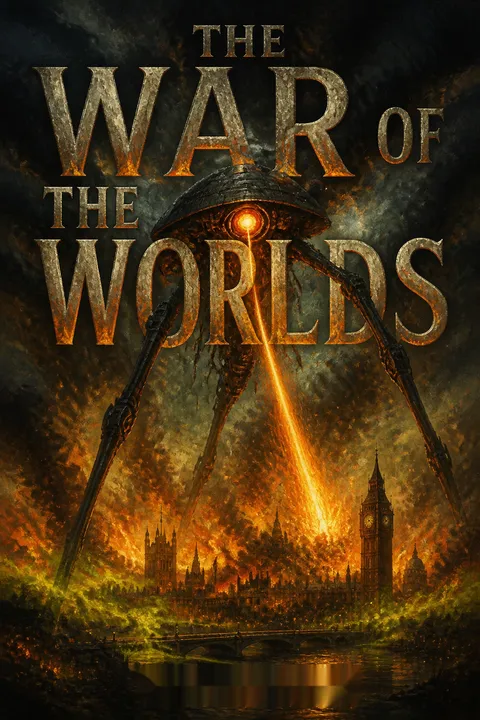


Plot Summary
Mars Sends Its Missiles
Mars is a dying world, and its inhabitants have begun aiming at Earth, whose warmth and abundance promise survival. The narrator, a married philosophical writer, knows none of this when astronomer Ogilvy invites him to watch the red planet. They see a brief flare, one of several launches that send metal cylinders across space.
While people discuss the flashes as scientific curiosities, the narrator rides his bicycle and walks with his wife beneath a seemingly harmless sky. The first cylinder strikes Horsell Common. Ogilvy finds it buried in a smoking crater, recognizes that it is artificial, and hears movement inside. He summons journalist Henderson, but their warning draws curious crowds rather than serious alarm.
The first catastrophe is not only the Martians’ arrival but humanity’s failure to interpret evidence beyond familiar categories. Ogilvy sees a designed object and quickly revises his assumptions, while the crowd and newspapers turn the discovery into entertainment. The narrator’s ordinary evening with his wife makes the danger intimate without making it legible to him. Wells establishes a mismatch between technological power and imaginative readiness: people possess instruments capable of seeing the launches, yet their confidence in human centrality keeps them from grasping what those signs mean.
The Cylinder Opens
By evening, hundreds have gathered around the cylinder, and workmen have failed to force it open. When its lid finally turns from within, the spectators expect visitors they can understand. Instead, a frail, tentacled Martian struggles out, followed by another. The narrator retreats, but the crowd edges closer, and a deputation approaches with a white flag.
A green flare rises from the pit; then the Martians’ Heat-Ray sweeps across the common. It kills the emissaries and ignites trees, buildings, and people in a single pass. The narrator escapes through the dark, while those on the road stampede back toward Woking. In the crush, several fugitives are trampled, and the first cylinder’s arrival becomes a massacre.
The white flag turns a reasonable human custom into a fatal misreading. The visitors are not simply hostile strangers; they occupy a biological and technological world in which human signals have no shared meaning. The crowd’s curiosity also becomes part of the danger: people keep approaching because the spectacle feels containable until the weapon makes distance irrelevant. The narrator’s escape depends on panic and chance, not superior judgment. That dependence begins dismantling his belief that observation and rational explanation can protect him from events that move faster than understanding.
A Dinner Before Flight
At home, the narrator recounts the attack to his wife, then tries to reassure her with the mistaken belief that Earth’s gravity will immobilize the Martians. On Saturday, soldiers cordon off the common, and a second cylinder falls near Byfleet. When guns begin firing, the narrator finally takes his wife and servant to Leatherhead, borrowing a dog cart and leaving his home under threat.
He returns that night to honor his promise to the cart’s owner. A third cylinder falls during a storm. In lightning flashes, the narrator sees enormous metal tripods striding through the trees. His horse bolts, overturning the cart; he reaches home on foot and finds the cart’s owner dead beside the road.
The narrator’s first response to danger is to reason it down, and his confidence borrows authority from scientific language without testing whether the assumptions apply. His wife’s fear proves more perceptive, but he leaves her behind because he still imagines the crisis as a local disturbance that can be managed. The tripods expose the error: the Martians have converted their vulnerable bodies into mobile machines. The overturned cart and the dead owner make the collapse personal, while the narrator’s return to an emptying home marks the loss of his former domestic security.
Guns at Shepperton
An artilleryman reaches the narrator’s house and describes how the Martians destroyed the soldiers at Woking, then marched through the town with their Heat-Rays. At dawn, the two men leave for London, but the narrator’s urgent plan is still to reach his wife. Near Weybridge, the artilleryman goes on to report to the military, while the narrator reaches the Thames as Martians advance on Shepperton.
He dives into the river to escape the Heat-Ray. Hidden guns fire at a tripod, and a shell strikes its hood, killing the Martian inside. The machine staggers into the river, where its heat weapon turns water to steam. The narrator escapes the boiling surge, but the surviving Martians renew their attack.
The artilleryman’s testimony changes the narrator’s understanding from an isolated horror to a military disaster, but it also introduces the possibility that human force can matter. The shell’s success is real and costly: it kills one invader, yet does not reverse the advance. The narrator survives by reading the terrain, using water as cover when the land offers none. His actions are becoming less governed by abstract confidence and more by immediate attention to physical danger. The victory at Shepperton is therefore a narrow opening, not a promise that human institutions can regain control.
Black Smoke Takes Surrey
After escaping the river, the narrator meets a fugitive curate and travels with him through devastated villages. The Martians spread a heavy black vapor from projectile canisters, using it to smother hidden batteries and break the remaining organized resistance.
The narrator and the curate shelter in a house at Upper Halliford as the cloud sinks through the surrounding country. When a Martian clears the vapor with superheated steam, the men seize a brief chance to move.
They cross streets strewn with bodies and abandoned belongings, then hide as a fighting-machine pursues people across a field and lifts them into its carrier. Near Mortlake, they take refuge in a house whose pantry holds food. A fifth cylinder strikes nearby, burying them beneath the ruins.
The black vapor changes the terms of survival. The Heat-Ray makes visible destruction immediate, while the cloud attacks the infrastructure that lets people organize resistance, turning roads, ditches, and shelters into traps. The narrator and curate are no longer choosing a route so much as borrowing temporary gaps in the Martians’ activity. The sight of people carried away also deepens the threat beyond death: humans may be useful to the invaders. The fifth cylinder’s impact converts a refuge into a prison, making the narrator’s next struggle depend not on escape across open country but on endurance in confined darkness.
The Curate Breaks
Trapped in the ruined kitchen beside the new Martian pit, the narrator and curate watch the invaders dismantle their cylinder, build machines, and bring captured humans to the pit. The narrator rations their dwindling food, but the curate eats impulsively and grows louder as fear overtakes him. After days of quarrels, the narrator strikes him with the blunt end of a meat cleaver when he threatens to expose their hiding place.
A Martian handling-machine probes through the wall, finds the curate’s body, and searches the scullery and cellar with a tentacle. The narrator hides among coal and firewood until the machine withdraws. He emerges only after hunger and thirst have weakened him, and finds the pantry stripped bare.
The curate’s collapse is not simply a contrast between faith and science. Under confinement, his religious explanations cannot help him make practical decisions, while the narrator’s discipline hardens into violence. The narrator’s blow preserves his concealment, but it also leaves him responsible for the death of his sole companion. The probing tentacle makes this moral crisis inseparable from physical threat: one man’s breakdown can expose both. Wells refuses the comfort of a clean survival ethic. The narrator remains alive, but his choices acquire a cost that cannot be dismissed as merely strategic.
London Joins the Flight
While the narrator remains trapped, his younger brother, a medical student in London, learns that the Martians have defeated the defenses around the capital. When the authorities announce that black vapor is advancing, London erupts into flight.
The brother escapes the station crush on a stolen bicycle, then leaves it when its wheel breaks. On the road north, he helps Miss Elphinstone and her sister-in-law, Mrs. Elphinstone, after robbers attack their pony chaise.
He persuades the more composed Miss Elphinstone to continue east rather than return toward the danger. At Barnet, the party reaches a human torrent of refugees, where the brother helps force the chaise across the road and sees panic erase ordinary protections such as property and personal safety.
The brother’s route reveals the invasion from the perspective of a city whose danger arrives first as unreliable news and then as a collective stampede. The crowd is not a single mass of cowardice: people carry children, possessions, injuries, and competing hopes, but sheer numbers turn each attempt at safety into a hazard for others. The brother becomes useful through improvisation rather than authority, first defending the women and then helping them navigate a blocked road. Miss Elphinstone’s steadiness gives the group a counterweight to Mrs. Elphinstone’s fear, showing how survival can depend on small acts of mutual judgment.
The Thunder Child Charges
The brother and the two women cross Essex toward Tillingham, where a vast fleet of vessels is gathering to evacuate civilians. They pay for passage on a crowded steamer bound for Ostend. As the boat leaves shore, several Martian tripods wade toward the shipping to cut off escape. The ironclad Thunder Child charges from seaward.
It evades a canister of black vapor, closes on the Martians, and destroys one with its guns. The damaged warship drives into a second tripod, but the Heat-Ray strikes it and it explodes, crushing its target as it goes down. The steamer escapes amid the confusion. The brother and his companions survive the crossing, though the fate of the third Martian remains hidden in smoke and distance.
The Thunder Child’s charge offers the story’s clearest image of human courage meeting superior force on chosen terms. Its crew does not win by matching the Martians’ technology; it exploits speed, surprise, and the enemy’s uncertainty about the ship. The first strike creates genuine hope among the refugees, but the second attack destroys the ironclad and makes its victory inseparable from sacrifice. The brother’s survival is therefore not evidence that the world has been rescued. It is a temporary passage bought by people willing to place themselves between the invaders and those fleeing.
The Pit Falls Silent
Inside the cellar, the narrator waits through days of silence, thirst, and the spread of red weed across the broken house. A dog’s movements and the absence of the pit’s machinery finally persuade him to look outside. The Martians and their equipment have vanished, leaving scraps, debris, and scavenging birds.
He climbs from the ruins, gathers whatever garden vegetables he can find, and travels through the transformed landscape toward Putney. Red weed chokes waterways and covers gardens, while familiar roads lead past deserted houses and human remains.
On Putney Hill, he encounters the artilleryman, who has survived by hiding and scavenging. The artilleryman describes a plan for underground human communities, but his grand scheme gives way to drink, cards, and delay, so the narrator leaves him.
The narrator’s escape begins with an ecological change rather than a human victory. The red weed makes Earth look conquered, but its spread also provides cover and food, complicating the distinction between alien invasion and natural adaptation. The narrator’s hunger keeps his attention on practical needs even when the landscape invites despair. The artilleryman offers a future shaped by discipline, knowledge, and resistance, yet cannot sustain the work his vision requires. By leaving him, the narrator rejects both passive hopelessness and a fantasy of organized renewal that has not been earned through action.
The Martians Fall Silent
Alone in London, the narrator follows a repeated cry toward Regent’s Park and finds a Martian machine standing motionless. Near Primrose Hill, he sees birds feeding at another silent tripod and climbs into the Martian stronghold. The invaders lie dead among their machines.
Their bodies could not resist Earth’s ordinary disease-causing microorganisms, against which humans had developed defenses over generations. The Martians’ weapons, poison clouds, and mechanical ingenuity have failed where microscopic life succeeds.
The narrator looks across a battered but surviving London and understands that no army has delivered this reprieve. The dogs and birds feeding on the invaders make the victory physical and unsettling, while the dead machines mark the end of the immediate threat.
The reversal refuses the usual logic of a final military triumph. Human weapons can kill one Martian, but the decisive force is an ecological relationship too small to see and too ordinary to command. The same biological inheritance that humans barely notice becomes their protection, while the invaders’ technological advantage cannot compensate for their lack of exposure to terrestrial microbes. This is not a moral vindication of humanity: survival comes from contingency, not merit. The narrator’s changed perspective follows from that fact. Human dominion has been challenged, and human survival rests on dependence rather than mastery.
The House at Woking
After the discovery, the narrator loses several days in shock and wakes under the care of strangers. They tell him that Leatherhead was destroyed during his imprisonment, and he fears his wife has died with it. He returns to Woking through a landscape of repaired rail lines, blackened houses, and recovering crowds. At his home, he finds the writing and dinner he abandoned on the day the cylinder opened.
The stillness of the rooms persuades him that no one from his former life has returned. Then his wife and her cousin appear at the open French window. His wife, pale and overcome, reaches him, and he catches her. Their reunion restores one intimate bond, but it cannot restore the world they knew before the invasion.
The homecoming is built around objects that preserve the gap between the narrator’s ordinary life and the catastrophe: unfinished writing, spoiled food, and a house left open. Their persistence makes absence tangible before his wife’s return changes its meaning. The reunion resolves the personal question that has driven his journey, but it does not turn survival into a simple restoration. The narrator and his wife have each endured an experience the other could not witness, and their embrace joins two survivors rather than returning them to their earlier selves. Relief arrives alongside grief for a world that cannot be recovered.
Epilogue
In the aftermath, investigators study the Martians’ bodies, weapons, and machines, while London begins the slow work of repair. The narrator doubts that humanity has learned enough to prevent another attack and urges continued attention to Mars.
He also considers the invasion’s lasting changes: new scientific knowledge, a stronger sense of shared human fate, and the loss of confidence that Earth is secure. Daily life resumes, but ordinary streets and familiar crowds still remind him of the silent city and the dead. He lives with his wife, yet their survival carries the knowledge that each once believed the other lost.
The closing pages resist treating survival as a return to normal. The narrator can describe scientific consequences and imagine future precautions, but neither explanation nor vigilance erases the mental afterimage of the invasion. His changed outlook is not simple pessimism: he recognizes that the shock has enlarged human knowledge and weakened the complacency that made the attack unimaginable. Yet the possibility of another assault remains unresolved. The final emphasis on his wife’s hand makes the cost intimate. Reunification repairs a relationship’s physical separation, not the terror each endured while believing the other dead.
Analysis
The novel’s central reversal is that the human experience of empire becomes a template for imagining invasion. The narrator compares Martian treatment of Earth’s inhabitants with humanity’s own destructive history, making it difficult to regard the aliens as uniquely evil while still showing the terror of their actions. Their motive is survival, but survival pursued through conquest reduces other lives to resources. The resemblance is uncomfortable because it makes the invaders’ logic intelligible without making it acceptable.
Wells also makes the collapse of social order gradual and uneven. At first, newspapers minimize the threat, soldiers misunderstand what they face, and Londoners continue their routines. Once institutions fail, the refugee roads reveal how quickly property, status, and civic conduct lose force under scarcity. Yet the novel does not claim that all cooperation disappears: the narrator shelters a soldier, his brother protects travelers, and strangers care for the narrator after his collapse. Solidarity survives, but it is local and fragile rather than guaranteed by government or class.
The narrator’s changing self-image carries the psychological argument. He begins as a confident observer who believes explanation can contain danger. The invasion makes him a hunted body, dependent on hiding, food, weather, and luck. His encounter with the artilleryman briefly tempts him with an ambitious plan for human resistance, but the plan’s failure to become work shows how easily hope becomes another form of avoidance. The actual reprieve comes from microbes, not human mastery. That ending does not crown humanity as superior; it reveals that survival can depend on an unnoticed relationship with the living world. The novel’s warning is therefore double: civilizations may become predators when they confuse need with entitlement, and technological power never abolishes vulnerability.
Review Summary
The War of the Worlds is praised as a pioneering and influential science fiction novel. Reviewers appreciate Wells' imaginative alien invasion story, vivid descriptions, and social commentary on imperialism and human nature. Many note its lasting impact on the genre and pop culture. While some find the writing style dated, most consider it an important classic that remains thrilling and thought-provoking. The novel's themes of humanity's vulnerability and moral questions about colonization resonate with modern readers. Overall, it's highly regarded for its innovative ideas and lasting significance.
People Also Read




Characters
The narrator
A shaken human witnessAn unnamed married writer of philosophical works, the narrator begins as an educated observer who trusts reason and the familiar order of English life. The invasion repeatedly forces him to exchange speculation for physical judgment: he flees through burning country, hides from machines, scavenges for food, and struggles to keep a frightened companion quiet. His account is shaped by retrospection, and he admits to fear, anger, and choices that trouble him rather than presenting himself as a flawless hero. His central drive is to find his wife, but survival alters his sense of humanity’s place in the world. He becomes more alert to vulnerability, dependence, and the limits of intellectual confidence.
The narrator’s wife
The threatened home bondThe narrator’s wife is introduced within the safe routines he initially assumes can survive the invasion. She recognizes the danger more readily than he does and responds to it with visible fear, while he tries to steady her with scientific arguments. Her relationship with him gives his flight a personal purpose beyond mere survival. She is not developed through an independent viewpoint, but the narrator’s memories of her anxious face and his persistent fear for her make clear how deeply their marriage anchors him. She represents the ordinary life he struggles to recover, without reducing her to a symbol: she is a person whose fate remains uncertain to him throughout much of the crisis.
Ogilvy
The first alert astronomerOgilvy is a respected astronomer and the narrator’s acquaintance. When he learns of unusual activity on Mars, he invites the narrator to observe the planet and then investigates the fallen cylinder at Horsell Common. His scientific curiosity makes him one of the first people to recognize that the object is artificial, and he tries to bring others into the investigation. Ogilvy represents disciplined observation, but his expertise cannot protect him from the consequences of approaching a danger whose nature he does not yet understand. His actions help establish the tension between careful inquiry and the limits of knowledge when confronting an entirely unfamiliar intelligence.
Henderson
The doomed local reporterHenderson is a local journalist who helps Ogilvy investigate the cylinder and sends news of it toward London. His reporting links the isolated discovery to a wider public, though the first accounts fail to convey the danger. He represents the press’s role as messenger, constrained by distance, incomplete evidence, and the assumption that extraordinary news may be false.
Stent
The official observerStent, the Astronomer Royal, joins the effort to examine the cylinder and helps manage the crowd around it. His official standing brings scientific authority to the scene, but authority cannot make the Martians communicate or render their technology safe. He embodies the limits of established institutions when faced with an unprecedented threat.
The artilleryman
The survivor with a schemeA surviving gunner whom the narrator shelters, the artilleryman has witnessed the destruction of his battery and understands the Martians’ machines at close range. He is observant, resourceful, and capable of imagining a human future under occupation. His confidence can inspire the narrator, but his appetite for comfort and his reluctance to sustain labor expose a gap between vision and discipline. Through him, the story tests whether survival requires not only courage and intelligence but also the patience to carry a plan through. He is both a practical witness and a persuasive, unreliable architect of what humanity might become.
The curate
A faith under pressureThe curate is a religious minister the narrator meets while both are fleeing the destruction around Weybridge. He searches for spiritual meaning in the disaster, but fear and grief overwhelm his ability to act calmly. In confinement, he becomes an increasingly difficult companion, unable to share food or observe the precautions that might keep them hidden. His relationship with the narrator exposes a clash between their coping styles: one reaches for explanations and lament, the other for discipline and action. The curate is neither a simple fool nor a stable moral guide; he is a vulnerable man whose familiar sources of meaning fail under extreme pressure.
The narrator’s brother
A London escapeeThe narrator’s younger brother is a medical student in London, initially distant from the danger unfolding in Surrey. As news spreads, he must navigate crowded stations and roads, relying on quick decisions rather than formal authority. He protects two women from attackers and helps them travel toward the coast. His practical courage differs from the narrator’s inward, reflective survival: the brother is repeatedly drawn into immediate action among strangers. Through his account, the story broadens beyond one man’s experience and shows how ordinary people respond when the systems they depend on stop functioning.
Miss Elphinstone
The steady fellow travelerMiss Elphinstone is the younger sister of Mrs. Elphinstone and one of the women the narrator’s brother encounters during the flight from London. Though frightened, she remains composed enough to assess danger and accept a difficult eastward route when returning home would be unsafe. She helps resist the robbers who attack their chaise and cooperates with the brother as their journey becomes more uncertain. Her steadiness is not fearlessness; it is the ability to act while afraid. In a crowded landscape where panic often makes people passive or reckless, she contributes judgment and resolve to the small group.
Mrs. Elphinstone
A frightened companionMrs. Elphinstone travels with her sister-in-law and the narrator’s brother after the London exodus begins. She is deeply anxious about leaving England and longs to return to her husband and familiar home. Her fear makes the journey harder, but it also shows how displacement can unsettle people who have never imagined life outside a secure routine. She depends on the others to keep moving when danger leaves little room for certainty.
The Martians
Minds inside machinesThe Martians are intelligent inhabitants of an older, colder planet whose dwindling resources drive them toward Earth. Their own bodies are frail under terrestrial gravity, so they rely on machines to travel, fight, excavate, and manipulate their surroundings. They do not share human customs or moral assumptions, and their behavior makes them difficult to interpret as either monsters or people. The story presents them as calculating and technologically advanced, but also as organisms shaped by their environment, with needs and limitations of their own. Their presence exposes how easily a powerful civilization can mistake superiority in one domain for command over every condition.
Plot Devices
Interplanetary cylinders
The invasion’s arrival podsThe cylinders are projectiles launched from Mars and sent toward Earth at regular intervals. Each carries Martians and the equipment they need to establish a foothold. Their arrival structures the invasion’s escalation: the first draws curious spectators to Horsell Common, later landings bring new threats into other regions, and the narrator’s refuge is struck by another cylinder. Their metal shells are not merely transport; they create craters, bury buildings, and protect their contents during the journey. The repeated launches also emphasize that the invasion is planned rather than accidental, and that destroying one machine or one group does not necessarily end the danger.
The Heat-Ray
Invisible destruction at rangeThe Martians project intense heat through a directed beam generated by a mechanical apparatus. It ignites combustible material, melts or shatters other objects, and can kill people before they understand what has struck them. The weapon first turns the crowd at Horsell Common into victims, then makes military defenses and towns dangerously exposed. Its range shapes the narrator’s movement: he seeks cover, water, and darkness whenever open ground becomes unsafe. The Heat-Ray represents the Martians’ ability to translate scientific knowledge into overwhelming force, while its destructive effect on the Thames shows that even natural features offer only temporary protection.
Black Smoke
A creeping poison weaponThe Martians fire canisters that release a heavy, dark vapor which sinks into low ground and kills those who breathe it. Unlike the Heat-Ray, which destroys visibly and in an instant, the smoke spreads across a region and makes escape routes, shelters, and military positions unsafe. It breaks organized resistance by reaching places artillery cannot defend. The narrator and curate survive it only by sheltering above or beyond its path, and London’s population flees when reports of the vapor arrive. The weapon turns the landscape itself into a threat, showing how the invaders adapt tactics to defeat human defenses rather than relying on one terrifying device.
Martian machines
Bodies made into weaponsThe tripods carry the Martians across terrain and mount weapons that their fragile bodies could not use unaided. Handling-machines perform delicate work around the cylinders, while other apparatus excavates pits and processes materials. These devices give the invaders mobility, reach, and dexterity, making them seem like a civilization whose tools have become extensions of thought. Their movements also confound human categories: they are machines, yet they act with a responsive, almost animal quality. The contrast between the Martians’ vulnerable bodies and their immense mechanical power helps explain why human observers first underestimate them and then struggle to imagine any effective defense.
Terrestrial microorganisms
An invisible natural defenseThe story establishes that Earth’s organisms have developed resistance to many microbes through a long history of exposure. The Martians, arriving from a world without the same microbial dangers, have no comparable defenses. This biological difference ultimately matters more than the weapons, machines, and military plans that dominate the invasion’s middle stages. The device reframes survival as a result of ecological history rather than human intention: people do not consciously wield the microorganisms, and the Martians cannot recognize the threat in time. Its resolution is deliberately humbling, since the decisive force is both ancient and microscopic, beyond the control of either civilization.
FAQ
Synopsis & Basic Details
What is The War of the Worlds about?
- Martian invasion of Earth: The story depicts a technologically superior Martian race invading Earth, specifically targeting England, and the ensuing chaos and destruction.
- Humanity's struggle for survival: It follows the experiences of an unnamed narrator as he witnesses the devastating effects of the invasion and struggles to survive.
- Themes of power and vulnerability: The narrative explores themes of human vulnerability, the limits of technological advancement, and the unexpected power of nature.
Why should I read The War of the Worlds?
- Classic sci-fi experience: It's a foundational work of science fiction, offering a thrilling and thought-provoking narrative of an alien invasion.
- Exploration of human nature: The novel delves into the psychological and emotional responses of individuals and society under extreme duress.
- Timeless themes and relevance: It raises questions about humanity's place in the universe, the dangers of unchecked power, and the importance of resilience.
What is the background of The War of the Worlds?
- Late 19th-century anxieties: The novel reflects late 19th-century anxieties about technological progress, imperialism, and the potential for societal collapse.
- Scientific speculation: Wells incorporates contemporary scientific ideas about Mars, astronomy, and evolution, adding a layer of realism to the fantastical elements.
- British Imperialism critique: The story can be interpreted as a critique of British imperialism, with the Martians acting as a mirror to the colonizing powers of the time.
What are the most memorable quotes in The War of the Worlds?
- "No one would have believed...": This opening line sets the tone of disbelief and foreshadows the unexpected nature of the Martian invasion.
- "The chances against anything manlike on Mars are a million to one.": This quote highlights the hubris of humanity and its underestimation of the universe.
- "We men are beat. We don't know enough.": This quote encapsulates the artilleryman's grim realization of humanity's limitations in the face of a superior force.
What writing style, narrative choices, and literary techniques does H.G. Wells use?
- First-person perspective: The use of a first-person narrator creates a sense of immediacy and allows the reader to experience the events through his eyes.
- Vivid and descriptive language: Wells employs vivid and descriptive language to paint a picture of the Martian technology, the destruction, and the emotional turmoil of the characters.
- Foreshadowing and suspense: The narrative is filled with foreshadowing and suspense, creating a sense of impending doom and keeping the reader engaged.
Hidden Details & Subtle Connections
What are some minor details that add significant meaning?
- The red weed's symbolism: The red weed, initially a sign of Martian presence, becomes a symbol of nature's resilience and the eventual downfall of the invaders.
- The dog's behavior: The dog's initial fear and later scavenging behavior highlight the breakdown of civilization and the return to primal instincts.
- The broken clock: The broken clock in the narrator's house symbolizes the disruption of time and the end of the familiar world.
What are some subtle foreshadowing and callbacks?
- Early astronomical observations: The early descriptions of Mars and the strange lights foreshadow the impending invasion and the Martians' advanced technology.
- The narrator's philosophical musings: The narrator's philosophical musings about humanity's place in the universe foreshadow the humbling experience of the invasion.
- The artilleryman's underground plan: The artilleryman's plan for an underground society foreshadows the eventual need for humanity to adapt and survive in a changed world.
What are some unexpected character connections?
- The narrator and the artilleryman: Their unlikely alliance highlights the shared human experience of survival, despite their different backgrounds and perspectives.
- The narrator and the curate: Their contrasting reactions to the invasion reveal the different ways individuals cope with trauma and loss.
- The narrator and his brother: Their parallel experiences in different parts of London emphasize the widespread impact of the Martian invasion.
Who are the most significant supporting characters?
- The artilleryman: He represents the human spirit of resistance and the desire to rebuild, even in the face of overwhelming odds.
- The curate: His descent into madness highlights the psychological toll of the invasion and the fragility of the human mind.
- The narrator's wife: Her absence and the narrator's longing for her underscore the personal losses caused by the invasion and the importance of human connection.
Psychological, Emotional, & Relational Analysis
What are some unspoken motivations of the characters?
- The narrator's desire for normalcy: He seeks to return to his old life and find his wife, driven by a desire for stability and connection in a chaotic world.
- The artilleryman's need for control: He seeks to create a new society underground, driven by a need to regain control and purpose in a world turned upside down.
- The curate's fear of judgment: His religious fervor and subsequent breakdown reveal a deep-seated fear of divine judgment and a struggle to reconcile his faith with the horrors he witnesses.
What psychological complexities do the characters exhibit?
- The narrator's detachment: He experiences moments of detachment, observing the events as if from a distance, a coping mechanism for dealing with trauma.
- The artilleryman's delusions: His grandiose plans and unwavering optimism mask a deep-seated fear and a need to find meaning in a meaningless situation.
- The curate's religious mania: His descent into religious mania reveals the fragility of his faith and his inability to cope with the loss of his familiar world.
What are the major emotional turning points?
- The first sight of the Martians: The narrator's initial curiosity turns to horror, marking a shift from observer to victim.
- The destruction of Weybridge: The narrator's realization of the Martians' power and the loss of life triggers a sense of despair and helplessness.
- The discovery of the dead Martians: The narrator's discovery of the dead Martians brings a sense of relief and hope, marking a turning point in the narrative.
How do relationship dynamics evolve?
- The narrator and the curate: Their relationship deteriorates from initial companionship to open conflict, highlighting their fundamental incompatibility.
- The narrator and the artilleryman: Their relationship evolves from initial skepticism to a shared understanding of the new reality, though their paths diverge.
- The narrator and his wife: Their reunion is bittersweet, marked by the loss of their old life and the trauma they have both endured.
Interpretation & Debate
Which parts of the story remain ambiguous or open-ended?
- The Martians' motivations: The Martians' true intentions and the reasons for their specific actions remain somewhat ambiguous, leaving room for interpretation.
- The future of humanity: The novel ends with a sense of uncertainty about the future of humanity and the long-term consequences of the invasion.
- The nature of the red weed: The origin and purpose of the red weed are never fully explained, adding to the sense of mystery and the alien nature of the invasion.
What are some debatable, controversial scenes or moments in The War of the Worlds?
- The narrator's killing of the curate: This act raises questions about morality and the limits of human behavior under extreme duress.
- The artilleryman's vision of the future: His plan for an underground society and his views on human nature are open to debate and interpretation.
- The ending's deus ex machina: The Martians' defeat by bacteria is seen by some as a convenient plot device, rather than a satisfying resolution.
The War of the Worlds Ending Explained: How It Ends & What It Means
- Martians succumb to Earth's bacteria: The Martians are defeated not by human force, but by terrestrial bacteria, highlighting the power of nature.
- Humanity's survival is a reprieve: The ending suggests that humanity's survival is not guaranteed and that the threat of future invasions remains.
- Themes of humility and resilience: The ending underscores the themes of human vulnerability, the limits of technological power, and the importance of resilience in the face of the unknown.
About the Author

Download PDF
Download EPUB
.epub digital book format is ideal for reading ebooks on phones, tablets, and e-readers.








