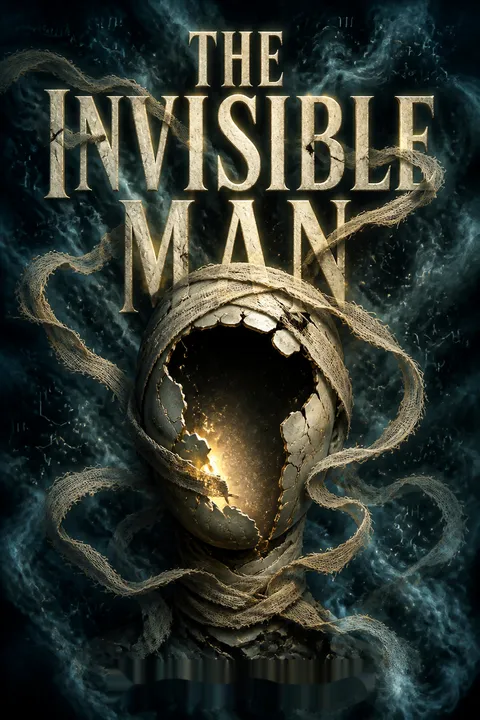


Plot Summary
Snowbound at the Coach and Horses
Mrs. Hall sees her new lodger refuse to remove his hat, coat, goggles, and layers of bandages, even beside a roaring fire. He gives no name and insists on privacy, explaining that an accident and painful eyes require isolation. When a delivery brings trunks, books, and crates of chemicals and glassware, his impatience makes clear that the experiments matter more to him than the inn or its people.
A carrier's dog bites his leg, and the stranger rushes upstairs, rejecting help before returning with changed clothes. He spends long hours mixing substances, breaks bottles in sudden fits, and mutters angrily about a discovery that may take years. His secrecy turns a paying guest into the village's unanswered question.
The inn is a modest social world built on observation, courtesy, and small exchanges, exactly the conditions Griffin cannot tolerate. His demand for privacy is not merely a scientist's preference: it is an attempt to control what others can know about him. Yet the labor required to preserve his concealment makes him conspicuous. Mrs. Hall notices his dress, the villagers notice his temper, and his equipment advertises the very research he hopes to hide. The opening therefore makes secrecy self-defeating. Griffin seeks refuge from scrutiny, but his refusal to participate in ordinary life turns every ordinary gesture into evidence.
The Sleeve Moves Alone
As spring advances, Griffin's dwindling money sharpens his quarrels with Mrs. Hall, while his odd hours and violent temper feed village gossip. Dr. Cuss visits under a charitable pretext and sees Griffin's apparently empty sleeve reach toward him; an unseen pinch sends the doctor fleeing to the vicar, Mr. Bunting.
On Whit Monday, the Buntings wake to bare footsteps in their study and discover that a burglar has taken their household money, though no person can be found. At the inn, Mr. Hall finds Griffin's room empty of its occupant, with his clothes left behind. Mrs. Hall enters and the bedding, hat, and chair suddenly attack and drive her out. The evidence now connects the guest to both burglary and impossible movement.
The clues arrive through different kinds of authority: Cuss's professional curiosity, the Buntings' careful search, and Mrs. Hall's intimate knowledge of her own rooms. None can explain what happened, but each supplies a concrete observation that resists the villagers' preferred explanations. Their uncertainty is socially productive: rumor offers easy labels, from criminal disguise to supernatural trick, while the material evidence keeps defeating them. Griffin's powers grant him access to spaces and objects without accountability, but the emptied sleeve and animated furniture turn that privacy into a public disturbance. The episode shifts the question from what Griffin looks like to what he can do to other people.
The Bandages Come Off
By midday, Mrs. Hall demands payment and an explanation for the room's impossible movements. Griffin answers by removing his false nose, spectacles, bandages, and whiskers. The villagers see an ordinary body end abruptly at the collar: he is invisible.
Constable Jaffers nevertheless tries to execute a warrant for the vicarage burglary, and Griffin initially submits before stripping off his clothes, which are the only parts of him the crowd can see. The room erupts into a blind melee.
Jaffers is knocked unconscious, several villagers are hurt, and Griffin slips out of the inn and across the village. The crowd's discovery does not free him from suspicion; it transforms a strange lodger into a fugitive whom everyone fears but few can actually locate.
The unveiling reverses the villagers' expectation of a hidden face: beneath the bandages is not a scarred or deformed man, but an absence. That revelation makes sight itself unreliable, yet the scene also insists on Griffin's physical reality through blows, collisions, and the constable's attempt to restrain him. His invisibility does not make him immaterial; it makes ordinary systems of recognition and arrest fail. The villagers' panic is therefore not simply fear of the supernatural. It arises from a practical crisis in which a visible warrant cannot be enforced against an unseen body. Griffin's first public freedom is inseparable from the injuries he inflicts while escaping.
Marvel Becomes the Mule
On the open downs, Griffin catches Thomas Marvel, a shabby, homeless tramp, and forces him to become an accomplice by threatening him with unseen blows. Griffin needs clothing, shelter, and the books containing his research, so Marvel returns to the Coach and Horses to collect a bundle and the three coded notebooks.
While Cuss and Bunting inspect Griffin's abandoned room, the invisible man corners them and takes the books and clothes. Huxter spots Marvel leaving with the goods and gives chase, only to be tripped and flung aside by Griffin.
When the villagers pursue, Griffin strikes people at random, smashes windows, overturns the holiday stalls, and cuts a telegraph wire before vanishing. Marvel escapes with the precious books, but Griffin keeps him under threat.
Marvel's presence gives Griffin a human instrument, but not a willing partner. Griffin interprets shared exclusion as kinship, then converts that supposed bond into coercion. Marvel's fear and physical vulnerability make him useful precisely because he is easy to control, while the stolen notebooks represent knowledge Griffin cannot risk losing. The Iping riot shows what happens when his private advantage meets collective resistance: he cannot be seen, but he can still be resisted indirectly, and each interruption intensifies his violence. The village's holiday becomes a disorderly counter-image to Griffin's dream of command. He can scatter the crowd, yet the crowd has already made his existence public.
The Books Reach Burdock
Griffin drives Marvel toward Port Stowe with the notebooks, taking money from shops and banks invisibly and forcing it into his reluctant carrier's pockets. A sailor recognizes the newspaper account of the Iping escape and questions Marvel, who nearly reveals what he knows before Griffin's unseen grip pulls him away.
The pursuit continues toward Port Burdock. At the Jolly Cricketers, Marvel gets inside and begs the men there to protect him. Griffin breaks through the locked doors and fights the barman, a policeman, and other customers as they try to hold him.
A man with a revolver fires into the struggle, but Griffin escapes. Marvel is eventually confined in the police station at his own request, while the wounded, exhausted Griffin seeks shelter at the home of Dr. Kemp.
The chase makes the novel's central asymmetry tangible: Griffin can move unseen, but his need for money, food, clothes, and manuscripts repeatedly forces him into contact with other people. Marvel is both a carrier of the notebooks and a witness who can expose him, so Griffin's control is never secure. In the tavern, collective action briefly counters the advantage of invisibility, though the defenders cannot capture what they cannot see. The sequence also divides their trajectories. Marvel gains a human refuge through public protection; Griffin, injured and depleted, turns toward the one person he expects to understand him. His flight has brought him to a former friend, but not to safety.
Kemp Opens the Bedroom Door
Late at night, Kemp finds blood on his bedroom door and sheets, then notices a bandage hanging unsupported in the air. Griffin reveals himself by name as Kemp's former university companion, and Kemp verifies the claim by touching the unseen man.
He offers food, drink, and a dressing gown, while Griffin, exhausted and wounded, eats and explains that he made himself invisible. Kemp listens but does not yet accept the promised partnership at face value. After Griffin finally sleeps, Kemp reads the newspaper accounts of Iping and Port Burdock.
They describe Griffin's attacks and the chase after Marvel, and Kemp concludes that his visitor is dangerous. Before morning, he writes a message for Colonel Adye, the local police chief, quietly setting events in motion while Griffin remains upstairs.
Kemp's recognition turns an apparently impossible intruder into a person with a shared past. That intimacy creates both a reason to listen and a reason to mistrust: Griffin assumes that intellectual familiarity will secure loyalty, while Kemp measures the man against the injuries reported in the papers. His choice to contact Adye before confronting Griffin is a precaution grounded in evidence, not simply a rejection of science. The bedroom becomes a temporary laboratory of competing interpretations. Kemp tests the claim with touch; Griffin treats his friend's hospitality as the beginning of collaboration. Their mismatch foreshadows the conflict between understanding how power works and deciding what its holder may do.
The Price of Vanishing
Over breakfast, Griffin explains how his research into light led him to a process for making living tissue transparent. He first tested the method on a cat, whose eyes and claws resisted the change, then used money stolen from his father to complete the experiment.
His father killed himself after the theft, but Griffin describes the loss as an interruption to his work. In a London lodging house, Griffin transformed himself and escaped when his landlord and the landlord's family broke into his room.
He burned the lodging to conceal his equipment, then discovered that snow, dirt, hunger, and clothing could expose or burden an invisible body. A failed theft at a department store and a violent struggle in a theatrical costumier's shop left him disguised, penniless, and intent on recovering his notebooks at Iping.
Griffin's account presents discovery as both extraordinary labor and moral narrowing. He sacrifices ordinary ties to finish the experiment, then treats the consequences, including his father's death, as peripheral to the work. His practical setbacks expose the gap between theoretical mastery and embodied life: invisible skin still feels cold, gets dirty, and leaves traces in snow. Even his attempted disguises require theft and violence. The scientific explanation clarifies the mechanism without redeeming the choices surrounding it. Griffin can alter how light passes through matter, but he cannot detach himself from dependence on food, shelter, or other people. His supposed freedom is built on needs he resents having.
A Kingdom of Fear
Griffin argues that invisibility has failed to give him a usable life, but he now sees a way to turn it into political power. He wants Kemp to provide food, rest, and a hiding place while they impose a reign of terror, using unseen attacks to punish anyone who resists. Kemp rejects the plan and urges him to publish his discovery and seek support rather than wage war on the public.
Griffin hears movement downstairs, realizes Kemp has deceived him, and starts removing his clothes to escape unseen. Kemp tries to lock him in the belvedere, but the key falls from the door and Griffin forces his way out. Colonel Adye arrives as Griffin attacks Kemp and flees the house, leaving the police chief and Kemp injured.
The central disagreement is not about whether Griffin's science is real, but about what follows from possessing it. Griffin treats vulnerability as proof that he must dominate others before they can threaten him; Kemp treats that same vulnerability as a reason to build cooperation and public accountability. Griffin's plan for terror converts an advantage in concealment into a theory of rule. Kemp's deception is ethically uneasy, yet it responds to a credible threat rather than an abstract fear. When Griffin detects the trap, the last possibility of private persuasion collapses. His escape carries the conflict from a strained friendship into an organized confrontation with the public.
The Hunt Turns Fatal
After Griffin escapes, Kemp tells Adye that the invisible man must be prevented from finding food, sleep, weapons, or a route out of the district. Police warn householders to bar their doors, train services are restricted, and armed search parties with dogs spread through the countryside. Griffin injures a child near Kemp's gate, then disappears for hours.
In the afternoon, estate steward Mr. Wicksteed is found dead beside a gravel pit, beaten with an iron rod. The exact cause of their encounter is uncertain, but the evidence points to a violent struggle and Griffin's flight from the scene. By night, the roads and fields are full of watchers. Griffin has become both quarry and public danger, with every refuge closing around him.
The search turns invisibility from a private secret into a problem of coordination. Kemp's instructions target the body's ordinary requirements, food and rest, while the authorities spread observation across roads, homes, and fields. This is not a simple contest between sight and concealment; it is a contest between isolated perception and shared procedure. Wicksteed's death makes that procedure morally urgent, though the uncertain circumstances prevent the reader from treating every inference as settled fact. Griffin's ability to vanish does not erase consequences. The more effectively he evades individual witnesses, the more broadly the community organizes itself against him.
Kemp's House Under Siege
Griffin sends Kemp a written death threat, and Kemp shuts the house, arms himself, and waits for Adye. Griffin smashes the windows, then confronts Adye outside, takes his revolver, and shoots him. He breaks into the kitchen with an axe as Kemp and two policemen defend the rooms with pokers. Kemp slips out through a window and runs downhill, drawing Griffin after him.
At first he cannot persuade anyone to help, but workers and townspeople recognize the chase and join it. A navvy strikes Griffin with a spade; the crowd piles on as Kemp holds the unseen body down. Griffin stops breathing. His body slowly becomes visible, revealing the young, white-haired man beneath the violence and the legend.
The climax makes collective action the counterforce to Griffin's singular advantage. Kemp's escape succeeds not because he can see or overpower Griffin, but because he carries the danger into public space and persuades others to act together. The final struggle is physically chaotic, and the crowd risks harming an opponent it cannot see; the spade blow marks the cost of making him tangible enough to restrain. As Griffin's body reappears, the spectacle reverses the novel's opening concealment. The visible man is neither a monster nor a mere idea, but a human being whose choices have made his body the last evidence against him.
Epilogue
Marvel settles near Port Stowe and makes a living recounting his strange encounter, though he denies possessing Griffin's manuscripts. He has in fact hidden the three damaged notebooks in a locked cupboard, where he studies them with more awe than understanding.
They contain the method of invisibility and other scientific secrets, yet Marvel has neither the training nor the intention to repeat Griffin's experiment. Kemp and Adye continue looking for the books, unaware that they are in Marvel's keeping. The final secret belongs not to a scientist but to the frightened tramp who survived by carrying the knowledge away.
The epilogue refuses to make Griffin's death a clean end to the danger or the knowledge he created. The notebooks survive, but their custodian is Marvel, whose curiosity exceeds his ability to interpret them. That reversal matters: the secret does not pass to a disciplined scientific institution, nor does it disappear with its inventor. It rests with a man who has learned that possession can be safer than use. Marvel's private ritual around the books echoes Griffin's secrecy, but without Griffin's confidence that power will solve his life. The ending leaves scientific knowledge materially present and ethically unresolved.
Analysis
The novel treats invisibility less as a magical gift than as a failed social technology. Griffin can evade sight, but he cannot escape embodiment: he is cold without clothes, conspicuous when clothed, exposed by snow, and dependent on food that temporarily makes him visible. His power removes the ordinary checks of mutual recognition without removing ordinary needs. That imbalance does not make him free; it makes cooperation seem, to him, like a threat and coercion like the only reliable tool.
Griffin's scientific intelligence and ethical failure are deliberately entangled. He understands the physics of visibility with precision, yet repeatedly misreads the human conditions of a livable life. He dismisses his father's death as irrelevant to research, treats Marvel as equipment, and turns a former friend's hospitality into a proposed alliance in terror. His problem is not simply that power corrupts him after the experiment. The experiment enlarges a prior conviction that his aims outrank other people's claims. Kemp offers a contrasting model of knowledge. He accepts evidence even when it overturns his assumptions, but he refuses to treat explanation as permission. His decision to alert Adye makes scientific responsibility public and collective. The final capture extends that principle: no single observer can reliably apprehend Griffin, but many people can coordinate around sound, footprints, danger, and shared testimony. Their victory is imperfect and violent, not a triumph of flawless institutions. It nevertheless defeats Griffin's fantasy that invisibility can sustain solitary rule.
The epilogue leaves the scientific secret with Marvel, a survivor rather than a successor. The books remain capable of renewing the experiment, but Marvel's awe is paired with practical caution. The story ends by separating possession of knowledge from mastery of it, and by leaving readers with the unresolved question of whether a discovery becomes dangerous through its method, its keeper, or the moral world in which it is used.
Review Summary
The Invisible Man receives mixed reviews, with many praising its innovative concept and Wells' writing style. Readers appreciate the exploration of power and its consequences, as well as the scientific explanations for invisibility. Some find the protagonist unsympathetic and the story predictable, while others enjoy the blend of science fiction, horror, and social commentary. The book's themes of alienation and moral decay resonate with many readers, although some feel the narrative structure and character development could be improved.
People Also Read




Characters
Griffin
The invisible experimenterA gifted physicist and former university student, Griffin is driven by the wish to make a discovery that will force the world to recognize his intellect. His work on light and matter demands years of isolation, and he regards ordinary obligations as distractions from achievement. Invisibility intensifies traits already present: secrecy becomes suspicion, ambition becomes entitlement, and frustration becomes aggression. He is not simply fascinated by scientific possibility; he imagines that exceptional knowledge should exempt him from ordinary limits. His dependence on food, shelter, and other people repeatedly collides with that self-image. Griffin's central psychological tension is between wanting freedom from human judgment and needing human beings to sustain the life his experiment has made.
Dr. Kemp
The cautious former friendKemp is a physician and independent scientific thinker who once studied alongside Griffin. He values observation and reason, but he does not confuse explaining a phenomenon with approving its use. His initial disbelief gives way when touch and evidence confirm Griffin's presence, and his curiosity remains active even as he judges the danger. Kemp's instinct is to contain risk through planning and cooperation, which puts him at odds with Griffin's demand for personal allegiance. He can be calculating, particularly when he hides his intentions, but his choices are shaped by the injuries Griffin has already caused and the threat he hears directly. Kemp represents science answerable to other people's safety.
Thomas Marvel
The unwilling accompliceMarvel is a wandering tramp with a taste for comfort, a wary intelligence, and little physical power. Griffin chooses him because he appears isolated and therefore easy to recruit, but Marvel's first response to the invisible man is fear rather than wonder. He survives by reading danger quickly, negotiating when possible, and seeking protection when escape opens a chance. His reluctance makes him an uneasy carrier of Griffin's plans and notebooks, not a true collaborator. Marvel's comic self-interest is also practical: he understands that the person controlling the money, clothes, and force controls the immediate situation. Beneath his bluster, he is alert to the cost of being useful to a stronger man.
Mrs. Hall
The inn's sharp-eyed keeperMrs. Hall runs the Coach and Horses and takes pride in keeping her establishment orderly. Griffin's money initially makes his eccentricity tolerable, but his rudeness and unpaid bill test her patience. She is observant enough to notice his odd clothing and forceful enough to confront him when his behavior crosses into her rooms and possessions. Her response to the moving furniture combines fear with a sense of violated ownership, especially because the chair has personal meaning. Mrs. Hall embodies the practical social rules Griffin repeatedly ignores: payment, privacy in both directions, and basic respect for the people who accommodate him.
Colonel Adye
The police organizerAdye leads the Port Burdock police and approaches the crisis as an urgent logistical problem. Once Kemp warns him, he organizes searches, alerts transport routes, and mobilizes the countryside rather than waiting for a conventional arrest to become possible. His courage is expressed through action, not confidence that he can control Griffin alone. Adye recognizes that the police need help from ordinary residents and must adapt their methods to a suspect who cannot be seen. His presence gives the pursuit an institutional structure, while his dealings with Kemp show the strain of making rapid decisions under an extraordinary threat.
Mr. Hall
The innkeeper's husbandMr. Hall helps run the Coach and Horses, though he is slower than his wife to interpret the stranger's behavior. Teddy Henfrey's suspicions make him inspect Griffin's room and notice the unlocked door and abandoned clothes. Once the furniture attacks Mrs. Hall, Hall's practical loyalty becomes more important than his earlier hesitation. He represents the ordinary person whose understanding comes not through theory but through direct disturbance of home and routine.
Dr. Cuss
The curious village doctorCuss is a local doctor whose professional curiosity draws him to Griffin's laboratory and mysterious bandages. He approaches the stranger intending to investigate, but an encounter with Griffin's empty sleeve turns curiosity into alarm. Cuss is among the first to recognize that the village's rumors may describe a physical reality, even though he cannot yet explain it. His testimony helps connect the scientific stranger to the broader crisis.
Mr. Bunting
The unsettled village vicarBunting is Iping's vicar, a measured man who prefers respectable explanations and initially doubts Cuss's account. The vicarage burglary forces him to confront evidence that has no visible culprit. His attempt to inspect Griffin's notebooks later exposes both his limits as a Greek scholar and his vulnerability to the unseen intruder. Bunting's caution makes him a useful counterpoint to the villagers' more imaginative theories.
Constable Jaffers
The warrant-bearing constableJaffers is Iping's constable, tasked with carrying out a warrant in the face of an impossible suspect. He insists on performing his duty even when Griffin has no visible head or hands. His struggle shows the practical limits of legal procedure when a person's body cannot be reliably seen or restrained.
Mr. Wicksteed
The estate stewardWicksteed is the steward of Lord Burdock's estate, a quiet middle-aged man whose daily route brings him into Griffin's path. He is not a pursuing officer or an antagonist, but his ordinary presence becomes caught in the escalating danger around Port Burdock.
Mr. Huxter
The watchful shopkeeperHuxter keeps a shop near the Coach and Horses and watches the village's public life from his doorway. His suspicion of Marvel's furtive movements prompts a chase that draws attention to Griffin's unseen interference. Huxter's alertness helps turn private theft into a public confrontation.
Mr. Heelas
The skeptical neighborHeelas is a villa owner near Kemp who dismisses reports of an invisible man as nonsense. His confidence in ordinary appearances shapes his response when Kemp's house is attacked. He represents the social cost of refusing to prepare for a danger simply because it seems impossible.
Teddy Henfrey
The village clock-jobberHenfrey repairs clocks and is among the first villagers to scrutinize Griffin's strange appearance. His suspicions help spread unease through Iping, although his observations are often mixed with gossip. He is a small but useful example of how a village assembles a picture from incomplete encounters.
Millie
The inn's overworked maidMillie works at the Coach and Horses under Mrs. Hall's impatient supervision. She has little power in the household, but her presence underlines the inn's ordinary labor and routines, which Griffin disrupts through his demands for service and seclusion.
Plot Devices
The invisibility process
Science made bodilyGriffin's experiments alter how his body interacts with light, making him visually imperceptible while leaving him solid and vulnerable to touch. The mechanism gives him access to places and people without being noticed, but it does not remove his need for food, warmth, rest, or protection. The narrative uses the process as more than a marvel: it makes scientific achievement inseparable from physical consequences. Griffin's body can disappear from sight, yet ordinary matter continues to mark and constrain it. The device is the premise behind both his power and his repeated practical failures.
Clothing and digestion
The body leaves evidenceClothes make Griffin visible as an apparently headless or handless figure, while food remains visible inside him until his body absorbs it. These limits complicate every attempt to travel, hide, or eat without attracting attention. Snow can settle on his body, rain and dirt can outline it, and bare footprints can betray his path. The device prevents invisibility from functioning as effortless power. Each ordinary need creates a new trace that other people can follow, turning survival itself into a source of exposure.
The coded notebooks
Knowledge that changes handsGriffin's three coded notebooks contain the records of his experiments and the knowledge needed to understand his work. He depends on them enough to force Marvel to retrieve and carry them, then makes their recovery central to his plans. The books also motivate Kemp's efforts to keep Griffin in the district, since Griffin is likely to pursue them. Their obscure contents keep scientific knowledge physically present but inaccessible to most characters. In the epilogue, their secret possession gives the final word to a person far less capable and far less ambitious than their author.
Village rumor and newspapers
Fear becomes public recordAt first, Iping explains Griffin through competing rumors: criminal disguise, lunacy, unusual coloration, or supernatural trickery. Once the village sees his invisibility, newspapers carry the account beyond the people who witnessed it. Kemp uses those reports to assess Griffin, and the police use public notices to organize a search. Rumor is often inaccurate, but circulation makes the threat legible to people who have never encountered Griffin. The device traces how a private experiment becomes a communal emergency through testimony, print, and coordinated action.
Dogs, weather, and traces
Invisible does not mean absentDogs can scent Griffin even when people cannot see him, while snow, mud, blood, and footprints reveal where his body has passed. These traces repeatedly defeat the fantasy that invisibility erases physical presence. The animal's attack in Iping first hints at a body hidden beneath the clothing; later, dogs and environmental marks become tools in the search. Weather can expose him, but also makes his life harder by intensifying cold and discomfort. The device grounds the supernatural premise in practical observation and gives the hunt credible methods.
FAQ
Synopsis & Basic Details
What is The Invisible Man about?
- Scientific breakthrough gone wrong: The story centers on a scientist, Griffin, who discovers a way to make himself invisible, but the process leads to his descent into madness and violence.
- A town terrorized: Griffin's invisibility allows him to commit crimes and terrorize the village of Iping, leading to a desperate hunt to capture him.
- Exploration of power and isolation: The novel explores the themes of power, isolation, and the ethical implications of scientific discovery, as Griffin's invisibility both empowers and isolates him.
Why should I read The Invisible Man?
- Classic sci-fi thriller: It's a foundational work of science fiction, blending suspense, horror, and social commentary in a compelling narrative.
- Exploration of human nature: The novel delves into the dark side of human ambition and the consequences of unchecked power, offering insights into human psychology.
- Thought-provoking themes: It raises questions about the nature of visibility, identity, and the ethical responsibilities of scientific advancement, making it relevant even today.
What is the background of The Invisible Man?
- Late Victorian England: The story is set in late Victorian England, a time of rapid scientific progress and social change, which provides a backdrop for the themes of scientific hubris and societal anxieties.
- Scientific advancements: The novel reflects the contemporary fascination with scientific discoveries, particularly in optics and physiology, which are central to Griffin's invisibility.
- Social commentary: Wells uses the story to comment on class divisions, the fear of the unknown, and the potential for scientific progress to be misused, reflecting the social concerns of his time.
What are the most memorable quotes in The Invisible Man?
- "I'll show you. By Heaven! I'll show you.": This quote, uttered by Griffin before revealing his invisibility, encapsulates his arrogance and desire to shock and control others.
- "An invisible man is a man of power.": This statement reveals Griffin's distorted view of his invisibility as a means to achieve dominance and control, highlighting his megalomania.
- "The game is only beginning.": This chilling line, from Griffin's letter to Kemp, foreshadows the escalating violence and terror he plans to unleash, emphasizing his relentless pursuit of power.
What writing style, narrative choices, and literary techniques does H.G. Wells use?
- Third-person limited perspective: Wells primarily uses a third-person limited perspective, focusing on the experiences and perceptions of various characters, which creates suspense and allows for a gradual reveal of the Invisible Man's true nature.
- Vivid descriptions and imagery: Wells employs vivid descriptions and imagery to create a sense of realism and to immerse the reader in the story's setting, from the quiet village of Iping to the bustling streets of London.
- Foreshadowing and suspense: Wells masterfully uses foreshadowing and suspense to build tension and keep the reader engaged, hinting at the Invisible Man's true nature and the impending chaos he will unleash.
Hidden Details & Subtle Connections
What are some minor details that add significant meaning?
- The stranger's bandaged appearance: The initial description of the stranger's bandaged face and dark glasses, while seemingly a disguise, foreshadows his invisibility and the lengths he goes to conceal his true nature.
- The recurring sound of bottles: The constant clinking and smashing of bottles in Griffin's room foreshadows his volatile nature and the dangerous experiments he is conducting.
- The dog's reaction: Fearenside's dog's aggressive reaction to the stranger hints at his unnatural state, as animals are often portrayed as having a heightened sense of the supernatural or unusual.
What are some subtle foreshadowing and callbacks?
- Mrs. Hall's dream: Mrs. Hall's dream of "huge white heads like turnips" foreshadows the grotesque image of Griffin's bandaged head and the terror he will bring.
- Henfrey's clock repair: Henfrey's clock repair, where he is unnerved by the stranger's silent observation, foreshadows the later, more violent encounters with the Invisible Man.
- The "Bogey Man" song: The children's song "Bogey Man" becomes a recurring motif, highlighting the growing fear and paranoia surrounding the stranger and his eventual transformation into a terrifying figure.
What are some unexpected character connections?
- Kemp and Griffin's past: The revelation that Kemp and Griffin were former colleagues adds a layer of betrayal and personal conflict to their later confrontation, highlighting the tragic consequences of Griffin's actions.
- Marvel as a foil: Marvel, the tramp, serves as a foil to Griffin, highlighting the contrast between the Invisible Man's ambition and the ordinary man's desire for self-preservation.
- The mariner and Marvel: The mariner's conversation with Marvel about the Invisible Man, unknowingly speaking to someone directly involved, creates a sense of dramatic irony and highlights the pervasive nature of the story.
Who are the most significant supporting characters?
- Mr. Hall: Mr. Hall's initial skepticism and later attempts to assert control over his own inn highlight the disruption Griffin causes to the established order of the village.
- Mr. Cuss: Mr. Cuss's medical curiosity and his encounter with Griffin's empty sleeve provide early evidence of the Invisible Man's true nature, driving the plot forward.
- Colonel Adye: Colonel Adye's role as the chief of police and his efforts to organize the hunt for Griffin demonstrate the community's response to the threat and the limitations of conventional law enforcement.
Psychological, Emotional, & Relational Analysis
What are some unspoken motivations of the characters?
- Griffin's desire for recognition: Beyond power, Griffin's actions are driven by a deep-seated desire for recognition and validation, which he believes his invisibility will finally grant him.
- Kemp's intellectual curiosity: Kemp's initial fascination with Griffin's invisibility stems from his intellectual curiosity, which is later replaced by a moral obligation to stop him.
- Marvel's fear of authority: Marvel's compliance with Griffin is driven by his fear of authority and his desire to avoid trouble, highlighting his vulnerability and lack of agency.
What psychological complexities do the characters exhibit?
- Griffin's megalomania: Griffin's descent into madness is marked by his megalomania, a belief in his own superiority and a desire to control others, which ultimately leads to his downfall.
- Kemp's internal conflict: Kemp experiences an internal conflict between his scientific curiosity and his moral conscience, struggling to reconcile his fascination with Griffin's discovery with the ethical implications of his actions.
- Marvel's survival instincts: Marvel's actions are driven by his survival instincts, as he navigates the dangerous situation he finds himself in, highlighting the psychological toll of fear and paranoia and coercion.
What are the major emotional turning points?
- Griffin's discovery of invisibility: The moment Griffin achieves invisibility is a turning point, marking the beginning of his descent into madness and the unleashing of his destructive potential.
- Kemp's betrayal: Kemp's decision to betray Griffin and alert the authorities is a major emotional turning point, shifting the narrative from a scientific exploration to a desperate hunt.
- The Wicksteed murder: The murder of Mr. Wicksteed marks a significant emotional turning point, highlighting the brutality of Griffin's actions and solidifying the community's resolve to stop him.
How do relationship dynamics evolve?
- Griffin and Marvel's power dynamic: The relationship between Griffin and Marvel evolves from one of coercion to one of mutual distrust and fear, highlighting the destructive nature of power imbalances.
- Kemp and Griffin's shift: The relationship between Kemp and Griffin shifts from one of intellectual camaraderie to one of betrayal and conflict, demonstrating the consequences of unchecked ambition.
- The community's unity: The community's initial fear and paranoia gradually transform into a unified effort to capture Griffin, highlighting the power of collective action in the face of a common threat.
Interpretation & Debate
Which parts of the story remain ambiguous or open-ended?
- The exact nature of Griffin's process: The precise scientific details of Griffin's invisibility process are left somewhat ambiguous, allowing for a sense of mystery and wonder while focusing on the ethical implications.
- Griffin's true motivations: While his desire for power is evident, the deeper psychological roots of Griffin's megalomania and his ultimate goals remain open to interpretation, inviting readers to consider the complexities of his character.
- The fate of the books: The final fate of Griffin's notebooks and the knowledge they contain is left open-ended, suggesting the potential for future discoveries or the dangers of repeating Griffin's mistakes.
What are some debatable, controversial scenes or moments in The Invisible Man?
- Griffin's violence: The level of violence Griffin inflicts, particularly on innocent individuals like Mr. Wicksteed, raises questions about the nature of justice and the limits of self-defense.
- Kemp's betrayal: Kemp's decision to betray Griffin, while morally justifiable, can be seen as a violation of trust, prompting debate about the ethics of loyalty versus the greater good.
- The community's response: The community's collective response to Griffin, including the use of dogs and powdered glass, raises questions about the morality of mob justice and the potential for dehumanization in the face of fear and paranoia.
The Invisible Man Ending Explained: How It Ends & What It Means
- Griffin's death: Griffin's death at the hands of the townspeople, while seemingly a victory for the community, also highlights the tragic consequences of his actions and the loss of his potential.
- The return to visibility: The slow return of Griffin's body to visibility symbolizes the restoration of order and the defeat of the unnatural, but also serves as a reminder of his humanity.
- Marvel's possession of the notes: Marvel's secret possession of Griffin's notes suggests that the knowledge of invisibility remains a potential threat, leaving the reader to ponder the future implications of scientific discovery and the cyclical nature of ambition.
About the Author

Download PDF
Download EPUB
.epub digital book format is ideal for reading ebooks on phones, tablets, and e-readers.








