

Plot Summary
Crusoe Rejects the Middle Course
At eighteen, Robinson Crusoe leaves home against his parents’ wishes, though his father has urged him to choose a settled life. A violent storm on his first voyage terrifies him into promising to return, but calmer weather and a companion’s teasing dissolve his resolve. Another storm nearly sinks the ship off Yarmouth.
Rescued and treated kindly ashore, Crusoe still refuses to go home. Shame at admitting failure keeps him moving toward London and another voyage. His father’s warning has named the danger, but Crusoe’s immediate fear of looking foolish proves stronger than his memory of the sea’s threat.
The opening makes Crusoe’s restlessness less a brave vocation than a habit of refusing limits. His father offers a psychological alternative to adventure: not passivity, but a life whose security depends on accepting proportion. Crusoe’s first crisis briefly makes that argument bodily real, then social pressure undoes it. The companion’s ridicule gives him a way to treat fear as childishness rather than evidence. His choice to persist therefore begins as a conflict between judgment and self-image, a pattern that will return whenever safety feels like confinement.
A Guinea Voyage Turns Captive
A Guinea captain first teaches Crusoe navigation and earns him a profitable return, encouraging him to imagine that fortune rewards risk. After the captain dies, Crusoe repeats the trade with a new commander. A Sallee pirate captures their ship, kills and wounds members of the crew, and carries Crusoe to North Africa as a slave.
For two years, his captor keeps him at housework and aboard ship, while Crusoe privately searches for a chance to escape. When fog carries a fishing party away from shore, Crusoe sees an opening: he gathers provisions and weapons, then takes control of the boat with the help of Xury, a young enslaved boy who agrees to flee with him.
The shift from merchant to captive exposes the instability of the identity Crusoe has built around independence. He enjoys the benefits of trade and privilege without learning the practical work that might have made him less vulnerable. His escape requires both improvisation and coercion: Xury’s loyalty matters, but Crusoe secures it through threat and unequal power. The episode complicates his self-image as a man rescued by ingenuity. Even in danger, he is willing to reproduce the domination from which he is trying to escape.
Xury Sails Toward Brazil
Crusoe and Xury travel south along the African coast, avoiding both Moorish pursuit and the dangers of landing among unfamiliar communities. After they exchange goods and water with local people, a Portuguese ship takes them aboard and carries them to Brazil.
Its captain treats Crusoe generously, but Crusoe transfers Xury into the captain’s service under an agreement that promises the boy freedom after ten years if he converts to Christianity. In Brazil, Crusoe buys land and begins a sugar plantation beside another planter, Wells.
His work prospers, and the settled life he once rejected starts to reward him. Yet his success does not satisfy him; he agrees to join fellow planters on a Guinea voyage to acquire enslaved Africans for their plantations.
Brazil gives Crusoe the stability his father recommended, but success does not cure his appetite for acceleration. The plantation also reveals the moral cost hidden inside his economic ambition: Crusoe’s own freedom has come through escape, yet he participates in a system that treats other people as transferable labor. His handling of Xury is an early, intimate version of that contradiction. The narrative presents material improvement as a genuine achievement, while Crusoe’s decision to risk it shows how quickly achievement becomes, for him, a platform for another wager.
The Voyage That Breaks Everything
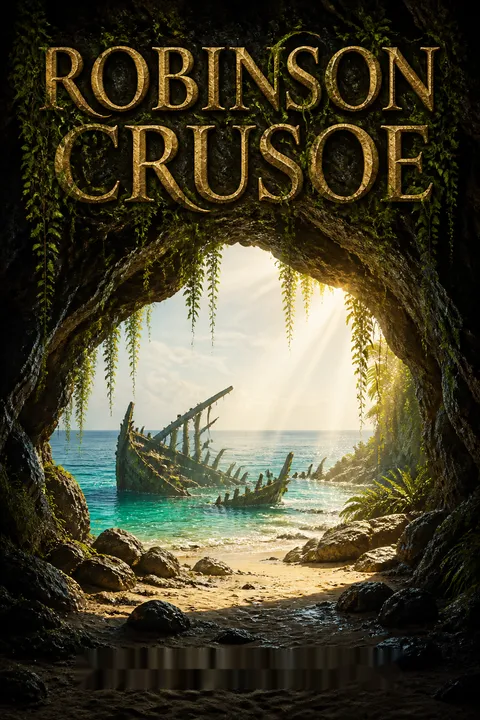
Crusoe leaves his growing plantation in 1659 to manage the trading side of a voyage intended to bring enslaved Africans to Brazil. A hurricane drives the ship far off course, and a second storm pushes it onto a shoal. The crew escapes in a small boat, but a breaking wave scatters them; Crusoe alone reaches land alive.
He wakes on an unfamiliar island without food, tools, or company, and spends his first night in a tree, afraid of animals he cannot see. The wreck lies offshore, close enough to promise supplies but too distant to reach safely at first. His survival has begun as a reprieve with no clear means of lasting.
The wreck is not simply punishment imposed from outside. Crusoe has chosen the voyage that abandons a secure livelihood and repeats his earlier refusal of restraint. Yet the storm also breaks the logic of moral accounting: the crew dies together, while the man who narrates his life survives. Alone, Crusoe must turn chance into work before he can make sense of it. The island removes the social measures of wealth and status, leaving only the immediate question of what his hands can preserve.
The Wreck Becomes a Storehouse
At low tide, Crusoe swims to the stranded ship and finds its stores largely intact. He builds rafts from spare timber, hauling biscuits, weapons, powder, clothes, carpentry tools, sails, rope, and other supplies back to shore over repeated trips. When a storm finally destroys the ship, he has already carried away what he can manage.
He chooses a sheltered site beneath a rock, raises a fenced enclosure, pitches a tent, and digs a cave for storage. The work is slow and physically punishing, but each salvaged tool expands what he can do next. The island becomes less an empty landscape than a difficult inventory he must learn to use.
Crusoe’s first durable resource is not a miraculous rescue but the disciplined conversion of wreckage into capacity. Tools, powder, and food are valuable because they can be used, not because they possess exchange value. This distinction will later make his gold seem absurd. The repeated trips also establish his characteristic response to fear: he reduces an overwhelming situation into tasks with visible results. His enclosure protects him, but it also marks the beginning of a private world organized around possession, labor, and control.
Fever Opens a New Reckoning
Crusoe keeps track of days with notches and begins a journal as he makes his shelter more secure. He discovers that stray barley and rice have sprouted from grain shaken out of a ship’s bag, then saves the seeds for future planting. An earthquake shakes his home, forcing him to reinforce the cave and consider moving.
Soon afterward, a severe fever leaves him weak, thirsty, and frightened of dying without help. During the illness, a dream and the memory of his father’s warning sharpen his remorse. Reading the Bible he salvaged from the wreck, Crusoe begins praying and treats his recovery as a gift, even though the island itself remains unchanged.
The island does not produce faith through isolation alone. Crusoe has experienced storms, earthquakes, and survival without lasting reflection; sickness finally narrows his attention to dependence. The Bible becomes meaningful because it enters a life where self-sufficiency has reached its limit. His spiritual change is also practical: he begins to read, pray, and interpret his circumstances differently. The distinction between being physically delivered and feeling delivered from guilt gives his inner transformation a specific shape, rather than making religion a simple solution to loneliness.
Bread Takes Years to Make
Crusoe surveys the island, finds fruit and fertile valleys, and begins cultivating barley and rice. His first sowing fails in the dry season; the next crop succeeds after he learns when the rains will come. Goats, birds, and imperfect tools repeatedly threaten the harvest, so he builds fences and makes traps.
He teaches himself to weave baskets, shape clay pots, grind grain in a wooden mortar, and bake bread under heated earthenware. These inventions take months, and none works neatly at first. He also cuts down a large tree to carve an ambitious canoe, only to find he cannot move it to the water. The crop survives; the boat does not become a route out.
The labor of bread-making gives Crusoe a new measure of value: a harvest depends on timing, protection, processing, and patience, not merely possession of land. Each improvised tool is a small correction to his earlier confidence that desire itself can solve a problem. The immovable canoe is a particularly exact lesson. Crusoe can complete the object he imagines while neglecting the conditions that make it useful. His competence grows through repeated limits, not through an effortless mastery of nature.
A Current Nearly Takes Him
After years of work, Crusoe builds a smaller canoe and digs a canal to bring it to the creek. He sails around part of the island, but a powerful current pulls him away from shore and nearly carries him out to sea. Watching the water and wind carefully, he finds an eddy that returns him to land.
The danger makes his island feel precious rather than merely confining. He later learns to catch goats alive, breeds a tame herd, and adds milk, butter, and cheese to his food supply. With dependable provisions and several secure retreats, he can live comfortably for a time, though his desire for human company has not disappeared.
Crusoe’s near-loss of the island reverses his usual longing for elsewhere. Only when home is physically slipping away does he recognize what years of labor have made possible. His goat herd extends that achievement from stored resources to renewable provision, reducing his dependence on gunpowder and luck. The episode therefore joins psychological and material security: the island feels safer because Crusoe has learned to sustain himself there, yet that security cannot answer his need for another human presence.
A Footprint Breaks the Quiet
After roughly fifteen years on the island, Crusoe finds a clear human footprint in the sand. He retreats to his fortified home, imagining attackers before he knows whether anyone is nearby. Searching the coast later, he discovers human bones and the remains of fires used by visitors who have eaten captives.
The finding explains the print and confirms that the island is not entirely beyond human reach. Crusoe strengthens his defenses, hides his stores, and establishes a second, concealed enclosure for goats. He considers attacking the visitors, then concludes that they have not harmed him and that he has no right to appoint himself their executioner.
The footprint turns solitude into surveillance: Crusoe’s first response is not relief at evidence of other people, but fear that his hidden life can be breached. The bones then force him to confront a practice he finds horrifying, while his own wish to kill the visitors exposes how easily disgust becomes a claim to authority. His decision to refrain is a genuine moral check, but it does not erase his assumptions about cultural superiority. The episode makes fear both a protective signal and a force that distorts judgment.
A Ship Dies on the Rocks
In his twenty-third year on the island, Crusoe sees a fire on the shore and hides until the visitors leave. Months later, during a storm, guns sound from offshore. He lights a signal fire, then sees a Spanish ship wrecked on the submerged rocks that once nearly carried him away.
He paddles out hoping to find survivors, but the only living creature aboard is a starving dog; two sailors lie dead, and the cargo is mostly ruined. Crusoe brings the dog, useful supplies, clothes, and a large quantity of Spanish money back to the island. The money cannot buy food or companionship, so the wreck deepens his awareness of what he lacks.
The wreck makes Crusoe face the limit of solitary competence: he can reach the ship and salvage objects, but he cannot save the people who might have changed his life. His longing for a survivor is more urgent than his interest in money, even as he carries the coins home. The episode also complicates his earlier sense of providential protection. The same rocks that made his escape possible have destroyed another crew, so survival remains a circumstance, not a proof that he controls the world.
Friday Runs Toward the Castle
After dreaming that he will save a captive, Crusoe watches a group of visitors bring prisoners ashore. One captive escapes and runs toward his hidden settlement. Crusoe intercepts the pursuers, knocks one down, and shoots another; the fugitive then kills the stunned attacker with Crusoe’s sword.
Crusoe takes him to safety, gives him food and clothing, and names him Friday after the day they met. Friday shows gratitude and quickly learns simple English, while Crusoe begins teaching him how to work around the settlement. For the first time in decades, Crusoe has another person beside him, but the relationship begins under Crusoe’s authority and with Friday dependent on his protection.
Friday’s arrival answers Crusoe’s long deprivation of company, but the scene is structured by unequal power. Crusoe controls the weapons, shelter, name, and language through which their relationship first takes shape. Friday’s gratitude is real, yet the narrative’s presentation of it cannot be separated from the fact that Crusoe has just saved his life. Their connection will develop into affection and practical cooperation, while retaining the master-servant hierarchy Crusoe assumes rather than questions.
Friday Becomes a Teacher Too
Crusoe teaches Friday to cook meat and make bread, and Friday’s help allows them to expand their crops. As Friday learns English, he explains that his people have rescued seventeen white men from a wreck and keep them alive on the mainland. When Friday expresses a wish to return home, Crusoe fears he may lose his companion, but Friday makes clear that he wants Crusoe to come with him.
He also offers to introduce Crusoe to his people. Friday’s questions about God challenge Crusoe’s religious explanations, making the lessons less one-sided than Crusoe expects. The possibility of reaching the stranded Europeans gives Crusoe a practical reason to build a larger boat.
Language becomes the bridge between immediate survival and a possible future beyond the island. Crusoe teaches Friday his own practices, but Friday’s questions expose gaps in Crusoe’s understanding and unsettle the teacher’s sense of authority. His offer to return with Crusoe also reverses the expected direction of dependence: Friday is not simply someone to be kept, but someone with knowledge, family, and a world beyond Crusoe’s enclosure. The boat plan grows from this shared horizon, even as Crusoe still imagines escape largely on his own terms.
Friday Finds His Father
Before Crusoe and Friday can attempt the mainland crossing, visitors arrive with three captives. Crusoe and Friday attack them, rescue a Spanish prisoner, and discover that another captive is Friday’s father. Friday’s reunion with his father overwhelms him; he tends the older man while Crusoe brings both survivors to shelter.
The Spaniard explains that other Europeans from his wreck still live among Friday’s people, though they lack tools and food. Crusoe begins planning to bring them to the island, but the group agrees that they must first grow enough grain to support more mouths and provision a voyage. The rescue turns Crusoe’s private household into a small, precarious community.
The father’s rescue gives Friday a relationship that predates and exceeds his bond with Crusoe. His attention shifts immediately from service to care for his own family, showing that his loyalties are not possessions Crusoe can command. The Spaniard’s account widens the story from two survivors to a stranded community. Yet the proposed rescue depends on material preparation, not benevolent feeling alone. Food stores become the condition for solidarity, tying Crusoe’s practical habits to a more collective purpose.
A Strange English Sail Appears
Crusoe, Friday, Friday’s father, and the Spaniard enlarge their fields and raise a harvest intended to feed the Europeans across the water. Once their stores are secure, the Spaniard and Friday’s father leave to bring the others back. Before they return, an English ship anchors nearby.
Crusoe sees a longboat land eleven men, including three prisoners, and suspects trouble when the crew treats the captives violently. He approaches the prisoners and learns that the ship’s captain has been deposed by a mutiny. The captive commander agrees to Crusoe’s conditions: the islanders will follow Crusoe’s orders, and the captain will carry him home if they can recover the ship.
The English ship offers the rescue Crusoe has imagined for years, but its arrival first presents a familiar danger in an unfamiliar form. The threat is not a distant pirate or an imagined visitor, but fellow Europeans using violence against their own commander. Crusoe’s decision to help follows a careful calculation: he secures promises before lending weapons. This is a turning point from passive hope to political action, with his hidden settlement and accumulated resources suddenly giving him leverage over people who arrived believing themselves in control.
The Governor Retakes the Ship
Crusoe and the captain’s loyal men first disarm the shore party, then use false signals and carefully timed ambushes to separate the mutineers from their boats. Crusoe refuses to kill men who surrender, though the boatswain and the new rebel commander are killed during the fighting.
The remaining rebels give up their weapons and agree to help recover the ship. The captain’s party boards at night, overpowers the crew, and kills the rebel commander after he resists. Seven gunshots signal success to Crusoe, who sees the ship brought within reach of the island. After twenty-eight years, a way home is finally in his hands.
The climax depends less on brute force than on Crusoe’s ability to read terrain, manage information, and make a small group appear larger than it is. His conduct is not purely merciful: he accepts lethal violence when he believes it necessary, but he distinguishes surrender from continued resistance. The captain’s restoration of command also echoes Crusoe’s own earlier rebellions, now viewed from the position of a man asked to judge them. Rescue arrives through disciplined cooperation, not through solitary ingenuity alone.
Twenty-Eight Years End
Before sailing, Crusoe releases several mutineers who choose to remain on the island and equips them with weapons, seeds, and instructions for farming, baking, and keeping goats. Two later beg to rejoin the ship after conflict with the others; the captain takes them aboard. Crusoe departs in December 1686, carrying his old cap, umbrella, parrot, and the money that had been useless there.
He reaches England in 1687 after thirty-five years away. His parents are dead, and only two sisters and a brother’s children remain; nobody has kept a place for him. The captain whose life he saved rewards him, but Crusoe must still decide what kind of homecoming is possible.
Leaving the island is not a clean reversal of captivity. Crusoe returns to a country that has continued without him, and his family’s absence strips the homeward journey of its imagined emotional reward. His choice to leave supplies and practical knowledge for the remaining mutineers shows how far his habits have shifted from private accumulation toward stewardship. Yet the relics he carries preserve the identity he formed in isolation. He has escaped the island, but cannot simply return to the life he abandoned.
Fortune Waits in Lisbon
Crusoe travels to Lisbon to learn what became of his Brazilian plantation. The elderly Portuguese captain who once rescued him explains that the estate has prospered and produces income despite Crusoe’s long absence. Records and trustees confirm his claim; the captain also returns money he had held for Crusoe and lends him a hand in recovering the rest.
Crusoe repays the captain and arranges an annuity for him and his son. He then crosses Europe by land rather than risk another sea voyage. In the Pyrenees, Friday saves the guide from a wolf, and later draws a bear into a tree before killing it. Crusoe reaches England, restores his finances, marries, and raises three children.
The recovered plantation converts Crusoe’s past into wealth, but the episode’s emotional center is not the balance sheet. The Portuguese captain’s honesty gives Crusoe a model of loyalty that survives distance and misfortune, and Crusoe answers it through repayment rather than mere gratitude. Friday’s actions during the mountain journey show his expertise in a landscape foreign to Crusoe, reversing the earlier pattern of Crusoe as sole instructor. The return to prosperity is real, yet it does not extinguish the wandering impulse that has shaped Crusoe’s life.
The Island Becomes a Colony
After his wife dies, Crusoe joins his adventurous nephew on an East Indies voyage and revisits the island in 1694. The Spaniards he once hoped to rescue have become settlers there, joined by the Englishmen he left behind. Crusoe hears how the groups struggled, made peace, and fought off attacks from Carib visitors.
He divides the land among the settlers and brings tools, weapons, livestock, and a carpenter and smith; from Brazil, he sends more people and supplies, including women and farm animals. The island that once held one frightened castaway now supports families and a growing community. Crusoe leaves them provisioned, while the account closes with their continued life there.
The final return transforms the island from a personal proving ground into a social world. Its survival no longer depends on Crusoe’s solitary labor, and its future rests on negotiated land, shared skills, families, and defense. That development is also ethically uneasy: Crusoe continues to speak as owner and governor, distributing territory and directing migration. The ending therefore offers both a measure of growth and a continuation of colonial authority. His achievement is not simply that he escaped, but that his private refuge became a place other people could inhabit.
Analysis
Robinson Crusoe organizes adventure around a repeated test: whether desire can be made answerable to consequence. Crusoe leaves home because a moderate life feels too small, then repeatedly discovers that wanting escape, wealth, or speed does not make a plan workable. The island makes this pattern visible in material terms. Food requires seasons, tools require invention, and even a well-made canoe is useless if it cannot reach water. His survival is not a triumph of effortless mastery, but a long education in limits.
The novel’s solitude is both physical condition and moral laboratory. Crusoe first interprets hardship as misfortune, then gradually reads it through religious repentance and gratitude. That change gives him comfort, but the narrative does not make his judgment uniformly generous. He admires Friday’s intelligence and affection while treating him as a subordinate; he condemns the visitors’ violence while confronting his own impulse to kill them. Crusoe’s growing self-command is real, but it coexists with assumptions of cultural and economic authority.
The book also ties personal survival to colonial systems. Crusoe’s Brazilian success depends on plantation labor, and he willingly joins an expedition to acquire enslaved Africans. His later island settlement extends his power over land and people, even as it brings tools, families, and shared work. That contradiction matters: the novel’s ideal of industrious self-sufficiency is never purely private. Crusoe’s life is sustained by trade, extraction, and human relationships, including relationships he does not initially recognize as equal.
By the end, the island has changed from a place where Crusoe must manufacture order alone into a community whose future depends on collective labor. The transformation is hopeful but not innocent. Crusoe has learned dependence, gratitude, and care, yet still imagines himself as the person entitled to distribute land and direct others. The story’s deepest tension lies there: survival teaches him humility before circumstance, but not complete humility about power.
Review Summary
Robinson Crusoe receives mixed reviews, with some praising its historical significance and compelling survival story, while others criticize its outdated colonial attitudes and tedious details. Many readers appreciate the protagonist's resourcefulness and spiritual journey, but find the writing style challenging. Some view it as a timeless adventure tale, while others see it as boring and problematic by modern standards. The book's impact on literature and popular culture is widely acknowledged, despite its controversial aspects.
People Also Read









Characters
Robinson Crusoe
Restless son turned survivorCrusoe is an ambitious, self-reliant narrator whose longing to travel repeatedly overrules prudent advice. He tends to treat desire as evidence that a risk is worth taking, then responds to the consequences with intense practical effort. On the island, he becomes a farmer, maker, keeper of records, and teacher, while his private reflections shift from self-pity toward gratitude and religious commitment. His resourcefulness is genuine, but so is his habit of claiming authority over people and places he encounters. The tension between his growing capacity for care and his confidence in command shapes both his relationships and his changing understanding of what it means to be secure.
Friday
Companion and quick learnerFriday is an Indigenous man whose life intersects with Crusoe’s after he escapes captivity. He is physically capable, observant, affectionate, and quick to learn new tasks, but he also brings knowledge, loyalties, and a history of his own. Crusoe teaches him English and European practices; Friday’s questions and explanations in turn challenge Crusoe’s assumptions. His loyalty is often expressed through practical care, especially toward his family, and he wants a future that includes more than service to Crusoe. The relationship develops into real companionship while remaining unequal, since Crusoe controls the shelter, weapons, and terms under which Friday first enters his household.
Xury
Fellow escapee and sailorXury is a young enslaved boy who helps Crusoe escape from Sallee. He is brave, loyal, and resourceful, especially when finding water and navigating danger along the African coast. Crusoe values his help but ultimately transfers him to the Portuguese captain under an agreement that makes future freedom conditional. Xury’s brief presence exposes the gap between Crusoe’s desire for liberty and his willingness to accept another person’s unfreedom.
Crusoe’s father
Voice of cautious stabilityCrusoe’s father argues that a secure, moderate life can offer more happiness than the hazards of ambition or poverty. He is grave, affectionate, and attentive to his son’s temperament, using the fate of an older son as a warning against reckless departure. His advice remains important because Crusoe remembers it whenever hardship forces him to reconsider his choices.
Crusoe’s mother
Protective family anchorCrusoe’s mother understands his determination to leave but refuses to help him act against his father’s judgment. Her refusal reflects concern rather than indifference: she will not lend her consent to a choice she believes will harm her son.
The Guinea captain
First honest sailing mentorThe captain who first takes Crusoe to Guinea treats him as a companion and teaches him navigation and trade. His fairness helps Crusoe make an early profit and gives the young man practical knowledge. The captain’s example briefly shows Crusoe a safer way to learn the sea, though Crusoe does not hold to it.
The Portuguese captain
Rescuer and honest creditorThe Portuguese captain rescues Crusoe and Xury at sea, then carries Crusoe to Brazil and gives him generous, careful assistance. Years later, his honesty remains intact despite his own financial difficulties. He is a counterweight to Crusoe’s suspicion of other people: practical, charitable, and scrupulous about debts and promises.
The widow
Faithful keeper of fundsThe widow of Crusoe’s first Guinea captain safeguards money he leaves in England and helps maintain his connection to home. Her care is steady and trustworthy, even while her own circumstances become difficult. Crusoe remembers her past help and seeks to repay it when he has the means.
Wells
Brazilian planter neighborWells is Crusoe’s neighboring planter in Brazil. Their sociable relationship gives Crusoe a companion in his early years of cultivation and places his developing plantation within a community of fellow settlers.
The Spanish survivor
Castaway and cautious envoyThe Spaniard is a shipwreck survivor who has endured hardship among Friday’s people. He is candid about the dangers facing his stranded countrymen and advises Crusoe to secure enough food before attempting a rescue. His caution and practical judgment help turn Crusoe’s wish to escape into a plan that considers the needs of others.
Friday’s father
Elder and family anchorFriday’s father is an older captive who has survived years among the people who brought him to the island. His relationship with Friday reveals the depth of Friday’s family ties and gives Crusoe information about the wider community across the water. He is a source of local knowledge and a reminder that Crusoe’s companion belongs to a world beyond the island.
The English captain
Mutiny’s dispossessed commanderThe English captain arrives as a prisoner after his crew mutinies. He is restrained under pressure and willing to negotiate, accepting Crusoe’s conditions in exchange for help. His command experience complements Crusoe’s knowledge of the island, making their cooperation essential when the mutiny spreads from shore back to ship.
Will Atkins
Ringleader among mutineersAtkins is one of the mutineers singled out by the captain as especially dangerous. His defiance and past violence make him a source of tension during the effort to regain control of the ship.
Poll
Parrot companion and mimicPoll is Crusoe’s parrot, whom he patiently teaches to repeat his name and familiar phrases. The bird gives sound and routine to a life otherwise marked by silence, becoming a small but vivid presence in Crusoe’s household.
Crusoe’s dog
Shipwreck’s loyal animal companionThe dog swims ashore after the shipwreck and remains a companion during Crusoe’s early years on the island. He offers affection and practical help, though he cannot replace the human conversation Crusoe misses.
Crusoe’s nephew
Young sailor and later partnerCrusoe’s nephew is an enterprising young sailor whom Crusoe helps establish in a maritime career. His later voyages rekindle Crusoe’s appetite for travel and draw him back toward adventure after a period of settled family life.
The Sallee captor
Master during Crusoe’s captivityThe Sallee captor keeps Crusoe as an enslaved worker after pirates seize his ship. He uses Crusoe for domestic labor and boating, creating the conditions Crusoe studies while waiting for an opportunity to escape.
The mutinous boatswain
Shipboard mutiny leaderThe boatswain leads the mutinous party that comes ashore with the captain as a prisoner. His role makes the mutiny a direct threat to Crusoe’s safety and to the captain’s attempt to regain the ship.
Plot Devices
The Stranded Ship
Turns wreckage into toolsThe ship stranded near the island gives Crusoe a narrow window to recover provisions, weapons, clothing, and equipment before the sea destroys it. Salvage is more than a supply of objects: the tools let him build shelter, cultivate food, and defend himself. The Spanish wreck later repeats the pattern on a smaller scale, bringing a dog and useful goods but no surviving crew. In both episodes, what the sea returns can sustain Crusoe, but it cannot restore the human company he wants.
The Notched Calendar
Measures life in isolationCrusoe cuts notches into a post to keep track of days, weeks, and years after realizing that isolation could erase his sense of time. His journal records labor, weather, sickness, and changes in belief while ink lasts. These records make the island legible to him and preserve a sequence of events he can later recount. Their eventual limits also matter: Crusoe loses track of some dates, showing that even his system of order depends on fragile materials and memory.
Crops and Goat Herds
Builds renewable survivalA few grains spilled from a ship’s bag sprout on the island, giving Crusoe seed for barley and rice. Through failed sowings, improvised tools, and careful protection from animals, he develops a regular harvest and learns to make bread. Traps and enclosures let him breed goats, eventually supplying meat and milk without constant hunting. These systems change survival from a daily gamble into planned work and later make it possible to feed a larger group. They also require Crusoe to think beyond his own immediate needs.
The Footprint
Makes solitude feel watchedA single human footprint in the sand disrupts Crusoe’s belief that the island is empty. He first considers supernatural explanations, then finds evidence of visitors who have eaten captives. The print changes his habits: he hides his work, builds stronger defenses, conceals his animals, and watches the coast. It also establishes the danger that shapes his later decisions about the visitors and prepares the ground for the encounters that bring Friday and other survivors into his life.
The English Ship
Turns waiting into actionThe English ship appears after years of Crusoe hoping to see a vessel, but its crew has mutinied and brought its captain ashore as a prisoner. The ship is therefore both a possible route home and a threat that must be assessed. Crusoe uses his knowledge of the island, his weapons, and carefully staged signals to help the captain regain control. The ship finally makes departure possible, while its arrival tests whether Crusoe’s resourcefulness can work with other people rather than only against the island.
FAQ
Synopsis & Basic Details
What is Robinson Crusoe about?
- Man marooned, fights to live: Robinson Crusoe, shipwrecked on a desert island, uses his resourcefulness and ingenuity to survive for over two decades.
- Self-reliance and transformation: The story chronicles his physical and spiritual journey as he builds a life, confronts solitude, and ultimately finds redemption.
- Encounter and companionship: Crusoe's isolation ends with the arrival of Friday, a native he rescues, leading to a complex relationship exploring themes of civilization and colonialism.
Why should I read Robinson Crusoe?
- Classic adventure tale: It's a foundational adventure story, inspiring countless tales of survival and exploration.
- Exploration of human nature: The novel delves into themes of self-reliance, perseverance, and the human need for connection.
- Historical and cultural insights: It offers a glimpse into 18th-century views on colonialism, religion, and the individual's place in the world.
What is the background of Robinson Crusoe?
- Inspired by real events: The novel was inspired by the true story of Alexander Selkirk, a Scottish sailor who was marooned on a desert island for four years.
- Colonial context: The story reflects the era's interest in exploration, trade, and the relationship between Europe and the rest of the world.
- Religious and philosophical ideas: Defoe explores themes of sin, redemption, and the individual's relationship with God, reflecting the religious climate of his time.
What are the most memorable quotes in Robinson Crusoe?
- "All our discontents...thankfulness": This quote encapsulates the theme of appreciating one's blessings, highlighting Crusoe's eventual gratitude for his survival.
- "I might be more happy...world": This quote reflects Crusoe's evolving perspective on happiness, finding contentment in his solitary life despite its hardships.
- "That all the good things...use": This quote speaks to the futility of excess and the importance of appreciating what one needs, a lesson Crusoe learns through his isolation.
What writing style, narrative choices, and literary techniques does Daniel Defoe use?
- First-person narrative: Defoe employs a first-person perspective, creating a sense of immediacy and realism, drawing the reader into Crusoe's experiences.
- Detailed realism: The novel is characterized by its meticulous descriptions of Crusoe's daily life, tools, and surroundings, lending credibility to the narrative.
- Didactic tone: Defoe often uses Crusoe's reflections to impart moral and religious lessons, reflecting the author's own beliefs and values.
Hidden Details & Subtle Connections
What are some minor details that add significant meaning?
- The salvaged Bible: The Bible, initially just another item salvaged, becomes Crusoe's source of solace and spiritual guidance, highlighting the theme of redemption.
- The footprint in the sand: This single detail shatters Crusoe's sense of security and forces him to confront the possibility of other inhabitants, driving the plot forward.
- The growing corn: The unexpected growth of corn from discarded chicken feed symbolizes hope and the potential for life to flourish even in desolate circumstances.
What are some subtle foreshadowing and callbacks?
- Father's warnings: Crusoe's father's initial warnings about the dangers of a seafaring life foreshadow the hardships and isolation he later experiences.
- Dreams of rescue: Crusoe's recurring dreams of rescue provide a glimmer of hope throughout his years of solitude, sustaining him during difficult times.
- Echoes of the storm: The initial storm that shipwrecks Crusoe is mirrored in later storms, reminding him of his vulnerability and dependence on nature's forces.
What are some unexpected character connections?
- The captain's son: The captain who rescues Crusoe in Africa later has a son who aids Crusoe in Brazil, demonstrating a recurring theme of unexpected kindness.
- The English widow: The widow who faithfully manages Crusoe's money in England represents a connection to his past life and a source of unexpected support.
- The Spanish captain: The Spanish captain rescued from the cannibals creates a link to the larger world and foreshadows future interactions with other cultures.
Who are the most significant supporting characters?
- Friday: Friday's loyalty and companionship transform Crusoe's life, challenging his prejudices and providing him with a sense of purpose.
- The Portuguese Captain: This character's generosity and honesty are crucial to Crusoe's survival and success, representing the potential for human kindness.
- Crusoe's father: Though absent, his wisdom and warnings resonate throughout the story, shaping Crusoe's reflections and moral development.
Psychological, Emotional, & Relational Analysis
What are some unspoken motivations of the characters?
- Crusoe's restlessness: Beyond adventure, Crusoe's desire for the sea may stem from a need to escape societal expectations and forge his own identity.
- Friday's devotion: Friday's unwavering loyalty to Crusoe may be rooted in a desire for protection and a longing for a father figure.
- The mutineers' desperation: The mutineers' actions are driven by a fear of punishment and a desire for freedom, highlighting the complexities of human motivation.
What psychological complexities do the characters exhibit?
- Crusoe's ambivalence: Crusoe struggles with conflicting desires for solitude and companionship, reflecting the inherent human need for both independence and connection.
- Friday's internalized colonialism: Friday's ready acceptance of Crusoe's worldview reveals the psychological impact of colonialism and the power dynamics between colonizer and colonized.
- The captain's guilt: The captain's willingness to help Crusoe may be driven by a sense of guilt over his past actions and a desire for redemption.
What are the major emotional turning points?
- The footprint discovery: This event triggers intense fear and paranoia, forcing Crusoe to confront his vulnerability and the potential for danger.
- Friday's arrival: This encounter brings joy, companionship, and a renewed sense of purpose, transforming Crusoe's solitary existence.
- The shipwreck rescue: This event offers Crusoe a chance to return to civilization and reclaim his life, filling him with hope and gratitude.
How do relationship dynamics evolve?
- Crusoe and Friday: Their relationship evolves from master and servant to a deep friendship based on mutual respect and understanding, challenging traditional power dynamics.
- Crusoe and his father: Their relationship is characterized by conflict and regret, highlighting the challenges of generational differences and the consequences of disobedience.
- Crusoe and the mutineers: Their relationship shifts from captor and captive to a complex dynamic of power, negotiation, and the potential for redemption.
Interpretation & Debate
Which parts of the story remain ambiguous or open-ended?
- The nature of Friday's conversion: The extent to which Friday truly understands and embraces Christianity is open to interpretation, raising questions about cultural assimilation.
- Crusoe's ultimate fate: The novel ends with Crusoe contemplating further adventures, leaving his future uncertain and open to speculation.
- The morality of colonialism: The novel's portrayal of colonialism is complex and debatable, prompting discussions about power, exploitation, and cultural exchange.
What are some debatable, controversial scenes or moments in Robinson Crusoe?
- Crusoe's treatment of Friday: Crusoe's initial view of Friday as a servant raises questions about colonialism, racism, and the ethics of power dynamics.
- The violence against the cannibals: Crusoe's decision to attack the cannibals is a controversial moment, prompting debate about the justification of violence and cultural intervention.
- Crusoe's religious justifications: Crusoe's use of religion to justify his actions can be seen as both a source of strength and a form of self-deception, sparking debate about faith and morality.
Robinson Crusoe Ending Explained: How It Ends & What It Means
- Wealth and family: Crusoe returns to England a wealthy man, reconnects with his sisters, and starts a family, suggesting a return to societal norms.
- Restless spirit: Despite his newfound comfort, Crusoe feels a pull towards further adventures, indicating that his desire for exploration remains unfulfilled.
- Ambiguous future: The ending leaves Crusoe's ultimate fate open, suggesting that his journey of self-discovery and adventure is never truly over.
Robinson Crusoe Series
Download PDF
Download EPUB
.epub digital book format is ideal for reading ebooks on phones, tablets, and e-readers.








