

Key Takeaways
Use psychedelic experience to investigate mind, without mistaking intensity for evidence.
A strange trip became a research problem. In 1971, brothers Terence and Dennis McKenna traveled to the Upper Amazon to study psychoactive plants and shamanic practice. Their expedition did not reach its intended destination. Instead, experiences involving a local mushroom became the starting point for a theory connecting brain chemistry, consciousness, and time. Dennis pursued molecular explanations; Terence developed a cosmology around the I Ching and historical change.
The wager was ambitious. The book treats psychedelic states as potentially valuable probes of mind, not merely as symptoms or curiosities. Its authors try to join first-person experience with biology and philosophy. The strongest lasting question is whether neuroscience can explain the felt reality of altered consciousness. The book's answers are far less secure than its question.
What's valuable here is the insistence that subjective experience belongs in a science of mind, rather than being dismissed as noise. But vividness is not a truth test: dreams, pain, and perceptual illusions can feel utterly certain while misleading about their causes. A useful distinction is between experience as data about what consciousness can do and interpretation as a claim about what exists outside it. The first deserves careful study; the second requires independent evidence.
Study the shaman as a trained mediator, not simply a person in crisis.
Training changes the comparison. The book describes shamans as healers and guides who deliberately enter altered states to serve their communities. Initiation may involve illness, isolation, or visions, but it also includes instruction in ritual, healing, and the use of plants. The authors contrast this with schizophrenia, especially episodes marked by withdrawal, overwhelming inner experience, and difficulty returning to ordinary life.
Social meaning matters. In the authors' account, a shaman is not defined by unusual experiences alone, but by the ability to integrate them and function in a recognized role. They argue that cultural acceptance can help shape how such experiences are understood. They also acknowledge that not every shaman has a history of mental illness, and that the analogy is not an identity.
This comparison usefully shifts attention from bizarre content to integration, agency, and social role. Contemporary cultural psychiatry likewise cautions that distress and impairment cannot be judged without context. Yet the contrast should not romanticize psychosis as an unrecognized spiritual calling: severe mental illness can be disabling regardless of cultural interpretation. The more careful lesson is that communities influence the meaning and management of unusual states, while clinical suffering still requires attention to the person's safety and needs.
Model living minds as organized processes, not piles of molecules.
Organization is the central issue. Drawing on process philosophy, especially Alfred North Whitehead, the authors argue that living things are not fixed collections of material parts. A body remains recognizably itself while metabolism continually replaces its components. Its identity is better understood as an ongoing pattern of activity than as a particular set of atoms.
Mind belongs in that picture. The authors propose that mental life arises within the organized activity of an organism and cannot be fully explained by listing its smaller parts. This does not make biology irrelevant. It means that an explanation of a whole system may need concepts that describe its organization, history, and internal coordination, as well as the chemistry beneath it.
The process view offers a productive alternative to the misleading image of a mind assembled from inert components. In systems biology, similar reasoning explains why interactions and feedback can produce properties absent from isolated parts. Such emergence does not require a nonphysical mind; it can identify levels of explanation that reduction alone leaves out. The useful challenge is to specify which organizing principles matter and how they can be tested, rather than treating wholeness as an explanation in itself.
Use holography as a model of distributed memory, not a proven brain blueprint.
A hologram stores patterns across a surface. Unlike an ordinary photograph, a hologram can retain an image in fragments, although smaller fragments lose detail. The book uses this as an analogy for memory distributed through brain tissue rather than stored in one tiny location. It discusses Karl Lashley's experiments, in which removing portions of animal brains did not simply erase particular learned behaviors, and Paul Pietsch's reported rearrangements of salamander brain tissue.
The analogy grows speculative. The authors extend holographic organization from brain to mind, then to DNA and the structure of reality. They suggest that each part may in some sense reflect a larger whole. The analogy makes distributed storage imaginable, but it does not establish that the brain literally records memories as optical holograms.
The hologram is memorable because it turns a difficult idea, distributed representation, into something visual. Modern neuroscience also treats memory as involving networks rather than a single filing cabinet in the brain. Still, distributed representation is not the same as holographic storage: neural networks can be robust to damage without every fragment containing a complete memory. The analogy is most useful when it generates questions about redundancy and resilience, and least useful when metaphor is mistaken for mechanism.
Separate molecular questions from the book's speculative quantum machinery.
The chemistry starts with real analogies. Many hallucinogens discussed in the book resemble neurotransmitters such as serotonin. The authors review research on neurotransmitter activity, monoamine oxidase, and the possibility that some compounds bind to nucleic acids. These topics prompt a reasonable question: how can small changes in brain chemistry alter the character of conscious experience?
Their proposed answer outruns the evidence. They hypothesize that tryptamines and harmine interact with RNA or DNA, produce electron spin resonance signals, and help create a molecular readout of memory or consciousness. They also invoke superconductivity. These are presented as speculative mechanisms, not demonstrated explanations of psychedelic experience. The book's enduring contribution is the question of how molecules and subjective states connect, not proof that its proposed pathway exists.
The authors are right that pharmacology can reveal how fragile and biologically grounded ordinary perception is. But a resemblance between two molecules, or a laboratory binding result, does not by itself establish a pathway from that interaction to conscious thought. Modern psychedelic research investigates receptor activity, brain networks, and subjective reports through methods that allow competing explanations to be compared. The gap between molecular event and lived experience remains important, but naming a quantum mechanism does not bridge it without reproducible evidence.
Treat La Chorrera's visions as real experiences, not proof of aliens.
The experiment became an ordeal. At La Chorrera, the brothers explored tryptamine-containing mushrooms and ayahuasca, and attempted to amplify unusual sounds they associated with altered states. After an experiment in March 1971, they reported sensing an unseen intelligence and developing elaborate ideas about time, space, and humanity's future. One brother described eleven days without sleep; both said their thinking and personalities changed dramatically.
They made the experience part of the theory. The authors interpreted the visions as possible evidence that their molecular experiment had opened access to a larger informational reality. They also recognized similarities to the forms of altered thinking they had discussed in relation to schizophrenia. Their account is a report of intensely felt events, followed by an interpretation that cannot be verified from the experience alone.
First-person accounts can preserve details that standardized measures miss, including fear, wonder, and the sense that an experience is autonomous. They are essential records of phenomenology, but not independent confirmation of the entities or mechanisms perceived. Sleep loss and shared expectation can also shape interpretation, without making the experience unreal to those undergoing it. The disciplined response is neither ridicule nor credulity: take the experience seriously, then test claims about its external cause separately.
Read the I Ching sequence as a pattern-making hypothesis, not a clock.
The numbers invited a calendar. The I Ching contains sixty-four six-line figures, or hexagrams. The authors focus on the King Wen sequence, an old ordering of those figures, and note that sixty-four multiplied by six gives 384. Thirteen lunar cycles total about 383.9 days, a close numerical match. They also examine patterns in the transitions between hexagrams and suggest that the sequence may encode a calendar and larger astronomical cycles.
A fit is not a provenance. The book proposes that ancient Chinese thinkers may have used this structure to model time, including cycles associated with sunspots and the precession of the equinoxes. But the numerical correspondences do not demonstrate that the sequence was designed as such a calendar. The authors are reconstructing a possible use from the pattern they perceive.
The passage from symbolic order to a mathematical hypothesis is intellectually adventurous. It also illustrates a familiar risk in pattern analysis: a striking match can emerge after many possible numbers, cycles, and comparisons have been explored. The strength of the proposal depends on constraints set in advance and on evidence independent of the pattern itself, such as historical records or successful predictions. Without those, an intriguing correspondence remains a prompt for investigation, not evidence of ancient astronomical intent.
The 2012 Timewave forecast makes the book's boldest claim its clearest test.
The wave tracks novelty. The authors convert changes in the King Wen sequence into a numerical pattern, then arrange that pattern in nested cycles called a modular hierarchy. In their model, time alternates between novelty, meaning new forms and connections, and habit, meaning established patterns. Timewave Zero software displays the proposed fluctuations across spans ranging from days to millennia.
The endpoint was specific. The authors aligned their wave with historical events and identified December 2012 as a peak of novelty and a possible major transformation. They did not claim to predict particular events, but argued that whatever happened would occur under the wave's changing conditions. The date has passed without the predicted global rupture or transformation. That outcome makes the forecast a useful test of the model's limits.
A theory that risks a dated forecast is more accountable than one that can explain every outcome after the fact. Here, the distinction between predicting a general atmosphere and predicting a defined event makes evaluation difficult: almost any period can be narrated as unusually novel. The failure of a major 2012 transformation does not erase the book's imaginative value, but it weakens its strongest empirical claim. A more rigorous version would define novelty numerically and specify in advance what would count as success or failure.
Let temporal patterns constrain possibility without turning evolution into destiny.
The authors resist simple determinism. Their model treats time as a hierarchy of cycles that shape the conditions in which events occur, not as a script specifying each event. They connect this to evolution, suggesting that temporal patterns may influence when new forms emerge. In their account, life and consciousness are increasingly organized expressions of novelty, while human freedom consists in choosing among possibilities within the conditions of a given era.
The tension remains unresolved. The book argues against explanations based entirely on chance mutation and considers whether evolution may have a direction or purpose. Yet its own framework assigns a special endpoint to history. The result is a theory that wants both an overall destination and meaningful freedom along the way, without showing how either claim can be independently established.
This tension is philosophically productive: constraints need not eliminate agency, and a patterned environment can still leave room for contingent choices. Evolutionary biology, however, does not require a predetermined destination to explain adaptation or increasing complexity in particular settings. The strongest version of the authors' idea is that conditions shape the range of possible change. The weaker version treats later outcomes as evidence that an earlier cosmic plan was always in motion. Keeping those claims distinct protects both scientific explanation and the human importance of choice.
Analysis
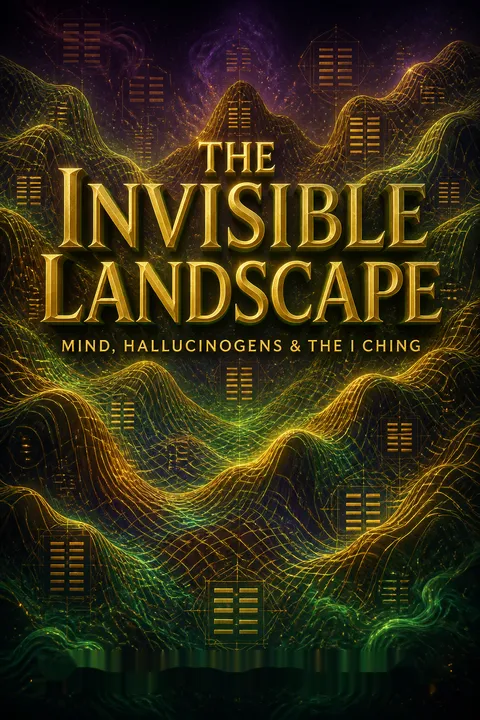
The Invisible Landscape is best read as a record of two young investigators trying to build a bridge between altered consciousness and scientific explanation. Its structure follows that ambition: first, a discussion of shamanism, mind, and neurobiology; then an account of the La Chorrera experiment; finally, a mathematical and cosmological theory derived from the I Ching. The progression gives the book narrative force. A jungle encounter becomes a laboratory problem, then a theory of history, then a forecast about the end of an era.
Its most durable contribution is methodological rather than mechanistic. Psychedelic experience raises a legitimate problem for any account of mind that ignores subjective life. The authors also insist that biological organization matters, and that a shaman's social role cannot be reduced to a list of unusual symptoms. These insights remain useful even if the proposed molecular explanation is rejected.
The book's central weakness is a repeated leap from analogy to ontology. Holographic memory, quantum processes, tryptamine chemistry, ancient calendrics, and historical novelty are joined into one system, but the links between them are not established by evidence of comparable strength. The authors themselves describe crucial steps as hypotheses, yet their later interpretations often treat the whole chain as if it were a discovery. A numerical pattern in an ancient text cannot independently validate a theory of DNA, and an intense vision cannot confirm a theory of time.
The 2012 forecast sharpens this problem. The date supplied a potential test, but the predicted transformation did not occur in any clear, agreed sense. This makes the work valuable as an intellectual artifact and a case study in visionary theory-building, not as a validated scientific model. Its best legacy is the question it refuses to abandon: how can a biological account of mind do justice to the reality of experience without confusing experience with proof?
Review Summary
The Invisible Landscape receives mixed reviews, with readers finding it ambitious but challenging. Many praise its originality and thought-provoking ideas on shamanism, consciousness, and time. However, its dense scientific language and speculative theories prove difficult for some. The book's exploration of psychedelic experiences, holographic mind theory, and the I Ching-based Timewave concept intrigues many readers. While some find it revolutionary, others dismiss it as pseudoscience. Overall, reviewers appreciate the McKenna brothers' innovative thinking but struggle with the book's complexity and far-fetched ideas.
People Also Read






Glossary
Organismic thought
Process-centered view of natureThe book's philosophical approach, influenced by Alfred North Whitehead, treats nature as nested processes rather than fixed material objects. Organisms and minds are organized wholes whose properties cannot be fully described by listing their parts. The authors extend this approach beyond biology, proposing that process and organization operate at every scale.
Holographic theory of mind
Distributed model of mindA model that uses holography, where information can be distributed across a surface, to imagine how brain activity might represent memory and perception across networks rather than in isolated locations. The authors extend the analogy to mind and reality. It is presented as a theoretical model, not proof that brains literally store information as optical holograms.
Electron spin resonance (ESR)
Signal from unpaired electronsA physical phenomenon in which unpaired electrons absorb electromagnetic energy at particular frequencies in a magnetic field. The authors hypothesize that interactions between tryptamines and nucleic acids might generate or modulate ESR signals related to thought. This proposed link between ESR and consciousness is speculative in the book, not an established account of brain function.
King Wen sequence
Traditional hexagram orderingThe arrangement of the sixty-four hexagrams in the I Ching attributed to King Wen. The book examines the sequence's pairings and the number of lines that change between successive figures. The authors argue that its numerical structure may encode a model of time, but the proposed calendrical purpose is their interpretation rather than a demonstrated historical fact.
Modular hierarchy
Nested repeating time cyclesThe authors' model in which a basic pattern is repeated at successively larger and smaller scales. They construct the hierarchy from a numerical wave derived from changes in the King Wen sequence, treating each level as a module within a larger cycle. The proposed structure is meant to describe temporal change from short periods to cosmic epochs.
Timewave Zero
Software for mapping noveltyThe name given to software implementing Terence McKenna's numerical model of time. It graphs changes in a proposed hierarchy of cycles, interpreting movement toward a designated zero point as increasing novelty. The software displays the theory; it does not independently establish that novelty is measurable in this way or that the model predicts historical events.
Concrescence
Many becoming oneA term from Whitehead's process philosophy for the way multiple influences combine into one completed event or entity. McKenna uses it for a much larger proposed culmination, in which temporal processes converge into a transformed state. The book's cosmic and historical use of the concept goes beyond Whitehead's technical account and remains speculative.
Eschaton
Quantized unit of timeThe book's name for a proposed wave-particle unit of temporal change within its hierarchy. The authors suggest that such units occur at multiple scales and help describe how novelty enters time. The term connects their mathematical model to ideas of an ultimate or final time, but the proposed physical entity is not established science.
About the Author
Other books by Terence McKenna

Download PDF
Download EPUB
.epub digital book format is ideal for reading ebooks on phones, tablets, and e-readers.








