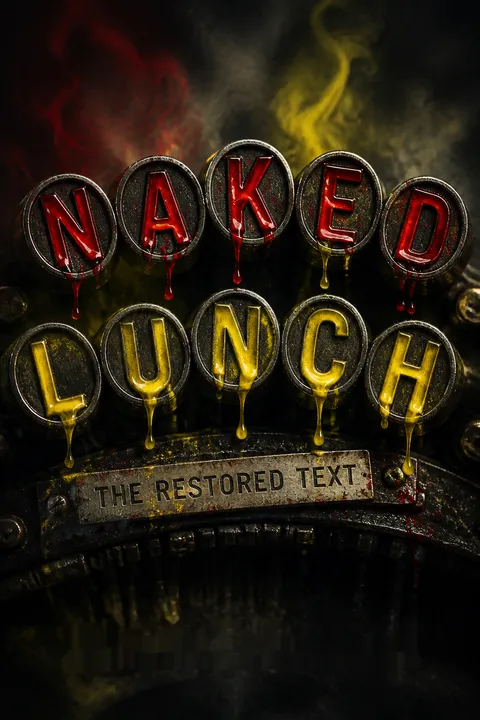


Plot Summary
Prologue
The opening introduction frames the book as a record made inside addiction. The narrator describes fifteen years of opiate dependence, ending in near-total paralysis in a Tangier room, then his decision to travel to London for apomorphine treatment.
After recovering, he presents the fragments as notes from sickness and delirium, and argues that addiction is not simply a private weakness: a market of pushers depends on the needs it creates. This medical testimony gives the book a point of reference, though the scenes that follow fracture time, identity, and narrative certainty.
The introduction supplies a factual frame without promising a conventional plot. It asks the reader to treat grotesque images as testimony shaped by illness, while also warning that the narrator’s memory may preserve events more clearly than their emotional meaning. Its account of addiction as a system of dependence turns the coming surrealism into more than spectacle: bodies, institutions, and markets all appear caught in circuits that feed on need. Yet the book's fragmentation resists the clean authority of a case history. The frame is a compass, not a map.
The Narcotics Net Tightens
At the opening, Lee believes narcotics agents are closing in after they seize his spoon and dropper. He throws away the evidence, uses a chatty advertising executive as cover, and boards a moving subway before an officer can stop him. In the city, Lee encounters old dealers and addicts, including Bart and Bill Gains, whose customers show what years of dependence have done to them.
He also fears Willy the Disk, a blind, ruined addict who can track him for the police. With arrest threatening and his own customers a possible source of testimony, Lee and his companions gather heroin, buy a used Studebaker, and leave New York.
The chase begins with a small object, a syringe, but its importance lies in the network behind it. Police, informers, dealers, and customers all become parts of a system that can locate Lee through need. His evasion depends on performance: he distracts a stranger with a story and turns social attention into camouflage. Yet the old addicts he visits expose the cost of that improvisation. They are not warnings from outside his world; they are possible versions of himself, which makes flight feel less like escape than another turn in the same circuit.
The Road Runs on Junk
Lee's westward flight becomes a search for another dose. In Philadelphia, the Rube's attacks draw police attention, and Lee eventually leaves him waiting on a street corner. The journey continues through failing cars, small towns, and improvised substitutes until a Houston druggist supplies paregoric and sleeping pills.
In New Orleans, Lee finds heroin and turns back toward Mexico, where Lupita sells him drugs and Old Ike supplies a government-script connection. Cocaine briefly offers a different, sharper rush, but its hunger soon fades if he cannot score. Elsewhere on the route, Jane disappears with a pimp who condemns heroin, and Lee later hears she is dead. Every stop offers relief, then another reason to move.
The road trip is not a passage out of addiction but its geography made visible. Each town changes the available substance, the danger, and the manner of waiting, while the underlying need remains constant. Lee can improvise with pharmacies, local contacts, or another car, but improvisation cannot restore control. The Rube's abandonment is especially revealing: survival in this economy means treating companions as liabilities once they threaten the route. Jane's disappearance offers no moral lesson or closure, only another life swallowed by the same unstable world.
Benway's Clean State
Islam Inc. asks Lee to enlist Doctor Benway, a physician skilled in interrogation and psychological control. Benway recounts how he made life in Annexia unbearable without relying mainly on overt violence: citizens face impossible paperwork, arbitrary inspections, searches, and punishments that teach them to blame themselves.
In Freeland, he runs a reconditioning center where patients are treated as experimental material. He shows Lee people left with irreversible neural damage, then points to addicts whose dependence has replaced other symptoms.
When an electronic chess system releases the center's patients into the streets, the city erupts into disorder. Benway takes the crisis as a reason to accept work with Islam Inc., leaving the wreckage behind him.
Benway's expertise lies in making coercion look like administration. His citizens cannot identify a single enemy or appeal to a stable rule, so they internalize the explanation that something is wrong with them. The reconditioning center extends this logic into medicine, where care and control share the same equipment. His observation that addiction imposes contact gives the scene a bitter counterpoint: dependence can interrupt isolation, but it does so by installing another master. Benway is not an external critic of the system. He is its most articulate and adaptable technician.
Joselito at the Sanitarium
Joselito, a young poet, begins coughing, and a German doctor privately tells Carl that both lungs are badly affected. The physician offers little real care, hiding his contempt for local people behind medical ceremony. Carl visits Joselito in a clean room before the transfer to a sanitarium and tries to learn whether chemical treatment might help.
At the institution, the commandante takes Carl's letter, pins it to a spike, and continues his paperwork without answering the question. Carl considers bribing him, but his thoughts dissolve into memories of addiction, illness, and failed treatment. Joselito's name later drifts through the night with other boys' names, while the neon sign flares above the silent institution.
The episode turns medical uncertainty into a problem of access and power. Joselito's illness is named, but the institutions that might respond offer only surfaces: a well-appointed room, a letter, a commandant absorbed in records. Carl's helplessness grows from a familiar trap in the book: he can recognize suffering but cannot make the system answer it. The ending with the names fading away preserves uncertainty rather than giving a tidy account of Joselito's fate. His disappearance from the scene feels bureaucratic before it feels supernatural.
The Sailor Sells Black Meat
In the City, the Sailor approaches Fats Terminal with a plan to supply black meat, flesh from a giant aquatic centipede. Fats demands a larger quantity than the Sailor first offers and refuses to provide an advance, forcing him to seek credit elsewhere. The Sailor visits a Reptile, an addict dependent on fluid from a Mugwump, and waits hours before receiving a small signal that eggs may be available.
Around them, the Meet Cafe serves as a market for stranger appetites, and black-meat eaters consume the delicacy until nausea overwhelms them, only to eat again. The Sailor's deal makes the City’s commerce literal: appetite creates a market, and the market keeps appetite alive.
This scene gives the book's abstract economy a grotesque commodity. Black meat is both food and a cycle of compulsion, irresistible even when it makes its consumers sick. The Sailor understands that commerce depends on patience and leverage, while Fats controls access by withholding credit. Their transaction echoes the street-level drug trade without simply repeating it: here the product is an entire ecology of appetite. The City does not stand outside human need as a setting. It is built from needs that have become trades, then from trades that manufacture new needs.
Withdrawal's False Frontier
During withdrawal, Lee experiences the hospital as a hostile place: ordinary patients seem like conspirators, food appears contaminated, and every delay feels deliberate. His dreams repeatedly return him to a frontier guarded by a sharply dressed man who cannot remove a mirror chained around his neck.
When Lee reaches the barrier, the guard loses his voice and Lee unhooks the chain himself, crossing into the mist. The passage makes detoxification feel like a border crossing rather than a clean cure.
Elsewhere in the hospital visions, Benway performs surgery with reckless improvisation, while a staged patriotic broadcast collapses into electrical destruction. Lee's body is being treated, but his mind turns every institution into another unstable theater.
Withdrawal does not restore a neutral view of the world. It intensifies perception until care, threat, and hallucination become difficult to separate. The guard's mirror makes the obstacle partly self-made: he is trapped by the apparatus through which he watches himself. Lee crosses only when the guard can no longer speak, suggesting that progress requires action where explanation has failed. The hospital's other grotesque scenes broaden the critique from private illness to public performance. Both medicine and patriotism promise order, yet their rituals produce fresh violence.
Miguel's Borrowed Body
Miguel returns from months away from heroin, apparently proud of his recovered body, but Lee notices the familiar craving returning. Lee keeps his packet of heroin rather than giving him a dose. As Miguel handles a nail file, his borrowed flesh changes color and drops away in the room, leaving Lee to order him to clean up the mess.
Lee himself lives in a near-transparent body, repeatedly taking heroin to keep a painful cold burn at bay. He visits NG Joe, another addict whose fear of a fatal sleep disorder has driven his habit higher. From Lee's eye, a slug writes a message that the Sailor is buying Time in the City.
Miguel's return makes recovery visible but precarious. The body that looks restored cannot protect him from the habits that reorganize perception and desire. Lee's refusal to share heroin briefly interrupts that cycle, though he remains dependent himself, using a dose to quiet his own burning symptoms. His act is therefore neither rescue nor judgment; it is a boundary drawn by someone still inside the same illness. The message about the Sailor expands the economy beyond drugs into time itself, implying that addiction's deepest commodity may be the life it consumes.
Hassan's Rumpus Room
At Hassan's ornate salon, a Mugwump leads a young man to a gallows while the guests watch. The boy is frightened, and the Mugwump turns the killing into a ritualized spectacle, then collapses beside him. The room continues to fill with sexual tableaux, as if individual bodies were interchangeable acts in a show.
The scene breaks open when lust-maddened American women rush in and attack the guests. A.J. tries to rally his guards, then fights back with a cutlass as the salon becomes a shambles. Hassan, disgusted by the disorder, blames A.J. and drives him out. The party exposes the violence beneath the room's expensive finish.
Hassan's salon sells transgression as luxury, but the killing reveals how little distance its guests have from the violence they consume. The victim's terror becomes part of the performance, and the spectators' refinement offers no moral protection. The arrival of the women disrupts the room's controlled arrangement of bodies and turns its appetite back on itself. A.J.'s response is not to restore safety but to intensify the spectacle with armed force. Hassan's expulsion of him is less a defense of the victim than a rejection of an event that has become inconvenient.
The Professor Stops Listeners
At Interzone University, the Professor tries to lecture students seated among livestock, junk, and trading carts. His subject shifts from his own bodily complaints to Coleridge's Ancient Mariner and the power of an imposed audience. He argues that the listener may be reading the speaker, not the reverse, and that words can matter less than the relationship that compels someone to listen.
The students interrupt, threaten him, and demand stories about local figures, while passing trains repeatedly cut across the lecture. The Professor survives by changing his approach and continuing after each interruption. His improvised class makes Interzone's disorder part of the lesson rather than an obstacle to it.
The lecture offers a rare statement about how the book itself works. Meaning does not arrive as a stable message from an authoritative speaker; it emerges through the listener's attention, resistance, and prior relation to what is being said. The students' interruptions enact that argument. They do not receive the Professor's lesson passively, and he must adapt to their demands in order to hold the room. The passing train gives this exchange a physical rhythm: thought is repeatedly cut off, then resumed in altered form.
Slashtubitch Takes the Screen
At A.J.'s annual party, the Great Slashtubitch appears as an exacting impresario of erotic films. A screening begins with Johnny and Mary, then moves through encounters involving Mark, changing costumes, and increasingly elaborate performances. The film's scenes slide between tenderness, humiliation, killing, and surreal transformations, while the spectators are treated as an audience for every shift.
The performers repeatedly return to staged scenes of hanging, only to appear again in altered roles. By the end, the movie's machinery has made pleasure and violence difficult to separate, and the actors take a bow with ropes still around their necks. A.J.'s party offers no stable line between a spectacle and its cost.
Slashtubitch represents the director as a judge of authenticity, but the film he oversees keeps dissolving the distinction between genuine feeling and performed sensation. Its scenes recur with changed bodies and roles, so the audience cannot settle into a single moral position. The staged hangings are especially unsettling because they make death both an event and a theatrical device. The actors' final bow does not resolve the tension; it exposes the audience's dependence on performance to make violence consumable. The episode implicates spectators without claiming that watching and doing are identical.
The Centipede in Court
At a conference on technological psychiatry, Doctor Schafer presents a supposedly perfected human being as the result of neurological control. The specimen's body dissolves into a vast black centipede, and the assembled experts recoil. They destroy the creature, then face a courtroom accusation that Schafer has forcibly lobotomized people and concealed the evidence.
The centipede rushes through the hall as the conference members flee. The narrative then opens onto the Market, a composite city where drugs, diseases, memories, and human possibilities are traded together. Lee's notes on Yage explain the visionary state behind this panorama, in which identity seems to pass through bodies and places rather than remain fixed in one person.
The centipede is the conference's rejected consequence made visible. Schafer's promise of a perfected human fails to produce a stable subject; what appears instead is a form the experts can only classify as monstrous and destroy. The courtroom cannot fully contain the accusation, just as the conference cannot contain its own creation. The Market then shifts from the controlled individual to a crowded ecology of exchange. Yage loosens the borders of identity, but the vision is not offered as simple liberation: in this world, openness can mean connection, invasion, or both.
Islam Inc. Sells Revolt
Lee explains that Islam Inc. is financed by A.J. and populated by factions that do not share an objective. Clem and Jody use poisoned wheat to devastate Hassan's republic, while Hassan's business empire stretches through counterfeit medicines and other corrupt trades.
A.J. presents himself as a playboy, but his pranks repeatedly provoke public disorder. The organization also uses a fake prophet, Ahmed, to broadcast manufactured religious authority.
Beyond the conspiracy, Interzone's political parties pursue different forms of domination: Liquefactionists seek absorption into one being, Divisionists multiply replicas, and Senders aim to impose one-way control. Factualists oppose those schemes, but their warnings compete with the same machinery they condemn.
Islam Inc. is less a unified conspiracy than a marketplace for private agendas. Its members cooperate only where interests overlap, making betrayal a structural expectation rather than a surprise. The competing parties turn political ideas into literal bodily programs: absorb everyone, reproduce oneself, or control another mind. Each offers an escape from conflict by eliminating difference, and each therefore reproduces the violence it claims to solve. The Factualists' resistance is ethically important but not triumphant. Their difficulty is that exposing a control system does not automatically create a shared alternative.
The County Clerk's Maze
Lee travels to Pigeon Hole to file an affidavit claiming bubonic plague so he can avoid eviction from a house he has occupied for years without paying rent. Customs officers search his papers and body, then seize his suitcase of legal documents. Inside the crumbling courthouse, Lee climbs dangerous stairs and machinery to find the County Clerk, who spends the meeting telling a rambling story instead of addressing the case.
Lee's papers and the clerk's records belong to a system designed to make every claim disappear into misplaced files. Only after Lee presents an old Razor Back card does the clerk recognize a shared identity and tell his assistants to handle the request.
The courthouse makes delay a form of rule. Lee's urgent need cannot be distinguished from the clerk's endless anecdote because the institution has no meaningful scale for urgency. Paperwork promises evidence, but the building's decay and filing practices turn evidence into an obstacle. Lee advances not through the merits of his claim but through an old social credential that persuades the clerk he belongs to the same group. The scene's humor sharpens its politics: a system can appear absurd and still exercise real power over shelter, movement, and survival.
Interzone's K.Y. Deal
In Interzone, Marvie and Leif The Unlucky form an import business around a shipment of lubricant made from whale waste. Their partnership deteriorates over commissions and control of the bill of lading, then briefly mends when Marvie obtains a check that will take almost a year to clear. They cannot even spend it on a drink.
Their Expeditor, a disgraced former Island president, demands payment and condemns the merchandise as shoddy. Marvie and Leif dismiss his complaints until their insults provoke him into a furious return to his old Island identity. Across the channel, the Island preserves democratic forms while soldiers with machine guns oversee the annual renewal of its British lease.
The deal turns commerce into a performance of wealth: Marvie possesses a check that cannot buy anything now, while the partners argue over the appearance of ownership. The Expeditor's work is equally ambiguous, useful only because everyone argues about whether it is useful. His outburst exposes the humiliation beneath the polished identity he has tried to adopt. The Island's renewal ceremony extends the same joke into politics, where formal consent is staged under guns. Interzone's comedy does not soften coercion; it shows how readily power hides inside procedure and status.
Benway Examines Carl
Carl Peterson receives an appointment at the Ministry of Mental Hygiene, where Benway says the state wants to assess him before marriage. The examination is framed as reassurance, but Carl must provide a semen sample and submit to questions about his sexual history. Benway first presents a negative test as good news, then probes Carl's past service and presses him to remember encounters he would rather dismiss.
When Carl recognizes a memory involving Hans, his body reacts with revulsion and anger. He tries to leave, but the office seems to stretch away from him as Benway invokes a green door. Carl exits the interview without learning what the Ministry will do with its findings.
The exam shows how benevolent language can make surveillance difficult to refuse. Benway calls the process preventive and nonjudgmental, yet its procedures compel Carl to expose private bodily and emotional material. The test's apparent reassurance does not end the inquiry; it gives the doctor a platform to demand more. Carl's memory arrives not as a neat confession but as a physical rupture that unsettles his carefully managed self-image. The green door marks the point where institutional questioning merges with psychological disorientation, leaving the threat unresolved.
Five Years for Heroin
In another encounter, the Sailor offers a fourteen-year-old boy pure heroin in exchange for five years of his life. The boy accepts without understanding the bargain, and the Sailor pulls a strange, eye-bearing object from him before preparing the dose. The Exterminator later explains that his assignment is to find and eliminate surviving agent patterns, because defectors threaten the system that employs them.
The book's earlier images of old addicts return in the fragment about Pantopon Rose and other people who wait for drugs as their bodies fail. Across these scenes, the Algebra of Need links the street addict, the dealer, the official, and the agent in one economy of dependency.
The Sailor's bargain gives the book's recurring metaphor of time a brutal transaction: the boy receives immediate relief, while the cost is measured in years he cannot yet comprehend. The Exterminator's mission widens that exchange into a political system in which even agents are treated as disposable products. The remembered addicts make the abstraction bodily again, placing the boy's future beside the visible ruin of people already consumed by need. The sequence refuses to separate private compulsion from institutional control. Both prosper when someone else must keep paying.
Lee Shoots His Way Out
When Hauser and O'Brien enter Lee's hotel room to arrest him, he is preparing his morning injection. They refuse to let him take it, so Lee offers to lead them to Marty Steel, a dealer they want. While they look away, Lee splashes alcohol into Hauser's eyes, reaches his suitcase, and shoots Hauser and O'Brien.
He gathers his notebooks, drugs, and weapon, then leaves through the hotel corridor. After buying heroin, he tries to contact the narcotics department, only to learn that the officers he killed do not exist in its records. Lee realizes he has lost his point of entry into ordinary time. The final preface leaves him among broken memories, unable to offer a conventional return or cure.
The killing is a point of no return, but it does not grant Lee mastery. He acts with precision to avoid capture, then discovers that the world has changed its accounting of him. The missing records turn his escape into a kind of exile from shared reality, where identity depends on a system that can erase its own agents. The final preface refuses to repair this rupture with a stable chronology. Instead, it presents the book as a record assembled from sensory fragments, making formal dislocation the last consequence of Lee's flight.
Analysis
Naked Lunch uses addiction as both subject and organizing principle. The drug trade is presented as a precise economy: dealers regulate access, delay sharpens desire, and the addict's body becomes the market's most dependable customer. That structure then expands outward. Benway's state, Hassan's companies, the Interzone parties, and the Island's political ceremony all create dependencies that help preserve their authority. The book's central political insight is not simply that power corrupts. It is that institutions can manufacture the needs that make their own continuation seem necessary.
The body is where these abstractions become legible. Lee's changing flesh, the damaged addicts, the reconditioned patients, and the centipede all make identity seem vulnerable to external systems. Yet the novel does not offer a pure self untouched by those systems. Memory shifts, desire is difficult to classify, and Lee's own observations are compromised by withdrawal and drug use. The reader must therefore judge without the shelter of a fully reliable narrator.
The fragmented structure enacts this uncertainty. Reports, scenes, jokes, lectures, and hallucinations collide without resolving into a conventional chain of causes. Their repetition supplies a different kind of continuity: the same bargains recur in new forms, whether the price is heroin, time, obedience, or a person's capacity to remain separate. The book's comedy sharpens rather than softens its violence, exposing the absurd language institutions use to make harm sound routine. Its lasting challenge is to notice when care becomes control, when commerce turns need into ownership, and when the desire to eliminate disorder begins by eliminating the person who experiences it.
Review Summary
Naked Lunch is a controversial, avant-garde novel that polarizes readers. Many praise its groundbreaking style, vivid imagery, and dark humor, while others find it incomprehensible and disturbing. The book's fragmented narrative, explicit content, and drug-induced hallucinations challenge conventional literary norms. Some readers appreciate its cultural impact and social commentary, while others struggle with its graphic depictions of sex and violence. Despite its divisive nature, Naked Lunch is widely regarded as an influential work of postmodern literature that continues to provoke strong reactions decades after its publication.
People Also Read





Characters
Lee
Addict on the runLee is the book's recurring first-person observer, an opiate addict whose need directs his routes, attention, and sense of time. He can read the practical codes of dealers and police, but that competence does not free him from the market he navigates. His wit often serves as cover, allowing him to distract strangers or make danger feel manageable. Beneath that performance, he watches other addicts with both contempt and recognition, aware that their ruined bodies resemble possible versions of his own. Lee's fragmented perceptions make him an unreliable guide to sequence and motive, but his physical knowledge of craving gives the scenes a consistent center.
Doctor Benway
Control's physicianBenway is a physician, interrogator, and administrator who treats human behavior as material to be managed. He favors elaborate psychological pressure over simple brutality because it makes people participate in their own subjection. His comic manner and technical fluency conceal a cold appetite for experiment, though he often describes his work as scientific rather than ideological. Benway moves easily between medicine, policing, and politics, exposing how those professions can share a vocabulary of treatment while pursuing control. He is compelling not because he is secretly humane, but because he can explain coercion as common sense.
The Sailor
Dealer in appetitesThe Sailor is a calculating figure in the City’s drug and black-meat economy. He waits for openings, negotiates on credit, and recognizes that customers can be made to trade more than money. His controlled manner contrasts with the bodily ruin surrounding him, giving him the aspect of a businessman who has learned to treat desperation as inventory. The Sailor's transactions show how dependence creates intimacy without trust: he knows what another person needs, but that knowledge becomes leverage. His role connects the street-level drug market to the book's stranger exchanges of life, time, and bodily substance.
A.J.
Disruptive impresarioA.J. is a wealthy provocateur and organizer whose public persona is that of an eccentric playboy. He stages pranks, backs political schemes, and treats social conventions as material for disruption. His jokes can expose the pretensions of elites, but they also injure bystanders and escalate into disorder. A.J. rarely makes his motives clear, and even his allies are unsure which faction he serves. That ambiguity makes him less a stable political leader than a force that tests how quickly institutions and crowds can be made to reveal their violence.
Salvador Hassan O'Leary
Empire-building fixerHassan is a financier and businessman whose sprawling companies trade in pharmaceuticals, food, and other goods of doubtful quality. He presents himself as genial and harmless, but his operations depend on aliases, front companies, and carefully managed associations. Hassan's ambition is to expand, absorb, and proliferate, a commercial instinct that aligns him with Interzone's fantasies of bodily merger. He uses humor and lavish entertainment to soften suspicion, though the attractions he offers are inseparable from exploitation. He functions as both a political patron and a portrait of commerce without a meaningful boundary.
Carl Peterson
Citizen under examinationCarl is a young man who expects to marry and regards himself as an ordinary citizen. His confidence depends on familiar rules about privacy and self-knowledge, which Benway's examination steadily unsettles. Carl tries to answer plainly and preserve his independence, but the Ministry's polite procedures make refusal difficult. His memories do not arrive under voluntary control, revealing the gap between a person's public account of himself and the experiences he has excluded. Carl's section gives the book a focused view of how an institution can turn intimate uncertainty into administrative evidence.
Joselito
Ill young poetJoselito is a young poet whose cough brings him into contact with doctors and institutions that offer little reliable care. He remains outwardly courteous while fear appears in brief changes of expression. His illness matters to Carl because it turns abstract questions about treatment into an immediate responsibility toward another person. Joselito's vulnerability is not presented as a lesson in courage; the scene gives him little power over diagnosis, transfer, or access to help. He represents a life placed at the mercy of officials who can name a condition without meaningfully answering it.
Fats Terminal
Black-meat brokerFats is a dealer and organizer whose blank, surveying manner suits the City’s commerce in drugs and exotic substances. He controls access through terms of credit, demanding a larger return while refusing to relieve the Sailor's immediate need. His business depends on knowing how appetite behaves under pressure. Fats is less a conventional villain than a concentrated image of the market's logic: whoever controls the supply can make another person's urgency profitable.
Miguel
Recovering young addictMiguel returns from time away from heroin carrying the visible confidence of someone who believes his body has recovered. Lee sees how quickly that confidence meets old craving. Miguel's scene is brief, but it makes recovery feel embodied and fragile rather than abstract. He and Lee share an understanding of addiction that does not need explanation, though their differing choices create distance between them.
Clem and Jody
Agents of comic sabotageClem and Jody are former vaudeville performers who work as agents and specialize in schemes that disgrace American interests. Their conspiracies often involve poison, counterfeit goods, or public humiliation, and they recount consequences with a showman's detachment. They are useful to Islam Inc. because they can turn political operations into outrageous spectacle. Their partnership is built on shared performance rather than visible moral purpose.
The Rube
Falling street hustlerThe Rube is a con man whose attacks and physical deterioration make him increasingly difficult for other addicts to keep around. He begins as a practiced hustler but becomes a liability to the people traveling with him. His presence shows how a life organized around manipulating others can collapse under the same pressures it exploits.
Hauser
Veteran narcotics officerHauser is an experienced narcotics officer who approaches an arrest with a drawn gun and a practiced sense of danger. He is not portrayed as a grand strategist; his authority is procedural and physical, reinforced by years of routine encounters with addicts.
O'Brien
Officer with a conman's mannerO'Brien is Hauser's partner, an officer who uses friendliness and insinuation as tools during an arrest. His genial manner does not make him less threatening; it gives coercion the sound of an ordinary conversation. The contrast between his approach and Hauser's bluntness makes the pair an effective police team.
The Vigilante
Violent hustlerThe Vigilante is a hustler whose criminal bravado gives way to episodes of mental disintegration. His story joins street violence to the book's recurring fear that identity can fracture under pressure.
Willy the Disk
Blind addict trackerWilly the Disk is a severely damaged addict whom Lee imagines as a relentless tracker for the police. His ruined senses and dependence make him frightening to Lee, while also showing the physical cost of the world they share.
NG Joe
Fear-driven addictNG Joe lives under the fear of Bang-utot, a sleep-related death syndrome described in the text. His anxiety pushes his heroin use higher, illustrating how a genuine or imagined bodily danger can become another source of dependence.
Marvie
Restless import traderMarvie is a former official turned Interzone entrepreneur, forever alert to a deal that might restore his fortunes. He can celebrate a large check even when it cannot yet be spent, revealing how much business there is conducted through appearances.
Leif the Unlucky
Serial failed entrepreneurLeif is Marvie's Norwegian business partner, marked by a history of failed ventures and personal misfortune. His ingratiating manner hides neither his hunger for a successful deal nor his expectation that it will go wrong.
Doctor Schafer
Neurological engineerSchafer is a psychiatrist who imagines reducing the nervous system to a controllable mechanism. His ambition to engineer a perfected human reveals the danger of treating complexity as a defect to remove.
Nick
Street-level connectionNick is a cautious supplier who helps Lee obtain heroin during his flight. He understands the delays and risks of the trade, and he offers practical help without pretending the arrangement is friendship.
Plot Devices
The Algebra of Need
Need reproduces its marketThe book uses addiction as an economic mechanism rather than merely a personal habit. The addict's bodily dependence creates a guaranteed customer, while dealers control supply through delay, scarcity, and graduated access. The same logic spreads into business, politics, and institutional control: each system creates or intensifies the need that justifies its continued operation. The device links Lee's daily search for heroin to Interzone's stranger trades in time, memory, and bodily substance. It also complicates blame, since the addict participates in the cycle while being physically shaped by it.
Interzone
A city of competing systemsInterzone is a composite setting where markets, political factions, clinics, parties, and police overlap without stable borders. Its inhabitants trade in drugs, services, memories, and body parts, while buildings and identities seem capable of merging or changing. The setting lets the book place rival models of control side by side: bureaucratic inspection, commercial exploitation, psychological conditioning, and political absorption. Interzone is not a realistic city map so much as a social laboratory, where each institution becomes visible through the odd transaction it demands.
Benway's reconditioning
Care disguises coercionBenway's clinics use tests, paperwork, drugs, humiliation, and behavioral conditioning to make control appear therapeutic. His methods rarely need an openly declared political purpose because the patient is taught to experience punishment as deserved and the institution as benevolent. This device appears in his account of Annexia and in Carl's examination, where a marriage-related test becomes an inquiry into private desire. The clinic's medical language gives the state access to bodies and memories while obscuring who benefits from the knowledge.
The fragmented record
Memory breaks linear plotThe book moves through scenes, reports, fantasies, lectures, and clinical notes rather than following a single uninterrupted storyline. Recurring figures and images, including Lee, Benway, the Sailor, drugs, and bodily transformation, create connections across otherwise separate episodes. The shifting form also reflects the narrator's altered attention and uncertain emotional memory. A reader must assemble relationships among scenes without assuming that every transition marks ordinary chronological progression. This device makes the book's structure part of its subject: control over experience, recollection, and sequence is itself contested.
Interzone's factions
Politics becomes bodily practiceThe Liquefactionists, Divisionists, Senders, and Factualists turn political theories into literal changes in bodies and relationships. Their programs seek absorption, replication, one-way mental control, or resistance to those forms of domination. The factions make abstract arguments concrete, showing what happens when an ideology treats difference as a defect to eliminate. They also explain why alliances in Interzone remain unstable: characters often use a party's language while pursuing private interests. The system is less a backdrop than a set of competing technologies for defining who may remain an individual.
FAQ
Synopsis & Basic Details
What is Naked Lunch: The Restored Text about?
- A Disjointed Odyssey: Naked Lunch follows William Lee, a drug addict, through a series of hallucinatory, non-linear vignettes set in various locations, most notably the dystopian "Interzone." The narrative, often shifting in perspective and reality, depicts Lee's desperate pursuit of drugs, his encounters with grotesque characters, and his observations on addiction, control, and societal decay.
- Exploration of Addiction's Grip: At its core, the novel is a raw, unflinching portrayal of heroin addiction, described by Burroughs as "The Sickness." It delves into the physiological and psychological torment of withdrawal, the parasitic relationship between addict and pusher, and the dehumanizing "Algebra of Need" that governs their existence.
- Critique of Control Systems: Beyond drug addiction, the book satirizes and dissects various forms of control—governmental, medical, sexual, and psychological—through characters like Dr. Benway, a master of demoralization, and the omnipresent "Senders" who manipulate minds. It presents a world where freedom is an illusion and individuals are constantly subjected to unseen forces.
Why should I read Naked Lunch: The Restored Text?
- Unparalleled Literary Experimentation: Readers seeking a truly groundbreaking and challenging literary experience will find Naked Lunch a pivotal work. Its non-linear, cut-up style, grotesque imagery, and unflinching honesty pushed the boundaries of narrative, influencing generations of writers and artists.
- Profound Social Commentary: Beneath its shocking surface, the novel offers a scathing critique of power structures, bureaucracy, and the insidious ways society controls individuals. It forces readers to confront uncomfortable truths about human nature, addiction, and the mechanisms of oppression, making it highly relevant for Naked Lunch analysis of societal control.
- A Unique Vision of Reality: Burroughs crafts a world that blurs the lines between dream, hallucination, and reality, inviting readers into a deeply subjective and often terrifying landscape. It's a journey into the subconscious, offering insights into the nature of perception and the human psyche that are both disturbing and revelatory.
What is the background of Naked Lunch: The Restored Text?
- Autobiographical Roots in Addiction: William S. Burroughs drew heavily from his own fifteen-year struggle with heroin addiction, particularly his experiences in Mexico City, New Orleans, and Tangier. The raw, visceral descriptions of withdrawal and the drug underworld are deeply personal, lending an authentic, albeit distorted, lens to the narrative.
- Beat Generation Context: The novel emerged from the Beat Generation literary movement of the 1950s, sharing its themes of rebellion against conformity, exploration of alternative lifestyles, and experimental prose. Jack Kerouac famously suggested the title, encapsulating the moment "when everyone sees what is on the end of every fork."
- Censorship and Legal Battles: Naked Lunch gained notoriety for its explicit content, leading to obscenity trials in the U.S. in the early 1960s. Its eventual vindication in 1966, with the Massachusetts Supreme Judicial Court ruling it had "redeeming social importance," was a landmark decision for freedom of speech and literary expression.
What are the most memorable quotes in Naked Lunch: The Restored Text?
- "Naked Lunch – a frozen moment when everyone sees what is on the end of every fork.": This iconic line from the Introduction defines the book's core philosophy, suggesting a brutal, unvarnished revelation of truth, stripped of illusion. It encapsulates the raw honesty and confrontational nature of Burroughs's vision, a key insight for Naked Lunch meaning.
- "The face of evil is always the face of total need.": This quote, central to "The Algebra of Need," distills Burroughs's understanding of addiction and its moral implications. It highlights how absolute dependence can strip away humanity, reducing individuals to primal, amoral agents driven solely by their craving, a profound statement on themes in Naked Lunch.
- "I deplore brutality. It's not efficient.": Uttered by Dr. Benway, this chilling statement reveals the insidious nature of modern control. It's not about overt violence but about subtle, psychological manipulation that breaks the spirit more effectively, showcasing Benway's sinister Dr. Benway motivations and the novel's critique of institutional power.
What writing style, narrative choices, and literary techniques does William S. Burroughs use?
- Non-Linear, Fragmented Narrative: Burroughs employs a "cut-up" technique, presenting vignettes and episodes in a non-chronological, often disorienting order. This fragmentation mirrors the fractured consciousness of addiction and challenges traditional narrative expectations, making Burroughs writing style highly experimental.
- Grotesque and Visceral Imagery: The prose is rich with shocking, often repulsive descriptions of bodily functions, decay, and violence. This deliberate use of the grotesque serves to confront the reader, stripping away polite societal veneers to reveal raw, uncomfortable realities, a hallmark of Naked Lunch literary techniques.
- Satire and Dark Humor: Despite its grim subject matter, the novel is infused with biting satire and black humor, particularly in its critiques of bureaucracy, medicine, and politics. This sardonic tone often underscores the absurdity and horror of the situations depicted, adding layers to Naked Lunch analysis beyond mere shock value.
Hidden Details & Subtle Connections
What are some minor details that add significant meaning?
- The Ubiquitous "Old Grey Mare": The recurring phrase "The Old Grey Mare ain't what she used to be" or references to "humping the Old Gray Mare" (County Clerk chapter) subtly links sexual degradation, aging, and the futility of past pleasures to the pervasive decay of the world. It symbolizes a lost vitality and the desperate, often perverse, attempts to recapture it, a subtle Naked Lunch symbolism.
- The Candiru Fish as Invasive Threat: The mention of the candiru, a small Amazonian fish that invades bodily orifices, appears multiple times (e.g., "Benway," "A.J.'s Annual Party"). This seemingly minor detail symbolizes the invasive, inescapable nature of addiction, control, and sexual violation, highlighting the vulnerability of the body and mind to external forces, a chilling Naked Lunch hidden meaning.
- The "Smell of Death" in Withdrawal: Burroughs repeatedly describes the "colorless no-smell of death" or the "death smell" during junk withdrawal (e.g., "Atrophied Preface"). This sensory detail goes beyond mere description, becoming a motif for the addict's liminal state between life and death, a profound internal decay that is paradoxically both odorless and overwhelmingly present, deepening the Naked Lunch addiction analysis.
What are some subtle foreshadowing and callbacks?
- The Rube's Demise and "The Mark Inside": Early in "Heat Closing In," the Rube's descent into madness and eventual abandonment ("The Mark Inside") foreshadows the ultimate self-destruction inherent in unchecked addiction and parasitic relationships. His physical and mental deterioration serves as a grim premonition for other characters, illustrating character development in Naked Lunch.
- Benway's Early Departure from Annexia: Benway's "precipitate departure from Annexia" after his "Total Demoralization" assignment (Benway chapter) subtly foreshadows the chaotic release of the R.C. patients later. It suggests a pattern of his destructive "experiments" leading to widespread societal breakdown, a recurring theme in Dr. Benway's methods explained.
- The "Hot Shot" and Informers: The detailed description of a "hot shot" (poisoned junk) given to informers in "Heat Closing In" is a grim callback to the constant paranoia and betrayal within the drug underworld. It establishes the brutal consequences of informing, a pervasive undercurrent of fear and distrust that permeates all relationships in the novel, a key aspect of Naked Lunch themes.
What are some unexpected character connections?
- Lee as the "Invisible Man": Lee is referred to as "El Hombre Invisible" by Spanish boys (Hospital chapter), suggesting his detachment and spectral presence due to heavy addiction. This connects him to the broader theme of dehumanization and the loss of self, making William Lee's identity fluid and symbolic rather than fixed.
- The President as an "Oblique Addict": The revelation that the President is an "Oblique Addict" who recharges through Lee (Hospital chapter) creates a bizarre, parasitic power dynamic. This unexpected connection highlights how addiction permeates all levels of society, even the highest, and how power itself can be a form of dependence, a unique insight into Naked Lunch power dynamics.
- The Exterminator's Shifting Identity: The Exterminator, initially presented as an enforcer, later reveals his true "assignment: Find the live ones and exterminate. Not the bodies but the 'molds'" ("The Exterminator Does a Good Job"). This blurs his identity with the narrative voice, suggesting he is an agent of a deeper, more abstract form of control, connecting him to the "human virus" concept and offering a deeper Exterminator motivation analysis.
Who are the most significant supporting characters?
- A.J., The Trickster Agent: A.J. (alias Placenta Juan, After Birth Tycoon) is a chaotic, amoral figure who embodies disruption and subversion. His "practical jokes" and schemes, from releasing piranhas to sabotaging anti-fluoride societies, are not random but calculated acts of destabilization, making him a central figure in Interzone power struggles and a key to understanding A.J. motivations.
- The County Clerk, Bureaucracy Incarnate: This character, trapped in a decaying courthouse, symbolizes the suffocating, self-perpetuating nature of bureaucracy. His endless anecdotes and inability to process anything efficiently highlight the absurdity and ultimate futility of rigid systems, a satirical element crucial to Naked Lunch social commentary.
- The Mugwumps, Longevity Dealers: These liverless, sweet-eating creatures who secrete life-prolonging fluid (The Black Meat chapter) represent a perverse form of immortality and parasitic existence. Their role in the Interzone market underscores the transactional nature of life and the addictive quality of even "longevity agents," adding a layer of Naked Lunch symbolism to the pursuit of eternal life.
Psychological, Emotional, & Relational Analysis
What are some unspoken motivations of the characters?
- Lee's Quest for "The Word": Beyond mere survival, William Lee's constant movement and observation, particularly his role as a "recording instrument" (Atrophied Preface), suggests an unspoken motivation to document and understand the "human virus" and "The Algebra of Need." His journey is a perverse form of research, seeking to unlock "The Word" that explains the chaos, a deeper William Lee motivation.
- Benway's Drive for Absolute Control: While Benway explicitly states his methods are about efficiency, his underlying motivation appears to be a perverse artistic drive for absolute control and manipulation, seeing human beings as mere "thinking machines" or "raw material." His experiments are a form of creative destruction, revealing a chilling Dr. Benway psychology.
- Fats Terminal's Survival through Parasitism: Fats Terminal's transformation into a "foetal monkey" with a "lamphrey disk mouth" (The Algebra of Need) reveals an unspoken motivation for survival at any cost, even if it means becoming a pure parasite. His evolution embodies the ultimate consequence of "The Algebra of Need," where self-preservation overrides all other instincts, a stark Fats Terminal analysis.
What psychological complexities do the characters exhibit?
- Identity Diffusion and Interchangeability: Characters frequently merge, transform, or are described as interchangeable (e.g., Lee, the Sailor, the Exterminator). This reflects a profound psychological complexity where individual identity is fluid and unstable, particularly under the influence of drugs and oppressive systems, a key aspect of Naked Lunch character psychology.
- The "Mark Inside" and Self-Destruction: The concept of "The Mark Inside" (Heat Closing In) represents an internal, inescapable force of self-destruction. This psychological complexity suggests that many characters are not merely victims of external forces but are also complicit in their own undoing, driven by inherent flaws or the corrosive effects of addiction, a deep Naked Lunch psychological analysis.
- Affective Zero and Detachment: Burroughs describes the addict's state as "affective zero," where emotional memory is scanty and surroundings lose emotional connotation (Afterthoughts, Hospital). This profound detachment is a psychological defense mechanism against the overwhelming pain of existence, but it also leads to a chilling dehumanization, central to addiction's psychological impact.
What are the major emotional turning points?
- The "Cold Burn" of Withdrawal: While not a single event, the onset of "The Cold Burn" (Lazarus Go Home) during withdrawal is a recurring emotional turning point, representing the body's ultimate betrayal and the raw, inescapable agony of junk-sickness. It's a moment where all defenses crumble, and the addict confronts their absolute vulnerability, a visceral Naked Lunch emotional analysis.
- Carl Peterson's Humiliation in "The Examination": Carl's experience in the Ministry of Mental Hygiene, culminating in the forced "specimen" collection and the doctor's sneering manipulation, marks a significant emotional turning point. It strips him of his dignity and forces him to confront his own latent desires and societal pressures, highlighting the psychological violence of institutional control, a key moment for Carl Peterson's emotional journey.
- The Realization of "No Return": The Sailor's statement to the boy, "Junk is a one-way street. No U-turn. You can't go back no more" (The Exterminator Does a Good Job), represents an emotional nadir. This realization of irreversible commitment to addiction, the loss of any possibility of a past self, is a profound and devastating turning point for many characters, a core Naked Lunch theme of irreversibility.
How do relationship dynamics evolve?
- From Transactional to Parasitic: Relationships in Naked Lunch are primarily transactional, driven by need (e.g., pusher/addict, hustler/client). Over time, these evolve into overtly parasitic dynamics, such as the "Oblique Addict" and "Recharge Connection," where one entity literally feeds off the other, illustrating the corrosive effect of total need on human connection, a central aspect of Naked Lunch relationship analysis.
- Loss of Empathy and Dehumanization: As characters descend deeper into addiction and the Interzone's control systems, empathy erodes, and individuals are increasingly viewed as objects or resources. The casual brutality and indifference, such as Benway's treatment of patients or the "smother party" concept, demonstrate a profound dehumanization in relationship dynamics, a key Naked Lunch social critique.
- The Illusion of Connection: Even seemingly intimate relationships, like those depicted in A.J.'s party, are often revealed as performances or power plays, devoid of genuine emotional connection. The constant shifting of identities and the prevalence of "replicas" further underscore the superficiality and ultimate futility of seeking authentic bonds in this world, a poignant Naked Lunch emotional theme.
Interpretation & Debate
Which parts of the story remain ambiguous or open-ended?
- The Reality of Interzone: A central ambiguity is whether Interzone is a literal place, a drug-induced hallucination, or a metaphorical landscape of the mind. Burroughs's non-linear narrative and shifting realities leave this question open, inviting readers to interpret the setting as a reflection of internal states or a critique of global societal decay, a key point in Interzone symbolism explained.
- The Identity of William Lee: Lee's role as narrator, participant, and observer is constantly blurred. Is he Burroughs himself, a fictional construct, or a composite of various figures? His "invisible" nature and the fluidity of his experiences contribute to the ambiguity of his identity, prompting debate on the nature of authorship and character in experimental fiction, a core aspect of William Lee identity analysis.
- The Nature of "The Human Virus": The concept of "The Human Virus" (Islam Inc. and the Parties of Interzone) is introduced as the root of societal ills, but its exact nature and origin remain abstract. This ambiguity allows for multiple interpretations, from a literal biological threat to a metaphorical representation of destructive human tendencies or systemic corruption, a profound Naked Lunch themes debate.
What are some debatable, controversial scenes or moments in Naked Lunch: The Restored Text?
- The Talking Asshole Monologue: Dr. Benway's anecdote about the man whose "asshole learned to talk" (Ordinary Men and Women) is highly controversial due to its explicit scatological content. This scene sparks debate about its purpose: is it pure shock value, a grotesque metaphor for uncontrolled bodily functions, or a satirical commentary on the breakdown of communication and the rise of autonomous, degenerate systems? This is a prime example for Naked Lunch controversial scenes.
- The "Smother Party" and "Leader Out" Practices: The descriptions of the "smother party" (eliminating aged dependents) and the "Leader Out" (abandoning old characters in the jungle) in "Heat Closing In" are deeply disturbing. These moments provoke debate on Burroughs's use of extreme social practices to highlight the brutal logic of utility and the dehumanization of the vulnerable, pushing the boundaries of Naked Lunch social commentary.
- The Sexual Violence and Dehumanization: Numerous scenes depict explicit and often violent sexual acts, frequently involving non-consensual encounters and the objectification of bodies (e.g., Hassan's Rumpus Room, A.J.'s Annual Party). These passages are highly debatable, raising questions about their artistic intent: are they a raw portrayal of human depravity, a critique of power dynamics, or simply gratuitous? This is central to any Naked Lunch literary criticism.
Naked Lunch: The Restored Text Ending Explained: How It Ends & What It Means
- A Cyclical, Unresolved Conclusion: The novel does not offer a traditional resolution but rather a cyclical return to the themes of addiction, control, and the fragmented nature of reality. The "Atrophied Preface" and "Appendix" frame the main narrative, suggesting that the "sickness" is ongoing and the "cure" is elusive, emphasizing the perpetual struggle inherent in Naked Lunch ending explained.
- The Liberation of "The Word": The final sections, particularly the "Atrophied Preface," speak of "The Word" being "divided into units" and "spill[ing] off the page in all directions." This signifies a liberation from linear narrative and conventional meaning, suggesting that true understanding comes from embracing chaos and recognizing the interconnectedness of all things, a key insight into Naked Lunch meaning.
- A Call to Awareness and Resistance: The ending implies that the reader, like Lee, is a "recording instrument" who must confront the "human virus" and the mechanisms of control. The phrase "The way OUT is the way IN" suggests that understanding and resisting these forces requires a deep, often uncomfortable, introspection and a willingness to see the "naked lunch" of reality, serving as a powerful Naked Lunch themes statement on individual agency.
Download PDF
Download EPUB
.epub digital book format is ideal for reading ebooks on phones, tablets, and e-readers.








