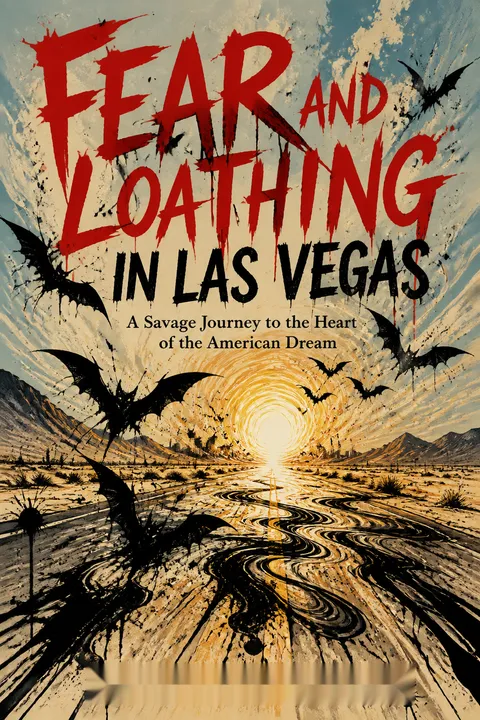


Plot Summary
The Pink Telephone Assignment
At the Beverly Hills Hotel, a call from New York sends Raoul Duke, a freelance journalist, to Las Vegas to cover the Mint 400 desert race and meet Portuguese photographer Lacerda. Duke’s attorney, Dr. Gonzo, sees trouble ahead but joins him, insisting they need a fast convertible.
The magazine supplies only three hundred dollars. The pair spend the night gathering a formidable supply of drugs and alcohol, a tape recorder, and flamboyant shirts before setting out in a red Chevy. Near Barstow, Duke begins hallucinating.
Gonzo picks up a hitchhiker who has never ridden in a convertible, and Duke tries to explain their supposed search for the American Dream. Their manic talk terrifies the passenger. When Gonzo invents a revenge mission, the young man jumps from the car and runs into the desert.
The assignment gives Duke a professional excuse for a journey that is already becoming an experiment in excess. He calls the trip a search for the American Dream, but the magazine’s vague instructions and meager cash make that purpose look self-invented. Gonzo’s practical advice about cars and equipment repeatedly shares space with drug use and threats, so the pair’s performance of competence is unstable from the start. The hitchhiker is the first person outside their partnership to encounter that performance. His escape makes clear that Duke and Gonzo’s private mythology does not travel safely into ordinary life.
Las Vegas Eats the Assignment
The Mint Hotel clerk tells Duke that his suite is not ready, but an envelope directs him to Lacerda, who is waiting upstairs. Gonzo visits the photographer while Duke sees the lobby as a reptile enclosure and panics at the press table, nearly getting them thrown out. They eventually reach their suite, retrieve the red Chevy, and drive toward the Mint Gun Club.
Duke finds racers, mechanics, and armed men firing shotguns into the desert. Gonzo arrives in a drugged confusion, and the pair mistake the gathering for a threat. Rather than investigate or enter the race, they hurry back to the highway. The magazine assignment has brought them to the event, but their fear and intoxication already keep them at its edge.
The hotel and gun club offer two versions of Las Vegas: a polished service system and a rough sporting crowd, both experienced by Duke as hostile theater. Lacerda’s presence ought to anchor the assignment in actual reporting, yet Gonzo’s suspicions and Duke’s hallucinations turn even that contact into potential danger. Their retreat from the gun club is a concrete early failure of professional purpose. They have reached the place they came to cover, but their altered perceptions make participation feel more threatening than useful.
The Race Disappears in Dust
At dawn, racers begin leaving in groups of ten, and their tires raise a dust cloud that quickly hides the course. Duke watches the start, then rides out in a Ford press Bronco with a driver and Lacerda, but the vehicle finds little action beyond scattered motorcycles and dune buggies. The race’s scale defeats ordinary reporting: checkpoints are far apart, visibility collapses, and the field disappears into the desert.
Lacerda keeps trying to get photographs while Duke returns to the Mint Gun Club, where he drinks and fills napkins with fragmentary notes. The sporting event continues, but Duke’s coverage has become a record of its own failure. He cannot reliably see the race, identify its winner, or produce the story his editors expected.
The dust is not simply an obstacle; it exposes the mismatch between a spectacular event and the tools meant to make it legible. Duke has a press vehicle and a photographer, yet the race’s scale turns observation into guesswork. Instead of admitting that the assignment cannot be completed as planned, he retreats to the bar and records impressions. His notes preserve confusion rather than facts, a choice that anticipates the book’s larger method: the reporter’s compromised consciousness becomes part of the subject. The race vanishes from view, leaving the press to cover its own helplessness.
Circus-Circus Turns Menacing
After drinking through Las Vegas casinos, Duke and Gonzo enter Circus-Circus, where gambling tables sit beneath acrobats and a machine can project a customer’s image over the city. Gonzo becomes frightened by the spectacle and nearly freezes in the crowd, so Duke pushes him toward the exit. Back at the Mint suite, Gonzo grows convinced that photographer Lacerda has taken a woman he imagined was interested in him.
He grabs a hunting knife, then eats a large dose of acid and lies in the bathtub with a radio. When Gonzo demands that Duke throw the plugged-in radio into the water, Duke instead hurls a grapefruit and yanks out the cord. He later blocks the bathroom door and leaves the knife-wielding attorney to come down from the drug.
The casino’s circus imagery externalizes the pair’s loss of control: spectacle keeps escalating while neither man can decide whether he is watching or participating. Gonzo’s fear turns quickly into aggression, and Duke’s attempt to manage him depends on improvisation rather than trust. The grapefruit thrown into the tub is a grotesque substitute for the requested electrocution, a moment in which Duke avoids catastrophe through absurdity. His recollection of the mid-sixties counterculture, when he believed a generation was rising toward victory, sharpens the contrast between remembered collective hope and the present night’s isolated, self-destructive panic.
The Telegram Reverses Flight
Gonzo leaves for Los Angeles, leaving Duke alone with a vast hotel bill, the red convertible, drugs, and Gonzo’s loaded .357 Magnum. As Duke prepares to flee, a telegram arrives for Hunter S. Thompson, addressed through Raoul Duke.
Gonzo has arranged a second Las Vegas assignment: a four-day narcotics conference attended by district attorneys, with expenses covered. Duke still drives west, but a California Highway Patrol officer stops him without arresting him and advises him to rest.
In Baker, Duke thinks he recognizes the hitchhiker from the desert and panics that the young man will identify him. He calls Gonzo, who reminds him of the telegram. Duke disguises his location during the call, then decides the safest escape is to turn around and return to Las Vegas.
The telegram offers Duke a second chance to turn chaos into legitimate work, but it also traps him in the city he is trying to escape. His fear of the hitchhiker and the highway patrol grows from real risks, yet he transforms both into a conspiracy closing around him. The officer’s restraint briefly interrupts that pattern, but Duke cannot accept help that would require sleep and surrender of control. The decision to return is both professional and paranoid: a conference about drug enforcement promises cover, while its police audience makes the next assignment more dangerous.
The White Cadillac Cover
Driving east again, Duke fires Gonzo’s revolver into the empty desert, then checks the drug supply and buys more liquor and ether near Las Vegas. He abandons the red Chevy by exchanging it for a white Cadillac convertible, hoping police will not connect the new car with his earlier escape. At the Flamingo, he checks in under Gonzo’s reservation while hundreds of conference attendees, many dressed alike in vacation clothes, fill the lobby.
Duke looks conspicuous but is admitted without challenge. He takes the room alone and waits for Gonzo, who is still traveling from Los Angeles. The second assignment now has a room, a new car, and a conference full of law officers. Duke’s disguise is only a rental contract and a confident manner.
Duke treats the Cadillac as more than transportation. It is a fresh identity, a way to replace the evidence of his previous flight without changing the person driving. His successful check-in among police depends less on an elaborate deception than on the ordinary authority of a reservation and his readiness to act as though he belongs. The conference setting gives this maneuver an ironic shelter: the people most likely to scrutinize him are busy managing one another and their own convention. His confidence is tactical, but it remains fragile.
Lucy Arrives in the Suite
When Gonzo finally reaches the Flamingo, Duke opens their suite door to find him naked and in the company of Lucy, a young artist who has drawn dozens of portraits of Barbra Streisand. Gonzo says he met Lucy on the plane and gave her LSD before realizing how inexperienced she was. Duke fears she will remember the encounter and expose them, especially if she reaches the celebrity she has come to see.
The men persuade Lucy to take her suitcase and portraits to the Americana Hotel, telling her she will meet Streisand there. Gonzo arranges for a cab driver to deliver her, and the pair return to the Flamingo. Their effort to send Lucy away postpones the immediate danger but leaves her able to find them again.
Lucy changes the stakes because she is not another willing participant in Duke and Gonzo’s private game. Her innocence and disorientation expose the ethical cost of their drug use more plainly than the men’s own suffering does. Duke’s response is partly protective, since he wants her moved somewhere safer, but it is also driven by fear of prosecution and scandal. Gonzo’s impulsive kindness has already become a risk he does not know how to manage. Sending Lucy away is less a solution than an attempt to control what she may remember.
The District Attorneys Convene
Lucy’s call from the Americana makes Duke consider leaving, but Gonzo phones her and invents a story that Duke has harmed someone and that police may be coming. Duke remains at the Flamingo, where he takes too much adrenochrome and spends hours unable to move normally.
The next day, they attend the district attorneys’ narcotics conference at the Dunes, wearing badges that identify Duke as a private investigator and Gonzo as a drug analyst. Director Patrick Healy opens the event, while Dr. Bloomquist lectures about marijuana using stereotypes and outdated jargon.
A film warns the audience about drugs. Gonzo slips out, and Duke follows, then the two invent lurid tales about drug users and violent cults for a Georgia prosecutor. The prosecutor believes them, revealing how easily official certainty can be manipulated.
The conference reverses the expected relationship between experts and outsiders. Duke and Gonzo have no serious credentials for drug enforcement, yet their confident performance earns the attention of a prosecutor. Meanwhile, the official lecture reduces drug users to crude categories, showing how institutional knowledge can be both authoritative and shallow. Duke’s adrenochrome paralysis makes the contrast bodily: the men are not detached observers but vulnerable users hiding inside a professional costume. Their invented horrors exploit the same appetite for simple explanations that the conference’s rhetoric encourages.
The Night Becomes a Threat
After the conference session, Duke and Gonzo drive around Las Vegas while Gonzo vomits from the drugs. At a stoplight, he leans toward a family in another car and pretends to sell them heroin, frightening a passenger who threatens them from inside the vehicle.
Later, at an all-night diner, Gonzo writes an obscene phrase on a napkin and passes it to the waitress. When she confronts him, he pulls a knife, cuts the payphone cord, and takes a pie before Duke can turn the encounter into an ordinary dispute over the bill.
The waitress freezes, and the men leave. Their reckless performance has now moved beyond private hallucinations: strangers are forced to absorb the danger, while Duke keeps treating each escalation as another piece of the trip.
These encounters show how Duke and Gonzo’s imagined roles become real sources of fear for other people. The men may regard the heroin offer and knife as comic theater, but the family and waitress have no reason to recognize a joke. Gonzo’s actions convert intoxication into coercion, while Duke’s narration tries to retain control by making the events sound manageable. That gap between the narrator’s tone and the consequences is central to the book’s uneasy humor. The public world is not merely a backdrop for their private madness; it is made to suffer from it.
The Dream Is Already Burned
Still searching for the American Dream, Duke and Gonzo stop at a taco shop in Boulder City and ask a waitress and cook whether they know where it is. They describe a place for drug users and hear about the Old Psychiatrist’s Club, once a nightclub where people gathered to buy drugs. The directions lead them to an empty, weed-covered lot.
A gas-station owner explains that the building burned down years earlier. Their search has produced no active refuge or promised revelation, only a vanished address and the leftovers of a scene that no longer exists. The discovery makes their mission feel less like a solvable assignment than a chase after a cultural moment already past, while the conference they came to cover continues without them.
The destroyed club gives the search a physical answer that is also a refusal. Duke and Gonzo have been asking strangers to locate an ideal, but the most concrete lead ends at rubble. The scene does not prove that the American Dream never existed; it shows that the men have mistaken a former gathering place for a destination they can still enter. Their reliance on local directions briefly resembles reporting, yet the information only confirms absence. The search begins to expose the distance between memory and available reality.
Gonzo Crosses the Runway
At dawn, Duke and Gonzo realize they are about to miss Gonzo’s flight to Los Angeles. Rather than turn back toward the airport entrance, Duke drives the white Cadillac off the freeway, across a ditch and cactus ground, and onto the runway. Gonzo is terrified as the plane draws near, but Duke reaches a break in the fence and drops him beside a van.
Gonzo boards; Duke escapes without being stopped. Alone again, Duke returns to the Flamingo, where the wrecked room and the conference’s aftermath sharpen his sense that the old counterculture has collapsed. The dangerous shortcut ends their partnership for the moment, leaving Duke in Las Vegas with the damaged rental, the drug supply, and no attorney to share the consequences.
The runway crossing is an extreme version of the pair’s usual refusal to accept limits. Duke turns a missed flight into a physical assault on infrastructure, and the absence of immediate pursuit briefly makes his recklessness seem vindicated. Yet Gonzo’s fear and departure expose the cost of that shared bravado: the partnership can dissolve as soon as one man gets safely aboard. Duke’s subsequent solitude matters more than the escape itself. Without Gonzo beside him, he must sit with the wreckage and the fading cultural promise that once made their excess feel purposeful.
Alice Joins the Fiction
During an earlier morning at the Flamingo, Gonzo mistakes a maid’s entry into their room for an attack and fights her on the floor. Duke flashes his police badge and helps transform the assault into a story: they persuade Alice, a hotel employee, that they are undercover investigators and that she should report what she sees.
She agrees, expecting payment, and the men give her a code phrase and a supposed contact. Later, as Duke reflects on the drug culture, he recalls how the optimism of the 1960s has given way to a market dominated by drugs that numb rather than expand consciousness.
Alice’s recruitment repeats that retreat into invention. Instead of acknowledging what they have done, the men recruit the frightened woman into another fiction.
The maid’s encounter compresses the book’s ethical distortion into one room. A hotel worker doing her job is attacked, then offered a role in a fantasy that recasts her as an informant and her attackers as law officers. The badge makes the lie plausible because it borrows authority from the very institutions the men mock. Duke’s reflection on the failed promise of the 1960s broadens this self-deception: the old language of liberation no longer matches the drugs, violence, and exhaustion he sees. He can diagnose the cultural collapse more clearly than he can take responsibility for his own part in it.
The Circus Holds the Answer
After Gonzo has left, Duke goes to Circus-Circus to buy an ape arranged through his friend Bruce Innes. The animal is gone: it has bitten an old man at the bar, and police have taken it away. Duke abandons the purchase and decides the casino itself represents the American Dream, built by an owner who once wanted to run away and join the circus.
Bouncers soon show him a photograph of Duke and Gonzo together, proving that their identities are no longer safely disguised. Duke drives off in the damaged Cadillac, leaves it at the rental agency, and boards a flight with drugs and Gonzo’s revolver. At a Denver airport drugstore, he uses his police and religious credentials to obtain amyls, then heads for the bar.
Duke’s answer to the search is not a recovered ideal but a business built from the spectacle he has been moving through all along. The circus owner’s childhood wish has become a successful institution, suggesting that the American Dream may be less a moral promise than the power to turn private appetite into public enterprise. The ape’s removal and the bouncers’ photograph interrupt Duke’s moment of certainty with consequences he cannot narrate away. Even so, he leaves by performing authority once more, using false credentials to secure drugs at the next airport.
Analysis
The book makes the failed assignment its narrative engine. Duke and Gonzo arrive to cover a desert race, but the race disappears behind dust, their notes dissolve into intoxicated fragments, and a second commission places them among prosecutors who misunderstand the drug culture they aim to control. Each new professional frame promises order, yet the men use credentials and confident improvisation to evade the ordinary consequences of their actions. Their performance is funny because it is audacious, and disturbing because strangers repeatedly bear its costs.
Duke’s narration keeps the reader suspended between observation and fabrication. He recognizes that the mid-sixties promise of collective transformation has ebbed, and he can describe the shift toward drugs that numb rather than liberate. Yet insight does not make him more responsible. He continues to invent cover stories, frighten bystanders, and treat fear as evidence of an elaborate plot. His self-awareness functions less as a cure than as another rhetorical tool.
The American Dream is therefore not a final prize waiting at a destination. It is a story Duke needs in order to make his movement seem purposeful. The burned nightclub gives the search a material image of a vanished counterculture; Circus-Circus offers a harsher replacement, a private appetite turned into a profitable spectacle. The book’s ending refuses a clean moral awakening. Duke leaves Las Vegas, but carries the drugs, weapon, and borrowed identities onward. The journey ends geographically, while its central habit persists: when reality becomes intolerable, he converts it into another story.
Review Summary
Fear and Loathing in Las Vegas receives mixed reviews, with many praising Thompson's unique writing style and cultural commentary. Readers find the drug-fueled narrative both hilarious and disturbing, appreciating its portrayal of 1970s America. Some criticize the lack of plot and excessive drug use, while others view it as a poignant reflection on the American Dream. The book's impact on popular culture is widely acknowledged, with many considering it a classic of gonzo journalism and counterculture literature.
People Also Read
Characters
Raoul Duke
Unsteady gonzo reporterDuke is a freelance journalist sent to Las Vegas to cover a desert motorcycle race, then drawn into a second assignment about narcotics enforcement. He narrates his own drug use and misconduct with a mixture of bravado, fear, and comic invention, often turning events into stories before he can face their consequences. His professional identity gives him access to hotels, press credentials, and official gatherings, but it rarely produces dependable reporting. Duke is alert to the gap between the hopeful mythology of the 1960s and the harsher drug culture he sees in 1971. He wants to believe the trip has a larger purpose, even as his actions repeatedly make that purpose harder to distinguish from an excuse.
Dr. Gonzo
Lawyer, volatile companionGonzo is Duke’s attorney, traveling partner, and fellow drug user. He approaches practical problems with legal confidence, arranging travel and talking his way through hotel desks, but his judgment can collapse into sudden aggression or panic. His appetite for risk makes him both useful to Duke and dangerous to everyone around them. Gonzo’s occasional concern for vulnerable people, as when he tries to help Lucy, is tangled with impulsiveness and poor foresight. He often treats the men’s shared inventions as if they were facts, turning imagined threats into real confrontations. His partnership with Duke rests on loyalty and familiarity, but also on a chemistry that can magnify their worst instincts.
Lacerda
Portuguese race photographerLacerda is the photographer Duke has been told to meet in Las Vegas. He is there to document the Mint 400 and keeps trying to work despite the dust and the journalists’ disorganization. Gonzo’s suspicions cast him as a possible threat, but the assignment gives him a straightforward professional purpose that contrasts with Duke and Gonzo’s improvised mission. Lacerda’s limited presence underscores how far the pair drift from the work they were sent to do.
The hitchhiker
Uneasy accidental passengerThe hitchhiker is a young traveler whom Gonzo picks up on the way to Las Vegas. His first ride in a convertible becomes a frightening introduction to Duke and Gonzo’s drugged behavior. He tries to remain polite, but their talk of violence and revenge drives him to flee into the desert. Later, Duke thinks he recognizes him in Baker, turning the passenger’s brief appearance into a source of renewed paranoia.
Lucy
Stranded portrait artistLucy is a young artist who has filled a room with portraits of Barbra Streisand and traveled to Las Vegas hoping to meet the singer. Gonzo encounters her while high, gives her LSD without understanding her inexperience, and brings her to the Flamingo. Her confusion and vulnerability expose the human cost of the men’s self-indulgence. Duke and Gonzo try to send her to another hotel, but Lucy’s later call shows that their efforts have not erased her distress or her connection to them.
Bruce Innes
Vegas contact and brokerBruce Innes is Duke’s friend in Las Vegas and the contact who locates the ape Duke wants to buy. Bruce provides a link to the city’s casual networks of bars, deals, and acquaintances, while his practical caution contrasts with Duke’s appetite for impulsive schemes. When the ape is taken by police, Bruce urges Duke not to risk arrest trying to retrieve it.
Alice
Hotel maid turned informantAlice works for the Flamingo’s linen service and enters Duke and Gonzo’s suite to clean it. The men mistake her for a threat and frighten her badly. They then persuade her that they are undercover investigators, offering payment for reports about hotel activity. Alice is eager to cooperate, not because she understands the men’s real situation, but because the invented job promises money and gives her a way to make sense of the encounter.
Patrick Healy
District attorney conference directorHealy directs the National District Attorneys’ narcotics conference at the Dunes. His formal opening establishes the official setting that Duke and Gonzo enter under misleading credentials. He represents the conference’s institutional authority, though the event’s lectures and procedures do little to bridge the distance between official drug policy and the culture it claims to understand.
Dr. E. R. Bloomquist
Drug lecture authorityBloomquist is a conference speaker and author presented as an authority on marijuana and drug abuse. His lecture relies on dated terminology and simplistic explanations, giving Duke and Gonzo material for their mockery. He is less a personal adversary than a representative of the conference’s confident but limited account of the drug culture.
The Georgia district attorney
Credulous conference attendeeThis prosecutor meets Duke and Gonzo at the conference bar. The two men feed him invented accounts of violent drug users and hidden cults, and he accepts their stories with growing alarm. His credulity reveals how official fear can be steered by a convincing performance, even when the supposed experts are intoxicated and fabricating what they claim to know.
Plot Devices
The Red Shark and White Whale
Cars as shifting disguisesDuke’s red Chevy convertible, which he calls the Red Shark, carries the pair from Los Angeles into the Mint 400 assignment and becomes an unmistakable emblem of their excess. After fleeing west and returning to Las Vegas, Duke trades it for a white Cadillac, the White Whale, hoping to break the link between himself and the earlier drive. The switch offers a temporary disguise but no real escape from responsibility. The Cadillac carries the men through the conference, their reckless night drives, and Gonzo’s runway crossing, then ends up badly damaged. Both cars turn mobility into a false promise: Duke can change vehicles, but not the consequences following him.
The Drug Supply
Intoxication as distorted perceptionDuke and Gonzo carry an excessive mix of drugs and alcohol, using different substances throughout the trip and repeatedly misjudging what they can safely manage. The drugs generate Duke’s visions of reptiles, bats, and threats, while Gonzo’s doses feed fear, aggression, and bodily collapse. Intoxication also shapes the book’s comic narration: dangerous scenes are reported with a confidence that often contradicts their consequences. The supply is not merely background detail. It makes the men unreliable observers, creates practical risks such as the bathtub episode, and complicates the work they have been hired to perform. Their changing drug use tracks the shift from imagined freedom toward exhaustion and loss of control.
Press and Police Badges
Credentials as borrowed authorityDuke’s press credentials and the badges he and Gonzo wear at the narcotics conference let them pass through settings where they might otherwise be challenged. Their official-looking identities help secure a hotel room, place them among district attorneys, and support their pretense that they are undercover investigators. The badges do not make their claims true, but they persuade strangers to treat the men as legitimate. At the airport, Duke again relies on credentials to obtain amyls. This device links journalism, policing, and performance: in Las Vegas, identity often depends less on proven knowledge than on the confidence with which a person displays a credential.
The Mint 400 Assignment
Work as an excuse for excessThe magazine’s commission gives Duke a reason to travel, spend money, and claim professional purpose, but the assignment is poorly defined and difficult to report. The race disappears behind dust, while Duke’s intoxication and Gonzo’s interference prevent them from producing clear coverage. A second commission, the narcotics conference, offers a fresh reason to remain in Las Vegas, this time among the very officials who police drug use. Together, the assignments keep the plot moving while exposing the gap between the journalist’s stated work and what he actually observes. The professional frame never fully disappears, but it increasingly serves as cover for a journey that has escaped its original purpose.
The American Dream Search
A destination that keeps recedingDuke repeatedly describes the trip as a search for the American Dream, although the original commission is to cover the Mint 400. This phrase gives shape to a journey otherwise defined by improvised decisions and drug episodes. The pair ask strangers for directions and pursue a lead to the Old Psychiatrist’s Club, only to find a burned-out lot. Near the end, Duke decides the Dream is embodied by Circus-Circus and its owner, who turned a childhood wish to join a circus into a business. The changing answer is part of the device’s meaning: Duke’s search reveals less a single ideal than his need to attach a larger story to the city’s appetites and spectacles.
FAQ
Synopsis & Basic Details
What is Fear and Loathing in Las Vegas about?
- Drug-fueled road trip: The story follows Raoul Duke and his attorney, Dr. Gonzo, on a drug-addled trip to Las Vegas, ostensibly to cover a motorcycle race.
- Surreal American Dream quest: Their journey quickly devolves into a chaotic and hallucinatory search for the "American Dream," marked by paranoia and excess.
- Critique of 70s culture: The narrative satirizes the counterculture, consumerism, and the disillusionment of the era through the lens of their drug-induced experiences.
Why should I read Fear and Loathing in Las Vegas?
- Unique narrative style: Experience Hunter S. Thompson's signature Gonzo journalism, a blend of fiction, personal experience, and social commentary.
- Exploration of dark themes: Delve into a raw and unflinching portrayal of drug use, paranoia, and the search for meaning in a chaotic world.
- Cult classic status: Discover a seminal work of counterculture literature that continues to resonate with readers for its rebellious spirit and unconventional approach.
What is the background of Fear and Loathing in Las Vegas?
- 1970s counterculture backdrop: The story is set against the backdrop of the early 1970s, a period of social and political upheaval, disillusionment, and experimentation with drugs.
- Gonzo journalism origins: The book is a prime example of Gonzo journalism, a style that blends subjective experience with factual reporting, blurring the lines between fiction and reality.
- Personal experience influence: The narrative draws heavily from Hunter S. Thompson's own experiences with drugs and his observations of American society, making it a deeply personal and reflective work.
What are the most memorable quotes in Fear and Loathing in Las Vegas?
- "We were somewhere around Barstow on the edge of the desert when the drugs began to take hold.": This iconic opening line immediately establishes the chaotic and drug-fueled nature of the story.
- "Buy the ticket, take the ride.": This quote encapsulates the reckless and impulsive nature of the characters' journey, highlighting their willingness to embrace chaos.
- "Too weird to live, too rare to die.": This phrase, often attributed to Thompson, reflects the characters' extreme lifestyle and their defiance of societal norms.
What writing style, narrative choices, and literary techniques does Hunter S. Thompson use?
- First-person, subjective narration: The story is told from Raoul Duke's perspective, immersing the reader in his drug-addled thoughts and perceptions, creating a highly subjective and unreliable narrative.
- Gonzo journalism style: Thompson blends personal experience, fictional elements, and social commentary, blurring the lines between fact and fiction, creating a unique and immersive reading experience.
- Stream-of-consciousness: The narrative often mimics the chaotic and fragmented nature of drug-induced thought, using a stream-of-consciousness style that reflects the characters' mental states.
Hidden Details & Subtle Connections
What are some minor details that add significant meaning?
- The Great Red Shark: The car, a red convertible, symbolizes the characters' reckless pursuit of the American Dream and their desire for freedom and escape.
- Recurring references to reptiles: The characters' hallucinations of lizards and reptiles reflect their paranoia and the sense of unease they feel in the artificial environment of Las Vegas.
- The tape recorder and "Sympathy for the Devil": The constant playing of this song underscores the chaotic and rebellious nature of their journey, as well as the sense of impending doom.
What are some subtle foreshadowing and callbacks?
- Early mention of ether: The narrator's early concern about the ether foreshadows its later use and the extreme state of mind it induces.
- The hitchhiker's fear: The hitchhiker's terror early in the story foreshadows the increasing paranoia and danger that the characters will experience.
- Recurring mention of "Savage Henry": The repeated, though likely fictional, threat of "Savage Henry" adds to the sense of paranoia and impending danger.
What are some unexpected character connections?
- The hotel clerk and the telegram: The hotel clerk's confusion over the telegram and his concern for "Dr. Gonzo" highlights the absurdity of the situation and the characters' impact on those around them.
- The waitress and the "American Dream": The waitress's casual mention of the "Old Psychiatrist's Club" as a possible location for the American Dream underscores the characters' misguided quest.
- The maid and the "undercover" operation: The maid's accidental encounter with the characters leads to a bizarre and humorous "undercover" operation, highlighting the absurdity of their situation.
Who are the most significant supporting characters?
- The hitchhiker: His brief but impactful presence highlights the extreme nature of Duke and Gonzo's behavior and the disconnect between their reality and the outside world.
- Lucy: Her unstable presence adds a layer of unpredictability and danger to the story, serving as a cautionary tale about the consequences of drug use.
- The various hotel staff: The hotel clerks, maids, and bartenders provide a glimpse into the reactions of ordinary people to the characters' bizarre behavior, highlighting the absurdity of their actions.
Psychological, Emotional, & Relational Analysis
What are some unspoken motivations of the characters?
- Escape from reality: Both Duke and Gonzo are driven by a desire to escape the mundane and confront the disillusionment of their generation through extreme experiences.
- Search for identity: Their chaotic journey can be seen as a desperate attempt to define themselves and find meaning in a world that seems increasingly absurd.
- Rebellion against conformity: Their drug use and reckless behavior are a form of rebellion against societal norms and expectations, a rejection of the status quo.
What psychological complexities do the characters exhibit?
- Paranoia and anxiety: Both Duke and Gonzo experience intense paranoia and anxiety, often fueled by their drug use, leading to distorted perceptions of reality.
- Self-destructive tendencies: Their reckless behavior and excessive drug use reveal a self-destructive streak, a willingness to push themselves to the brink of collapse.
- Contradictory emotions: They often display a mix of bravado and vulnerability, humor and despair, highlighting the internal conflicts that drive their actions.
What are the major emotional turning points?
- The encounter with the hitchhiker: This early encounter highlights the characters' disconnect from reality and sets the stage for their increasing paranoia and isolation.
- The Circus-Circus experience: The chaotic and hallucinatory experience at the casino marks a turning point, as their drug use escalates and their grip on reality loosens.
- The departure from Vegas: The decision to flee Vegas represents a moment of clarity, as they realize the futility of their quest and the need to escape the consequences of their actions.
How do relationship dynamics evolve?
- Co-dependent partnership: Duke and Gonzo's relationship is characterized by a co-dependent dynamic, where they enable each other's reckless behavior and rely on each other for support.
- Shifting power dynamics: The power dynamic between them shifts throughout the story, with Duke often acting as the more rational observer while Gonzo is the catalyst for chaos.
- Underlying loyalty: Despite their conflicts and erratic behavior, there is an underlying sense of loyalty and camaraderie between them, a bond forged through shared experiences.
Interpretation & Debate
Which parts of the story remain ambiguous or open-ended?
- The true nature of the "American Dream": The story never explicitly defines the "American Dream," leaving it open to interpretation and highlighting its elusive and subjective nature.
- The reliability of the narrator: Duke's drug-induced state makes him an unreliable narrator, leaving the reader to question the accuracy of his perceptions and the events he describes.
- The meaning of the ending: The ending, with Duke's departure from Vegas, is open-ended, leaving the reader to ponder the ultimate meaning of their journey and the characters' future.
What are some debatable, controversial scenes or moments in Fear and Loathing in Las Vegas?
- The treatment of Lucy: The characters' treatment of Lucy, particularly their decision to abandon her, raises questions about their morality and the consequences of their actions.
- The excessive drug use: The story's graphic depiction of drug use has been both praised and criticized, with some seeing it as a realistic portrayal of addiction and others as glorifying it.
- The satirical tone: The story's satirical tone can be interpreted in different ways, with some seeing it as a biting critique of American society and others as simply nihilistic and cynical.
Fear and Loathing in Las Vegas Ending Explained: How It Ends & What It Means
- Duke's solo departure: The ending sees Duke leaving Las Vegas alone, having sent Gonzo off on an earlier flight, symbolizing a separation from the chaos and a return to some semblance of reality.
- Reflection on the journey: Duke's reflections on the events of the past few days highlight the futility of their quest for the American Dream and the disillusionment of their generation.
- Ambiguous future: The ending is open-ended, leaving the reader to wonder about Duke's future and whether he will ever find the meaning and purpose he seeks, suggesting that the search itself is more important than the destination.
Download PDF
Download EPUB
.epub digital book format is ideal for reading ebooks on phones, tablets, and e-readers.








