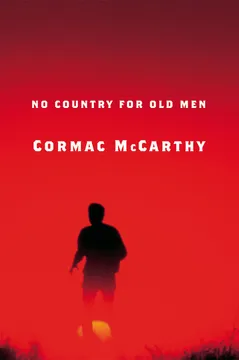


Plot Summary
The Cattle Gun
Sheriff Ed Tom Bell begins with the memory of a young murderer who met execution without remorse, a case that has unsettled his faith in what law can contain. Then a deputy leaves Anton Chigurh, a prisoner carrying a pneumatic cattle-killing weapon, alone in the office.
Chigurh slips his cuffed hands beneath his legs, strangles the deputy with the chain, takes his keys, and walks out. On the highway, he stops a passing motorist under the pretense of a traffic check and kills him with the cattle gun. Bell has not yet met the killer, but the deaths announce the kind of violence he will soon be asked to pursue.
The opening places Bell’s moral unease beside Chigurh’s practical violence. Bell remembers a criminal whose evil seemed impossible to explain; Chigurh makes that fear physical by turning ordinary custody and an ordinary traffic stop into opportunities to kill. The cattle gun matters because it belongs to work, not spectacle. Its impersonal efficiency hints at a world in which people can be reduced to obstacles, while Bell’s reflective voice insists that a human conscience still has to reckon with what happens.
Money in the Caldera
Llewelyn Moss, a Vietnam veteran and welder, is hunting antelope in the desert when he spots vehicles and bodies below a ridge. The scene holds a dead dog, a machine pistol, parcels of heroin, and a wounded man pleading for water. Moss studies the bullet patterns and tracks blood away from the trucks until he finds another dead man beside a leather case.
Inside are millions of dollars in bundled bills. He knows the money will attract whoever survived the shootout, yet he carries it to his truck and hides the machine pistol beneath his trailer. At home, Carla Jean, his young wife, doubts his story about the pistol but cannot make him explain where he has been.
Moss’s discovery is not a simple temptation scene: he knows enough about the massacre to recognize the danger, and takes the money anyway. His competence makes his choice more consequential, not less. He reads the ground accurately, wipes away traces, and understands that someone will come looking, yet treats the cash as a possible escape from the narrow life he has lived. The distance between his practical intelligence and his faith in his own control becomes the novel’s central pressure.
The Water He Brings
Moss wakes in the night troubled by the wounded man he left behind, fills a jug, and drives back toward the massacre site. He finds the man dead and the vehicles stripped. On the climb out of the caldera, he sees someone beside his truck and runs for the rocks as a vehicle searches the dark with a spotlight.
At dawn, Moss races toward the Rio Grande while the pursuers fire after him. He tumbles down the riverbank, loses his pistol, recovers it, then swims across with his boots and weapon. A shotgun blast wounds his arm as he reaches the far bank. He keeps moving, injured and barefoot, knowing the men can identify him through his truck.
Moss’s return with water is a rare attempt to answer another person’s need, but it does not undo his earlier decision to take the money. The dead man and stripped vehicles make the consequence immediate: the pursuit is already underway. His escape across the river shows his physical resourcefulness, but each survival tactic leaves him more injured and more exposed. The border offers distance, not absolution; the truck and the stolen cash have tied his identity to the violence on both sides.
A Sheriff Finds the Trail
Bell and Deputy Wendell ride into the caldera and reconstruct the shooting from tire marks, shell casings, and bodies. They recognize Moss’s truck but cannot find its owner. Moss, meanwhile, reaches home injured and orders Carla Jean onto a bus to Odessa, where she can stay with her mother.
He returns to the scene, discovers his truck has vanished, and escapes by bus toward Del Rio. Chigurh searches Moss’s trailer, then uses the phone records to find numbers linked to Del Rio and Odessa. Bell learns that Moss has a wife and understands that the people hunting him may use her as leverage, but he has no clear way to protect either of them.
The chapter braids two kinds of pursuit. Bell reads physical evidence with patience, while Chigurh turns mundane records into a map of Moss’s intimate life. Moss’s decision to send Carla Jean away is protective, but it also reveals how little control he has over what she knows or where danger may follow. Bell’s careful investigation cannot keep pace with a killer who treats ordinary information as a weapon. Law sees the tracks; Chigurh sees the connections.
The Money Has a Signal
In Del Rio, Moss rents a cheap motel room and hides the case in an air duct, lowering it on a cord. He discovers that a small transponder is concealed among the bills, which explains how Chigurh can follow the money. When Chigurh reaches the motel, Moss has moved rooms and prepared a shortened shotgun, while Chigurh kills two armed men waiting in the original room.
Moss returns for the case, retrieves it from the duct with makeshift poles, and leaves before the next search. He has learned that the cash itself is broadcasting his location, but the discovery comes after the pursuit has already narrowed around him.
The transponder transforms the money from portable wealth into an active trap. Moss’s mechanical ingenuity lets him retrieve it, but the device exposes the limits of cleverness: every hiding place can be searched, and every tactical gain costs time. Chigurh’s killings of the waiting men also establish that he is not merely a hired guard for one side of the drug deal. He eliminates anyone who complicates his route, making the case’s signal a marker of a violence that is widening beyond Moss.
Blood on the Bridge
Moss reaches a hotel in Eagle Pass and finds the transponder inside one packet of bills. He removes it, but Chigurh has already followed the signal to the room. Moss hides beneath the bed and catches Chigurh as he enters; after disarming him, he takes the case and escapes down the stairs.
Chigurh shoots him from the hotel balcony, and armed men arrive in the street, turning the pursuit into a crossfire. Wounded, Moss crosses the bridge into Mexico and throws the case into the river cane before collapsing in Piedras Negras. Chigurh is also hit in the leg during the gunfight, but survives and leaves the scene.
The hotel encounter gives Moss his clearest tactical victory, yet it cannot restore safety. He wounds and outmaneuvers Chigurh long enough to escape, but the street fills with competing gunmen and his body is failing. Throwing the case into the cane separates him, briefly, from the object that has governed the chase. The border crossing saves him from immediate capture while making him dependent on strangers and improvised care. Both men survive the exchange, so the conflict remains unresolved and grows more personal.
Wells Misjudges the Rules
Carson Wells, a former Special Forces officer hired to recover the missing money, visits Moss in the hospital. He explains that Chigurh will keep hunting him even if he returns the cash, and offers to negotiate a safer arrangement. Moss refuses to trust him. After Moss contacts Wells’s number from the hospital, Chigurh answers instead.
Chigurh later finds Wells at a hotel and kills him; he also kills the businessman who had set the hunt in motion. The conversation with Moss has left him focused on Carla Jean. He warns that she will be answerable for Moss’s choices, making the threat reach beyond the man who took the money.
Wells’s professional confidence rests on the belief that violence can be managed through information and negotiation. His warning to Moss is accurate, but his own expertise cannot make Chigurh governable. Moss’s refusal to accept Wells’s help is partly pride and partly a refusal to become another contractor’s problem. Chigurh’s response to both men makes the distinction clear: he treats the transaction as secondary to his own rules. Carla Jean becomes vulnerable not because she chose the bargain, but because she belongs to Moss’s life.
Moss Chooses the Road
From the hospital, Moss calls Carla Jean and urges her to leave Odessa with her sick mother. He also tells Chigurh he will come to meet him, hoping to draw the threat away from her. Before dawn, Moss slips out of the hospital and crosses back into Texas. He buys clothes, retrieves the case from the cane where he left it, and arranges transport toward San Antonio.
After buying a truck and a gun, he picks up a teenage hitchhiker who is headed west. The two travel together through West Texas. Moss gives her money and intends to leave her safely along the route, but he cannot make his own danger disappear by helping someone else.
Moss’s escape is driven by a new mixture of fear and responsibility. He tries to redirect danger from Carla Jean, then gives money to a hitchhiker whose vulnerability resembles the ordinary lives his choices have put at risk. Yet his promise to confront Chigurh is made without a workable plan. The road offers him movement, not a clean beginning. His brief generosity matters precisely because it does not cancel the harm around him or guarantee that he can protect the people he meets.
Van Horn Goes Quiet
In Van Horn, armed men arrive at the motel where Moss and the hitchhiker have stopped. Gunfire erupts, and the young woman is killed. When Bell reaches the scene, Moss and the girl are dead, while the attackers have escaped. Bell identifies Moss and must carry the news to Carla Jean, who has traveled with her mother toward El Paso.
He later meets Carla Jean and asks what she knows about Moss’s whereabouts. She refuses to betray her husband until Bell promises that he will not harm him. By the time Bell can act on what she tells him, the pursuit has already carried Moss beyond his reach.
Moss’s death arrives without the anticipated duel with Chigurh. The motel’s sudden violence denies him the final confrontation he had promised, and Bell inherits the task of explaining an outcome he could not prevent. The hitchhiker’s death makes the cost extend beyond the original drug deal: a stranger drawn into Moss’s escape is consumed by it. Carla Jean’s loyalty is not ignorance but a deliberate moral boundary. Bell’s promise can earn her trust, yet it cannot repair what the violence has already taken.
The Coin Cannot Decide
Chigurh recovers the money and returns most of it to a new business contact, presenting himself as a reliable specialist. He then finds Carla Jean after her mother’s death and funeral. She tells him the money is gone, but Chigurh insists that he gave Moss his word to kill her if Moss failed to deliver it.
He flips a coin and asks her to call it; she refuses to let the coin carry responsibility for his choice. The result does not save her. Chigurh shoots her, then leaves the house. Three blocks away, a car strikes his truck and breaks his arm. He pays two boys for a shirt, binds his injuries, and walks away before help arrives.
The coin toss is Chigurh’s performance of impartiality: he frames murder as an outcome delegated to chance, even though he controls the weapon and the terms. Carla Jean sees through that arrangement and refuses to collaborate in disguising his agency. Her resistance does not save her, but it exposes the moral fraud at the center of his system. The crash that follows punctures his pose of invulnerability without transforming him. Even badly injured, he converts other people’s ordinary kindness into a means of escape.
Bell Loses the Trail
Bell learns that a teenager took Chigurh’s pistol from the truck after the collision and traces the weapon through a later robbery. He questions the boys who saw Chigurh injured, but their account gives him no name or reliable lead. The killer remains outside the reach of ordinary investigation.
Bell also revisits the war medal he received after abandoning a position where his men died. He tells his uncle Ellis what happened and admits that the guilt has shaped his decades in law enforcement. Ellis listens without absolving him, forcing Bell to face the difference between living with a choice and pretending it can be undone.
The pistol offers Bell a physical lead, but its passage through strangers and crimes produces evidence without an arrest. That frustration mirrors his private reckoning: facts can establish what happened, yet they cannot restore the lives or choices they document. His confession to Ellis is not a bid for simple forgiveness. Bell has long treated duty as a way to compensate for surviving his men, and speaking the truth tests whether that self-imposed burden has become another form of evasion.
A Fire in the Dark
Bell retires, admitting that he no longer believes he can protect his county from the violence he has seen. He visits Moss’s father, who remembers his son as a gifted rifleman and a veteran troubled by the friends he outlived. At home, Loretta meets Bell’s uncertainty with steady affection, and he chooses to return to ordinary life rather than keep pretending that resolve can solve everything.
The novel closes with Bell’s dream of his father riding ahead through a cold, dark pass, carrying fire to make a place of warmth. Bell wakes with no proof that the world has improved, only an image of guidance he can still follow.
Bell’s retirement is neither a triumph nor surrender to Chigurh. It is an admission that public duty cannot make one person sovereign over history. Moss’s father and Ellis connect the present violence to older forms of loss, while Loretta offers care without pretending to explain it away. The final dream replaces Bell’s desire for mastery with a more modest hope: someone has gone ahead and carries a light. The image does not promise rescue; it gives him a reason to keep moving through darkness.
Analysis
The novel makes the stolen money less a prize than a mechanism that reveals how people understand responsibility. Moss believes skill can contain the consequences of his choice; Bell believes duty can make him answerable for the safety of others; Chigurh treats a private code as if it releases him from ordinary moral agency. Each belief is tested by events that exceed its owner’s control. The case’s transponder literalizes the way a choice follows the person who made it, while the coin toss shows how easily chance can be recruited to disguise intention.
Bell’s narration gives the pursuit a second scale. He is not merely investigating a crime; he is measuring the distance between the violence he remembers and the violence he now encounters. His war memories complicate his authority, because the sheriff who judges others has also lived with a decision he cannot reverse. His eventual retirement is not proof that evil has won or that withdrawal is virtuous. It is an admission that responsibility has limits, and that pretending otherwise can become its own form of dishonesty.
The book’s bleakness is concrete rather than abstract. A deputy is killed in an office, a wounded man is left in the desert, a teenager is drawn into a fugitive’s journey, and a wife becomes a target because of choices she did not make. Against these losses, the final dream offers no rescue or explanation. Bell’s father carries fire ahead through darkness: a modest image of continuity, not certainty. The story asks what remains possible when justice cannot restore the past. Its answer is small but demanding: acknowledge the choice, refuse to call violence fate, and keep faith with the people still beside you.
Review Summary
Reviewers widely praise No Country for Old Men as a gripping, genre-defying thriller that transcends its crime novel premise. Most highlight Anton Chigurh as one of literature's greatest villains — a chilling embodiment of fate and evil. McCarthy's minimalist prose style, while initially challenging due to absent punctuation and quotation marks, is largely celebrated as fitting the story's tone. Sheriff Bell's philosophical monologues are frequently noted as the novel's moral core. Some critics found the ending unsatisfying or certain events frustratingly off-page, but the majority consider it a masterwork.
People Also Read







Characters
Llewelyn Moss
The capable fugitiveMoss is a Texas welder, Vietnam veteran, skilled hunter, and Carla Jean’s husband. He notices details, plans carefully, and can improvise under pressure, qualities that make his choice to take the money feel calculated rather than innocent. His pride is less a boast than a belief that competence can keep consequences manageable. He cares for Carla Jean, but withholds information in the name of protecting her, leaving her to live with dangers she cannot assess. His character is shaped by the tension between self-reliance and the obligations he cannot control.
Anton Chigurh
The rule-bound predatorChigurh is a methodical killer who treats each encounter as an occasion to impose his own terms. He is observant, patient, and frighteningly calm, using tools such as a cattle gun and transponder as efficiently as other people use keys. His coin tosses suggest that he sees himself as an instrument of fate rather than an ordinary man making choices. That belief does not make him impartial; it lets him disguise responsibility from himself and others. Against Moss’s improvisation and Bell’s moral doubt, Chigurh represents a will that recognizes no authority beyond its own rules.
Ed Tom Bell
The aging county sheriffBell is a veteran Texas sheriff whose investigations unfold alongside his reflections on age, duty, faith, and the violence he has seen. He is attentive to evidence and protective of the people in his county, but he doubts whether his experience is enough for the crimes now confronting him. His memories of war and an earlier execution shape his fear that some forms of violence cannot be understood through familiar moral categories. Bell is not indifferent or cowardly; his struggle is to distinguish responsible limits from the temptation to call retreat wisdom.
Carla Jean Moss
The loyal young wifeCarla Jean is Moss’s nineteen-year-old wife, practical and emotionally perceptive despite having little control over the crisis surrounding her. She knows her husband’s habits and recognizes when he is concealing something, but she does not mistake love for complete knowledge. Her loyalty is active: she weighs what Bell tells her, protects Moss’s confidence, and tries to care for her ill grandmother. Carla Jean’s directness contrasts with the men’s tactical evasions. She insists, even under pressure, that choices belong to the people making them rather than to money, fate, or someone else’s rules.
Carson Wells
The rival trackerWells is a former Special Forces officer and professional tracker hired to recover the missing money and manage the threat posed by Chigurh. He understands the danger more clearly than Moss does and tries to offer a practical arrangement, but he also assumes that expertise can give him room to negotiate. His cool manner and tactical intelligence make him a plausible intermediary between criminal business and personal survival. Wells’s role tests the idea that knowing how violence works is the same as being able to control it.
Loretta Bell
The sheriff's anchorLoretta is Bell’s wife and the person who knows the private cost of his public duty. She offers companionship without sharing his despair about the county’s changing world, and her steadiness helps Bell imagine a life beyond the badge. Their marriage is built on shared history, teasing, and an uncommon willingness to let the other remain imperfect. Loretta does not solve Bell’s moral crisis; she gives him a relationship in which he can admit uncertainty without losing his place.
Uncle Ellis
The wounded family elderEllis is Bell’s disabled uncle, an old lawman who lives with the injuries and losses of an earlier frontier. His blunt perspective challenges Bell’s assumptions about duty, regret, and what a person can repair. Ellis has seen violence persist across generations, but he does not turn that knowledge into easy wisdom. His home and family stories give Bell a place to voice a wartime failure he has carried for decades.
The hitchhiker
A restless young runawayThe unnamed teenage hitchhiker meets Moss while trying to travel west and is drawn to the danger he represents. She is restless, alert to possibility, and eager to imagine a fresh start. Moss recognizes her vulnerability even as she romanticizes his outlaw life, so their brief companionship exposes the gap between adventure and its cost. She serves as a stranger with her own desires, not merely as a reflection of Moss.
Moss’s father
A grieving veteran fatherMoss’s father is a widowed veteran who remembers his son as an exceptional rifleman and a young man burdened by the friends he lost in Vietnam. His account complicates Bell’s view of Moss, revealing a history of grief behind the fugitive’s self-command. He speaks from a generation that has also witnessed war change the people it sends home.
Wendell
Bell’s steady deputyWendell works beside Bell at the massacre scene, helping read tire tracks, shells, and bodies. His practical questions keep the investigation grounded, while his presence gives Bell a colleague with whom he can share uncertainty. Wendell respects the dead and follows Bell’s lead without pretending the evidence is clearer than it is.
Deputy Haskins
The first fallen deputyHaskins is the deputy assigned to watch Chigurh after his arrest. His ordinary lapse in attention gives Chigurh the opening to escape, making the danger visible before Bell understands its scale.
Sheriff Lamar
A neighboring sheriffLamar is a fellow sheriff who shares Bell’s burden of handling the killings and informing victims’ families. The deaths in his jurisdiction make the drug violence personal and strain his long record of service.
Plot Devices
The money case
Bait made portableThe leather case turns a failed drug transaction into a pursuit that Moss can carry with him. Its millions promise escape from ordinary work, but the weight, conspicuous hiding places, and rightful claimants make it a liability at every stop. The case also contains a transponder, so it does more than motivate the chase: it actively reveals Moss’s location. When Moss throws it into the river cane, he briefly separates his survival from the object that began the crisis, though he later retrieves it.
The transponder
A hidden beaconConcealed among the cash, the small transmitter allows Chigurh to track the case across motel rooms and towns. Moss discovers it only after he has already been found, prompting him to change rooms and prepare for an armed encounter. The device turns money into a signal: every effort to preserve the fortune can also guide its pursuers toward him. It makes modern technology feel less like a rescue than another instrument available to whoever is willing to use it.
The coin toss
False theater of chanceChigurh uses a coin toss to make a victim participate in a decision he has already arranged. The ritual first appears in an encounter at a Texas gas station, where the proprietor is forced to call a coin without understanding the stakes. Later, Chigurh presents the same ritual to Carla Jean as if chance can justify his action. The coin is not supernatural and does not remove his agency. It exposes his need to turn deliberate violence into a rule-bound process that looks larger than himself.
The cattle gun
Industrial killing toolChigurh’s pneumatic cattle gun is adapted from a slaughterhouse tool and becomes his signature weapon. Its compressed-air bolt kills without the familiar report of a gunshot, making violence abrupt and difficult for witnesses to explain. The weapon links Chigurh’s method to an industrial logic: a body is treated as something to be dispatched cleanly. It also signals his preparation and unnerving practicality from the first scenes, before his motives or personal code are fully apparent.
About the Author
Other books by Cormac McCarthy

Download PDF
Download EPUB
.epub digital book format is ideal for reading ebooks on phones, tablets, and e-readers.








