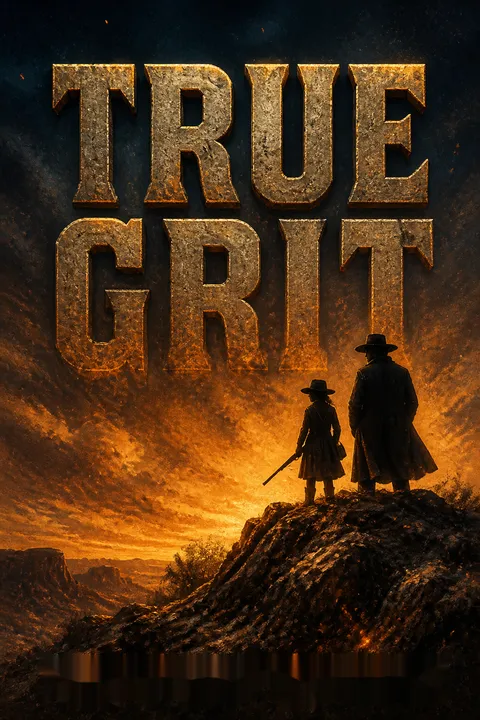


Plot Summary
A Tenant Turns Murderer
At fourteen, Mattie Ross remembers her father, Frank, as a generous man who gave a hungry drifter, Tom Chaney, work and a cabin on the family farm. When Frank rode to Fort Smith to buy four Texas ponies, Chaney insisted on going with him. After losing his wages in a card game and drinking whiskey, Chaney raised his rifle against Frank, who had followed him outside to prevent trouble.
The shot killed Frank instantly. Chaney took his employer’s cash and two California gold pieces, then stole Frank’s mare, Judy, and escaped into the Indian Territory. Mattie’s father had tried to protect the man who killed him; the theft left his daughter with both a private loss and a trail of missing property to follow.
Frank’s murder is not presented as a clash between equally armed men. Chaney kills an unarmed employer who had offered him shelter, making Frank’s kindness part of the wound Mattie must interpret. The stolen money, gold, and mare give grief a practical inventory, a form of accounting that suits Mattie’s mind and gives her vengeance a concrete direction. Her older voice insists on the facts while also judging them, converting a child’s shock into a durable case against Chaney. Yet the story’s central contradiction is already visible: Frank’s moral generosity could not make Chaney better, and Mattie will answer that failure not with forgiveness but with pursuit.
Mattie Takes the Case
Mattie travels to Fort Smith with Yarnell Poindexter, the Ross family’s trusted neighbor, to identify Frank’s body and settle his affairs. The town is absorbed by a public triple hanging, which she witnesses before going to the undertaker. At the sheriff’s office, she learns that Chaney has crossed into the Indian Territory, where local officers cannot pursue him, and that federal marshals have not yet made his arrest a priority.
The sheriff even has the fugitive recorded under the wrong name. Mattie corrects him, gathers Frank’s belongings, and decides not to return home with Yarnell. Her mother and younger siblings need her, but she believes no one else will make the law act quickly enough to bring Chaney back.
The hanging makes justice visible as public ritual, but Mattie’s own case exposes its limits: a body can be punished before a family can even secure its affairs, while a named killer can slip beyond one jurisdiction’s reach. Her decision to stay is grounded in procedure as much as fury. She corrects the sheriff’s record, accounts for Frank’s property, and treats delay as a problem she can solve through competent work. That discipline gives her agency, though it also lets a child take on responsibilities no adult has adequately assumed. Yarnell’s presence offers care, but Mattie refuses the comfort of returning home without action.
Rooster Names His Price
At the federal courthouse, Mattie watches Deputy Marshal Reuben Cogburn testify in the trial of Odus Wharton. He is older, heavy, one-eyed, and reputed to be the toughest marshal in the district. Mattie approaches him after court and asks him to hunt Chaney, who may be riding with Lucky Ned Pepper’s gang.
Cogburn questions whether she can pay and warns that the work will be dangerous. He sets a fee of one hundred dollars, twice what Mattie first offered, but does not yet promise to take her along. That night, in the back room of Lee’s grocery, Cogburn drinks, plays cards, and fires Mattie’s father’s pistol at a rat. Mattie leaves without an agreement, then falls ill.
Cogburn arrives carrying the contradiction that defines him: he is a working officer whose authority depends on violence, yet he treats a grieving child’s case as a negotiation complicated by expenses. His refusal to offer a clean heroic image is sharpened by the episode with the pistol. Mattie’s property becomes a prop in his drunken performance, and her insistence on its proper use meets his indifference. Still, she approaches him because the community’s reputation for grit matters more than his manners. Their relationship begins not in trust but in bargaining, a practical bond that will have to survive each person’s doubts about the other.
Two Bounties, One Fugitive
While Mattie recovers at the Monarch boardinghouse, Texas Ranger LaBoeuf arrives with a photograph of Chaney and explains that the fugitive is also wanted for killing a Texas senator. He has pursued Chaney for months and wants to claim the Texas reward, while Mattie insists that Frank’s killer must be returned to Arkansas. A letter from lawyer J.
Noble Daggett gives Mattie authority to settle with stock trader Colonel Stonehill. She negotiates three hundred and twenty-five dollars for Frank’s stolen mare and the ponies, then buys one pony, Little Blackie, for the journey. Cogburn accepts her fee, and LaBoeuf joins the expedition for the larger Texas reward. The three agree to ride together, but not on where their prisoner should go.
The Texas reward turns the search into a contest over who gets to define justice. LaBoeuf sees a fugitive wanted for a senator’s death and a substantial bounty; Mattie sees the man who killed her father and rejects the idea that one prosecution can stand in for another. Her settlement with Stonehill shows that the same child who seeks a gunman can also move an adult trader through contracts, deadlines, and legal risk. Money here is not merely temptation. It is the instrument that lets Mattie convert grief into a plan, though the competing claims make clear that the law rarely belongs to only one interested party.
Across the Icy River
Before dawn, Mattie rides Little Blackie to the ferry and finds Cogburn and LaBoeuf preparing to cross without her. They arrange for a ferryman to take her back to town, but she breaks free, rides to a narrow stretch of the river, and swims her pony across the freezing current. The officers try to outpace her on their heavier horses.
When they stop, LaBoeuf drags Mattie from the saddle and strikes her with a switch for refusing to turn back. Cogburn draws his revolver and forces him to stop. Mattie remounts, and the three continue together. LaBoeuf’s attempt to protect the expedition by removing her has instead exposed how much force the men are willing to use, and how little it can make her surrender her place.
The river crossing gives Mattie’s refusal a physical cost: she risks cold water, a young pony, and the possibility of being stranded rather than accept the men’s decision for her. The scene also complicates the language of protection. LaBoeuf claims the authority of an experienced officer, but enforces it by beating a child; Cogburn’s intervention protects Mattie while revealing that he recognizes her resolve as part of the working arrangement. The three do not become a family or even a harmonious team. They become a party bound by shared danger, with Mattie forcing the adults to treat her presence as a fact rather than a favor.
Snowbound at the Dugout
A storekeeper near the river tells Cogburn that Ned Pepper was seen near McAlester’s, and the party rides through worsening winter weather toward the outlaws’ territory. Snow drives them to shelter in an isolated dugout, where Cogburn and LaBoeuf confront two armed stock thieves, Emmett Quincy and Moon Garrett.
Cogburn wounds Moon and takes both men prisoner. When Moon reveals that Ned and another robber are expected back for horses, Quincy chops off Moon’s fingers and stabs him; Cogburn shoots Quincy.
Dying, Moon gives the marshals the outlaws’ location and warns of their plans. Searching Quincy, Mattie recognizes one of Frank’s stolen California gold pieces. The coin confirms that Chaney’s trail has joined the larger gang’s, while Moon’s information gives the officers a chance to intercept them.
The dugout compresses the book’s moral landscape into one room: lawmen and thieves share a fire, but the handcuffs do not make anyone safe. Moon’s loyalty to Quincy initially prevents him from helping, then the prospect of losing his leg and his life breaks that silence. Quincy answers disclosure by mutilating his friend, an act that turns criminal solidarity into immediate violence. Mattie’s recognition of the gold piece reconnects the gang’s movements to Frank’s murder through an object small enough to carry in a pocket. The recovered coin is evidence, but it is also an intimate remainder of the family life Chaney interrupted.
An Ambush Comes Apart
Cogburn leaves a fire burning in the dugout to draw Ned Pepper’s gang into an ambush. When six riders arrive, LaBoeuf fires before the outlaws enter the cabin, and the plan collapses into a running gunfight.
Cogburn kills Haze and wounds the Mexican robber known as the Original Greaser Bob; LaBoeuf’s shot brings down Ned’s horse, but Ned escapes with Bob and other survivors. The marshals recover stolen horses, bodies, and a bag of watches, rings, weapons, and money from the train robbery.
A rifle cartridge confirms that a Henry rifle was used, matching the weapon Chaney carries. At McAlester’s store, Captain Finch tells them that Odus Wharton has escaped from jail. Cogburn chooses to pursue the outlaws before other marshals can claim the case.
The failed ambush makes the difference between tactical success and strategic victory painfully concrete. The officers kill men and recover property, yet Ned escapes with the gang’s leader and most of the robbery’s proceeds. Mattie’s attention to evidence keeps the effort from becoming a mere tally of bodies: the Henry rifle cartridge offers a specific connection to Chaney. Meanwhile, Wharton’s escape revives the courthouse conflict from Cogburn’s testimony and adds urgency to the pursuit. The law’s victories are provisional, dependent on who can move fastest and document what happened. Cogburn’s decision to press on reflects both professional ambition and the personal danger of letting rivals take over.
Fifty Miles to Chaney
After leaving McAlester’s, the three push toward the Winding Stair Mountains, riding hard over rough ground and stopping only to spare their exhausted horses. Cogburn drinks as they travel and fills the cold hours with stories of his life before the marshal’s badge, including his wartime past and years of unstable work.
Mattie listens without mistaking his talk for proof of virtue. Near the outlaws’ stronghold, she descends alone to fetch water while Cogburn and LaBoeuf remain above.
At the creek, she comes face to face with Chaney watering horses. He recognizes her, but when she orders him to surrender, he refuses. Mattie raises her father’s heavy dragoon pistol and fires, striking Chaney in the side. Her shot finally reaches the man whose trail began with Frank’s death.
The ride strips away the comfortable distinctions between an officer’s present and his past. Cogburn’s stories reveal a man shaped by war, precarious labor, and repeated improvisation, but Mattie’s attention remains practical: she listens without granting him moral absolution. At the creek, she is briefly alone with the fugitive and acts before the professional hunters can intervene. Her shot is an assertion of agency, but it does not settle the encounter. The pistol is an inherited instrument, powerful and unwieldy, just as Mattie’s inherited duty is both a source of resolve and a burden she cannot control completely.
Mattie Shoots First
Chaney refuses to follow Mattie, and she prepares to shoot again, but the dragoon’s percussion caps fail. He seizes a piece of wood, knocks her down, and drags her toward two arriving outlaws, Ned Pepper and the Original Greaser Bob. The bandits retreat with Mattie and several horses while Cogburn and LaBoeuf approach from opposite slopes.
At their camp, Ned keeps Mattie as leverage and leaves her with Chaney while he and the others prepare to ride. Before leaving, he forces her to copy bank signatures from stolen mail, using powder and a feather as ink. Chaney threatens her, but LaBoeuf reaches the camp on foot and disarms him. Mattie is no longer alone with the man who killed her father, though the other outlaws are still nearby.
Mattie’s first shot wounds Chaney but cannot secure him; the failed caps convert her small advantage into a dangerous reversal. The encounter exposes the material limits of courage. A person can be willing to fire and still be undone by faulty equipment, greater strength, and numbers. Ned’s demand that she forge financial instruments also exploits the very literacy and competence that have helped her negotiate with adults. LaBoeuf’s rescue shows his earlier objections giving way to action, but it does not make Mattie safe. In this camp, the skills that distinguish her are useful to criminals as well as to the law.
One-Eyed Charge
From the ridge, Mattie and LaBoeuf see Ned’s four remaining riders emerge into a meadow, where Cogburn blocks their path alone. He charges them on horseback with both revolvers firing. The bandits bring him down with gunfire, and his horse falls mortally wounded. LaBoeuf steadies his rifle and kills Ned with a long shot.
Chaney then strikes LaBoeuf with a rock, giving Mattie time to shoot Chaney before she tumbles into a deep fissure. Trapped above a nest of rattlesnakes with a broken arm, she clings to a bone from a buried skeleton until Cogburn descends and pulls her free. LaBoeuf and Little Blackie help haul them up. Cogburn carries Mattie toward a doctor, driving Little Blackie until the pony collapses and dies.
The climax joins three kinds of courage without making them interchangeable. Cogburn’s charge is a deliberate gamble that draws the gang’s fire; LaBoeuf’s distant shot prevents Ned from finishing him; Mattie’s second shot ends Chaney’s threat. Her victory immediately becomes a struggle to stay alive, not a clean release from the past. The fissure literalizes the cost of reaching a conclusion through violence: Mattie falls among the snakes and the remains of someone already lost. Little Blackie’s death is the price of urgent rescue, turning the pony she chose and trained into a final sacrifice rather than a triumphant mount.
After the Snow
Cogburn carries Mattie to Fort Smith, taking a wagon and then a faster team when the journey demands it. Doctors set her broken arm, but infection forces them to amputate above the elbow. LaBoeuf takes Chaney’s body to Texas, while Mattie returns home and sends Cogburn the balance of his fee. Lawyer Daggett, who had blamed Cogburn for taking her into danger, apologizes and gives him money of his own.
Later, Cogburn loses his marshal’s badge after killing the escaped Odus Wharton in a gun duel, then moves through other work in Texas and Wyoming. Mattie learns that he has died on a traveling Wild West show. She brings his body to Dardanelle and gives him a place beside her family. Judy and the second gold piece are never recovered.
The closing years extend the question of justice beyond the hunt. Mattie’s amputation makes the bodily cost permanent, while her payment to Cogburn and Daggett’s apology show that responsibility continues after the gunfire. Cogburn’s later loss of office complicates the image of the fearless marshal: the law that employed him also withdraws its protection when his violence becomes politically inconvenient. Mattie’s decision to rebury him beside her family gives him a place in the record without erasing his failures. Her final accounting preserves what was recovered and what was not, suggesting that remembrance can grant honor without pretending that loss has been repaired.
Analysis
True Grit makes justice a matter of pursuit, jurisdiction, and personal memory rather than a clean moral settlement. Frank Ross’s murder begins with a failed act of kindness, and Mattie answers it by treating the world as a set of obligations that can be named, priced, and pursued. Her bookkeeping and negotiation are not incidental talents. They are tools that let a young girl claim authority among men who otherwise decide where she may go and what risks she can take. Yet the story does not suggest that competence can master violence. A bad percussion cap defeats her at the creek; her successful shot later leaves her injured, and the pony who carries her toward help does not survive the effort.
The novel also refuses to equate official authority with moral clarity. Cogburn’s badge, LaBoeuf’s Ranger commission, the local sheriff’s limits, and the Texas reward all represent different systems with competing claims. The officers can cooperate only by negotiating their interests, while Mattie insists that her father’s murder cannot be absorbed into another man’s case. The violence of the frontier is not merely lawlessness outside institutions; it is also the means by which institutions operate, punish, and sometimes disown their agents.
Mattie’s older narration adds another tension. She presents herself as precise and factual, but her opinions about people, faith, and community shape every remembered event. That mixture of evidence and judgment is part of the book’s emotional truth: she cannot restore her family, so she preserves a record of what was taken and who stood beside her. Her final gesture toward Cogburn grants him a place in that record without pretending he was innocent, dependable, or easy to love. The title’s grit belongs not only to physical endurance, but to the stubborn labor of deciding what deserves remembrance.
Review Summary
True Grit is widely praised as a classic Western novel with memorable characters, especially the determined 14-year-old Mattie Ross. Readers appreciate Portis's authentic dialogue, deadpan humor, and vivid portrayal of the Old West. The story of Mattie seeking revenge for her father's murder, aided by one-eyed Marshal Rooster Cogburn, captivates audiences across generations. Many reviewers note the book's superior quality compared to its film adaptations and highlight Mattie's unique voice as a narrator. The novel's blend of adventure, comedy, and poignant moments earns it consistent five-star ratings.
People Also Read



Characters
Mattie Ross
Relentless young claimantMattie is a sharp-minded fourteen-year-old from a prosperous Arkansas family, already accustomed to keeping accounts and speaking for herself. Her father’s murder turns those habits toward a dangerous purpose: she expects promises to be honored, money to be counted, and adults to answer for their decisions. She is brave without being unafraid, and her confidence can shade into self-righteousness when she believes the facts are settled. As an older narrator, she recounts the adventure with pride, comic precision, and an instinct to correct anyone she considers careless. That retrospective voice makes her both participant and editor, revealing how strongly she needs her choices to remain intelligible.
Reuben Cogburn
One-eyed federal marshalKnown as Rooster, Cogburn is a deputy marshal whose physical toughness and willingness to use force make him useful in the Indian Territory. He is also a heavy drinker, an untidy worker, and a man who measures many decisions by their costs and rewards. His stories suggest a past built from war, dangerous jobs, and improvised escapes, though his self-accounting is not always dependable. Mattie first sees him as a hired instrument and then has to judge what his actions are worth. Cogburn’s loyalty is difficult to read because he rarely expresses it gently; he tends to show concern by taking responsibility when danger has already arrived.
LaBoeuf
Ambitious Texas RangerLaBoeuf is a Texas Ranger who has spent months tracking the fugitive Mattie calls Chaney. Well dressed, self-assured, and proud of his professional standing, he expects his experience to carry weight with the people around him. His pursuit is tied to a Texas murder case and a substantial reward, which puts his priorities at odds with Mattie’s insistence on Arkansas justice. He can be condescending and quick to use authority, but he is also a capable tracker and a disciplined marksman. His rivalry with Cogburn is partly a contest of competence and partly a struggle over whose version of law should guide the expedition.
Tom Chaney
The fugitive killerChaney is a drifter whom Frank Ross takes in when he arrives hungry and without prospects. He presents himself as dull and easily led, but his quiet manner conceals a volatile temper and a readiness to reach for violence when thwarted. He changes names and moves between regions, making it difficult for authorities to connect his crimes. His resentment of responsibility helps explain how he can accept another person’s generosity without feeling bound by it. In Mattie’s account, Chaney is not a grand criminal mastermind. He is dangerous precisely because he can turn from self-pity to cruelty whenever he believes circumstances give him permission.
Frank Ross
Mattie's generous fatherFrank is a prosperous Arkansas farmer, husband, and father who takes pity on Chaney and gives him work and shelter. Mattie remembers him as honorable and kind, with an appetite for schemes and travel. He is not foolish, but his generous disposition leads him to feel responsible for people who may not return that care. His death becomes the event that reorganizes Mattie’s life and gives her pursuit its personal meaning.
Mrs. Ross
Grieving family anchorMattie’s mother is left at home with her younger children when Frank dies. Mattie describes her as loving and serene, but also unable to manage the family’s business affairs as confidently as her eldest daughter. Her worry for Mattie’s safety gives the pursuit a domestic cost: Mattie is not acting alone, even when she chooses to travel without her mother’s consent.
J. Noble Daggett
Mattie's forceful lawyerDaggett is the Ross family’s lawyer, an experienced advocate who handles difficult commercial disputes and trusts Mattie’s intelligence even when he worries about her impulsiveness. His legal work gives her leverage in Fort Smith, but he would prefer to manage the family’s affairs himself. Their relationship is affectionate and argumentative, shaped by his recognition that Mattie is capable and his unease about how much responsibility she has taken on.
Yarnell Poindexter
Trusted family neighborYarnell is a dependable neighbor who helps the Ross family and accompanies Mattie to Fort Smith after Frank’s murder. He treats her with care and understands the depth of the family’s loss, but he cannot persuade her to return home before she has dealt with the immediate business. His steadiness contrasts with Mattie’s urgency.
Lucky Ned Pepper
Outlaw gang leaderNed leads the gang suspected of harboring Chaney. A small, wiry man with a damaged lip, he is both calculating and capable of sudden violence. He thinks in terms of escape routes, useful associates, and the distribution of stolen money. His authority depends less on brute size than on his ability to keep others moving around his decisions.
Colonel Stonehill
Hard-nosed stock traderStonehill is the Fort Smith livestock dealer who sold ponies to Frank and later faces Mattie’s demand for compensation. He is proud, theatrical, and reluctant to admit liability, yet he understands bargaining and recognizes when a legal fight could cost more than a settlement. His exchange with Mattie reveals that her youth does not prevent her from negotiating as an equal.
Moon Garrett
Wounded stock thiefMoon is a young thief found wounded in the dugout with Emmett Quincy. He is less committed to silence than his companion and weighs loyalty against the immediate prospect of losing his leg. His painful disclosure gives the lawmen a lead on Ned Pepper’s gang.
Emmett Quincy
Violent stock thiefQuincy is an armed stock thief who tries to control what Moon tells the marshals. Suspicious and fiercely protective of his own position, he turns on his companion when Moon starts cooperating. A California gold piece found on him connects the thieves to the property stolen from Frank Ross.
Captain Boots Finch
Choctaw law officerFinch is a captain in the Choctaw Light Horse, whose authority concerns crimes involving Choctaw people. He knows Cogburn and helps him handle the dead and stolen horses after the fight near the dugout. His news about Odus Wharton’s escape renews the urgency of the pursuit.
Lee
Fort Smith shopkeeperLee owns the Chinese grocery where Cogburn rents a small back room. He shares meals and space with the marshal and witnesses Mattie’s negotiations with him. His quiet presence offers a measure of ordinary hospitality amid Cogburn’s untidy habits and the expedition’s approaching violence.
Little Frank Ross
Mattie's younger brotherLittle Frank is Mattie’s younger brother, still at home when she leaves to pursue Chaney. Mattie feels responsible for him and later shares family memories and jokes with him. His presence helps define the household she temporarily leaves behind.
Victoria Ross
Mattie's younger sisterVictoria is Mattie’s younger sister, living with their mother and Little Frank in Arkansas. She remains outside the pursuit, representing the family life Mattie is trying to protect even as she leaves it to seek justice for their father.
Plot Devices
The California gold pieces
A stolen family clueFrank carries two gold pieces given to him by Mattie’s maternal grandfather. Chaney steals both after the murder, making them part of the loss that Mattie wants to correct. One piece later turns up among property held by a stock thief, linking the local murder to the wider criminal trail and confirming that the outlaws have crossed paths with Chaney. The pieces also give Mattie a personal measure of what can and cannot be recovered. One is found, while the other remains missing, so the evidence serves both as a clue and as a lasting record of incomplete restitution.
Jurisdiction and competing rewards
Law split across bordersFrank’s murder occurs in Arkansas, but Chaney escapes into the Indian Territory, beyond the authority of the local sheriff. Federal marshals can pursue crimes there, while LaBoeuf brings a separate Texas claim and reward. The overlapping jurisdictions make cooperation necessary but give each officer a different destination in mind. Mattie’s insistence on returning Chaney to Fort Smith turns geography into an argument about whose justice counts. The legal framework also shapes the practical choices of the search, from the warrant to the question of who can claim payment for the arrest.
Mattie's accounts and contracts
Competence becomes leverageMattie’s skill with figures and careful reading lets her manage Frank’s affairs after his death. She negotiates a cash settlement with Stonehill, checks the terms of the agreement, and helps Cogburn prepare the expense papers required by the marshal’s office. Her fluency with written records gives her power in rooms where adults initially dismiss her as a child. The same literacy later becomes vulnerable to exploitation when a criminal demands that she copy bank signatures. The device therefore shows that a useful skill is not inherently virtuous; its moral force depends on who controls it and for what purpose.
Little Blackie
A pony earns Mattie's trustMattie buys Little Blackie in Fort Smith and chooses him despite his uncertain manners and her father’s old superstition about white stockings. She patiently rides him into a working partnership, and his speed helps her keep pace with the older officers. He is more than transportation: his loyalty gives Mattie a measure of independence in a journey where the men repeatedly try to send her home. His role reaches its full force during the rescue, when he helps bring Mattie and Cogburn out of danger. The cost of that effort makes him one of the story’s most personal losses.
Mattie's retrospective account
Memory as a case recordThe story is told by Mattie years after the pursuit, in a voice that mixes exact recollection with judgments about religion, politics, money, and the people around her. She frequently corrects other accounts and names the practical details she considers important. This gives the narrative the texture of testimony, but it also makes her assumptions visible. Her confidence can turn subjective impressions into firm verdicts, while her dry humor and concern with receipts reveal how she protects herself from grief. The older narrator does not simply preserve events; she continues to argue for what they meant and for how the people involved should be remembered.
FAQ
Synopsis & Basic Details
What is True Grit about?
- A Young Girl's Vengeance: Fourteen-year-old Mattie Ross embarks on a relentless quest to avenge her father, Frank Ross, who was murdered by their tenant Tom Chaney in Fort Smith, Arkansas.
- Hiring a Tough Marshal: Undeterred by her youth and the dangers of the Indian Territory, Mattie hires Reuben "Rooster" Cogburn, a one-eyed, hard-drinking U.S. Marshal known for his "true grit," to track down Chaney.
- An Unlikely Trio's Hunt: Their journey is complicated by the arrival of LaBoeuf, a Texas Ranger also pursuing Chaney for a separate murder, forcing the three into an uneasy alliance against the backdrop of a lawless frontier.
Why should I read True Grit?
- Unforgettable Narrative Voice: Charles Portis crafts a unique, formal, and often humorous first-person narration through the adult Mattie Ross, offering a distinctive perspective on a classic Western tale. Her precise, almost legalistic language contrasts sharply with the brutal events she recounts.
- Complex Character Studies: The novel delves deep into the motivations and moral ambiguities of its characters, particularly Mattie's unwavering resolve, Rooster's flawed heroism, and LaBoeuf's evolving sense of duty, making them far more than simple archetypes.
- Authentic Frontier Realism: Beyond the adventure, the book provides a gritty, unsentimental portrayal of the post-Civil War American West, exploring themes of justice, revenge, and survival with historical detail and a keen eye for the harsh realities of the time.
What is the background of True Grit?
- Post-Civil War Frontier: The story is set in the late 19th century, primarily in Fort Smith, Arkansas, and the Indian Territory (present-day Oklahoma), a region known for its lawlessness and as a refuge for outlaws. This historical context of a still-untamed West, where federal law often struggled to assert authority, is crucial to the plot.
- Judge Isaac Parker's Court: The narrative frequently references Judge Isaac Parker, the "Hanging Judge" of Fort Smith, whose court had jurisdiction over the Indian Territory. His strict, often brutal, application of the law and the high number of executions under his tenure underscore the harsh justice system of the era, as Mattie notes, "I know sixty-five of his marshals got killed."
- Cultural and Social Dynamics: The book subtly explores the cultural landscape, including interactions between white settlers, various Native American tribes (Cherokee, Choctaw, Creek), and the lingering divisions from the Civil War, as seen in Rooster's past as a Confederate bushwhacker and his later service as a U.S. Marshal.
What are the most memorable quotes in True Grit?
- "People do not give it credence that a fourteen-year-old girl could leave home and go off in the wintertime to avenge her father's blood but it did not seem so strange then...": This opening line immediately establishes Mattie's extraordinary character and the novel's unique perspective, setting the tone for her improbable quest.
- "I was just fourteen years of age when a coward going by the name of Tom Chaney shot my father down in Fort Smith, Arkansas, and robbed him of his life and his horse and $150 in cash money plus two California gold pieces that he carried in his trouser band.": This direct and factual statement encapsulates Mattie's motivation and the precise, almost legalistic nature of her grievance, highlighting her focus on tangible losses beyond just her father's life.
- "Fill your hand, you son of a bitch!": Uttered by Rooster Cogburn as he charges four bandits alone, this iconic line epitomizes his reckless courage and the raw, unrefined "true grit" that Mattie sought, showcasing his willingness to face overwhelming odds head-on.
What writing style, narrative choices, and literary techniques does Charles Portis use?
- First-Person Retrospective Narration: The story is told by an adult Mattie Ross looking back on her youth, lending a formal, precise, and often wryly humorous tone to the brutal events. This narrative distance allows for both objective recounting and subtle emotional undertones, as she reflects on her past self.
- Dry Wit and Understated Humor: Portis employs a distinctive dry wit, often through Mattie's matter-of-fact observations and her interactions with the rougher characters. Her precise language and moral judgments, even in the face of absurdity or violence, create a unique comedic effect, such as her assessment of Mrs. Floyd's biscuits or her legalistic haggling with Stonehill.
- Detailed Realism and Dialogue: The novel is rich in authentic period details, from descriptions of frontier life to the specific weaponry and legal procedures of the time. The dialogue is sharp, regional, and character-defining, revealing personalities and power dynamics through their distinct speech patterns, like Rooster's folksy pronouncements and Mattie's formal challenges.
Hidden Details & Subtle Connections
What are some minor details that add significant meaning?
- The California Gold Pieces: Frank Ross's two California gold pieces, a marriage gift from Mattie's grandfather, are not just stolen money but a symbolic link to family and a tangible representation of Chaney's complete violation. Mattie's recovery of one piece from Quincy's pocket in Chapter 6 is a small but significant victory, confirming Chaney's association with the gang and fueling her resolve.
- Mattie's Accounting Skills: From the outset, Mattie's meticulous record-keeping for her father ("I kept his books for him") and her sharp financial acumen (negotiating with Stonehill, correcting Rooster's fee sheets) highlight her precocious intelligence and practical nature. This detail underscores her capability to navigate a man's world and her methodical approach to justice, treating it almost as a business transaction.
- Rooster's Cat, General Sterling Price: The presence of Rooster's fat brindle cat, named after a Confederate general, offers a subtle glimpse into Rooster's domestic life and his lingering ties to his past. The cat's name is a nod to Rooster's Confederate service, and his affection for the animal contrasts with his rough exterior, hinting at a softer, more complex inner world.
What are some subtle foreshadowing and callbacks?
- The Pit of Snakes: Chaney's threat to throw Mattie into a pit of rattlesnakes in Chapter 7 is a direct and chilling callback to his earlier, seemingly casual mention of a "ball of rattlesnakes" in the same pit. This foreshadows Mattie's eventual fall into the pit, intensifying the horror of her snakebite and near-death experience.
- Mattie's Arm Injury: Early in the book, Mattie mentions her "strong right arm" in a letter from Lawyer Daggett, who calls her "her strong right arm now, Mattie." This seemingly innocuous detail foreshadows the tragic loss of her arm at the end of the story, making the physical cost of her quest even more poignant and ironic.
- Rooster's Past as a Bushwhacker: Rooster's casual recounting of his violent past, including riding with Quantrill and robbing a Federal paymaster, subtly foreshadows his morally ambiguous methods and his willingness to bend or break the law in pursuit of his own brand of justice. It explains his "true grit" but also his questionable ethics, which Mattie later confronts.
What are some unexpected character connections?
- Rooster and Columbus Potter: Rooster's deep bond with his former marshal partner, Columbus Potter, is revealed through his emotional testimony at the Wharton trial and his later lament about Potter's absence when doing paperwork. This connection highlights Rooster's capacity for loyalty and grief, contrasting with his gruff demeanor, and shows the profound impact of his past relationships on his present self.
- LaBoeuf's War Service: LaBoeuf's pride in his Confederate service, despite being a young recruit who "counted beeves and sacked oats," creates an unexpected parallel with Rooster's own Confederate past. Their shared history, though experienced differently, forms a subtle bond that transcends their initial animosity and contributes to their eventual, albeit uneasy, alliance.
- The Permalee Family's Criminality: The detailed description of the Permalee family's long history of crime, from Henry Joe's train wrecking to Carroll's execution and Darryl's death, reveals a generational pattern of lawlessness. This background provides a stark contrast to Mattie's family values and underscores the pervasive nature of crime in the Indian Territory, showing the deep roots of the world she has entered.
Who are the most significant supporting characters?
- Colonel Stonehill: The stock trader in Fort Smith, Stonehill, serves as Mattie's first significant adult adversary and a test of her business acumen. His initial dismissal of her ("I do not like to deal with children") and subsequent capitulation to her demands ("You are an unnatural child") establish Mattie's formidable will and foreshadow her ability to manipulate and outmaneuver powerful men.
- Yarnell Poindexter: The "colored man" who works for the Ross family, Yarnell, represents a steadfast and loyal figure in Mattie's life, accompanying her to Fort Smith and offering practical advice. His journey from being kidnapped into slavery to becoming a prosperous house painter in Memphis highlights themes of resilience and social mobility in the post-Civil War South, providing a quiet counterpoint to the violence of the frontier.
- Mrs. Floyd, the Boardinghouse Keeper: Mrs. Floyd, with her gossipy nature and intrusive questions, provides a glimpse into the social fabric of Fort Smith and the public's fascination with sensational events like hangings and murders. Her character serves as a foil to Mattie's reserved and private nature, emphasizing Mattie's discomfort with idle curiosity and her focus on her mission.
Psychological, Emotional, & Relational Analysis
What are some unspoken motivations of the characters?
- Mattie's Need for Control: Beyond simple revenge, Mattie's relentless pursuit of Chaney is driven by a deep-seated need to restore order and control to her life after her father's sudden, senseless death. Her meticulous planning and insistence on her terms ("I will have my way") reflect a psychological effort to regain agency in a world that has violently disrupted her sense of security.
- Rooster's Search for Redemption/Purpose: Rooster's willingness to take on dangerous jobs, despite his cynicism and drinking, suggests an underlying need for purpose or a form of redemption. His past as a bushwhacker and his failed personal life (divorced wife, estranged son) imply a man seeking to prove his worth, perhaps to himself, through his "dangerous work" as a marshal, as explored in "Rooster Cogburn character analysis."
- LaBoeuf's Desire for Recognition: LaBoeuf, the Texas Ranger, is motivated not just by the reward money but also by a strong desire for professional recognition and validation. His constant references to Ranger policy and his initial attempts to assert authority over Mattie and Rooster reveal a man eager to prove his competence and earn respect in a challenging environment, a key aspect of "LaBoeuf character analysis."
What psychological complexities do the characters exhibit?
- Mattie's Precocity and Trauma: Mattie exhibits a remarkable blend of childlike innocence and adult pragmatism, a psychological complexity born from her traumatic experience. Her ability to negotiate with hardened men and witness gruesome events without flinching ("I have never been one to flinch or crawfish") masks a deep emotional cost, which only surfaces in moments of extreme stress or in her later, reflective narration.
- Rooster's Moral Ambiguity: Rooster embodies a complex moral code, operating outside conventional legal and ethical boundaries while still serving a form of justice. His past as a "road agent" and his brutal methods ("I never shot nobody I didn't have to") reveal a man shaped by a violent world, yet his loyalty to Mattie and his ultimate self-sacrifice demonstrate a hidden integrity, making his "Rooster Cogburn character" deeply nuanced.
- LaBoeuf's Pride and Vulnerability: LaBoeuf's initial arrogance and "stuck-up" manner hide a surprising vulnerability, particularly after his injury and his near-whipping of Mattie. His pride is easily wounded, but his eventual acceptance of Mattie's presence and his crucial role in saving Rooster's life show a capacity for growth and genuine heroism, adding layers to "LaBoeuf character analysis."
What are the major emotional turning points?
- The Triple Hanging: Witnessing the public execution in Fort Smith, particularly the Indian's prolonged strangulation and the yellow-haired man's tearful last words, is a profound emotional turning point for Mattie. It exposes her to the brutal reality of frontier justice and the finality of death, hardening her resolve while also stirring her empathy, a key moment in "Mattie Ross motivations."
- Rooster's Defense of Mattie: When LaBoeuf attempts to whip Mattie, Rooster intervenes, drawing his pistol and threatening the Texan. This act marks a significant shift in their relationship, as Rooster moves from reluctant guardian to protector, demonstrating his growing respect and affection for Mattie, and solidifying their unlikely bond.
- Mattie's Fall into the Snake Pit: Mattie's fall into the pit of rattlesnakes after shooting Chaney is the climax of her emotional and physical ordeal. This terrifying experience, culminating in her snakebite and broken arm, represents the ultimate cost of her quest for vengeance, forcing her to confront her own mortality and the harsh consequences of her "true grit."
How do relationship dynamics evolve?
- Mattie and Rooster: From Employer to Paternal Figure: Their relationship begins as a strictly transactional one, with Mattie hiring Rooster. Over the journey, Mattie's unwavering determination earns Rooster's respect, and he gradually assumes a paternal, protective role, culminating in his desperate efforts to save her life. This evolution is central to "themes in True Grit," highlighting unexpected bonds.
- Mattie and LaBoeuf: From Antagonism to Mutual Respect: Initially, Mattie and LaBoeuf are at odds, clashing over Chaney's fate and LaBoeuf's attempts to assert authority. Their shared dangers and LaBoeuf's eventual sacrifice for Mattie and Rooster forge a grudging respect, transforming their dynamic from rivalry to a functional, if still prickly, alliance.
- Rooster and LaBoeuf: Professional Rivalry to Comradeship: Their relationship is marked by professional jealousy and cultural clashes (Texas Ranger vs. Federal Marshal). Despite their constant bickering and Rooster's contempt for LaBoeuf's "Texas waddie" ways, they ultimately prove to be effective partners in combat, relying on each other's skills in the final showdown, showcasing a complex "Rooster Cogburn character" interaction.
Interpretation & Debate
Which parts of the story remain ambiguous or open-ended?
- Rooster Cogburn's True Past: While Rooster recounts parts of his past, particularly his time with Quantrill and his "road agent" activities, the full extent of his moral compromises remains ambiguous. Mattie herself questions his "stretching the blanket," leaving readers to debate the veracity of his claims and the true nature of his "true grit" – was he a lawman who sometimes broke the law, or a criminal who found a legal outlet for his violence?
- The Nature of "True Grit": The novel constantly explores what "true grit" actually means. Is it Mattie's unwavering resolve, Rooster's reckless courage, or LaBoeuf's quiet endurance? The story doesn't offer a single definition, leaving it open to interpretation whether grit is an admirable quality, a stubborn flaw, or a necessary but costly trait for survival in a brutal world.
- The Long-Term Impact on Mattie's Soul: While Mattie achieves her vengeance, the narrative leaves open the question of the psychological cost. Her adult narration is detached and factual, but the loss of her arm and her lifelong unmarried status suggest a profound, perhaps isolating, impact from her youthful quest. The story doesn't explicitly state if her "true grit" brought her lasting peace or merely a different kind of burden.
What are some debatable, controversial scenes or moments in True Grit?
- LaBoeuf's Attempted Whipping of Mattie: The scene where LaBoeuf attempts to whip Mattie for her stubbornness is highly controversial, highlighting the brutal realities of the era and the gender dynamics at play. While Rooster intervenes, the moment forces readers to confront the vulnerability of a young girl in a man's world and the harsh disciplinary methods considered acceptable at the time, sparking debate about the characters' morality.
- Rooster's "Justice" vs. Legal Due Process: Rooster's methods, such as his high body count ("Around twelve or fifteen... I believe them two Whartons made twenty-three") and his willingness to kill rather than capture, are constantly debated within the story and by readers. His actions raise questions about whether his "justice" is truly just, or merely a violent expediency, especially in the context of Judge Parker's "slaughterhouse" court.
- The Treatment of Native American Characters: The portrayal of Native American characters, from the "civilized Creeks and Cherokees" to the "heathen" Indian at the hanging, can be seen as controversial. While Mattie's narration reflects the attitudes of her time, the novel's depiction of their roles and the casual racism ("darkies," "nigger") present in dialogue invites discussion on historical accuracy versus modern sensibilities.
True Grit Ending Explained: How It Ends & What It Means
- Chaney's Demise and Mattie's Sacrifice: The "True Grit ending explained" reveals Mattie finally kills Tom Chaney, but not before he injures LaBoeuf and causes her to fall into a snake pit, where she is bitten and breaks her arm. Rooster's heroic rescue, involving a desperate ride to save her from the snake venom, ultimately leads to the amputation of her arm, a permanent physical cost for her vengeance.
- The Cost of Vengeance and Grit: Mattie's lost arm symbolizes the profound personal sacrifice and the high price of her quest for justice. While she achieves her goal, the ending suggests that "true grit" is not without its severe consequences, leaving her physically scarred and, as an adult, seemingly emotionally detached, highlighting the "themes in True Grit" about the burden of revenge.
- Rooster's Fading Glory and LaBoeuf's Disappearance: Rooster, after saving Mattie, loses his badge due to another controversial shooting and ends up in a Wild West show, a shadow of his former self, eventually dying alone. LaBoeuf, after recovering Chaney's body, disappears from Mattie's life. This bittersweet conclusion emphasizes the transient nature of frontier heroism and the ultimate solitude of those who live by "true grit," leaving Mattie as the sole, enduring witness to their shared, brutal history.
Download PDF
Download EPUB
.epub digital book format is ideal for reading ebooks on phones, tablets, and e-readers.








