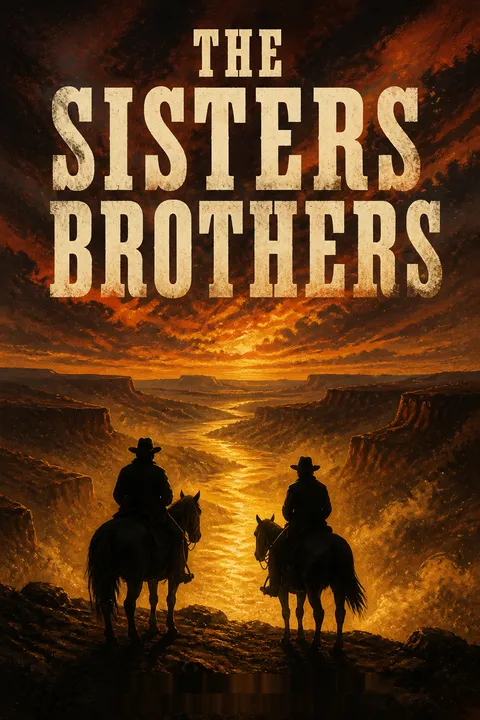


Plot Summary
The Commodore's New Lead
Eli Sisters waits outside the Commodore's mansion while his older brother, Charlie, secures their next assignment. The brothers are hired to find Hermann Kermit Warm, a California prospector accused of taking something from their employer, and kill him.
Charlie is named lead man, which means a larger share of the pay for him and less for Eli. Their argument over the cut exposes a familiar imbalance: Charlie directs their work, while Eli resents being treated as secondary, even as he remains loyal to his brother.
They ride south on horses neither chose, with Eli grieving the fast horse lost on their last job and mistrusting the slow, injured Tub beneath him. The mission begins as another paid killing, but Eli already doubts the story behind it.
The job is framed as ordinary business, but the altered pay makes the brothers' private hierarchy visible before the violence begins. Eli's resentment is not simply about money. He wants his labor, pain, and judgment to count equally, while Charlie accepts authority as a natural extension of competence. The horse dispute gives this tension a physical form: Eli is expected to carry a burden he did not choose. His doubts about the Commodore's account also suggest a conscience that has survived years of work by learning to question the employer only in private.
A Cabin with a Noose
On the trail, a spider bites Eli, leaving him feverish and grotesquely swollen. A dentist, Reginald Watts, drains his face and removes two teeth; Charlie then robs Watts of the numbing medicine.
When the brothers shelter in an old woman's cabin, she hangs a strand of beads across the doorway and warns them without explaining what it means. Charlie escapes through a window, leaving Eli inside. A grizzly attacks Tub outside, and Eli crosses the threshold he feared, shooting the bear before it can kill the horse.
Charlie returns, burns the cabin and bear, and admits he has killed prospectors who refused him tools. Eli refuses their valuables. Tub survives, but his eye is badly damaged, and the brothers continue south carrying a growing argument about what their work makes them.
Eli's decisive act is not a clean victory but a contradiction: he risks his life for a horse he often resents, while Charlie will kill strangers to solve a practical inconvenience. Their different responses to danger reveal separate moral habits. Eli's compassion is instinctive and selective, not yet powerful enough to stop his work as a hired killer. The cabin's beads and the warning about the dead following the brothers introduce a supernatural possibility that the novel refuses to settle. The episode lets guilt look like a curse without proving that guilt has become one.
A Room Above the Duel
In a town along the route, Eli meets Sally, the overworked hotel employee, and imagines that he might be wanted rather than merely tolerated. He leaves her money and dreams of returning as a more desirable man.
Charlie mocks the attachment, then admits he slept with Sally while Eli was away and refused to pay her after the encounter disappointed him. Eli's hopes collapse into anger and humiliation. Before they leave, the brothers watch a duel: the lawyer Williams is shot dead by Stamm, and his panicked return shot wounds a young woman in the crowd.
The public spectacle confirms how casually the town treats violence. On the road, the brothers encounter a starving boy guarding abandoned wagons. His account of a failed westward journey reveals another life already broken by the pursuit of California's promised riches.
Eli's longing for Sally matters because it asks for a kind of intimacy his profession cannot provide: being seen without fear or payment. Charlie's betrayal turns that hope into another contest between the brothers, with Charlie's power expressed through access and contempt. The duel makes violence public and almost ceremonial, yet its stray bullet exposes the disorder beneath the performance. The boy's appearance then shifts the story's scale. The brothers' choices do not occur in an isolated outlaw world; they move through the wreckage of ordinary people who have also been drawn toward California by promises they cannot control.
The Boy and the Claim
The boy, who hopes to reunite with a girl named Anna, travels with his sickly horse, Lucky Paul, and believes California will make him rich. After the horse repeatedly fails on the pass, Eli gives the boy his share of gold dust from a prospector the brothers killed, along with instructions for getting home safely.
Charlie objects, but Eli lets the boy keep it. The brothers continue into California and meet a lonely prospector who threatens Eli at gunpoint. Charlie shoots the man as he runs; Eli, enraged by the bullying, crushes the dead man's face before burying him in his tunnel.
They divide his hidden gold. Soon afterward, they spot the red-haired bear that local boss Mayfield has put a bounty on. Charlie pursues it, and Eli skins it for the promised reward.
Eli's gift is a small, costly refusal to treat every encounter as an opportunity for profit. He cannot undo the boy's losses, but he chooses to make the gold useful to someone who needs an exit more than a fortune. Yet his mercy coexists with a brutal eruption against the prospector, showing that his sense of justice is intensely personal and easily overtaken by rage. California offers both men a landscape of possibility and a market for violence. The bear bounty binds those forces together: wilderness becomes another commodity, and the brothers' skill at killing is again converted into money.
A Bear for Mayfield
The brothers bring the red pelt to Mayfield, a wealthy camp boss whose parlor is crowded with trophies, hired trappers, and paid entertainment. Mayfield pays for the skin, then invites Charlie into his circle; Eli watches him recognize a possible future in the older man's drunken power.
Mayfield describes being robbed years earlier by James Robinson, and Charlie falsely claims Robinson is still alive, though he has been dead for months.
Eli meets Mayfield's bookkeeper, a pale, sharp-eyed woman who warns him that the trappers are dangerous and gives him a blue silk sash as a reminder to return. A strange girl outside town tells Eli that he is protected, describing a dream of a poisoned dog and a violent dark cloud. The warning stays with him, unresolved.
Mayfield offers Charlie a vision of violence without personal risk: a throne built from other men's weapons and other people's labor. Eli recognizes the appeal and fears what it would make of his brother. The bookkeeper's quiet attention offers a contrasting kind of connection, though Eli's eagerness makes him mistake kindness for certainty. The girl's dream complicates the novel's realism without confirming a supernatural order. Her warning may be prophecy, delusion, or a story Eli needs because he is increasingly conscious of the dead behind him.
Four Guns in the Stable
By morning, Mayfield's red pelt has vanished, and his men accuse the brothers of stealing it. Charlie decides they must flee rather than fight while sick and outnumbered. The trappers corner them in the stable, demanding Mayfield's money; Charlie uses their familiar false count to draw first, and both brothers kill all four men.
They also kill the stable hand who has hidden in the loft and witnessed their method. Charlie then forces Mayfield to reveal his safe. The brothers take most of the fortune but leave Mayfield enough money to travel to Oregon City, where his revenge plan against the already-dead Robinson will fail.
Eli gives another hundred dollars to the bookkeeper through a companion and promises to return. He and Charlie ride on toward San Francisco, where Morris is supposed to meet them.
The brothers' escape depends on practiced deception, but the stable fight makes the cost of that competence plain: a witness becomes another body because the brothers cannot imagine leaving a loose end alive. Their treatment of Mayfield is less simple. They strip him of power yet let him keep a narrow chance at a different life, even as Charlie's false information turns that mercy into a joke. Eli's money for the bookkeeper shows how he tries to convert stolen wealth into care. The gesture is sincere, but it cannot guarantee either her safety or his return.
Morris's Missing Journal
Henry Morris, the Commodore's scout, is missing from his San Francisco hotel. The brothers obtain his journal from the hotelkeeper and learn that Morris left with Warm willingly. Warm has invented a liquid that makes gold glow through earth and water, allowing it to be gathered far faster than ordinary panning.
Morris's notes also explain why the Commodore wants Warm dead: Warm refused to share the formula after the Commodore tried to seize it and was accidentally struck down during his escape. The alleged theft was a pretext.
Charlie reveals that the Commodore ordered him to obtain the formula before killing Warm, though he had not understood what it was. Faced with evidence that their employer wants invention by force, the brothers begin to question whether they will complete the assignment.
The journal changes the assignment from a dispute over property into a contest over who may claim another person's knowledge. The Commodore's authority depends on making violence look like legitimate enforcement, while Warm's refusal exposes the coercion beneath that arrangement. Morris's decision to abandon his post lends the revelation moral weight: even a man employed by the Commodore can recognize the difference between service and complicity. Charlie's confession is crucial because he does not defend the order once he understands it. For the first time, the brothers can imagine their employer as the villain in their own story.
The Job They Reconsider
At a lavish San Francisco restaurant, Eli urges Charlie to quit the Commodore and use their savings to open a shop. Charlie refuses to promise that their partnership will continue; he says Eli may leave after the current job, while he finds another hired hand.
The threat of separation cuts deeper than their arguments about money. Still, they ride inland together. Before leaving the city, Eli has Tub's injured eye removed, and the horse begins the trip in pain and weakness.
On the trail, Eli and Charlie discuss what the Commodore would do with the formula and what they might do if they defied him. They agree that Warm and Morris do not deserve to be killed, but they have not yet chosen a safe way out. They reach Warm's claim and camp nearby.
Eli's proposed shop is not merely a business plan; it is an attempt to imagine a life whose purpose is not assigned by a powerful man. Charlie hears the proposal as a possible abandonment, so he answers with the very threat Eli fears: a future in which the brothers no longer belong to each other. Their conversation on the trail turns moral hesitation into practical planning, but does not resolve their dependence on the Commodore. Tub's painful treatment parallels this uncertainty. Eli wants to care for the horse, yet still pushes him into a journey the animal may not survive.
Warm in the Branches
The brothers find Warm's neat camp beside the river and discover Morris has traded his city clothes and habits for rough work in the wilderness. Warm spots them first, holding them at gunpoint from a tree.
He knows they are the Commodore's killers and refuses their offer to join the expedition, seeing no reason to trust men who have spent their lives solving problems with bullets. Warm and Morris slip away before the brothers can force the issue. When Eli and Charlie return to their camp, Tub has gone over a steep bank and died.
Charlie offers to help find a better horse, but Eli feels more relief than grief, then recognizes the selfishness of that response. Charlie insists their only options are to leave or try again by force. Eli chooses to return, hoping they can still avoid more killing.
Warm's refusal draws a boundary the brothers are unaccustomed to meeting: their reputations do not automatically grant them access or obedience. Eli's offer is partly sincere, but it also asks Warm to trust the very skills that make him unsafe. Tub's death brings this contradiction into the open. Eli's relief is human, not noble, and his belated affection cannot undo the burdens he placed on the horse. Choosing to return means Eli is not yet free of violence, but he has begun to distinguish necessity from habit.
Beavers Break the Standoff
That night, the brothers watch Warm and Morris hide near camp while beavers investigate the barrels of formula. A band of three blue-eyed brothers arrives, intent on stealing the liquid. Warm refuses to come out, and the exchange turns into gunfire after he shoots the leader.
Charlie and Eli kill the two remaining attackers from the hillside, preventing them from overrunning the camp. The brothers call down that they have no wish to kill Warm or Morris and repeat their offer to help.
Warm finally walks out to meet them, impressed by the brothers' intervention and their willingness to risk themselves without taking the formula. They agree to work as a four-person company, splitting the immediate yield. Morris remains wary, but he accepts the alliance and lets Charlie treat his grazed arm.
The alliance begins through action rather than trust. The brothers have killed the attackers, but unlike earlier fights they do not claim the right to own whatever survives. Warm can judge their intentions only by what they do after gaining the advantage. His decision to meet them is cautious, not credulous. The beavers provide a small, disruptive trigger for the human violence, their ordinary search for food revealing the danger of the exposed barrels. The scene also shifts Eli and Charlie from a pair defined by blood ties into a group forced to negotiate obligations with people they once came to kill.
The River Turns Gold
Warm explains that the formula works, though its caustic liquid has already blistered his and Morris's legs. The four men pour two barrels into the river and stir the water so the gold shines through the dark bottom.
Charlie opens a third barrel against Warm's instructions, spilling formula over his gun hand. Eli rinses and wraps it, then Charlie continues with a bucket strapped to his forearm. For a brief, brilliant stretch, they gather more gold than ordinary panning could yield in weeks.
Morris later falls into the contaminated water, and Warm dives in after him. Despite the brothers' washing and medicine, both men suffer severe burns. Morris dies first. Warm survives long enough to speak with Eli and Charlie, then dies after entrusting them with the formula's future.
The river's glow makes scientific ingenuity visible as wonder, but the same process marks human skin as a cost the inventors did not fully anticipate. Charlie's decision to empty the third barrel repeats his habit of treating caution as an obstacle, and the injury lands on the hand that has made him dangerous. Yet the shared harvest briefly gives all four men a genuine experience of cooperation and astonishment. The deaths that follow do not cancel that joy; they reveal its limit. Knowledge can enlarge human possibility while leaving its makers exposed to consequences they cannot control.
Mayfield's Hotel Becomes Ash
While Eli buries Morris and Warm, a group of Indigenous men takes the gathered gold and leaves the brothers' weapons and horses behind. Eli buries Warm beside Morris, unable to decipher the inventor's notes well enough to reproduce the formula.
They return to Mayfield and find the hotel burned, their hidden fortune destroyed with it. The bookkeeper is gone, and Mayfield's former employees blame the brothers for the ruin. They beat and rob Eli and Charlie, taking their weapons and money.
Later, the strange girl from Eli's earlier encounter appears beside Charlie with a jar of poisoned water. Eli knocks it away before Charlie drinks. He and Charlie leave with little besides the money in their boots, carrying injuries, grief, and no clear plan for what comes next.
The loss of the gold strips away the fantasy that the brothers can buy their way out of their past. They also lose the formula's practical promise when Warm's notes prove unreadable, while the bookkeeper's absence makes Eli's private hope feel suddenly fragile. The attack by Mayfield's employees reverses the brothers' usual position: they are helpless before a crowd that has its own grievance and its own rules. The girl's poison brings the earlier warning back without explaining it. Eli's intervention matters less as proof of magic than as a rare moment when he sees danger in time to protect someone else.
The Last Contract
In Jacksonville, a doctor amputates Charlie's infected hand below the elbow. Eli stays beside him, then returns with him to their wrecked home, where they discover that Rex, their former associate, has stolen their hidden savings.
Charlie is drugged and barely able to travel, but Eli leaves him sleeping and rides alone to the Commodore's mansion. He enters the house at night, finds the employer bathing and speaking to an imagined audience, and abandons his knife.
Instead, Eli holds the Commodore underwater until he dies, then arranges the body to suggest an accidental drowning. Eli wakes Charlie and takes him toward their mother's home. The killing is not another job for pay. It is Eli's decision to end the authority that has organized his life, whatever danger follows.
Eli's final violence is morally complicated because he uses the same intimate, bodily force that defined his work, but no longer at another man's command. He does not become innocent by killing the Commodore; he becomes answerable for a choice he makes himself. Charlie's amputation alters their partnership more deeply than their earlier quarrels because it removes the hand through which he has exercised power. Eli's departure from the ruined house with his brother suggests that independence need not mean abandonment. Their old roles have broken, leaving them to discover whether kinship can survive without command and obedience.
Epilogue
Eli and Charlie reach their mother's newly improved home. She welcomes Eli, questions him about his temper, and asks what happened to Charlie's hand. Charlie comes inside and asks for a bath. Their mother offers them a place to sleep, though she expects them to find work and contribute.
Eli imagines opening a trading post, and she doubts he will enjoy serving customers, but she lets the brothers stay. Before Eli leaves her bedside, she pulls him close and kisses him beneath the eye. He lies down in the brothers' childhood room and listens to Charlie bathing, hearing in the ordinary sounds of water a temporary peace neither man could make for himself.
The return does not restore the family to its former shape. Charlie is injured, Eli has killed the man who employed them, and their mother receives them with affection mixed with blunt skepticism. Her home offers shelter, not absolution or a ready-made future. The proposed trading post is therefore less a completed transformation than a test of whether Eli can imagine ordinary work without romanticizing it. The final attention to Charlie's bath makes peace deliberately modest: not a cure for violence, but a room, a mother nearby, and the possibility of rest.
Analysis
The novel makes the western journey a test of how men learn to call violence work. The Sisters brothers are not simply outlaws moving through a lawless landscape. They are employees of the Commodore, whose money and reputation turn killing into a service with a wage, a chain of command, and a ready-made excuse. Eli's doubts begin as complaints about pay and horses, then deepen when he discovers that Warm is being hunted for refusing to surrender an invention. The truth does not make Eli instantly virtuous. He still lashes out, takes part in killings, and struggles to separate moral judgment from temper. His development is visible in the pauses he begins to make before obeying.
Charlie presents a different problem. He is more capable of violence and more comfortable with authority, yet his bond with Eli is real. Their quarrels expose a relationship built from childhood protection and adult dependence, where love often arrives disguised as command, mockery, or shared danger. Warm and Morris offer another model of companionship. They are mismatched and sometimes exasperated with one another, but their work depends on trust rather than domination. The brothers' eventual alliance with them briefly makes cooperation feel possible, then the formula's injuries reveal how readily ambition can outrun care.
The gold itself is both miracle and trap. Its sudden illumination gives the men a moment of awe and shared purpose, but the chemical burns, deaths, theft, and loss of the recipe prevent wealth from becoming a clean escape. The novel repeatedly withholds moral neatness: Eli's generosity to the stranded boy coexists with cruelty toward a dead man; his final killing of the Commodore ends one form of command without erasing his own history of violence. The conclusion offers no grand redemption. Instead, Eli and Charlie return to their mother, where rest, work, and ordinary family contact become uncertain possibilities. Their future begins not with innocence, but with the choice to live beyond the orders that shaped them.
Review Summary
The Sisters Brothers is a darkly comedic Western novel that follows two assassin brothers on a mission in 1850s California. Readers praise the book's unique blend of humor, violence, and philosophical musings. Many find the characters compelling, particularly the narrator Eli Sisters. The novel's unconventional take on the Western genre, witty dialogue, and exploration of morality are frequently highlighted. While some readers find certain scenes disturbing, most appreciate the book's originality and engaging storytelling. Overall, it receives positive reviews for its quirky charm and thought-provoking narrative.
People Also Read








Characters
Eli Sisters
The troubled younger brotherEli narrates the journey with a watchful, self-questioning eye. He is physically imposing but unusually tender toward animals and alert to the vulnerability of strangers, qualities that sit uneasily beside his work as a hired killer. His humor often softens embarrassment, while his anger can suddenly overwhelm his judgment. He wants a quieter life and genuine affection, yet struggles to imagine himself outside his bond with Charlie or the violence that has given the brothers their livelihood. Eli's defining tension is between a conscience that keeps registering harm and a temper that can turn that awareness into further harm.
Charlie Sisters
The charismatic older brotherCharlie is Eli's older brother, partner, and usual leader. He is decisive under threat, persuasive with employers, and capable of affection, but he is also proud, miserly, and quick to use violence when it serves his purpose. His drinking gives him a route into pleasure and confidence, while his loyalty to the Commodore reveals how strongly he wants recognition from powerful men. Charlie and Eli share a history of family trauma, but Charlie tends to turn that history into action and authority rather than reflection. Their bond is intimate and combative, shaped by the difficult question of whether love can survive when one brother expects to lead.
Hermann Kermit Warm
The stubborn gold inventorWarm is a solitary prospector, self-taught scientist, and restless thinker whose interest in the natural world has hardened into a consuming project. He can be abrasive, odd, and careless with his own body, yet he is also capable of deep loyalty and of recognizing qualities in others they have not recognized in themselves. His ambition is practical as well as visionary: he wants his discovery to make him independent and to fund future work. Warm's life has been shaped by abandonment, poverty, and a history of self-destruction, but curiosity remains his strongest way of reaching beyond those experiences.
Henry Morris
The Commodore's conflicted scoutMorris is a meticulous scout and longtime employee of the Commodore, known for his polished appearance and careful observation of other people. His loyalty is not simple obedience; he is drawn to dignity, civility, and the possibility that a person can choose a more honest life. Warm's unusual mind challenges the role Morris has accepted for himself, while life outdoors tests his dependence on the comforts and routines he values. His journal reveals a private capacity for reflection beneath his formal manner. Morris is most compelling when his sense of duty conflicts with his growing desire to act from personal conviction.
The Commodore
The brothers' powerful employerThe Commodore is the wealthy, influential employer who sends the Sisters brothers to settle disputes through force. He presents his demands as business and expects loyalty from people whose lives he controls through money and reputation. Charlie admires his success, while Eli has long distrusted his methods. The Commodore's reach extends well beyond his mansion, giving him the power to make private violence feel like a public institution. He is less a battlefield antagonist than the center of a system that rewards obedience and disguises coercion as respectable work.
Mayfield
California's indulgent camp bossMayfield has made money from a successful strike and surrounds himself with trophies, hired men, and expensive entertainments. His authority is theatrical: he likes to display wealth and command attention, but his confidence depends on the people he pays to protect him. He is also capable of imagining a life beyond his present excess, though pride and grievance repeatedly cloud that possibility. Through Mayfield, Eli sees one version of what Charlie might become if power replaces partnership.
The Mayfield Bookkeeper
Eli's guarded new connectionMayfield's bookkeeper is observant, hard-working, and careful about what she reveals. She knows the dangers of her workplace and does not confuse Eli's attention with a promise of love. Her brief warmth gives Eli a glimpse of companionship outside the brothers' work, while her independence keeps that hope from becoming a simple romance. The blue silk she gives him becomes a private reminder of the promise he makes to return.
The Boy
The stranded young travelerThe boy is a hungry, stubborn traveler who crosses the country with his father and relatives in search of California gold. He clings to Lucky Paul, his underfed horse, and to a romantic belief that riches will win him the girl he loves. His story reveals how quickly a migration can turn into isolation, and his pride makes it difficult for him to accept help without imagining a future in which he will no longer need it.
The Sisters' Mother
The brothers' estranged anchorThe brothers' mother is intelligent, frank, and emotionally perceptive, though years of family violence have left their mark on her body and her relationship with her sons. She has refused contact while they continue their work as killers, setting a boundary that neither brother can easily dismiss. Her practical outlook contrasts with Eli's habit of turning hopes into imagined scenes. She represents both the family's painful history and the possibility of a home not organized around the Commodore.
Reginald Watts
The cheerful frontier dentistWatts is a struggling dentist whose many failed ventures have left him more amused than embittered. He treats Eli's swollen face with professional enthusiasm and introduces him to a toothbrush, a small practical gift that remains important to Eli. Watts's ease with failure offers a rare alternative to the brothers' belief that every setback must be answered with force.
Rex
The brothers' unreliable associateRex is an associate who has asked the Commodore for work and knows the brothers well enough to understand how they earn. His note to Charlie and Eli mixes familiarity with self-serving excuses, showing the casual betrayal that can grow inside a life built on money and violence.
The Weeping Man
A recurring figure of griefThe brothers encounter this unnamed traveler on the road and later see him again in California. His persistent grief makes him seem almost detached from ordinary conversation, and his repeated appearances sharpen Eli's awareness of how many people are moving through the West without finding the future they were promised.
The Strange Girl
A child bearing warningsThe girl Eli meets in Mayfield is unsettlingly composed, speaks with certainty about suffering, and claims to have seen him in a dream. Her statements blur the line between childish imagination and genuine forewarning, making her a small but memorable disturbance in Eli's already troubled sense of cause and consequence.
Plot Devices
Warm's gold-finding formula
Makes buried gold visibleWarm's caustic liquid makes gold shine through earth and river water for a short time, allowing prospectors to collect it rapidly. It transforms the traditional labor of panning into a scientific process and motivates the Commodore's attempt to seize Warm's work. Its power is inseparable from its danger: exposure burns the people who use it, and the recipe remains difficult to understand without Warm's knowledge. The formula represents both an extraordinary invention and the risks of treating discovery as a shortcut to wealth.
Morris's journal
Reveals the real assignmentMorris's private journal preserves the account of how he met Warm, saw the formula demonstrated, and chose to leave the Commodore's service. Because the brothers arrive too late to meet him in San Francisco, the journal becomes their only clear explanation of the conflict. It turns a vague murder order into a specific moral choice and gives Eli and Charlie reason to reconsider their employer's version of events.
The brothers' horses
Make loyalty physicalThe horses repeatedly expose how the brothers understand care and obligation. Eli's attachment to his animals persists even when they frustrate him, while Charlie tends to judge them by their usefulness. Tub's weakness and the brothers' treatment of him echo Eli's struggle to distinguish affection from responsibility. The changing mounts also make the journey's costs tangible: each new animal is not simply transportation, but another test of whether the brothers can act with patience toward a dependent creature.
The cabin beads and dream
Leaves danger unexplainedAn old woman hangs beads across her cabin doorway and warns the brothers that the dead follow them. Later, a strange girl tells Eli that he is protected and describes a dream involving poison and a dark cloud. The warnings do not establish a definite supernatural rule, but they connect guilt, fear, and violence to the possibility of fate. Their ambiguity leaves Eli unsure whether he has been spared by protection, chance, or his own interventions.
FAQ
0. Synopsis & Basic Details
What is The Sisters Brothers about?
- A Western Subversion: The Sisters Brothers follows Eli and Charlie Sisters, two infamous hired killers in 1850s Oregon, as they journey to California during the Gold Rush to assassinate a prospector named Hermann Kermit Warm for their shadowy employer, the Commodore. The narrative, told from the perspective of the more introspective Eli, chronicles their arduous and often absurd journey, filled with encounters with eccentric characters, unexpected violence, and moments of profound self-reflection.
- Brotherhood's Complexities: At its core, the novel is an exploration of the complicated bond between Eli and Charlie, two brothers shaped by a violent past and a life of crime. Eli yearns for a gentler existence and questions the morality of their work, while Charlie, the more ruthless and impulsive "lead man," embraces their brutal profession, often to his own detriment.
- A Quest for Meaning: Beyond the assassination plot, the story becomes a quest for meaning and a different life, as the brothers confront the consequences of their actions, the allure and futility of the Gold Rush, and the possibility of redemption. Their mission to kill Warm takes an unexpected turn, leading them to a miraculous discovery and a series of events that irrevocably alter their lives.
Why should I read The Sisters Brothers?
- Unique Narrative Voice: Eli Sisters's deadpan, often anachronistic, and deeply introspective narration provides a fresh and darkly humorous perspective on the Western genre. His internal struggles and observations about the absurdities of frontier life offer a compelling contrast to the brutal events unfolding around him, making for a surprisingly empathetic read.
- Subversive Western Themes: The novel masterfully deconstructs traditional Western tropes, presenting a world where heroism is ambiguous, violence is often senseless, and the pursuit of fortune leads to ruin. It's a story that challenges expectations, blending elements of adventure, black comedy, and philosophical inquiry into the nature of good and evil.
- Rich Character Development: Beyond the thrilling plot, readers will be drawn to the complex psychological portraits of Eli and Charlie. Their evolving relationship, marked by both deep loyalty and profound conflict, is the emotional heart of the story, offering a nuanced look at family bonds under extreme pressure and the possibility of change.
What is the background of The Sisters Brothers?
- Gold Rush Setting: The story is set against the backdrop of the California Gold Rush in 1851, a period of immense social upheaval, lawlessness, and frenzied ambition. This historical context provides a fertile ground for the novel's themes of greed, opportunity, and the breakdown of traditional societal norms, as thousands flocked west in search of instant wealth.
- Frontier Lawlessness: The absence of established law and order on the American frontier is a crucial element, allowing characters like the Sisters brothers and the Commodore to operate with impunity. This environment highlights the moral vacuum in which the brothers exist, where personal codes and brute force often dictate justice, and survival depends on one's capacity for violence.
- Author's Distinct Style: Patrick deWitt's writing is characterized by its anachronistic language, dry wit, and a blend of the mundane with the grotesque. He subverts genre expectations by infusing the violent Western landscape with moments of unexpected tenderness, philosophical musings, and a unique brand of dark humor, creating a world that feels both familiar and strangely alien.
What are the most memorable quotes in The Sisters Brothers?
- "A great man is one who can pinpoint a vacuity in the material world and inject into this blank space an essence of himself!": Spoken by the Commodore in Chapter 60, this quote encapsulates his self-serving philosophy of power and creation from nothingness, ironically delivered just before Eli drowns him. It defines the ruthless ambition that drives many characters in The Sisters Brothers analysis.
- "I am not an efficient killer. I was not and had never been and would never be.": Eli's profound realization in Chapter 41 marks a pivotal moment in his character arc, signaling his internal break from his violent profession. This quote is central to understanding Eli Sisters' motivations and his longing for a different life.
- "It is the hardest thing in this world to find a friend.": The one-eyed proprietor of the Black Skull utters this in Chapter 39, a poignant reflection on loneliness and the difficulty of genuine connection in a world driven by self-interest and betrayal. This highlights a key theme in The Sisters Brothers about human relationships.
- "This moment, this one position in time, was the happiest I will ever be as long as I am living.": Eli's reflection in Chapter 53, after witnessing the glowing gold, captures a fleeting moment of transcendent joy and unity. It underscores the novel's exploration of happiness and its impermanence, a powerful emotional turning point.
What writing style, narrative choices, and literary techniques does Patrick deWitt use?
- Deadpan First-Person Narration: The novel is told entirely from Eli Sisters's perspective, characterized by his dry, understated, and often anachronistic voice. This narrative choice creates a unique blend of dark humor and profound introspection, allowing readers to experience the brutal world through the eyes of a sensitive, morally conflicted protagonist. Eli's detached observations of violence and his earnest attempts at civility are central to The Sisters Brothers's literary techniques.
- Subversion of Western Tropes: DeWitt deliberately plays with and subverts classic Western conventions. Instead of stoic heroes, we have bickering brothers; instead of clear-cut good versus evil, there's moral ambiguity. The journey itself, often a symbol of freedom, becomes a source of physical and psychological torment, challenging traditional notions of frontier adventure. This subversion is a key aspect of The Sisters Brothers analysis.
- Anachronistic Language and Detail: The dialogue and descriptions often feature a blend of period-appropriate and subtly anachronistic phrasing, contributing to the novel's unique tone. Details like Eli's obsession with his toothbrush or the Commodore's "Chinese folding screen" add a layer of quirky realism and highlight the characters' individual quirks against a harsh backdrop, enriching the themes in The Sisters Brothers.
1. Hidden Details & Subtle Connections
What are some minor details that add significant meaning?
- Eli's Toothbrush Obsession: Eli's consistent use of the toothbrush and powder, introduced by the eccentric dentist Watts (Chapter 6), is a subtle but powerful symbol of his yearning for cleanliness, order, and self-care amidst the filth and chaos of his violent life. It represents his internal struggle for civility and a desire to distance himself from the brutal aspects of his profession, a key element in Eli Sisters's character development.
- The Commodore's Head Wound: Morris's diary (Chapter 37) reveals that Warm struck the Commodore in the head with a paperweight, causing the injury the brothers observed earlier. This seemingly minor detail retroactively recontextualizes the Commodore's initial instructions and his vendetta against Warm, exposing his true, petty motivations and confirming Warm's story, adding depth to The Sisters Brothers's plot analysis.
- The Weeping Man's Recurrence: The weeping man Eli encounters early in the journey (Chapter 3) reappears near the end (Chapter 58), still in a state of inconsolable grief. His unexplained, persistent sorrow serves as a recurring motif of universal, inescapable suffering, foreshadowing the brothers' own eventual losses and Eli's growing despair, a subtle piece of foreshadowing in The Sisters Brothers.
What are some subtle foreshadowing and callbacks?
- The Witch's "Mostly Gone" Prophecy: The witch-like woman in Chapter 7 tells the brothers, "In the morning, I will be mostly gone." This cryptic statement subtly foreshadows the partial, rather than complete, disappearance of various elements throughout the story—the gold is "mostly" stolen, Charlie's hand is "mostly" gone, and the brothers' old lives are "mostly" left behind, hinting at the lingering consequences of their actions.
- Warm's Father's Destructive Inventions: Warm's recounting of his father's diabolical inventions, like "The Conclusive Blanket" and "The Triangle of Prosperity" gun (Chapter 51), subtly foreshadows the destructive potential of Warm's own gold-finding formula. It highlights a generational pattern of genius applied to dangerous ends, connecting Warm's scientific ambition to a legacy of harm, a deeper layer of Hermann Warm's symbolism.
- Charlie's "I am like no one" Statement: Early in the novel (Chapter 4), Charlie declares, "I am like no one." This statement, initially a display of his self-assuredness, subtly foreshadows his eventual isolation and the profound personal transformation he undergoes after losing his hand. By the end, he is indeed "like no one" he was before, stripped of his primary tool for violence and forced to redefine himself, a crucial aspect of Charlie Sisters's character arc.
What are some unexpected character connections?
- Mayfield as Charlie's Shadow Self: Mayfield, the corrupt local boss in California, serves as an unexpected mirror for Charlie. Both are ambitious, ruthless, and surrounded by sycophants and whores. Mayfield embodies a more established, decadent version of the violent life Charlie leads, offering a glimpse into a potential, more corrupted future for Charlie if he continued on his path. This connection deepens the themes in The Sisters Brothers about power and its corrupting influence.
- The Hotel Woman's Brother Pete and Charlie's Hand: The hotel woman mentions her brother Pete was "kicked in the chest by a mule" (Chapter 17), leaving a hoof-shaped mark. This seemingly throwaway detail unexpectedly parallels Charlie's later, more severe injury—the loss of his hand due to the formula. Both incidents highlight the fragility of the body and the random, often brutal, nature of frontier life, creating a subtle thematic echo of shared human vulnerability.
- The Stable Hand's Unexpected Kindness: The stable hand who removes Tub's eye (Chapter 40) initially appears gruff and mercenary. However, his offer of a cigarette, his shared work with Eli, and his genuine concern for Tub's recovery reveal an unexpected layer of kindness and professionalism. This interaction provides a brief moment of human connection in a harsh world, contrasting with the brothers' usual violent encounters.
Who are the most significant supporting characters?
- Reginald Watts, the Failed Dentist: Watts (Chapter 6) is more than just a plot device for Eli's toothache. His self-deprecating humor about his "luckless" life and numerous failures ("I've failed at straight business, I've failed at criminal enterprise, I've failed at love, I've failed at friendship") makes him a poignant figure. He represents the pervasive theme of failed ambition and the struggle for survival on the frontier, yet he also introduces Eli to the toothbrush, a small but significant symbol of self-care and progress.
- The Boy from the Wagons: This unnamed boy (Chapters 23-26) embodies the naive hope and brutal realities of the Gold Rush. His tragic story of abandonment, his unwavering belief in "gold tumbling down those California rivers like hop-frogs," and his attachment to his sickly horse, Lucky Paul, serve as a stark contrast to the brothers' cynicism. He highlights the innocence lost and the harsh lessons learned by those drawn to California's promise, deepening the themes in The Sisters Brothers about greed and disillusionment.
- The Hotel Woman (Bookkeeper): Eli's brief, unfulfilled connection with the hotel bookkeeper (Chapters 16-17, 29-31) is crucial for understanding Eli Sisters's motivations. She represents his longing for domesticity, love, and a "slower life." Her intelligence, quiet strength, and eventual tragic fate (implied by the returned money) underscore the difficulty of escaping the violence of their world and the fragility of such dreams.
2. Psychological, Emotional, & Relational Analysis
What are some unspoken motivations of the characters?
- Eli's Quest for Moral Absolution: Beyond simply wanting a "slower life," Eli is driven by an unspoken desire for moral absolution. His constant questioning of their work, his empathy for victims, and his attempts at kindness (e.g., with Tub, the hotel woman) suggest a deep-seated need to atone for his past and find a path that aligns with his conscience. This is a core aspect of Eli Sisters's psychological complexity.
- Charlie's Fear of Inadequacy: Charlie's aggressive pursuit of being the "lead man," his heavy drinking, and his need for control (e.g., over Eli, over situations) are unspoken manifestations of a profound fear of inadequacy. His childhood trauma with his violent father (Chapter 35) likely instilled a need to prove his strength and avoid vulnerability, leading him to overcompensate with ruthlessness, a key insight into Charlie Sisters's motivations.
- Warm's Desire for Recognition and Legacy: While Warm seeks wealth, his deeper, unspoken motivation is intellectual validation and a lasting legacy. His detailed scientific calculations and his passionate explanations of the formula (Chapter 37) suggest he craves recognition for his genius, not just the gold itself. This ambition, born from a life of being misunderstood and dismissed, ultimately contributes to his downfall.
What psychological complexities do the characters exhibit?
- Eli's Duality and "Second Self": Eli grapples with a profound psychological duality, describing a "second self" that emerges during violence (Chapter 48): "I felt at once both lust and disgrace and wondered, Why do I relish this reversal to animal?" This internal conflict between his gentle, introspective nature and his capacity for brutal violence is a central psychological complexity in The Sisters Brothers, highlighting the dehumanizing effects of his profession.
- Charlie's Self-Destructive Coping Mechanisms: Charlie's heavy drinking and impulsive violence are not merely character flaws but complex coping mechanisms for a lifetime of trauma and the moral emptiness of his work. His "brandy-sickness" and subsequent vulnerability (Chapter 15) reveal a man deeply affected by his choices, using alcohol to numb the psychological toll, a critical part of Charlie Sisters's character analysis.
- Morris's Idealism vs. Pragmatic Fear: Henry Morris exhibits a complex shift from the Commodore's pragmatic scout to Warm's idealistic partner, driven by the promise of scientific revolution (Chapter 37). However, his terror when confronted by the Sisters brothers and his quick suggestion to "shoot them" (Chapter 46) reveal that his idealism is fragile, easily overridden by primal fear and the harsh realities of survival, showcasing the emotional analysis of Henry Morris.
What are the major emotional turning points?
- Eli's Disillusionment with the Hotel Woman: Learning that Charlie had been with the hotel woman (Chapter 24) shatters Eli's romantic ideal and his nascent hopes for a different life. This emotional turning point forces him to confront the harsh realities of his world and the casual cruelty of his brother, deepening his resolve to leave their profession. "It must not have been that I loved the bookkeeper, but that I loved the idea of her loving me, and the idea of not being alone."
- Charlie's Hand Injury and Amputation: The burning of Charlie's hand by the formula and its subsequent amputation (Chapter 59) is a profound emotional and physical turning point. It strips him of his primary tool for violence, forcing him to confront his vulnerability and the irreversible consequences of his actions. This loss initiates a significant shift in his personality, leading to a more subdued and reflective demeanor, central to Charlie Sisters's character arc.
- The Shared Experience of the Glowing Gold: The moment the gold glows in the river (Chapter 52-53) is a transcendent emotional peak for all four men, particularly Eli. He describes it as "the happiest I will ever be as long as I am living," a rare moment of pure joy and wonder. This shared, almost spiritual experience, immediately followed by the formula's toxic effects and Morris's
Download PDF
Download EPUB
.epub digital book format is ideal for reading ebooks on phones, tablets, and e-readers.








