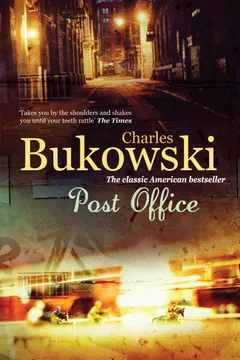


Plot Summary
A Sack at Christmas
During holiday hiring, Henry Chinaski discovers that carrying letters can bring him sex as well as easy money. A brief affair with a lonely officer’s wife convinces him that postal work suits him, so he passes the exams and becomes a substitute carrier.
At Oakford Station, supervisor Jonstone assigns him unfamiliar routes, impossible schedules, and night collections, then punishes his complaint about the workload by withholding assignments. Rather than surrender, Chinaski takes a special-delivery shift at another station, where he can work slowly and take breaks.
Jonstone orders him back. On the street, Chinaski faces snarling dogs, lost mail, confused customers, and repeated write-ups, while the supervisor’s red-shirted authority waits for him at the station.
The Stone's Impossible Routes
On a flooded Sunday collection run, Chinaski loses his directions, finds them floating in the street, and abandons his stalled truck in rising water. The episode brings no relief: Jonstone continues assigning brutal routes.
Chinaski also sees Matthew Battles, the supervisor’s immaculate favorite, arrested for stealing money from mail. The station’s older carrier, G.G., later breaks down when Jonstone adds circulars to a workload he can barely finish; Chinaski tries to get help, but management prioritizes covering the route.
After three years Chinaski becomes a regular and receives a stable set of routes. A petty dispute over where he puts his cap becomes a chain of disciplinary notices. He refuses to play along, resigns, and returns to his life with Betty.
Betty Out, Joyce In
Chinaski’s run of racetrack winnings falters, and Betty, tired of supporting their idle life while he flirts with neighbors, ends their relationship. He leaves with little money and soon marries Joyce, a young woman from Texas, in Las Vegas. In her small hometown, her wealthy family treats him as a suspected fortune hunter; her grandfather’s buffalo prank leaves Chinaski scrambling over a fence while the family laughs.
Joyce takes him back to Los Angeles, where her money buys a car and a respectable new wardrobe. Chinaski tries an art-store shipping job, but its manager’s incessant whistling wears him down. An old drunk’s claim that postal clerking is easy sends Chinaski back to the civil-service exam, this time for a clerk’s position.
Twelve Hours, Two Birds
Chinaski’s first shift as a clerk lasts twelve and a half hours, and the promise of a secure job quickly becomes repetitive labor, strict break rules, and speed tests.
Joyce urges him to endure the work so they can prove their independence, while she fills their home with geraniums, flies, a neglected dog named Picasso, and eventually parakeets. Chinaski cannot sleep through the birds’ noise and releases them outside, believing they can manage on their own. Meanwhile, Joyce grows captivated by a courthouse colleague she calls Purple Stickpin.
When Chinaski warns that the man’s courtly attention may be an office flirtation, Joyce rejects his judgment. She files for divorce, and Chinaski leaves her with the house, dog, and birds, while she helps him pack.
Betty's Bottles and Roses
After the divorce, Chinaski reconnects with Betty, now older, poor, and living in a hotel where she cleans rooms. They drink together, but their former ease has thinned into silence. Chinaski calls in sick so they can spend the day together, hiding Betty when a postal nurse checks on him.
At Christmas, he finds Betty surrounded by liquor gifts from hotel residents and urges her to stop drinking. When he returns later, she is in County General Hospital, gravely ill.
He tries to give her water and challenges the staff for leaving her unattended, but she dies while he tracks down her son. Chinaski attends her funeral with the son and the hotel owner’s disabled sister. A priest gives only part of a service, and the wreath Chinaski bought falls face down beside the grave.
Vi at the Track
After Betty’s funeral, Chinaski meets Vi, a fellow postal employee, at the racetrack and wins by trusting his own reading of the horses rather than her doubts. Their brief intimacy does not last. Back at work, supervisor Feathers questions Chinaski’s absences, while personnel officer Miss Graves investigates his old arrests.
Chinaski sends her a sprawling, officially dressed defense of his record, buying time but not certainty. When the personnel office clears him, it schedules the City Primary scheme test that he has been avoiding.
He invents lurid stories to memorize the street breaks, fails once, then returns and scores perfectly. The result makes him a regular clerk, but the relief is short-lived: he meets David Janko, whose loud complaints and ambitions begin to consume Chinaski’s attention at work.
Janko's Novel, Mary Lou's Knife
Janko unloads his misery and his overwrought novel on Chinaski, who tells him the manuscript loses credibility when it turns sentimental. At the same time, Chinaski develops a racetrack method that earns enough to request a ninety-day leave. He spends the break winning, dining by the coast, and imagining a life beyond the postal floor.
At the track he meets Mary Lou, an intoxicated woman being escorted out, and takes her back to his room. The next day, her former companion Hector confronts them and lunges with a stiletto. Chinaski strikes Hector with a beer bottle, then accuses Mary Lou of arranging the attack for his cash. He leaves with the knife and spends weeks expecting retaliation. The winnings fade, and the leave ends.
A Daughter in the Commune
Back at work, Chinaski starts a relationship with Fay, an older antiwar writer whose idealism and untidy domestic life irritate him even as they share an apartment. His body begins to fail under the night shift: dizzy spells worsen, and he leaves work early, though doctors find no clear cause.
Fay becomes pregnant, and Chinaski drives her to the hospital, stays beside her through labor, and meets their daughter, Marina Louise. He keeps working through city riots and the demands of caring for the baby. As Marina grows, Fay decides to move out and takes their daughter with her. Chinaski visits often, but Fay eventually sends word that they have joined a commune in New Mexico, enclosing a drawing Marina made for him.
The Cage Door Opens
Postal discipline tightens as Chinaski misses shifts and accumulates warnings, suspensions, and a proposed dismissal. After nearly twelve years, a supervisor’s reprimand over one slow tray crystallizes his sense that the job has consumed his time without changing his life. He goes to the Federal Building and resigns, inventing a plan to trap animals in Louisiana rather than admit he has no real next step.
Freedom brings no immediate clarity. Chinaski drinks for days, puts a knife to his throat, and wakes amid bottles, garbage, and a borrowed human heart kept in a jar by a medical student. With no job to return to and his daughter far away, he survives the spell, imagines writing a novel, and begins one.
Analysis
Post Office makes employment feel less like a backdrop than a force that rearranges the body: Chinaski walks until his feet hurt, sorts letters until his arm repeats the same motion, and measures time through missed breaks and exhausted mornings. The postal system’s rules are absurd, but the novel does not present resistance as clean heroism. Chinaski objects to cruelty, yet he also avoids responsibility, lies to supervisors, and treats partners as temporary shelter. His irreverence protects him from humiliation while limiting his ability to care consistently for others.
The women in his life expose different versions of dependence. Betty shares a rough familiarity that cannot restore what time and poverty have worn away. Joyce seeks social and financial respectability through marriage and work. Fay connects domestic life to political and artistic ideals, then makes choices for Marina that Chinaski cannot control. He can recognize these women’s pain, but recognition rarely becomes sustained responsibility. His tenderness is real, as his care for Betty and attachment to his daughter show, yet it competes with appetite and flight.
The racetrack promises a loophole in wage labor, but its wins reproduce the same unstable cycle as the post office: temporary relief, renewed risk, and return to need. Resigning is therefore not a simple victory. Chinaski leaves a system that has depleted him, then confronts the disorder that the job had contained. His decision to write is less a triumphant solution than a first act of converting years of repetition into material he can shape. The book’s bleak comedy depends on that distinction: survival may begin with a joke, but it still requires looking directly at what the joke has been covering.
Review Summary
Post Office receives mixed reviews, with many praising Bukowski's raw, honest portrayal of working-class life and his humorous, direct writing style. Critics appreciate the novel's wit, authenticity, and blunt depiction of alcoholism, sex, and mundane work. Some find the protagonist Chinaski's behavior and attitude repulsive, while others see it as a reflection of societal absurdities. The book's autobiographical nature and its critique of bureaucracy resonate with many readers. However, some criticize its repetitiveness and perceived misogyny.
People Also Read







Characters
Henry Chinaski
Reluctant postal rebelChinaski is a Los Angeles postal carrier and clerk who distrusts authority, resists routine, and uses alcohol, sex, and horse betting to escape demands he cannot or will not meet. His first-person account is alert to the absurdity of postal procedures and often blind to the harm he causes. He can show tenderness toward the exhausted G.G., Betty, and his daughter, yet his instinct is usually to deflect discomfort with a joke or an insult. He prefers freedom in theory, but repeated returns to postal work reveal how financial need and habit can bind someone as firmly as loyalty. His sharp observations coexist with unreliable judgments about other people.
Betty
First love, old companionBetty is Chinaski’s early partner, sharing with him a life of drinking, sex, and precarious domestic comfort. She is capable of working and supporting herself, but she also wants recognition and resents being made to look like the sole provider. Her relationship with Chinaski is marked by rough affection and mutual familiarity, not a stable promise of care. When they meet again later, their history remains vivid, but age, poverty, and disappointment have changed what closeness can offer.
Joyce
Possessive young wifeJoyce is a young Texan whose sexual appetite, family wealth, and small-town sense of propriety pull Chinaski into a marriage neither seems prepared to sustain. She wants him to work partly to prove that he is not dependent on her family, and she tries to arrange their household and his appearance accordingly. Her insistence can feel smothering to Chinaski, but it also grows from a desire for security and social approval. She is emotionally volatile, affectionate, and capable of deep distress, qualities his mocking narration often reduces to a caricature.
A. E. Jonstone
Red-shirted station bossJonstone, known to carriers as the Stone, supervises the Oakford station and assigns Chinaski difficult routes, impossible schedules, and disciplinary notices. He maintains control through rules and workload rather than open explanation. His affection for polished carrier Matthew Battles shows that he can admire exemplary service, but his loyalty to the institution leaves little room for workers who fail or complain. Chinaski’s defiance makes their encounters a contest over who gets to define a reasonable day’s work.
G. G.
Aging route veteranGeorge Greene, called G.G., is an aging carrier whose long service has narrowed his world to familiar routines. He gives neighborhood children candy and has a gentle, if awkward, attachment to them. When the work begins to overwhelm him, Chinaski recognizes his distress before the other carriers do. G.G. embodies the human cost of a job that measures effort by output while leaving little space to notice the person doing it.
Matthew Battles
Supervisor's polished favoriteBattles is a pristine, orderly carrier whom Jonstone presents as a model employee. His immaculate appearance and apparent devotion to the work make him seem to embody everything the station rewards. The contrast between that public image and the suspicions that eventually surround him punctures Chinaski’s already weak faith in institutional appearances.
Tom Moto
Carrier turned supervisorMoto is one of Chinaski’s fellow substitutes under Jonstone. He shares the absurd routes and dangerous weather, and their exchanges offer brief companionship without pretending that either man can change the system. Years later, his promotion to supervisor unsettles Chinaski, who understands the family obligations that can make such a choice feel necessary.
Fay
Idealist and new motherFay is an older writer and antiwar activist whose political commitments and literary circles shape her life more than conventional employment does. She wants Chinaski to share the responsibility of building a stable household, though her own habits can frustrate him. Her pregnancy and approach to parenthood reveal a capacity for patience and steadiness that his workplace-centered perspective rarely anticipates. She is not simply a symbol of idealism: she makes practical decisions about her child even when Chinaski resists them.
Marina Louise Chinaski
Chinaski's young daughterMarina is the daughter of Chinaski and Fay. As an infant, she becomes a new responsibility in a life organized around night shifts, drinking, and evasion. Chinaski’s visits and attachment to her give his choices a consequence beyond his own comfort. She is still a child, not a participant in the adults’ conflicts, and the story presents her mainly through the care and distance those conflicts create.
Vi
Trackside postal clerkVi works for the postal service and meets Chinaski at the racetrack after Betty’s funeral. She follows the horses with her own opinions and briefly shares drinks and intimacy with him. Her presence links the habits of his working life to the escape he seeks at the track, without becoming a lasting solution to either.
Mary Lou
Beautiful track drifterMary Lou is an intoxicated woman Chinaski meets at the racetrack. He is drawn to her immediately and takes her away from the track, where she is connected to Hector, her former companion. Chinaski’s desire quickly turns to suspicion when violence erupts, showing how readily he treats intimacy as both an opportunity and a threat.
David Janko
Loud aspiring novelistJanko is a young clerk who assumes Chinaski’s knowledge of classical music signals a kindred intellectual. He talks insistently about women, his disappointments, and a novel he hopes will win recognition. His need for reassurance frustrates Chinaski, who can identify the weaknesses in Janko’s writing but cannot offer the kind of encouragement he wants.
Parker Anderson
Compromised union officerAnderson is Chinaski’s union representative and a former drifter who has worked his way into union leadership. He responds to Chinaski’s complaints with the practiced assurances of someone who wants to remain useful and liked. Their exchanges show how a worker’s advocate can become absorbed into the same bureaucratic culture he is meant to challenge.
Plot Devices
Postal schedules and write-ups
Rules as daily pressureRoute timings, production standards, break limits, scheme tests, and disciplinary notices give the workplace its recurring structure. Each rule claims to be objective, yet Chinaski encounters standards that ignore flooded streets, uneven trays, unfamiliar routes, and human exhaustion. The paperwork turns small acts of resistance into official offenses, while its repetition makes the job feel less like a single conflict than a system that can absorb almost any complaint.
Horse-racing form
A wager on escapeChinaski studies race records, odds, distance, weight, and public betting patterns to identify horses the crowd undervalues. Winning gives him temporary confidence and a fantasy of independence from wages. Yet the track offers risk rather than a dependable exit: profits encourage larger ambitions, losses return him to postal work, and a lucky streak can make an unstable life look briefly secure.
Alcohol
Numbing and fuelDrinking runs through Chinaski’s shifts, relationships, celebrations, and attempts to sleep. It helps him blunt physical pain and makes humiliating situations seem comic, but it also worsens his exhaustion, damages intimacy, and deepens moments of crisis. The bottle is not simply an escape from work; it becomes a second routine that shapes how he enters work and what he can bear there.
The open cage
Freedom without a mapThe escaped parakeets offer a pointed image of release: Chinaski opens their cage because he needs quiet, and the birds must choose whether to enter the uncertain world outside. Later, leaving the postal service gives him a similar opening, but freedom does not arrive with a plan or security. The image links escape to risk rather than triumph, and it helps frame Chinaski’s final attempt to turn experience into writing.
About the Author
Other books by Charles Bukowski





Download PDF
Download EPUB
.epub digital book format is ideal for reading ebooks on phones, tablets, and e-readers.








