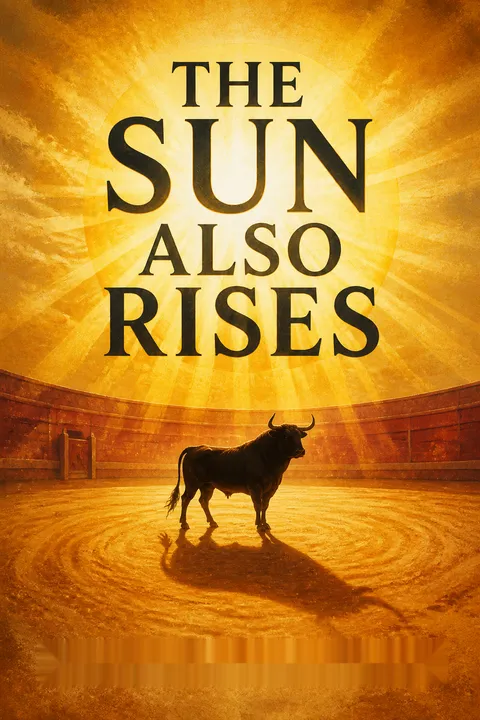


Plot Summary
Paris Makes Room for Brett
Jake Barnes, an American journalist in Paris, is close to Robert Cohn, a shy novelist who once boxed to defend himself against anti-Jewish treatment. At a dance, Jake arrives with Georgette, a woman he has picked up for company, and encounters Lady Brett Ashley, a magnetic Englishwoman with whom he has a painful history.
Cohn watches Brett with instant fascination, while Jake leaves with her in a taxi. When he tries to kiss her, Brett pulls away. She loves him, but the war has left Jake with an injury that makes a sexual relationship impossible. They agree that their attachment cannot become an ordinary partnership, yet neither can end it. Their tenderness survives as an ache neither is willing to name as finished.
Jake's injury is not merely a private obstacle. It sets the terms by which he understands desire: intimacy can be real, even mutual, without offering the conventional proof of a shared life. Brett's refusal to pretend otherwise protects them from false hope, but their agreement to remain close keeps the wound active. Cohn's fascination begins in the same scene, yet he sees Brett as an answer to his dissatisfaction rather than as a person with a history of her own. The three characters therefore enter the story with different relationships to longing: Jake manages it, Brett fears its cost, and Cohn idealizes its promise.
Frances Names the Price
Cohn returns from America changed by his novel's acceptance and the attention he receives from women. His partner, Frances Clyne, has spent years expecting him to marry her, but he now hesitates, and she tells Jake that Cohn wants independence and a literary success of his own.
At a café, Frances exposes the small bargains and humiliations that have kept them together, then prepares to leave for England with money from Cohn. Her departure confirms that the relationship is over, though Cohn still feels guilty and unable to act decisively.
Soon afterward, he admits to Jake that he is falling for Brett. Jake warns him that Brett is engaged to Mike Campbell, but Cohn treats the warning as an obstacle to his imagined romance rather than a reason to step back.
Cohn's increased confidence is less a settled adulthood than a new dependence on external approval. Praise for his book and women's interest briefly loosen the old insecurity he acquired at Princeton, but he converts that relief into a fantasy of starting over. Frances understands the pattern more clearly than he does: she has already reshaped her life around his indecision, and his retreat leaves her to absorb its consequences. His fixation on Brett repeats this passivity in a more romantic register. He does not simply desire her; he casts her as evidence that his life might become adventurous and significant. Jake's blunt warning cannot reach him because Cohn is protecting the story he wants to believe.
The Count's Champagne
Brett spends an evening with Jake and Count Mippipopolous, a wealthy, seasoned man who treats food, wine, and pleasure as things to be enjoyed without apology. The count offers Brett expensive holidays, but she declines and returns to Jake's flat, where their affection again approaches a life they cannot share.
Brett says she will leave for San Sebastian rather than keep Jake trapped in a relationship that would hurt him. She also expects to marry Mike once her divorce is complete.
Jake lets her go, though her departure brings him no relief. In Paris, he continues working and drinking, while Brett's absence briefly quiets the immediate tension. Her choice is not a clean break: she is trying to spare Jake, but the two remain emotionally bound.
The count functions as a foil to Jake and Brett, not because he has escaped pain, but because he has developed a method for containing it. His enjoyment is concrete and self-directed, while Jake and Brett keep testing whether love can overcome the conditions that make their relationship unlivable. Brett's departure is an act of care, yet it also preserves their attachment by avoiding a final severance. The scene complicates any simple reading of her as merely restless: she recognizes the harm she might cause and attempts to limit it. Jake's acceptance, however, is not emotional freedom. His restraint lets Brett choose while leaving him to carry the cost alone.
Southbound With Bill
Jake's friend Bill Gorton returns to Paris, cheerful after a trip through Central Europe, and the two men prepare for fishing in Spain before the Pamplona fiesta. Brett reappears with Mike, her English fiancé, and asks to join them. Jake agrees, although Brett privately worries that Cohn will be hurt by the arrangement.
Cohn has been at San Sebastian with Brett and hopes to see her again, but he joins Jake and Bill at Bayonne for the journey inland. They cross the border through green Basque country and reach Pamplona, where Cohn waits anxiously for Brett and Mike. When they do not arrive on the expected train, Jake and Bill decide to go ahead to Burguete. Cohn stays behind, convinced Brett may still be coming.
The journey gives the novel a physical direction while making the group's emotional imbalance harder to ignore. Jake and Bill can treat travel as a shared pleasure, but Cohn experiences the same itinerary as a chance to remain near Brett. His choice to wait at Pamplona is not forced on him; he gives up the fishing trip because he believes proximity may still turn into intimacy. Brett's decision to bring Mike also makes the social facts plain, though Cohn continues to read them through hope. The landscape offers a temporary alternative to Paris's crowded cafés and stalled ambitions, but it cannot erase the motives each traveler brings along.
The River Before Pamplona
At Burguete, Jake and Bill spend several days fishing cold mountain streams and sharing meals with Harris, an English fisherman who has become a warm, temporary companion. Their routine gives Jake a rare interval of physical calm: he wades, catches trout, and rests outdoors without having to interpret Brett's choices.
A letter from Mike explains that Brett needed time to recover in San Sebastian, and Cohn sends word that he is coming to Pamplona. Harris gives the departing friends flies he has tied himself, a small gift that makes their brief friendship feel substantial.
Back at the Montoya hotel, Jake and Bill find Cohn, Brett, and Mike together. Mike's drinking quickly turns the reunion sour, as he mocks Cohn for pursuing Brett and compares him to a steer that follows the herd.
Fishing offers Jake and Bill a form of attention unlike the group's Parisian vigilance. Their hands, lines, and changing water occupy the present, and Harris's generosity creates companionship without romantic bargaining. The return to Pamplona restores the social pressure the river temporarily suspended. Cohn has waited for Brett, while Mike interprets that devotion as an insult and uses the public setting to humiliate him. Jake's irritation at Cohn coexists with his awareness that Mike's cruelty is excessive. The contrast matters: the novel does not present the countryside as a cure, but as a brief practice in inhabiting experience directly before the characters resume their familiar injuries.
The Fiesta Finds Its Audience
Pamplona's San Fermin festival begins with religious processions, dancing, wine, and streets crowded through the night. Before the formal bullfights, Jake shows the others the bulls being unloaded from their transport cages.
Their raw force unsettles the group, and Mike revives his insults toward Cohn, who remains fixated on Brett. At the first fights, Brett discovers that she can watch the dangerous spectacle without turning away. Her attention settles on Pedro Romero, a nineteen-year-old matador whose calm, exact movements create genuine danger rather than theatrical imitation.
Jake explains what Romero is doing, and Brett begins to understand the difference. The next day, Romero's performance confirms her fascination. Cohn, who had feared being bored, is instead sickened by the violence, while Brett watches Romero closely.
The fiesta transforms private tensions into public spectacle. Its noise and excess seem to suspend consequences, but the bullring insists on exact consequences: distance, timing, and skill determine whether a movement is beautiful or fatal. Romero attracts Brett because his composure is earned through attention to the animal, not manufactured for applause. Jake's explanations give her a way to see the art rather than only the gore, and his expertise becomes an intimate act even as it helps redirect her desire. Cohn's physical revulsion punctures his attempt to appear worldly. Each character's response to the ring reveals a different relation to risk, performance, and the reality beneath a romantic image.
Brett Crosses the Line
As the fiesta intensifies, Brett's interest in Romero becomes an attachment she can no longer contain. After another strained evening with Mike and Cohn, she walks with Jake through the dark streets and admits that she has fallen for the young matador.
Jake warns her against acting on it, but she insists that she must follow what she wants. He takes her to the café where Romero is sitting with fellow bullfighters and critics. Brett and Romero begin talking across language barriers, and Jake recognizes the choice forming between them.
Rather than remain as a witness, he leaves to find the others. When he returns, Brett and Romero have gone. Jake has helped bring them together, although he knows that his help will deepen the loss he has been trying to manage.
Jake's decision to introduce Brett to Romero is both generous and self-destructive. He acts as the facilitator of her desire even while understanding that it will displace him, a role that lets him preserve closeness through service when he cannot claim a shared future. Brett's confession is not a request for permission. She frames action as a way to reclaim agency after the humiliations and emotional exhaustion of the fiesta. Romero, meanwhile, appears to offer a new object of attention, but not an escape from the social conditions around Brett. The scene's moral complexity lies in Jake's consent: he does not simply lose Brett to circumstance; he participates in the event that makes the loss immediate.
Cohn's Last Contest
Cohn finds Jake at a café and demands to know where Brett has gone. When Jake refuses to tell him, Cohn calls him a pimp and knocks him to the pavement, striking him again before the others pull them apart.
Later that night, Cohn finds Brett and Romero together and attacks the matador, knocking him down repeatedly. Romero refuses to stay down, and Brett intervenes to stop the fight. Cohn eventually breaks into tears, apologizes, and seeks forgiveness from both of them, but neither accepts the reconciliation he wants.
Jake visits him in his room, where Cohn cries and admits that Brett's rejection has overwhelmed him. The next morning Cohn leaves Pamplona. His departure ends the immediate confrontation, but Jake is left bruised and the group fractured.
Cohn's violence is a desperate attempt to turn emotional humiliation into a contest he knows how to fight. Boxing once gave him a way to answer exclusion, but here physical force cannot restore the romance he imagined or the dignity he thinks he has lost. His repeated effort to apologize shows that the aggression is not a stable identity; he wants the old bonds restored as soon as the violence has failed. Yet apology cannot undo the harm or make his presence welcome. Jake's response is equally complicated: he resents Cohn, has helped provoke his jealousy, and still visits him in distress. Their shared history survives, but it cannot protect either man from what the rivalry has exposed.
The Bull's Ear
During the morning bull run, a bull gores Vicente Girones, a local farmer, who later dies. The festival's festive danger becomes a family's irreversible loss. That afternoon, Romero enters the ring with his face swollen from Cohn's attack, yet performs with such control that the crowd awards him a bull's ear. He gives it to Brett, and the two leave Pamplona together by train that evening.
Jake stays behind as the fiesta winds down. Romero's triumph follows the same bull's killing of Girones, tying beauty and death together in a way no celebration can soften. Brett's departure leaves Jake alone with the consequences of a choice he helped make, while Cohn has already gone and Mike is too exhausted by drink to steady anyone.
The death of Girones breaks the fiesta's illusion that danger can be consumed as entertainment. The waiter's sober response, and the later details of the dead man's wife and children, restore the human life hidden behind the crowd's appetite for spectacle. Romero's performance does not cancel that death; it gives form to danger through discipline, which is why the crowd responds so intensely. Brett's departure with him joins desire to the same world of risk. Jake sees the difference between Romero's control and the group's drifting, but he cannot make the bullring's order govern their private lives. The ear becomes a token of Brett's fascination and of a festival that has exacted a real price.
After the Last Rocket
The morning after the fiesta, Pamplona returns to an ordinary square, with notices being torn from the arcade pillars. Jake, Bill, and Mike leave together for Bayonne. Bill catches a train to Paris, while Mike goes on to Saint-Jean-de-Luz, short of money and trying to joke about his debts.
Jake continues alone to San Sebastian, hoping for swimming, quiet, and distance from the festival. He resumes familiar routines, but Brett's telegram interrupts them. She is in Madrid and says she is in trouble, so Jake cancels his solitude and takes the night train.
His response is immediate, even though the message offers no details and their old relationship has never become a workable life. The journey back toward Brett begins before he can decide what going will cost him.
The cleared square is a visual counterpoint to the fiesta's overwhelming abundance. Once the music and crowds vanish, the characters must face the habits that the festival merely amplified: Mike's debt and drinking, Bill's need to return to work, and Jake's reflexive availability to Brett. Jake's attempt at rest in San Sebastian is modest but meaningful; he imagines a life governed by swimming, reading, and orderly meals. The telegram shows how fragile that imagined boundary is. Brett does not explain her trouble, yet Jake responds without demanding an account. His loyalty is genuine, but it also repeats the pattern that keeps him emotionally present in a relationship he cannot resolve.
A Ride Without Remedy
In Madrid, Jake finds Brett alone in a hotel room. Romero has left after asking her to change her appearance and agreeing that marriage would keep her with him; Brett decided that such a life would damage him and sent him away.
She is relieved by the choice, but she is also grieving it, and she plans to return to Mike. Jake comforts her without pretending that their own relationship can become permanent. They share drinks and lunch, then ride through the bright city in a taxi.
Brett regrets that they might have made a good life together; Jake answers with a wistful acknowledgment that the possibility belongs to imagination, not to the life they have. The taxi's movement presses them close for a moment, but it changes neither the past nor the terms that separate them.
The ending offers no reconciliation because the novel has carefully distinguished emotional intimacy from practical possibility. Brett's decision to leave Romero is an ethical judgment: she sees that his wish to remake her would bind him to a life she cannot honestly sustain. Returning to Mike is not presented as a cure, only as the relationship she knows how to resume. Jake remains tender, but tenderness no longer disguises the limits between them. The taxi briefly arranges their bodies as if closeness were enough, while the conversation exposes the fantasy beneath that image. The novel's final irony is not that they do not love each other, but that love cannot retroactively supply the conditions their shared life required.
Analysis
The novel's central problem is not that its characters feel too little, but that feeling alone cannot provide them with a workable form of life. Jake and Brett love each other, yet Jake's war injury makes the ordinary future they might imagine unavailable. Brett's repeated movement between partners can look like freedom, but the story shows its costs in the people she leaves behind and in her own fear of becoming harmful. Cohn's idealism supplies another inadequate answer: he treats travel and romance as routes out of dissatisfaction, then mistakes persistence for a claim on Brett. Their different strategies all seek to convert pain into something manageable.
Against this drift, bullfighting offers a severe standard of attention. Romero's movements matter because he reads the bull accurately and accepts the danger rather than faking it. Jake's aficion lets him recognize that distinction, and his explanations help Brett see what she responds to. But the bullring does not make violence noble by itself. The death of Vicente Girones restores the human consequence that the crowd's pleasure risks obscuring. The contrast between Romero's technical discipline and the expatriates' emotional disorder is illuminating, not a simple endorsement of tradition over modernity.
The title's recurring image of the sun rising suggests continuity beyond individual failure, but the book does not use continuity as consolation. The fiesta ends, the travelers separate, and morning arrives without repairing what happened. Jake's final closeness with Brett cannot turn their imagined shared life into a real one. His wit and endurance are forms of survival, not solutions. The novel's painful insight is that people may understand their limits and still keep choosing one another, because recognition can clarify loss without abolishing attachment.
Review Summary
The Sun Also Rises receives mixed reviews, with some praising Hemingway's sparse writing style and exploration of post-WWI disillusionment. Many consider it a masterpiece of 20th-century literature, capturing the essence of the "Lost Generation." Critics applaud the vivid descriptions of Paris and Spain, particularly the bullfighting scenes. However, some readers find the characters unlikable and the plot repetitive. The novel's portrayal of excessive drinking, masculinity, and antisemitism is controversial. Overall, it remains a polarizing yet influential work in American literature.
People Also Read






Characters
Jake Barnes
The wounded observerJake is an American journalist living in Paris and the novel's narrator. His war injury shapes his relationship with Brett Ashley, whom he loves, and his friendship with Robert Cohn, Bill Gorton, and Mike Campbell. He is perceptive about other people's evasions, but he often uses irony and work to avoid stating his own needs. His attention to fishing, food, writing, and bullfighting gives him ways to experience the world through concrete acts rather than grand explanations. Jake's restraint can look like indifference, though his choices repeatedly show loyalty and care. He is especially drawn to forms of skill and discipline that make danger legible, even when the emotional disorder around him remains beyond his control.
Lady Brett Ashley
The restless belovedBrett is an Englishwoman living among expatriates in Paris, where she moves between Jake, her fiancé Mike, and a wider circle of admirers. Her cropped hair, confidence, and ease in male company challenge conventional expectations, but they do not make her invulnerable. She drinks heavily and seeks pleasure partly because stillness leaves room for old grief and dissatisfaction to surface. Brett is drawn to people who make her feel vividly alive, yet she recognizes that her desires can injure others. Her relationship with Jake is especially charged because affection exists alongside a barrier neither can remove. She is neither simply careless nor simply trapped: she makes choices, sometimes impulsively, and remains alert to the costs those choices impose.
Robert Cohn
The hopeful outsiderCohn is an American novelist and former Princeton boxer whose wealth and education have not erased the insecurity created by anti-Jewish prejudice. He is gentle by temperament, eager to be liked, and often slow to recognize when another person has stopped welcoming his attention. His first marriage and long relationship with Frances leave him accustomed to being chosen rather than choosing clearly for himself. Cohn's literary success briefly enlarges his sense of possibility, while idealized adventure stories encourage him to imagine travel and romance as ways to remake his life. His attachment to Brett grows from genuine feeling, but also from his hope that she will make his existence extraordinary. The tension between tenderness and entitlement makes him both sympathetic and difficult.
Mike Campbell
The indebted fiancéMike is Brett's English fiancé, a former soldier whose debts and bankruptcy sit uneasily beside his social confidence. He is funny and affectionate when sober, but alcohol can make him cruel, especially toward Cohn, whose pursuit of Brett sharpens his jealousy. Mike often turns his own failures into jokes before anyone else can use them against him. His humor keeps the group moving, yet it can also become a weapon when he feels threatened. His relationship with Brett is familiar and passionate, though not free of strain. Beneath the banter is a man who depends on other people's tolerance and struggles to sustain the authority his aristocratic background appears to promise.
Bill Gorton
Jake's comic companionBill is Jake's American friend, a successful writer who returns from travel ready to joke about nearly everything. On the fishing trip, he becomes Jake's closest companion and shares the pleasures of outdoor routine without demanding emotional explanation. His humor is affectionate, often absurd, and sometimes sharp enough to expose the group's pretensions. Bill recognizes that Mike's treatment of Cohn is unfair, even though he also dislikes Cohn's behavior. He is loyal to Jake and capable of direct tenderness, but he prefers to approach difficult feeling sideways, through jokes and shared activity.
Pedro Romero
The disciplined matadorRomero is a nineteen-year-old Spanish bullfighter whose work impresses Jake because it is precise, courageous, and free of showy tricks. He treats the bullring as a serious craft and possesses a confidence grounded in training rather than social display. Brett is drawn to his youth and composure, while Jake sees in his technique a rare union of danger and control. Romero is polite and modest with the expatriates, though he understands the expectations surrounding his profession. His presence contrasts with the group's drifting self-consciousness: he knows what his work demands and attends to it without turning it into a performance of sophistication.
Frances Clyne
Cohn's disillusioned partnerFrances is Cohn's longtime partner, a tall, forceful woman who has invested years in a future he once promised her. She wants marriage and children, but also recognition for her writing and security of her own. When Cohn hesitates, Frances uses caustic humor to expose the imbalance in their relationship and the sacrifices she has made. Her wit protects her from appearing abandoned, though it also makes her pain public. She understands Cohn's vanity and uncertainty better than he does, and her departure marks the end of a partnership shaped by unequal expectations.
Count Mippipopolous
The seasoned pleasure-seekerThe count is a wealthy, cosmopolitan man who meets Brett through Paris's expatriate circle. He has survived wars and revolutions and treats food, drink, and companionship as pleasures worth appreciating on their own terms. His generosity is practical rather than sentimental: he offers Brett travel and gives Jake and Brett a lavish evening without demanding that they become a couple. He serves as a contrast to the younger characters, whose desires are tangled with fantasies of rescue, status, or a different life. The count's calm does not mean he has escaped experience; it suggests he has found a way to live with it.
Juanito Montoya
The keeper of aficionMontoya owns the Hotel Montoya in Pamplona and cares deeply about bullfighting. He judges matadors by their seriousness and skill, not simply their popularity, and recognizes Jake as a genuine aficionado. His approval gives Jake a sense of belonging in a culture where he might otherwise remain an outsider. Montoya is protective of Romero, fearing that foreign admirers will flatter the young fighter and distract him from his craft. His quiet disapproval makes him a moral counterweight to the tourists who treat the bullring as a fashionable spectacle.
Harris
The generous fishermanHarris is an English fisherman Jake and Bill meet at Burguete. He joins them for fishing and bridge, and his handmade flies turn a brief holiday friendship into a lasting memory. His warmth contrasts with the group's more tangled relationships.
Georgette
Jake's Paris companionGeorgette is a woman Jake meets in Paris and takes to dinner before bringing her to a dance. Her frankness and independence expose the casual transactions of expatriate nightlife. She briefly accompanies Jake but does not mistake the evening for romance.
Harvey Stone
The hungry café regularHarvey is an American writer in Paris who sometimes goes without food when money fails to arrive. Jake helps him, while Harvey's dry assessments of the other expatriates reveal the precariousness beneath their café-going routines.
Edna
The visiting spectatorEdna is a visitor from Biarritz who joins Bill and Mike during the fiesta. She tries to keep Mike out of trouble and later watches the bull run with them. Her presence gives the group an outsider's view of its reckless habits.
Plot Devices
Jake's war injury
Desire without fulfillmentJake's injury, sustained during the war, makes a conventional sexual relationship with Brett impossible. It is introduced as a private fact but shapes nearly every choice he makes around her. The injury distinguishes physical intimacy from emotional intimacy, forcing Jake and Brett to confront the gap between loving each other and building a life together. It also influences Jake's use of irony: he can narrate pain with composure, but that composure does not remove it. The injury is not a puzzle to solve or a temporary obstacle. It is a lasting condition that gives the romance its particular limit and makes Jake's willingness to remain close both generous and costly.
The Pamplona fiesta
Pleasure under pressureThe weeklong festival gathers the expatriates in a setting where drinking, dancing, religious observance, and bullfighting continue with little pause. Its noise and crowds intensify relationships already strained in Paris, while its apparent freedom encourages the characters to act as if consequences can wait. The bull run and the fights steadily puncture that illusion. Local routines, the festival's religious dimension, and the visitors' fascination with spectacle coexist, creating a world that is not simply a holiday backdrop. The fiesta brings Jake's group into contact with a different measure of value, one shaped by communal tradition and technical skill, even as the travelers continue to carry their private conflicts through it.
Aficion
A test of attentionAficion means a passionate, informed commitment to bullfighting. Montoya uses it to distinguish genuine respect for the craft from mere excitement or tourist curiosity, and Jake's knowledge earns him a place in that tradition. Through Jake's explanations, Brett learns to notice Romero's control, proximity to danger, and economy of movement. Aficion therefore works as both cultural practice and narrative lens: it teaches the reader how to see the bullring, while setting disciplined attention against the expatriates' habit of turning experience into talk. The concept does not excuse the violence. Instead, it makes the participants' different responses to danger and artistry legible.
Fishing in Burguete
A pause from ParisThe fishing excursion gives Jake and Bill a temporary rhythm apart from cafés, romantic jealousy, and the festival crowds. Preparing tackle, wading cold streams, catching trout, and sharing lunch focus attention on physical tasks with clear results. The trip also introduces Harris, whose generosity offers a brief example of companionship without rivalry or elaborate social performance. Its calm is not a cure for the characters' difficulties: Cohn remains behind because he is waiting for Brett, and the group must return to Pamplona. The fishing scenes instead show what Jake values when he is not managing other people's feelings, and make the return to the fiesta feel like a deliberate reentry into disorder.
Alcohol and cafés
A shelter with costsDrinking and café life structure the expatriates' days, providing meeting places, rituals, and ways to pass time. Alcohol can loosen the group's restraint and give conversation a temporary ease, but it also magnifies jealousy, debt, and cruelty. Mike's drunkenness turns his insecurity into public attacks on Cohn; Jake often drinks to dull pain, while Brett uses drink as part of her social freedom. The cafés allow the characters to remain together without deciding what they owe one another. Their repeated return to bars is therefore both companionship and avoidance: a shared routine that postpones decisions without making the underlying conflicts disappear.
FAQ
Basic Details
What is The Sun Also Rises about?
- Post-War Expatriate Lives: The novel follows a group of American and British expatriates in post-World War I Europe, particularly in Paris and Spain, as they navigate love, loss, and disillusionment.
- Unrequited Love and Relationships: The story centers on Jake Barnes's unrequited love for Lady Brett Ashley, and the complex relationships within their circle of friends, including Robert Cohn and Mike Campbell.
- Journey to Pamplona Fiesta: The group travels to Pamplona for the annual San Fermín festival, where bullfights and revelry serve as a backdrop for their emotional struggles and personal conflicts.
Why should I read The Sun Also Rises?
- Iconic "Lost Generation" Novel: It's a defining work of the "Lost Generation," capturing the disillusionment and aimlessness of post-WWI expatriates with a unique, minimalist style.
- Exploration of Complex Themes: The novel delves into themes of love, loss, masculinity, and the search for meaning, offering a timeless exploration of human relationships and existential angst.
- Hemingway's Distinctive Style: Readers can experience Hemingway's groundbreaking, sparse prose and dialogue, which revolutionized modern literature and influenced countless writers.
What is the background of The Sun Also Rises?
- Post-World War I Disillusionment: The novel is set against the backdrop of post-World War I Europe, reflecting the disillusionment and moral ambiguity experienced by many in the aftermath of the conflict.
- Expatriate Lifestyle in Paris: It portrays the lives of American and British expatriates in Paris during the 1920s, a period marked by artistic experimentation, social upheaval, and a search for new values.
- Spanish Bullfighting Tradition: The novel incorporates the cultural significance of Spanish bullfighting, using it as a metaphor for the characters' struggles with passion, courage, and mortality.
What are the most memorable quotes in The Sun Also Rises?
- "You are all a lost generation.": This quote, attributed to Gertrude Stein, encapsulates the novel's central theme of disillusionment and the aimlessness of the post-war generation.
- "Nobody ever lives their life all the way up except bullfighters.": This line highlights the characters' yearning for a life of purpose and passion, contrasting their own experiences with the perceived intensity of bullfighters' lives.
- "Isn't it pretty to think so?": This poignant line, spoken by Jake at the end, reflects the bittersweet nature of their relationship with Brett and the acceptance of their unfulfilled desires.
What writing style, narrative choices, and literary techniques does Ernest Hemingway use?
- Sparse and Direct Prose: Hemingway employs a minimalist style characterized by short, declarative sentences, simple vocabulary, and a focus on concrete details, creating a sense of emotional detachment.
- Objective Point of View: The narrative is primarily told from Jake Barnes's first-person perspective, but with a detached, almost journalistic tone, allowing readers to draw their own conclusions about the characters and events.
- Use of Dialogue and Subtext: Hemingway relies heavily on dialogue to reveal character traits and relationships, often using subtext and unspoken emotions to convey deeper meanings and tensions.
Hidden Details & Subtle Connections
What are some minor details that add significant meaning?
- Robert Cohn's Flattened Nose: This detail, stemming from his boxing days, symbolizes his attempts to overcome feelings of inferiority and his physical vulnerability, foreshadowing his emotional fragility.
- The Clocks in the New York Herald Bureau: The clocks showing the time in America highlight the characters' sense of displacement and longing for their homeland, emphasizing their expatriate status.
- The Faded Purple Wreath on Ney's Statue: This detail, a seemingly random observation, subtly underscores the theme of lost glory and the passage of time, reflecting the characters' own sense of being adrift.
What are some subtle foreshadowing and callbacks?
- Cohn's Dream: Cohn's cryptic dream, where he says "I can't do it. Nothing will make me do it," foreshadows his inability to cope with his emotions and his eventual breakdown.
- The Stuffed Dog: Bill's repeated references to wanting a stuffed dog, initially humorous, later become a symbol of the characters' desire for something tangible and lasting in their transient lives.
- Brett's "Never Let You Down" Line: Brett's assurance to Jake that she's "never let you down" is a callback to her earlier actions and foreshadows her eventual departure with Romero, highlighting her pattern of behavior.
What are some unexpected character connections?
- Harvey Stone and Mencken: The brief mention of Harvey Stone's connection to Mencken reveals a shared intellectual background and a cynical worldview, highlighting the influence of literary figures on the expatriate community.
- The Concierge's Past: The concierge's past as a concession owner at the racecourses adds depth to her character, revealing her keen eye for social status and her ability to judge people, influencing her interactions with Jake's guests.
- The Old Man at the Border: The old man without a passport, who is forced to wade across the stream, mirrors the characters' own sense of being outsiders and their struggles with belonging.
Who are the most significant supporting characters?
- Montoya: As the hotel owner and a bullfighting aficionado, Montoya represents traditional Spanish values and serves as a foil to the expatriates' aimlessness, offering a perspective rooted in passion and authenticity.
- Harvey Stone: A cynical and impoverished intellectual, Harvey embodies the disillusionment and despair that pervades the expatriate community, providing a counterpoint to the more romanticized struggles of the main characters.
- The Waiters: The waiters, particularly the one who discusses the bullfight with Jake, offer a glimpse into the local perspective on the fiesta and its inherent violence, highlighting the cultural divide between the expatriates and the Spanish.
Psychological, Emotional, & Relational Analysis
What are some unspoken motivations of the characters?
- Jake's Resignation: Jake's unspoken motivation is to find a way to live with his physical and emotional wounds, often resorting to a detached observation of others' lives as a way to cope with his own pain.
- Brett's Search for Fulfillment: Brett's unspoken motivation is to find a sense of purpose and fulfillment, often seeking it through intense relationships and experiences, while simultaneously fearing commitment and stability.
- Cohn's Need for Validation: Cohn's unspoken motivation is to gain validation and acceptance, driving his pursuit of Brett and his desire to be seen as a successful writer, stemming from his deep-seated insecurities.
What psychological complexities do the characters exhibit?
- Jake's Emotional Detachment: Jake's emotional detachment is a defense mechanism against his physical and emotional wounds, leading to a complex mix of cynicism and underlying vulnerability.
- Brett's Fear of Commitment: Brett's fear of commitment stems from her past experiences and a desire for independence, leading to a pattern of intense but ultimately fleeting relationships.
- Cohn's Insecurity and Jealousy: Cohn's insecurity and jealousy are rooted in his past experiences of being an outsider, leading to his obsessive behavior and inability to accept rejection.
What are the major emotional turning points?
- Cohn's Fight with Romero: The fight between Cohn and Romero is a major turning point, exposing Cohn's emotional fragility and his inability to compete with Romero's authenticity and passion.
- Brett's Decision to Leave Romero: Brett's decision to leave Romero marks a turning point in her character arc, as she chooses self-preservation over romantic fulfillment, highlighting her internal conflict.
- Jake's Acceptance of Loss: Jake's final conversation with Brett in Madrid represents a turning point, as he accepts the impossibility of their relationship and the transient nature of their lives, leading to a sense of resignation.
How do relationship dynamics evolve?
- Jake and Brett's Unfulfilled Love: Their relationship evolves from a shared understanding and deep affection to a recognition of their fundamental incompatibility, highlighting the tragic nature of their unrequited love.
- Cohn's Isolation: Cohn's relationships with the group deteriorate as his obsession with Brett intensifies, leading to his isolation and eventual departure, underscoring his inability to connect with others on an equal footing.
- Mike's Self-Destructive Behavior: Mike's relationship with Brett is marked by his self-destructive behavior and drunken outbursts, revealing his insecurities and his inability to cope with his financial and emotional struggles.
Interpretation & Debate
Which parts of the story remain ambiguous or open-ended?
- The Nature of Jake and Brett's Love: The exact nature of Jake and Brett's love remains ambiguous, leaving readers to question whether their bond is based on genuine affection or a shared sense of loss and disillusionment.
- The Meaning of the Fiesta: The significance of the fiesta is open to interpretation, with some viewing it as a symbol of freedom and liberation, while others see it as a chaotic and ultimately destructive force.
- The Characters' Futures: The novel's ending leaves the characters' futures uncertain, with no clear resolution to their personal struggles, reflecting the open-ended nature of life and the lack of easy answers.
What are some debatable, controversial scenes or moments in The Sun Also Rises?
- Mike's Anti-Semitic Remarks: Mike's anti-Semitic remarks towards Cohn are controversial, raising questions about the characters' prejudices and the novel's portrayal of social issues.
- Brett's Treatment of Cohn: Brett's treatment of Cohn is debatable, with some viewing her as a victim of her own desires, while others see her as a manipulative and cruel figure.
- The Glorification of Bullfighting: The novel's portrayal of bullfighting is controversial, with some readers finding it a celebration of violence and machismo, while others see it as a metaphor for the human condition.
The Sun Also Rises Ending Explained: How It Ends & What It Means
- Brett's Departure with Romero: Brett's decision to leave with Romero, and then ultimately leave him, highlights her inability to find lasting happiness and her tendency to seek intense but ultimately fleeting relationships.
- Jake's Resignation: Jake's final line, "Isn't it pretty to think so?" reflects his acceptance of the impossibility of his relationship with Brett and the bittersweet nature of their shared experiences.
- Ambiguous Conclusion: The ending is open-ended, leaving readers to ponder the characters' futures and the lasting impact of their experiences, emphasizing the novel's themes of disillusionment and the search for meaning in a chaotic world.
About the Author
Other books by Ernest Hemingway



Download PDF
Download EPUB
.epub digital book format is ideal for reading ebooks on phones, tablets, and e-readers.








