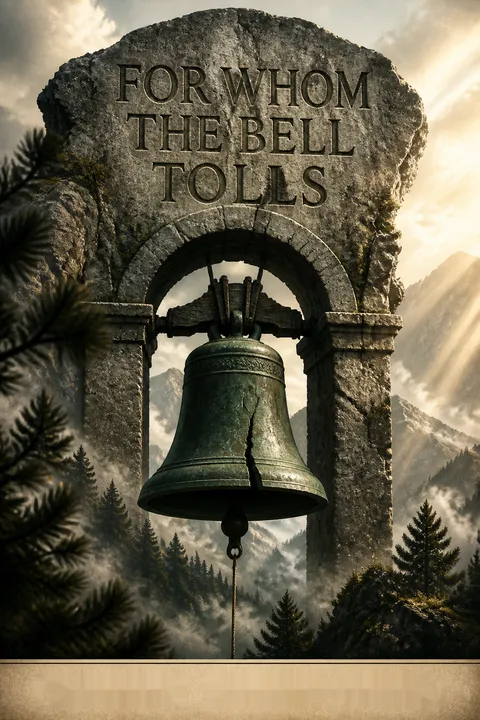


Plot Summary
A Bridge on Golz's Clock
Robert Jordan, an American demolition expert serving the Spanish Republic, crosses behind enemy lines with the guide Anselmo. General Golz has ordered him to destroy a bridge only after a Republican offensive begins, so Fascist reinforcements cannot reach the pass. Jordan knows the delay could let the enemy strengthen its guard, but he cannot act early without disobeying the plan.
From a mountainside he studies the road and sees the mill post, the bridge beyond the gorge, and the route where the guards patrol. His task is technically simple; the timing makes it dangerous. Anselmo leads him toward the guerrilla band whose cooperation Jordan needs, while Jordan carries explosives and responsibility for men he has never met.
The mission is defined by a conflict between technical certainty and political uncertainty. Jordan understands how to destroy steel; he cannot control whether the offensive starts on time, whether orders change, or whether the enemy has learned the plan. The bridge therefore becomes more than a target. It is the point where military procedure meets human consequence. Jordan's professional discipline gives him a narrow refuge from worry, but the command's timing already implicates him in risks borne by people whose lives and homes depend on the operation.
Pablo's Cave Divides
Pablo, the band leader, resents Jordan's arrival and refuses to help destroy a bridge near the mountains where his people hide. He fears that the operation will draw Fascist troops into their refuge and cost the band its horses and safety. Anselmo condemns Pablo's caution, while the others watch to see which man will command them.
Pilar, Pablo's formidable companion, openly supports the mission; Primitivo and the two brothers side with her, and the gypsy Rafael follows. The argument strips Pablo of control, though Jordan declines to kill or expel him. The explosives remain under guard, and the divided band accepts Jordan's authority for now, with Pilar's determination holding the group together.
Pablo's resistance is not simple cowardice. He is protecting a community whose survival depends on remaining unseen, while Jordan's assignment treats that community as military capacity. Pilar sees the larger political danger of retreating into private safety, yet her challenge does not erase the practical risk Pablo identifies. The scene establishes leadership as a contested, relational force rather than a title: Jordan has orders, Pilar has allegiance, and Pablo has local knowledge. Their uneasy arrangement will depend less on unity than on whether each can keep acting despite distrust.
The Sentry and the Span
Jordan and Anselmo creep close enough to inspect the steel bridge, its sentry boxes, and the road beyond. Jordan sketches where explosive charges must be fixed so the span will fall into the gorge; Anselmo watches the guard and reports that the larger post is farther down the road.
Their reconnaissance confirms the job is feasible, but also reveals why the timing matters: a sentry can see the approach, and a telephone line may carry warning. On the climb back, Anselmo admits that killing men troubles him even when war makes it necessary. He has killed before, but believes the act leaves a moral debt. Jordan promises to keep him beside him during the operation.
The bridge's physical structure offers Jordan a problem he can solve, but Anselmo's response insists that competence does not make killing morally clean. The two men share a task without sharing its emotional logic: Jordan treats lethal force as a grim necessity, while Anselmo experiences it as a lasting injury to the self. Their relationship becomes a small model of the book's larger ethical tension. Duty can coordinate action, but it cannot make the people carrying it feel the same about what they do.
Maria's First Night
At the hidden camp, Jordan meets Maria, a young woman the guerrillas rescued after a train raid. Her hair has been forcibly cut, and she remains wary of touch, though she and Jordan are drawn to one another at once. Pilar warns him that Maria has suffered and must not be treated carelessly. That night Maria comes to Jordan's sleeping robe, frightened but willing to trust him.
When she tells him that men assaulted her, Jordan reassures her that their intimacy belongs to her present choice, not to what was done against her will. Maria begins to imagine leaving the mountains with him. Their sudden closeness gives Jordan a personal hope that competes with the mission he has come to complete.
Maria's recovery is not presented as a simple cure produced by romance. She chooses intimacy while carrying memories that can still alter her sense of safety, and Jordan's tenderness matters because he listens rather than demanding that she perform healing for him. Their attachment also exposes the cost of Jordan's professional detachment: he has treated personal desire as a distraction, but Maria makes a future imaginable at exactly the moment his work threatens to end one. The relationship is both real and precarious, not merely an escape from war.
Planes Over the Pines
The next morning, waves of Fascist bombers and fighters cross the mountains, far more aircraft than the guerrillas have ever seen. Jordan suspects they are heading toward an airfield, but their scale alarms the band. Reports from La Granja add rumors that the Republic is preparing an offensive and that troops may be sent to clear the hills.
Jordan dispatches Anselmo to count traffic on the road and Rafael to check the guards and watch changes at the bridge. He then travels with Pilar and Maria to meet El Sordo, a nearby guerrilla leader. El Sordo confirms troop movements and agrees to help, but warns that the operation will leave both bands exposed in daylight.
The planes turn an isolated sabotage mission into part of a much larger military system. The guerrillas can observe traffic and infer danger, but they lack reliable communications and cannot distinguish reconnaissance from attack with certainty. Jordan's decision to gather road intelligence is a disciplined response to that uncertainty, while El Sordo makes its human cost explicit: success at the bridge may leave a whole group unable to escape. The scene also shows how rumor functions as an imperfect intelligence network. Information travels, but often too late or in forms that cannot be trusted.
Pilar Remembers the Plaza
On the walk, Pilar recounts how Pablo led their town's uprising at the war's beginning. After capturing the Civil Guards, he executed four prisoners; later, townspeople killed Fascist civilians in the plaza, with drunkenness and mockery turning a planned act of judgment into a mob massacre. Pilar remembers the terror and shame, not a clean victory.
She also explains that Fascist troops retook the town within days. At El Sordo's camp, Jordan learns that the older guerrilla has eight dependable men, an automatic rifle, and too few horses for a safe retreat. El Sordo nevertheless commits his band to the bridge operation, agreeing to attack the roadmender's post and bring extra dynamite.
Pilar's memory prevents the Republic's cause from becoming an excuse for whatever its supporters do. She distinguishes opposition to Fascism from the intoxicating permission to punish, showing how a community can begin with a claim to justice and end by reproducing the cruelty it condemns. Her account also complicates Pablo: the brutal organizer of the uprising is the same man now afraid of further violence. El Sordo's practical commitment carries this history forward. He joins not because the operation is safe, but because preserving the possibility of collective resistance still matters.
Snow Closes the Pass
An unexpected May snowstorm sweeps over the mountains, interrupting Jordan's reconnaissance plans and forcing Anselmo to wait in the cold beside the road. The old man watches traffic but cannot read the staff cars' significance; he records each one as Jordan instructed. The snow also makes movement harder to conceal.
Pablo knows the mountain weather and predicts the storm will pass, while Jordan waits for the scouts to return before committing the band. During the night, Jordan and Maria lie together again and speak of marriage and a life in Madrid, though neither can make the imagined future secure. By morning the snow begins to melt, exposing tracks left by horses moving through the hills.
The storm acts as both obstacle and evidence. It temporarily masks movement, then preserves tracks that can expose the guerrillas once the weather clears. Anselmo's careful record-keeping cannot compensate for information he has not been trained to interpret, underscoring the uneven distribution of expertise in the resistance. Meanwhile, Jordan and Maria's private plans do not suspend the mission; they sharpen what is at stake. Their imagined domestic life is specific, full of rooms and daily habits, which makes its fragility more painful than a generalized wish for peace.
Sordo's Last Hill
El Sordo's attempt to acquire horses leaves tracks in the melting snow. A Fascist patrol follows them to his band, and Sordo's men retreat to a bare hilltop, where they repel an initial cavalry assault with grenades and automatic fire. Surrounded, wounded, and short of ammunition, they wait for help that Jordan cannot safely send without abandoning the bridge mission.
Fascist officers eventually call in aircraft. Bombs tear apart the hilltop, killing Sordo and his men; Lieutenant Berrendo orders the survivors' bodies gathered and their heads taken as proof. Anselmo later finds the devastated position and returns with news. The loss removes El Sordo's eight fighters from Jordan's already inadequate force.
The destruction of Sordo's band is the operation's clearest demonstration that tactical choices distribute death unevenly. Jordan could attempt a rescue, but doing so might destroy the remaining force and leave the bridge intact. His refusal is not emotionally neutral: he hears the attack, understands what is happening, and chooses the larger mission over comrades he cannot reach. Sordo's final stand preserves a measure of agency, but the aircraft make plain how little courage can accomplish against overwhelming material power. The aftermath turns the bridge plan from a difficult assignment into a plan made with fewer people and less margin.
A Message Through the Lines
After Sordo's band is wiped out, Anselmo reports a sharp increase in military traffic, including four trucks carrying anti-tank guns. Jordan writes a dispatch warning General Golz that the Fascists appear ready for the offensive. He sends Andrés, one of Pablo's men, through the lines with the message and instructions to reach the general's headquarters.
Jordan cannot know whether the attack can still be stopped, but he needs command to understand the danger before the bombing begins. At the camp, Pablo has become increasingly unstable, drinking and speaking against the mission. Jordan's attention is divided between the dispatch, the reduced force, and the explosives kept near Pilar's sleeping place.
The dispatch is a belated attempt to restore communication to a system that has already outrun its own information. Jordan's report is careful, factual, and urgent, yet it cannot guarantee a response; he is responsible for sending it, not for making the army capable of acting on it. At the same time, Pablo's drinking and opposition make the camp itself another unreliable link in the plan. Military danger and interpersonal danger converge around the same question: can anyone preserve a chain of trust long enough for coordinated action?
A Future in Madrid
During their last night before the operation, Jordan and Maria plan an imagined life together in Madrid, with a hotel room, clean clothes, and ordinary days beyond the war. Maria then tells him what happened after Fascists shot her parents: they cut off her braids, shaved her head, humiliated her, and assaulted her.
Jordan listens, furious, and promises to marry her, even after Maria fears her injuries may prevent her from having children. She asks to join him in the coming fight, but he refuses because his work will be too dangerous. Their tenderness does not erase her past or the battle ahead; it gives both of them a chosen future to carry into a night with very little time left.
The Madrid plans are not a sentimental detour from the political plot. They show what the Republic is meant to protect: not only institutions, but the possibility of privacy, bodily autonomy, and shared ordinary life. Maria's account reveals how political violence enters the body and tries to make shame part of its lasting damage. Jordan cannot undo what happened, and his promise cannot make the future certain. What he can offer is recognition and commitment. Their imagined home becomes an ethical measure of the war, not a guarantee that they will reach it.
The Missing Detonators
While the camp sleeps, Pablo slips away with two horses and cuts open Jordan's packs. He takes the detonators, the exploder, and other firing equipment, then disappears into the mountains. At two in the morning, Pilar wakes Jordan and shows him the empty, slashed sacks.
His first response is anger at Pilar for failing to guard them, but he forces himself to stop; they still need each other, and there may be another way to set off the charges. The loss makes the original demolition method impossible and leaves the mission exposed to Pablo's return or betrayal. Jordan keeps the remaining explosives, prepares an improvised method, and waits for daylight with fewer tools than his orders assumed.
Pablo's theft turns the camp's political disagreement into a material crisis. He does not merely oppose the mission; he removes the means by which Jordan planned to carry it out. Jordan's decision not to punish Pilar or waste time in blame reflects a hard-earned distinction between accountability and useful action. The improvised solution will depend on intimate knowledge of the explosives and on trusting people to perform tasks under fire. In that sense, the missing equipment strips away the illusion that technical preparation alone can control events.
Marty Delays the Warning
Andrés crosses the Fascist lines and reaches Republican positions, where suspicion, paperwork, and competing commands slow him down. Captain Gómez finally carries him toward the mountain headquarters. There André Marty, a political commissar, mistakes Jordan's dispatch for evidence of treason and has Andrés and Gómez detained.
Karkov intervenes, recognizes the message, and forces Marty to release it. General Golz's chief of staff, Duval, receives Jordan's warning, but the bombers are already approaching and no one can halt the offensive in time. Golz understands that the enemy is prepared, yet the attack proceeds. Jordan's attempt to warn headquarters therefore succeeds as communication and fails as prevention.
The episode exposes a structural weakness rather than a single villainous mistake. Andrés must negotiate a maze of local authority, suspicion, and military hierarchy, while André Marty converts political vigilance into paranoia. Karkov can correct the immediate obstruction, but even he cannot reverse the inertia of an operation already in motion. The dispatch reaches the right hands too late to protect the fighters. Its partial success matters: the warning is heard, but knowledge does not equal control. The novel treats bureaucracy as a force capable of killing without firing a weapon.
Pablo Rides Back
Before the assault, Pablo returns to the cave with five men and horses gathered from neighboring bands. He admits he threw Jordan's firing equipment into the river, but now offers a different way to detonate the charges with grenades. He had left because the plan seemed impossible, then came back because he could not bear isolation and saw a chance to make the operation work.
Jordan accepts the help without pretending the theft is forgiven. He reorganizes the remaining fighters: Pablo's group will attack one post, Pilar and her people the other, while Jordan and Anselmo cover the bridge. Maria is assigned to the horses. The force is still small, but Pablo's return gives it enough people to attempt both attacks.
Pablo's return does not redeem him through a sudden change of character; it reveals that fear and courage can coexist in a person who is intelligent, selfish, and capable of loyalty. Jordan accepts the practical value of the men without requiring emotional reconciliation first. This is a grim form of cooperation, built from necessity rather than trust restored. The plan's new dependence on grenades makes the earlier technical failure part of the final method. Improvisation is not presented as romantic freedom; it is what remains when institutions, weather, and people have all failed to provide ideal conditions.
The Bridge Breaks
When the Republican bombardment begins, Jordan shoots the sentry at his end of the bridge, and Anselmo kills the guard at the far post. Pablo's men and Pilar's group attack their assigned positions as Jordan and Anselmo fix explosive blocks and grenades to the bridge supports, using wire as a trigger. The upper fight is costly: Eladio is killed and Fernando is gravely wounded.
Jordan completes the charges, and Anselmo pulls the wire. The central span collapses into the gorge, cutting the reinforcement road. A fragment of steel strikes Anselmo, killing him beside the road. Jordan confirms the bridge is down, then climbs toward the others carrying the old man's rifle and the emptied packs.
The operation achieves its military objective, but its success refuses to resemble triumph. Jordan's technical skill and the band's coordination destroy the bridge, while the improvised trigger places Anselmo close enough to die from the blast. Anselmo's death brings his moral conflict over killing into painful focus: he carries out the necessary act and is then killed by the machinery of that necessity. The bridge is both an obstacle removed from the battlefield and a boundary crossed by the survivors. The result is measurable; the human cost is not made smaller by the result.
A Tank Finds the Road
After the bridge falls, Fascist aircraft arrive and a tank advances toward the crossing. Jordan helps defend the escape route, then rejoins Pablo's surviving group as they move the horses up the slope. A tank shell strikes Jordan's mount and crushes his left thigh beneath the horse.
Unable to ride, Jordan knows he will slow everyone down and asks Pablo to get Maria and the others away. He sends Maria with Pilar, insisting that she carry their shared future with her rather than remain beside him in danger. Maria resists, but Pilar takes her out of sight. Jordan remains behind with a submachine gun, while the group escapes toward the mountains.
The injury turns the mission's final cost inward: Jordan can no longer move with the people whose lives he has helped endanger. His choice to send Maria away converts love into an act of separation, not possession. He uses the language of shared identity to help her leave, but the act is still his alone to endure. The tank's arrival also shows that destroying the bridge does not end the battle; it merely changes the terrain and the available routes. Survival now depends on abandoning the injured man.
Jordan's Last Tree
With his leg broken and Maria gone, Jordan settles behind a pine tree overlooking the road. He rejects the temptation to end his life before the Fascists arrive, reasoning that he may still delay them and help the others escape. He checks his submachine gun and watches the slope, the bridge, and the road below.
A cavalry patrol emerges from the timber, and Jordan recognizes Lieutenant Berrendo among the riders. He steadies himself, aims from cover, and waits until Berrendo reaches a clear patch of sunlight. The novel ends before Jordan fires. His final act remains suspended between pain, duty, and the chance to buy the escaping band a little more time.
The ending gives no assurance that Jordan's sacrifice will alter the larger battle. Instead, it narrows the moral field to one remaining decision: whether an injured man can still act for others. Jordan does not discover comfort in death or certainty in victory. He chooses to remain present, observe, and wait for a moment when his action may matter. The unresolved shot preserves the novel's refusal to convert courage into a guaranteed outcome. His agency survives as attention and judgment, even after his body can no longer carry him.
Analysis
The novel compresses a civil war into a few days without shrinking its moral scale. Jordan's bridge mission has a clear military purpose, but the people who make it possible do not experience the task as an abstraction. Anselmo fears the moral damage of killing; Pilar remembers how revolutionary justice became a massacre; Pablo protects his band by resisting a plan that may destroy it. Their disagreements are not decorative political debate. Each changes what the group can do and who is likely to survive.
Jordan's love for Maria gives the story a second measure of value. Before meeting her, he can treat his life as expendable and his work as sufficient. Their imagined Madrid is deliberately ordinary: rooms, clothes, food, and days together. That future makes the operation's stakes intimate without displacing its public purpose. Maria's trauma also prevents romance from functioning as a clean cure. Trust is an ongoing choice, not a reward Jordan can claim for being kind.
The novel is skeptical of systems that mistake plans for control. Golz's timing depends on an offensive that command cannot stop in time. Andrés's warning reaches headquarters, yet bureaucratic suspicion delays it. Snow, horses, weapons, and terrain exert more immediate force than political declarations. Still, the book does not reduce action to futility. Jordan, Anselmo, Pilar, and even Pablo make decisions that matter locally, though none can command the larger outcome.
The unfinished final scene refuses the consolation of a completed heroic story. Jordan is wounded, separated from Maria, and waiting for an enemy officer to enter range. His last possibility is not victory but useful action. The title's bell suggests that a death belongs to more than the person who dies: each loss diminishes a shared human world. The novel's argument is therefore neither that sacrifice guarantees change nor that it is meaningless. It asks readers to recognize the people carried inside every military objective.
Review Summary
For Whom the Bell Tolls received mixed reviews, with some praising its powerful storytelling, complex characters, and exploration of war's impact on humanity. Critics lauded Hemingway's prose and his ability to capture the essence of the Spanish Civil War. However, others found the dialogue stilted, the pacing slow, and the characters underdeveloped. Many readers appreciated the novel's themes of love, sacrifice, and mortality, while some struggled with its length and repetitive nature. Overall, it remains a controversial yet influential work in American literature.
People Also Read






Characters
Robert Jordan
The bridge demolitions expertAn American Spanish instructor turned Republican volunteer, Jordan is assigned to destroy a bridge behind Fascist lines. He relies on technical competence, clear orders, and emotional self-control, often treating his own survival as secondary to the work. His time with the guerrillas unsettles that detachment: he grows attached to Maria, respects Anselmo's moral seriousness, and learns that responsibility cannot be reduced to completing a task. Jordan is neither a pure ideologue nor a detached professional. He questions the politics and violence around him while continuing to serve the Republic, trying to act without lying to himself about what his choices cost.
Maria
The rescued young fighterMaria is a young woman whom the guerrillas rescue after a train raid. Fascist violence has left her traumatized and has altered how she experiences her body, safety, and trust. Pilar protects her while giving her room to regain strength; Jordan's attention awakens love and a vision of life beyond the mountains. Maria is not simply a symbol of innocence or recovery. She shows courage, desire, humor, and the difficulty of rebuilding a self after others have tried to take control of it. Her wish to remain close to Jordan exists alongside her capacity to make choices for herself.
Pilar
The band's fierce centerPilar is Pablo's companion and the force holding his guerrilla band together. Blunt, physically imposing, politically committed, and emotionally perceptive, she can challenge a leader without losing sight of the people who depend on him. She protects Maria, judges Jordan's intentions, and understands how fear can disguise itself as prudence. Pilar's memories of the revolution's violence give her a moral authority no formal title could supply. Her confidence is not invulnerability: she knows sorrow, jealousy, and the fatigue of years spent resisting defeat, but she keeps turning those feelings into care and action.
Pablo
The compromised guerrilla chiefPablo leads the guerrillas whose mountain territory surrounds the bridge. Once an audacious organizer, he has grown protective of his horses and refuge, and fear has made him resist operations that could expose the band. He is also intelligent, experienced, and capable of reading military danger before others do. His relationship with Pilar combines intimacy, rivalry, and a struggle over leadership. Pablo's self-interest does not erase his past commitment, just as his past courage does not excuse his present betrayals. He represents the way survival can harden into retreat, while leaving open the possibility that a person may still act beyond his own safety.
Anselmo
Jordan's trusted mountain guideAnselmo is an older peasant and experienced guide who leads Jordan through the mountains. Loyal, patient, and physically resilient, he obeys orders while continuing to question the morality of killing. His religious faith has been shaken by the war, but his concern for human dignity remains strong. Anselmo does not confuse obedience with enthusiasm: he will do what the mission requires and still feel the weight of each life taken. His trust in Jordan grows through practical work and frank conversation, giving their partnership an intimacy founded on mutual respect rather than shared politics alone.
El Sordo
The neighboring guerrilla leaderEl Sordo is a neighboring guerrilla chief, a practical man who speaks sparingly and weighs plans against the conditions his fighters will face. He agrees to aid Jordan despite seeing the risks, offering men, ammunition, and explosives. Deafness makes conversation difficult, but it has not dulled his judgment or his ability to read danger. El Sordo is neither dazzled by military ambition nor indifferent to the Republic. He measures loyalty through useful action and expects others to acknowledge the consequences their plans impose.
Agustín
The profane machine-gunnerAgustín is a blunt, foul-mouthed member of Pablo's band who uses jokes and insults to keep fear from becoming visible. Beneath the bravado, he is capable of loyalty and disciplined action. He respects Jordan's competence and grows protective of Maria, though he never treats his concern as sentimental weakness. His rough humor often punctures political slogans and false confidence, while his willingness to follow orders makes him one of the group's most dependable fighters.
Rafael
The careless gypsy scoutRafael, called the gypsy, is a talkative, playful fighter whose improvisation and good heart coexist with poor discipline. He jokes when tension rises and can be useful as a scout, but his wandering attention creates risk for the people depending on him. His affection for Maria is protective rather than possessive, and his warmth helps the camp feel briefly like a community rather than a collection of armed people.
Joaquín
The grieving young volunteerJoaquín is a young Republican fighter from Valladolid whose family has been devastated by Fascist reprisals. He once hoped to become a bullfighter, but fear kept him from the ring; the war gives him a different test of courage. He carries political slogans as a way to steady himself, even when older fighters distrust slogans. Maria's kindness lets him acknowledge grief without being treated as weak.
Fernando
The fastidious militiamanFernando is a courteous, literal-minded member of the band who values dignity, formal manners, and clear procedure. His calm can look like passivity, and his attention to propriety makes him a target for the others' teasing. Yet he takes his duties seriously and does not need noisy displays of courage to serve. Through him, the group tests whether civility can survive amid hardship without becoming mere fussiness.
Primitivo
The steady riflemanPrimitivo is a quiet, reliable fighter in Pablo's band. He listens carefully, follows instructions, and can keep functioning when grief or fear makes others want to act impulsively. His concern for comrades is direct and practical, shaped by the knowledge that a badly timed rescue can cost more lives than it saves.
Andrés
The dispatch runnerAndrés is a capable guerrilla tasked with carrying Jordan's warning through the lines to Republican command. Patient and observant, he accepts danger without romanticizing it and grows frustrated when officers mistake caution for wisdom. His experience as a village fighter contrasts with the formal systems he must navigate to deliver military information.
General Golz
The distant Republican commanderGolz is the Soviet general directing the offensive for which Jordan's bridge demolition is planned. He understands that military operations are vulnerable to delays, interference, and inadequate resources, and he gives Jordan a narrow but clear assignment within that larger plan. His authority is real, but not absolute: command cannot guarantee that orders arrive in time or that the battlefield will follow the map.
André Marty
The suspicious political commissarMarty is a senior political commissar whose vigilance has curdled into suspicion. He interprets an unfamiliar dispatch and its bearer as possible evidence of betrayal, intervening in military matters he does not fully understand. His position gives his errors serious consequences, illustrating how political authority can obstruct the very cause it means to defend.
Karkov
The journalist with accessKarkov is a Russian journalist and political observer with unusual access to Republican leaders. Witty, sharp, and skeptical of public narratives, he understands that truth in wartime is often distorted by ambition and fear. He can intervene when a message is wrongly blocked, but he cannot make the military system move faster than its own momentum.
Lieutenant Berrendo
The devout Fascist officerBerrendo is a disciplined young officer serving the Fascist forces. He carries out orders in a brutal war while retaining a private religious conscience and a capacity to recognize the horror of what he witnesses. His presence complicates any easy division between humane individuals and violent institutions: a man may grieve, pray, and still take part in the machinery of war.
Captain Gómez
Andrés's Republican escortGómez is a Republican battalion commander who recognizes the urgency of Andrés's dispatch and helps him reach higher command. His impatience with bureaucratic obstruction reflects a soldier's sense that military time is measured in lives.
Plot Devices
The bridge mission
A timed military bottleneckThe steel bridge is the only road across which the Fascists can send reinforcements into the pass. Golz orders Jordan to destroy it only after the Republican attack begins, so it cannot be repaired if the offensive is postponed. This timing creates the novel's central pressure: Jordan must wait for a signal while the enemy strengthens its position and the guerrillas bear the danger. The bridge concentrates technical work, military strategy, and human cost in one place. Its destruction can impede reinforcements, but cannot guarantee that the wider attack succeeds.
The improvised detonator
A workaround under pressureJordan arrives with explosives, detonators, wire, and a hand-operated exploder, then relies on careful charges fixed to the bridge supports. When Pablo steals the firing equipment, Jordan must use grenades and wire to create an alternative trigger. This device links technical knowledge to group dependence: Jordan can design the mechanism, but Anselmo must help place it and operate the wire. The improvised method keeps the mission possible while increasing the danger to the people nearest the bridge.
The snowstorm
A weather-made trailThe late-season snow temporarily disrupts movement, delays Anselmo, and complicates Jordan's reconnaissance. When it melts, horse tracks become visible and help the Fascist cavalry find El Sordo's band. The weather is neither a moral force nor a convenient omen; it is a physical change that reshapes what each side can see and do. Its consequences remove experienced fighters from Jordan's plan and intensify the risks of moving through the mountains.
The horses
Mobility and exposurePablo's horses represent his success, pride, and desire to preserve a life in the mountains. They also determine whether the guerrillas can carry ammunition and escape after the bridge operation. Acquiring more horses gives the band a possible route out, but moving them leaves tracks in the snow, which lead the Fascists to El Sordo. Later, the horses become the means of retreat and the source of Jordan's disabling injury. Their practical value repeatedly carries a human price.
Andrés's dispatch
A warning lost in commandJordan sends Andrés through the lines with a written report of the Fascist troop build-up, hoping Golz can reconsider the attack. The dispatch moves through checkpoints, officers, and a political commissar who mistakes it for treason. Karkov eventually gets it to command, but the operation is already underway. The message demonstrates the gap between knowing danger and possessing the authority or time to prevent it. It also provides a parallel narrative that shows the military system from the side Jordan cannot see.
FAQ
Basic Details
What is For Whom the Bell Tolls about?
- Mission to Destroy Bridge: The novel centers on Robert Jordan, an American dynamiter tasked with blowing up a strategic bridge in Spain during the Spanish Civil War to support a Republican offensive. He is embedded with a diverse group of anti-fascist guerrillas operating in the mountains.
- Humanity Amidst Conflict: The story unfolds over three days and nights, focusing on Jordan's interactions with the guerrilla band, particularly the formidable Pilar, the conflicted Pablo, and the young woman Maria, exploring themes of love, loyalty, sacrifice, and the brutal realities of war.
- Race Against Time: Jordan must navigate the complex dynamics of the group, secure their cooperation, and execute his mission under immense pressure, knowing the success of a major military operation hinges on his actions, all while grappling with the personal cost of the conflict.
Why should I read For Whom the Bell Tolls?
- Deep Character Portrayals: The novel offers incredibly rich and complex characters, delving into their motivations, fears, and resilience in the face of extreme circumstances, providing a profound look at the human spirit under pressure.
- Masterful Prose & Atmosphere: Hemingway's signature sparse yet evocative style creates a powerful sense of place and atmosphere, immersing the reader in the Spanish landscape and the tense, often brutal, environment of the civil war.
- Timeless Themes: Beyond the specific historical setting, the book explores universal themes of duty, sacrifice, love, death, and the interconnectedness of humanity, making it a deeply resonant and enduring work of literature.
What is the background of For Whom the Bell Tolls?
- Spanish Civil War Setting: The novel is set in May 1937 during the Spanish Civil War (1936-1939), a conflict between the Republican government (supported by various left-leaning factions, including Communists, Socialists, and Anarchists) and the Nationalist rebels (led by Francisco Franco, supported by fascists, monarchists, and conservatives).
- Author's Personal Experience: Ernest Hemingway reported on the Spanish Civil War as a journalist, witnessing firsthand the brutality and ideological fervor of the conflict. His experiences and observations heavily influenced the novel's realism and thematic concerns.
- Geographical Specificity: The story takes place in the Sierra de Guadarrama mountains near Segovia, a strategically important area north of Madrid, reflecting the actual geographical and military context of the war.
What are the most memorable quotes in For Whom the Bell Tolls?
- "No man is an Iland...": The famous epigraph from John Donne's Meditation XVII sets the central theme of interconnectedness: "any mans death diminishes me, because I am involved in Mankinde; And therefore never send to know for whom the bell tolls; It tolls for thee."
- "Merely to blow the bridge is a failure.": General Golz delivers this stark instruction to Robert Jordan, emphasizing that the mission's success depends entirely on its precise timing relative to the larger offensive, highlighting the often-impersonal nature of military objectives.
- "The world is a fine place and worth the fighting for and I hate very much to leave it.": Robert Jordan's final internal reflection encapsulates his belief in the cause despite the personal cost, serving as a powerful statement on the value of life and the necessity of struggle against tyranny.
What writing style, narrative choices, and literary techniques does Ernest Hemingway use?
- Sparse, Direct Prose: Hemingway employs a minimalist style characterized by short sentences, simple vocabulary, and a focus on concrete actions and dialogue, creating a sense of immediacy and realism.
- Interior Monologue: The narrative frequently shifts into Robert Jordan's thoughts, revealing his internal conflicts, reflections, and calculations, providing deep psychological insight often presented without explicit authorial judgment.
- Repetition and Rhythm: Hemingway uses repetition of phrases and sentence structures to build intensity, emphasize key ideas, and create a distinct rhythm, particularly noticeable in moments of high emotion or tension.
Hidden Details & Subtle Connections
What are some minor details that add significant meaning?
- The Smell of Death: Pilar's chilling description of smelling death on certain individuals, like the bullfighter Granero or Kashkin, is initially presented as gypsy superstition but subtly foreshadows doom and highlights a primal, non-rational perception of fate. "He smelt of death... When Blanquet... told me that on the day of Manolo Granero's death... the odor of death was so strong on Manolo that it almost made Blanquet sick."
- The Significance of Hands: Repeated descriptions of characters' hands—Anselmo's steady hands despite fear, Pablo's large hands, Maria's "handsome brown hands," Pilar's "big but nice-looking hands," Agustín's "big work-worn hands"—reveal character, connection (Maria and Jordan's hands touching), and the tools of their trades or actions (Anselmo's hunting, Pablo's violence, Jordan's demolition).
- The Razor Blade: Maria carries a razor blade given to her by Pilar for suicide if captured, a small, sharp detail that underscores the brutal realities faced by women and the grim preparations for potential torture, linking her personal trauma to the broader context of the war's cruelty.
What are some subtle foreshadowing and callbacks?
- Pablo's Sadness: Early on, Robert Jordan observes Pablo's "sadness that was disturbing... That's the sadness they get before they quit or before they betray. That is the sadness that comes before the sell-out." This foreshadows Pablo's later theft of the exploder and detonators.
- The Earth Moving: Maria's description of feeling the earth move during their lovemaking becomes a powerful, almost mystical callback when Jordan, severely wounded at the end, feels the earth move again, connecting their intense personal bond to his final moments and the ultimate, shared human experience of mortality.
- Anselmo's Killing Conflict: Anselmo's early confession that he dislikes killing men, viewing it as a sin, foreshadows his emotional distress and tears after killing the sentry at the bridge, highlighting the moral toll even necessary violence takes on a good man.
What are some unexpected character connections?
- Jordan and Kashkin's Shared Path: Robert Jordan learns that Kashkin, the previous dynamiter, was also a fair-haired foreigner, used Russian cigarettes, and had a "rare name," establishing a direct, albeit posthumous, connection and suggesting Jordan is stepping into a dangerous, potentially doomed role previously held by a man who chose suicide over capture.
- Pilar's Bullfighting Past: Pilar's detailed, visceral stories of bullfighting, particularly her relationship with the matador Finito, reveal an unexpected depth and connection to a world of ritualized danger, fear, and death, contrasting sharply with her current role as a guerrilla leader and providing a unique lens through which she views courage and fear.
- Agustín's Hidden Affection for Maria: Agustín, known for his crude language and tough exterior, reveals a deep, unspoken affection and protective concern for Maria, telling Jordan, "I have cared much for her, too... More than one is able to imagine," adding a layer of unexpected tenderness to his character.
Who are the most significant supporting characters?
- Pilar: As the de facto leader of the band, Pilar's strength, charisma, storytelling, and complex emotional life (including her past, her relationship with Pablo, and her maternal care for Maria) are central to the narrative, providing structure and revealing much about the human cost of the war.
- Anselmo: Jordan's initial guide, Anselmo represents a pure, almost spiritual commitment to the Republic and a deep moral conflict regarding killing. His unwavering loyalty and simple goodness serve as a crucial counterpoint to the cynicism and brutality elsewhere in the story.
- Agustín: The foul-mouthed, volatile Agustín embodies the raw, passionate, and often brutal nature of the Spanish fighters, yet his moments of unexpected depth, loyalty, and protective instincts make him a vital and memorable figure in the band.
Psychological, Emotional, & Relational Analysis
What are some unspoken motivations of the characters?
- Pablo's Desire for Retirement: Beyond fear, Pablo's actions are driven by a deep weariness and a desire to preserve his current, relatively comfortable life with his horses, viewing the mission as an unwelcome disruption rather than a necessary act for the cause. "To me, now, the most important is that we be not disturbed here... I am tired of all this."
- Pilar's Need for Purpose: Pilar's fierce dedication to the Republic and the mission, even taking command from Pablo, seems fueled by a need for purpose and validation in a life marked by past loves and the perceived decline of her husband, finding meaning in the collective struggle.
- Maria's Search for Belonging and Healing: Maria's immediate and intense attachment to Robert Jordan is motivated not just by love, but by a desperate need for safety, belonging, and healing after her horrific trauma, viewing their connection as a way to erase or overcome her past suffering.
What psychological complexities do the characters exhibit?
- Jordan's Compartmentalization: Robert Jordan exhibits a complex ability to compartmentalize his emotions and personal life from his duty, striving for cold efficiency in his work while simultaneously experiencing profound love and connection, a tension that becomes increasingly difficult to maintain.
- Pablo's Cowardice and Cunning: Pablo is not simply a coward; he is a cunning survivor whose fear manifests as strategic calculation and unpredictable shifts in loyalty, demonstrating a complex interplay between self-preservation and a residual sense of duty or shame.
- Pilar's Blend of Strength and Vulnerability: Pilar projects immense strength and authority, but her stories and moments of jealousy or sadness reveal a deep vulnerability and a struggle with aging and loss, showcasing the multifaceted nature of resilience.
What are the major emotional turning points?
- Pablo's Open Defiance: Pablo's explicit refusal to participate in the bridge mission marks a major turning point, forcing a confrontation for leadership and revealing the deep divisions and psychological decay within the band.
- Maria and Jordan's Intimacy: Their first night together is a pivotal emotional turning point, establishing a deep bond that transforms the mission from a purely professional task into one deeply intertwined with personal stakes and the value of life.
- The Attack on El Sordo's Band: The distant sounds and eventual confirmation of El Sordo's band's annihilation serve as a brutal emotional turning point, bringing the reality of death and the high cost of the war directly to Jordan's group and underscoring the peril they face.
How do relationship dynamics evolve?
- Jordan and Pablo's Antagonistic Alliance: Their relationship shifts from initial suspicion and open conflict (Pablo's defiance, Agustín hitting Pablo) to a grudging, complex alliance born of necessity and a shared understanding of the mission's difficulty, culminating in Pablo's unexpected return and cooperation.
- Pilar's Matriarchal Authority: Pilar's dynamic with the band evolves from being Pablo's wife to asserting herself as the true leader, earning the loyalty of most of the men and demonstrating her inherent strength and decisiveness in contrast to Pablo's decline.
- Jordan and Maria's Love Story: Their relationship rapidly intensifies from initial attraction to deep love and commitment over three days, becoming a central emotional core of the novel and highlighting how profound human connection can form and flourish even in the most compressed and dangerous circumstances.
Interpretation & Debate
Which parts of the story remain ambiguous or open-ended?
- The Ultimate Success of the Offensive: While the bridge is blown, the novel leaves ambiguous whether the larger Republican offensive succeeds or fails, focusing instead on the immediate consequences for Jordan's group, reflecting the often uncertain outcomes of individual actions in a large-scale conflict.
- Pablo's True Motivations for Returning: While Pablo claims loneliness and a change of heart, his exact mix of motivations for returning after stealing the exploder remains open to interpretation – was it guilt, fear of being alone, a strategic calculation, or a complex blend?
- The Fate of Maria and the Surviving Guerrillas: The novel concludes with Jordan facing his end, but the fate of Maria, Pilar, and the rest of the band as they attempt to escape remains unknown, leaving their future and the impact of their experiences open to the reader's imagination.
What are some debatable, controversial scenes or moments in For Whom the Bell Tolls?
- Pilar's Village Execution Story: Pilar's graphic and detailed recounting of the brutal, mob-led executions of fascists in her village is highly controversial, depicting the savagery committed by the Republican side and challenging simplistic notions of good versus evil in the war.
- Pablo's Theft of the Exploder: Pablo's act of stealing the vital demolition equipment is a moment of clear betrayal, sparking debate about his character – is he a complete coward, a pragmatist prioritizing survival, or a complex figure whose fear leads to destructive actions?
- The "Earth Moving" Experience: The mystical description of Maria and Jordan's lovemaking, where they feel the earth move, is a moment of intense, almost spiritual connection that some readers find deeply moving, while others view it as overly romanticized or out of place in the novel's otherwise grounded realism.
For Whom the Bell Tolls Ending Explained: How It Ends & What It Means
- Jordan's Final Stand: The novel ends with Robert Jordan severely wounded by a tank shell, his leg shattered, unable to escape with the surviving guerrillas. He sends Maria away with the others, knowing he must stay behind. He positions himself with his submachine gun, intending to ambush the approaching enemy cavalry led by Lieutenant Berrendo, hoping to delay them and ensure his comrades' escape.
- Acceptance and Reflection: Facing certain death, Jordan experiences a profound sense of peace and acceptance. He reflects on his life, his love for Maria (realizing he has lived a full life in just a few days), the nature of war, and his belief in the cause. He is determined to perform one last act of duty by taking out the officer, preventing his capture and potential interrogation.
- Meaning of Sacrifice and Interconnectedness: The ending underscores the novel's central themes: the personal cost of war, the value of love found amidst brutality, and the interconnectedness of all lives ("for whom the bell tolls"). Jordan's sacrifice is not just for the mission, but for the people he has come to love, particularly Maria. His final thoughts emphasize that even in death, he is part of something larger, and his actions, however small in the grand scheme, have meaning within the human collective. The final sentence leaves his immediate fate open, but his acceptance and readiness for the final moment are clear.
About the Author
Other books by Ernest Hemingway





Download PDF
Download EPUB
.epub digital book format is ideal for reading ebooks on phones, tablets, and e-readers.








