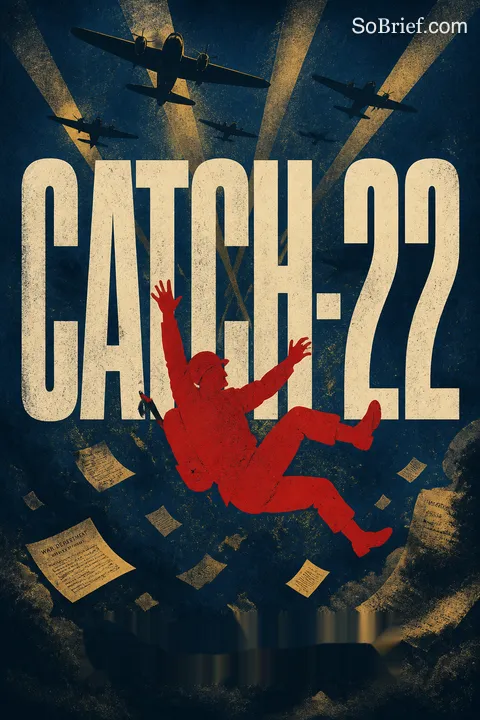


Plot Summary
The Hospital's False Shelter
With a persistent fever and a pain that has already vanished, Captain Yossarian keeps himself in the hospital rather than return to combat. He turns the duty of censoring letters into a private game, blacking out their contents and signing invented names until investigators begin asking questions.
The ward offers its own grotesque education: a cheerful Texan overwhelms the other patients with patriotic opinions, while the silent soldier in white dies without anyone knowing what is inside his bandages.
Yossarian blames the Texan for the death, though the accusation changes nothing. A shy Anabaptist chaplain visits, and Yossarian welcomes his company. When the Texan drives the other patients from the ward, Yossarian's refuge ends and he is sent back to his squadron.
The hospital is not a cure so much as a pocket of suspended obligation. Yossarian manipulates symptoms because the Army's own diagnostic uncertainty gives him a narrow space in which to choose survival. The soldier in white makes that bargain harder to ignore: the ward can conceal death behind clean procedures, but it cannot make death less real. Yossarian's welcome to the chaplain also hints at a need his evasions cannot satisfy. He wants not only to stay alive, but to have someone recognize that his fear has a rational cause.
Clevinger's Trial by Logic
Yossarian returns to a squadron where Colonel Cathcart keeps raising the number of missions needed for discharge, while official rules offer no dependable way out. Doc Daneeka explains that a flyer may be grounded as insane only if he asks to be, but asking proves he understands the danger and is therefore sane enough to keep flying.
Earlier, Clevinger, an earnest student of principles, had challenged an absurd military court at cadet school and been convicted through rules that made every answer incriminating. Later, while flying a routine mission, he vanishes with his plane inside a cloud. Yossarian sees the same machinery in both events: authority can define the charge, the evidence, and the verdict, then call the result orderly.
Clevinger's fate gives Yossarian's suspicion a history. The tribunal does not merely misunderstand a conscientious young man; it converts his effort to reason into proof of guilt. Daneeka's rule extends that logic into combat, making self-preservation evidence against the person seeking it. The two episodes expose an institution that treats procedural consistency as more important than human consequence. Yossarian's distrust is not a general dislike of discipline. It grows from repeated demonstrations that the rules have been designed to preserve authority, not to distinguish the sane from the endangered.
The Bologna Bomb Line
As the squadron waits through rain for orders to bomb Bologna, the men fix their hopes on a red ribbon marking the Allied front. Yossarian quietly shifts it across the city on the map, and the supposed advance cancels the mission for a time. When the bombing is rescheduled, he exploits a faulty intercom to make Kid Sampson turn back with him.
The other planes return safely, and Yossarian briefly believes the danger has passed. It has not. On the next attack, German guns pour flak around the formation, and Yossarian's evasive commands keep McWatt's plane alive. Orr also brings his damaged aircraft down safely at sea. The mission teaches Yossarian that small acts of evasion can buy time, but cannot control the war.
The altered map and the broken intercom are small acts of agency against a system that claims to leave none. Their success is deliberately limited: the map postpones danger, while the false equipment failure saves one crew but not the squadron from returning. Bologna's changing threat also unsettles the usual distinction between courage and cowardice. Yossarian's evasive flying is not a refusal to act; it is skilled action directed toward getting people home. The military can call that dereliction because its measures reward reaching a target, not preserving the lives entrusted to the crew.
A Medal for Ferrara
At Ferrara, Colonel Cathcart's promise to destroy a bridge keeps sending the squadron back after missed attacks. Yossarian makes a second run because he cannot confirm that the target was hit. The bridge falls, but flak destroys Kraft's plane and kills its crew.
Rather than acknowledge that the repeated mission caused their deaths, Cathcart and Colonel Korn recast Yossarian's return as heroism, award him a medal, and promote him to captain.
When General Dreedle presents the decoration, Yossarian stands naked in formation because Snowden's blood has made him refuse his uniform. The commanders accept the spectacle rather than punish him. Their praise and his humiliation arrive together, showing that official honor can cover an outcome no one wants to examine.
Ferrara binds achievement to injury in a way the Army can neatly misreport. Yossarian's accurate second pass completes the target, yet it also exposes how a commander's impatience with failure puts crews at risk. Cathcart and Korn respond by turning a compromised mission into a public success story. Yossarian's nakedness interrupts that performance, but even his refusal becomes a spectacle the officers can absorb. The medal does not restore moral order; it gives the institution a usable account of events and makes Yossarian more valuable as evidence of its supposed competence.
Milo's Profitable War
Milo Minderbinder begins as the squadron's mess officer, intent on improving its meals, then builds a trading network that treats every shortage as an opportunity. His syndicate moves food and goods across borders, claims every participant owns a share, and even arranges contracts with both American and German forces.
At Orvieto, Milo helps organize an American bombing mission while arranging German antiaircraft defense, and a newly arrived pilot dies in the attack.
When Milo's Egyptian cotton gamble leaves him near bankruptcy, his planes bomb the squadron, destroying aircraft and killing men. He survives public outrage by displaying the syndicate's profits and arguing that every soldier has a share. The men accept compensation as justification, and the machinery resumes.
Milo's business is not an interruption of the military system; it is its most candid expression. He turns public resources, military secrecy, and even enemy cooperation into private transactions, then uses shared profit to make responsibility feel communal and therefore difficult to assign. The bombing of his own squadron is the sharpest test. Once Milo shows a ledger that promises everyone a portion, the victims are asked to treat destruction as a successful enterprise. The episode suggests that corruption flourishes not only through greed, but through the comforting belief that benefit can erase the moral meaning of an act.
Snowden's Open Secret
During a mission over Avignon, Dobbs seizes control of the plane and sends it plunging through the flak. Yossarian recovers the intercom, reaches the wounded radio-gunner Snowden, and treats a serious leg injury while the unconscious tail-gunner lies nearby. When Snowden keeps shivering, Yossarian opens the man's flak suit and discovers a devastating wound beneath it.
Snowden dies as Yossarian tries to help. Afterward, Yossarian refuses to wear his uniform, and the sight of his bloodied body at a medal ceremony makes his commanders uneasy without changing their orders. The memory follows him into the hospital, where he begins to regard its controlled deaths as preferable to the sudden, unceremonious deaths outside.
Snowden's death transforms Yossarian's fear from an abstract prediction into bodily knowledge. He has done what a competent soldier is expected to do, yet competence cannot close the wound or make the dying man warm. The hidden injury also punctures the protective appearance of the flak suit: equipment can conceal vulnerability without removing it. Yossarian's later nakedness rejects the uniform's promise that duty makes the body meaningful. His refusal is not a simple protest against clothing; it is a refusal to let military ceremony pretend that the body's exposure to death is honorable or controlled.
Rome's Borrowed Tenderness
On leave in Rome, Yossarian meets Luciana, a lively young woman injured by an American air raid. Her account of the wound unsettles his appetite for casual pleasure, and he falls in love, only to destroy the address she gives him when she leaves. Nately, meanwhile, pours his money and attention into a prostitute who barely notices him.
Her elderly companion mocks Nately's faith in American power and patriotism, while Nately insists that love might give his life direction. After Nately and his friends rescue the exhausted woman from officers who have kept her in a hotel, she sleeps for eighteen hours and wakes with genuine affection for him. Yossarian's brief intimacy ends in regret; Nately's long courtship begins to become mutual.
The Roman relationships expose different defenses against intimacy. Yossarian treats desire as temporary because attachment would make loss harder to survive; destroying Luciana's address is an attempt to keep feeling from becoming obligation. Nately does the opposite, imagining marriage and family before the woman has chosen him. Her eventual affection follows rest and safety, not his wealth or persuasion. That change unsettles the transactional frame around her work without pretending that love can erase poverty. The contrast gives both men a human bond to protect, but only Nately allows his attachment to alter his plans.
A Beach Turns Deadly
McWatt, Yossarian's cheerful pilot, likes to skim his plane over the beach to frighten the men. One pass goes too low: a propeller strikes Kid Sampson on the raft, killing him in front of the swimmers. McWatt circles the airfield, then deliberately flies into a mountain.
Doc Daneeka was listed on the passenger manifest, although he had not boarded; the paperwork nevertheless declares him dead. The Army removes him from its rolls, and his wife receives death benefits while his living husband is left without pay or standing.
Cathcart raises the mission requirement again. Yossarian's friends are disappearing through both physical violence and administrative record, while the same system converts their absence into another reason to keep the survivors flying.
The beach disaster collapses the distance between play and combat. McWatt's easy delight in flight has seemed like a temperamental opposite to Yossarian's fear, but a casual stunt produces an irreversible death. Doc Daneeka's false death then extends the catastrophe into paperwork: a manifest becomes more authoritative than the living person it misidentifies. The juxtaposition is crucial. The institution need not intend every harm to reproduce it; routine records can make an error durable, while command decisions turn loss into pressure on those still alive. Yossarian's world becomes frightening not only because people die, but because reality itself can be overruled by a form.
Dunbar Vanishes
Dunbar tries to make time last by seeking boredom, but the hospital's doctors send him back to combat after he and Yossarian feign symptoms. Later, he protests missions that would destroy an Italian village and drops his bombs well beyond it. The Army eventually removes him from the hospital and the squadron without explanation, as if he had never been there.
The chaplain, meanwhile, resists his assistant Whitcomb's plans to send formulaic condolence letters in Cathcart's name. After a deadly mission, the chaplain is seized and interrogated over forged signatures and a plum tomato, then released without learning what he was accused of. He emerges angrier, less deferential, and more willing to challenge the officers who control the men.
Dunbar's disappearance and the chaplain's interrogation reveal two forms of institutional violence: one removes a troublesome person, the other makes a confused person doubt his own innocence. Dunbar's resistance to bombing a village begins in moral attention to civilians, while the Army reads it as a discipline problem. The chaplain's ordeal similarly turns ordinary facts, such as handwriting and a gift of food, into signs of conspiracy. His change is modest but consequential. He does not become powerful; he becomes less willing to confuse obedience with virtue, and his new willingness to speak gives Yossarian one ally who understands the cost of the rules.
Nately Dies at La Spezia
After Chief White Halfoat dies, Nately seeks a way to remain overseas with the woman he loves. Milo persuades Cathcart to let him fly extra missions on the syndicate's behalf, and Cathcart raises the squadron's quota to eighty.
Nately accepts the assignment rather than return to the States and risk losing his relationship. On a strike against a disabled Italian cruiser at La Spezia, Dobbs mishandles his aircraft and collides with another plane. Both crews fall into the sea, including Nately.
Yossarian receives the news with the chaplain nearby, while the surviving men stand stunned outside the briefing room. Nately's death strips the romance of its fragile future and makes Yossarian's refusal to keep flying feel less like eccentricity than an urgent response to repeated, preventable loss.
Nately's choice is sincere but not free. His desire to stay with the woman he loves makes him vulnerable to a command structure that can turn longing into additional service. Milo's request and Cathcart's quota increase convert private attachment into military labor. Nately's death then destroys the future he was trying to preserve. The episode complicates the language of voluntary sacrifice: he agrees to fly, but his reasons have been shaped by rules that deny him a safe alternative. Yossarian's grief sharpens because the loss is neither heroic nor strategically meaningful. It is the consequence of a quota and a mistake.
Rome Under Catch-22
Yossarian brings Nately's death to the woman he loved, and she attacks him with kitchen knives, blaming him for the loss. After he escapes, he returns to Rome and finds the apartment cleared out under a military crackdown.
The elderly woman there explains that the police invoked Catch-22 to drive the prostitutes into the street without showing them any law. Searching the city for Nately's young sister, Yossarian passes scenes of poverty and violence that make his own safety feel indefensible.
At the officers' apartment, he discovers that Aarfy has raped and killed Michaela, the maid. When military police arrive, they ignore Aarfy's crime and arrest Yossarian for being in Rome without a pass. The law protects the officer and punishes the witness.
Rome turns the abstract Catch-22 into a force applied to the poor: the women are expelled because authorities claim a rule they need not display. Yossarian's attempt to find Nately's sister places him among other vulnerable people whose suffering cannot be reduced to a military target. Aarfy's murder of Michaela is the brutal center of this episode. His confidence that rank and social standing will protect him proves accurate when the police arrest Yossarian instead. The scene exposes a hierarchy in which morality is not merely ignored; it is selectively enforced, with the powerful insulated and the already exposed made answerable.
The Deal and the Knife
Back at Pianosa, Cathcart and Korn offer Yossarian a return home, a promotion, and public praise in exchange for pretending to admire them and keeping other airmen from learning that he refused further missions. Yossarian accepts, reasoning that the other men can resist on their own. Nately's whore then attacks him outside the commanders' office and stabs him.
The officers describe her as a Nazi assassin, turning her grief-driven pursuit into a story that makes Yossarian a hero and their own offer easier to honor. In the hospital, he realizes that the bargain would make him endorse the same deception that has trapped his friends. He tells Major Danby he will not go home on those terms, even if refusing means a court-martial.
The bargain is the novel's sharpest test of Yossarian's self-preservation. It offers safety, but only by converting his refusal into propaganda and isolating him from the men who remain. His initial acceptance is not erased by the later choice; it shows how exhaustion can make complicity look like a reasonable exit. The stabbing gives the officers a convenient false narrative, demonstrating how quickly violence can be repackaged as proof of their virtue. Yossarian's rejection of the deal matters because he no longer treats survival as a private calculation. He refuses to purchase safety by helping the system deceive others.
Orr Rows to Sweden
As Yossarian recovers, he remembers Snowden's hidden wound and learns that Hungry Joe has died in his sleep, with a cat on his face. He understands that nearly every friend he relied on is gone. Then the chaplain brings news that Orr has reached Sweden.
The small pilot's repeated crashes, raft repairs, fishing gear, and practice at ditching were not merely eccentric habits; they prepared him to escape and survive. Yossarian sees that Orr had invited him to learn the same skills, and regrets refusing.
Rather than accept the officers' deal or return to combat, he decides to flee toward Rome and then try to reach Sweden. He also hopes to find Nately's abandoned young sister and protect her. Danby gives him money, and the chaplain helps him get dressed.
Orr's survival changes what Yossarian can imagine, not what he can prove. The Army's version of events has taught him to expect capture, death, or punishment; Orr's deliberate escape supplies a counterexample built from patience and practical preparation. Yossarian's regret is specific: he rejected the companionship that might have taught him how to leave. The final choice is therefore neither triumph nor certainty. He runs toward the possibility of life, carrying grief for the friends already lost and responsibility toward a child he may never find. The chaplain and Danby help not by defeating the institution, but by refusing to obstruct one man's escape.
Analysis
Catch-22 portrays bureaucracy not as a dull background to violence but as one of its operating mechanisms. Mission quotas turn time into a weapon: the men cannot know when their service will end, and each apparent finish can be moved farther away. The absurd logic is funny because it is precise, but its precision protects decision-makers from responsibility. When Yossarian asks to be grounded, the rule makes his fear proof that he is fit to fly. When Doc Daneeka is misrecorded as dead, paper defeats the body. The novel's comedy repeatedly exposes this gap between an official account and the consequences people endure.
Its characters respond to that gap in incompatible ways. Clevinger trusts that argument can correct injustice; Milo trusts that shared profit can justify almost anything; Cathcart converts casualties into career evidence; Danby tries to preserve ideals by looking away from the men who betray them. Yossarian begins with evasions designed to save himself, but each death narrows the space in which survival can feel morally neutral. Snowden's concealed wound makes vulnerability literal, while Nately's death and the destruction of Michaela's life show how power protects some people and abandons others. Yossarian's final flight is not a victory over the system. It is a refusal to let the system define courage as obedience, or responsibility as dying on command.
The novel also distrusts easy consolations. Patriotism, religion, commerce, and military honor can all be recruited to bless actions that injure actual people. Yet the ending does not reduce hope to foolishness. Orr's escape gives Yossarian evidence that practical intelligence and persistence can open a way out. The path is uncertain, and his friends are mostly gone, but he chooses a responsibility that points toward life rather than toward the institution's appetite for more sacrifice.
Review Summary
Catch-22 is a satirical, anti-war novel that has deeply affected readers with its dark humor and portrayal of the absurdities of war and bureaucracy. Many praise its non-linear structure, memorable characters, and thought-provoking themes. Some find it repetitive or difficult to follow, but most consider it a masterpiece of 20th-century literature. The book's title has become a common phrase in English, referring to paradoxical situations. Readers often describe the novel as both hilarious and heartbreaking, with its impact growing stronger over time.
People Also Read







Characters
Yossarian
The wary bombardierA bombardier in an Army Air Forces squadron, Yossarian measures every order against the immediate possibility of being killed. His fear is intense, but it is also perceptive: he notices when leaders turn danger into career advancement and when official explanations contradict what he has seen. He relies on irony, sexual detachment, malingering, and evasive flying to keep control over a life the Army treats as a resource. Beneath those defenses, he is capable of tenderness and moral concern, especially when friends suffer or civilians are endangered. His central struggle is not simply whether to obey, but whether survival can remain honorable when institutions demand that he help disguise their harms.
Chaplain Tappman
The uncertain ministerAn Anabaptist chaplain serving a large, unfamiliar military group, Tappman is quiet, conscientious, and prone to doubting his own judgment. He misses his wife and children, worries about whether his faith can withstand the evidence around him, and often mistakes timidity for moral failure. His conversations with Yossarian give him a rare friendship in which he is treated as a person rather than a religious function. Tappman wants to comfort soldiers, but his discomfort with conflict makes him easy for officers and his ambitious assistant to manipulate. His story explores how compassion can persist even when certainty and institutional respectability have failed.
Milo Minderbinder
The syndicate's salesmanMilo begins as a diligent mess officer who sincerely wants to feed the squadron well. His talent for trade expands into an international syndicate that treats military access, public money, and enemy contracts as ordinary business opportunities. He believes shared ownership makes nearly any transaction legitimate, even when his schemes injure the men he serves. Milo is not driven by simple malice; he is a devoted entrepreneur whose moral vocabulary has been reshaped by profit. He can show loyalty to Yossarian while simultaneously asking him to accept dangers for the syndicate. That contradiction makes him both charming and alarming.
Nately
The devoted young pilotA wealthy, courteous young pilot, Nately has been raised to trust in family, country, and respectable social order. His attachment to a Roman prostitute unsettles those assumptions: he loves her even when she ignores him, spends beyond his means, and refuses to treat her work as proof that she lacks dignity. Nately is earnest rather than calculating, and his romantic imagination can make him blind to the power imbalance between them. His friendship with Yossarian gives the novel one of its gentler bonds. He represents a young man trying to reconcile inherited ideals with the complicated people he encounters in wartime.
Orr
The resourceful oddballYossarian's small, inventive tentmate, Orr spends hours repairing valves, building a stove, and improving their shelter. His strange anecdotes and mischievous grin make it easy to dismiss him as a fool, but he is observant, mechanically gifted, and exceptionally capable in a crisis. Orr rarely explains himself directly, preferring practical experiments and jokes that conceal what he knows. His relationship with Yossarian is affectionate but strained by Yossarian's impatience and fear of flying with him. Orr's quiet competence challenges the squadron's habit of confusing conventional seriousness with intelligence.
Colonel Cathcart
The promotion-seeking commanderCathcart commands the bombing group and continually searches for visible achievements that might earn him a general's star. He raises mission quotas, volunteers his men for dangerous targets, and worries about how each decision will look to superiors. His ambition is tangled with insecurity, so he alternates between bravado and panic. He can recognize a useful public-relations opportunity faster than he recognizes the cost paid by his airmen.
Colonel Korn
The cynical strategistCathcart's clever aide, Korn designs schemes that help his commander advance while keeping himself near power. He understands the group's regulations and knows how to make them serve a chosen outcome. His dry humor and apparent candor can make him seem more reasonable than Cathcart, but he is equally willing to sacrifice airmen's safety to protect their careers. Korn treats honesty as one more instrument to deploy selectively.
Clevinger
The earnest questionerA brilliant, idealistic cadet and later airman, Clevinger trusts reason, education, and the possibility that institutions can be persuaded by sound argument. He wants to defend principles and understand the war, yet his confidence makes him slow to recognize when authority is not debating in good faith. His debates with Yossarian reveal the distance between abstract duty and the danger faced by individual soldiers.
Dunbar
The time-stretching skepticDunbar tries to make life feel longer by seeking boredom and discomfort, a strategy that suits his skeptical view of military routine. He is Yossarian's ally in questioning patriotic slogans and the logic of dangerous missions. His dry humor masks a serious concern with how quickly life can be taken away. Dunbar's resistance becomes more openly moral when orders threaten civilians.
Doc Daneeka
The self-protective doctorThe squadron flight surgeon fears airplanes, resents military service, and measures his responsibilities against his longing for a safer, more profitable civilian life. Though he understands the rules well enough to explain why Yossarian cannot be grounded, he is reluctant to risk his own position to help him. His self-pity is comic, but it also reveals how an institution turns even its medical staff toward protecting themselves first.
Nately's whore
The guarded Roman loverA Roman prostitute, she initially regards Nately as another serviceman paying for her time. Her indifference is not a puzzle for him to solve but a boundary shaped by work, exhaustion, and limited choices. Nately's persistent attention eventually meets a warmer response, though she does not surrender her independence or accept his plans without resistance. Her fierce attachment to her younger sister helps define what she values beyond the men who come and go.
Aarfy
The complacent navigatorAarfy is a friendly, pipe-smoking navigator whose confidence survives even when he loses his way or fails to understand danger. He treats social status and fraternity connections as guarantees of safety. His genial manner conceals an alarming inability to recognize other people's vulnerability, particularly when women are concerned. Yossarian repeatedly expects Aarfy's apparent harmlessness to mean something it does not.
McWatt
The fearless pilotYossarian's pilot is cheerful, competent, and seemingly comfortable with the risks of flight. His habit of buzzing the camp and beach is meant as play, but it reveals how differently he experiences danger from Yossarian. McWatt's ease makes him a valued friend and, at times, a source of terror to the man in his bombardier's seat.
Major Major Major Major
The inaccessible commanderA lonely, awkward squadron commander promoted through an administrative mistake, Major Major longs for ordinary companionship but finds that rank makes others avoid him. His attempts to withdraw from attention become a private system of windows, closed doors, and carefully timed absences. He is neither a strong leader nor a schemer; he is a timid man whose isolation grows when military authority is placed on him without regard for his temperament.
Hungry Joe
The sleepless photographerA combat veteran who repeatedly packs for home, Hungry Joe suffers nightmares whenever he is taken off flying status. He is also a frantic amateur photographer whose pictures of women never turn out. His shifting terror exposes how waiting for safety can become its own punishment.
Dobbs
The desperate co-pilotA frightened pilot who knows he is unfit to fly, Dobbs asks Yossarian to join a plot against Cathcart. His panic makes him both dangerous in the air and desperate for another person's permission to act. He wants escape but struggles to take responsibility for the choice.
Chief White Halfoat
The bitter flight surgeon's roommateA Creek Indian assigned to intelligence, White Halfoat tells a bitterly comic story of oil companies repeatedly driving his family from its land. He distrusts white authority and uses threats, drinking, and jokes to keep others uneasy. His anger carries the history of displacement into the squadron's daily life.
Major Danby
The cautious idealistThe group's operations officer, Danby believes that doing one's assigned job is a meaningful contribution to the war. He is gentle, nervous, and uncomfortable with confrontation, yet he listens closely to Yossarian's objections. His difficulty is not a lack of conscience but a habit of trusting large causes more than the people managing them.
Nurse Duckett
The independent nurseA capable hospital nurse, Duckett is self-possessed and quick to act in a crisis. Her relationship with Yossarian offers him physical comfort, though she does not share his view of the world or promise him lasting commitment. She is a person with her own plans, not merely a refuge from combat.
General Peckem
The polished bureaucratPeckem is an ambitious general who values administrative influence, elegant language, and the appearance of organization. He competes with General Dreedle for control, treating combat operations as another jurisdiction to acquire. His self-image as a sophisticated realist blinds him to how little his abstractions resemble the lives of airmen.
General Scheisskopf
The parade enthusiastScheisskopf is an ambitious officer whose passion for perfect marching formations begins in cadet school. He prizes visible coordination and obedience, often more than the purpose behind either. His rise shows how a narrow talent can become institutional power when it matches what superiors reward.
Mudd
The unrecorded replacementMudd is a newly arrived pilot killed before he can officially report to his squadron. Because the paperwork never registers his arrival, his belongings remain in Yossarian's tent and the Army cannot properly record his departure. His absence becomes a stubborn reminder that bureaucracy can make a person disappear before anyone has learned his name.
Corporal Whitcomb
The ambitious assistantThe chaplain's atheist assistant believes he could run the religious office more effectively than his superior. He pushes plans for mass mailings and public recognition, regarding the chaplain's restraint as incompetence. Whitcomb's ambition makes compassion vulnerable to the same careerism that shapes the command structure.
Major de Coverley
The imposing executiveA grave, white-haired executive officer, de Coverley commands respect without explaining himself. He rents apartments for servicemen on leave, arranges local labor, and pitches horseshoes with equal authority. His presence unsettles officers who cannot tell whether he is powerful, eccentric, or both.
Nately's kid sister
The vulnerable younger sisterThe young sister of Nately's Roman lover is often underfoot in the crowded apartment where the women work and live. She imitates the adults around her without fully understanding their world. Her dependence on her older sister makes her especially vulnerable when the authorities scatter the household.
Plot Devices
Catch-22
The self-sealing ruleCatch-22 is the name attached to rules that make refusal impossible while pretending to offer a choice. A flier can be grounded for insanity only by asking to be grounded, but asking proves he is rational; elsewhere, military police invoke the rule to remove women without showing them its text. The device changes shape as circumstances require, which is precisely its power. It does not need a stable written definition if officers and soldiers accept that it governs them. Its function is to expose how circular reasoning can become practical force.
Mission quotas
The moving finish lineColonel Cathcart repeatedly increases the number of combat missions required for a tour of duty. Men who near completion are returned to danger, and even those who have met the quota remain subject to new orders. The shifting threshold prevents service from having a dependable endpoint. It also lets Cathcart advertise his group as unusually committed while transferring the cost of his ambition to aircrews. The quota turns a measure of duty into a mechanism for extending exposure.
M&M Enterprises
Profit without allegianceMilo's syndicate uses military planes, mess funds, and international trade routes to buy and sell goods across national boundaries. Its claim that every participant owns a share blurs the difference between private gain and collective benefit. The business logic eventually reaches beyond food and includes contracts involving enemy forces and military targets. As a plot device, the syndicate makes the novel's comic economic absurdities consequential: decisions made for profit place soldiers, aircraft, and public resources at risk.
The hospital
A temporary escape hatchYossarian repeatedly uses the hospital to avoid combat, exploiting vague symptoms and the doctors' inability to settle on a diagnosis. The ward initially seems safer because its patients are removed from missions and its routines make danger feel manageable. Yet the soldier in white, the Army's return orders, and Yossarian's later wound show that the hospital cannot remain outside the war. It functions as both refuge and contrast, revealing how much Yossarian longs for a space where no one expects him to risk his life.
Official reports
Reality by paperworkReports, manifests, orders, and signatures repeatedly overrule what characters know firsthand. Doc Daneeka is recorded as dead despite being alive on the ground, and Yossarian's attack becomes a story about stopping an enemy assassin. Major Major forges names to escape a stream of documents, while investigators turn handwriting and trivial objects into evidence. These papers do not simply record the story. They determine who can be paid, punished, believed, or recognized as present.
FAQ
Synopsis & Basic Details
What is Catch-22 about?
- War's Absurdity Explored: Catch-22 follows Yossarian, a bombardier in World War II, as he desperately tries to avoid combat missions. The novel satirizes the illogical and dehumanizing nature of war and military bureaucracy.
- Bureaucracy's Illogical Grip: The story showcases the paradoxical "Catch-22" rule, which traps soldiers in a no-win situation, highlighting the absurdity of military regulations and the futility of trying to reason with them.
- Individual vs. System: The narrative focuses on Yossarian's struggle to maintain his sanity and self-preservation in a system that prioritizes rules and procedures over human life, exploring themes of survival and resistance.
Why should I read Catch-22?
- Satirical Masterpiece: Catch-22 is a brilliant satire that uses dark humor and irony to critique war, bureaucracy, and the human condition, offering a unique and thought-provoking reading experience.
- Timeless Relevance: The novel's themes of individual struggle against oppressive systems, the absurdity of war, and the dangers of unchecked power remain relevant today, making it a powerful and insightful read.
- Unique Narrative Style: Joseph Heller's distinctive writing style, characterized by non-linear storytelling, repetition, and circular logic, creates a captivating and immersive experience that challenges conventional narrative structures.
What is the background of Catch-22?
- World War II Setting: The novel is set during World War II on the fictional island of Pianosa, providing a backdrop of intense conflict and danger that underscores the absurdity of the characters' situations.
- Satire of Military Bureaucracy: Heller draws from his own experiences as a bombardier in World War II to satirize the illogical and dehumanizing aspects of military bureaucracy, exposing its flaws and contradictions.
- Cultural Critique: Beyond the military, Catch-22 critiques broader societal structures, including capitalism, patriotism, and the blind acceptance of authority, reflecting the cultural anxieties of the post-war era.
What are the most memorable quotes in Catch-22?
- "There was only one catch and that was Catch-22.": This quote defines the central paradox of the novel, encapsulating the illogical and inescapable nature of the military system, highlighting the theme of bureaucratic absurdity.
- "They're trying to kill me," Yossarian told him calmly.": This quote reveals Yossarian's core motivation and his clear understanding of the danger he faces, emphasizing his struggle for survival against a hostile system.
- "The enemy is anybody who's going to get you killed, no matter which side he's on.": This quote encapsulates the novel's anti-war sentiment, highlighting the futility of the conflict and the arbitrary nature of who is considered the enemy, challenging traditional notions of patriotism.
What writing style, narrative choices, and literary techniques does Joseph Heller use?
- Non-Linear Narrative: Heller employs a non-linear narrative structure, jumping between different time periods and perspectives, creating a sense of disorientation and mirroring the chaotic nature of war.
- Satire and Irony: The novel is filled with satire and irony, using dark humor to expose the absurdity of war and military bureaucracy, making the reader question the logic of the characters' situations.
- Repetition and Circular Logic: Heller uses repetition of phrases, events, and character interactions, creating a sense of circular logic that reflects the inescapable nature of Catch-22 and the characters' trapped circumstances.
Hidden Details & Subtle Connections
What are some minor details that add significant meaning?
- The Soldier in White: The recurring image of the soldier in white, completely encased in plaster, symbolizes the dehumanizing effects of war and the loss of individuality, highlighting the theme of mortality.
- The Censored Letters: Yossarian's creative censoring of letters, often removing more than he leaves, represents the absurdity of censorship and the futility of trying to control information, reflecting the theme of manipulation.
- The Constant Increase in Missions: The arbitrary and relentless increase in the number of missions required to go home underscores the illogical nature of the military system and the characters' hopeless situation, emphasizing the theme of bureaucratic absurdity.
What are some subtle foreshadowing and callbacks?
- Orr's Eccentric Behavior: Orr's seemingly nonsensical actions, like collecting apple cores, foreshadow his ingenious escape plan, revealing his resourcefulness and challenging initial perceptions of his character.
- The Old Man in Rome's Wisdom: The old man's cynical views on patriotism and the transience of nations foreshadow Yossarian's eventual decision to desert, highlighting the theme of individual resistance.
- Milo's Expanding Syndicate: The gradual expansion of Milo's syndicate, starting with simple trades and escalating to international deals, foreshadows the corrupting influence of capitalism and the moral ambiguities of war profiteering.
What are some unexpected character connections?
- Yossarian and Orr's Shared Tent: The close proximity of Yossarian and Orr, despite their seemingly different personalities, highlights the importance of unlikely connections and the potential for hidden strengths, emphasizing the theme of hope.
- Chaplain and Yossarian's Moral Alignment: The chaplain's growing disillusionment with the military and his eventual act of defiance mirrors Yossarian's own moral journey, revealing a shared sense of integrity and resistance.
- Nately and the Old Man's Philosophical Clash: Nately's idealistic views are directly challenged by the old man's cynicism, creating a philosophical debate that underscores the novel's exploration of war's underlying absurdities.
Who are the most significant supporting characters?
- Milo Minderbinder: Milo's character embodies the corrupting influence of capitalism and the moral ambiguities of war profiteering, serving as a critique of unchecked ambition and the commodification of war.
- Chaplain Tappman: The chaplain's crisis of faith and eventual act of defiance highlight the struggle for meaning in a senseless world, representing the potential for spiritual and moral resistance.
- Orr: Orr's seemingly eccentric behavior and eventual escape serve as a symbol of hope and ingenuity, inspiring Yossarian and demonstrating the power of individual agency.
Psychological, Emotional, & Relational Analysis
What are some unspoken motivations of the characters?
- Yossarian's Fear of Death: Yossarian's primary motivation is his deep-seated fear of death, driving his desperate attempts to avoid combat and highlighting the theme of survival.
- Colonel Cathcart's Ambition: Colonel Cathcart's unspoken motivation is his relentless pursuit of promotion, leading him to manipulate mission counts and prioritize personal gain over the well-being of his men.
- Milo's Greed: Milo's actions are driven by an insatiable greed, leading him to exploit the war for personal profit and highlighting the corrupting influence of unchecked capitalism.
What psychological complexities do the characters exhibit?
- Yossarian's Paranoia: Yossarian's paranoia, stemming from the constant threat of death, reflects the psychological toll of war and the breakdown of trust in a hostile environment.
- Clevinger's Cognitive Dissonance: Clevinger's inability to reconcile his idealistic beliefs with the reality of war highlights the psychological strain of cognitive dissonance and the struggle to maintain faith in a senseless system.
- Chaplain's Existential Crisis: The chaplain's crisis of faith reflects the psychological impact of war on spiritual beliefs and the search for meaning in a seemingly meaningless world.
What are the major emotional turning points?
- Orr's Escape: Orr's successful escape to Sweden is a major turning point for Yossarian, shifting his focus from passive survival to active resistance and inspiring hope for a better future.
- Yossarian's Bargain: The offer of a deal by Colonels Cathcart and Korn forces Yossarian to confront his moral principles and the corrupt nature of the military system, leading to his decision to desert.
- The Chaplain's Defiance: The chaplain's act of defiance against the military, inspired by Orr's escape, marks a turning point in his spiritual journey and his commitment to moral courage.
How do relationship dynamics evolve?
- Yossarian and the Chaplain: The relationship between Yossarian and the chaplain evolves from one of mutual skepticism to a shared sense of moral purpose, highlighting the importance of unlikely alliances.
- Yossarian and Orr: The dynamic between Yossarian and Orr shifts from one of confusion to admiration, as Yossarian comes to understand the ingenuity behind Orr's seemingly eccentric behavior.
- Yossarian and the Military Hierarchy: Yossarian's relationship with the military hierarchy deteriorates from one of reluctant compliance to outright defiance, reflecting his growing disillusionment with the system.
Interpretation & Debate
Which parts of the story remain ambiguous or open-ended?
- The Nature of Catch-22: The exact nature of Catch-22 remains ambiguous, representing the illogical and inescapable nature of bureaucratic systems and the futility of trying to understand them.
- The Fate of Some Characters: The fates of some characters, such as Nately and Clevinger, are left ambiguous, highlighting the arbitrary nature of war and the uncertainty of life in a chaotic world.
- The Meaning of Yossarian's Escape: The ultimate meaning of Yossarian's escape to Sweden is open to interpretation, representing both a personal triumph and a rejection of the corrupt system, leaving the reader to ponder the true nature of freedom.
What are some debatable, controversial scenes or moments in Catch-22?
- Milo's Profiteering: Milo's actions, while presented satirically, raise questions about the ethics of war profiteering and the moral compromises made in the pursuit of personal gain, sparking debate about the nature of capitalism.
- The Treatment of Women: The portrayal of women in the novel, often as objects of desire or victims of circumstance, has been criticized for its lack of depth and its reinforcement of gender stereotypes, leading to discussions about the novel's social commentary.
- The Ending's Ambiguity: The ending, with Yossarian's escape to Sweden, is open to interpretation, sparking debate about whether it represents a true victory or simply a different form of escape, highlighting the novel's complex themes.
Catch-22 Ending Explained: How It Ends & What It Means
- Yossarian's Desertion: Yossarian chooses to desert the military and flee to Sweden, rejecting the corrupt bargain offered by Colonels Cathcart and Korn, symbolizing his commitment to personal integrity and freedom.
- Rejection of False Choices: Yossarian's decision represents a rejection of the false choices presented by the military, highlighting the theme of individual resistance against oppressive systems and the pursuit of genuine autonomy.
- Hope for a Better Future: While the ending is not a traditional happy ending, it offers a glimmer of hope for a better future, suggesting that individual acts of defiance can lead to personal liberation and a rejection of the absurdities of war.
Catch-22 Series
Download PDF
Download EPUB
.epub digital book format is ideal for reading ebooks on phones, tablets, and e-readers.








