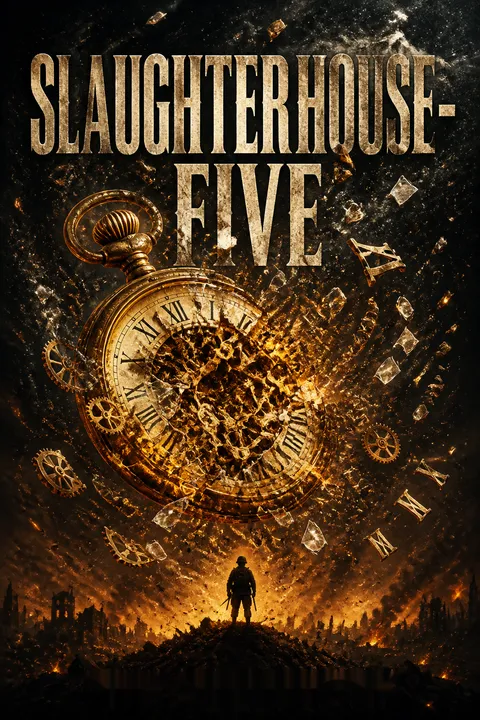


Plot Summary
The Children's Crusade
The narrator has spent years trying to write about Dresden, where he was a young American prisoner of war. When he visits fellow veteran Bernard O'Hare, O'Hare's wife, Mary, objects to the way books and films turn young soldiers into glamorous heroes. Such stories, she fears, make future wars easier to sell.
The narrator accepts her challenge and imagines a book about children sent into a slaughter they cannot understand. His difficulty is not a lack of memories but the mismatch between mass death and the neat plots that make violence entertaining. The frame begins with a promise: this account will keep the soldiers young, frightened, and powerless, rather than dress them up as willing champions.
Mary's objection supplies the book's ethical test. A conventional war story can make courage and victory feel like rewards, even when its soldiers are barely beyond childhood. The narrator's promise to Mary is therefore more than a change of tone: it refuses the emotional machinery that turns suffering into spectacle. His struggle to shape Dresden into a story also anticipates Billy's difficulty living within ordinary sequence. Both men face events too large to master, and both reach for forms that can hold fragments without pretending to explain them.
A Chaplain's Assistant
Billy Pilgrim enters the European war as an unarmed chaplain's assistant, awkward, cold, and without the instincts his fellow soldiers depend on. After his regiment is shattered during the Battle of the Bulge, he wanders behind German lines with Roland Weary and two scouts. Weary keeps him moving by force, then invents a heroic tale in which the men form a unit called the Three Musketeers.
In the forest, Billy's attention begins slipping unpredictably among different moments in his life. When the scouts abandon Billy and Weary, German soldiers find them just as Weary is about to attack Billy. The scouts are later shot, while the two remaining Americans are disarmed and taken prisoner.
Billy's passivity is not presented as a hidden form of heroism. He lacks weapons, training, and even a settled desire to survive, while Weary invents a heroic identity to cover his fear of being discarded. Their encounter exposes how easily violence can masquerade as care: Weary does keep Billy alive, but he does so through coercion and demands gratitude in return. Billy's first temporal dislocation arrives amid this confusion, making time itself resemble another force he cannot command.
Nine Days in the Boxcar
The captured Americans are packed into railcars bound for Germany. Weary's injured feet become gangrenous, and as he dies he repeatedly identifies Billy as the person responsible. Paul Lazzaro, a small, spiteful prisoner in the same train, hears the accusation and promises to avenge Weary after the war.
Billy reaches a camp crowded with starving prisoners, including Russians, before the Americans are housed with British officers. A Red Cross feast leaves the already weakened men violently ill; Billy collapses and is cared for by Edgar Derby, an older high-school teacher.
Once the Americans recover enough to move, Derby is elected their representative. The British tell them that their next assignment is Dresden, a city described as safe from attack.
The boxcar turns blame into a portable weapon. Weary needs a story in which his suffering has a culprit, and Lazzaro converts that story into a long-term promise of retaliation. Neither man can alter the conditions that injure them, so they fasten agency onto Billy instead. Derby offers a contrasting response: he accepts responsibility for the group and imagines getting everyone home. His steadiness matters, but the prisoners' destination shows how little influence decency can exert over the machinery moving them.
Dresden's Last Bright Days
Billy, Derby, and the other prisoners arrive in Dresden and are lodged in Slaughterhouse-Five. The city is still intact, its streets filled with workers and its buildings untouched by the raids that have devastated other German cities.
Billy and Derby are assigned to labor that includes cleaning and packing malt syrup intended for pregnant women. Hungry prisoners secretly taste it, and Billy eventually shares a spoonful with Derby. Howard Campbell, an American who has joined the Nazis, visits to recruit prisoners into a German unit.
Derby rejects Campbell's appeal and defends the ideals he believes America represents. That night, air-raid sirens send the prisoners and guards into a meat locker beneath the slaughterhouse. The shelter protects them as incendiary bombs turn Dresden into a citywide firestorm.
The syrup and the shelter bring bodily need into the same frame as political conviction. Billy and Derby steal food because hunger has narrowed life to immediate survival; Derby, by contrast, still finds room to defend ideals when Campbell offers food in exchange for collaboration. Neither gesture changes the coming raid. The city's supposed safety proves to be a fragile administrative description, not protection. By placing prisoners, guards, and animals together underground, the novel strips war's moral categories down to shared vulnerability.
The City Becomes Ash
The prisoners emerge after the raid to find Dresden burned and its streets reduced to unstable heaps of stone. American planes fire on people moving through the ruins, and the survivors search for food and shelter in a landscape where almost everyone has vanished.
Prisoners are then ordered to excavate bodies from collapsed shelters. When the bodies begin to decay, soldiers burn them in place with flamethrowers. During this work, Derby is caught with a teapot taken from the ruins.
The authorities give him a formal trial and execute him for plundering, although the city around him has been destroyed and its dead cannot be counted. In spring, the war ends in Europe; the prisoners discover their compound open and walk out into the quiet streets.
Derby's execution compresses the book's central absurdity into one concrete punishment. The destruction of Dresden produces no comparable trial for the people who ordered or carried out the bombing, while a survivor is processed for taking a teapot. The ceremony of justice remains intact where the larger moral order has collapsed. The corpse excavations also deny the comforting distance between combat and consequence: survivors must work directly among the bodies. Liberation comes, but it cannot restore the city or make its accounting fair.
A Life in Separate Moments
After the war, Billy returns to optometry school but suffers a breakdown and enters a veterans' hospital. There he befriends Eliot Rosewater, whose science-fiction books give them both a way to imagine realities beyond the damage they carry. Billy marries Valencia Merble, becomes a prosperous optometrist, and raises Barbara and Robert.
He later says that, on the night of Barbara's wedding, aliens from Tralfamadore abducted him and placed him in a zoo with Montana Wildhack, a movie star taken from Earth as his mate. Billy describes the Tralfamadorians as seeing every moment at once, with the past and future as permanent as the present. Their view gives him a language for death, though it also leaves little room for choice or prevention.
Billy's success does not erase his vulnerability; it gives it a respectable public setting. He becomes wealthy and builds a family, yet his private account of time refuses the usual story of progress, where the past is settled and the future remains open. Rosewater's science fiction helps Billy imagine alternatives when ordinary explanations feel inadequate. The Tralfamadorian model offers relief from grief by making every moment permanent, but that relief has a cost: if outcomes already exist, responsibility can begin to look as impossible as changing them.
The Crash and the Broadcast
In 1968, Billy survives a plane crash in Vermont with a severe head injury. Valencia rushes to the hospital, but her damaged car fills with exhaust fumes; she dies of carbon-monoxide poisoning before reaching him.
Their daughter Barbara takes charge of Billy's care, while their son Robert returns from Vietnam decorated and disciplined after a troubled youth. During recovery, Billy shares a hospital room with Air Force historian Bertram Rumfoord, who initially dismisses his account of having witnessed Dresden.
Billy eventually makes Rumfoord acknowledge that he was there. After returning home, Billy resumes work briefly, tells a young patient that the dead remain alive in other moments, and then goes to New York to broadcast his claims about Tralfamadore and time.
The crash gathers Billy's private losses into a single rupture: physical injury, Valencia's death, and Barbara's forced assumption of adult responsibility. Robert's return from Vietnam makes the family story touch another war, one Billy cannot prevent or even bring himself to challenge publicly. Rumfoord's reluctance to hear him reveals how institutions protect a usable history by treating witnesses as inconvenient. Billy's broadcast is an attempt to turn his experience into comfort for others, but its certainty may soothe grief by narrowing the space for action.
The Bird After Dresden
Billy says that Lazzaro's revenge will eventually reach him. In his account of the future, he is assassinated in Chicago in 1976 while speaking to a crowd about time and flying saucers; he treats the event as another moment that cannot be changed. The narrator's frame then returns to Dresden, which he visited with O'Hare in 1967.
Their taxi driver takes them to the former slaughterhouse, while the narrator reflects on the city's destruction and the human remains beneath it. The book closes by returning to 1945: the war is over, the prisoners are free, and Billy stands in a quiet, damaged landscape. A bird's brief, unanswered sound is all that follows the account.
Billy's predicted death fulfils the logic of Lazzaro's promise while withholding the suspense usually built around revenge. Billy does not try to defeat the future; he treats it as one scene among many. The narrator's return to Dresden supplies a different kind of witness, grounded in streets, bones, and a place that still carries the event. Ending with a bird rather than a verdict refuses to convert the massacre into a lesson neatly completed. The silence that follows leaves the reader with the limits of explanation, not permission to forget.
Analysis
Slaughterhouse-Five tests what a story can honestly do after mass violence. Its fragmented chronology refuses the reassuring sequence in which a crisis is explained, overcome, and safely left behind. Billy's jumps make the past recur as lived experience, while the narrator's frame admits that recollection is incomplete and that a polished plot can falsify the emotional scale of war. The Tralfamadorian view offers a psychological shelter: if every moment remains, death cannot erase a life. Yet that shelter risks turning preventable violence into inevitability. The book keeps this tension unresolved. Billy's calm is neither simple wisdom nor a cure; it may be the only way he can continue, but it cannot restore Dresden or protect another generation from war. Derby's execution sharpens the problem by showing that institutions can preserve procedure while abandoning proportion. The book's final bird does not explain the ruins. Its small sound marks the inadequacy of explanation and leaves the reader responsible for looking at what remains.
Review Summary
Slaughterhouse-Five is a unique, postmodern anti-war novel that blends science fiction with dark humor and satire. Readers appreciate Vonnegut's innovative storytelling, fractured narrative structure, and thought-provoking themes. The book's exploration of time, free will, and the human experience resonates with many, while some find the style challenging. Vonnegut's personal experiences during World War II, particularly the Dresden bombing, inform the narrative. Despite its occasional controversy, Slaughterhouse-Five is widely regarded as a classic of 20th-century literature.
People Also Read


Characters
Billy Pilgrim
The time-lost optometristBilly is a tall, mild-mannered optometrist who served in Europe as an unarmed chaplain's assistant. He is poorly suited to military expectations and rarely meets danger with aggression. After the war he builds a successful practice, marries Valencia, and raises two children, yet remains emotionally distant from ordinary explanations of suffering. Billy describes himself as moving among moments of his life without control and uses his account of Tralfamadore to make death and loss bearable. His passivity can look like serenity, but it also protects him from confronting what might be changed.
The narrator
Dresden's uneasy witnessThe narrator is a former American prisoner of war who witnessed Dresden's destruction and later tries to write about it. His bond with Bernard O'Hare gives him access to shared memories, but his account is shaped by gaps, repetition, and discomfort with conventional storytelling. Mary O'Hare's challenge forces him to consider how war fiction can make young soldiers seem eager and heroic. He writes as a witness who knows that surviving an event does not mean possessing a complete explanation for it.
Bernard O'Hare
Billy's war-worn companionO'Hare served alongside the narrator as an infantry scout and was captured with him. In later life he is a district attorney and a reluctant partner in revisiting memories of the war. He remembers little and does not share the narrator's appetite for turning their experience into a structured story. His presence anchors the frame in a friendship shaped by what both men endured, rather than by a polished account of combat.
Mary O'Hare
Antiwar moral challengerMary is O'Hare's wife and a trained nurse. She sees how romantic depictions of war can make violence attractive, especially when they cast young soldiers as seasoned heroes. Her anger is protective rather than abstract: she fears for the children who may be sent into future wars. By challenging the narrator's assumptions, Mary changes the book he intends to write and gives its title the force of an ethical promise.
Roland Weary
Self-appointed war heroWeary is an eighteen-year-old replacement soldier who carries an arsenal of equipment and a fantasy of heroic brotherhood. Repeated rejection has made him desperate to control the story of who belongs with him. He keeps Billy moving through the forest, but his help is mixed with bullying and demands for admiration. His invented identity as a member of the Three Musketeers reveals a young man trying to turn fear and loneliness into a role he can defend.
Edgar Derby
Teacher with civic faithDerby is an older high-school teacher who entered the Army late and believes that maturity can make him useful to younger men. He takes responsibility for fellow prisoners and retains faith in American principles even in a camp where hunger and exhaustion dominate. His steadiness contrasts with Billy's withdrawal and Weary's theatrical bravado. Derby's instinct is to keep caring for people and to preserve a moral language when the surrounding circumstances make it difficult to use.
Paul Lazzaro
Revenge-obsessed prisonerLazzaro is a small, sickly car thief whose idea of justice is personal retaliation. He treats an injury as proof that someone has crossed him and imagines revenge as the clearest pleasure available. His loyalty to Weary gives him a target in Billy, while his elaborate threats reveal how much he values control over other people. Lazzaro's worldview is the brutal inverse of Billy's fatalism: he cannot change the past, so he tries to make someone pay for it.
Valencia Merble
Devoted optometrist's wifeValencia is Billy's wealthy wife and the daughter of the owner of the Ilium School of Optometry. She loves Billy with an intensity he does not always know how to answer, and she helps build the domestic life around his career. Her attachment is expressed through practical loyalty as much as romance. She wants security and closeness, while Billy often retreats into silence, memory, or his private account of time.
Montana Wildhack
Fellow captive and performerMontana is a young film actress whom Billy says the Tralfamadorians bring to the zoo as his mate. She enters the experience frightened and exposed, then gradually forms a trusting relationship with Billy. Her identity as a performer makes her familiar with being watched, but not with being deprived of choice. Within Billy's account, she becomes a companion whose needs and presence make the alien enclosure feel more like a shared domestic life.
Eliot Rosewater
Science-fiction confidantRosewater is a former army captain whom Billy meets in a veterans' hospital. Haunted by his own wartime actions, he has grown tired of using alcohol to blunt his distress. He shares Billy's sense that familiar moral explanations no longer suffice and introduces him to science fiction, especially the neglected writer Kilgore Trout. Rosewater's books do not solve their problems, but they give the two men imagined worlds in which different explanations can be tested.
Kilgore Trout
Ilium's unrecognized novelistTrout is a prolific science-fiction writer whose books attract almost no recognition. To support himself, he manages newspaper delivery boys in Ilium, a job that leaves him bitter and defensive. Billy recognizes Trout's writing and treats him as a real author, briefly giving him an audience. Trout's strange plots repeatedly turn on technology, power, and the stories people tell to justify suffering, even when his own life offers little evidence that anyone is listening.
Howard W. Campbell Jr.
Nazi recruiter in costumeCampbell is an American who has joined the Nazis and designed a flamboyant uniform for himself. He writes about American prisoners and later tries to recruit them into a German military formation. His polished political arguments disguise a project of collaboration, making him a reminder that propaganda can borrow familiar national ideals and redirect them toward violence.
Bertram Copeland Rumfoord
Air Force historianRumfoord is a wealthy, forceful retired Air Force officer writing an official history of the Army Air Forces. In the hospital he is impatient with Billy and prefers a military account of Dresden that can fit established explanations. His resistance to Billy is not simple ignorance; he has professional and personal reasons to keep the bombing legible as a military action. He embodies the authority of institutions to decide which witnesses count.
Barbara Pilgrim
Daughter turned caretakerBarbara is Billy and Valencia's daughter. As a young adult, she manages family responsibilities after her mother's death and worries that Billy's public claims will make him seem incapable. Her efforts to protect him can become controlling, but they grow from a real burden placed on her too early. She represents the practical work of caring for someone whose inner life has become difficult to reach.
Robert Pilgrim
Troubled son in uniformRobert is Billy and Valencia's son. His adolescence includes school failure, heavy drinking, and destructive behavior, but military service gives him discipline and a role as a leader. His transformation is presented through his return from Vietnam in a decorated uniform. That change matters to Billy's family, while also placing another generation of the Pilgrims inside a war.
Plot Devices
Billy's temporal dislocation
Breaks chronological certaintyBilly moves unpredictably among moments from childhood, wartime, marriage, and the future. The shifts interrupt a conventional account of causes and consequences, placing a childhood swimming lesson beside combat or a hospital beside a later domestic scene. They also make his narration difficult for other people to trust. The device gives form to a mind carrying trauma, while leaving open whether Billy's experience is supernatural, psychological, or both.
Tralfamadorian time
Makes every moment permanentThe aliens describe time as a landscape that can be viewed all at once rather than as a line moving forward. Billy adopts this account to explain why the dead continue to exist in other moments and why the future seems fixed. It comforts him by giving loss a place within a larger whole. At the same time, it challenges ideas of free will and moral responsibility, since prevention and change appear impossible within this model.
The antiwar frame
Resists heroic war fictionThe narrator's struggle to write Dresden, his conversations with O'Hare and Mary, and his eventual return to the city surround Billy's story with questions about how war is represented. Mary's objection to glamorous soldiers becomes a constraint on the narration: the prisoners must remain young, frightened, and ordinary. This frame keeps the reader aware that a massacre cannot be made harmless by turning it into an exciting plot.
Recurring death refrain
Levels death's many scalesA repeated response follows deaths ranging from individual accidents to wartime mass killing. Its steady return can sound resigned, but it also prevents the narrative from treating one death as uniquely meaningful while overlooking others. In the context of Billy's fixed-time beliefs, the refrain becomes both a coping mechanism and a provocation: accepting that death exists in a moment is not the same as approving the forces that produced it.
FAQ
Synopsis & Basic Details
What is Slaughterhouse-Five about?
- Non-linear war story: The novel follows Billy Pilgrim, a WWII veteran, who becomes "unstuck in time," experiencing his life non-sequentially, jumping between different moments.
- Dresden bombing impact: A significant portion of the narrative focuses on Billy's experiences as a prisoner of war during the firebombing of Dresden, a traumatic event that deeply affects him.
- Tralfamadorian philosophy: Billy is abducted by aliens from Tralfamadore, who teach him that time is not linear and that all moments exist simultaneously, influencing his perspective on life and death.
Why should I read Slaughterhouse-Five?
- Unique narrative structure: Vonnegut's innovative use of time jumps and a non-linear narrative provides a fresh and engaging reading experience.
- Anti-war perspective: The novel offers a powerful and thought-provoking critique of war, exploring its absurdity, brutality, and lasting psychological impact.
- Philosophical exploration: It delves into profound questions about free will, fate, the nature of time, and the meaning of life, prompting readers to reflect on their own beliefs.
What is the background of Slaughterhouse-Five?
- WWII experience: Vonnegut's own experiences as a prisoner of war in Dresden during the firebombing directly inspired the novel's central events and themes.
- Post-war disillusionment: The novel reflects the disillusionment and trauma experienced by many veterans returning from WWII, grappling with the senselessness of war.
- Cultural context: It was written during the Vietnam War era, and its anti-war message resonated with the growing anti-establishment sentiment of the time.
What are the most memorable quotes in Slaughterhouse-Five?
- "So it goes.": This recurring phrase, used after every mention of death, embodies the Tralfamadorian acceptance of fate and the cyclical nature of life and death.
- "Everything was beautiful and nothing hurt.": This line, spoken by Billy after witnessing Edgar Derby's execution, highlights the disconnect between the beauty of life and the pain of war.
- "Poo-tee-weet?": The final line, a bird's call, symbolizes the simplicity and innocence of living in the present moment, contrasting with the complexities of human existence.
What writing style, narrative choices, and literary techniques does Kurt Vonnegut Jr. use?
- Non-linear narrative: Vonnegut employs a fragmented, non-chronological structure, mirroring Billy's time-traveling experiences and challenging traditional storytelling.
- Satire and dark humor: He uses satire and dark humor to critique war, society, and human nature, often juxtaposing tragic events with absurd or comical situations.
- Metafiction: Vonnegut frequently breaks the fourth wall, directly addressing the reader and commenting on the writing process, blurring the lines between fiction and reality.
Hidden Details & Subtle Connections
What are some minor details that add significant meaning?
- The dog's bark: The recurring sound of a dog barking, described as a "big bronze gong," often precedes moments of time travel or significant shifts in Billy's experience, acting as a trigger.
- The color blue: The color blue, often associated with Billy's feet and the azure curtains, symbolizes his detachment from reality and his connection to the Tralfamadorian perspective.
- The Magic Fingers: The vibrating bed device, a recurring motif, represents the artificial comforts and distractions that mask the underlying trauma and meaninglessness of life.
What are some subtle foreshadowing and callbacks?
- The hobo's words: The hobo's repeated phrase, "This ain't bad," foreshadows the acceptance of suffering and the Tralfamadorian philosophy of accepting all moments.
- The dog picture: The dirty picture of a woman and a pony, initially introduced as a crude object, later connects to the Tralfamadorian concept of multiple sexes and the absurdity of human sexuality.
- The silver boots: Billy's silver boots, initially a symbol of his clownish appearance, become a recurring motif, linking his experiences in the war to his later life.
What are some unexpected character connections?
- Vonnegut and Billy: The author's presence in the narrative, including his own experiences in Dresden, blurs the lines between fiction and reality, creating a connection between Vonnegut and Billy.
- Trout and Rosewater: The connection between Kilgore Trout and Eliot Rosewater, both influencing Billy's worldview, highlights the power of ideas and the interconnectedness of seemingly disparate characters.
- Weary and Lazzaro: The relationship between Roland Weary and Paul Lazzaro, both driven by violence and revenge, reveals a pattern of destructive behavior perpetuated by war.
Who are the most significant supporting characters?
- Kilgore Trout: As a recurring character, Trout's science fiction novels provide a lens through which Billy interprets his experiences, offering alternative perspectives on reality and time.
- Edgar Derby: Derby's character, a symbol of the senselessness of war, highlights the arbitrary nature of justice and the tragic consequences of even minor transgressions.
- Montana Wildhack: As Billy's mate on Tralfamadore, Montana represents the intersection of fantasy and reality, offering a glimpse of intimacy and connection amidst the chaos of his life.
Psychological, Emotional, & Relational Analysis
What are some unspoken motivations of the characters?
- Billy's passivity: Billy's passivity is a coping mechanism for dealing with the trauma of war and the absurdity of life, reflecting his adoption of the Tralfamadorian philosophy.
- Weary's delusions: Roland Weary's delusions of heroism stem from a deep-seated need for validation and a desire to escape his own feelings of inadequacy.
- Lazzaro's revenge: Paul Lazzaro's obsession with revenge is driven by a desire for control and a need to make sense of the senseless violence he has experienced.
What psychological complexities do the characters exhibit?
- Billy's detachment: Billy's detachment from his own life and emotions is a result of his time-traveling experiences and the trauma he has endured, leading to a sense of alienation.
- Rumfoord's arrogance: Bertram Rumfoord's arrogance and dismissiveness stem from a need to maintain his sense of superiority and control, masking his own insecurities.
- Trout's bitterness: Kilgore Trout's bitterness and cynicism are a result of his lack of recognition and the failure of his literary aspirations, reflecting a deep-seated sense of disappointment.
What are the major emotional turning points?
- Dresden bombing: The firebombing of Dresden is a major emotional turning point for Billy, shattering his sense of normalcy and leaving him deeply traumatized.
- Valencia's death: The accidental death of Valencia, Billy's wife, highlights the fragility of life and the randomness of fate, further contributing to his detachment.
- Tralfamadorian abduction: Billy's abduction by the Tralfamadorians and their teachings about time and death provide him with a new framework for understanding his experiences, leading to a sense of acceptance.
How do relationship dynamics evolve?
- Billy and Valencia: Their relationship, initially based on a sense of obligation and convenience, evolves into a strange form of affection, highlighting the complexities of human connection.
- Billy and Trout: The relationship between Billy and Kilgore Trout, initially based on Billy's admiration, evolves into a strange friendship, reflecting their shared sense of alienation and disillusionment.
- Billy and his children: Billy's relationship with his children, particularly Barbara, is strained by his detachment and their inability to understand his experiences, highlighting the generational gap and the impact of trauma.
Interpretation & Debate
Which parts of the story remain ambiguous or open-ended?
- The nature of time travel: The novel leaves the nature of Billy's time travel ambiguous, allowing for both a literal and metaphorical interpretation, blurring the lines between reality and delusion.
- The Tralfamadorians' existence: The existence of the Tralfamadorians and their philosophy is left open to interpretation, prompting readers to question the nature of reality and the possibility of alternative perspectives.
- Billy's sanity: The novel leaves Billy's sanity ambiguous, allowing readers to question whether his experiences are real or a product of his trauma and mental instability.
What are some debatable, controversial scenes or moments in Slaughterhouse-Five?
- The bombing of Dresden: The depiction of the firebombing of Dresden, a controversial event in history, raises questions about the morality of war and the justification of civilian casualties.
- Billy's passivity: Billy's passive acceptance of events, influenced by the Tralfamadorian philosophy, can be interpreted as either a coping mechanism or a form of moral abdication.
- The portrayal of women: The portrayal of women, particularly Valencia and Montana, can be seen as stereotypical or objectifying, raising questions about the novel's treatment of gender.
Slaughterhouse-Five Ending Explained: How It Ends & What It Means
- "Poo-tee-weet?": The novel ends with a bird's call, "Poo-tee-weet?", symbolizing the simplicity and innocence of living in the present moment, contrasting with the complexities of human existence.
- Acceptance of fate: The ending reinforces the Tralfamadorian philosophy of accepting all moments, both good and bad, as part of the eternal present, offering a way to cope with the chaos of life.
- Open-ended interpretation: The ending is open to interpretation, inviting readers to reflect on the novel's themes and draw their own conclusions about the meaning of life and death.
About the Author
Other books by Kurt Vonnegut Jr.




Download PDF
Download EPUB
.epub digital book format is ideal for reading ebooks on phones, tablets, and e-readers.








