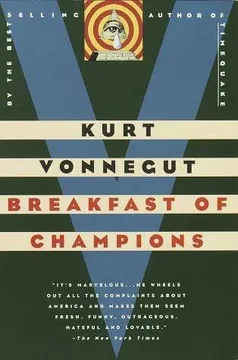


Plot Summary
The Invitation to Midland City
In autumn 1972, Midland City prepares its first Festival of the Arts. The wealthy Pontiac dealer Dwayne Hoover1 is its local celebrity, while Kilgore Trout,2 a penniless science-fiction writer, has spent decades publishing stories anonymously or under crude pornographic covers.
Eliot Rosewater,9 the only person who has praised Trout's2 work, persuades festival chairman Fred T. Barry12 to invite him. Barry12 offers travel money and a speaking place beside celebrated artists, hoping Rosewater9 will lend the festival a valuable painting.
Trout2 accepts because he wants the prosperous town to see what a failed artist looks like. Meanwhile, Dwayne1 is nearing a mental collapse. The narrator3 identifies their coming meeting as the hinge of the tale: Trout's2 words will give Dwayne's1 illness its dangerous shape.
The festival is not merely a backdrop for a chance encounter. It gathers people who have been sorted by wealth, reputation, and access to culture, then puts them in the same rooms. Trout arrives as a man whose work has been ignored, while Dwayne embodies the town's rewarded success. Rosewater's intervention briefly opens a door that the literary marketplace kept shut. The narrator's warning about Trout's influence makes recognition double-edged: an idea can confer meaning, but meaning can also become a weapon when it reaches someone already losing his grip.
Bad Chemicals, Worse Ideas
Dwayne's1 mood has shifted for weeks, though most people mistake his sudden singing for recovery from his wife Celia's suicide. His secretary and mistress,4 Francine Pefko,4 sees a generous employer who pays well and listens to employees' troubles.
Sales manager Harry LeSabre10 notices something darker when Dwayne,1 provoked by a conversation about adoption, viciously attacks Harry's10 conservative clothes. Harry10 is secretly a transvestite and takes the outburst as evidence that Dwayne1 has discovered his private life.
The insult exposes how little even close companions can read one another. Dwayne's1 illness is already changing his behavior, but the idea waiting in Trout's novel will tell him how to interpret that change: as proof that he alone is real and free.
The book distinguishes a bodily crisis from the story a person builds around it. Dwayne's chemical imbalance helps explain his instability, but it does not make his cruelty harmless or self-explanatory. Harry's fear grows from a secret that society has made dangerous to disclose; Dwayne's attack finds that vulnerability without understanding it. Meanwhile, Francine's loyalty encourages her to normalize warning signs. The people around Dwayne do not fail to care. They fail to imagine that a familiar, generous man can be changing in front of them.
The Silent Night Drive
During the Veterans' Day night, Dwayne's1 worsening illness drives him out of bed with a loaded revolver. He shoots up a bathroom instead of himself, then drives a used Plymouth into a guardrail and ends up in a vacant lot he owns. Hidden behind soundproof walls and sleeping streets, he plays the radio and absorbs its advertisements as if they were instructions.
At the County Hospital, Mary Young,15 a Black woman who once did laundry for Dwayne's1 family, dies alone. Her faint final message reaches him across town, and Dwayne1 drives to the Holiday Inn roof. Looking over the city, he forgets his wife's suicide, his son Bunny,5 and much of his own life. He asks himself where he is, then checks into his own hotel without recognizing it.
The night's danger is both intimate and civic. Dwayne has access to a gun, a car, and property, yet the insulated neighborhood keeps his distress invisible. Mary Young's death briefly links him to a history he has largely forgotten, but the connection arrives as a disorienting sensation rather than a usable memory. The hotel room offers a temporary, standardized refuge: Dwayne can obey its rules even when he cannot make sense of his life. The scene shows how a society can provide comfortable containers for people while leaving their suffering unheard.
Pluto Bandits on Forty-Second Street
While Dwayne1 wanders through Midland City, Trout2 travels east to New York before heading to the festival. He buys copies of his own books so he can read them aloud, then sleeps in a movie theater rather than pay for a hotel.
On Forty-second Street, men in a white Oldsmobile rob and assault him, leaving him injured and stripped of most of his money. Police release him after a hospital examination, but his account of possible attackers from Pluto becomes a newspaper joke. Other papers repeat it until frightened New Yorkers imagine a real gang and change their routines.
Trout2 has accidentally supplied a name for their diffuse fears. The episode echoes the danger of his fiction: an idea need not be credible to spread, especially when people already want a simple explanation for danger.
The invented gang is a miniature of the novel's larger argument about ideas. Reporting turns Trout's uncertainty into a public story, and repetition gives the story a social reality that evidence never supplied. The newspapers do not need to believe in extraterrestrials; they need only a catchy label that readers can carry into the streets. Trout's own invisibility makes the distortion easier: his identity is misspelled, his age exaggerated, and his experience converted into entertainment. Public fear is shown as something assembled, not simply discovered.
Hawaiian Week Turns Strange
After sleeping at the Holiday Inn, Dwayne1 briefly believes he has recovered, then sees the pavement sink beneath him. Across the used-car lot, Wayne Hoobler,6 a newly paroled Black man, polishes a Buick and pleads for work.
Wayne6 has built a private dream around Dwayne's1 advertisements, but Dwayne1 mistakes him for an hallucination and walks away. Inside the showroom, Dwayne1 also fails to recognize the Hawaiian decorations he designed or Harry's10 grass skirt and bright outfit.
At the same time, his stepbrothers Lyle and Kyle18 report that plastic waste is swelling into tough bubbles inside their tourist cave. The polluted stream threatens its wedding chapel and attractions. The city's cheerful festival display and its poisoned water now occupy the same landscape.
Wayne and Dwayne meet across a sharp divide between aspiration and power. Wayne has treated Dwayne's public image as a promise of safety and employment; Dwayne cannot even recognize the man asking him for a chance. The scene makes branding more dependable than personal contact. The cave's pollution extends that failure beyond human relationships: a business built on fabricated history is being physically overwhelmed by waste from modern industry. The festival's artificial paradise and the cave's damaged reality are not opposites. Both belong to the same town.
Francine's Motel Misreading
Dwayne1 asks Francine4 to leave work and meet him at a motel, hoping sex and company will steady him. After they make love, he mistakes her thought about a fried-chicken franchise near the prison for a request to spend his money. He calls her a prostitute and attacks the loyalty she has shown him. Francine4 breaks down, then tells him Harry10 had noticed his change.
Dwayne's1 hostility subsides into helplessness; he asks her to hold him and explain life. She cannot, but suggests he speak with the artists gathering for the festival. Dwayne1 accepts the idea because he wants to hear something genuinely new. This decision sends him toward Trout2 at precisely the moment Trout's novel is within reach.
Dwayne's suspicion turns care into a transaction because money is the language he knows best and fears being used through. Francine's offer was rooted in concern for him, but his wounded pride converts it into evidence against her. Their reconciliation does not erase the harm; it reveals how quickly Dwayne moves between aggression and dependence. Francine becomes the person who redirects him toward the festival, hoping unfamiliar artists might help. Her practical kindness therefore becomes a causal link between Dwayne's private crisis and Trout's dangerous fiction.
A Writer Crosses West
Trout2 continues west by hitchhiking and riding in a truck hauling olives. Its driver describes polluted land, exhausted labor, and industries that turn landscapes into raw material. In a roadside diner, Trout2 learns that the driver once read one of his stories on scraps of paper used in a Georgia jail. Trout2 does not admit authorship.
The discovery unsettles him: even a story printed as waste has reached someone, though not in the way its author imagined. Near Midland City, traffic stalls after a collision spills milk and blood into Sugar Creek. Trout2 wades through the contaminated water to reach the hotel, and a clear industrial plastic coats his feet. The town's pollution now touches him directly as he arrives.
Trout's journey brings his abstract pessimism into contact with working lives and damaged places. He is not a detached observer of environmental ruin: the polluted creek leaves a physical coating on his body. The driver's accidental reading also complicates Trout's belief that nobody has encountered his work. His stories circulate, but their passage through the world is governed by chance, poverty, and misuse rather than artistic intention. The scene prepares his meeting with Dwayne by making both men products of systems they barely understand.
The Painting's Two Lights
At the festival's hotel lounge, minimalist painter Rabo Karabekian7 faces anger over the fifty-thousand-dollar painting he gave Midland City. Waitress Bonnie MacMahon tells him the story of an condemned prisoner who mutilated himself to avoid execution.
Karabekian7 answers by explaining his painting as a simple image of awareness, the part of a living being that remains distinct beneath circumstance. His defense transforms the room's contempt into attention, and even the novelist Beatrice Keedsler8 listens differently.
Trout2 enters nearby, still filthy from his journey, but the celebration passes him by. The narrator,3 watching the exchange, recognizes that Karabekian's7 account has changed his own understanding of what art can protect. Dwayne1 sits close by, inwardly detached and waiting for a revelation.
Karabekian's defense matters because it does not claim that art makes suffering beautiful or orderly. He relocates value from prestige and technique to awareness, including the awareness of people whom respectable culture treats as marginal. Bonnie's story gives that claim a human test rather than an abstract proof. The audience's shift also shows that explanation can change how people see an object, though it cannot repair the conditions that produced the story. The narrator's response signals a renewal of attention, not a victory over chaos.
The Robot Book Opens
Dwayne1 approaches Trout2 and demands the meaning of life. Trout2 points him to Now It Can Be Told, whose central conceit is that one creature has free will while everyone else is an automatic machine. Dwayne1 speed-reads the book and accepts its premise as a revelation about himself.
He attacks his son Bunny5 at the piano, then strikes Beatrice8 and Bonnie when they try to stop him. Outside, he calls for Black people and turns Wayne Hoobler6 into a target, but Wayne6 repeatedly dodges his blows.
The runway lights at the airport appear beyond the highway, and Wayne6 sees them as the shining entrance to his private dream. Dwayne1 then drags Francine4 outside and attacks her. Trout2 intervenes, and Dwayne1 bites off the tip of Trout's2 finger before police restrain him.
The novel's premise becomes dangerous not because Dwayne simply believes in it, but because it flatters his isolation and converts other people into objects. His violence is not a logical consequence of the book; it is a delusional use of the book that removes the moral friction of recognizing another person's pain. Wayne's evasions interrupt Dwayne's fantasy of total control, while the airport lights offer Wayne a future not defined by confinement. The same night therefore produces two radically different readings of possibility: Dwayne's permission to dominate and Wayne's image of escape.
Martha Carries the Wounded
Emergency crews load Dwayne's1 victims into Martha, a mobile disaster unit, while doctors treat the injured and police secure the scene. Francine,4 Bunny,5 Beatrice,8 Trout,2 and other bystanders are among those hurt; Dwayne1 is restrained and taken for psychiatric care.
Trout2 sits upright with his wounded hand as the ambulance carries him away. Wayne,6 whom Dwayne1 failed to strike, remains outside the hospital's crisis and holds onto the possibility represented by the airport. The festival is postponed because of the violence.
The narrator3 makes clear that Dwayne's1 wealth cannot shield him from the consequences: those he injured may sue him into poverty. The town's carefully staged celebration ends under emergency lights, with its claims about progress exposed as fragile.
The ambulance gathers people whose lives had occupied separate social compartments: a wealthy dealer, a poor writer, a grieving secretary, a musician, and strangers passing through town. Their injuries make the consequences of Dwayne's private delusion public and material. At the same time, the narrative resists a neat moral accounting. Dwayne is not reduced to a villain, and Trout's accidental influence does not make him solely responsible. The festival's cancellation leaves no triumphant cultural solution, only the cost of damage and the unfinished work of caring for those hurt.
Epilogue
After treatment, Trout2 wanders through the hospital and then sets out on foot toward the festival grounds. The narrator3 waits along the route, survives an attack by a guard dog, and finally tells Trout2 that he is a character in a book. To prove his power, he carries Trout2 across impossible places, then returns him to Midland City.
The narrator3 offers him an apple as a sign of nourishment and wholeness, and declares him free. Trout's2 final plea to be made young follows him into the narrator's3 disappearance, leaving freedom less like a cure than a door opened too late to erase his sorrow.
The ending turns the novel's argument about machinery back on its author. The narrator can control Trout's surroundings, but cannot give him a painless history or make him accept the revelation. The apple offers a deliberately imperfect symbol of nourishment, one the narrator hopes is not poisoned by national violence or commercial greed. Declaring Trout free is both an ethical gesture and a recognition of power: a creator who has used a character's suffering can choose to stop directing him. Yet Trout's wish for youth exposes the limit of that gesture. Release cannot return what time has taken.
Analysis
Breakfast of Champions sets a wealthy dealer,1 an ignored writer,2 a newly released prisoner,6 a working secretary,4 and a gallery of other lives inside one town, then refuses to let the reader sort them into clean moral categories. Dwayne's1 illness matters, but so do the ideas that shape his delusion and the social habits that keep others from recognizing his decline. His Pontiac advertisements promise trust; his business rewards ownership; his reading of Trout2 turns those familiar values into a private theology in which other people cease to count.
The novel's sharpest satire comes from the gap between public symbols and lived conditions. Midland City sponsors a festival while its creek carries industrial waste. A prison offers polished teeth but not a prepared life after release. Roads and homes display wealth while workers and Black residents bear the costs of systems they do not control. Wayne's6 airport vision briefly opens another possibility, though the book does not pretend that hope alone can dismantle those systems. The narrator's3 interruptions make form part of the argument. He rejects the tidy hierarchy by which conventional stories assign some people central importance and others expendable roles, yet he remains a creator3 who can direct their suffering. Karabekian's7 account of awareness offers the book's most humane counterweight: beneath class, race, illness, and social function, each living being has an interior presence that cannot be reduced to its usefulness. The ending does not solve the contradiction between human vulnerability and mechanical power. It makes the act of noticing, and the choice not to treat people as props, the beginning of an ethical response.
Review Summary
Breakfast of Champions receives mixed reviews, with most praising Vonnegut's satirical wit and unconventional narrative style. Readers appreciate the book's dark humor, social commentary, and unique illustrations. Many find it hilarious and thought-provoking, while others criticize its repetitive nature and use of offensive language. The novel's exploration of free will, mental illness, and American culture resonates with fans. Some consider it among Vonnegut's best works, while others prefer his earlier novels. Overall, it's seen as a challenging but rewarding read that showcases Vonnegut's distinctive voice.
People Also Read



Characters
Dwayne Hoover
The unraveling dealerDwayne is a prosperous Pontiac dealer whose charm, generosity toward employees, and confidence have made him a civic fixture. Beneath that public ease are grief for his wife, estrangement from his son5, and a life organized around buying, selling, and ownership. As his mental state deteriorates, he searches for an explanation that can make his confusion feel purposeful. He is vulnerable to ideas that flatter his loneliness, but the novel does not reduce him to a diagnosis: his illness collides with real relationships and a culture that has trained him to see people as functions. His mixture of decency, entitlement, and fear makes him both responsible for his actions and difficult to dismiss as merely monstrous.
Kilgore Trout
The unseen novelistTrout is an elderly science-fiction writer who has produced an enormous body of work while remaining unknown to publishers and readers. He earns his living installing storm windows and screens, and his stories are often buried inside pornographic publications. Pessimism protects him from hope, but it also isolates him from people who might recognize his work. He observes a damaged world with a mixture of disgust, wit, and stubborn endurance. His strange inventions often expose the absurd rules people accept as normal. Trout believes himself to be a failure, yet his writing carries consequences he never intended, forcing him to confront the moral weight of ideas.
Kurt Vonnegut
The intrusive creatorThe narrator appears as a self-conscious author who enters his own fiction, comments on its construction, and claims responsibility for the lives and events he invents. He is funny, uneasy, and openly implicated in the violence and disorder he describes. Rather than presenting himself as an all-knowing moral judge, he questions the habits of storytelling that make some lives seem important and others disposable. His attention moves between personal memory, social criticism, and the people in Midland City. The character's central tension is between wanting to clear away false cultural ideas and recognizing that he cannot stand outside the systems, grief, and storytelling habits he criticizes.
Francine Pefko
Dwayne's devoted secretaryFrancine is Dwayne's1 secretary and mistress, a war widow whose loyalty gives her a close view of his ordinary kindness and emerging instability. She tends to interpret his behavior generously, partly because she loves him and partly because care has become her way of making a precarious life bearable. She is practical, emotionally open, and used to smoothing over other people's discomfort. Her concern leads her to encourage Dwayne1 to meet the festival's artists, hoping an unfamiliar perspective might help him. She is not naïve about hardship, but her devotion makes it difficult to distinguish patience from self-erasure.
Bunny Hoover
Dwayne's guarded sonBunny is Dwayne's1 son, a skilled pianist who plays in the Holiday Inn lounge and lives modestly despite his father's1 wealth. Sent to military school young, he learned discipline and combat skills in an environment that treated obedience as virtue. He is homosexual and keeps much of his inner life private, using meditation to retreat from a world he finds hostile. His quietness is not emptiness; it is a survival strategy shaped by family tension and institutions that offered little room for tenderness. Music gives him a livelihood and a language for feelings he rarely shares.
Wayne Hoobler
The hopeful paroleeWayne is a Black man newly released from prison after years in institutions. He has built an idealized picture of Dwayne1 from advertisements and hopes that work at the Pontiac dealership will give his life structure and belonging. His reading skills are limited, and he has had few chances to make choices outside systems that direct his movements. He is cautious, deferential, and keenly observant of the world immediately around him. The dream he carries is fragile but persistent, making him a counterpoint to Dwayne's1 growing conviction that other people exist only for his benefit.
Rabo Karabekian
The minimalist painterKarabekian is a successful painter whose sparse work provokes suspicion among people who believe art should display visible labor or technical skill. He is vain enough to enjoy the controversy around his painting, but capable of taking the room seriously when challenged. His defense shifts the discussion from price and artistic prestige toward awareness as something shared by all living beings. He does not claim that a painting can solve the suffering around it. Instead, he argues that art can direct attention toward the living presence people overlook. His bluntness unsettles the festival and unexpectedly changes the narrator's3 view of his own work.
Beatrice Keedsler
The hometown novelistBeatrice is a Gothic novelist who grew up in Midland City and returns for the arts festival with apprehension about confronting her past. She is observant and intellectually engaged, but her confidence in the conventions of storytelling is tested by the town's messy reality. Her conversation with Karabekian7 reveals a writer who can question what stories make meaningful, even while continuing to work within narrative forms. She serves as a bridge between the returning artist and the people who stayed home, carrying both the distance of success and the unease of recognition.
Eliot Rosewater
Trout's unlikely patronRosewater is a wealthy collector and the sole fan who has written to Trout2 before the festival. His praise prompts Fred Barry12 to invite Trout2, using access to his valuable El Greco painting as leverage. Rosewater's resources give him influence, but his attention is unusually directed toward a writer the literary world has ignored. He is a patron whose generosity can create opportunity without controlling what the recipient will do with it. His role connects private appreciation to public recognition.
Harry LeSabre
Dwayne's wary managerHarry has worked beside Dwayne1 for decades and understands the dealer's1 habits well enough to notice his sudden change. He is an effective manager who dresses conservatively at work and privately enjoys wearing women's clothing with his wife's support. The threat of public exposure makes Dwayne's1 unexpected criticism feel dangerous rather than merely rude. Harry's experience shows how carefully people manage the distance between private identity and public safety. His warning to Francine4 is one of the few early attempts to name what is happening to Dwayne1.
Cyprian Ukwende
The Nigerian physicianUkwende is a Nigerian doctor working in Midland City, far from the relatives and home he misses. He encounters Dwayne1 during the dealer's1 disoriented night and later serves among the medical staff responding to the violence. His professional composure places him near suffering without making him emotionally immune to it. The novel also gives him a distinct history and sense of belonging rather than treating him as a faceless imported professional.
Fred T. Barry
The festival benefactorBarry is Midland City's wealthy civic benefactor and the chairman of its arts festival. He funds the new arts center and tries to give the event cultural prestige, though he admits he has not read Trout2 before Rosewater9 recommends him. His enthusiasm for public improvement sits beside a family fortune built through business and changing industrial ventures. He represents a town's capacity to sponsor art while remaining entangled in the economic systems the novel criticizes.
Milo Maritimo
Trout's first admirerMilo is the Holiday Inn's young desk clerk and an ardent reader of Trout2. He has studied the writer's work in preparation for the festival and welcomes him with a seriousness Trout2 has never encountered. His enthusiasm offers a brief, personal form of recognition amid the town's uncertain response.
Lottie Davis
Dwayne's housekeeperLottie cleans Dwayne's1 house and prepares his supper. She and Dwayne1 like one another, though they speak little, and she descends from people enslaved in the South. Her routine presence reveals how domestic labor sustains Dwayne's1 comfortable life while remaining largely invisible to him.
Mary Young
The city's oldest residentMary is an elderly Black woman whose parents were enslaved. She once did laundry for Dwayne's1 family and told the young boy stories about slavery and public violence. Her brief connection to him gives the town's racial history a personal thread rather than leaving it in monuments and slogans.
Patty Keene
The indebted waitressPatty is a seventeen-year-old waitress working to help pay the medical bills left by her father's illness. She recognizes Dwayne1 as a powerful local figure and wonders whether he might change her circumstances. Her history includes unreported sexual violence, revealing how financial pressure and social silence narrow the choices available to her.
Don Breedlove
The predatory installerBreedlove installs gas-conversion equipment and has a family, but uses his position and strength to assault Patty Keene16. His ordinary professional role conceals predatory behavior, showing how respectable appearances can coexist with serious harm.
Lyle and Kyle Hoover
The cave-owning brothersDwayne's1 younger stepbrothers run Sacred Miracle Cave, a tourist attraction they own with him. Their report about the growing industrial waste bubbles brings the town's environmental damage into the main story. They care about preserving the cave's chapel and attractions, even when the business depends on invented history.
Plot Devices
Now It Can Be Told
A delusion with a scriptTrout's2 science-fiction novel imagines a universe in which one creature has free will and everyone else is an automatic machine. It is written as a message to that supposedly exceptional being, and Dwayne1 reads it while searching for a new account of his life. The premise gives his confusion a grand explanation and lets him reinterpret other people's feelings as unreal. Its role is not to prove that humans are machines. It shows how an idea, taken up by someone in crisis, can become a permission structure for cruelty.
The Chemical Body
Biology shapes beliefThe novel repeatedly connects mood, behavior, and bodily chemistry, especially through Dwayne's1 deteriorating mental state. This framework complicates simple moral explanations: illness affects perception, but people and institutions still shape what a sick person does. The narrator3 also extends the metaphor to habits and social roles, describing people as mechanisms without claiming that their awareness is meaningless. The device keeps the story between two poles, material causation and moral responsibility, rather than allowing either one to cancel the other.
The Creator Narrator
Author enters the machineryThe narrator3 interrupts the plot with memories, invented explanations, sketches, and reflections on his power to make characters act. He eventually appears as a person within the story and addresses Trout2 directly. This device exposes how fiction can assign importance, manipulate outcomes, and make some characters seem disposable. At the same time, the narrator3 questions his own authority rather than presenting authorship as innocent control. The interventions turn the book's concern with free will into a formal problem: what does it mean to care for a character whose life one has arranged?
Plastic in Sugar Creek
Industry enters the bodyWaste from Barrytron's weapons production leaks into Sugar Creek as a clear plastic substance. The material forms tough bubbles in Sacred Miracle Cave, threatens its attractions, and coats Trout's2 feet when he wades across the stream. These separate consequences connect the cave subplot to Trout's2 arrival and to the novel's broader account of industrial damage. The transparent pollution is especially effective because it can look harmless at first, even as it clings to people and landscapes. The device makes corporate negligence tangible without requiring the characters to understand the systems that caused it.
About the Author
Other books by Kurt Vonnegut Jr.




Download PDF
Download EPUB
.epub digital book format is ideal for reading ebooks on phones, tablets, and e-readers.








