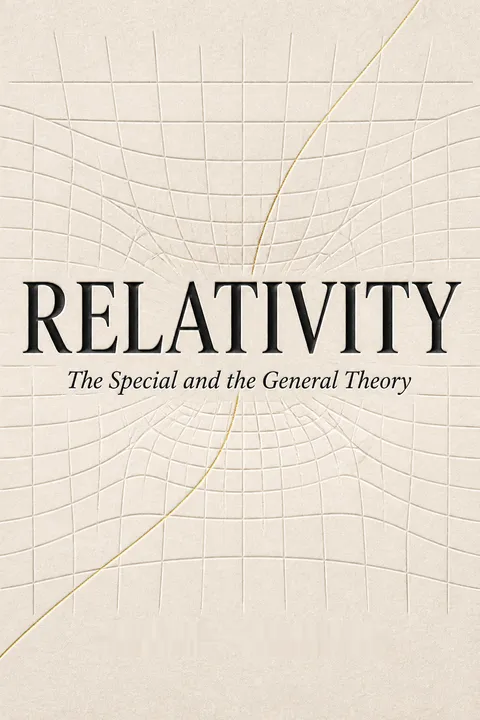


Key Takeaways
Ground geometry in physical measurement, not diagrams alone
Math and measurement differ. Pure geometry proves what follows from its chosen axioms. Physics asks whether those propositions describe actual distances and shapes. Einstein connects geometrical length to the behavior of measuring rods, making geometry answerable to experiment rather than treating it as automatically true of the world.
Rods reveal the limits. Imagine laying equal rods across a table to build a grid. If heating makes some rods expand more than others, the grid no longer fits the rules of flat Euclidean geometry. The failure may reflect the measuring material, the surface, or both. In general relativity, gravity similarly makes the geometry used to describe physical space non-Euclidean.
The distinction resembles the difference between a map's internal consistency and its accuracy on the ground. A mathematical model can be flawless on its own terms while misdescribing a physical system. Einstein's move is especially powerful because it makes geometry testable through instruments. It also raises a lasting question: if rods, clocks, and light are all affected by physical conditions, which measurements establish the geometry? The answer is not one privileged instrument, but a consistent account of how instruments and events relate.
Synchronize clocks operationally, then accept that simultaneity depends on motion
Define what a clock means. To decide whether distant lightning strikes happen at the same time, Einstein proposes a procedure: place an observer halfway between them and compare when each flash arrives. This definition assumes light takes equal time to reach the midpoint from either side. Synchronized clocks can then assign times to events across a reference system.
Motion changes the verdict. A train observer moves toward one flash and away from the other, so the light reaches that observer at different times. The same pair of strikes can therefore count as simultaneous for someone on the embankment but not for someone on the train. There is no single universal time shared by every moving observer.
This is a model of operational thinking: replace an intuitive word with a procedure that could, in principle, settle a real case. It does not make simultaneity a matter of personal opinion. Observers can translate their measurements using precise physical laws. The subtlety is that the procedure itself depends on assumptions about light and synchronized clocks. Einstein exposes those assumptions rather than hiding them inside an everyday idea of now.
Let light speed revise everyday assumptions about space and time
Keep light's speed fixed. Special relativity combines two claims: the laws of nature have the same form in uniformly moving reference systems, and light in a vacuum travels at the same speed for all such observers. The resulting Lorentz transformation relates their measurements of space and time, mixing quantities that classical mechanics treated separately. Minkowski's four-dimensional space represents each event with three spatial coordinates and one time coordinate.
Fast motion changes measures. A rod moving along its length is measured shorter, while a moving clock ticks more slowly relative to an observer at rest with that clock. These effects become significant near light speed. The equations also make light speed a limit that a material body cannot reach.
The striking lesson is that measurement changes are not mere optical tricks. They are the consistent consequences of how observers assign space and time to events. In modern terms, the theory preserves shared invariants while allowing particular measurements to differ by frame. Everyday intuition remains reliable at ordinary speeds, which explains its persistence, but familiarity is not a proof of universality. The book's argument succeeds by identifying precisely where common sense stops being a dependable guide.
Reject absolute rest; compare motion only between reference systems
No frame gets special status. A Galileian system of co-ordinates is a reference system in which an isolated body remains at rest or moves uniformly in a straight line. Special relativity says that all such uniformly moving systems describe natural laws in the same way. No experiment in the book's account establishes one as the universe's true resting frame.
Velocity addition changes. Ordinary arithmetic would add a person's walking speed to a train's speed. Relativity instead gives, for motion in one direction, W = (v + w)/(1 + vw/c^2). In the Fizeau experiment, light travels through flowing liquid. Measurements agreed with the relativistic rule, which adjusts the simple addition expected in classical mechanics.
This principle is a useful antidote to confusing a convenient viewpoint with an objective privilege. A train passenger and a platform observer can give different descriptions without either being mistaken. The discipline is to state the reference system and then compare predictions. Relativity does not claim every frame is equally practical: some make calculations far simpler. It claims that convenience does not turn one frame into a physically absolute standard.
Account for energy as mass, and mass as energy
Unify two conservation laws. Classical physics treated conservation of mass and conservation of energy as separate rules. Special relativity links them: a body's energy includes a rest-energy contribution expressed as E = mc^2. If a body absorbs energy, its inertial mass increases by the corresponding amount divided by c^2; mass is not an unchanging quantity independent of energy.
The change is measurable in principle. For ordinary energy transfers, the mass difference is so small that classical mechanics remains an excellent approximation. The book's later note points to nuclear reactions as a clear confirmation: the masses before and after a reaction differ by the mass equivalent of released or absorbed energy. The relation turns mass and energy into two forms of one accounting system.
The conceptual gain is larger than the slogan suggests. Conservation laws remain powerful, but what is conserved depends on how a system is defined and what energy crosses its boundary. Mass-energy equivalence supplies a common ledger for processes that once seemed to violate separate rules. It should not be mistaken for the claim that mass is simply ordinary energy in disguise. The equation specifies a quantitative equivalence, while the physical forms and transformations still require careful description.
Use the equivalence of falling and acceleration to rethink gravity
Compare two experiences. Einstein imagines an observer inside a closed chest being pulled upward. If the observer releases an object, it falls toward the floor just as it would in a gravitational field. Since different materials fall with the same acceleration, the observer cannot distinguish these situations by that experiment alone. This connection rests on the equality of inertial mass, which resists acceleration, and gravitational mass, which responds to gravity.
Do not overgeneralize. The principle lets a suitably chosen accelerating reference system imitate certain gravitational effects. It does not mean every gravitational field can be erased by changing observers. Einstein explicitly distinguishes fields that can be produced by a change of reference system from more general gravitational fields.
The thought experiment shows how a local experience can be explained through two different causal stories: a force pulling an object down, or a floor accelerating into it. This resembles a recurring strategy in science, where equivalent descriptions expose hidden assumptions about what counts as a cause. The limitation matters just as much as the insight. A local resemblance between gravity and acceleration does not make all gravitational environments interchangeable, and treating it as universal would erase the very structure the theory is meant to describe.
Treat gravity as a change in spacetime geometry, not merely a pull
Rods and clocks respond to gravity. On a rotating disc, a clock at the rim moves faster than one at the centre and therefore ticks at a different rate. Measuring the disc's circumference and radius also fails to produce the Euclidean relationship expected for a flat surface. Einstein uses this kind of case to show why rigid rods and identical clocks cannot always provide a simple, universal coordinate grid.
Coordinates need not be physical rulers. Gaussian co-ordinates assign numbers to events without requiring those numbers to be direct measurements of distance and time. The general principle of relativity requires the laws of nature to retain their form across arbitrary such coordinate choices. Gravity is thereby connected to the structure of spacetime itself.
This is a major shift in what counts as an explanation. Newtonian gravity describes a force acting within space; Einstein's account makes the geometry of space and time part of the physical problem. The rotating-disc example is valuable because it starts with measurements rather than abstract curvature. Coordinate freedom also has a modern methodological lesson: mathematical labels can change while observable relationships remain stable. That freedom is not a license for arbitrary interpretation; predictions about actual events still constrain the theory.
Test relativity through precise predictions, not elegance alone
Demand numerical consequences. General relativity predicts that Mercury's orbit should rotate slightly beyond the motion explained by Newtonian mechanics. The extra advance is about 43 seconds of arc per century, matching the previously unexplained observation. It also predicts that the Sun bends passing starlight by about 1.7 seconds of arc at its edge.
Look for independent effects. Photographs taken during the 1919 solar eclipse supported the predicted light deflection. The theory also predicts that light from a strong gravitational field shifts toward the red end of the spectrum. The appendix reports that this effect was established for the dense companion of Sirius in 1924. Together, these tests link orbital motion, light paths, and atomic frequencies to gravity.
The strongest feature of this evidence is its variety. The theory does not merely fit one unusual orbit; it connects celestial mechanics, the path of light, and spectral measurements. Independent kinds of evidence make a framework harder to rescue with an ad hoc adjustment. Still, historical confirmation is not the same as final proof. Measurements have uncertainty, and each test depends on auxiliary models and instruments. The proper conclusion is stronger than plausibility but more disciplined than declaring any theory beyond revision.
Let matter and evidence decide whether cosmic space is curved
Cosmic shape is physical. Einstein argues that the geometry of the universe depends on how matter is distributed. A universe can be finite yet have no edge, much as a spherical surface has finite area without a boundary. If matter has a uniform average density, his discussion finds a spherical or elliptical universe more plausible than an infinite, nearly flat one with matter spread everywhere.
The appendix revises the picture. Einstein's early cosmological model assumed both a nonzero average density and a universe whose size did not change with time. The appendix explains that Friedman's solutions allowed expansion, and that Hubble's observed redshift pattern supported an expanding system of galaxies. The question of cosmic size and shape therefore depends on both theory and astronomical evidence.
The lasting lesson is methodological: cosmic geometry is not settled by intuition about an endless, flat backdrop. It must be inferred from matter, light, and the equations that connect them. The appendix also makes the book unusually revealing as a scientific document, since it records a shift in Einstein's own assumptions. Its cosmology is a historical argument, not a current all-purpose map of the universe. Scientific strength includes the capacity to revise the picture when new observations change the question.
Analysis
The book's central move is to turn space and time from a silent stage into measurable parts of physical theory. Einstein starts with deceptively ordinary problems: what makes two distant events simultaneous, how can a moving observer measure a length, and what does it mean for geometry to describe the real world? Each question exposes an assumption that classical mechanics treated as obvious. Special relativity replaces absolute time and simple velocity addition with a coherent account in which measurements depend on reference system while the laws and light speed remain invariant.
General relativity extends this method rather than discarding it. The equality of inertial and gravitational mass motivates a comparison between gravity and acceleration. The behavior of clocks and measuring rods then points toward a deeper conclusion: gravity is not merely a force operating inside an unchanged geometry. The geometry itself becomes part of the physical field. The narrative succeeds because abstract mathematics repeatedly grows from an imagined measurement, such as the train, the falling body, or the rotating disc.
The book's explanatory achievement is also its principal limitation. It is a guided conceptual argument, not a modern technical account of all evidence or a full mathematical derivation. Some experimental claims are presented in their early twentieth-century setting, and its cosmological discussion reflects a period when the universe's expansion was newly entering the debate. The appended revision is instructive: a scientific theory can retain its core while the model built from it changes. Readers should therefore separate the durable conceptual architecture from historically provisional conclusions.
The deepest transferable lesson is not that perception is unreliable, but that measurement requires explicit rules. Define the clock, state the reference frame, identify the physical assumptions, and then test the resulting predictions. Relativity's counterintuitive claims become less mystical once their operational meaning is clear. Its ambition is to replace unexamined intuition with a more disciplined account of what observers can measure and how those measurements fit together.
Review Summary
Relativity receives mostly positive reviews, with readers praising Einstein's attempt to explain complex theories to the general public. Many find it challenging but rewarding, appreciating Einstein's clear writing and use of examples. Some criticize it as too difficult for laypeople, suggesting other books for beginners. Readers note the book's historical significance and Einstein's philosophical approach. Several mention the need for basic mathematical knowledge to fully grasp the content. Overall, it's seen as an important work that provides insight into Einstein's groundbreaking ideas.
People Also Read







Glossary
Galileian system of co-ordinates
Uniform-motion reference systemA coordinate system in which an isolated body remains at rest or continues in uniform straight-line motion. Systems moving uniformly and without rotation relative to one another are equivalent for describing natural laws in classical mechanics and special relativity. The term identifies the relevant family of inertial reference systems.
Lorentz transformation
Space-time conversion between framesThe equations that relate the space and time coordinates assigned to an event by two reference systems moving uniformly relative to one another. Unlike the classical Galilei transformation, the Lorentz transformation mixes space and time measurements and preserves the same vacuum light speed for both observers.
Relativity of simultaneity
Frame-dependent distant timingThe result that two spatially separated events judged simultaneous in one reference system need not be simultaneous in another system moving relative to it. The difference follows from how observers compare light signals and synchronize clocks, not from a mistake or a delay in human perception.
Minkowski's four-dimensional space
Unified space-time representationA mathematical representation in which an event is specified by three spatial coordinates and one time coordinate. In special relativity, these four coordinates form a unified space-time continuum, and Lorentz transformations relate different observers' descriptions of it.
General principle of relativity
Laws across coordinate systemsEinstein's principle that the general laws of nature should retain their form under arbitrary continuous changes of coordinates. It extends the special principle, which concerns uniformly moving reference systems, and allows gravity to be described without assigning one coordinate system a uniquely privileged physical status.
Gaussian co-ordinates
Numbers assigned to eventsA general way of assigning coordinate values to points in a continuum, without requiring the coordinates to correspond directly to physical measuring rods or clocks. In general relativity, they let physicists describe space-time even where gravity prevents a simple Euclidean grid from being built from rigid rods and uniformly ticking clocks.
Principle of equivalence
Gravity and acceleration correspondenceThe principle that certain effects of a gravitational field can be reproduced by an appropriately accelerated reference system. Einstein connects this possibility to the observed equality of inertial and gravitational mass. It motivates general relativity, while not implying that every gravitational field can be eliminated by a choice of reference system.
FAQ
What is "Relativity: The Special and the General Theory" by Albert Einstein about?
- Accessible explanation of relativity: The book provides a non-mathematical introduction to both the Special and General Theories of Relativity, aiming to make Einstein’s revolutionary ideas understandable to readers without advanced physics backgrounds.
- Structure and content: It is divided into three main parts: the Special Theory of Relativity, the General Theory of Relativity, and considerations on the universe as a whole, plus several appendices for deeper exploration.
- Focus on conceptual clarity: Einstein emphasizes the physical meaning behind the theories, using thought experiments and analogies to clarify complex concepts.
- Historical and philosophical context: The book also discusses the evolution of ideas about space, time, and gravity, and how relativity challenges classical physics.
Why should I read "Relativity: The Special and the General Theory" by Albert Einstein?
- Direct insight from Einstein: The book is written by Einstein himself, offering a unique opportunity to learn the theory from its creator.
- Foundational scientific ideas: Understanding relativity is essential for grasping modern physics, cosmology, and the nature of the universe.
- Accessible to non-specialists: Einstein intentionally avoids heavy mathematics, making the book suitable for readers with a general scientific background.
- Philosophical implications: The book explores deep questions about reality, space, time, and the limits of human knowledge.
What are the key takeaways from "Relativity: The Special and the General Theory"?
- Relativity of space and time: Space and time are not absolute but depend on the observer’s state of motion, fundamentally altering our understanding of the universe.
- Constancy of the speed of light: The speed of light in a vacuum is the same for all observers, regardless of their motion, leading to surprising consequences like time dilation and length contraction.
- Equivalence of mass and energy: The famous equation E=mc² emerges from the theory, uniting mass and energy as interchangeable.
- Gravity as geometry: In General Relativity, gravity is not a force but a manifestation of the curvature of space-time caused by mass and energy.
- Experimental confirmation: The book discusses key experiments (e.g., Mercury’s perihelion, light deflection by the sun) that support the theory.
How does Einstein define the Special Theory of Relativity in "Relativity: The Special and the General Theory"?
- Principle of relativity: The laws of physics are the same in all inertial (non-accelerating) reference frames; no frame is preferred.
- Constancy of light speed: The speed of light in a vacuum is constant for all observers, regardless of their motion or the motion of the light source.
- Consequences for measurements: Time intervals and lengths are not absolute but depend on the observer’s relative motion (time dilation and length contraction).
- Lorentz transformation: The mathematical framework (Lorentz transformation) replaces the classical Galilean transformation to relate measurements between moving frames.
What is the General Theory of Relativity according to Einstein’s book?
- Extension to acceleration and gravity: General Relativity extends the principle of relativity to all reference frames, including those that are accelerating.
- Equivalence principle: There is no observable difference between acceleration and gravitational fields; inertial and gravitational mass are equivalent.
- Gravity as space-time curvature: Massive objects cause space-time to curve, and this curvature dictates the motion of objects and light.
- New predictions: The theory predicts phenomena such as the bending of light by gravity and the precession of planetary orbits.
How does "Relativity: The Special and the General Theory" explain the relativity of simultaneity?
- Simultaneity is observer-dependent: Events that are simultaneous in one reference frame may not be simultaneous in another moving frame.
- Thought experiment with trains: Einstein uses the example of lightning strikes observed from a train and an embankment to illustrate how simultaneity depends on the observer’s motion.
- Role of light signals: The definition of simultaneity relies on the assumption that light travels at the same speed in all directions for all observers.
- Implications for time: This leads to the conclusion that time is not absolute but relative to the observer’s frame of reference.
What is the Lorentz transformation, and why is it important in Einstein’s "Relativity: The Special and the General Theory"?
- Mathematical tool for relativity: The Lorentz transformation provides the equations that relate space and time coordinates between two inertial frames moving at constant velocity relative to each other.
- Preserves the speed of light: Unlike the Galilean transformation, the Lorentz transformation ensures that the speed of light remains constant for all observers.
- Foundation for relativistic effects: It explains phenomena such as time dilation, length contraction, and the relativity of simultaneity.
- Essential for both theories: The Lorentz transformation is central to both Special and General Relativity, underpinning their mathematical structure.
How does Einstein’s "Relativity: The Special and the General Theory" describe the relationship between mass and energy?
- E=mc² explained: The book derives and explains the famous equation, showing that mass and energy are two forms of the same thing.
- Mass increases with energy: When a body absorbs energy, its inertial mass increases accordingly.
- Unified conservation law: The conservation of mass and the conservation of energy are unified into a single law in relativity.
- Experimental confirmation: The equivalence of mass and energy is confirmed by nuclear reactions and radioactive decay, as discussed in the book.
What experimental evidence does Einstein present in "Relativity: The Special and the General Theory" to support his theories?
- Mercury’s perihelion advance: The unexplained rotation of Mercury’s orbit is accurately predicted by General Relativity.
- Deflection of starlight: Light from stars passing near the sun is bent by the sun’s gravity, confirmed during solar eclipses.
- Gravitational redshift: Light emitted from massive bodies is shifted to longer wavelengths, as predicted by the theory.
- Fizeau’s experiment: The speed of light in moving water supports the relativistic addition of velocities rather than the classical one.
How does "Relativity: The Special and the General Theory" address the structure and geometry of the universe?
- Space is not absolute: The geometry of space is determined by the distribution of matter and energy, not fixed independently.
- Finite but unbounded universe: Einstein discusses the possibility of a universe that is finite in volume but has no boundaries, using analogies like the surface of a sphere.
- Role of non-Euclidean geometry: The book explains how space can be curved, requiring non-Euclidean geometry to describe it.
- Cosmological implications: The general theory leads to new models of the universe, including expanding and closed universes.
What are the best quotes from "Relativity: The Special and the General Theory" by Albert Einstein, and what do they mean?
- “The present book is intended, as far as possible, to give an exact insight into the theory of Relativity to those readers who...are not conversant with the mathematical apparatus of theoretical physics.”
Einstein’s goal is to make his revolutionary ideas accessible to a broad audience, not just specialists. - “Physical objects are not in space, but these objects are spatially extended. In this way the concept ‘empty space’ loses its meaning.”
Einstein challenges the classical notion of space as a container, emphasizing the inseparability of objects and space. - “Events which are simultaneous with reference to the embankment are not simultaneous with respect to the train, and vice versa (relativity of simultaneity).”
A clear statement of how relativity overturns the idea of absolute time. - “The gravitational mass of a body is equal to its inertial mass.”
This equivalence is a cornerstone of General Relativity, leading to the insight that gravity and acceleration are fundamentally linked.
How does Einstein’s "Relativity: The Special and the General Theory" approach the philosophical implications of space and time?
- Space and time as constructs: Einstein argues that space and time are not absolute entities but are defined by the relationships between physical events.
- No absolute reference frame: The book rejects the idea of a privileged or absolute frame of reference, emphasizing the relativity of all motion.
- Field replaces substance: The concept of the field (especially the gravitational field) replaces the notion of space as a passive stage for events.
- Limits of human knowledge: Einstein acknowledges the provisional nature of scientific theories and the importance of intuition and creativity in scientific progress.
Download PDF
Download EPUB
.epub digital book format is ideal for reading ebooks on phones, tablets, and e-readers.








