

Key Takeaways
Treat empty space as part of the physical system, not a blank stage

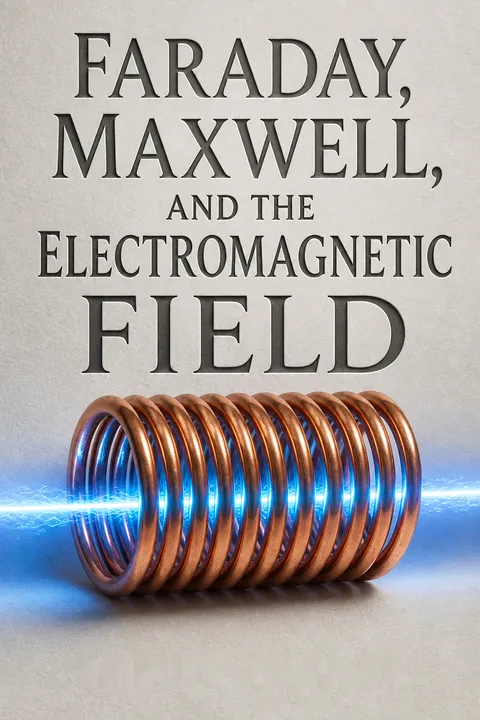
A new kind of reality. In the Newtonian picture that dominated nineteenth-century physics, objects exerted forces on one another across space, which itself was treated as passive. Faraday and Maxwell proposed a different account: an electromagnetic field is a physical state spread through space, carrying energy and transmitting forces. The idea began with Faraday’s experimental observations and became a mathematical theory through Maxwell’s work.
A prediction made visible. In 1888, Heinrich Hertz produced sparks in one circuit and detected faint sparks in a nearby wire loop. A metal sheet reflected the waves, creating a standing pattern that confirmed their presence. The experiment gave physical evidence for a theory that had recast space from empty backdrop into active participant.
What's striking is the change in the unit of explanation. Instead of asking only what one object does to another, field thinking asks what conditions exist at every point between them. That move is useful well beyond electromagnetism: many modern explanations describe distributed states rather than isolated things. The book also keeps a crucial distinction in view. Calling a field physically real does not mean it must be a familiar substance. Faraday and Maxwell's insight concerns what the field does and how its quantities relate, not an easily pictured material filling space.
Train observation to challenge inherited theories before they harden into facts

Facts before authority. Faraday grew up poor, left school early, and entered science through books he encountered while apprenticed to a London bookbinder. He learned to keep careful notes, repeat other people's experiments, and distrust conclusions drawn from too few observations. As a young man, he made a small battery from coins, zinc, and salt-soaked paper, then watched it decompose a chemical solution. The result convinced him that science was not merely something to read about. It was work he could do.
A disciplined imagination. Faraday lacked formal mathematical training, but his experimental skill became a strength. He imagined bold explanations, then tried to make experiments expose their weaknesses. His approach did not mean rejecting theory. It meant refusing to treat an elegant account as settled until nature had been asked.
Faraday's path shows how access to scientific work can come through practice, not credentials alone. Repeating an experiment is more than a teaching exercise: it tests whether a result depends on hidden conditions, an unreliable instrument, or an observer's expectations. Yet observation is not theory-free. What counts as a meaningful result depends partly on the question being asked. Faraday's advantage was not simply that he watched carefully, but that he paired close observation with an unusual willingness to question the categories his contemporaries took for granted.
Follow changing effects, not just steady states

A brief twitch mattered. After Oersted showed that an electric current could move a compass needle, Faraday began investigating the link between electricity and magnetism. His decisive iron-ring experiment connected two wire coils around an iron ring. Switching on current in one coil made a needle in the second circuit twitch, then stop. Switching the current off made it twitch again in the opposite direction. The effect appeared during change, not while the current remained steady.
From motion to power. Faraday found that moving a magnet into or out of a coil also produced a current. He then rotated a copper disc between magnet poles to generate a steady current, demonstrating the principle of the dynamo. In 1821, he had already shown that a current could make a wire circle a magnet, demonstrating the electric motor. The electrotonic state was his proposed temporary condition of strain associated with changing magnetic influence and induced current.
The lesson is methodological: transitions can reveal mechanisms that stable conditions conceal. A system at rest may look simple because its internal changes have ceased; switching, moving, or perturbing it can expose the relationships that maintain it. This style of investigation recurs throughout experimental science. It also warns against treating a fleeting signal as noise too quickly. Faraday's twitch became meaningful only because he repeated it, altered the setup, and established when it appeared. One surprising observation is a lead, not yet a conclusion.
Pair experimental intuition with mathematics to make a new theory legible
Two kinds of seeing. Faraday described magnetic influence through lines of force, imagined paths that could be revealed by iron filings and that represented the direction and strength of magnetic action. He treated these lines as more than diagrams, but most mathematical physicists found the idea vague. Maxwell, a Cambridge-trained mathematician forty years younger, studied Faraday's experimental writings and saw that they could be translated into equations.
A shared creation. Faraday's lines of force gave Maxwell a way to organize phenomena; Maxwell's mathematics made the relationships precise enough for other physicists to use. Their collaboration was mainly intellectual, carried through papers and correspondence rather than sustained joint laboratory work. The field theory belongs to both: Faraday supplied the physical vision, while Maxwell developed the mathematical structure that could express and extend it.
This partnership is a case study in translation between forms of expertise. Mathematical formalization did not merely decorate Faraday's ideas. It made consequences explicit, helped compare the theory with competing accounts, and exposed further implications. At the same time, the mathematical achievement depended on experimental questions and concepts that did not originate in equations. Neither mode of thought is sufficient by itself. The story also resists the familiar split between the intuitive experimenter and the abstract theorist: Faraday theorized boldly, and Maxwell built and tested apparatus as well as writing mathematics.
Use analogies as scaffolds, then test what survives without them
A useful fiction. To bring Faraday's lines of force into mathematics, Maxwell first compared them with the streamlines of an imaginary fluid. The flow's direction and speed represented the direction and strength of electric or magnetic influence. This analogy let him recover known laws in a new form without claiming that electricity was literally a fluid.
Scaffolding, not the building. Maxwell later developed a more elaborate model of spinning cells and tiny particles, using it to represent magnetic forces, electrical displacement, and currents. The model helped him reason toward new results, but he warned readers not to confuse it with nature's actual machinery. In his mature theory, he used the laws of dynamics to describe the field without relying on one specific mechanical picture.
Models earn their keep by making relationships thinkable and consequences calculable, not by looking like miniature photographs of reality. This is a powerful distinction because vivid analogies can quietly become beliefs about what nature must contain. Maxwell's successive models show a productive cycle: construct a representation, derive what it implies, and preserve the results that remain meaningful when the representation is discarded. The caution is that no analogy is neutral. A model emphasizes some relations and hides others, so its usefulness depends on identifying both what it clarifies and what it leaves unexplained.
Demand that theories predict invisible phenomena before instruments can reveal them
The missing link. Maxwell's spinning-cell model suggested that a changing electric field could create a displacement current, a brief effective current caused by electrical displacement even in an insulator. Because this process could also occur in empty space, changing electric and magnetic fields could sustain one another as travelling electromagnetic waves.
Light in the equations. Maxwell calculated that these waves should travel at about 310,740 kilometers per second, close to the measured speed of light, about 314,850 kilometers per second. He concluded that visible light was one part of a wider electromagnetic spectrum. At first, the prediction seemed too strange to many physicists. Hertz's laboratory experiments in 1888, including the detection of waves reflected from a zinc sheet, supplied the evidence the theory had predicted.
Prediction is a particularly strong test because it risks more than fitting facts already in hand. Maxwell's account connected electricity, magnetism, and light through one mathematical framework, then pointed toward a phenomenon that experimenters could seek. Still, agreement between predicted and measured values is not a magic stamp of final truth. Measurements have uncertainty, and theories can share predictions while differing elsewhere. What made the result compelling was the convergence of several claims: the wave speed matched light, and Hertz could produce, reflect, and detect the waves in the laboratory.
Expect a theory to need a second generation of builders
A theory needs translators. Maxwell's work was difficult to follow, partly because it used unfamiliar mathematics and retained a complicated set of equations. Oliver Heaviside, who learned electromagnetism while working in telegraphy, developed vector analysis as a practical language for describing quantities with magnitude and direction. He used it to condense Maxwell's theory into four equations, the form in which it became widely known.
A theory needs witnesses. Hertz independently derived equations similar to Heaviside's and then demonstrated electromagnetic waves in free space. Oliver Lodge and George Francis Fitzgerald helped explain and publicize the theory. Their contributions were different: clearer mathematics, experimental proof, and advocacy. Marconi later used the waves for wireless telegraphy, turning a disputed theory into a basis for communication.
Scientific recognition is not automatic, even when the central insight is sound. A theory must become teachable, experimentally accessible, and useful to people who were not present at its creation. Heaviside's simplification and Hertz's evidence addressed different obstacles, while Lodge and Fitzgerald helped the scientific community understand why the result mattered. This is not merely a story of successors finishing unfinished work. It shows that knowledge changes form as it travels, and that a discovery's public impact can depend on technical communicators as much as on its originators.
Track energy through fields, not merely through the wires that guide it
The wire is not the whole circuit. Maxwell's theory located electromagnetic energy in the field around electrical systems, not simply inside their wires. Heaviside and John Henry Poynting independently described the direction and rate of energy flow using the electric and magnetic fields. In this account, wires guide the field and current, while energy moves through the surrounding space; energy that enters a wire is the portion dissipated as heat.
Theory becomes infrastructure. Faraday's induction made generators and transformers possible in principle. Later improvements in lamps, power distribution, and alternating-current systems made large-scale electrical use practical. Maxwell's predicted waves, confirmed by Hertz, supported wireless telegraphy and eventually radio, television, radar, and mobile communication. The book's technological story is not a detour from physics: it shows how a theory of invisible fields became the operating logic of everyday devices.
The energy-flow account changes the mental picture of a circuit from a pipe carrying a substance to a coupled system of conductors and fields. That shift is useful whenever the visible component is mistaken for the whole mechanism. It also helps explain why apparently empty space can matter to engineering. The account should not be reduced to the slogan that wires do nothing: conductors constrain currents and shape fields, and resistance converts some energy to heat. The important point is that the field carries a real, measurable share of the system's behavior.
Let equations outlive the mechanical pictures that first made them imaginable
Pictures can be temporary. Maxwell used mechanical models to reason about the field, including an all-pervading medium with elastic and inertial properties. The proposed aether was not the lasting achievement. The relationships expressed by the theory survived even when scientists abandoned the picture of a mechanical medium.
The field keeps opening doors. Maxwell's equations helped inspire special relativity, while later physicists joined field theory with quantum mechanics to describe light and matter at small scales. The book traces a path from Faraday's laboratory experiments, through Maxwell's account of electricity, magnetism, and light, to the field-based theories used in modern physics. The historical lesson is precise: a model can be wrong as a literal description yet still help reveal a structure that remains valuable.
The history distinguishes two kinds of scientific success. A model may fail to describe what the world is made of while still helping scientists discover equations that correctly describe what the world does. That distinction prevents two opposite errors: treating every useful picture as literal, or dismissing a theory because its first explanatory imagery later proves mistaken. Maxwell's work also suggests that abstraction is not an escape from evidence. Its strength comes from relations that can be tested, predictions that can fail, and mathematical structures that remain coherent across new problems.
Analysis
The book's deepest story is not simply that Faraday discovered a field and Maxwell explained it. It is that a new object of scientific thought had to be invented, tested, translated, and accepted. Faraday's experiments challenged the assumption that forces were instantaneous actions between separate bodies. Maxwell made the challenge mathematically precise, then derived consequences neither man could establish alone. Hertz supplied the experimental confirmation that turned those consequences from a daring theory into observable phenomena.
The biographical contrast matters because it dramatizes a division of labor without making it a hierarchy. Faraday's limited formal education did not make him an incomplete scientist; it shaped a way of reasoning grounded in experiment, visual intuition, and careful language. Maxwell's mathematical education did not make him a mere translator; his analogies and predictions were acts of physical imagination. Their work shows that scientific creativity can move from apparatus to concept, from concept to equation, and from equation back to apparatus.
The narrative also corrects the myth of immediate recognition. Maxwell's theory initially looked cumbersome and speculative. Heaviside simplified its mathematics, Hertz demonstrated its waves, and other advocates made it intelligible to a skeptical community. The practical technologies that followed helped bring the theory into wider use, but utility was not its only measure. Its more radical achievement was to make fields, rather than mechanical objects alone, central to physical explanation.
One productive tension remains. Mechanical pictures helped Maxwell think, yet the theory's force ultimately lay in mathematical relations that did not depend on those pictures. This is not a flaw in the account. It is a useful warning about scientific models: they can be indispensable tools without being literal portraits. The book's most enduring intellectual lesson is that disciplined experiment, imaginative theory, and mathematical translation work best as a cycle, with each correcting and extending the others.
Review Summary
Faraday, Maxwell, and the Electromagnetic Field is highly praised for its engaging dual biography of two scientific giants. Readers appreciate the accessible explanations of complex physics concepts and the authors' ability to weave personal stories with scientific discoveries. The book is commended for its comprehensive coverage, from Faraday's experiments to Maxwell's equations, and their lasting impact on modern physics. Many reviewers found it inspiring and enlightening, noting how it sparked their interest in electromagnetism and the history of science. Some wished for more supplementary material or felt the mathematical explanations challenging.
People Also Read








Glossary
electromagnetic field
energy and forces in spaceA physical state extending through the space around and within electrical or magnetic systems. In Faraday and Maxwell's account, the field carries energy and transmits electromagnetic effects, rather than serving as a passive gap between objects that act on one another at a distance. Its changing electric and magnetic components can propagate as waves.
lines of force
paths showing field directionFaraday's way of representing the direction and relative strength of electric or magnetic action through space. Magnetic lines form continuous loops, while electric lines connect charges of opposite sign. Faraday treated the lines as more than a drawing convention, and Maxwell developed mathematical descriptions of the relationships they represented.
electrotonic state
proposed electromagnetic strainFaraday's name for a proposed condition of strain associated with a wire under magnetic influence. He used it to make sense of the brief induced currents that appeared when magnetic conditions changed. Maxwell later gave the idea a mathematical role related to electromagnetic momentum and the changing state of the field.
electromagnetic induction
changing magnetism produces electricityThe production of an electromotive force, and potentially a current, when magnetic influence through a circuit changes. Faraday demonstrated it by switching current in a coil, moving a magnet through a coil, and rotating a copper disc between magnet poles. The principle underlies dynamos and transformers.
displacement current
current from changing electric displacementMaxwell's term for the effective current associated with changing electric displacement in an insulating material. Unlike an ordinary conduction current, it does not require charge to travel freely through a wire. Maxwell extended the idea to empty space, where it helped complete the connection between changing electric and magnetic fields and implied the possibility of electromagnetic waves.
Maxwell's equations
laws linking electric and magnetic fieldsA compact mathematical description of how electric and magnetic fields relate to charges, currents, and changes over time. Maxwell developed the theory and its equations; Oliver Heaviside later recast them in the concise four-equation vector form widely used today. The equations describe electromagnetic waves and connect their speed in empty space with the speed of light.
vector analysis
calculus for directional quantitiesA mathematical language for describing quantities that have both magnitude and direction, and how those quantities vary through space. Oliver Heaviside and Josiah Willard Gibbs developed forms of this language independently, drawing on ideas in Maxwell's work. Heaviside used vector analysis to simplify Maxwell's electromagnetic theory and express it in a more accessible form.
Maxwell distribution of molecular speeds
statistical spread of gas speedsMaxwell's statistical description of the range of molecular speeds in a gas at a given temperature. Instead of assuming all molecules move at one speed, the distribution describes how many are slower or faster. It was an early statistical law in physics and helped establish a quantitative basis for the kinetic theory of gases.
FAQ
What is Faraday, Maxwell, and the Electromagnetic Field by Nancy Forbes about?
- Dual biography and science: The book tells the intertwined stories of Michael Faraday and James Clerk Maxwell, two pivotal 19th-century scientists who developed the concept of the electromagnetic field.
- Scientific revolution focus: It explains how their discoveries transformed physics, unifying electricity, magnetism, and light, and laying the groundwork for modern technology.
- Contextual narrative: The book situates their work within the broader scientific, social, and personal contexts of their times, highlighting both their experiments and the evolution of electromagnetic theory.
Why should I read Faraday, Maxwell, and the Electromagnetic Field by Nancy Forbes?
- Accessible science history: The book makes complex physics understandable through clear explanations and engaging storytelling, ideal for readers interested in the history of science.
- Humanizing great scientists: It reveals the personalities, struggles, and relationships of Faraday and Maxwell, making their scientific achievements relatable and inspiring.
- Insight into scientific method: The narrative highlights the interplay between experiment and theory, showing how foundational scientific ideas develop and change the world.
What are the key takeaways from Faraday, Maxwell, and the Electromagnetic Field by Nancy Forbes?
- Revolution in physics: Faraday and Maxwell’s work replaced Newtonian action-at-a-distance with the concept of fields, fundamentally changing our understanding of physical reality.
- Foundation for technology: Their discoveries underpin electric power, motors, radio, television, and much of modern technology.
- Inspiration from perseverance: The book illustrates how determination, curiosity, and collaboration can overcome social and intellectual barriers in science.
Who were Michael Faraday and James Clerk Maxwell, and what were their main contributions according to Nancy Forbes?
- Michael Faraday: A self-taught experimentalist who discovered electromagnetic induction, the electric motor principle, and introduced the concept of lines of force.
- James Clerk Maxwell: A mathematically gifted physicist who translated Faraday’s ideas into mathematical form, creating Maxwell’s equations and predicting electromagnetic waves.
- Joint legacy: Together, they established the electromagnetic field concept, which became the foundation for much of modern physics and technology.
How did Michael Faraday’s background and approach shape his scientific discoveries, as described by Nancy Forbes?
- Autodidact and observer: Faraday’s lack of formal education led him to rely on meticulous experimentation and imagination rather than advanced mathematics.
- Emphasis on scientific method: He was influenced by Isaac Watts’s The Improvement of the Mind, focusing on precise language, careful observation, and skepticism of unproven theories.
- Ethical and practical: Faraday’s humble origins and Sandemanian faith instilled discipline and a focus on experimental proof over speculation.
What were Michael Faraday’s key discoveries in electromagnetism highlighted in Faraday, Maxwell, and the Electromagnetic Field?
- Electric motor principle: Faraday discovered that a current-carrying wire near a magnet experiences a force, leading to the invention of the electric motor.
- Electromagnetic induction: He found that changing magnetic fields induce electric currents, the principle behind generators and transformers.
- Lines of force: Faraday introduced the concept of magnetic lines of force and the idea of an electrotonic state, foundational to field theory.
How did James Clerk Maxwell build upon Faraday’s ideas to revolutionize physics, according to Nancy Forbes?
- Mathematical translation: Maxwell expressed Faraday’s qualitative concepts in precise mathematical form, resulting in Maxwell’s equations.
- Field theory development: He used analogies like fluid flow to model electric and magnetic fields, making Faraday’s ideas mathematically tractable.
- Prediction of electromagnetic waves: Maxwell’s theory predicted that electromagnetic waves travel at the speed of light, uniting optics with electromagnetism.
What is the electromagnetic field, and how did Faraday and Maxwell develop this concept in Nancy Forbes’s book?
- Faraday’s lines of force: Faraday introduced the idea of lines of magnetic force as real entities in space, challenging Newtonian action-at-a-distance.
- Maxwell’s equations: Maxwell formulated these ideas into a set of equations describing how electric and magnetic fields propagate and interact.
- Unified theory: Their work showed that electricity, magnetism, and light are all manifestations of the same electromagnetic field.
What is the significance of Maxwell’s displacement current and the prediction of electromagnetic waves in Faraday, Maxwell, and the Electromagnetic Field?
- Displacement current concept: Maxwell introduced the idea of displacement current, completing the symmetry of electromagnetic theory and allowing for changing electric fields in insulators and vacuum.
- Electromagnetic wave prediction: This led to the prediction that changing electric and magnetic fields propagate as waves at the speed of light.
- Experimental confirmation: Heinrich Hertz’s experiments later confirmed the existence of electromagnetic waves, validating Maxwell’s theory.
How did Maxwell’s electromagnetic theory influence the development of relativity and modern physics, as explained by Nancy Forbes?
- Speed of light constancy: Maxwell’s equations implied a fixed speed of light, conflicting with classical mechanics and prompting new experiments.
- Lorentz-Fitzgerald contraction: To explain experimental results, concepts like length contraction and time dilation were proposed, later incorporated into Einstein’s special relativity.
- Einstein’s synthesis: Einstein used Maxwell’s theory as a foundation for special relativity, fundamentally changing our understanding of space, time, and energy.
Who were the Maxwellians, and what role did they play in advancing electromagnetic theory according to Nancy Forbes?
- Successors and popularizers: The Maxwellians, including Heaviside, Lodge, Fitzgerald, and Hertz, refined and experimentally confirmed Maxwell’s theory.
- Mathematical reformulation: Heaviside simplified Maxwell’s original equations into the four vector equations used today, making the theory more accessible.
- Experimental breakthroughs: Hertz’s experiments produced and detected electromagnetic waves, providing crucial proof of Maxwell’s predictions.
What are the best quotes from Faraday, Maxwell, and the Electromagnetic Field by Nancy Forbes, and what do they mean?
- On Faraday’s method: “Take imagination to its limits but draw no conclusions without solid experimental proof.” This highlights Faraday’s balance of creativity and rigorous evidence.
- On scientific theory: Maxwell’s metaphor, “The dimmed outlines of phenomenal things all merge into one another unless we put on the focusing glass of theory…” emphasizes the clarifying power of theory in science.
- On Faraday’s character: John Tyndall’s tribute, “Underneath his sweetness and gentleness was the heat of a volcano...he completely ruled his own spirit,” reveals Faraday’s passionate yet disciplined nature.
Download PDF
Download EPUB
.epub digital book format is ideal for reading ebooks on phones, tablets, and e-readers.








