

Key Takeaways
Let mortality clarify what deserves your remaining attention.
A diagnosis changed the clock. At twenty-one, Stephen Hawking learned he had ALS, a progressive disease that destroys the motor neurons controlling voluntary movement. Most people with ALS die within two to five years. Hawking lived with it for about fifty. After a period of despair, the nearness of death made him examine how he spent his time and commit himself to cosmology, the study of the universe’s origin and development.
Attention became a choice. Physics did not erase his illness, and his story is not evidence that suffering automatically makes people stronger. It did give him a way to pursue questions that mattered to him. He also became more attentive to things many people overlook, including time with friends, the river, and the night sky.
What's powerful here is the change in scale: a diagnosis turns abstract mortality into a daily fact, and that fact reorganizes attention. Research on mortality awareness often finds mixed effects, however. It can deepen purpose, but it can also intensify anxiety or narrow a person’s outlook. Hawking’s response depended on his particular interests, relationships, and opportunities. His example is less a prescription to welcome catastrophe than an invitation to ask, before crisis arrives, what deserves the best hours of an ordinary life.
Turn constraints into a method, not a verdict on your capacity.
His working style changed. As Hawking lost the ability to write equations, he trained himself to picture problems geometrically, manipulating shapes and relationships in his mind. He also became more willing to use mathematical approximations rather than spend scarce time proving every step. The aim was not to abandon standards, but to make progress where his reasoning was strongest.
Adaptation had limits. Hawking learned to recognize which problems suited his visual approach and which did not. His disability did not magically improve his science: it imposed severe practical barriers, including an increasingly slow way to communicate. Assistants, carers, and computer technology helped make his work possible. The achievement lies in a changed method supported by other people, not in pretending the barrier was a gift.
This is a striking example of adaptive expertise: skill is not only mastery of a familiar procedure, but the ability to redesign the procedure when circumstances change. In many fields, a constraint can expose which parts of a task are essential and which are merely customary. Still, celebrating adaptation can obscure the labor of the people and tools that make it possible. Hawking’s case insists on both truths: individual ingenuity matters, and access is not an optional extra.
Ask the question a field has trained itself to ignore.
Cosmology looked like a dead end. When Hawking began graduate study, many physicists considered the universe’s origin too remote from experiment to be serious science. The field also lacked the computing power needed to solve many of general relativity’s equations. Hawking saw an opening where others saw a backwater. He wanted to know how the universe began, not merely how familiar particles behaved.
A borrowed tool opened a path. After learning about Roger Penrose’s mathematical work on collapsing stars, Hawking adapted its methods to the universe. In his doctoral work, he argued that general relativity implies a beginning in a singularity, a state where quantities such as density become infinite. His originality lay partly in seeing that methods developed for one problem could illuminate another.
Research agendas are shaped by more than evidence. Funding, available instruments, professional prestige, and prevailing assumptions influence which questions seem respectable. Hawking’s choice shows the value of intellectual independence, while his use of Penrose’s methods shows that independence is not the same as working alone. A fruitful outsider question still needs tools, mathematical discipline, and engagement with a community capable of checking the result.
Treat tiny anomalies as possible warnings about the whole theory.
Small errors can point to deep trouble. In 1900, physicist Lord Kelvin thought two experimental puzzles were minor clouds over an otherwise settled picture of physics. They instead helped lead to quantum theory and special relativity. A slight mismatch between Newton’s prediction and Mercury’s orbit also foreshadowed Einstein’s general relativity. The discrepancy mattered because it revealed a limit in a theory that had seemed dependable.
Hawking uses the same pattern personally. As a young man, he became clumsy and began slurring his speech. These seemed like small problems, but they were early signs of ALS. The comparison is illuminating, though not exact: a puzzling symptom is not itself a diagnosis, just as one anomalous measurement may have an ordinary explanation. In both science and medicine, the signal deserves careful investigation.
Anomalies are valuable because they interrupt confidence. In science, a mismatch can reveal a faulty instrument, a mistaken calculation, or a limit in the theory itself. The challenge is to avoid both premature dismissal and premature revolution. The history of physics rewards attention to small discrepancies, but it also shows why independent checks matter. A good investigator treats an anomaly as a question to resolve, not automatic proof of a preferred alternative.
Investigate the seam where successful theories contradict each other.
Black holes exposed a clash. General relativity describes gravity and curved space-time; quantum theory describes the probabilistic behavior of matter and energy at small scales. Hawking studied black holes, where intense gravity makes the two theories relevant at once. Jacob Bekenstein proposed that a black hole has entropy, a measure related to the number of possible microscopic arrangements. That idea implied that black holes should have a temperature and emit radiation, a conclusion Hawking initially opposed.
The calculation changed the picture. After hearing Yakov Zel’dovich discuss radiation from spinning black holes, Hawking developed his own analysis. It indicated that all black holes radiate, even those that do not spin. This radiation, now called Hawking radiation, means a black hole can gradually lose mass. The discovery made black holes a rare theoretical laboratory for probing how gravity and quantum physics fit together.
The most productive theories often meet at their borders. When two powerful descriptions apply to the same system but disagree, the tension can reveal missing principles rather than a simple winner and loser. Hawking’s result illustrates the value of following an implication even when it unsettles a favored theory. Its limitation is also instructive: Hawking radiation has not been directly observed from an astrophysical black hole, so theoretical coherence is not the same as experimental confirmation.
Let evidence make changing your mind a scientific achievement.
Hawking changed sides. The black hole information paradox asks whether information about matter is permanently lost when a black hole evaporates. Quantum theory implies that information should be recoverable in principle, while Hawking’s original account seemed to say it was destroyed. In 2004, he announced that he had changed his view and conceded his bet with physicist John Preskill.
A reversal is not a proof. Hawking’s conference argument depended on a calculation that was not fully worked out, and many physicists already suspected information survived. His willingness to revise his position was important, but the reasoning he presented did not settle the problem. The episode separates two virtues that are easy to confuse: intellectual honesty about being wrong, and a complete demonstration of what is right.
Publicly revising a position can strengthen a field’s credibility, especially when status makes retreat costly. But humility is not a substitute for evidence. Scientific claims become dependable through explicit reasoning, criticism, and results others can examine, not through the stature or sincerity of the person making them. Hawking’s reversal is most valuable when read in both ways: as a model of openness, and as a reminder that even a brilliant scientist can announce a conclusion before its case is complete.
Treat scientific theories as useful maps, not final portraits of reality.
A model organizes what we observe. Hawking and Mlodinow called their approach model-dependent realism: different theories can describe the same observations while presenting different pictures of what is happening. Their example is a scientist-fish inside a curved glass bowl. Objects outside may appear to move along curved paths because light bends through the glass, or the fish may instead describe straight paths and explain the apparent curve through the light. Either model could predict the same observations.
Usefulness matters. The authors argue that theories should be judged by whether their predictions agree with observation, and that simplicity can make one model more practical than another. The point is not that all accounts are equally good. A model that fails tests is not rescued by being a different perspective, and a simpler account is not automatically true.
This view usefully distinguishes what a theory predicts from what its equations claim the world is ultimately made of. It echoes a long debate in philosophy of science: whether theories reveal reality or chiefly organize experience. The fishbowl image makes the limits of observation vivid, but it cannot prove that every unreachable question is meaningless. Predictive success, simplicity, and explanatory reach still help researchers compare models, even when no experiment can deliver a final verdict about reality itself.
Use cosmic explanations boldly, but label speculation honestly.
The universe may have no sharp beginning. In the no-boundary proposal, Hawking and physicist Jim Hartle applied quantum ideas to the universe as a whole. In their model, time near the earliest stage behaves more like a spatial dimension, avoiding the initial singularity predicted by classical general relativity. Hawking’s top-down cosmology takes a different angle: it considers possible histories consistent with the universe we observe now, rather than calculating forward from one definite starting point.
The implications remain uncertain. These ideas suggest a multiverse, with many universes and different physical laws. That could help explain why our universe permits life, but the proposals are difficult to test and remain unsettled. Hawking’s argument was that physics need not invoke a creator to explain the universe, not that physics had experimentally disproved every religious idea.
Cosmology pushes science toward its evidential edge. Mathematical models can expose consequences that ordinary intuition misses, but a model’s elegance does not guarantee that nature selected it. The multiverse offers one response to fine-tuning, yet its difficulty of testing raises a genuine methodological question: what evidence could distinguish it from alternatives? Careful popular science can preserve the excitement of a bold proposal while marking the boundary between established result, plausible model, and open speculation.
Make difficult science accessible without letting headlines distort its claims.
A book changed Hawking’s reach. Before A Brief History of Time, his work was known chiefly within physics. Editor Peter Guzzardi pushed him to make the book more conversational and less like a technical textbook. Published in 1988, it sold more than ten million copies worldwide. Its success brought Hawking fame and money that helped support the extensive care his illness required, though public attention also consumed time he might otherwise have spent on research.
Attention can warp a message. When The Grand Design appeared, a headline simplified its argument into a declaration that God did not create the universe. The book’s more careful claim was that physics did not need to invoke God to account for the universe. Popular science must compress difficult ideas, but compression can turn a qualified argument into a certainty its authors never claimed.
Science communication is not merely translation. Editors, headlines, and public expectations shape which version of a scientific idea reaches readers. A popular book can bring new audiences into contact with cosmology and fund work that academic salaries cannot support, while celebrity can reduce a complex thinker to a symbol. The practical standard is fidelity under compression: make the idea understandable, retain its uncertainty, and resist presenting a provocative headline as the same thing as a scientific result.
Remember that great minds also depend on ordinary acts of care.
The physicist was never alone. Hawking’s daily life depended on carers who fed, dressed, and watched over him, alongside assistants who maintained his communication technology. He built lasting friendships, shared meals, and worked closely with Mlodinow, who became both coauthor and friend. Their collaboration involved years of argument over physics and individual sentences, as well as the ordinary companionship of dinners and conversation.
His private life resists a simple legend. Jane, Elaine, Diana, his children, friends, and carers each occupied different, sometimes painful roles. Their devotion did not erase the strain of care or the sacrifices his needs demanded. In one of his last conversations with Mlodinow, Hawking was asked what mattered most among his achievements. He named his children, placing human bonds ahead of scientific fame.
The memoir’s most useful correction to the lone-genius story is its account of dependence. Intellectual work may be produced by one person, but the conditions that permit it often involve technology, institutions, money, and sustained care. Naming that network does not diminish Hawking’s achievement; it makes the achievement more accurately visible. At the same time, care should not be romanticized. The book shows how demanding it was for those close to him, and how affection and exhaustion could coexist.
Analysis
This memoir works on two scales at once. It explains how Hawking changed the study of black holes and cosmology, while showing the daily human arrangements that allowed the physicist to keep working. Its strongest resistance is to the familiar image of a mind triumphing alone over a failing body. Hawking’s ideas depended on geometric imagination and a willingness to use approximations, but his work also depended on carers, communication technology, collaborators, publishers, and institutions. The book makes that support visible without treating it as a substitute for his intellectual achievement.
Its account of science is similarly anti-mythic. Progress comes not from a steady march toward certainty, but from contested models, anomalies, technical shortcuts, and the willingness to abandon a claim. Hawking’s discovery of radiation demonstrates the power of following an implication across the divide between quantum theory and general relativity. His later public reversal on information loss complicates the heroic story: a scientist can be admirably open to correction and still offer an argument too incomplete to persuade colleagues. That distinction is central to how scientific credibility is earned.
The memoir also holds tension between empirical restraint and cosmological ambition. Hawking wants explanations grounded in observation, yet his most ambitious proposals about the universe’s origin and a multiverse are difficult to test. Rather than making this contradiction disappear, the narrative lets readers see the boundary between confirmed physics and speculative framework. That is a strength, although popular presentation can blur the boundary, as headlines about God did.
The book’s deepest contribution is therefore not a single lesson about resilience. It is a richer account of what resilience consists of: purpose, intellectual flexibility, dependence accepted without self-pity, and relationships that make a life more than its work. Hawking’s science sought an account of the universe. His life, as recalled by a friend, also shows that no account of achievement is complete until it includes the people who sustain it.
Review Summary
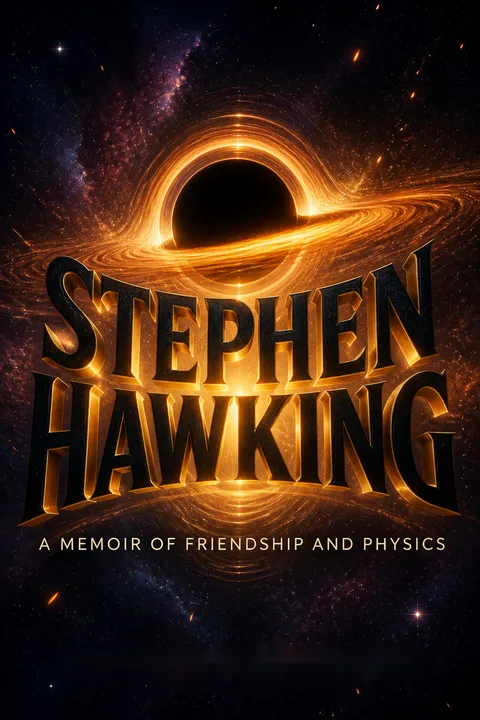
Stephen Hawking: A Memoir of Friendship and Physics offers an intimate portrait of the renowned physicist through the eyes of his collaborator and friend, Leonard Mlodinow. Readers appreciate the book's honest depiction of Hawking's brilliance, humor, and flaws, while also providing accessible explanations of complex physics concepts. Some reviewers found certain personal details uncomfortable, but most praised the memoir for its unique perspective on Hawking's life and work. The book balances scientific discussions with personal anecdotes, creating a multifaceted view of a remarkable individual who overcame tremendous challenges to leave an indelible mark on science.
People Also Read




Glossary
Hawking radiation
Black hole thermal emissionRadiation that Hawking’s calculations predict black holes emit because quantum effects matter near their horizons. The emission gives a black hole a temperature and causes it to lose energy and mass over time. For ordinary astrophysical black holes, the predicted temperature is extremely low, making direct observation exceptionally difficult.
model-dependent realism
Reality described through modelsThe view that a scientific theory offers a model of the world, not necessarily a final picture of reality independent of human description. Different models can represent the same observations while using different concepts. They are judged by their predictive agreement with observation and by practical qualities such as simplicity.
no-boundary proposal
Quantum account without an initial edgeA proposal developed by Stephen Hawking and Jim Hartle that applies quantum theory to the universe as a whole. It suggests that near the earliest stage, time behaves like a spatial dimension, removing the sharp beginning or singular boundary found in classical descriptions. It is a theoretical proposal, not an experimentally settled account.
top-down cosmology
Cosmic histories from present observationsHawking’s approach to cosmology that considers possible histories of the universe consistent with what is observed now. It contrasts with starting from one definite initial condition and calculating forward. Using a quantum sum over histories, the approach explores how different possible pasts could contribute to the universe’s present properties.
black hole information paradox
Conflict over information survivalThe apparent conflict between Hawking’s original prediction that black holes evaporate and quantum theory’s expectation that information is preserved. If a black hole disappears after emitting generic radiation, information about what fell in seems lost. Physicists broadly expect information to survive, but the precise mechanism remains an open problem.
unitarity
Reversible quantum evolutionA fundamental property of quantum theory in which the mathematical evolution of a system preserves information. In principle, knowing the system’s later state allows its earlier state to be reconstructed. The black hole information problem became important because Hawking’s original account appeared to violate this principle.
singularity
Point of infinite physical quantitiesA point or boundary in a mathematical description where quantities such as density or space-time curvature become infinite. In general relativity, singularities appear in descriptions of black holes and the early universe. Physicists treat them as signs that the theory may be incomplete in that regime, not as ordinary objects that have been fully explained.
general relativity
Einstein’s theory of gravityEinstein’s theory describing gravity through the curvature of space-time. Matter and energy affect that curvature, and the resulting geometry influences how matter moves and light travels. It is highly successful for large-scale systems and strong gravity, but it is not a quantum theory and conflicts with quantum descriptions in certain extreme situations.
quantum theory
Probabilistic physics of small scalesA framework for describing matter and energy in which some measurable quantities have discrete values and predictions are generally probabilistic. It underlies modern accounts of atoms and elementary particles. Its mathematical principles differ from those of classical general relativity, creating a challenge when both theories are needed to describe the same system.
FAQ
What is "Stephen Hawking: A Memoir of Friendship and Physics" by Leonard Mlodinow about?
- Personal and Professional Memoir: The book is a blend of memoir and scientific exploration, chronicling Leonard Mlodinow’s friendship and collaboration with Stephen Hawking over nearly two decades.
- Behind-the-Scenes Look: It offers an intimate look at Hawking’s personality, daily life, and the challenges he faced due to ALS, as well as his approach to science and relationships.
- Physics and Philosophy: The narrative weaves together stories of their work on books like "A Briefer History of Time" and "The Grand Design," while explaining complex physics concepts in accessible language.
- Humanizing a Genius: Mlodinow aims to show Hawking not just as a scientific icon, but as a deeply human, humorous, and resilient individual.
Why should I read "Stephen Hawking: A Memoir of Friendship and Physics" by Leonard Mlodinow?
- Unique Perspective: The author provides a rare, firsthand account of working closely with one of the most famous scientists of our time, revealing Hawking’s character beyond his public persona.
- Accessible Science: Mlodinow explains advanced physics concepts—like black holes, quantum theory, and cosmology—in a way that is engaging and understandable for non-experts.
- Inspiration and Resilience: The book is a testament to overcoming adversity, showing how Hawking’s physical limitations did not hinder his intellectual achievements or his zest for life.
- Insight into Collaboration: Readers gain insight into the creative process behind major popular science books and the dynamics of scientific partnership.
What are the key takeaways from "Stephen Hawking: A Memoir of Friendship and Physics"?
- Resilience in Adversity: Hawking’s ability to adapt to his progressive illness and continue groundbreaking work is a central theme.
- Importance of Human Connection: Despite his fame and disability, Hawking valued friendship, love, and human bonds as much as scientific discovery.
- Curiosity and Questioning: The book emphasizes the importance of asking the right questions in science and life, and not being afraid to challenge established ideas.
- Science as a Human Endeavor: Mlodinow illustrates that science is not just about equations, but about creativity, debate, and the personalities behind discoveries.
How does Leonard Mlodinow describe his friendship and collaboration with Stephen Hawking?
- From Colleagues to Friends: Their relationship began as a professional collaboration on books, but evolved into a deep personal friendship marked by mutual respect and affection.
- Working Process: Mlodinow details the painstaking process of co-authoring with Hawking, including the challenges posed by Hawking’s slow communication and perfectionism.
- Shared Humor and Humanity: The memoir is filled with anecdotes that showcase Hawking’s wit, stubbornness, and warmth, as well as the frustrations and joys of their partnership.
- Support and Inspiration: Mlodinow reflects on how Hawking’s attitude toward life and work inspired him to face his own challenges with greater perspective.
What are the most important scientific concepts explained in "Stephen Hawking: A Memoir of Friendship and Physics"?
- General Relativity and Black Holes: The book explains Einstein’s theory of general relativity, the nature of black holes, and Hawking’s contributions to understanding their properties.
- Quantum Theory and Hawking Radiation: Mlodinow discusses quantum mechanics, the paradoxes it introduces, and Hawking’s discovery that black holes emit radiation (Hawking radiation).
- The Big Bang and Cosmology: The origins and evolution of the universe, including the big bang theory and Hawking’s "no-boundary proposal," are explored in accessible terms.
- Model-Dependent Realism: The book introduces Hawking’s philosophical stance that reality is shaped by the models we use to describe it, rather than an objective truth.
How did Stephen Hawking’s disability influence his life and work, according to Leonard Mlodinow?
- Gradual Adaptation: Hawking’s ALS forced him to adapt his methods, shifting from writing equations to visualizing problems geometrically in his mind.
- Focus and Drive: The limitations imposed by his illness intensified his focus and urgency, leading to a prolific output despite physical decline.
- Communication Challenges: Hawking’s slow communication required patience from collaborators, but also led to deeper, more thoughtful exchanges.
- Perspective on Suffering: Hawking’s refusal to feel sorry for himself and his ability to find meaning and joy in life are highlighted as key aspects of his character.
What is "model-dependent realism" as discussed in "Stephen Hawking: A Memoir of Friendship and Physics"?
- Definition: Model-dependent realism is the idea that our understanding of reality is shaped by the models we construct; different models can describe the same phenomena equally well.
- Fishbowl Analogy: Mlodinow uses the story of goldfish in a bowl to illustrate how different perspectives (or models) can lead to different, yet equally valid, descriptions of reality.
- Implications for Science: The concept suggests that there may not be a single, objective reality, but rather multiple valid ways to interpret observations, depending on the chosen model.
- Philosophical Significance: This stance bridges scientific realism and anti-realism, and underpins much of Hawking’s later work, including "The Grand Design."
How does "Stephen Hawking: A Memoir of Friendship and Physics" explain Hawking’s major scientific achievements?
- Big Bang Singularity: Hawking’s early work proved that the universe must have begun with a singularity, using mathematical methods inspired by Roger Penrose.
- Black Hole Thermodynamics: He formulated the laws of black hole mechanics, drawing parallels with the laws of thermodynamics.
- Hawking Radiation: Hawking’s most famous discovery showed that black holes emit radiation due to quantum effects, leading to the concept of black hole evaporation.
- No-Boundary Proposal and Top-Down Cosmology: In his later work, Hawking proposed that the universe has no boundary in time, and developed the idea that the present can determine the past in quantum cosmology.
What does "Stephen Hawking: A Memoir of Friendship and Physics" reveal about Hawking’s views on God and religion?
- Non-Belief in a Personal God: Hawking did not believe in a biblical or interventionist God, though he sometimes used the term "God" metaphorically to refer to the laws of nature.
- Science and Creation: He argued that the universe can be explained by the laws of physics without invoking a creator, especially through his no-boundary proposal and multiverse ideas.
- Respect for Believers: Despite his views, Hawking was sensitive to not being aggressively anti-religion and respected the faith of those close to him.
- Public Misinterpretation: The book discusses how media often misrepresented his statements about God, leading to controversy and debate.
How does Leonard Mlodinow portray the personal side of Stephen Hawking in "Stephen Hawking: A Memoir of Friendship and Physics"?
- Humor and Mischief: Hawking is depicted as witty, playful, and sometimes stubborn, with a love for causing a stir and challenging conventions.
- Relationships and Love: The memoir explores Hawking’s marriages, friendships, and his deep need for human connection, despite the barriers posed by his illness.
- Vulnerability and Strength: Mlodinow emphasizes Hawking’s vulnerability—physical and emotional—alongside his extraordinary resilience and determination.
- Daily Life and Care: The book provides detailed accounts of Hawking’s routines, his reliance on carers, and the complex logistics of his daily existence.
What are some of the best quotes from "Stephen Hawking: A Memoir of Friendship and Physics" and what do they mean?
- "Stubbornness is my best quality." – Hawking’s self-assessment, highlighting the role of persistence in his scientific and personal achievements.
- "Love is life." – A poignant statement from Hawking, showing that, despite his devotion to physics, he saw love and human connection as central to existence.
- "A law is not a law if you allow God to intervene." – Reflects Hawking’s scientific worldview, emphasizing the consistency and universality of physical laws.
- "I’d rather be right than rigorous." – Hawking’s pragmatic approach to theoretical physics, especially as his illness progressed and time became more precious.
What is the legacy of Stephen Hawking as presented in "Stephen Hawking: A Memoir of Friendship and Physics"?
- Scientific Impact: Hawking’s work transformed our understanding of black holes, the origins of the universe, and the interplay between relativity and quantum theory.
- Popular Science Icon: Through books like "A Brief History of Time," he brought complex scientific ideas to a global audience, inspiring millions.
- Personal Example: Hawking’s life is portrayed as a testament to the power of the human spirit to overcome adversity and find meaning in suffering.
- Enduring Influence: Mlodinow concludes that Hawking’s greatest legacy may be the inspiration he provided to others—scientists and non-scientists alike—to pursue knowledge, resilience, and compassion.
About the Author
Other books by Leonard Mlodinow



Download PDF
Download EPUB
.epub digital book format is ideal for reading ebooks on phones, tablets, and e-readers.








