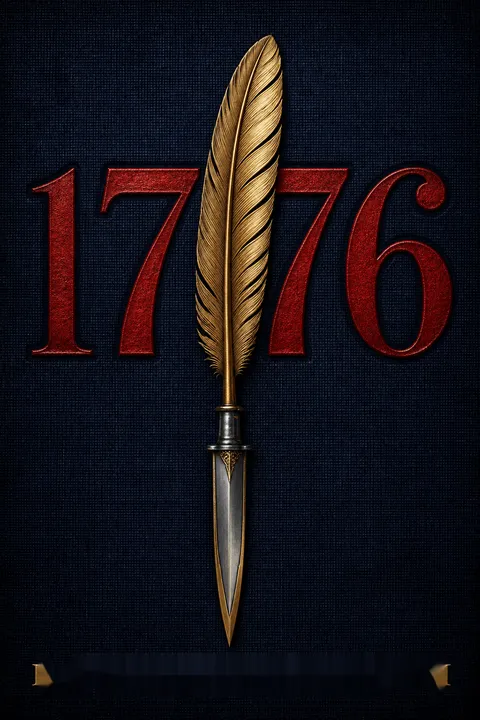


Key Takeaways
Treat rejected compromise as a political event, not just a diplomatic failure
The break hardens. In 1775, many Americans still described their fight as a defense of their rights as British subjects, not a campaign for independence. The Continental Congress sent George III a petition seeking reconciliation. He refused to receive it, declared the colonies in rebellion, and approved more troops, including foreign soldiers. His speech also accused the rebels of seeking independence before they had publicly made that their aim. The refusal made continued loyalty harder to defend and helped turn a dispute over authority into a struggle over separation.
Words reshape the stakes. When soldiers heard the King’s speech in January 1776, they burned copies in anger. Nathanael Greene and Washington now argued openly for independence. Thomas Paine’s pamphlet Common Sense helped make separation imaginable to more people, while Congress’s Declaration made it official in July.
What's striking is that the political meaning of a conflict can change through the choices of its opponents. The King treated resistance as evidence of treason, while many colonists still hoped to preserve a relationship with Britain. That framing helped erase the middle ground. In modern conflict analysis, this resembles a commitment trap: each side interprets the other's action as proof that compromise is impossible. Yet the shift was not automatic. Petitioning, debate, and changing public opinion mattered before independence became policy.
Patriotism cannot supply powder, sanitation, or soldiers whose enlistments have expired
An army is infrastructure. Washington inherited a force assembled in haste from local militia and volunteers. At Boston it numbered about 16,000, but fewer than 14,000 were fit for duty. The army had no consistent uniforms, little discipline, poor sanitation, and so little gunpowder that each man had roughly nine shots. Disease killed soldiers and spread to nearby towns. Many volunteers had enlisted only until the end of 1775, and when their terms expired, thousands went home even as the British remained nearby.
Commitment has conditions. Washington learned that patriotic speeches could not replace pay, clothing, food, trained officers, and reliable enlistments. He repeatedly warned Congress that militia service was too temporary and unpredictable to anchor a long war. His requests for permanent troops, bounties, and stronger discipline were not administrative distractions. They were part of the fight itself.
The Boston encampment shows the difference between collective enthusiasm and durable capacity. Organizations often mistake commitment for a resource that can be spent indefinitely. In reality, people need food, health, compensation, and clear roles to keep contributing. Washington’s predicament also reveals a political tradeoff: a republic feared the coercion of a standing army, yet the absence of one threatened its survival. The story resists the comforting idea that courage alone can compensate for a system that fails to support its people.
Give untested talent responsibility when the problem exceeds conventional expertise
Ability beats pedigree. Nathanael Greene had no battlefield experience, little formal schooling, and a stiff leg. He educated himself through books on military art, served willingly as a private after being rejected as an officer, and became one of Washington’s most trusted commanders. Henry Knox was a young bookseller with no established career as an artillery officer. Washington nevertheless gave him a mission few would have accepted: bring the abandoned cannon at Fort Ticonderoga to Boston.
Execution earns authority. Knox moved 58 guns, weighing about 120,000 pounds, nearly 300 miles over frozen lakes, rivers, and mountains. The effort delivered the artillery Washington needed to threaten Boston. Greene helped make the army more disciplined and later became one of its strongest commanders. Their rise shows how a crisis can expose talent that conventional credentials overlook.
This is a case for selection by demonstrated judgment and follow-through, rather than by polish alone. Greene’s self-education and Knox’s endurance mattered because their abilities matched urgent problems. The army’s loose structure created room for initiative that a more rigid hierarchy might have suppressed. But improvisation has limits: giving responsibility to capable newcomers works only when leaders can assess performance, coordinate effort, and provide resources. Knox could move the guns because local labor, oxen, boats, and community help joined his own persistence.
A cautious council can save an army from its commander's impatience
Restraint has strategic value. Washington repeatedly wanted to attack the British in Boston. His generals and advisers judged that a direct assault could leave American troops stranded on mudflats under heavy fire. They rejected the attack, even as winter approached and the army’s enlistments neared expiration. Washington accepted their decision, then shifted toward a plan to occupy Dorchester Heights and make the British position untenable.
Preparation beats bravado. Rufus Putnam proposed constructing fortifications elsewhere, then hauling them onto the frozen heights under cover of darkness. Knox’s artillery, thousands of laborers, oxen, and a noisy bombardment made the plan possible. By dawn, American guns and defenses commanded the harbor. Faced with the prospect of a bloody counterattack, the British evacuated Boston. A council that restrained one risky impulse helped create the conditions for a better move.
The episode distinguishes courage from action for action’s sake. In high-pressure groups, a leader’s impatience can make a visible offensive feel more satisfying than a sound plan. A council provides valuable friction by forcing assumptions into debate. Still, deliberation can become paralysis if it never produces a decision. Here, restraint was productive because it redirected energy into an alternative operation with a clearer tactical advantage, not because caution was treated as an end in itself.
Defend strategic value, not a city merely because it is prestigious
Geography sets the terms. New York mattered because its harbor and rivers offered the British control of the Hudson corridor, which could separate New England from the other colonies. But the city was exposed to attack from water on several sides, and the Americans had no navy capable of stopping the British fleet. Washington knew the danger, yet he felt that abandoning New York without a fight would damage public confidence and the cause of independence.
A weak defense invites disaster. Washington spread his limited troops between Manhattan and Long Island while unsure where the British would strike. At Brooklyn, British forces used an unguarded pass to outflank the American line. The defeat cost hundreds of lives and more than a thousand prisoners. Later, a British landing at Kips Bay scattered American troops and forced the evacuation of New York. The city’s symbolic value could not cancel its geographic vulnerability.
The campaign illustrates a basic strategic distinction: political importance does not make a position defensible. Leaders can become attached to places because retreat looks like failure, even when terrain and force ratios make the position untenable. Washington faced real political costs if he withdrew, but the choice to defend New York divided an already outmatched army. The difficult judgment is not simply when to fight or retreat. It is how to preserve legitimacy while refusing to let prestige dictate military reality.
Preserve the army, because territory lost can be retaken; an army cannot
Survival can be an achievement. After defeat at Brooklyn, Washington’s army risked being trapped against the East River. In late August, under darkness and heavy rain, soldiers, horses, cannon, and supplies crossed to Manhattan in boats crewed by John Glover’s experienced sailors. Nearly 9,000 troops escaped in one night without losing a life. A heavy fog concealed the final departures at dawn.
Retreat is not one event. The army then left New York, lost Fort Washington, abandoned Fort Lee, and withdrew across New Jersey toward the Delaware. These reverses exposed serious errors, including divided forces, poor intelligence, and Washington’s hesitation over whether to hold positions. Yet the army survived. Its continued existence mattered more than holding every fort or city, because independence still depended on an organized force capable of fighting again.
The book makes retreat legible as a military skill rather than a simple verdict on courage. The Brooklyn evacuation required secrecy, discipline, seamanship, and timing. Its success did not erase the losses or mistakes that forced it, but it prevented a worse outcome. In strategic terms, preserving a force retains future options. The important qualification is that withdrawal only buys time if the surviving organization can regroup, recruit, and learn; otherwise, retreat merely delays collapse.
When morale collapses, a credible surprise can make resistance imaginable again
The winter reverses the mood. By December 1776, Washington’s force was ragged, cold, underpaid, and shrinking. Many enlistments were about to expire, Congress had left Philadelphia, and the British had occupied much of New Jersey. The enemy expected the war to end soon. Washington instead planned a night crossing of the Delaware to attack the Hessian garrison at Trenton.
A small victory travels far. The crossing took place in sleet, wind, and floating ice. Washington’s column reached Trenton hours behind schedule, but pressed on rather than turn back. The Americans captured about 900 Hessians, with very few casualties. They then won at Princeton. These victories did not end the war, but they disrupted the belief that defeat was inevitable and helped renew enlistments and public confidence.
Trenton mattered beyond the territory or prisoners gained. It changed what people believed was possible. In collective action, expectations influence whether individuals keep contributing: when everyone assumes a cause is finished, participation becomes harder to justify. A visible success can coordinate renewed effort by changing those expectations. Yet the win depended on circumstances, secrecy, and a difficult operation, not optimism alone. Morale is powerful, but it is most useful when attached to a feasible action.
Treat liberty as a mobilizing promise, and confront who remains excluded
The cause carried contradictions. The Declaration made independence a public claim about liberty and equality, but American society did not extend those principles equally. Washington enslaved more than one hundred people and initially opposed the enlistment of Black soldiers. By the end of 1775, with free Black men seeking to serve and the army needing recruits, he authorized their enlistment. Black soldiers served in several colonial regiments, and officers described many as capable and brave.
Loyalty had competing meanings. Loyalists did not necessarily see themselves as enemies of liberty. Many believed the Crown’s government protected lawful rights and feared that rebellion would produce mob rule. Their forced departure from Boston shows the human cost of a conflict in which neighbors held incompatible ideas of patriotism. The revolution’s ideals inspired resistance, while its limits shaped who could claim its protection.
The tension between universal language and unequal practice is not a footnote to political ideals. It tests whether a principle can criticize the society that invokes it. The book’s account also complicates a simple division between liberty-minded patriots and freedom-hating Loyalists: both groups claimed to defend legitimate rights and public order. That complexity need not flatten moral distinctions. It does show why ideals gain force through argument and action, rather than through declarations alone.
Let failures teach, then keep faith with the people who keep the cause alive
Washington was not infallible. He misjudged the defense of New York, failed to protect the Jamaica Pass, and shared responsibility for the disastrous decision to retain Fort Washington. His own officers questioned his indecision. Yet he learned from experience, accepted counsel, and continued to command through defeat, sickness, desertion, and near-empty ranks.
Loyalty became practical. Washington relied on Greene, Knox, and other officers who remained committed when circumstances were bleak. He did not discard Greene after the loss of Fort Washington, despite Greene’s part in the decision. At Trenton, Washington asked exhausted soldiers to stay beyond their enlistments, offering money and appealing to the homes and liberties at stake. The book’s central argument is not that Washington always chose well, but that persistence, trust, and adaptation helped keep the army alive.
The portrait is persuasive because it includes error rather than polishing leadership into genius. Washington’s credibility grew from visible steadiness, willingness to rely on others, and capacity to continue after reversals. Loyalty here is not blind agreement: councils challenged him, and he sometimes had to change course. A useful distinction emerges between loyalty to a person and commitment to a shared purpose. The former can protect poor decisions; the latter can survive criticism and help repair them.
Analysis
1776 is organized as a sequence of narrowing options. The Americans begin with an improvised siege force and an unresolved political aim. They gain Boston through the unusual combination of Knox’s artillery expedition, collective labor, and a carefully timed occupation of Dorchester Heights. In New York, the same army confronts a different geography and a far stronger British force. Its defeats are not merely dramatic reversals. They expose failures of intelligence, command, discipline, and strategic judgment. The final movement across New Jersey shows how quickly a revolution can seem finished when troops disappear, political leaders flee, and civilians change sides to protect themselves.
The book’s central insight is that the fate of the rebellion rests less on possession of individual cities than on whether Washington can preserve an army. That argument gives the narrative coherence, but it avoids turning perseverance into magic. The army survives partly through skill and resolve, and partly through weather, timing, enemy hesitation, and individual competence. The fog that hides the Brooklyn evacuation and the storm that disrupts the British response at Dorchester are reminders that historical outcomes are contingent. Courage matters, but it operates inside material and environmental conditions it cannot command.
McCullough also makes leadership visible through practical details: counting troops, finding powder, moving guns, managing enlistments, maintaining sanitation, and deciding when not to attack. These details correct the tendency to remember the Revolution only as a sequence of speeches and heroic set pieces. They also reveal the tension between democratic participation and military discipline. Volunteers brought political commitment, local knowledge, and resilience, but short enlistments and suspicion of authority repeatedly weakened the force.
The result is a narrative of independence as neither inevitable nor cleanly unified. Loyalists understood themselves as defenders of order; patriots disagreed over the war’s purpose; and the language of equality existed alongside slavery and exclusion. Trenton offers hope, not resolution. The year’s lasting achievement is that a fragile political cause survives long enough to become a functioning military and national project.
Review Summary
1776 is widely praised as an engaging and accessible account of the Revolutionary War's first year. Readers appreciate McCullough's vivid storytelling, balanced perspective, and focus on military events. The book offers insights into key figures like George Washington and brings the struggles and triumphs of the Continental Army to life. While some critics note its narrow scope, most find it an informative and compelling read that sheds light on a pivotal moment in American history. Many reviewers express surprise at how much they learned about this familiar period.
People Also Read







Glossary
Continental Army
Colonies’ unified armyThe military force authorized by the Continental Congress and commanded by George Washington. It emerged from separate colonial and militia forces that initially lacked consistent organization, discipline, equipment, and enlistment terms. By January 1776, Washington formally identified the new army as continental, signaling an effort to build a force representing the united colonies rather than any single region.
Army of Observation
Rhode Island force watching BostonThe name used for Nathanael Greene’s Rhode Island troops, who joined the forces surrounding British-held Boston in 1775. The term reflected their early role in observing and containing the British rather than conducting a conventional campaign. Greene’s regiment was notably better organized than many units in the improvised American force.
Loyalists
Colonists loyal to BritainAmerican colonists who remained loyal to the British Crown during the Revolution. Their motives and circumstances varied, but many believed British rule protected lawful rights and social order, and feared rebellion would bring violence or instability. Loyalists faced pressure and danger in patriot-held areas, while many who left Boston with the British abandoned homes, businesses, and community ties.
Hessians
German troops hired by BritainGerman soldiers, especially from Hesse-Cassel, hired by Britain to serve in the American war. They formed a substantial part of the British force around New York and New Jersey. The book presents them as trained professional soldiers, not simply as a faceless enemy. Washington’s capture of a Hessian garrison at Trenton in December 1776 became a major morale-boosting victory.
Privateers
Privately operated wartime raidersPrivately owned vessels authorized to attack enemy shipping during wartime. American privateers captured British supply ships and disrupted the flow of provisions and military goods, including during the difficult winter at Boston. They offered the colonies a way to strike at British commerce despite lacking a conventional navy capable of matching the Royal Navy.
FAQ
What is "1776" by David McCullough about?
- Focus on pivotal year: "1776" by David McCullough provides a detailed narrative of the critical year in the American Revolutionary War, highlighting the military, political, and social events that shaped the fight for independence.
- Key campaigns and events: The book covers major events such as the Siege of Boston, the Battle of Brooklyn, the fall of Fort Washington, and the crossing of the Delaware leading to Trenton and Princeton.
- Humanizing historical figures: McCullough brings to life the experiences and personalities of leaders like George Washington, Nathanael Greene, and Henry Knox, as well as the ordinary soldiers on both sides.
Why should I read "1776" by David McCullough?
- Engaging narrative history: The book is praised for its vivid storytelling, making complex historical events accessible and compelling for readers of all backgrounds.
- Insight into leadership: Readers gain valuable lessons on leadership under pressure, resilience, and the human dimension of war, especially through the example of George Washington.
- Comprehensive and balanced: McCullough uses rich primary sources from both American and British perspectives, offering a well-rounded view of the year that changed the course of history.
What are the key takeaways from "1776" by David McCullough?
- Leadership and perseverance: The survival and eventual success of the Continental Army hinged on Washington’s steadfast leadership and the resilience of his troops.
- Complexity of war: The book illustrates how luck, weather, intelligence, and human error all played crucial roles in the outcome of battles and campaigns.
- Balanced historical perspective: McCullough acknowledges both American courage and British professionalism, emphasizing the harsh realities and uncertainties of war.
How does "1776" by David McCullough portray George Washington’s leadership?
- Steadfast under adversity: Washington is depicted as a leader who persevered through repeated defeats, learning from mistakes and never giving up on the cause.
- Calm and inspiring: Even in the darkest moments, such as the retreat across New Jersey, Washington maintained composure and inspired his troops by example.
- Strategic decision-making: His bold choices, like the crossing of the Delaware and the attack on Trenton, were pivotal in revitalizing the American cause.
What were the major battles and campaigns described in "1776" by David McCullough?
- Siege of Boston: The book details the American containment of British forces and the dramatic occupation of Dorchester Heights, leading to the British evacuation.
- Battle of Brooklyn (Long Island): A significant defeat for the Americans, but Washington’s night retreat saved the army from destruction.
- Fall of Fort Washington: A devastating loss for the Americans, resulting in thousands of prisoners and highlighting the precariousness of their position.
- Battles of Trenton and Princeton: Surprise attacks that boosted American morale and demonstrated the army’s resilience and tactical skill.
How does "1776" by David McCullough describe the composition and conditions of the Continental Army?
- Diverse and inexperienced: The army was made up of farmers, artisans, and tradesmen, many of whom lacked military training and discipline.
- Harsh conditions: Soldiers faced hunger, disease, inadequate clothing, and exposure to the elements, often standing in mud or water for hours.
- Morale and discipline issues: Desertion was common, and Washington struggled to maintain order and motivation among his troops.
What challenges did George Washington face as a leader in "1776" by David McCullough?
- Balancing military and political demands: Washington had to manage the expectations of Congress, maintain unity among diverse colonial forces, and respect civilian authority.
- Dealing with inexperience: He led an army of raw recruits and untested officers, requiring patience and strategic restraint.
- Personal sacrifices: Washington’s private correspondence reveals moments of despair and self-doubt, yet he continued out of a sense of duty and belief in the cause.
How does "1776" by David McCullough depict British military leadership and strategy?
- Experienced but divided: British generals like William Howe and Henry Clinton were seasoned officers but often disagreed on strategy and suffered from indecision.
- Underestimating the Americans: The British frequently dismissed the Continental Army as a "rabble," leading to strategic errors and missed opportunities.
- Logistical and intelligence challenges: The British faced stretched supply lines, poor intelligence, and the difficulties of waging war across the Atlantic.
What role did weather and geography play in the events of "1776" by David McCullough?
- Weather as both obstacle and advantage: Storms and cold weather complicated logistics but sometimes aided the Americans by masking their movements, such as during the Delaware crossing.
- Geographical challenges: Rivers, hills, and marshes like the East River and Jamaica Pass were critical in shaping battles and retreats.
- Impact on outcomes: Control of strategic terrain often dictated the success or failure of military maneuvers.
How does "1776" by David McCullough portray the political atmosphere in Britain and America?
- British political divisions: The book describes debates in Parliament, with some advocating conciliation and others pushing for forceful suppression of the rebellion.
- American move toward independence: Events like the King’s speech and Thomas Paine’s "Common Sense" fueled the push for independence, culminating in the Declaration of Independence.
- Loyalists and Patriots: The presence of Loyalists and their persecution added complexity to the conflict, especially in contested areas like New York.
What role did espionage and internal threats play in "1776" by David McCullough?
- Spy cases and betrayals: The exposure of Dr. Benjamin Church as a British spy shocked the American leadership and raised fears of further infiltration.
- Loyalist conspiracies: Plots such as the attempted assassination of Washington in New York heightened tensions and led to harsh reprisals.
- Impact on morale: These internal threats underscored the precariousness of the American cause and the difficulty of maintaining trust within the ranks.
What are the best quotes from "1776" by David McCullough and what do they mean?
- "Perseverance and spirit have done wonders in all ages." — Washington’s motto, capturing the resilience needed for the American struggle.
- "These are the times that try men’s souls." — Thomas Paine, reflecting the severe testing of American resolve.
- "The fate of unborn millions will now depend, under God, on the courage and conduct of this army." — Washington, emphasizing the monumental stakes of the war.
- British complacency: Quotes from British generals reveal their underestimation of the Americans, which contributed to their setbacks.
About the Author
Other books by David McCullough





Download PDF
Download EPUB
.epub digital book format is ideal for reading ebooks on phones, tablets, and e-readers.








