

Key Takeaways
Read great lives as accidents shaped by choices, not destinies.
A future not yet visible. David McCullough begins with a boy who seemed unlikely to become a national symbol of vigor. At ten, Theodore Roosevelt was undersized, anxious, often ill, and separated from ordinary childhood by tutors and asthma. His family was wealthy, close-knit, and full of competing influences: a father devoted to public service, a mother whose Southern stories fed his imagination, and siblings with very different strengths.
Formation before fame. The book follows the family and the forces that shaped Theodore, rather than marching through his presidential career. His health, relatives, travel, grief, work, and chance encounters all mattered. The story stops as his public rise is beginning, when the future still looks open. The point is not that hardship guarantees greatness, but that a life is made through many contingent turns.
What's striking is the refusal to let the ending rewrite the beginning. Readers know Roosevelt became president, so his childhood can seem like an inevitable preface to power. This account instead resembles a careful case study in path dependence: early conditions constrain and enable, but do not dictate, later choices. The approach also counters survivorship bias, the tendency to study successful people and mistake their traits for a reliable recipe. Roosevelt's life is memorable partly because its outcome was never guaranteed.
Study the people who model your ideals, including their contradictions.
The father at the center. Theodore Roosevelt Sr. was a devoted parent, philanthropist, and civic organizer. He spent Sundays with his children, encouraged them to work hard and show affection through action, and helped establish services for homeless boys, an orthopedic hospital, and New York's museums. His sister-in-law called him Greatheart, after the protective guide in John Bunyan's religious allegory, and young Theodore regarded him as nearly perfect.
An imperfect inheritance. During the Civil War, the elder Roosevelt opposed slavery but did not enlist. He paid a substitute to serve in his place, a legal privilege available to wealthy men. His daughter later said he regretted the choice. Theodore's sister believed the decision burdened her brother, though the book cannot prove how deeply it shaped him. The father taught duty through his example, while leaving behind a contradiction his son could not easily ignore.
The father is more than an influence; he is the standard against which the son measures himself. Developmental psychology often treats identity as relational: people form ideals by absorbing a caregiver's values, then testing those values against the caregiver's actual behavior. That process can produce discernment as well as imitation. The Civil War decision also shows how moral principles operate inside unequal systems. Roosevelt Sr.'s generosity was real, but so was his ability to buy exemption from a risk borne by others.
Read chronic illness through the body and the household around it.
Asthma reshaped family life. Theodore's attacks began when he was about three. At night he could struggle for hours to breathe, while his father carried him through the house or took him out in a carriage in hopes that different air would help. The family changed travel plans repeatedly, and tried remedies now recognized as harsh, including cigars and drugs meant to provoke vomiting.
A pattern, not a verdict. During the 1869-70 European tour, attacks often came on weekends, especially Sundays. McCullough connects this pattern to the strict Sabbath routine, Theodore's longing for his parents' attention, and the special outdoor excursions he sometimes took with his father. He presents asthma as a psychosomatic disorder, meaning a physical illness whose symptoms may also be affected by emotions and social surroundings. This is an interpretation of the surviving evidence, not proof that distress caused the disease.
The account anticipates a biopsychosocial view of illness: bodily processes, emotional experience, and family routines can interact without making symptoms imaginary. Its most useful insight is that care has a social setting. A sick child may be surrounded by love and still be shaped by separation, vigilance, or family stress. The interpretation needs restraint, however. A weekly pattern in one child's diaries cannot establish cause, and linking symptoms to family attention risks making caregivers feel responsible for an illness they did not create.
Build capacity through action, while noticing what was holding you back.
Strength took practice. Theodore's father told him that his mind would be limited by his frail body unless he worked to strengthen it. The boy began a demanding routine of weights, punching bags, and gymnastic exercises, but progress was slow. A separate discovery changed his perception: at thirteen, spectacles revealed that he had been unable to see clearly beyond a short distance. The animals and landscapes he had studied suddenly became visible in detail.
A wider world opened. His curiosity about nature had already led him to collect specimens and keep meticulous notes. On the Nile, he spent hours watching and collecting birds, often alongside his father. His asthma eased during some periods of outdoor activity, but returned at other times. The transformation was not willpower alone. Exercise, corrected eyesight, scientific curiosity, family support, and access to travel each expanded what he could do.
This is a useful corrective to the lone-hero story. Effort matters, but effort becomes productive when a hidden constraint is removed or an enabling environment appears. The spectacles are a small technological intervention with enormous consequences: they changed what Theodore could perceive, not merely how hard he tried. Modern accounts of disability make a similar distinction between an individual's impairment and barriers in the surrounding environment. The book also avoids turning physical training into a cure-all, since his health improved unevenly.
Let work carry grief, but do not mistake motion for healing.
A loss he could not repair. Theodore was nineteen when his father died of stomach cancer in 1878 after weeks of extreme pain. He had been away at Harvard and felt he had failed to help during the illness. His private diary records intense guilt, longing, and fear that he would never be worthy of his father. Outdoor exertion and the freedom of Oyster Bay brought relief, but his grief returned in quieter moments.
Then another catastrophe. In 1884, his mother Mittie died of typhoid fever, and his first wife, Alice Lee, died of kidney disease on the same day, hours after giving birth to their daughter. Theodore returned to Albany within days and threw himself into political work, sometimes laboring through the night. His own explanation was that employment kept him from falling apart. The book shows both the force of that coping strategy and the loneliness it could conceal.
Work can restore structure when loss has made ordinary life feel unreal. In that sense, Theodore's return to Albany resembles behavioral activation, the clinical practice of using purposeful activity to counter withdrawal and inertia. But activity is not the same as emotional processing. The biography makes room for both: work enabled him to function, while his diary and private memories reveal pain that public performance did not erase. That distinction matters because relentless productivity can look like resilience even when it is also a form of avoidance.
Turn privilege into responsibility by looking directly at hidden hardship.
Money widened his choices. Roosevelt's family wealth paid for tutors, servants, overseas travel, specialist care, and a life largely protected from financial insecurity. The same class position helped his father avoid military service by hiring a substitute. Later, inherited income gave Theodore room to pursue politics, natural history, writing, and ranching without depending on any one for a living.
Exposure changed his judgments. His father used wealth and time for charity, but Theodore's own civic commitments became more grounded when he saw tenement families making cigars in cramped, filthy rooms. He had assumed such conditions were exaggerated. After touring the workshops with labor leader Samuel Gompers, he supported a bill restricting home cigar production, despite his prior preference for minimal regulation. His privilege did not automatically make him public-spirited; it gave him the freedom to act, while direct observation challenged his assumptions.
The tension between privilege and responsibility is more revealing than a simple story of benevolence. Wealth can fund public service and shelter its beneficiaries from the conditions they hope to improve. Seeing the tenement workshops gave Roosevelt information that charitable distance could not provide. This resembles a basic principle in social research: claims about a population improve when observers encounter its actual setting. Yet reform from above can still become paternalistic. Observation can correct ignorance, but affected workers also need influence over the laws made in their name.
Test moral conviction against evidence, and correct yourself in public.
Politics became a classroom. Theodore's father had been nominated to lead New York's Customhouse, but Senator Roscoe Conkling helped block the appointment. The office was notorious for patronage and a practice called the moiety system, which gave customs officials shares of fines and forfeitures, creating incentives to exaggerate violations. Theodore entered the state Assembly determined to oppose corruption. He investigated Judge T. R. Westbrook's ties to financier Jay Gould, but the inquiry ended in a whitewash.
Principle required revision. Theodore also supported a bill to cut elevated railway fares, then concluded Governor Grover Cleveland was right that it violated the company's legal charter. He publicly admitted his vote had been wrong and changed it. The episode cost him allies and exposed his habit of treating political disputes as moral battles. His record shows a young reformer learning that courage includes investigation, restraint, and the willingness to revise a position.
Public correction is powerful because it makes reasoning visible, not just the final position. The case also highlights two distinct standards of reform: a policy may sound fair to the public while violating law, and legal correctness does not automatically make a policy just. Roosevelt's apology models intellectual accountability, though his theatrical self-reproach could turn judgment into performance. A durable reform culture needs both principled scrutiny and institutions that can distinguish genuine error from political showmanship.
Use chosen hardship to remake identity, without romanticizing its costs.
The West offered reinvention. After the death of his father and Alice, Theodore returned repeatedly to the Dakota Bad Lands, where he invested in cattle and worked alongside ranch hands. He joined roundups, endured long days in the saddle, and once broke a rib during the work. The open country gave him a setting far removed from New York's social expectations and helped him imagine himself as a different kind of man.
The romance had a price. His cattle investment reached about $52,500, and expenses brought his total outlay to roughly $82,500. A brutal winter killed most herds across the region. Roosevelt's eventual loss, counting missed investment returns, was estimated at about $70,000. He was also an affluent absentee ranch owner, not a wage-earning cowboy, and spent only a little more than a year in the West altogether. The experience was real, but the legend was partly self-fashioned.
Chosen hardship can be psychologically transformative because it offers new routines, tests, and social roles. Roosevelt's ranch life gave him credible experience and a powerful story about self-reinvention. But the distinction between voluntary adventure and necessary labor matters: he could leave the range, absorb substantial losses, and return east. The cattle boom also relied on free public grass and speculative capital, not simply individual toughness. The book's strongest version of the Western story keeps both truths in view: he changed through the experience, and he had unusual freedom to choose it.
Stay inside flawed institutions when influence can still change their course.
A hard choice in Chicago. At the 1884 Republican convention, Theodore fought to stop James G. Blaine, whom he considered a dangerous nominee. Blaine won. Some reformers left the party, but Roosevelt eventually supported the Republican ticket, reasoning that he could not influence politics from outside it. The decision alienated friends who had seen his independence as his defining virtue. It also began a lasting political partnership with Henry Cabot Lodge.
No instant triumph followed. In 1886 Roosevelt ran for mayor of New York against Democrat Abram Hewitt and labor candidate Henry George, finishing third. He was engaged to Edith Carow, whom he married in England after the election. The immediate arc ends in defeat, not coronation. The afterword supplies the longer perspective: Roosevelt became president in 1901, after years of public service. His route to power passed through compromises, losses, and choices about where to remain involved.
Political theorist Albert Hirschman's distinction among exit, voice, and loyalty offers a useful lens: people can leave an institution, challenge it from within, or remain attached while accepting its decisions. Roosevelt chose voice within the Republican Party, believing influence required membership. That choice can be strategically sound, but loyalty can also become an excuse for tolerating conduct that once seemed unacceptable. The biography does not make the decision clean. Its value lies in showing that reformers face a real tradeoff between preserving moral distance and retaining practical leverage.
Analysis
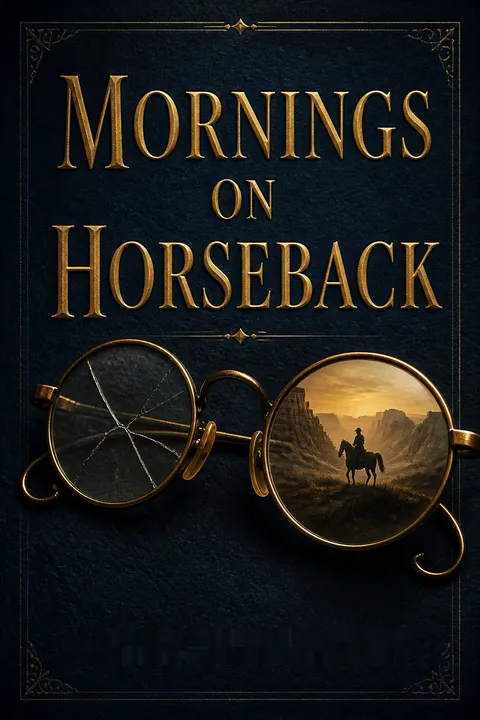
Mornings on Horseback is a family biography that treats character as a historical outcome, not a fixed essence. Its central achievement is to make Theodore Roosevelt's later vitality legible without pretending that a sickly child was secretly destined for greatness. The narrative keeps several explanatory scales in play: bodily vulnerability, intimate family relationships, inherited wealth, political institutions, and the accidents of travel, illness, and loss. This layered method is why the book resists a simple self-improvement lesson. Roosevelt's discipline mattered, but so did spectacles that corrected his vision, a father who organized his life around duty, access to exercise and travel, and the freedom to fail financially without losing shelter.
The father and son provide the book's strongest moral tension. Theodore Sr. combines extraordinary generosity with the privilege of purchasing a substitute during the Civil War. His son inherits both a demanding ideal of service and an example that falls short of it. The resulting story avoids making public virtue a matter of spotless private conduct. It also shows how family memory can shape action while distorting it: the son revered his father, yet the biography's archival detail reveals complexity that memorial accounts tend to smooth away.
The asthma chapters are among the most arresting and the most interpretively delicate. McCullough uses diaries to identify a Sunday pattern and connects it to family attention and restrictive routines. This is evocative evidence, not a clinical demonstration. The strongest modern reading is interactional: a physiological illness can be affected by stress and surroundings, but neither the child's needs nor parental responses should be reduced to blame.
The book also interrogates Roosevelt's Western identity. He genuinely worked, hunted, and suffered in the Bad Lands, yet he arrived with money, chose his degree of exposure, and helped turn the ranchman into a public persona. His adventure was neither fraudulent nor representative of ordinary frontier labor. By ending before the presidency begins, McCullough preserves uncertainty and makes the reader see the public figure as someone still becoming, rather than a legend whose childhood merely confirms what was already known.
Review Summary
Mornings on Horseback receives generally high praise from readers, earning a 4.1 average rating. Most reviewers celebrate McCullough's vivid storytelling and deep research into Roosevelt's formative years, highlighting the fascinating family dynamics, TR's battle with asthma, and the tragic losses that shaped him. Many appreciate the book's focus on Roosevelt's early life rather than his presidency. Some critics note the narrative occasionally feels disconnected, ends abruptly, or lacks deeper psychological interpretation, but the majority find it an engaging, illuminating portrait of both Roosevelt and Gilded Age America.
People Also Read

Glossary
Greatheart
Protective family idealA nickname given to Theodore Roosevelt Sr. by his sister-in-law, drawn from John Bunyan's The Pilgrim's Progress. Greatheart is a brave guide and protector of travelers, making the name a fitting description of the children's view of their father. In the book, it signals both his actual care for them and the near-heroic status he held in Theodore's imagination.
movement cure
Mobility-based physical treatmentAn approach used by orthopedic surgeon Charles Fayette Taylor to treat Anna Roosevelt's spinal tuberculosis, known as Pott's disease. Drawing on Swedish physical therapy, Taylor replaced a restrictive brace with a lighter support and encouraged movement. The treatment aimed to improve both physical function and spirits, and its effect on Anna helped inspire Theodore Roosevelt Sr. to support an orthopedic hospital.
psychosomatic disorder
Illness shaped by body and emotionA term the book uses for a physical illness whose symptoms may be influenced by emotional states and social surroundings. McCullough applies it to childhood asthma while emphasizing that the disease involves real bodily distress. He suggests family routines and anxiety may affect attacks, but treats the Roosevelt evidence as suggestive rather than proof of a single psychological cause.
Allotment Commission
Soldiers' pay-home programA Civil War initiative developed by Theodore Roosevelt Sr., William E. Dodge Jr., and Theodore Bronson. It enabled soldiers to direct part of their pay to dependents at home, helping families who might otherwise be left without support. The organizers secured congressional approval, then traveled among regiments to explain the plan and persuade soldiers to use it.
moiety system
Shared customs penaltiesA system at the New York Customhouse under which employees received shares of fines and forfeitures collected from importers. It was originally intended to reward inspectors, but it created incentives to identify violations and inflate penalties. The Phelps, Dodge case exposed how the system could facilitate extortion; Congress abolished it in 1874.
About the Author
Other books by David McCullough


Download PDF
Download EPUB
.epub digital book format is ideal for reading ebooks on phones, tablets, and e-readers.








